IELTS Reading Summary Completion questions can look deceptively simple. You see a short paragraph, a few gaps and a passage containing all the information you need. Yet many candidates lose marks because they search for exact words without understanding how the summary connects to the passage.
The good news is that this question type becomes much easier once you understand its structure.
In this guide, you will learn exactly how IELTS Reading Summary Completion works, how to locate answers efficiently, how to predict the type of word required, how to deal with paraphrasing, and which mistakes commonly cost candidates easy marks.
Table of Contents
What Is IELTS Reading Summary Completion?
IELTS Reading Summary Completion is a question type in which you are given a summary of part of a reading passage with several gaps. You must complete those gaps using information from the passage or, in some versions, by selecting answers from a list of words or phrases.
The official IELTS test format identifies summary, note, table and flow-chart completion as related task types. The summary normally represents part of the passage rather than the entire text, and the answers usually come from one particular section of the passage.
There are two main forms:
- Selecting words from the passage
- Selecting words or phrases from a provided list
The instructions tell you which form you are dealing with and specify the maximum number of words or numbers you can use.
For example:
Complete the summary below.
Choose NO MORE THAN TWO WORDS from the passage for each answer.
If the correct answer is rapid growth, both words can be used.
But if the correct answer is rapid economic growth, you cannot use it when the instruction allows only two words.
This makes reading the instructions carefully one of the most important IELTS Reading Summary Completion strategies.
How IELTS Reading Summary Completion Works
The task usually gives you a short summary containing several gaps.
The summary may describe:
- a process
- a discovery
- a research finding
- a historical development
- a problem and its solution
- a cause and effect relationship
- a comparison
- a sequence of events
Your job is not simply to find words that look similar to the words around the gap.
You need to establish three things:
What information is missing?
Where is that information located in the passage?
What exact word or phrase fits grammatically and logically?
The official IELTS guidance states that answers in summary completion do not necessarily appear in the same order as the information in the passage, although they will usually come from one part of the text.
That is an important difference between summary completion and some other completion tasks.
7 IELTS Reading Summary Completion Tips That Actually Work
1. Read the Instructions Before Looking for Answers
Never start searching the passage before checking the word limit.
Look for instructions such as:
- NO MORE THAN ONE WORD
- NO MORE THAN TWO WORDS
- NO MORE THAN THREE WORDS
- NO MORE THAN TWO WORDS AND/OR A NUMBER
- Choose from the list of words below
The word limit is not a suggestion. Exceeding it means the answer is marked wrong. IELTS also states that spelling and grammar matter when transferring answers to the answer sheet.
2. Read the Whole Summary First
A common mistake is to look immediately at the first gap.
Instead, read the complete summary before searching.
You are trying to understand its overall topic and structure.
For example:
Early researchers initially believed that the decline was caused by ________. However, later studies showed that environmental changes had a much greater ________ on the species.
Even before looking at the passage, you can predict that the first gap may require a cause and the second may require a noun.
The surrounding words give you valuable grammatical clues.
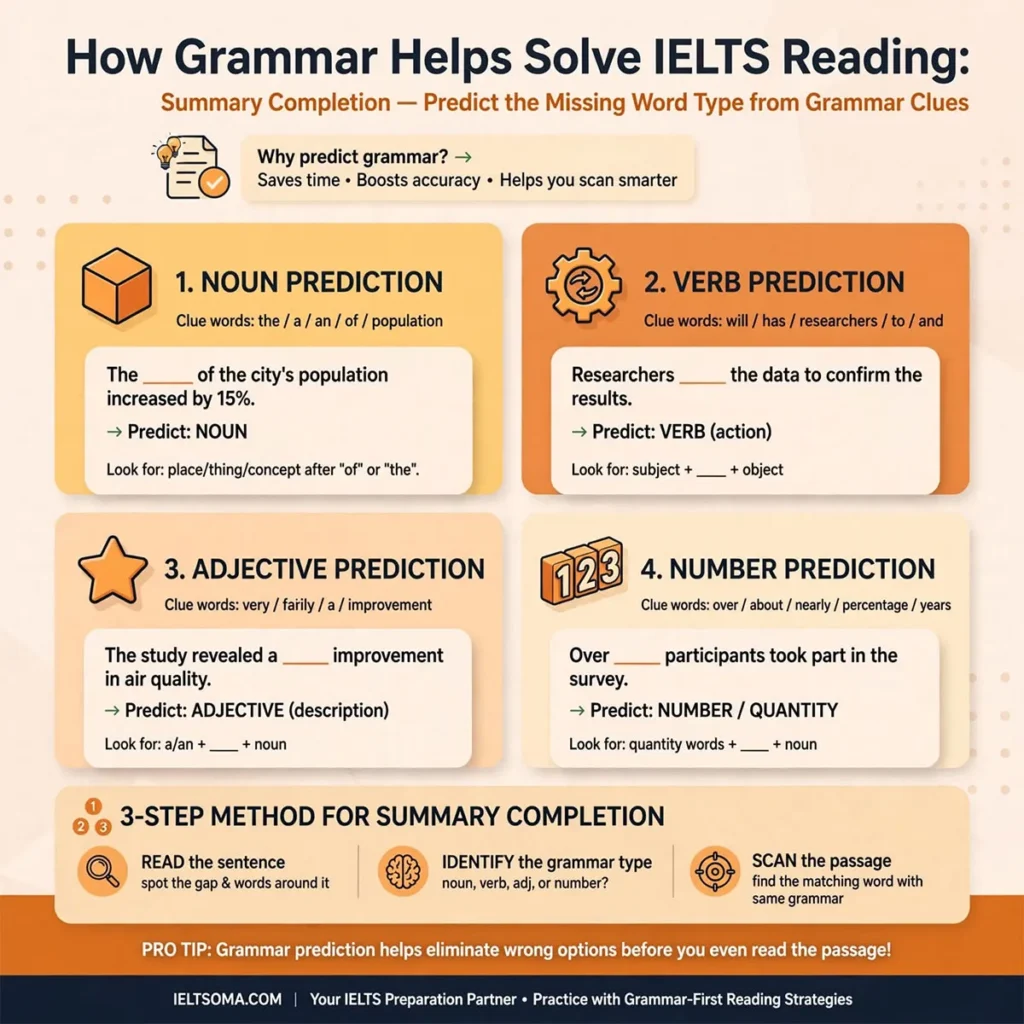
3. Predict the Type of Word You Need
Before searching for an answer, ask:
What kind of word can grammatically fit here?
The answer could be:
- a noun
- a verb
- an adjective
- an adverb
- a number
- a name
- a noun phrase
Consider:
The researchers discovered that the main ________ of the problem was inadequate funding.
The word after “main” is likely to be a noun.
If the passage contains:
“The researchers identified insufficient funding as the principal cause…”
then cause fits both the grammar and meaning.
This prediction technique dramatically reduces the number of possible answers you need to consider.
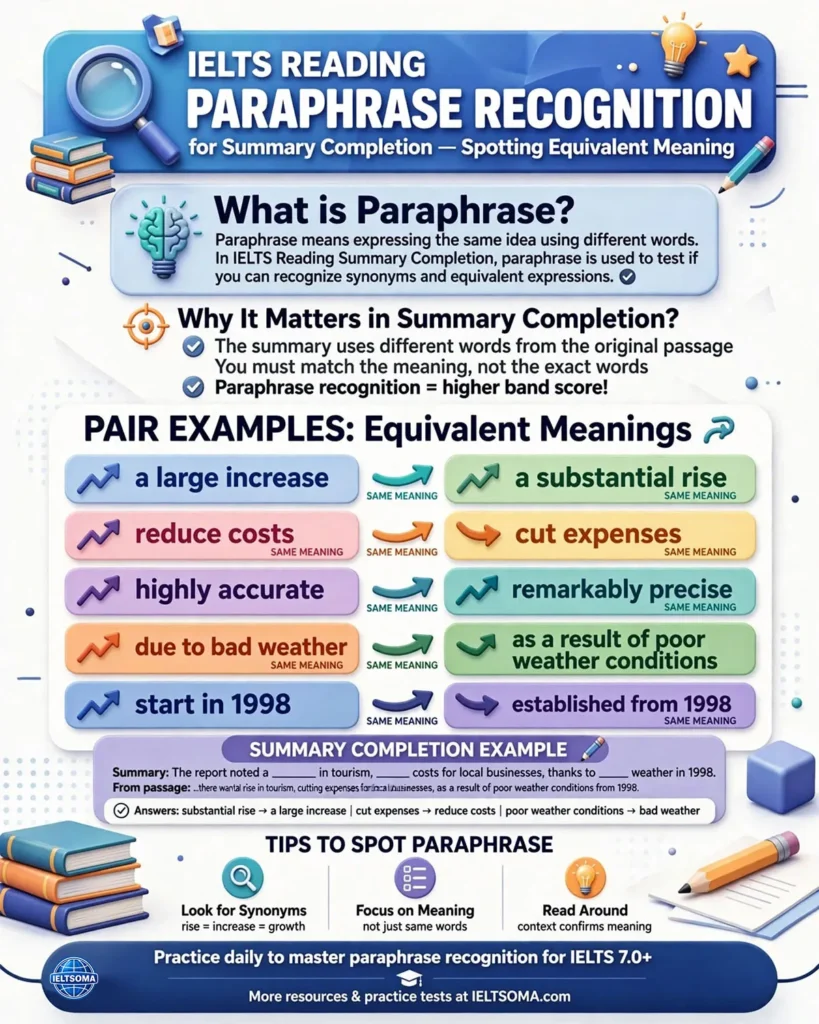
4. Search for Meaning, Not Just Identical Words
IELTS Reading is heavily dependent on paraphrasing.
The summary may use completely different vocabulary from the passage.
For example:
Summary:
The new system significantly reduced the amount of time required for processing.
Passage:
The technology enabled organisations to complete the procedure considerably faster.
The passage does not need to repeat the exact wording from the summary.
Instead:
- reduced → enabled … faster
- amount of time required → procedure
- significantly → considerably
The relationship between the ideas is what matters.
This is why strong IELTS Reading Summary Completion performance depends on vocabulary and paraphrase recognition, not simply keyword matching.
5. Use the Summary to Identify the Correct Part of the Passage
One of the biggest advantages of summary completion is that the answers will usually be concentrated in one part of the passage.
You do not necessarily need to read the entire passage word by word.
First identify the topic of the summary.
Suppose the summary discusses:
- the early development of electric vehicles
- problems faced by early manufacturers
- improvements in battery technology
Look for a section of the passage discussing those ideas.
Once you locate the relevant section, read it carefully.
This is much more efficient than repeatedly scanning all three passages.
6. Check the Grammar After Finding a Possible Answer
Finding a word with the correct meaning is not enough.
It must also fit the sentence.
Suppose the summary says:
The discovery resulted in a significant ________ in production costs.
You find the phrase:
“production costs declined substantially”
The answer might be decline, not declined, because the sentence requires a noun after “a significant”.
This is one reason IELTS Reading Summary Completion tests more than simple information retrieval.
You must connect:
meaning + grammar + context
before committing to an answer.
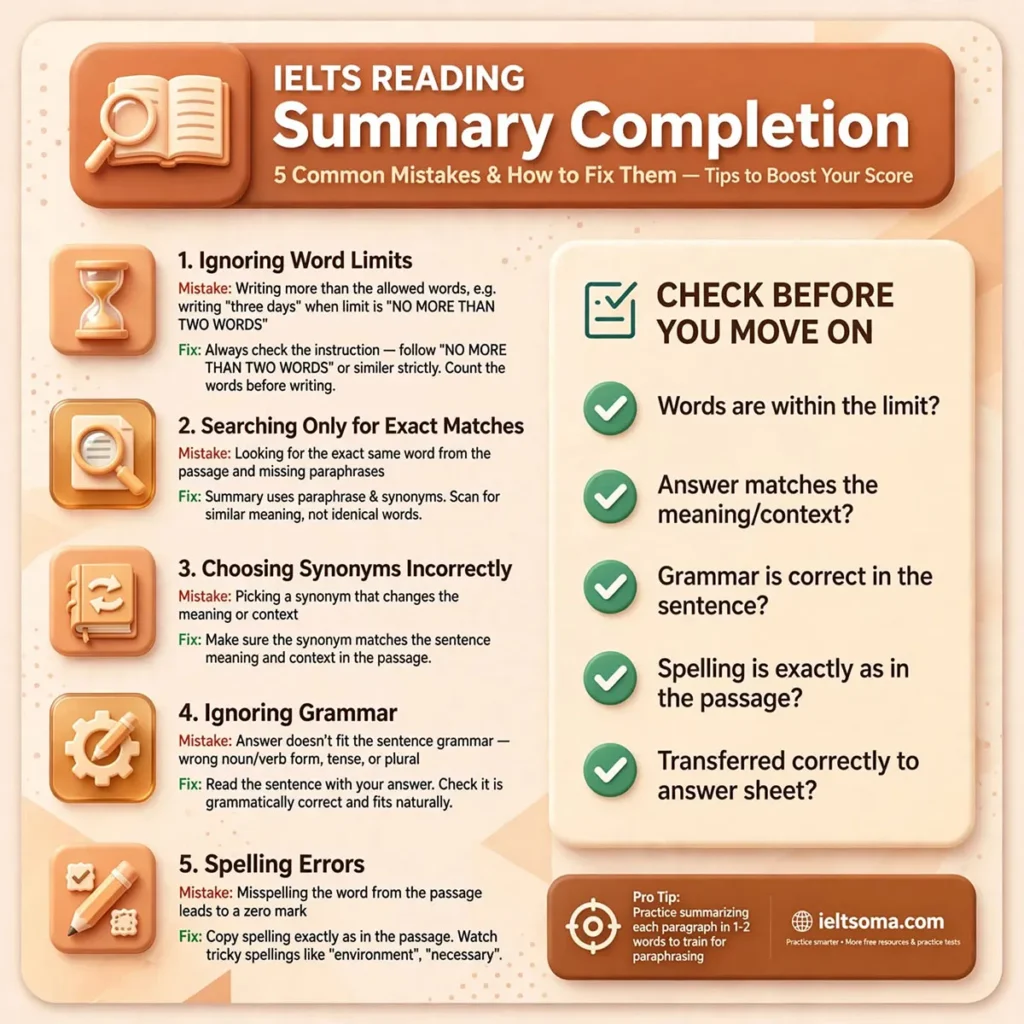
7. Check Spelling, Word Limit and Meaning
Before moving on, perform a quick three-part check:
Spelling: Is the word spelled exactly as required?
Word limit: Have you exceeded the maximum number of words?
Meaning: Does the answer accurately express the information in the passage?
This final check can prevent unnecessary lost marks.
Remember that IELTS gives one mark for each correct Reading answer, so a small spelling error can cost you a mark.
How to Find IELTS Reading Summary Completion Answers Faster
A reliable approach is to use a three-stage process.
Stage 1: Understand the Summary
Read the title, introduction and complete summary.
Ask:
- What is the summary about?
- What part of the passage is probably being summarised?
- What type of information is missing?
- Are there names, dates or technical terms that can help me locate the section?
Do not start guessing answers yet.
Stage 2: Locate the Relevant Section
Now scan the passage for distinctive words from the summary.
Names, unusual nouns, dates and technical terms are often useful signposts.
However, do not expect every word to appear exactly as it does in the question.
Look for related ideas and paraphrases.
Stage 3: Solve Each Gap in Context
Once you find the relevant section, read several sentences around the information.
Then compare the passage with the summary.
Ask:
What does the passage actually say?
Then ask:
What form of that information fits this sentence?
This prevents you from choosing a word simply because it looks familiar.
Example of an IELTS Reading Summary Completion Question
Consider this simplified example.
Passage:
Researchers studying urban farming found that rooftop gardens could provide fresh vegetables for local communities. However, the success of these projects depended heavily on access to sufficient water. In areas where rainfall was limited, farmers had to install efficient irrigation systems.
Summary:
Urban rooftop gardens can provide fresh ________ for people living in cities. However, their success may depend on having enough ________. Where rainfall is limited, farmers may need efficient irrigation ________.
Question 1
The summary says:
provide fresh ________
The passage says:
provide fresh vegetables
So the answer is:
vegetables
Question 2
The summary says:
having enough ________
The passage says:
access to sufficient water
The answer is:
water
Question 3
The summary says:
efficient irrigation ________
The passage says:
efficient irrigation systems
The answer is:
systems
Notice what happened.
The answers were not necessarily difficult vocabulary. The challenge was identifying the relevant section, understanding the relationship between the summary and passage, and choosing the grammatically appropriate words.
A Powerful Technique: Use Grammar as a Filter
Grammar can eliminate incorrect answers quickly.
Suppose you have:
The research produced a significant ________ in public awareness.
You should expect a noun.
If the passage contains:
- increase
- increased
- increasing
- significantly
only increase is likely to fit grammatically.
Now consider:
Researchers ________ that the treatment was effective.
You need a verb.
If the passage contains:
- conclusion
- concluded
- conclusive
- effectively
concluded is the grammatical match.
This technique is particularly useful when several words in the passage appear relevant.
What If the Answer Is a Paraphrase?
This is where many candidates become confused.
In some IELTS Reading tasks, you may need to understand that the question and passage express the same idea using different vocabulary.
For example:
| Summary | Passage |
|---|---|
| a large increase | a substantial rise |
| reduce costs | cut expenses |
| caused by | resulted from |
| a major problem | a significant difficulty |
| began | started |
| approximately | roughly |
Do not reject a section simply because the exact phrase from the summary is not present.
Instead, look for the same meaning.
Summary Completion vs Sentence Completion
These two question types are easy to confuse.
Sentence Completion
Sentence completion asks you to complete individual sentences using information from the passage.
The questions are normally presented in the same order as the information in the text.
Summary Completion
Summary completion gives you an overview of part of the passage.
The answers may not appear in exactly the same order as the gaps, although they usually come from one section of the text.
This distinction matters because you should not automatically assume that Question 2 must be located after Question 1 in the passage.
Common IELTS Reading Summary Completion Mistakes
Mistake 1: Ignoring the Word Limit
Writing three words when the instruction says “NO MORE THAN TWO WORDS” will cost you the mark.
Always check the instructions.
Mistake 2: Choosing a Synonym Instead of the Passage Word
If the instructions say to choose words from the passage, you should normally take the required answer from the passage rather than inventing your own synonym.
For example, if the passage says substantial increase, do not automatically write large rise.
Follow the task instructions.
Mistake 3: Looking for Exact Matches
The summary and passage may use different vocabulary.
Searching only for identical phrases can make you miss the answer.
Mistake 4: Ignoring Grammar
A word may have the right meaning but the wrong grammatical form.
Always read the completed sentence.
Mistake 5: Reading the Entire Passage Too Slowly
IELTS Reading gives you 60 minutes for 40 questions in both Academic and General Training Reading.
You cannot afford to spend several minutes reading every sentence with equal attention.
Use the summary to locate the relevant section, then read that section carefully.
Mistake 6: Using Your Own Knowledge
The answer must come from the information presented in the text.
Do not select an answer because it seems factually correct based on your general knowledge.
Your task is to understand what the passage says.
Academic and General Training IELTS Reading Summary Completion
Summary completion can appear in both IELTS Academic and IELTS General Training Reading.
The question types are broadly the same, although the reading content differs between the two tests. IELTS confirms that the Academic and General Training Reading tests use a variety of question types, including summary completion.
Academic Reading uses texts from sources such as books, journals, magazines and newspapers and is designed around topics of general interest at undergraduate or postgraduate level.
General Training Reading includes practical texts as well as longer texts, with material drawn from sources such as notices, advertisements, workplace documents, newspapers, magazines and books.
The strategy for summary completion remains fundamentally the same:
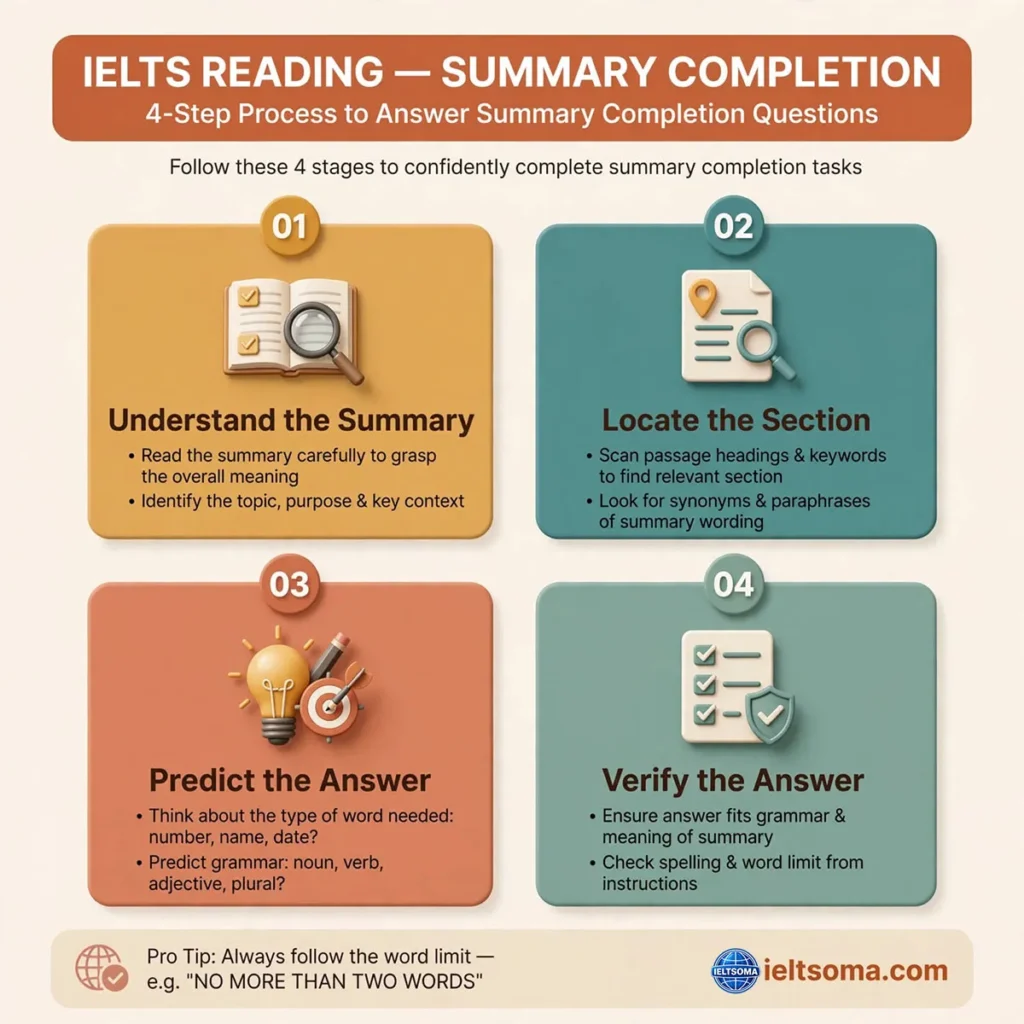
understand → locate → predict → verify
A 5-Step IELTS Reading Summary Completion Strategy
If you want a simple method to remember during practice, use this:
Step 1: Read the instructions
Identify the word limit and whether you must select words from the passage or from a list.
Step 2: Read the complete summary
Understand the topic before searching.
Step 3: Predict the missing word
Use grammar and context to predict whether you need a noun, verb, adjective, number or another type of information.
Step 4: Locate the relevant passage section
Search for distinctive ideas, names and keywords, while watching for paraphrases.
Step 5: Verify every answer
Check meaning, grammar, spelling and the word limit.
This method is simple, but it prevents many of the errors that cause candidates to lose marks.
How to Practise IELTS Reading Summary Completion
Simply doing hundreds of questions is not necessarily the best way to improve.
After every practice exercise, analyse your mistakes.
Create a simple table:
| Question | My Answer | Correct Answer | Why I Was Wrong |
|---|---|---|---|
| 1 | growth | decline | Misread the sentence |
| 2 | increased | increase | Grammar error |
| 3 | water supply | water | Exceeded word limit |
After several practice tests, patterns will become visible.
You may discover that most of your mistakes come from:
- paraphrases
- vocabulary
- grammar
- word limits
- locating information
- spelling
Once you know your weakness, your practice becomes much more targeted.
Expert Tip: Don’t Treat Every Gap Equally
Some gaps are much easier to predict than others.
If one gap clearly requires a number, name or noun, solve it first.
For example:
The project began in ________.
A year is likely.
Another gap might say:
The researchers described the results as ________.
That requires more interpretation.
Solving the easier gaps first can give you useful context for the more difficult ones.
How to Improve Your Score With Summary Completion Practice
For effective practice, focus on three abilities simultaneously.
Build paraphrase awareness
When reviewing an exercise, write down the relationship between the question wording and passage wording.
For example:
question: reduced significantly
passage: fell considerably
This trains you to recognise meaning rather than individual words.
Improve grammatical awareness
When you learn a new vocabulary item, notice how it behaves in a sentence.
Learn:
increase — noun
increase — verb
increased — adjective/past participle
increasingly — adverb
This makes it easier to predict which form belongs in a gap.
Practise under time pressure
Begin with accuracy.
Then gradually introduce time limits.
Your objective is not merely to finish quickly. It is to locate information efficiently while maintaining accuracy.
Frequently Asked Questions About IELTS Reading Summary Completion
Is IELTS Reading Summary Completion difficult?
It can be challenging because it combines several skills: locating information, recognising paraphrases, understanding grammar and selecting precise answers. With systematic practice, however, the task becomes much more predictable.
Are summary completion answers in order?
Not necessarily. IELTS states that answers may not come in the same order as the information in the passage, although they will usually come from one part of the text.
Can I use synonyms in Summary Completion?
Follow the exact instructions. If the task asks you to select words from the passage, use the appropriate words from the text. If it asks you to choose from a list, select from the provided options.
Does spelling matter in IELTS Reading Summary Completion?
Yes. IELTS advises candidates to check spelling and grammar because incorrect answers can lose marks.
Should I read the entire passage before doing Summary Completion?
Not necessarily. A more efficient approach is to understand the summary, identify its topic, locate the relevant section and then read that section carefully.
How many words can I write?
It depends on the instructions for that particular task. Always follow the stated limit, such as “NO MORE THAN TWO WORDS”. Writing more than the permitted number of words results in a wrong answer.
Is Summary Completion the same in Academic and General Training?
The fundamental task is similar, and summary completion is used in both versions. However, the reading material differs between Academic and General Training.
Final Strategy to Remember
When you face an IELTS Reading Summary Completion task, do not panic and start searching randomly.
Use this sequence:
Read the instructions → understand the summary → predict the answer → locate the section → identify the paraphrase → check grammar → check spelling and word limit.
The key is to think like a reader, not a word hunter.
You are not simply looking for a word that appears somewhere in the passage. You are looking for information that matches the meaning, grammar and context of the summary.
With regular practice, this approach can make IELTS Reading Summary Completion faster, more accurate and far less intimidating.
For official IELTS preparation and sample questions, use the IELTS Academic sample test questions and the IELTS General Training sample test questions.