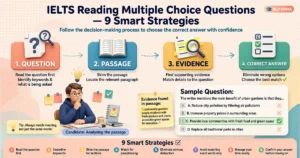
Multiple-choice questions can look like the easiest part of IELTS Reading. You are given several options, so surely the correct answer should be obvious.
Often, it is not.
IELTS Reading Multiple Choice Questions are designed to test whether you can understand meaning, recognise paraphrasing, distinguish between similar ideas and select the answer that is actually supported by the passage.
The biggest trap is choosing an option because it contains familiar words.
IELTS can deliberately place words from the passage into an incorrect option while expressing the correct answer using different language. If you rely only on word matching, you can easily select the wrong answer with confidence.
The solution is not to read faster or memorise hundreds of synonyms. You need a reliable method for analysing the question, locating the relevant part of the passage and proving which option is correct.
This guide explains how to approach IELTS Reading Multiple Choice Questions in both Academic and General Training, including the most common traps, practical examples and strategies you can practise before test day.
Table of Contents
What Are IELTS Reading Multiple Choice Questions?
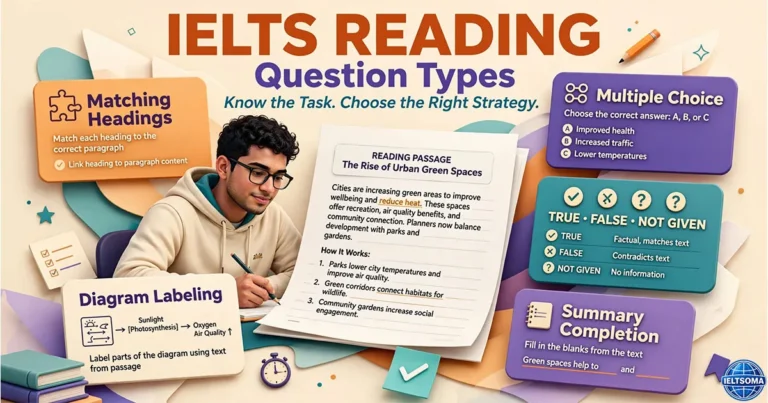
In IELTS Reading, multiple-choice questions require you to select the correct answer from a number of options.
Official IELTS guidance states that the task can involve a question followed by four possible answers or the first part of a sentence followed by four possible endings. In some Academic Reading tasks, you may instead be given a longer list and asked to select more than one answer, so you should always read the instructions carefully.
Multiple-choice questions can test different reading abilities, including:
- Understanding specific details
- Identifying the main point
- Understanding an explanation
- Recognising a writer’s idea
- Connecting information across a section
- Distinguishing between similar statements
- Understanding meaning expressed through paraphrasing
The number of multiple-choice questions can vary. They are one of several question types used in IELTS Reading rather than a fixed number of questions in every test.
How IELTS Reading Multiple Choice Questions Work
The basic process is simple:
- Read the question.
- Understand what information you need.
- Examine the options.
- Locate the relevant part of the passage.
- Compare the evidence with the options.
- Eliminate incorrect answers.
- Select the option that is best supported by the passage.
The difficulty lies in the fact that the correct answer may not use the same words as the passage.
For example:
Question:
Why did the researchers change their original method?
Passage:
The initial procedure proved unreliable, prompting the team to adopt a different approach.
The question uses change their original method, while the passage uses adopt a different approach.
You need to recognise that these expressions communicate a similar idea.
Do IELTS Reading Multiple Choice Questions Follow Passage Order?
Yes, this is one of the most useful features of this question type.
Official IELTS guidance states that multiple-choice questions are presented in the same order as the information in the text. In other words, the evidence for an earlier question should normally appear before the evidence for a later question.
This gives you an important navigation advantage.
Suppose Question 8 is answered in the middle of a passage.
When you move to Question 9, you generally do not need to search the entire passage from the beginning. Start looking from around the area where you found the previous answer and continue forwards.
This can save considerable time.
However, remember that following question order does not mean the answer will be located immediately after the previous one. A question may require you to read several sentences before the relevant evidence becomes clear.
Use the ordering rule as a navigation aid, not as a reason to rush.
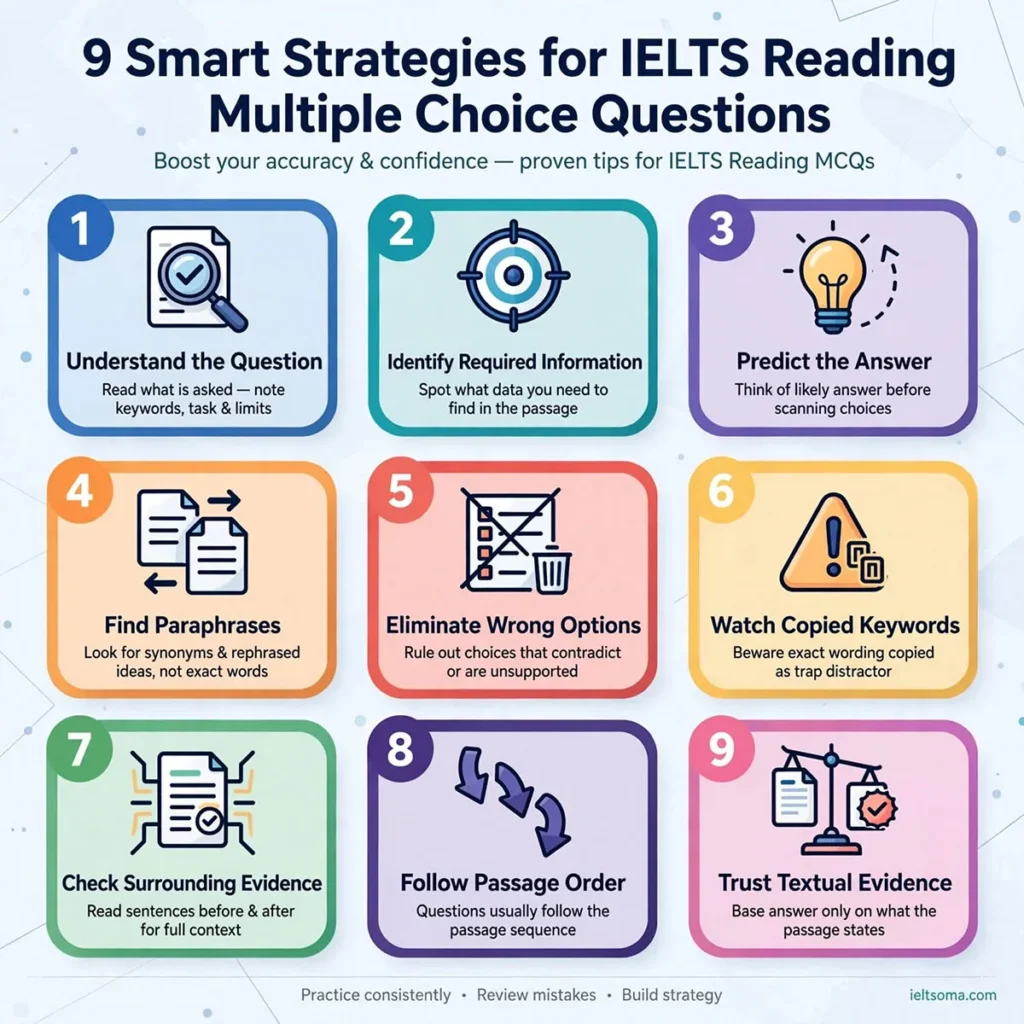
9 Powerful Strategies for IELTS Reading Multiple Choice Questions
1. Read the Question Before Studying the Options
Start with the question itself.
Ask:
What exactly am I being asked to find?
Consider this example:
What was the main reason the project was delayed?
The important concepts are:
- main reason
- project
- delayed
The word main is particularly important.
You are not looking for any reason mentioned in the passage. You are looking for the principal reason.
This distinction matters because IELTS may mention several possible causes before identifying the most significant one.
Understanding the question before looking at the options prevents you from being distracted by attractive answers.
2. Identify the Type of Information You Need
Different questions require different types of evidence.
Look for words such as:
- Why → reason or cause
- How → method or process
- When → time
- Where → location
- Who → person or group
- What → information, explanation or description
- Main reason → principal cause
- Main purpose → overall intention
- According to the passage → evidence must come from the text
For example:
Why did the company abandon the original plan?
You should search for a cause.
But:
What was the main purpose of the original plan?
requires you to identify its purpose, not simply find a problem associated with it.
This small distinction can prevent a major mistake.
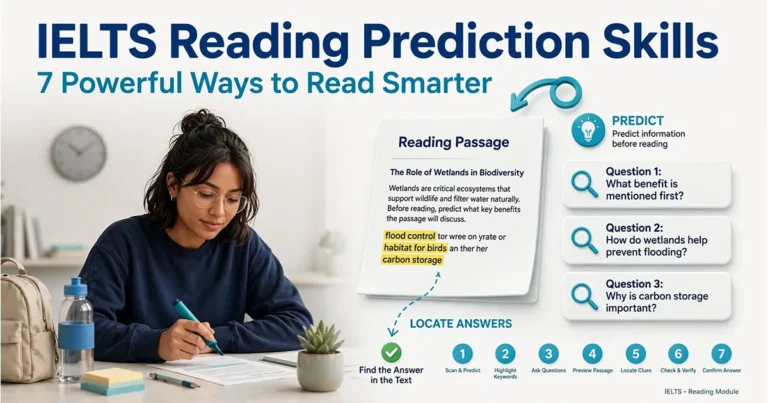
3. Predict the Answer Before Choosing an Option
Whenever possible, try to predict the answer before allowing the options to influence you.
Suppose the passage says:
The museum introduced free entry on Sundays to encourage more local residents to visit.
Question:
Why did the museum introduce free Sunday admission?
Before looking closely at the options, predict:
To encourage more local people to visit.
Now compare that idea with the options.
This is much safer than reading four options first and trying to decide which one sounds reasonable.
Options can influence your thinking.
Prediction gives you an independent reference point.
4. Search for Paraphrases, Not Identical Words
This is one of the most important skills for IELTS Reading Multiple Choice Questions.
The question may use one expression while the passage uses another.
For example:
| Question | Passage |
|---|---|
| reduced costs | lowered expenses |
| caused problems | created difficulties |
| began to decline | started to fall |
| unusual result | unexpected outcome |
| increased rapidly | rose sharply |
| changed the approach | adopted a different method |
| important factor | significant influence |
Do not assume that an option is wrong because its wording differs from the passage.
In fact, the correct answer may be the option that looks least similar linguistically but matches the meaning most accurately.
At the same time, do not treat every synonym as automatically correct.
Meaning matters more than individual words.
5. Eliminate Answers That Contradict the Passage
You do not always need to identify the correct answer immediately.
Sometimes eliminating wrong options is faster.
Imagine four options:
A. The researchers lacked funding.
B. The researchers changed their equipment.
C. The researchers wanted more accurate results.
D. The researchers stopped the experiment.
If the passage clearly says:
The team replaced its original equipment because it produced inconsistent measurements.
you can eliminate A, C and D if the text does not support them.
That leaves B.
This is especially useful when two options initially seem possible.
However, elimination must be based on evidence.
Do not eliminate an option simply because it contains unfamiliar vocabulary.
6. Beware of Options That Copy Words From the Passage
This is one of the most dangerous traps.
Suppose the passage says:
The company initially planned to expand into three European markets, but rising costs forced management to postpone the expansion.
Question:
Why was the expansion postponed?
Possible answers:
A. The company wanted to enter three European markets.
B. The company faced increasing costs.
C. The European markets were already overcrowded.
D. Management had changed its long-term objectives.
Option A contains several words directly from the passage.
That does not make it correct.
The actual reason is rising costs, so B is the answer.
This is why word matching is unreliable.
A good IELTS candidate asks:
Does this option express the correct idea?
not:
Does this option contain words I remember seeing?
7. Watch for Extreme Language
Be cautious when an answer uses unusually strong language.
Words such as:
- always
- never
- completely
- only
- all
- none
- impossible
- every
- entirely
can change the meaning of a statement significantly.
Suppose the passage says:
Some researchers believe that the method could improve accuracy.
An option saying:
The method will always improve accuracy.
is much stronger.
The passage does not support that claim.
Similarly, if the passage says:
The majority of participants preferred the new system.
an option saying:
All participants preferred the new system.
is not equivalent.
When comparing options, pay close attention to small words that change the strength or scope of a statement.
8. Read the Evidence Around the Answer
Finding a matching sentence is not always enough.
Read the surrounding sentences.
Consider:
The new system initially attracted considerable interest. However, after several months, users reported difficulties with its interface.
Question:
What problem did users experience with the new system?
The words attracted considerable interest might appear attractive if an option refers to popularity.
But the actual answer relates to difficulties with the interface.
Words such as:
- however
- although
- despite
- but
- instead
- whereas
- therefore
- consequently
can signal an important change in meaning.
Do not stop reading immediately after finding a familiar phrase.
Check what the surrounding text actually says.
9. Follow the Evidence, Not Your Personal Knowledge
IELTS Reading tests your ability to understand the passage.
It does not test whether you already know the subject.
Suppose you are reading about climate science and one option seems scientifically reasonable based on what you learned elsewhere.
That does not make it the correct IELTS answer.
The question is:
What does the passage say?
If the passage supports a particular explanation, select the answer that matches the passage—even if another option sounds more reasonable based on your outside knowledge.
This is particularly important when the topic is unfamiliar.
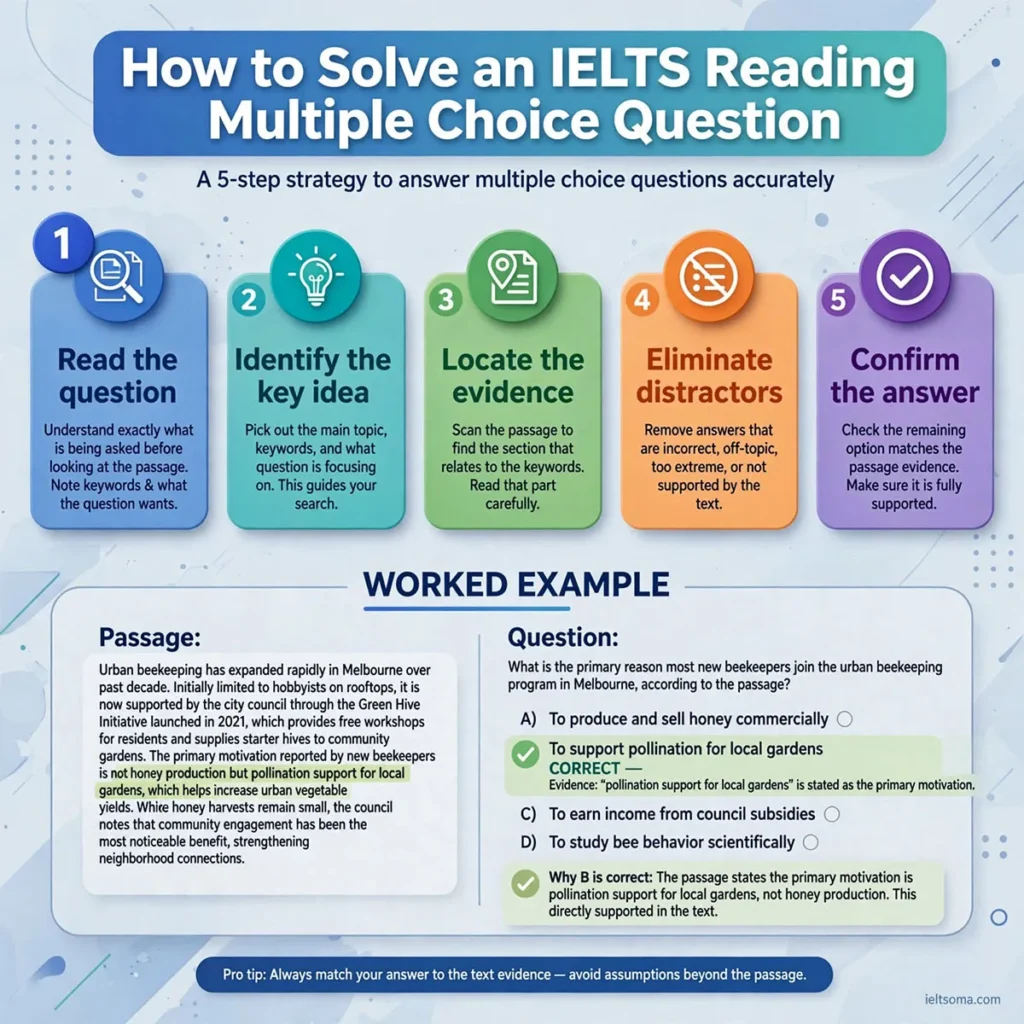
A Worked Example
Consider this short passage:
The city introduced a bicycle-sharing programme in 2018. Officials initially expected commuters to make up most of its users. However, a later survey showed that tourists represented the largest group of users, particularly during the summer months. As a result, the city expanded the programme near major tourist attractions.
Question:
Why did the city expand the bicycle-sharing programme near tourist attractions?
A. Most commuters preferred bicycles.
B. Officials wanted to reduce traffic.
C. Tourists were the largest group of users.
D. The programme was unsuccessful during summer.
Step 1: Identify the question
The question asks why.
We need a reason.
Step 2: Locate the relevant information
The final sentence explains the action, but the reason appears immediately before it.
Step 3: Identify the relationship
The passage says tourists represented the largest group of users.
Step 4: Eliminate the distractors
A is incorrect because the passage says officials initially expected commuters to be the main users.
B is not given.
D contradicts the passage because tourists used the programme particularly during summer.
Step 5: Choose the answer
C. Tourists were the largest group of users.
Notice how the answer is not difficult once the relevant evidence is identified.
The challenge is finding and interpreting that evidence accurately.
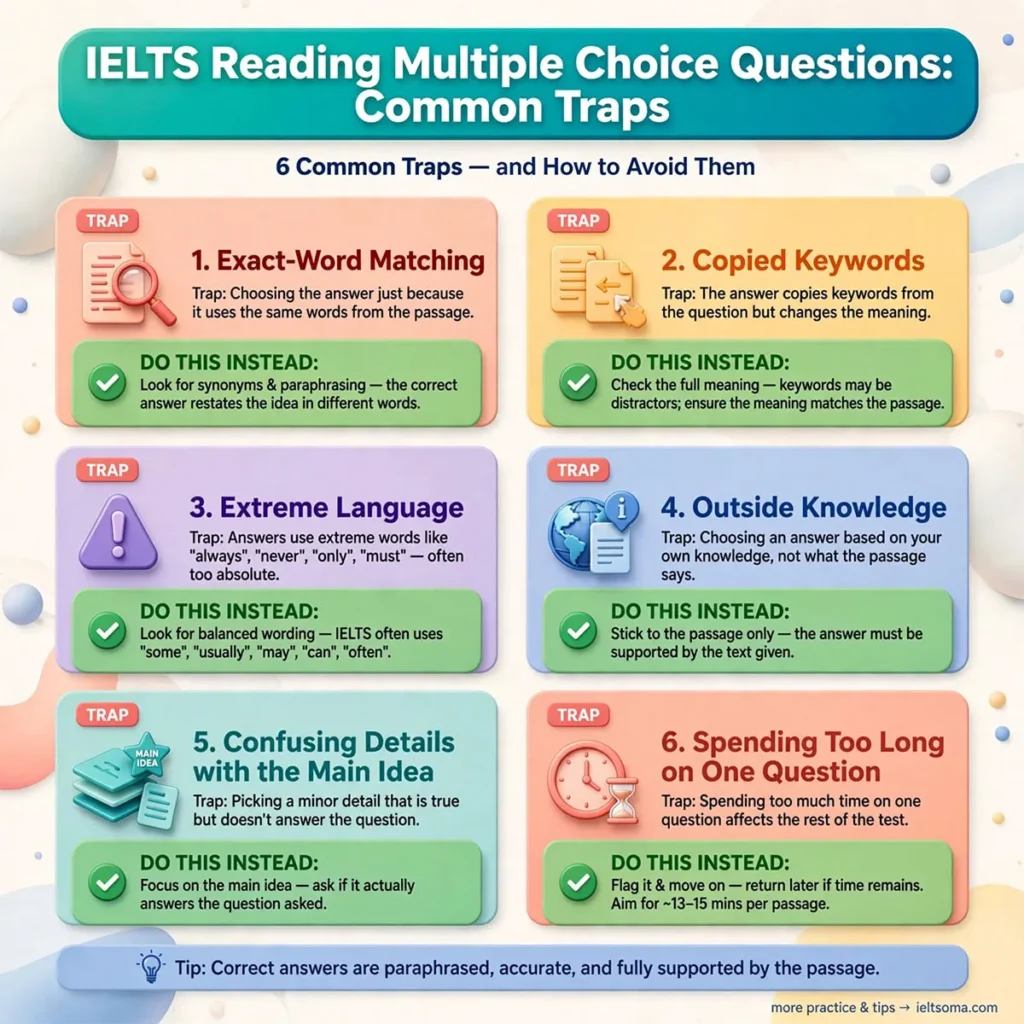
Common Mistakes in IELTS Reading Multiple Choice Questions
Choosing the first answer that looks familiar
A familiar word is not proof.
Always compare meaning.
Reading all four options repeatedly
This can waste time and increase confusion.
Understand the question first, then use the options to confirm or challenge your prediction.
Ignoring qualifiers
Words such as main, most, often, some, only and primarily can completely change the meaning.
Using outside knowledge
Your answer must be supported by the passage.
Spending too long on one question
If you cannot decide after careful analysis, make your best evidence-based choice and continue.
Changing an answer without evidence
If you initially select an answer and later change it simply because another option “sounds better”, you may be replacing an evidence-based answer with a guess.
Change your answer when you discover evidence that your original choice was wrong.
How to Manage Time
Both IELTS Academic and General Training Reading have 40 questions and 60 minutes.
Multiple-choice questions should therefore be handled efficiently.
A useful approach is:
- Read the question carefully.
- Identify the key concept.
- Predict the type of answer required.
- Locate the relevant section.
- Compare the options.
- Eliminate unsupported answers.
- Move on once you have sufficient evidence.
Do not spend several minutes trying to make one difficult option feel certain.
You are managing a complete Reading paper, not solving one question in isolation.
Academic vs General Training: Does the Strategy Change?
The core strategy for IELTS Reading Multiple Choice Questions works for both Academic and General Training.
The important difference is the material.
Academic Reading contains three sections and longer texts drawn from sources such as books, journals, magazines, newspapers and online resources. The texts are intended for a non-specialist audience and can include narrative, descriptive, discursive or argumentative writing.
General Training Reading also contains three sections, but the texts are based on everyday, workplace and general-interest contexts. The final section contains a longer, more complex text.
So your solving process can remain similar, but your practice should match the test you intend to take.
How to Practise IELTS Reading Multiple Choice Questions
Do not simply complete question after question without analysing your mistakes.
Use a structured process.
Step 1: Practise one question type
Complete a set of multiple-choice questions rather than mixing every IELTS Reading task together.
Step 2: Record your mistakes
For every incorrect answer, identify the reason.
For example:
| Mistake | What happened? |
|---|---|
| Keyword trap | I selected an option containing the same word |
| Paraphrase | I failed to recognise equivalent meaning |
| Detail vs main idea | I chose a minor point |
| Extreme language | I ignored “always” or “only” |
| Evidence | I did not check the surrounding sentences |
| Timing | I spent too long on one question |
Step 3: Revisit the passage
Do not immediately look at the answer key and move on.
Find the exact evidence that proves the correct answer.
Step 4: Explain why the other options are wrong
This is extremely valuable.
If you can explain why three options are wrong, you are developing much stronger test awareness than simply memorising the correct letter.
Step 5: Repeat under timed conditions
Once accuracy improves, introduce time pressure.
Your objective is eventually to make the process automatic.
A Simple Exam-Day Method
When you see a set of IELTS Reading Multiple Choice Questions, use this routine:
Question → Key idea → Location → Evidence → Eliminate → Answer
Do not turn it into a complicated mental procedure.
For example:
Question: Why did the organisation change its policy?
Key idea: reason for policy change
Location: find the relevant section
Evidence: identify the explanation
Eliminate: remove options that contradict or distort the passage
Answer: select the option that best matches the evidence
With enough practice, this process becomes faster and more natural.
Frequently Asked Questions
How many multiple-choice questions are there in IELTS Reading?
The number is variable. Multiple choice is one of several Reading question types, so there is no fixed number that appears in every IELTS Reading test.
Do IELTS Reading multiple-choice questions follow the order of the passage?
Yes. Official IELTS guidance states that the information needed to answer multiple-choice questions appears in the same order as the questions.
Should I look for the exact words from the question?
No. Look for the same meaning rather than identical wording. IELTS frequently uses paraphrasing.
What is the biggest mistake in multiple-choice questions?
One of the most common mistakes is choosing an option because it contains familiar words from the passage without checking whether the complete meaning is correct.
Should I read all the answer options first?
You can, but it is often more effective to understand the question first. Then examine the options with a clear idea of what information you need.
What should I do if two answers seem correct?
Return to the passage and compare both options against the evidence. Look for differences in scope, cause, timing, certainty and emphasis. Usually, one option will be more precisely supported.
Can I use my own knowledge to answer?
No. Your answer should be based on information and meaning supported by the passage, not on what you already know about the subject.
Are multiple-choice questions difficult in IELTS Reading?
They can be challenging because several options may appear plausible. The difficulty often comes from paraphrasing and distractors rather than from the basic format itself.
Final Checklist for IELTS Reading Multiple Choice Questions
Before selecting an answer, ask yourself:
- What exactly is the question asking?
- What type of information do I need?
- Where is the relevant part of the passage?
- What does the passage actually say?
- Is the information paraphrased?
- Does this option express the complete meaning?
- Is the option too strong or too broad?
- Is it confusing a detail with the main point?
- Does another option contradict the passage?
- Can I prove my answer using evidence?
If you can answer these questions consistently, your accuracy should improve.
Final Thoughts
Success with IELTS Reading Multiple Choice Questions is not about finding the option that looks most familiar.
It is about finding the option that is best supported by the passage.
Read the question carefully. Understand what information you need. Use the question order to navigate the text. Search for paraphrased meaning rather than identical vocabulary. Be suspicious of distractors that copy words from the passage. Watch for extreme language and check the surrounding evidence before making your final choice.
Most importantly, analyse your mistakes.
If you repeatedly choose answers because they contain familiar words, change that habit.
If you struggle with paraphrasing, train yourself to recognise equivalent ideas.
If you confuse a supporting detail with the main point, practise identifying what the writer is actually saying.
And if time is your biggest problem, practise making decisions efficiently rather than trying to understand every sentence in complete detail.
The goal is not simply to get more questions right during practice.
The goal is to develop a repeatable method that you can trust when the clock is running and the passage is unfamiliar.
That is the real skill behind mastering IELTS Reading Multiple Choice Questions.
Further Useful Links:
- IELTS Reading Summary Completion: 7 Proven Tips to Score Higher
- IELTS Reading Question Types: 14 Essential Tasks & Tips
- Yes/No/Not Given Questions in IELTS Reading: 9 Proven Strategies
- IELTS Reading Matching Strategies: 9 Powerful Tips
- IELTS Reading Strategies: 15 Powerful Ways to Score Higher
- IELTS Reading Section Strategy: 11 Proven Ways to Score Higher
- Official IELTS Academic Reading Test Format
- Official IELTS Academic Reading Sample Questions