Knowing more English words does not automatically mean you will get a higher IELTS score.
Many candidates spend weeks memorising impressive-looking vocabulary, only to discover that they cannot use those words naturally in an essay or speaking response. Others learn long lists of synonyms but still repeat the same basic expressions under exam pressure.
The better approach is to build Academic Vocabulary for IELTS around meaning, collocation, topic, context and accurate use.
IELTS does not reward vocabulary simply because a word is difficult. Lexical Resource is assessed through factors such as range, precision, appropriacy, collocation, spelling and word formation. Official IELTS guidance also highlights the importance of using vocabulary flexibly and accurately rather than simply using more complicated words.
So what should you actually learn?
This guide explains how to develop useful Academic Vocabulary for IELTS and, more importantly, how to turn that vocabulary into higher-quality Writing and Speaking responses.
Table of Contents
What Is Academic Vocabulary for IELTS?
Academic Vocabulary for IELTS refers to words and expressions that help you discuss ideas, explain information, compare evidence, describe trends and express opinions clearly and precisely.
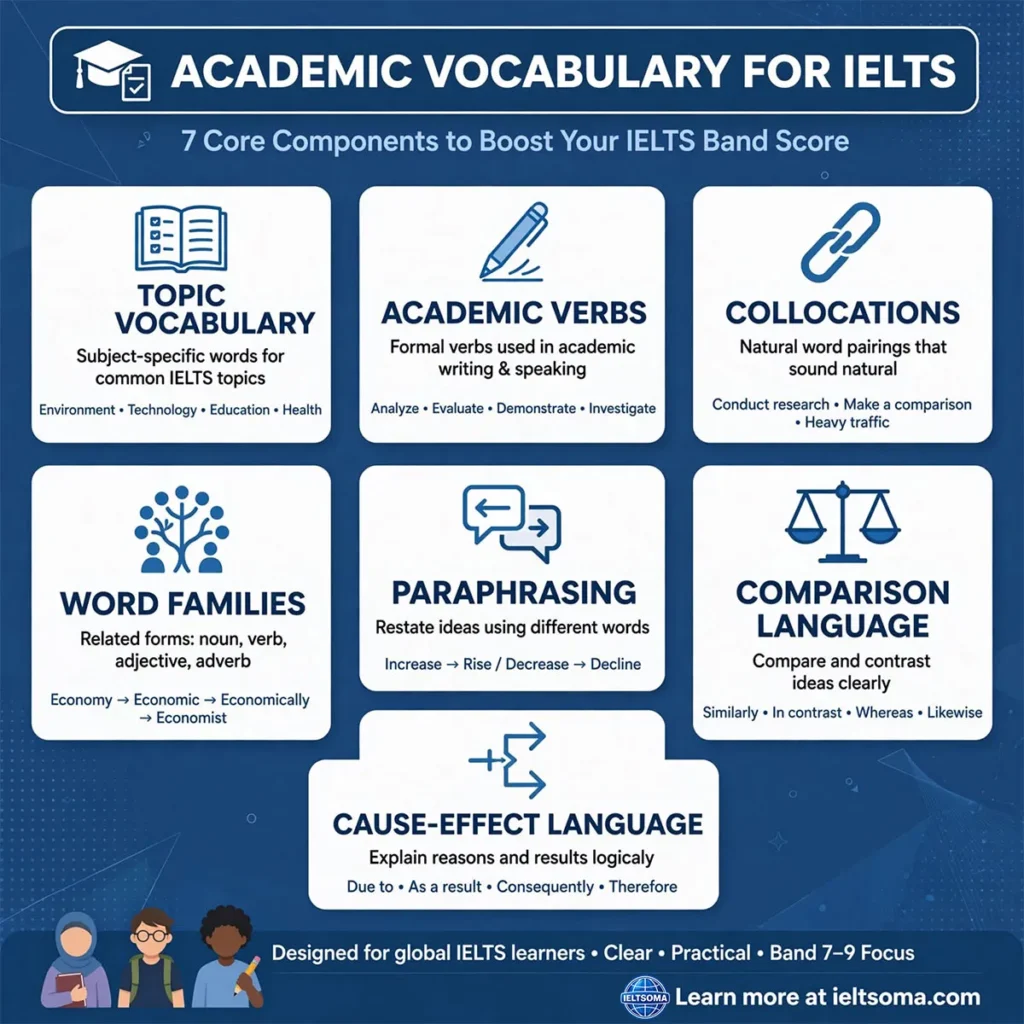
It includes several important areas:
- Topic-specific vocabulary
- Academic verbs
- Precise adjectives and adverbs
- Useful nouns
- Collocations
- Paraphrasing language
- Cause-and-effect expressions
- Comparison language
- Language for opinions and arguments
- Vocabulary for describing data and trends
For example, instead of repeatedly writing:
“This problem is very bad and causes many problems.”
you could write:
“This issue has significant consequences for public health and places additional pressure on healthcare systems.”
The second version is not better merely because the vocabulary is more advanced. It is better because the language is more precise and appropriate to the meaning.
That distinction is essential.
Why Vocabulary Matters in IELTS
Vocabulary directly contributes to the Lexical Resource criterion in both IELTS Writing and Speaking.
In Writing, examiners consider the range and accuracy of vocabulary, the appropriacy of word choice, collocations, spelling and word formation. In Speaking, Lexical Resource also considers how effectively you use vocabulary to express meaning and whether you can use alternative language when you do not know a particular word.
The official Band 7 Writing descriptor, for example, refers to sufficient vocabulary for flexibility and precision, some ability to use less common or idiomatic items, and awareness of style and collocation.
This means your goal should not be:
“How can I use the most difficult words?”
Your goal should be:
“How can I choose the most accurate word for this idea?”
That change in mindset can transform the way you study vocabulary.
7 Powerful Ways to Build Academic Vocabulary for IELTS
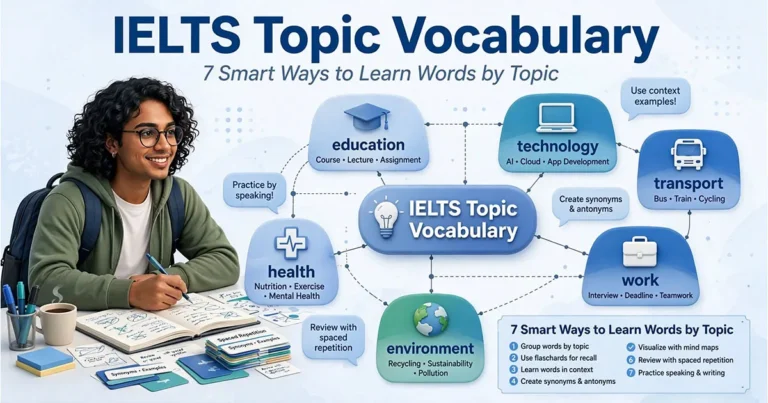
1. Learn Words in Topic Groups
Learning isolated vocabulary is one of the least effective ways to prepare for IELTS.
Instead, organise words around common IELTS themes.
For example, if you are studying the topic of education, you could build a vocabulary group like this:
| Vocabulary | Meaning / Use | Example |
|---|---|---|
| access to education | opportunity to receive education | Governments should improve access to education. |
| academic achievement | success in education | Technology may influence academic achievement. |
| higher education | university-level education | Higher education can improve employment prospects. |
| vocational training | practical career-focused education | Vocational training can prepare young people for employment. |
| educational inequality | unequal educational opportunities | Educational inequality remains a concern in many countries. |
| lifelong learning | continuing to learn throughout life | Lifelong learning is increasingly important in modern economies. |
This method creates connections between words.
Instead of remembering six unrelated expressions, you are building a vocabulary network around one subject.
Useful IELTS topics include:
- Education
- Environment
- Technology
- Health
- Work
- Globalisation
- Transport
- Crime
- Government
- Society
- Media
- Advertising
- Tourism
- Cities
- Family
- Science
When you learn vocabulary in groups, you are also more likely to remember it when you need to discuss the topic during the test.
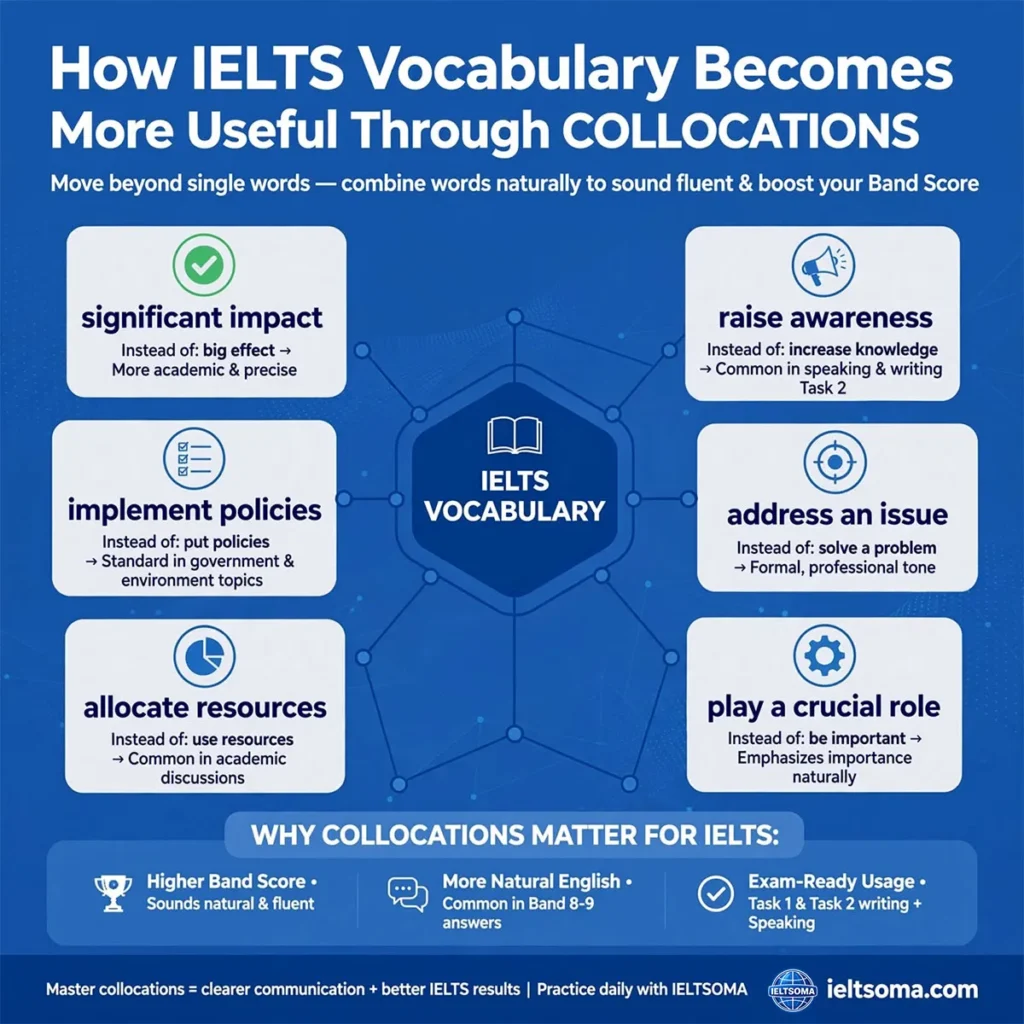
2. Learn Collocations, Not Just Individual Words
A candidate may know hundreds of English words but still sound unnatural because they do not know which words normally occur together.
This is where collocations become extremely valuable.
Consider the word impact.
You could learn:
impact = effect
But it is much more useful to learn combinations such as:
- have a significant impact
- have a negative impact
- have a lasting impact
- minimise the impact
- assess the impact
- the impact of technology
- the environmental impact
Now you can use the word naturally.
For example:
Social media has a significant impact on the way people communicate.
This is much more useful than memorising “impact = effect” and hoping you can construct a natural sentence during the exam.
Other useful academic collocations include:
- pose a serious threat
- address an issue
- tackle a problem
- play a crucial role
- reach a conclusion
- provide access
- raise awareness
- achieve a goal
- meet a demand
- conduct research
- generate employment
- reduce inequality
- improve living standards
- protect the environment
- allocate resources
The official IELTS guidance specifically identifies collocation as part of lexical performance, making collocation practice an important part of your vocabulary preparation.
3. Build a Bank of Academic Verbs
Many IELTS candidates overuse simple verbs such as:
- make
- get
- give
- show
- say
- do
- help
- cause
These verbs are not wrong. The problem occurs when they are used repeatedly when a more precise verb would communicate the idea better.
Compare:
The government should make changes to the education system.
with:
The government should implement reforms to the education system.
Or:
The graph shows an increase in unemployment.
with:
The graph illustrates an increase in unemployment.
Useful academic verbs include:
- analyse
- assess
- demonstrate
- indicate
- illustrate
- identify
- establish
- determine
- evaluate
- implement
- regulate
- facilitate
- contribute
- undermine
- enhance
- promote
- discourage
- address
- tackle
- reduce
- increase
However, do not replace every simple verb with an advanced one.
For example, “help” may be completely natural in a sentence. Using “facilitate” simply because it sounds more academic can make your writing less natural.
Precision comes before complexity.
4. Learn Vocabulary Through Word Families
One word can give you several useful forms.
Take the word economy:
- economy
- economic
- economical
- economically
- economist
Now consider develop:
- develop
- development
- developed
- developing
- developmental
This is particularly useful because IELTS can test your ability to form words accurately in Reading, while Writing and Speaking require you to select the correct grammatical form when producing language.
For example:
Economic development can improve living standards.
But:
The country has developed rapidly.
The root word is related, but the grammatical function is different.
Create vocabulary cards that include the whole family rather than memorising only one form.
A useful format is:
Verb: develop
Noun: development
Adjective: developed / developing
Adverb: —
Collocation: economic development
Example: Rapid economic development can create new employment opportunities.
This approach gives you much more usable vocabulary from every word you learn.
5. Learn Paraphrasing Instead of Memorising Synonym Lists
Paraphrasing is an essential IELTS skill, particularly in Writing.
But paraphrasing does not mean replacing every word with a synonym.
For example:
Many people believe that university education should be free.
Possible paraphrase:
It is widely argued that higher education should be provided without tuition fees.
Several changes have occurred:
- many people → it is widely argued
- university education → higher education
- should be free → should be provided without tuition fees
The sentence structure has also changed.
This is stronger than simply replacing “believe” with “think”.
Useful paraphrasing techniques include:
Change the word form
Governments should regulate advertising.
→
Government regulation of advertising is increasingly important.
Use a synonym where appropriate
serious problem
→
significant issue
Change the sentence structure
Technology has changed the way people work.
→
The way people work has been transformed by technology.
Use a broader or more specific expression
cars
→
private vehicles
Use a phrase instead of one word
unemployed people
→
people who are unable to find employment
The key is accuracy. A synonym is only useful if it preserves the original meaning and fits the context.
Academic Vocabulary for IELTS Writing Task 1
Academic Vocabulary for IELTS becomes particularly important in Academic Writing Task 1 because candidates need to describe graphs, charts, tables, processes, maps and other visual information.
You need vocabulary for:
- increases
- decreases
- stability
- fluctuations
- comparisons
- proportions
- quantities
- trends
- processes
- locations
For example, instead of repeatedly using increase, you can use:
- rise
- grow
- climb
- increase
- surge
- soar
But these words are not interchangeable in every situation.
Compare:
The number of visitors increased gradually.
with:
The number of visitors soared.
“Soared” suggests a dramatic increase, whereas “increased gradually” describes a controlled upward movement.
Similarly, for decreases:
- decline
- decrease
- fall
- drop
- plunge
- dip
Again, the strength of the word matters.
For example:
The figure dipped slightly in June.
is different from:
The figure plunged in June.
Choose vocabulary based on the data rather than trying to impress the examiner.
For Academic Writing Task 1, IELTS requires candidates to describe visual information in their own words, while the assessment includes Lexical Resource alongside the other Writing criteria.
Academic Vocabulary for IELTS Writing Task 2
Task 2 requires you to discuss an argument, problem or point of view, so your vocabulary needs to help you develop ideas logically.
Useful categories include:
Giving an opinion
- argue that
- maintain that
- contend that
- believe that
- take the view that
- from my perspective
- in my view
Example:
I would argue that governments should prioritise investment in public transport.
Giving reasons
- because
- owing to
- due to
- as a result of
- largely because
- one contributing factor is
Example:
One contributing factor is the increasing cost of private transport.
Discussing consequences
- result in
- lead to
- contribute to
- give rise to
- have consequences for
- result in
- pose a risk to
Example:
Excessive reliance on private vehicles can contribute to air pollution.
Introducing solutions
- address
- tackle
- resolve
- mitigate
- reduce
- regulate
- introduce measures
- implement policies
Example:
Governments could implement policies designed to reduce unnecessary car use.
Comparing ideas
- whereas
- while
- in contrast
- by comparison
- compared with
- similarly
- conversely
The important point is that these expressions should connect real ideas. Do not insert linking expressions simply because you have memorised them.
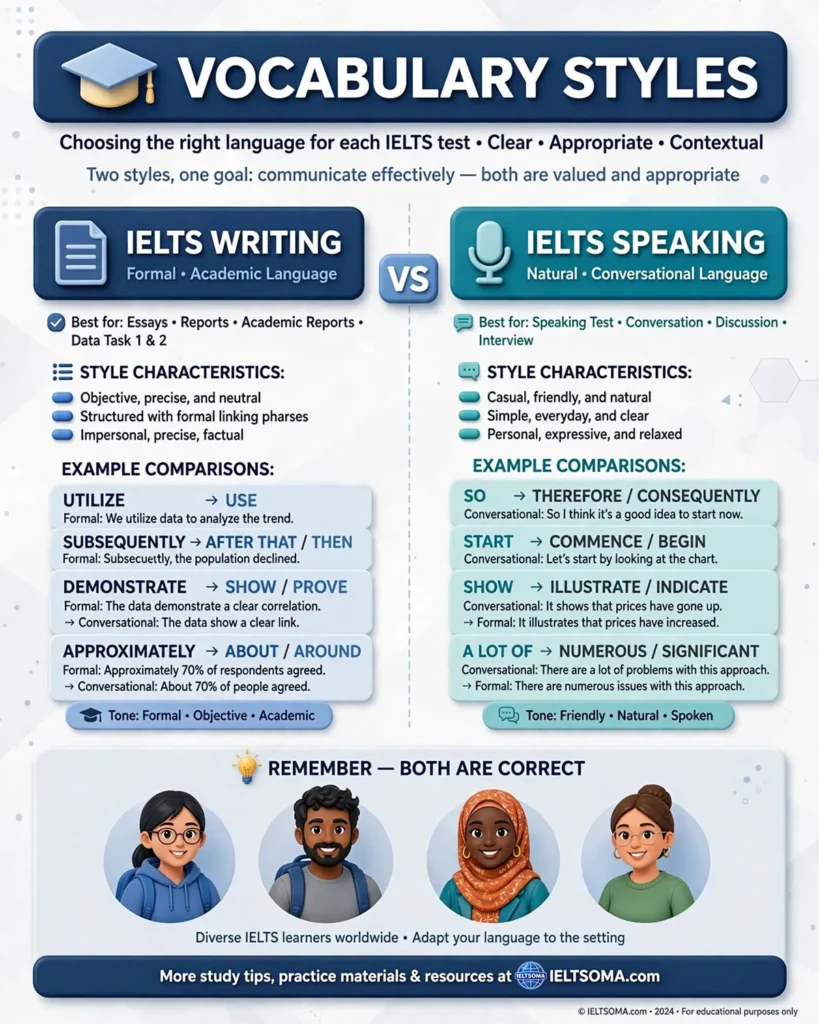
Academic Vocabulary for IELTS Speaking
Academic Vocabulary for IELTS is not limited to Writing.
Speaking is assessed using four criteria, including Lexical Resource. At higher bands, candidates are expected to use vocabulary flexibly and precisely, including less common and idiomatic items when appropriate.
However, this does not mean you should speak like an academic journal.
Natural spoken English is still essential.
Instead of saying:
I am of the opinion that recreational activities constitute an indispensable component of contemporary society.
you could simply say:
I think leisure activities are an important part of modern life.
Then add precise vocabulary naturally:
In particular, they give people an opportunity to reduce stress and maintain a healthier work-life balance.
That sounds much more appropriate for Speaking.
Useful speaking vocabulary includes:
- personally
- generally speaking
- to some extent
- in particular
- for instance
- from my experience
- I would say
- I tend to think
- one reason is that
- what I mean is
- a good example would be
- it depends on
- one advantage is
- the main drawback is
For unfamiliar topics, paraphrasing is particularly useful. If you forget a specific word, explain the idea using language you already know rather than stopping completely. The official Speaking criteria recognise the ability to use alternative vocabulary when a candidate does not know a particular word.
20 High-Value Academic Vocabulary Examples
Here is a practical set of words worth learning in context.
| Word | Useful collocation | Example |
|---|---|---|
| significant | significant impact | Education has a significant impact on society. |
| substantial | substantial increase | There was a substantial increase in demand. |
| crucial | crucial role | Teachers play a crucial role in education. |
| beneficial | beneficial effect | Exercise has beneficial effects on health. |
| detrimental | detrimental effect | Excessive screen time may have a detrimental effect. |
| sustainable | sustainable development | Countries should pursue sustainable development. |
| controversial | controversial issue | Immigration remains a controversial issue. |
| widespread | widespread concern | There is widespread concern about pollution. |
| inevitable | inevitable consequence | Some disruption may be an inevitable consequence. |
| feasible | feasible solution | Public transport may be a feasible solution. |
| implement | implement policies | Governments should implement effective policies. |
| enhance | enhance quality | Technology can enhance the quality of education. |
| facilitate | facilitate access | Online learning can facilitate access to education. |
| undermine | undermine confidence | Constant criticism can undermine students’ confidence. |
| mitigate | mitigate risks | Regulations can help mitigate environmental risks. |
| allocate | allocate resources | Governments must allocate sufficient resources. |
| address | address an issue | Authorities need to address the housing shortage. |
| assess | assess the impact | Researchers should assess the long-term impact. |
| demonstrate | demonstrate the importance | The findings demonstrate the importance of early education. |
| contribute | contribute to | Poor infrastructure can contribute to economic inequality. |
Do not try to memorise all 20 in one sitting.
Choose five to seven, learn their collocations and create your own sentences.
Common Academic Vocabulary Mistakes in IELTS
Mistake 1: Using Words You Do Not Fully Understand
A word that looks impressive can damage your score if you use it incorrectly.
For example, some candidates confuse:
- economic and economical
- historic and historical
- affect and effect
- effective and efficient
- personal and personnel
Always learn the meaning, grammatical form and typical context.
Mistake 2: Using Synonyms That Change the Meaning
Not every synonym has exactly the same meaning.
For example:
problem
could become:
issue
in many contexts.
But problem, challenge, difficulty, disadvantage and threat are not automatically interchangeable.
Ask yourself:
Does this replacement express exactly the idea I intend?
Mistake 3: Memorising Entire Essays
Memorised essays can create serious problems because the vocabulary may not fit the question.
Instead, memorise language resources, such as:
- useful collocations
- sentence patterns
- topic vocabulary
- paraphrasing techniques
- cause-and-effect expressions
Then build your response around the actual question.
Mistake 4: Overusing “Advanced” Vocabulary
A sentence does not become better simply because it contains difficult words.
Compare:
Governments should ameliorate the deleterious ramifications of vehicular congestion.
with:
Governments should reduce the harmful effects of traffic congestion.
The second sentence is clearer and more natural.
The best IELTS vocabulary is not necessarily the rarest vocabulary.
Mistake 5: Ignoring Collocation
Knowing a word is not enough.
You should know how that word behaves with other words.
For example:
strong evidence
is natural.
powerful evidence
may also work in some contexts.
But:
heavy evidence
is generally unnatural.
Learning vocabulary through collocations helps you avoid these errors.
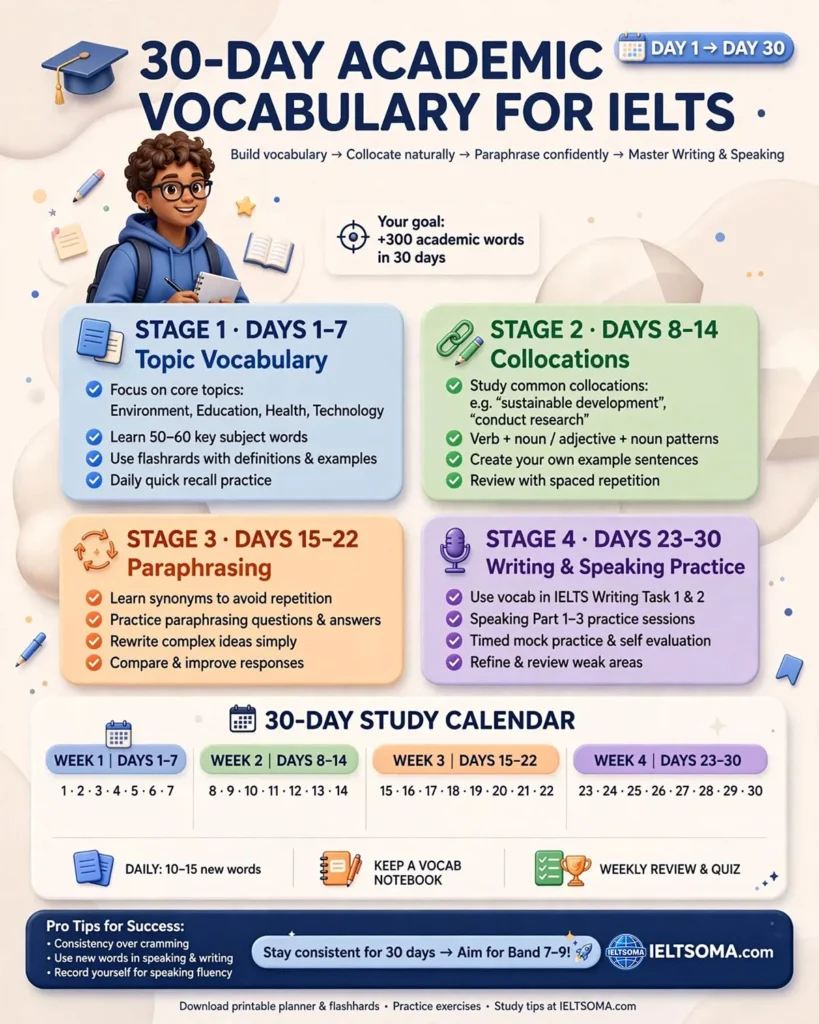
A Simple 30-Day Academic Vocabulary for IELTS Plan
You do not need to learn 1,000 words before your IELTS test.
A focused 30-day programme can be much more effective.
Days 1–7: Build Topic Vocabulary
Choose seven common IELTS topics.
For each topic, learn:
- 8–10 useful words
- 5 collocations
- 3 academic verbs
- 2 example sentences
Do not simply copy definitions. Write your own examples.
Days 8–14: Focus on Collocations
Review the vocabulary from the first week.
Turn individual words into combinations.
For example:
environment
becomes:
- protect the environment
- environmental damage
- environmental awareness
- environmental regulations
- sustainable development
Days 15–21: Practise Paraphrasing
Take IELTS-style questions and rewrite them using different structures.
Original:
Some people believe that children should start school at an early age.
Paraphrase:
It is argued that children should begin their formal education when they are relatively young.
Then create another version without relying on the same vocabulary.
Days 22–26: Use Vocabulary in Writing
Write short paragraphs rather than immediately writing full essays.
Choose one topic and write:
- An introduction
- One main-body paragraph
- A conclusion
Underline your academic vocabulary.
Then ask:
- Is each word accurate?
- Is the collocation natural?
- Have I repeated the same word?
- Have I used unnecessarily complicated language?
Days 27–30: Use Vocabulary in Speaking
Choose common Speaking topics and record yourself answering questions.
For each answer, try to include:
- one precise adjective
- one useful collocation
- one topic-specific word
- one example
- one paraphrased expression
Do not force vocabulary into your answer.
The goal is to make useful language available naturally when you need it.
The Best Way to Remember Academic Vocabulary for IELTS
Use the Learn → Connect → Use → Review method.
Learn
Understand the meaning, pronunciation and grammatical form.
Connect
Learn the word with related vocabulary and collocations.
Use
Create your own sentences and use the vocabulary in IELTS-style responses.
Review
Return to the vocabulary repeatedly rather than studying it once and forgetting it.
For example:
Word: mitigate
Meaning: reduce the seriousness or harmful effect of something
Collocations:
- mitigate risks
- mitigate the effects
- mitigate environmental damage
Example:
Governments can introduce stricter regulations to mitigate the environmental effects of industrial activity.
Speaking use:
Better planning could mitigate some of the problems caused by rapid urbanisation.
That is far more valuable than simply writing “mitigate = reduce” in a vocabulary notebook.
How Many Words Do You Need for IELTS?
There is no official magic number of vocabulary words that guarantees a particular IELTS band.
Your score depends on how effectively you use language, not simply on how many words you can recognise.
Official IELTS guidance describes higher-level performance in terms of flexibility, precision, appropriacy and accurate use rather than a fixed vocabulary count.
Therefore, learning 500 highly useful words and being able to use them accurately can be more valuable than memorising thousands of words that you cannot use confidently.
Think about depth of vocabulary knowledge, not just vocabulary size.
Quick Academic Vocabulary Checklist
Before your IELTS test, ask yourself:
- Can I discuss common IELTS topics without repeatedly using basic words?
- Do I know useful collocations rather than isolated words?
- Can I paraphrase a question naturally?
- Can I describe trends accurately in Academic Writing Task 1?
- Can I express causes and consequences precisely?
- Can I compare ideas clearly?
- Can I give opinions without memorising fixed sentences?
- Can I explain an unfamiliar word if I forget it?
- Do I understand the words I use?
- Can I use my vocabulary accurately under time pressure?
If you can answer “yes” to most of these questions, your vocabulary preparation is moving in the right direction.
FAQs About Academic Vocabulary for IELTS
What is the best way to learn Academic Vocabulary for IELTS?
Learn vocabulary in topic groups and collocations rather than memorising isolated word lists. Then use the words in your own IELTS Writing and Speaking responses.
How can I improve my vocabulary for IELTS Writing?
Study topic-specific vocabulary, academic verbs, collocations and paraphrasing patterns. Practise using them in paragraphs and essays, then check whether your word choices are accurate and natural.
Do I need difficult words to get Band 7?
No. Higher-band performance requires flexible and precise vocabulary, including appropriate less common language, but difficult words are not automatically better. Accurate and natural vocabulary is more important than unnecessarily complicated vocabulary.
Should I use the same vocabulary in Speaking and Writing?
Some vocabulary can be used in both, but your style should match the situation. Writing generally requires more formal academic language, while Speaking should remain natural and conversational.
How many new words should I learn every day?
There is no fixed number. A smaller group of words that you understand deeply and can actually use is usually more useful than a large list that you quickly forget.
Are idioms important for IELTS Speaking?
Idiomatic language can contribute to strong lexical performance when it is used naturally and appropriately. However, memorised idioms inserted into unrelated answers can sound unnatural. Focus on expressing your meaning clearly first.
Final Takeaway
The most effective Academic Vocabulary for IELTS is not a giant list of complicated words.
It is a collection of useful, accurate and flexible language that you can actually use under exam conditions.
Focus on topic vocabulary, collocations, academic verbs, word families and paraphrasing. Then practise using that language in realistic Writing and Speaking tasks.
Most importantly, do not ask:
“Does this word sound advanced?”
Ask:
“Is this the most accurate and natural word for my meaning?”
That is the approach that turns vocabulary knowledge into real IELTS performance.