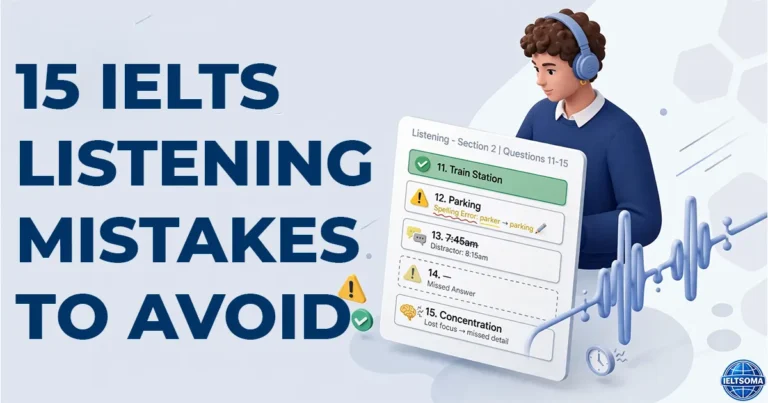
You hear the answer. You know it is important. Then, while you are writing it down, the speaker moves on—and suddenly you have lost the next answer too.
This is one of the biggest challenges in IELTS Listening.
The problem is often not your English. It is the attempt to listen, understand, remember, write and predict the next answer at the same time.
The right IELTS Listening note-taking tips can make this process much easier.
Effective note-taking is not about writing everything you hear. In fact, trying to record every word can make your Listening score worse. Your goal is to capture the information you need, recognise changes in meaning, and stay ready for the next question.
In this guide, you will learn practical IELTS Listening note-taking tips that you can use during practice and in the real test.
Table of Contents
Why Note-taking Matters in IELTS Listening
The IELTS Listening test contains four parts and 40 questions. You hear each recording once, and the questions generally follow the order of the information in the recording. You therefore need to keep moving with the audio rather than spending too much time on one answer.
Several IELTS Listening question types require you to identify and record specific information, including form, note, table, flow-chart and summary completion.
That means note-taking can help you:
- remember important details
- recognise numbers and names
- track changes and corrections
- record an answer before moving on
- understand relationships between ideas
- avoid losing information when several details appear close together
However, good note-taking is selective.
You are not creating a transcript of the recording.
You are creating a quick record of information that helps you answer the questions accurately.
9 IELTS Listening Note-taking Tips That Actually Work
1. Read the Questions Before the Recording
One of the most valuable IELTS Listening note-taking tips is to use the preparation time intelligently.
Before the recording begins, look at the questions and identify what information you need.
For example:
Name: __________
Date of arrival: __________
Cost: __________
Accommodation: __________
You already know that you are listening for a name, date, price and type of accommodation.
This changes the way you listen.
Instead of trying to understand every sentence, you can focus on information relevant to the questions.
Before the audio starts, quickly mark or mentally identify:
- names
- dates
- times
- prices
- places
- numbers
- nouns
- adjectives
- comparisons
- keywords that identify the topic
This preparation reduces the amount of information your brain needs to process during the recording.
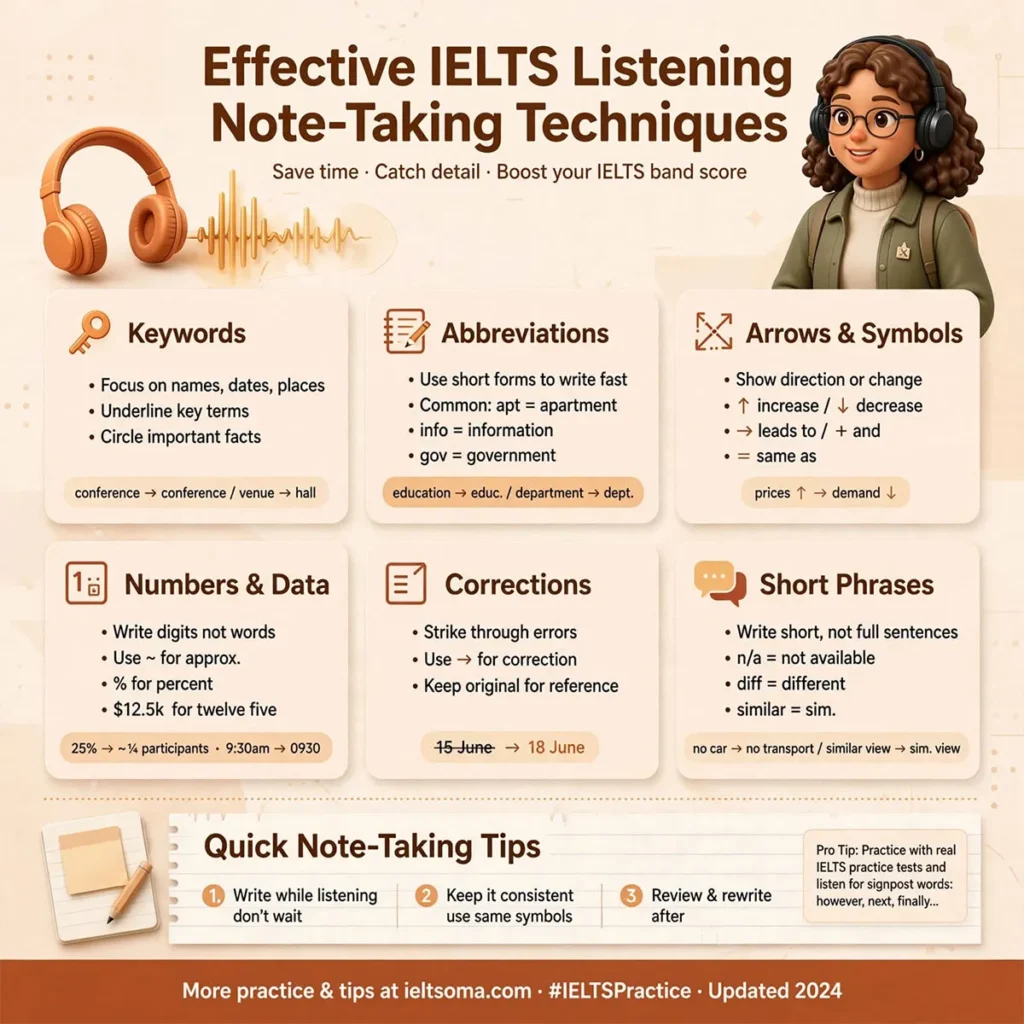
2. Do Not Write Every Word
This is probably the most important note-taking rule.
Do not try to write everything you hear.
Imagine the speaker says:
“The museum originally opened in 1985, but after extensive renovation work, it was reopened to the public in 1992.”
You do not need to write:
The museum originally opened in 1985, but after extensive renovation work…
A much more useful note would be:
museum → opened 1985 → reopened 1992
The important information is preserved without wasting time.
Use short forms, symbols and abbreviations whenever they are clear to you.
For example:
- increase → ↑
- decrease → ↓
- approximately → approx.
- because → b/c
- government → gov.
- university → uni.
- number → #
- more than → >
- less than → <
- important → imp.
The exact abbreviations do not matter as long as you understand them immediately.
3. Listen for Meaning, Not Just Keywords
A common mistake is to hear a familiar keyword and immediately write down the information that follows.
IELTS Listening often tests your ability to understand meaning rather than simply recognise repeated words.
For example:
“The course was initially planned for Tuesday, but it has now been moved to Thursday.”
If the question asks for the course day, Tuesday is not the answer.
The speaker corrected the information.
Your notes could look like:
course: Tue → Thu
The arrow helps you recognise that the first piece of information was replaced.
This is why you should listen carefully for expressions such as:
- but
- however
- actually
- although
- instead
- rather
- I mean
- sorry
- no, that’s not right
- let me correct that
- it has changed
- originally
- now
- rather than
These expressions often signal a change, contrast or correction.
4. Use Symbols for Fast Note-taking
Writing complete words takes time.
Symbols can help you record relationships quickly.
For example:
More students → ↑ demand → larger classes
Or:
cost ↑ → fewer bookings ↓
You can also use arrows for movement or change:
- ↑ = increase
- ↓ = decrease
- → = leads to / results in
- ← = comes from
- = = is / means
- ≠ = different from
- = additional / positive
- = negative / reduction
You can create your own system.
The important thing is consistency.
Do not invent a new abbreviation every time you practise. Build a small set of symbols that you can recognise automatically.
5. Pay Special Attention to Numbers and Spelling
Numbers can disappear from your memory surprisingly quickly.
IELTS Listening frequently includes details such as:
- telephone numbers
- dates
- prices
- addresses
- room numbers
- measurements
- percentages
- times
- years
If you hear:
“The fee is £75, although students who register before Friday only pay £60.”
Do not simply write:
75
Write something that reflects the important relationship:
fee = £75 → early = £60
This makes the information easier to interpret later.
Spelling also matters.
The official IELTS guidance states that incorrect spelling can result in a lost mark when answers are transferred to the answer sheet.
So when you hear a name or unfamiliar word, try to record enough information to reconstruct the spelling accurately.
6. Leave Space Between Your Notes
Messy notes can become a problem when several answers appear close together.
Instead of filling the page with continuous writing, organise your notes according to the questions.
For example:
- location → city centre
- opening → 9:30
- fee → £15
- contact → website
This is much easier to review than a paragraph of rushed handwriting.
If you are practising on paper, leave a small amount of space between groups of answers.
If you are taking IELTS on computer, your approach to note-taking may differ depending on the interface and your personal practice method. The question types themselves remain the same on computer and paper.
7. Do Not Let One Missed Answer Destroy the Next Five
This is one of the most important mental skills in IELTS Listening.
Suppose you miss Question 12.
You start thinking:
What did they say? Was it 15 or 50? Maybe I should remember it…
Meanwhile, the recording continues.
Now you miss Questions 13 and 14 as well.
One difficult question has turned into three lost marks.
A better strategy is:
Mark it, guess if necessary, and move on.
Because the questions generally follow the order of the information in the recording, staying with the sequence is extremely important.
You can use a simple symbol such as:
?
Then continue listening.
If you later have time to reconsider the answer, return to it.
The ability to recover quickly is just as important as the ability to find an answer.
8. Match Your Notes to the Question Type
Different IELTS Listening tasks require different types of attention.
Note or form completion
Focus on specific details such as:
- names
- dates
- addresses
- prices
- occupations
- locations
Your notes might look like:
Name → Ahmed
Date → 14 May
Cost → £45
Location → Green Street
Table completion
Look for relationships between categories.
For example:
| Item | Price | Location |
|---|---|---|
| Course A | £120 | Room 4 |
| Course B | £150 | Room 7 |
Your notes should help you connect the information to the correct category.
Flow-chart completion
Focus on sequence and stages.
For example:
application → interview → selection → training
Arrows are particularly useful here.
Summary completion
Focus on the main idea and the information needed to complete the summary.
You do not need to record every supporting detail.
Official IELTS guidance describes note completion as an outline of part or all of the recording, focusing on main ideas and facts.
9. Check the Word Limit Before Writing Your Answer
Good note-taking cannot save an answer that breaks the instructions.
Suppose the instruction says:
NO MORE THAN TWO WORDS AND/OR A NUMBER
You cannot write three words.
For example, if the recording says:
“The new library is located on King Street.”
And the question requires:
Location: ________
Writing:
on King Street
could be acceptable only if it fits the specific question and word limit. If the gap requires the location itself, King Street may be the intended answer.
Always check the exact instruction before you write.
Official IELTS guidance states that candidates can lose the mark if they write more than the specified word limit.
A Simple Note-taking System for IELTS Listening
You do not need a complicated system.
Try this four-step method:
1. Predict
Before the audio starts, predict what type of information is likely to appear.
2. Listen
Listen for the meaning and the information that answers the question.
3. Record
Write only the essential information using short forms and symbols.
4. Move
Once you have answered the question, immediately prepare for the next one.
For example:
Q21: Date → 14 June
Q22: Cost → £85
Q23: Location → west campus
Q24: Contact → website
This approach keeps your attention moving forward.

What Should You Write Down?
A useful rule is:
Write information that is difficult to remember, easy to confuse or important for the question.
Good things to note include:
- numbers
- dates
- names
- addresses
- prices
- unfamiliar terms
- changes
- corrections
- comparisons
- sequences
- causes and results
You usually do not need to write:
- complete sentences
- repeated information
- obvious explanations
- every adjective
- every example
- every word spoken by the speaker
Your notes should be a memory aid, not a transcript.
IELTS Listening Note-taking Mistakes to Avoid
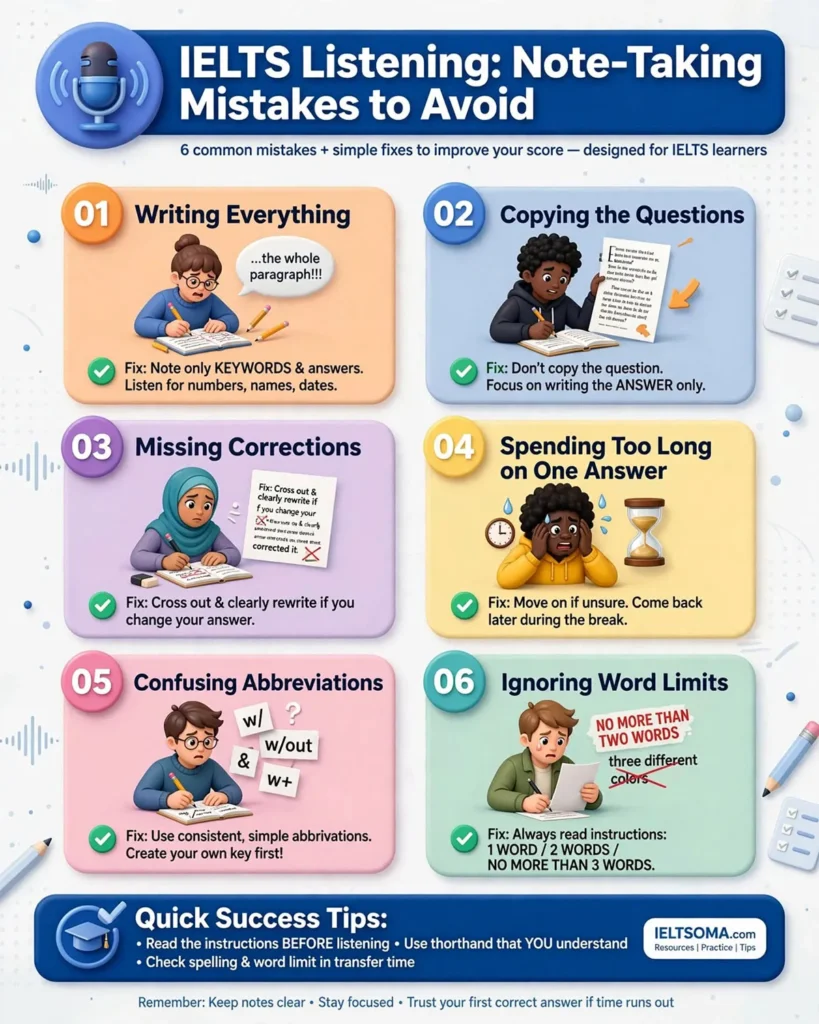
Mistake 1: Writing Too Much
If you are writing continuously, you may stop listening.
Fix: Use keywords and abbreviations.
Mistake 2: Copying the Question
The question is already on the page.
Fix: Use your time to predict the answer and listen.
Mistake 3: Ignoring Corrections
The first answer you hear may not be the final answer.
Fix: Pay attention to contrast and correction language.
Mistake 4: Spending Too Long on One Question
You cannot pause the recording to think.
Fix: Make a quick note and continue.
Mistake 5: Using Abbreviations You Cannot Understand
An abbreviation is useless if you forget what it means.
Fix: Practise the same shorthand repeatedly.
Mistake 6: Ignoring Grammar
Sometimes your notes identify the right idea but your final answer does not fit the sentence.
For example:
The students need to submit their ______.
If you hear “applications”, writing an unrelated singular form may make the sentence grammatically incorrect.
Use the question to check what type of answer is required.

How to Practise IELTS Listening Note-taking
Do not wait until the week before your test to develop this skill.
You can train it separately.
Practice 1: One-minute listening
Listen to a short English recording for one minute.
Write only the main points.
Then stop and ask yourself:
- What was the topic?
- What were the important facts?
- What numbers or names did I hear?
- What changed?
- What was the main conclusion?
This teaches you to identify important information.
Practice 2: Keyword notes
Listen to a short section and write only five to eight keywords.
Then explain what you heard using those keywords.
This helps you learn how little information you actually need to reconstruct meaning.
Practice 3: Numbers and names
Practise writing:
- telephone numbers
- dates
- prices
- addresses
- names
- percentages
This is particularly useful for Part 1, where everyday situations often contain factual details. The IELTS Listening test moves from everyday and social contexts in Parts 1 and 2 to educational or training contexts in Parts 3 and 4.
Practice 4: Correction training
Listen to sentences containing corrections:
“The appointment is on Monday—sorry, I mean Tuesday.”
Train yourself to record:
Monday → Tuesday
This develops the habit of recognising the final piece of information.
Practice 5: Full IELTS practice tests
Once your note-taking technique improves, practise under realistic conditions.
Official IELTS sample materials can help you become familiar with the test format, task types and timed practice.
After each practice test, do not only count your correct answers.
Analyse your mistakes.
Ask:
- Did I fail to hear the answer?
- Did I misunderstand the speaker?
- Did I write too slowly?
- Did I miss a correction?
- Did I exceed the word limit?
- Did I spell the answer incorrectly?
- Did I lose concentration after missing another question?
That analysis will tell you what to practise next.
A Practical IELTS Listening Note-taking Example
Imagine you hear:
“The workshop was originally scheduled for the 18th of July, but because the main hall is unavailable, it has been moved to the 21st. The registration fee is £40 for students and £65 for other participants.”
Poor notes might be:
The workshop was originally scheduled for the 18th of July, but because the main hall is unavailable, it has been moved…
That takes too much time.
Better notes:
workshop: 18 July → 21 July
fee: students £40 / others £65
reason: main hall unavailable
The second version is faster and preserves the important information.
That is exactly what effective note-taking should do.
Should You Take Notes for Every IELTS Listening Question?
No.
You should take notes when they help you remember, organise or confirm information.
For some multiple-choice questions, your main task may be comparing options and identifying the speaker’s meaning. For other tasks, particularly completion questions, writing down key details can be extremely useful.
The best strategy is therefore not:
“I must take notes for every question.”
Instead, think:
“I need to record the information that helps me answer accurately.”
This flexible approach prevents note-taking from becoming a distraction.
The Best IELTS Listening Note-taking Strategy
If you want one strategy to remember, use this:
Read → Predict → Listen → Note → Move
Read
Read the questions before the audio reaches them.
Predict
Think about what type of answer you need.
Listen
Follow the meaning rather than waiting only for exact keywords.
Note
Record the essential information using keywords, abbreviations and symbols.
Move
Do not become trapped by a difficult question.
This approach keeps your attention aligned with the recording.
Final Checklist for IELTS Listening Note-taking
Before your test, make sure you can:
- read questions quickly
- predict possible answers
- identify keywords
- use simple abbreviations
- recognise numbers and dates
- record names accurately
- notice corrections
- recognise changes in information
- use symbols efficiently
- avoid writing complete sentences
- follow the question sequence
- recover quickly after missing an answer
- check word limits
- check spelling
- stay focused until the recording ends
Remember: good IELTS Listening note-taking is selective, fast and purposeful.
You do not need to write more.
You need to write better.
The strongest candidates are not necessarily the ones who produce the most notes. They are the ones who can listen for meaning, identify the information that matters and record it without losing track of what comes next.
Practise that skill deliberately, and your Listening performance can become much more controlled.
FAQs About IELTS Listening Note-taking Tips
Should I write everything I hear in IELTS Listening?
No. Writing everything can distract you from listening. Record keywords, numbers, names, corrections and other information that helps you answer the questions.
What should I write down during IELTS Listening?
Focus on information that is important to the question and difficult to remember, such as names, dates, prices, numbers, places, changes and key relationships.
Is note-taking necessary in IELTS Listening?
Not for every question. Some questions require more written notes than others. Use note-taking as a tool to support your listening rather than as a requirement for every question.
How can I take notes faster in IELTS Listening?
Use keywords, abbreviations and simple symbols. Avoid complete sentences and practise your shorthand regularly until you can understand it instantly.
What should I do if I miss an answer in IELTS Listening?
Do not spend too long trying to recover it while the recording continues. Make a quick mark, move to the next question and return to the missed answer if you have an opportunity later.
Are IELTS Listening note-taking skills useful for both Academic and General Training?
Yes. The IELTS Listening test is the same for Academic and General Training. Both versions contain four Listening parts and 40 questions.
Can abbreviations be used when taking notes?
Yes. Your private notes can use abbreviations and symbols that help you work quickly. However, your final answers must follow the question instructions, including the required word limit and spelling.
How can I improve my IELTS Listening note-taking skills at home?
Practise with short recordings first. Write keywords rather than sentences, then gradually introduce numbers, names, corrections and full IELTS practice tests. Review your mistakes to identify whether the problem was listening, note-taking, spelling or concentration.
Does IELTS Listening note-taking matter more in Part 4?
Part 4 can be demanding because it involves a single speaker discussing an academic subject. However, effective note-taking can be useful throughout the test. Parts 1 and 2 generally involve everyday social situations, while Parts 3 and 4 involve educational and training contexts.
Further Reading: