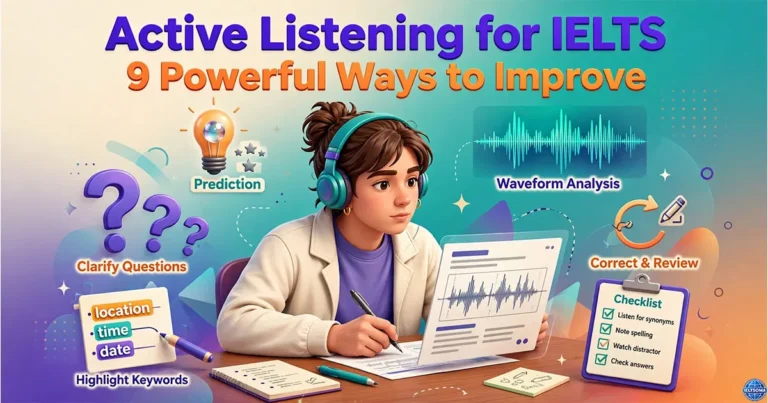
You can understand most of the recording and still lose 5, 10, or even 15 marks in IELTS Listening.
That sounds unfair, but it happens because IELTS Listening is not simply a test of how well you understand spoken English. It also tests how accurately you follow instructions, predict answers, recognize paraphrasing, manage your attention, and record your answers.
The most frustrating part? Many lost marks come from mistakes that are completely avoidable.
The good news is that once you identify your personal IELTS Listening Test Mistakes, you can often improve your score without trying to understand every single word in the recording.
This guide explains the 15 most damaging mistakes IELTS candidates make, why they happen, and exactly what you should do instead.
Whether you are taking IELTS Academic or IELTS General Training, the Listening test is the same. You will hear four parts containing 40 questions, and the recordings are played once only.
Table of Contents
Why Do IELTS Listening Test Mistakes Cost So Many Marks?
The IELTS Listening test contains 40 questions, with one mark available for each correct answer. Your raw score is then converted to an IELTS Listening band score.
For example, IELTS states that approximately 30 correct answers correspond to Band 7 and approximately 35 correspond to Band 8, although the precise conversion can vary slightly between test versions. IELTS scoring information
That means a few careless errors can have a meaningful effect on your result.
Consider this:
| What happens | Possible result |
|---|---|
| You understand the answer but spell it incorrectly | Lost mark |
| You miss one question and stop listening | Several lost marks |
| You ignore the word limit | Lost mark |
| You choose an answer because it sounds familiar | Lost mark |
| You fail to notice a correction in the recording | Lost mark |
| You panic during Part 4 | Multiple lost marks |
Strong Listening performance is therefore about accuracy under pressure, not simply English ability.
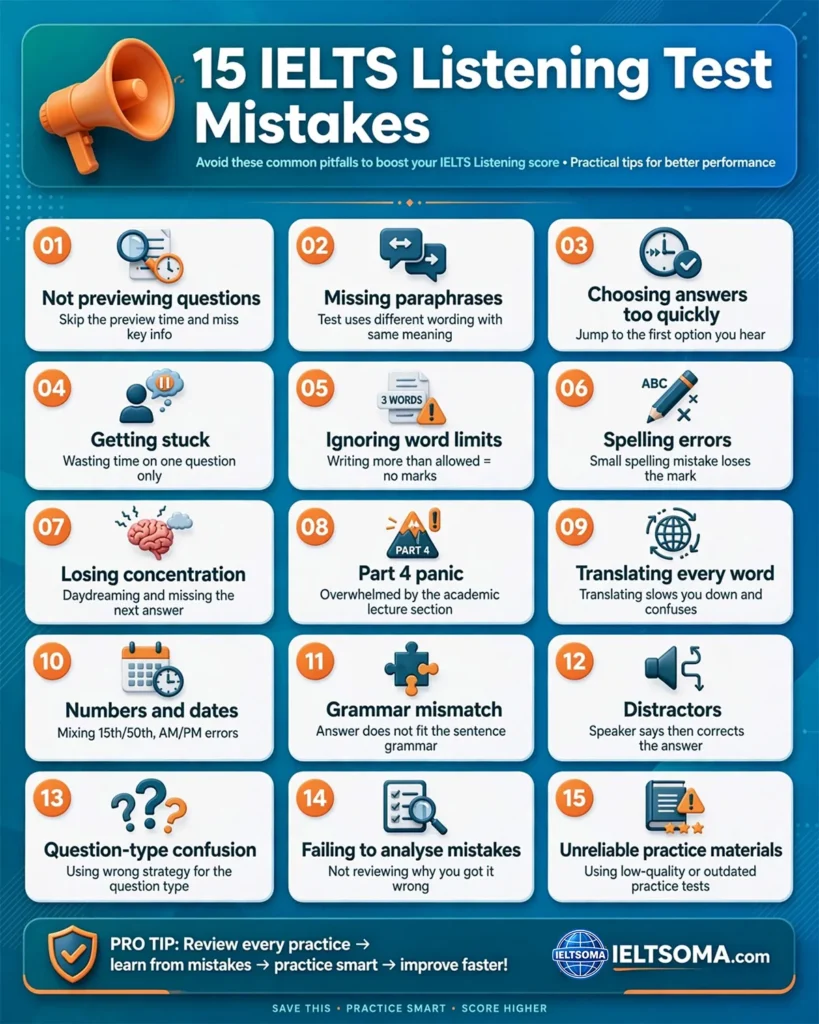
15 IELTS Listening Test Mistakes You Need to Stop Making
1. Not Reading the Questions Before Listening
One of the most damaging IELTS Listening Test Mistakes is starting the recording without using the available preparation time.
You should not passively stare at the questions.
Before the recording reaches the relevant section, quickly identify:
- What information is missing?
- Is the answer likely to be a name, number, place, date or noun?
- What keywords should you listen for?
- Are there options that look similar?
- What is the maximum number of words allowed?
For example:
The meeting will take place on ______ at 3 p.m.
You can immediately predict that the answer is probably a day or date.
This prediction makes your listening more focused.
2. Listening for the Exact Words in the Question
IELTS deliberately tests your ability to recognise meaning expressed in different words.
The question might say:
The company experienced a significant increase in sales.
But the recording could say:
Sales went up considerably.
If you only listen for the exact words “significant increase”, you may miss the answer.
Train yourself to recognise:
- synonyms
- paraphrases
- changes in grammatical form
- related expressions
- implied meaning
This is one reason vocabulary development matters for Listening.
3. Choosing an Answer Too Quickly
A speaker may mention several possible answers before giving the correct one.
For example:
“We originally planned to hold the event on Friday, but the venue wasn’t available, so we’ve moved it to Saturday.”
If the question asks for the final date, Saturday is the answer.
Choosing Friday simply because you heard it first is a classic trap.
Pay attention to correction language such as:
- but
- however
- actually
- instead
- rather
- I mean
- sorry
- no, that’s not right
- we’ve changed it to
When you hear these expressions, expect the information to change.
4. Getting Stuck on One Question
This is one of the most expensive IELTS Listening Test Mistakes.
You miss Question 17.
You start worrying about Question 17.
Meanwhile, the recording moves to Questions 18, 19 and 20.
Now one mistake has potentially become four.
If you miss an answer, make your best decision, leave it, and immediately focus on the next question.
Your objective is not to recover one lost mark at the expense of three more.
5. Ignoring the Word Limit
Instructions matter.
If the question says:
Write NO MORE THAN TWO WORDS AND/OR A NUMBER.
Your answer must follow that instruction.
For example:
public transport
contains two words and is acceptable.
But:
the public transport
contains three words and would not meet a “NO MORE THAN TWO WORDS” instruction.
Read the instruction before completing each question group.
6. Spelling the Answer Incorrectly
Understanding the recording does not guarantee a mark.
Spelling matters.
Suppose the recording clearly gives the answer:
accommodation
If you write:
accomodation
you may lose the mark.
Be particularly careful with words that frequently cause spelling problems, including:
- accommodation
- restaurant
- necessary
- separate
- environment
- government
- university
- Wednesday
Do not spend your preparation time memorising random spelling lists. Instead, keep a personal record of words you repeatedly spell incorrectly.
7. Losing Concentration After an Easy Section
Some candidates perform extremely well in Part 1 and then mentally relax.
That is dangerous.
The Listening test contains four parts, and the recordings move from everyday social contexts towards more educational or academic situations. Part 4 is a continuous monologue on an academic subject.
Your concentration must remain high throughout the test.
Treat every part as a new opportunity to collect marks.
8. Panicking During Part 4
Part 4 is often intimidating because it can involve a longer academic monologue with fewer obvious conversational cues.
But panic is not a strategy.
You do not need to understand every sentence.
Instead, concentrate on:
- The question in front of you.
- The key information you need.
- Changes in topic.
- Signposting expressions.
- The relationship between ideas.
Listen for expressions such as:
- firstly
- in contrast
- another factor
- the main reason
- for example
- finally
- an important point
- researchers found that
These phrases help you follow the structure of the speaker’s argument.
9. Trying to Understand Every Word
This is perhaps the biggest mindset problem among intermediate IELTS candidates.
You hear an unfamiliar word.
You start thinking about what it means.
The speaker continues.
You miss the next answer.
Then you try to catch up.
By the time you return to the recording mentally, several questions may have passed.
IELTS Listening rewards selective attention.
Your job is not to translate the recording word by word.
Your job is to extract the information required to answer the questions.
10. Ignoring Numbers, Dates and Names
Names, addresses, prices, dates, telephone numbers and measurements are common sources of avoidable errors.
A candidate may hear:
fifteen
and write:
fifty.
Or hear:
17th
and write:
70th.
Numbers require active attention.
When practising, deliberately train yourself to distinguish:
- 13 / 30
- 14 / 40
- 15 / 50
- 16 / 60
- 17 / 70
- 18 / 80
- 19 / 90
Also practise spelling names and places that you hear rather than relying on pronunciation alone.
11. Failing to Check Grammar in Completion Questions
Grammar can sometimes help you determine what kind of answer is required.
Consider:
The museum is famous for its collection of ______.
A plural noun may be more likely than a verb.
Now consider:
Visitors can ______ the museum online.
A verb is required.
The recording provides the information, but the sentence structure can help you recognise whether your answer fits.
This is especially useful when two possibilities sound similar.
12. Assuming the First Option You Hear Is Correct
Multiple-choice questions are designed to test more than simple word recognition.
A recording might say:
“We initially considered opening the centre in May. June was also discussed, but eventually July was selected because construction took longer than expected.”
If the question asks when the centre will open, the answer is July, not May or June.
Do not select an option simply because you hear the same word.
Ask:
What does the speaker finally mean?
13. Not Understanding Question-Type Strategy
Different question types require different listening behaviours.
| Question type | What to focus on |
|---|---|
| Form completion | Names, numbers, dates, factual details |
| Note completion | Main points and supporting details |
| Table completion | Information within categories |
| Multiple choice | Meaning, alternatives and distractors |
| Matching | Relationships between speakers/items |
| Map or plan labelling | Directions and spatial language |
| Summary completion | Overall meaning and key details |
The official IELTS format includes question types such as multiple choice, matching, plan/map/diagram labelling, and various completion tasks.
The more familiar you become with each format, the less mental energy you waste figuring out what to do.
14. Failing to Review Your Practice-Test Errors
Taking test after test without analysing mistakes is one of the least effective ways to prepare.
Suppose you score:
- Test 1: 26/40
- Test 2: 27/40
- Test 3: 26/40
- Test 4: 28/40
More practice has not necessarily solved the problem.
Now categorise the errors:
| Error type | Number of mistakes |
|---|---|
| Spelling | 4 |
| Missed paraphrase | 3 |
| Lost concentration | 2 |
| Numbers | 1 |
| Word-limit error | 1 |
Now you know what to fix.
Your next practice session should not simply be another random test. It should contain targeted work on those weaknesses.
15. Practising With Unreliable Materials
Not every IELTS practice test online is a good representation of the real examination.
Some materials have unnatural recordings, poor questions, incorrect answer keys or unrealistic difficulty.
Use authentic or high-quality preparation materials whenever possible.
The official IELTS website provides sample Listening tasks and practice materials for both Academic and General Training candidates.
This does not mean every minute of your preparation must involve a full IELTS test. General English listening practice is valuable too. But your exam-specific practice should be based on trustworthy material.
How to Fix Your IELTS Listening Test Mistakes
The most effective approach is to stop treating every wrong answer as the same type of failure.
Use this four-step system after every practice test.
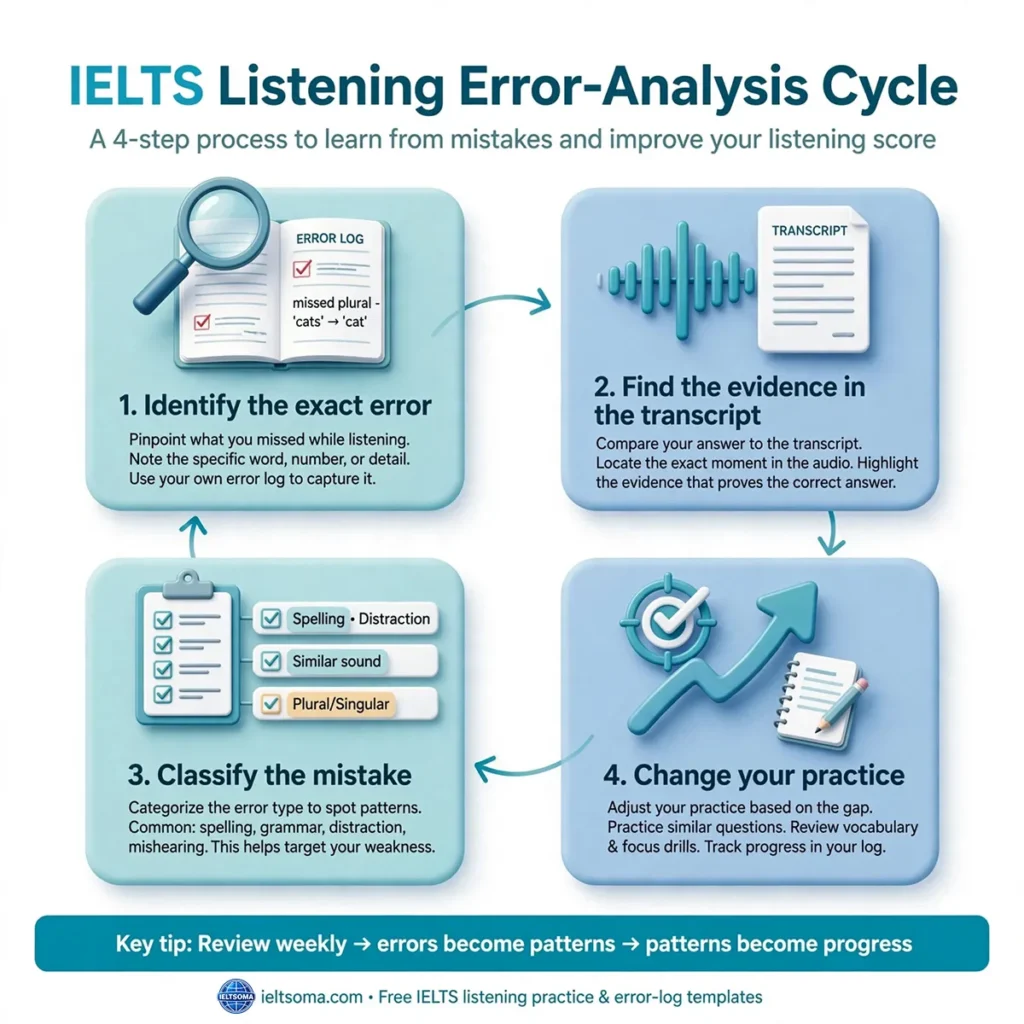
Step 1: Identify the Exact Error
Write down the question number and your wrong answer.
Then ask:
What caused the mistake?
Was it:
- vocabulary?
- spelling?
- concentration?
- pronunciation?
- paraphrasing?
- misunderstanding?
- question-type confusion?
- careless writing?
Step 2: Find the Evidence in the Transcript
If a transcript is available, locate the exact sentence containing the answer.
Compare:
Question → recording → your answer → correct answer
This shows you exactly where your listening process failed.
Step 3: Classify the Mistake
Create an error log such as:
| Date | Question | Mistake | Cause | Correction |
|---|---|---|---|---|
| 22 Aug | 8 | Wrong number | Similar pronunciation | Practise numbers |
| 22 Aug | 14 | Missed answer | Lost concentration | Improve tracking |
| 22 Aug | 27 | Wrong option | Distractor | Listen for final decision |
| 22 Aug | 35 | Spelling | Word unfamiliar | Add to spelling list |
After several tests, patterns become obvious.
Step 4: Change Your Practice
If spelling causes most of your mistakes, do more spelling work.
If you repeatedly miss answers because of paraphrasing, practise synonym recognition.
If you lose marks after missing one question, practise moving forward immediately.
Do not simply take another test and hope the problem disappears.
A Better IELTS Listening Practice Routine
If you have 30–45 minutes available, try this structure.
10 minutes: Active Listening
Listen to a short section of natural English without subtitles.
Focus on the main message and key details.
10 minutes: IELTS Question Practice
Complete a small set of authentic IELTS Listening questions.
Do not immediately check the answers.
10 minutes: Error Analysis
Check every incorrect answer and identify why you missed it.
5–15 minutes: Targeted Repair
Practise the exact weakness you discovered.
For example:
- spelling drills
- number recognition
- synonym matching
- map directions
- multiple-choice distractors
- note completion
This is far more productive than completing full tests every day without analysing them.
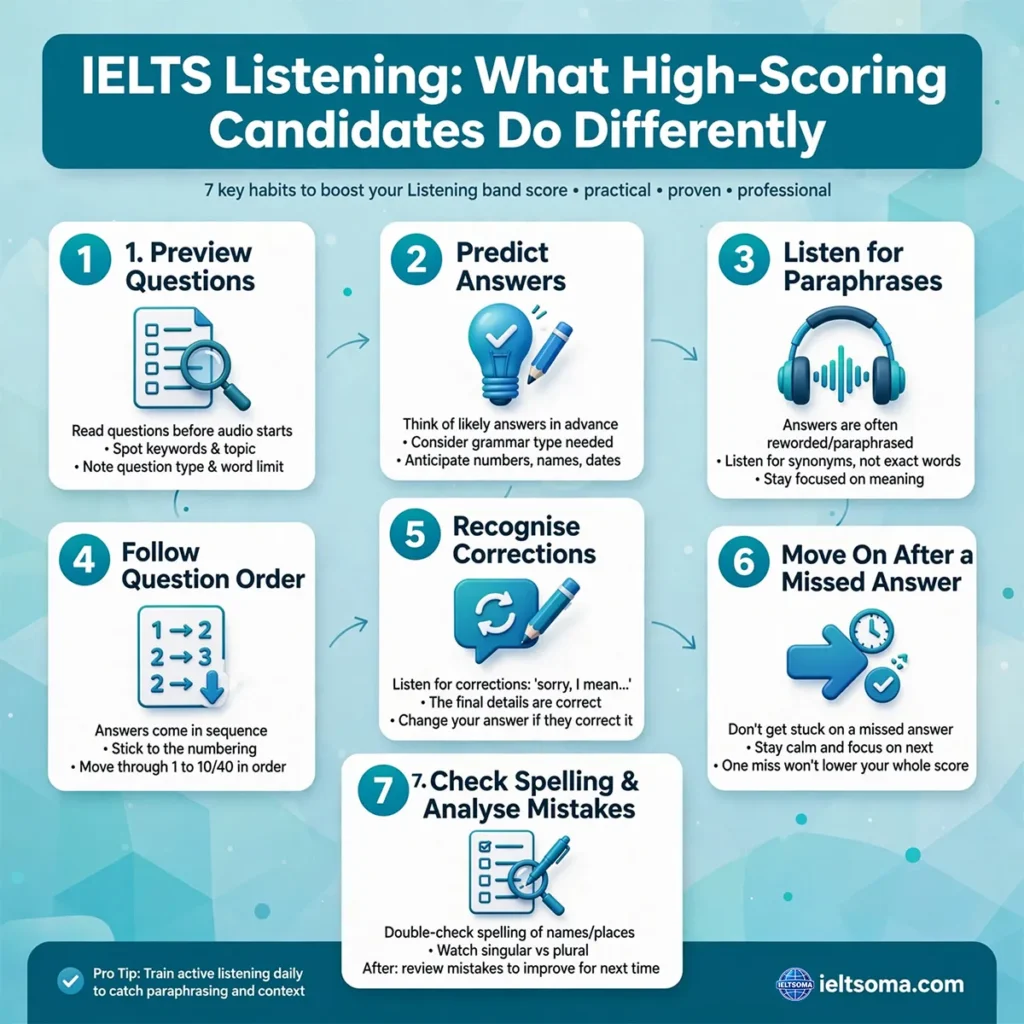
IELTS Listening Test Mistakes: What High-Scoring Candidates Do Differently
A strong candidate does not necessarily understand every word.
Instead, they tend to:
- preview questions efficiently
- predict possible answers
- recognise paraphrases
- follow the sequence of information
- notice corrections
- keep listening after a missed answer
- respect word limits
- check spelling
- remain focused in Part 4
- analyse mistakes after practice
The official IELTS format confirms that questions follow the order of information in the recording. That makes question tracking a particularly useful skill: once you know where you are, you can focus on the current question rather than trying to understand everything at once.
Should You Take IELTS Academic or General Training for Listening?
For Listening, there is no difference between IELTS Academic and IELTS General Training.
The Listening test is the same for both versions. The major differences between Academic and General Training are found in Reading and Writing.
Therefore, the Listening strategies in this article apply to both groups.
If you are unsure which IELTS test you need, check the requirements of your university, professional body, employer or immigration authority before booking.
Quick Checklist: Avoid These IELTS Listening Test Mistakes
Before your next practice test, remember:
- Read and predict before listening.
- Look for meaning, not just identical words.
- Watch for corrections and distractors.
- Follow the question order.
- Move on if you miss an answer.
- Check the word limit.
- Spell carefully.
- Pay close attention to numbers and names.
- Keep concentrating through Part 4.
- Do not translate every word.
- Use grammar to predict answer types.
- Analyse every practice-test mistake.
- Use reliable IELTS materials.
- Keep an error log.
- Turn repeated mistakes into targeted practice.
Frequently Asked Questions About IELTS Listening Test Mistakes
What is the most common IELTS Listening mistake?
One of the most common problems is losing concentration after missing an answer. Candidates become focused on the question they missed and then fail to follow the recording to the next questions.
Other frequent problems include spelling errors, ignoring word limits, failing to recognise paraphrases, and choosing distractor answers.
How can I stop losing marks in IELTS Listening?
Start by identifying the type of error rather than simply counting wrong answers.
After each practice test, classify your mistakes as vocabulary, spelling, concentration, paraphrasing, numbers, question-type strategy or carelessness. Then practise the specific weakness.
Is spelling important in IELTS Listening?
Yes. If an answer requires a written word and you spell it incorrectly, you can lose the mark even if you understood the recording.
What should I do if I miss an IELTS Listening answer?
Do not stop listening.
Make your best decision if appropriate, then immediately move to the next question. Spending too much time thinking about one missed answer can cause several additional mistakes.
Is IELTS Listening the same for Academic and General Training?
Yes. IELTS states that the Listening test is the same for Academic and General Training. The Reading and Writing sections are different.
How many correct answers do I need for Band 7 in Listening?
IELTS currently gives approximately 30 correct answers out of 40 as the average mark associated with Band 7 in Listening. The exact conversion can vary slightly between test versions.
Should I listen to English every day for IELTS?
Regular listening is beneficial, but simply listening passively is not enough.
Combine general English exposure with active listening tasks, IELTS question practice and detailed error analysis.
How many IELTS Listening practice tests should I take?
Quality matters more than quantity.
Taking several tests without analysing your mistakes may produce little improvement. A smaller number of carefully reviewed tests can be more useful because they reveal exactly what is preventing you from gaining marks.
Final Takeaway
The fastest way to improve IELTS Listening is not necessarily to listen to more English.
It is to understand why you are losing marks.
If your mistakes come from spelling, improve spelling. If you miss paraphrases, train synonym recognition. If you panic after missing one question, practise recovering immediately. If Part 4 causes problems, build your ability to follow longer academic monologues.
That is the difference between simply taking practice tests and actually learning from them.
Remember the central lesson:
You do not need to understand every word to achieve a high IELTS Listening score. You need to identify the information that matters, follow it accurately, and avoid giving away marks through preventable errors.
Use your next practice test as a diagnostic tool, keep an error log, and work systematically on your weakest areas.
Further IELTS Listening Related Links: