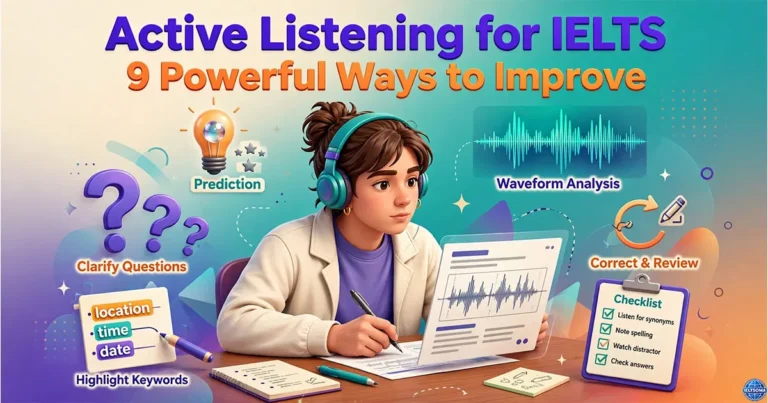
You can understand English well and still lose valuable IELTS Listening marks.
Why? Because the IELTS Listening test is not simply a test of whether you can hear English. You need to predict information, follow the recording, recognise paraphrases, avoid distractors, manage your attention and record accurate answers under pressure.
That is why having the right IELTS Listening Section Strategies can make a significant difference to your score.
Whether you are taking IELTS Academic or IELTS General Training, the Listening test follows the same format. You will hear four recordings and answer 40 questions. The recordings are played only once, and different English accents may be used.
The good news is that Listening can become much more manageable when you stop treating it as a test of luck and start using a clear strategy.
In this guide, IELTSOMA explains practical IELTS Listening Section Strategies that you can use before, during and after the recording to improve accuracy and work towards a higher band score.
Table of Contents
What Is the IELTS Listening Test?
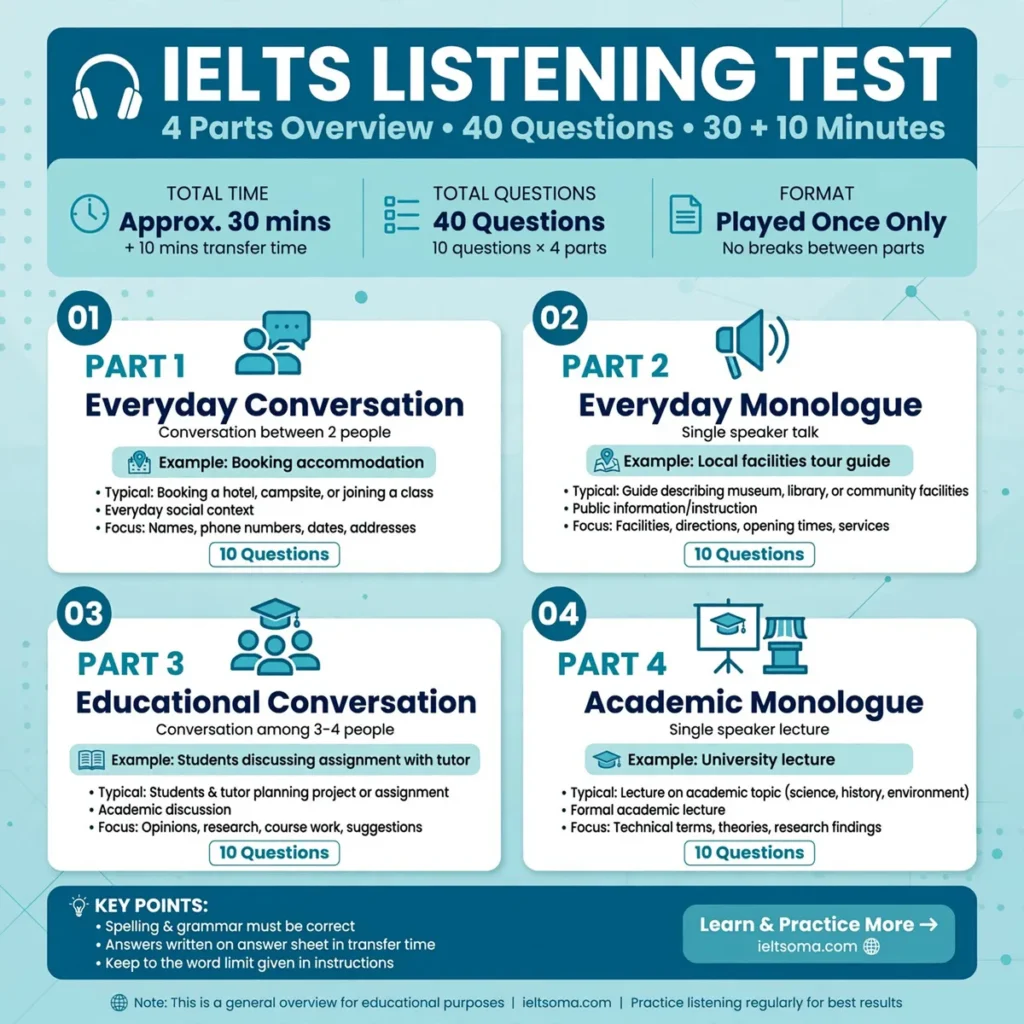
The IELTS Listening test contains four parts with 10 questions in each part, giving you 40 questions in total. The information generally appears in the same order as the questions, which allows you to follow the recording systematically.
The four parts become progressively more challenging:
- Part 1: A conversation in an everyday social situation.
- Part 2: A monologue about an everyday or social situation.
- Part 3: A conversation involving educational or training-related situations.
- Part 4: A monologue on an academic or educational subject.
You hear each recording once only, so there is no opportunity to replay a difficult section during the test. Different accents, including British, Australian, New Zealand and North American accents, may appear.
The Listening test is the same for IELTS Academic and IELTS General Training. Therefore, the IELTS Listening Section Strategies in this guide apply to both test types.
9 IELTS Listening Section Strategies to Improve Your Score
1. Read the Questions Before the Recording Starts
One of the most important IELTS Listening Section Strategies is to use your preparation time intelligently.
Do not spend the available time simply reading every word slowly. Instead, scan the upcoming questions and identify what information you need to listen for.
For example:
The student will meet the professor at ______.
Before the recording begins, you can predict that the answer is likely to be a time, although the actual wording may be different.
Look for:
- Names
- Dates
- Times
- Places
- Numbers
- Prices
- Nouns
- Adjectives
- Verbs
- Relationships between ideas
This gives your brain a listening target.
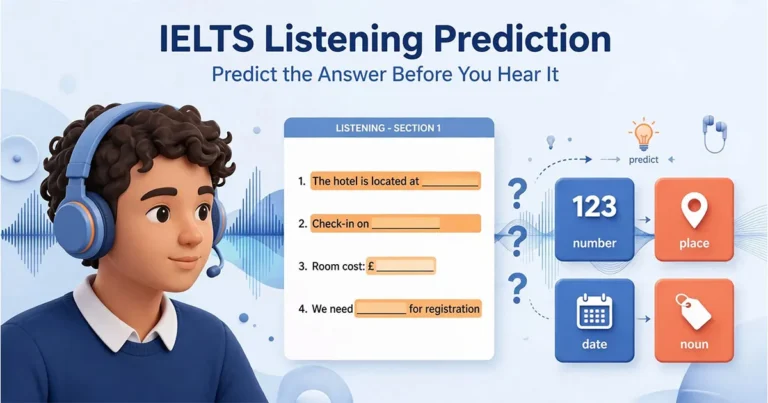
2. Predict the Type of Answer
Strong candidates do not just read the question; they predict what kind of information belongs in the gap.
Consider this example:
The library closes at ______ on Fridays.
You should immediately expect a time.
Another example:
Students must bring their ______ to the registration desk.
You should expect a noun, perhaps a document or object.
This prediction reduces the number of possibilities you are considering while listening.
However, do not become too attached to your prediction. The recording may use an unexpected word or expression. Your prediction is a guide, not the answer.
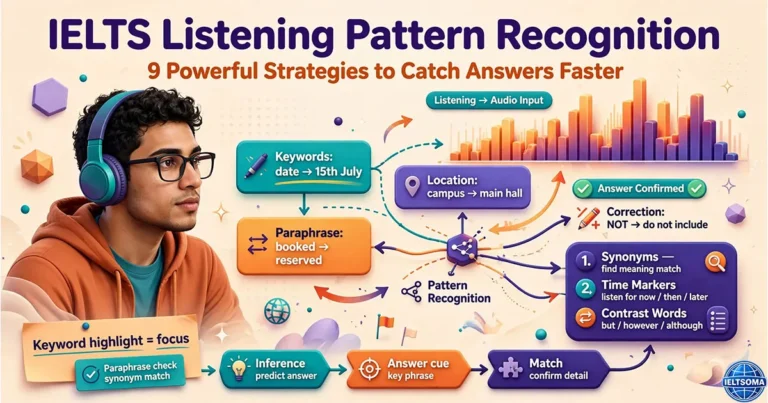
3. Listen for Paraphrases, Not Exact Words
A major reason candidates miss answers is that they expect the recording to repeat the exact wording from the question.
IELTS Listening frequently requires you to recognise that the same idea can be expressed differently.
For example:
Question:
The course is inexpensive.
Recording:
It doesn’t cost very much compared with the other programmes.
The recording does not need to repeat the word “inexpensive”. You need to recognise the meaning.
Make paraphrase recognition a central part of your IELTS Listening Section Strategies.
During practice, create a list of common transformations:
- cheap → inexpensive
- expensive → costly
- increase → rise
- decrease → fall
- approximately → about
- difficult → challenging
- immediately → straight away
- nearby → close to
- postpone → delay
- assist → help
You do not need to memorise thousands of synonyms. Focus on recognising meaning in context.
4. Watch for Distractors and Corrections
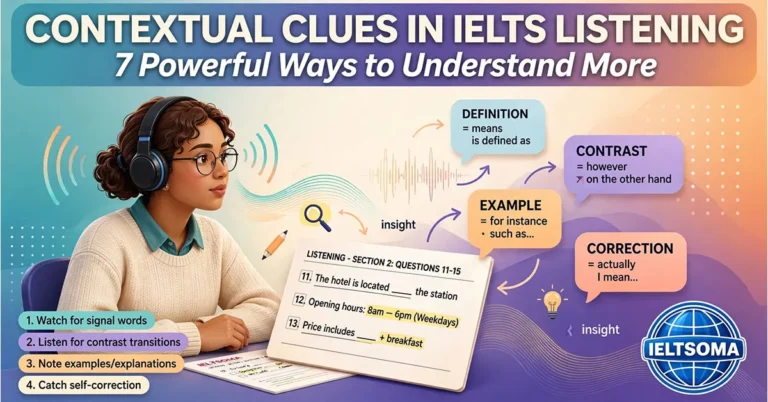
The IELTS Listening test can deliberately include information that sounds like the answer before the speaker corrects or changes it.
For example:
“The meeting will be held on Tuesday—actually, sorry, I mean Wednesday.”
If the question asks for the meeting day, Wednesday is the answer.
This is why you should not write an answer simply because you hear a familiar word.
Listen for signals such as:
- actually
- sorry
- I mean
- rather
- instead
- no, that’s not correct
- correction
- well, not exactly
- let me clarify
These expressions can indicate that the speaker is modifying information.
One of the most useful IELTS Listening Section Strategies is therefore to keep listening after you hear a possible answer.
5. Follow the Order of the Questions
The questions generally follow the order in which information appears in the recording.
This is extremely useful.
Suppose you are answering Questions 11–15. If you have just identified the answer to Question 12, you should expect information for Question 13 to appear relatively soon.
Do not spend too long trying to recover an answer you missed.
If Question 14 has already been discussed and you are still thinking about Question 13, you may miss Question 15 as well.
A better strategy is:
- Make your best decision.
- Move forward.
- Continue listening.
- Return to uncertain answers later if you have time.
Remember: one missed question should not become three missed questions.
6. Master Each Question Type Separately
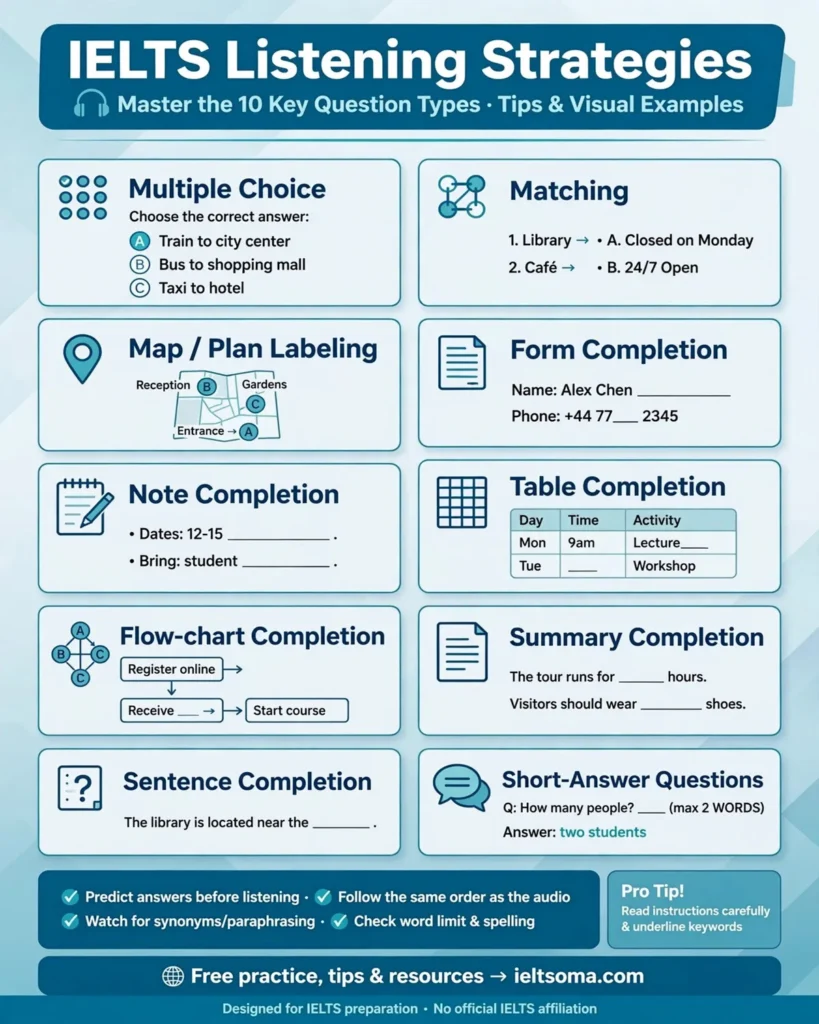
Different question types require slightly different approaches.
The IELTS Listening test may include multiple choice, matching, plan/map/diagram labelling, form completion, note completion, table completion, flow-chart completion, summary completion, sentence completion and short-answer questions.
For multiple choice, read all options and identify how they differ.
For matching, underline the key features that distinguish the options.
For map or plan labelling, identify the starting point, directions and major landmarks before listening.
For completion questions, predict the grammatical form of the missing information.
For short-answer questions, pay particular attention to names, places, numbers and factual details.
Practising each question type independently is one of the most effective IELTS Listening Section Strategies because it helps you develop a specific response pattern before combining everything in a full test.
7. Treat Spelling and Grammar as Part of Listening
Understanding the correct answer is not enough if you write it incorrectly.
Official IELTS guidance states that spelling and grammar matter when transferring answers to the answer sheet. You must also follow the stated word limit.
For example, if the instruction says:
NO MORE THAN TWO WORDS AND/OR A NUMBER
you cannot write three words.
If the correct answer is:
student accommodation
do not write:
university student accommodation
if that exceeds the permitted word limit.
Similarly, be careful with:
- Singular and plural nouns
- Spelling of names
- Dates
- Numbers
- Hyphenated words
- Verb forms
- Articles where required
A candidate may understand the recording perfectly but still lose a mark because the written answer is inaccurate.
8. Do Not Panic When You Miss an Answer
This is one of the most important mental IELTS Listening Section Strategies.
Everyone can miss an answer.
Perhaps the speaker talks too quickly. Maybe you become distracted. Perhaps you do not recognise an unfamiliar accent.
The dangerous reaction is to keep thinking about the missed answer while the recording continues.
Imagine you miss Question 18.
You spend 20 seconds thinking:
“What did they say? Was it Tuesday? Thursday? I heard something about a date…”
Meanwhile, the recording has moved to Questions 19 and 20.
Instead:
Accept → Guess if appropriate → Move on → Refocus.
Your goal is not to answer every question perfectly. Your goal is to maximise your total score.
9. Practise Under Real Test Conditions
Doing unlimited untimed exercises is not enough.
Effective IELTS Listening Section Strategies need to become automatic under pressure.
Use official-style practice tests and occasionally complete the entire Listening test without pausing, rewinding or checking answers during the recording. Official IELTS preparation materials provide sample Listening tasks for candidates to become familiar with the format and task types.
After each practice test, do more than check your score.
Create an error log.
For every incorrect answer, ask:
- Did I misunderstand the recording?
- Did I miss a paraphrase?
- Did I fall for a distractor?
- Did I lose concentration?
- Did I spell the answer incorrectly?
- Did I exceed the word limit?
- Did I misunderstand the question?
- Did I change a correct answer unnecessarily?
This turns every practice test into a learning opportunity.
IELTS Listening Strategies for Each Part
Although the same core techniques apply throughout the test, each part has its own challenges.
Part 1: Focus on Accuracy
Part 1 often involves an everyday conversation and may include practical information such as names, addresses, dates, prices or times.
Do not become overconfident because the context seems familiar.
Pay close attention to numbers and spelling.
For example:
“That’s 15 Green Street.”
The speaker may then spell the street name or correct a number.
Your job is to record exactly what is required.
Part 2: Follow the Structure
Part 2 is usually a single speaker discussing an everyday or social topic.
Maps, plans and descriptions may require you to understand where places are located.
Before the recording, identify:
- The starting point
- North or another directional reference if provided
- Main buildings
- Entrances
- Roads
- Important landmarks
Then follow the speaker’s movement through the visual.
Part 3: Track Different Speakers
Part 3 can involve several speakers in an educational or training context.
This can make it more difficult because speakers may agree, disagree, change their opinions or discuss different options.
Pay attention to who says what.
For example:
Speaker A: “I think the introduction is too long.”
Speaker B: “I agree about the first section, but the conclusion needs more work.”
If a question asks about Speaker B’s opinion, do not automatically select the point mentioned by Speaker A.
Part 4: Stay Focused Until the End
Part 4 is a monologue on an academic subject.
There are no conversational pauses to help you recover your concentration, so mental stamina becomes important.
Before listening, preview the questions and identify the topic.
Look for relationships such as:
- Cause and effect
- Problem and solution
- Advantages and disadvantages
- Historical development
- Classification
- Examples
- Processes
Do not worry if you do not understand every word.
Focus on the information required by the questions.
Common IELTS Listening Mistakes to Avoid
Even strong English speakers can lose marks through poor technique.
Here are some common mistakes:
Trying to understand every word: You do not need to understand everything. Listen for the information relevant to the question.
Ignoring instructions: The word limit matters. Always check whether you need one word, two words, a number or another specified format.
Waiting for exact words: Questions and recordings may express the same idea differently.
Getting stuck: If you miss an answer, move on.
Ignoring corrections: Speakers can change information after initially mentioning it.
Practising only easy recordings: Your practice should expose you to different accents, speaking speeds and question types.
Checking answers too early: During a timed practice test, follow test conditions before reviewing your mistakes.
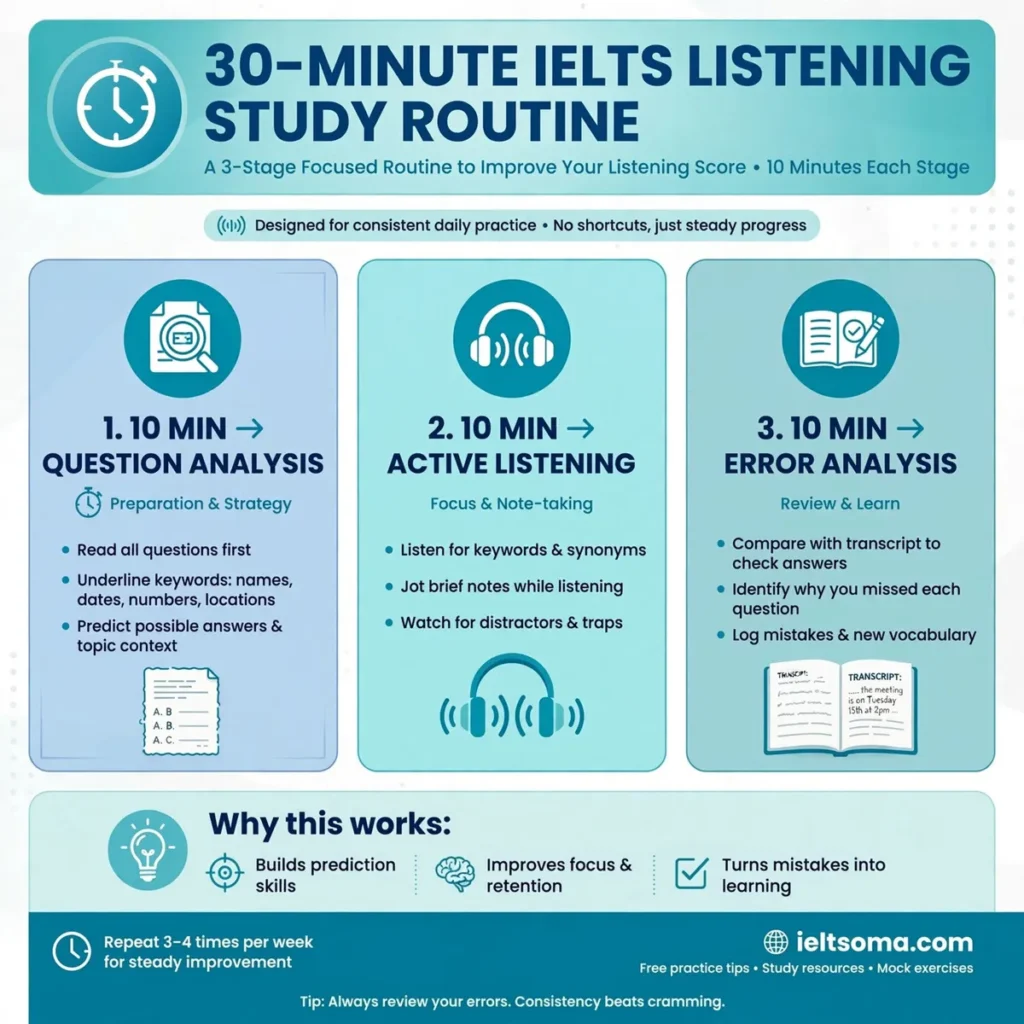
How to Improve IELTS Listening in 30 Minutes a Day
You do not necessarily need several hours of Listening practice every day.
A focused 30-minute routine can be highly productive.
10 minutes — Question analysis
Take a set of questions and predict answer types, keywords and possible paraphrases.
10 minutes — Active listening
Listen to a short recording without subtitles. Identify the main idea and important details.
10 minutes — Error analysis
Review difficult sections and compare what you heard with the transcript or answer explanation.
As your test approaches, add full-length practice tests to your preparation schedule.
The key is consistency.
How Many IELTS Listening Answers Do You Need for a High Band?
Your Listening result is based on the number of correct answers out of 40, with each correct answer receiving one mark. The raw score is converted into an IELTS band score, reported in whole or half bands.
Do not become obsessed with a single practice-test score.
Instead, monitor your performance over time.
For example:
| Practice Test | Correct Answers |
|---|---|
| Test 1 | 25/40 |
| Test 2 | 28/40 |
| Test 3 | 30/40 |
| Test 4 | 32/40 |
This trend tells you more than one isolated result.
Your target should be to make your performance increasingly consistent.
Frequently Asked Questions About IELTS Listening Section Strategies
Is IELTS Listening the same for Academic and General Training?
Yes. The Listening test is the same for IELTS Academic and IELTS General Training. The Reading and Writing tests differ between the two versions but Listening and Speaking are the same.
Can I listen to the IELTS Listening recording twice?
No. You hear each recording once during the test.
How many questions are there in IELTS Listening?
There are 40 questions in total, divided across four parts with 10 questions in each part.
What should I do if I miss an IELTS Listening answer?
Do not stop listening to search for the missed answer. Make your best choice if appropriate and immediately focus on the next question.
Is spelling important in IELTS Listening?
Yes. Incorrect spelling can cause you to lose a mark, so check spelling carefully when recording your answers. You should also follow the word limit given in the instructions.
What is the best IELTS Listening strategy?
There is no single technique that works for every candidate. The strongest approach combines question prediction, paraphrase recognition, careful attention to distractors, question-order awareness, accurate spelling and regular timed practice.
Final Thoughts
Improving IELTS Listening is not about hoping that the recording is easy.
It is about knowing exactly what to do when the recording starts.
Use these IELTS Listening Section Strategies consistently: preview the questions, predict answers, listen for paraphrases, watch for corrections, follow the question order, respect word limits and keep moving when you miss something.
Most importantly, analyse your mistakes instead of simply counting your correct answers.
With regular, focused practice, Listening can become one of the most predictable parts of your IELTS preparation.
For more practical IELTS preparation guidance, keep learning with IELTSOMA and build your preparation around strategies that help you understand not only what to practice, but how to practice effectively.