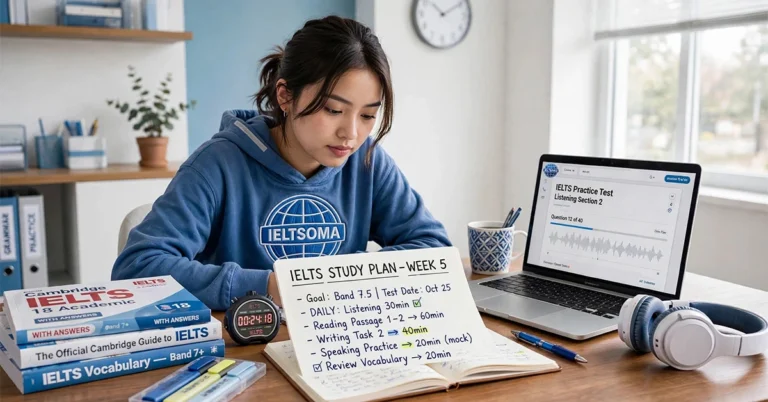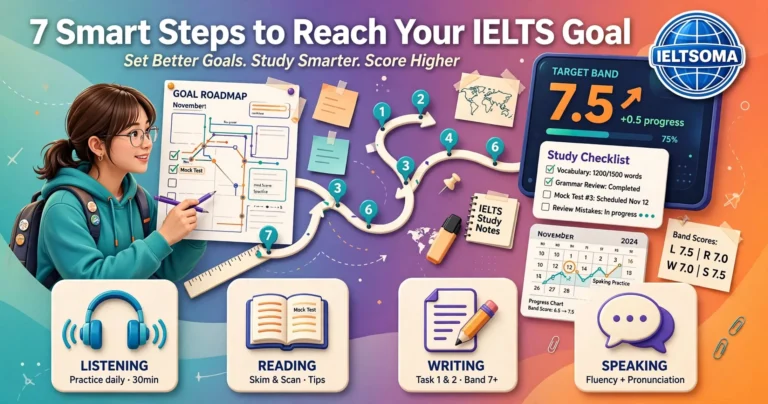
Feeling nervous before IELTS is normal. But when IELTS exam stress becomes overwhelming, it can affect concentration, memory, decision-making and even the way you communicate in the Speaking test.
You may know the answer but suddenly forget it. You may understand the Listening recording but lose track of the next question. You may have good ideas for Writing but struggle to organise them under pressure.
This does not necessarily mean that your English is weak.
Sometimes, the problem is that exam pressure is interfering with your ability to use the English you already know.
The good news is that IELTS exam stress can be managed. You do not need to eliminate every feeling of nervousness before your test. Instead, the goal is to become familiar enough with the test and develop practical routines that allow you to keep working when you feel nervous.
Table of Contents
What Is IELTS Exam Stress?
IELTS exam stress is the physical, emotional and mental pressure you may experience before or during the IELTS test.
It can appear as:
- Worrying about your target band score
- Fear of making mistakes
- Difficulty concentrating
- Racing thoughts
- Fast or shallow breathing
- Feeling that your mind has suddenly gone blank
- Overthinking simple questions
- Rushing through answers
- Losing confidence after one mistake
- Constantly comparing yourself with other candidates
A small amount of nervousness is not necessarily a problem. In fact, feeling alert before an important test is completely normal.
The difficulty begins when anxiety becomes strong enough to interfere with your performance.
Research into test anxiety has found a negative relationship between test anxiety and educational performance across a large body of research. A major meta-analysis covering 238 studies found that test anxiety was negatively associated with several forms of educational performance, including standardised tests.
How Can IELTS Exam Stress Affect Your Performance?
Stress does not automatically lower your IELTS band score. However, high levels of anxiety can make it harder to demonstrate your actual ability.
One important reason is attention and working memory.
A meta-analysis involving 177 samples and more than 22,000 participants found a reliable relationship between anxiety and poorer working-memory performance. The researchers suggested that anxiety can compete with the mental processes needed to complete a task.
This matters in IELTS because the test requires you to process information while simultaneously making decisions.
For example, in Listening, you may need to listen, identify an answer, remember the question, follow the recording and prepare for the next item.
If part of your attention is occupied by thoughts such as “What if I don’t get Band 7?”, less attention may be available for the task itself.
The stress-performance cycle
IELTS exam stress can sometimes create a cycle:
Worry → reduced concentration → mistake → loss of confidence → more worry → more mistakes
Breaking this cycle is one of the most useful things you can learn before test day.
The solution is not to expect yourself to feel completely calm. Instead, learn how to continue performing even when you feel nervous.
IELTS Exam Stress in the Listening Test
The Listening test can be particularly uncomfortable for anxious candidates because the recording continues even when you are worried about an earlier question.
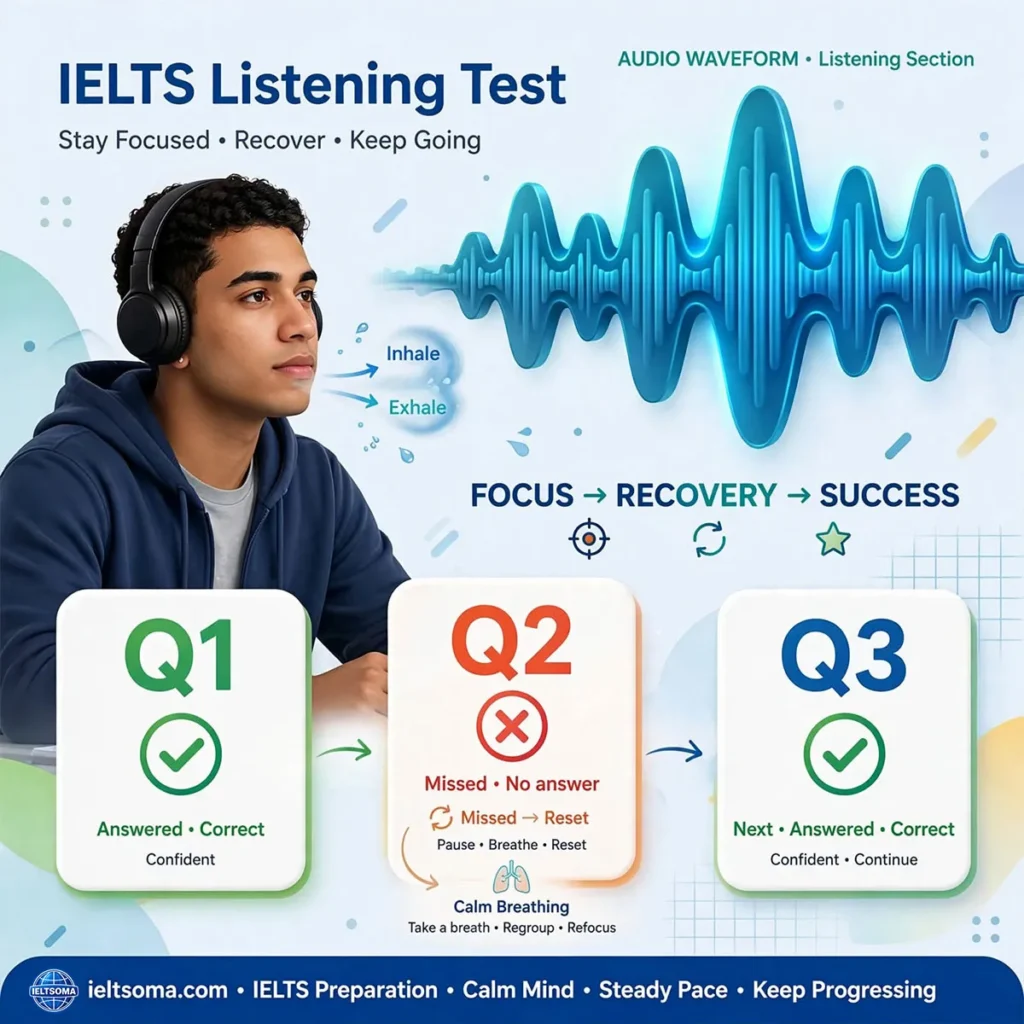
Imagine you miss Question 18.
You start thinking:
“I definitely got that wrong.”
Then you keep thinking about Question 18 while the recording moves on to Question 19 and Question 20.
Now one difficult question has potentially created several more problems.
How to manage stress during Listening
If you miss an answer, move on.
Do not spend the next 30 seconds mentally replaying what you might have heard.
Instead:
- Accept that the question may be lost.
- Move your attention to the next question.
- Listen for the next relevant information.
- Continue following the recording.
This is a skill worth practising during mock tests.
Official IELTS guidance also recommends staying calm, focusing on each question and taking deep breaths if you become worried.
Practise recovering from mistakes
When doing Listening practice, deliberately train yourself to recover.
If you miss an answer, do not pause the recording.
Continue.
This teaches your brain an important lesson:
One missed answer does not mean the test is lost.
IELTS Exam Stress in the Reading Test
Reading can create a different type of pressure.
You have a fixed amount of time, several passages to work through and questions that may appear difficult.
An anxious candidate may respond by reading everything extremely carefully.
That sounds sensible, but it can become a problem.
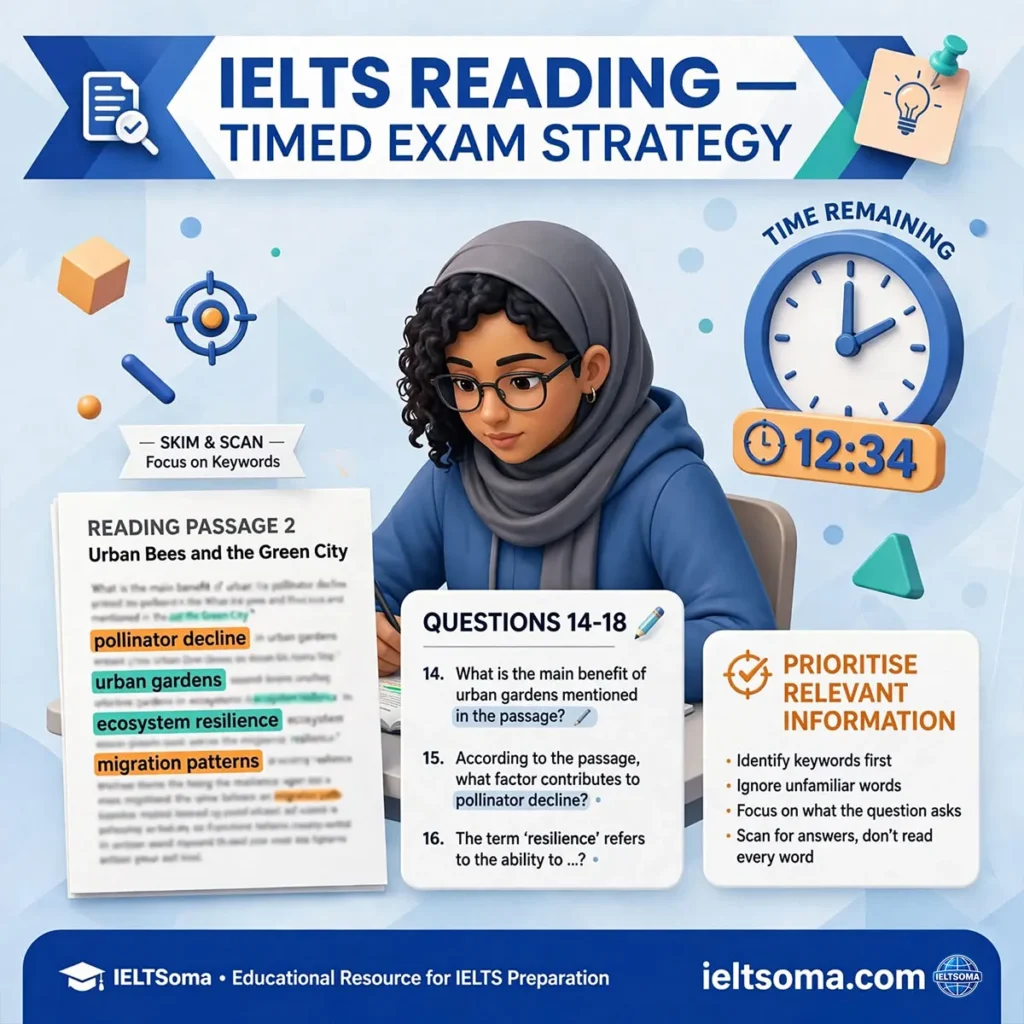
IELTS Reading requires you to make strategic decisions about where to focus your attention.
Avoid the “I must understand everything” trap
You do not need to understand every word in the passage.
You need to find and interpret the information required to answer the questions.
When stress increases, you may start obsessing over unfamiliar vocabulary.
For example:
“What does this word mean? I have never seen it before.”
You spend two minutes trying to understand one sentence while the clock continues.
A better approach is to ask:
“Do I actually need this word to answer the question?”
If not, continue.
Use timed practice before test day
One of the best ways to reduce Reading-related stress is to practise under realistic conditions.
Do not always practise Reading with unlimited time.
Occasionally simulate the pressure of the actual test.
This helps you become familiar with:
- Working against the clock
- Moving between question types
- Making decisions quickly
- Leaving difficult questions temporarily
- Returning to questions when appropriate
Official IELTS resources also emphasise becoming familiar with the test format and practising with sample tests.
IELTS Exam Stress in the Writing Test
Writing can trigger stress because you have to generate ideas, organise them, use appropriate vocabulary and grammar, and manage your time simultaneously.
The biggest danger is often overthinking the first few minutes.
You may spend too long worrying about whether your idea is good enough.
Then you rush the second half of the task.
Have a reliable planning routine
A consistent planning routine can reduce uncertainty.
For example:
- Read the question carefully.
- Identify exactly what you need to discuss.
- Decide your main position or ideas.
- Select two or three supporting points.
- Organise the response.
- Begin writing.
The exact planning method can vary between candidates, but the important principle is consistency.
You want to arrive at test day thinking:
“I know what I normally do when I see this type of question.”
That familiarity reduces the number of decisions you need to make under pressure.
Do not chase perfection
Another source of IELTS exam stress is trying to produce a perfect essay.
IELTS Writing is not about producing a flawless piece of literature.
You need to demonstrate the skills assessed by the test.
A clear, relevant and well-organised response is more useful than spending excessive time trying to create one impressive sentence.
IELTS Exam Stress in the Speaking Test
For many candidates, Speaking creates the strongest emotional reaction.
You are sitting in front of an examiner and responding in real time.
There is no opportunity to pause the conversation and rewrite your answer.
That can make even confident English speakers nervous.
Remember what the Speaking test is actually measuring
The examiner is assessing your spoken English, not whether you are naturally confident.
Being nervous does not automatically mean you will receive a low band score.
Your task is to communicate.
If you make a small grammar mistake, continue.
If you briefly hesitate, continue.
If you need a moment to think, take a natural pause.
IELTS itself has published guidance explaining that nerves and mental blocks can occur during the Speaking test and that candidates can use strategies such as pausing rather than becoming paralysed by the moment.
Do not memorise entire answers
Memorised answers can actually increase stress.
Suppose you have memorised a perfect response about your hometown.
The examiner asks something slightly different.
Suddenly, your prepared answer does not fit.
You panic because you are trying to remember the exact wording.
Instead, practise ideas and language, not entire speeches.
For example, prepare useful vocabulary and personal examples for topics such as:
- Hometown
- Education
- Work
- Technology
- Travel
- Hobbies
- Environment
- Family
- Food
- Future plans
This gives you flexibility.

9 Practical Ways to Reduce IELTS Exam Stress
1. Become familiar with the test format
Uncertainty creates unnecessary pressure.
Knowing the structure of IELTS means fewer surprises on test day.
Learn:
- What each section involves
- How questions are presented
- How much time you have
- What you are expected to do
- How the different tasks work
IELTS recommends becoming familiar with the test and completing practice tests as part of preparation.
2. Practise under realistic conditions
Practice that is always comfortable does not fully prepare you for exam pressure.
Sometimes practise:
- With a timer
- Without checking answers immediately
- In a quiet environment
- Without pausing recordings
- With realistic Writing time limits
- With Speaking questions delivered by another person
The purpose is not to make practice stressful for its own sake.
It is to make the real test feel less unfamiliar.
Official IELTS Trial Tests, where available, are specifically designed to give candidates experience with timed test conditions and the test environment.
3. Create a test-day routine
Do not leave everything to chance.
Prepare your test-day routine in advance.
Check:
- Test date and time
- Location or online test requirements
- Identification documents
- Travel arrangements
- What you need to bring
- When you need to leave
- When you will eat
- When you will sleep
Official IELTS test-day advice recommends checking the time and date, setting an alarm and allowing enough travel time so that you are not rushing.
4. Stop measuring your ability through one bad practice test
A poor mock-test result can create unnecessary panic.
Instead of thinking:
“I got Band 6 today, so I will definitely get Band 6 in IELTS.”
Ask:
“What caused the result?”
Perhaps you:
- Ran out of time.
- Misunderstood a question type.
- Made avoidable spelling mistakes.
- Had weak paragraph organisation.
- Lost concentration during Listening.
- Became nervous during Speaking.
A practice test should provide information about what to improve.
It should not become a prediction of your future.
5. Learn how to recover from mistakes
This is one of the most important IELTS stress-management skills.
You will probably make at least one mistake.
The objective is not perfection.
The objective is recovery.
If you miss a Listening answer, continue.
If you misunderstand one Reading question, move on.
If you make a grammar mistake in Speaking, continue communicating.
If one paragraph in Writing does not feel perfect, focus on completing the response effectively.
Your next decision matters more than the mistake you just made.
6. Use breathing to interrupt panic
If you suddenly feel overwhelmed, deliberately slow your breathing.
You do not need a complicated technique.
Take a controlled breath, relax your shoulders and bring your attention back to the task in front of you.
Official IELTS test-day guidance specifically recommends taking deep breaths if you begin to feel worried.
This is particularly useful when you notice that your attention has shifted from the test to worrying about the result.
7. Use confident body language
Your physical behaviour can influence how you feel.
In its guidance on stress and IELTS performance, IELTS has discussed using a relaxed and confident posture during Speaking and maintaining controlled breathing.
Before Speaking, try:
- Sitting comfortably upright
- Relaxing your shoulders
- Breathing naturally
- Looking at the examiner
- Speaking at a controlled pace
Do not force yourself to act like a completely different person.
Aim for calm, natural communication.
8. Replace catastrophic thoughts
Stress often produces extreme thoughts.
For example:
“If I get one answer wrong, I will fail.”
Replace it with something more realistic:
“One mistake does not determine my entire IELTS score.”
Or:
“I only need to focus on the question in front of me.”
This is not about pretending everything will be perfect.
It is about preventing one problem from becoming five problems.
9. Protect the final days before the test
Trying to learn huge amounts of new material the night before IELTS can increase stress.
The final days should focus on:
- Reviewing key strategies
- Completing selected practice tasks
- Identifying recurring mistakes
- Preparing your test-day routine
- Getting adequate rest
- Keeping your expectations realistic
You cannot transform your English overnight.
But you can arrive at the test organised, familiar with the format and mentally ready to perform.
Common IELTS Exam Stress Mistakes
Some candidates accidentally make their stress worse through the way they prepare.
| Stress mistake | Why it causes problems | Better approach |
|---|---|---|
| Taking endless mock tests | Can create fatigue and obsession with scores | Use tests to identify specific weaknesses |
| Memorising Speaking answers | Makes unexpected questions more stressful | Prepare ideas and flexible language |
| Studying until very late | Can increase fatigue before the test | Prioritise rest and preparation |
| Checking every answer repeatedly | Encourages overthinking | Follow a consistent strategy |
| Comparing scores with others | Creates unnecessary pressure | Track your own progress |
| Panicking after one mistake | Can affect several following questions | Reset and continue |
| Trying to eliminate all nervousness | Makes normal nerves feel like a problem | Learn to perform while nervous |
A Simple IELTS Stress-Management Plan
You do not need dozens of techniques.
Try this simple approach.
One week before IELTS
Focus on:
- Test format
- Weak areas
- Timed practice
- Speaking practice
- Writing timing
- Test-day logistics
One day before IELTS
Avoid trying to completely rebuild your English.
Instead:
- Prepare everything you need.
- Review your key strategies.
- Check the test arrangements.
- Avoid excessive last-minute practice.
- Get enough rest.
Before the test
Give yourself enough time to arrive or log in.
Avoid unnecessary rushing.
IELTS advises candidates to allow sufficient time for travel and to avoid arriving in a rushed state.
During the test
Use this mental sequence:
Breathe → Read carefully → Answer → Move on → Reset
If something goes wrong, do not turn one difficult moment into a prediction about your final score.
Can Stress Ever Help IELTS Performance?
A small amount of nervousness can make you more alert.
You may feel your heart beating faster or notice that you are more focused than usual.
That does not necessarily mean something is going wrong.
The problem is excessive anxiety that interferes with concentration and task performance.
Research on test anxiety also shows that its effects are not perfectly uniform. Some recent experimental research has found that people with higher test anxiety can maintain behavioural performance under some conditions, although the cognitive effort and underlying processes may differ, particularly as task demands increase.
So the goal should not be:
“I must feel completely relaxed.”
A better goal is:
“I can stay focused and continue working even if I feel nervous.”
That is a much more realistic test-day skill.
When IELTS Exam Stress Becomes a Bigger Problem
Normal exam nerves are different from severe or persistent anxiety.
If anxiety is seriously affecting your sleep, daily life, preparation or ability to function, consider speaking with an appropriately qualified health professional rather than treating it solely as an IELTS preparation problem.
You do not have to handle severe anxiety alone.
For most candidates, however, some nervousness is simply part of taking an important examination. The aim is to develop preparation habits and test-taking routines that prevent normal nerves from controlling your performance.
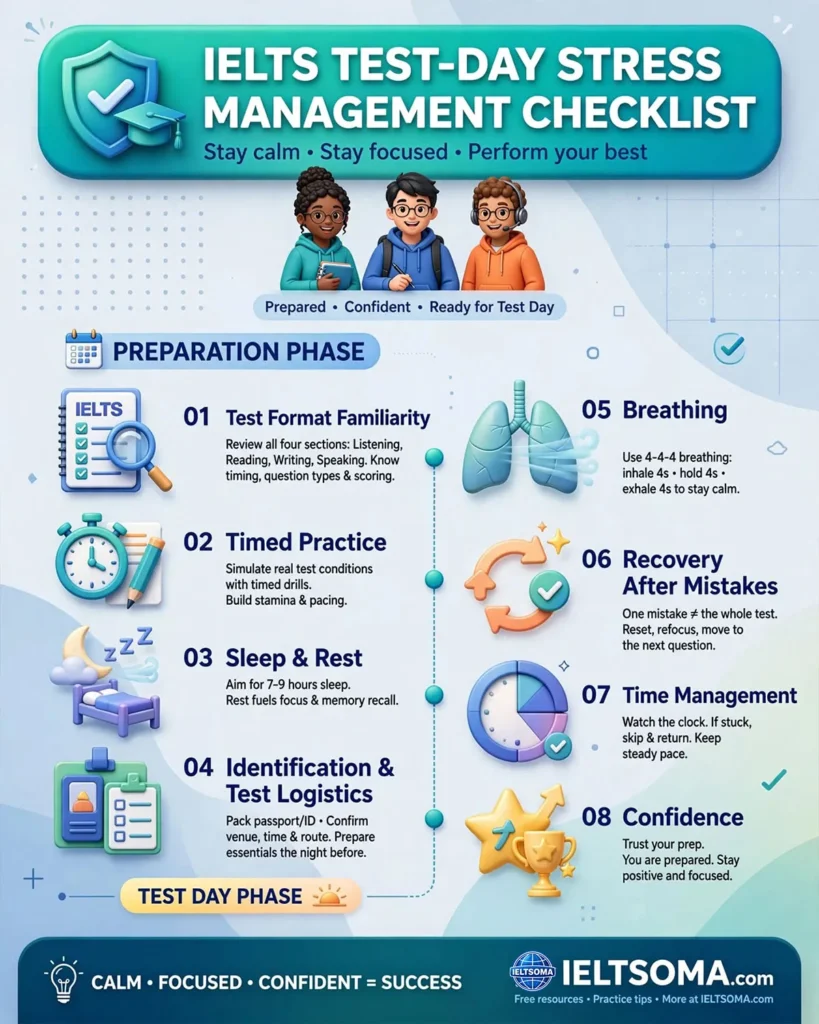
Final IELTS Exam Stress Checklist
Before your test, ask yourself:
- Do I understand the IELTS test format?
- Have I completed realistic timed practice?
- Do I know how I will handle a difficult question?
- Can I recover after making a mistake?
- Do I have a clear Speaking strategy?
- Can I manage my Writing time?
- Have I practised Listening without pausing?
- Do I know where and when my test takes place?
- Have I prepared the required identification?
- Have I allowed enough travel or login time?
- Am I avoiding excessive last-minute study?
- Do I have a simple strategy for calming myself?
If most of these answers are yes, you are doing more than preparing your English.
You are preparing yourself to perform under test conditions.
FAQs About IELTS Exam Stress
Can IELTS exam stress lower my band score?
High levels of test anxiety can interfere with concentration, working memory and task performance, which may make it harder to demonstrate your actual ability. However, feeling nervous does not automatically mean you will receive a lower band score.
How can I calm down before IELTS?
Prepare your test-day routine in advance, arrive with enough time, avoid rushing and use slow, controlled breathing if you feel worried. IELTS itself recommends staying calm and taking deep breaths when necessary.
What should I do if my mind goes blank in IELTS Speaking?
Pause briefly, breathe and continue with the question. You can also use natural language to indicate that you need a moment to think. The key is not to let one moment of hesitation turn into prolonged silence.
Does nervousness affect IELTS Speaking?
Nervousness can affect how comfortably and naturally you communicate, particularly if it causes excessive hesitation or makes you speak unusually quickly. However, being nervous does not automatically result in a low score.
How can I reduce IELTS anxiety before the test?
The most effective preparation includes becoming familiar with the test format, completing realistic practice, identifying weaknesses and developing a reliable test-day routine. Familiarity can reduce uncertainty and increase confidence.
Should I take a mock IELTS test if I am already stressed?
Yes, provided you use it constructively. A realistic mock test can help you become familiar with time pressure and identify weaknesses. However, taking tests repeatedly without analysing mistakes can increase frustration rather than improve performance.
What should I do if I make a mistake in IELTS Listening?
Do not spend too long thinking about the missed answer. Accept it, move to the next question and continue listening. Losing concentration over one question can cause you to miss additional answers.
Can IELTS exam stress affect Reading and Writing?
Yes. Stress can make it harder to maintain attention, manage time and make decisions. In Reading, this may lead to overthinking difficult questions. In Writing, it may lead to excessive planning or poor time management.
The Bottom Line
IELTS exam stress is normal, but it does not have to control your performance.
The most effective strategy is not to try to eliminate every nervous feeling. Instead, prepare so thoroughly that the test feels familiar, practise under realistic conditions and develop a clear response to mistakes.
When you miss one Listening answer, move on.
When a Reading question is difficult, manage your time.
When you make a Speaking mistake, continue communicating.
When Writing feels difficult, return to your structure and keep moving.
Your target is not a completely stress-free IELTS test.
Your target is to stay functional, focused and strategic when pressure appears.
That is a skill you can practise before test day.
Further Reading: