You hear an answer.
You write it down.
Then the speaker says something that makes you question everything.
Was the appointment on Tuesday or Thursday? Was the price £50 or £15? Did the speaker recommend the first option or reject it?
This is IELTS Listening Ambiguity.
The problem is not always that you cannot understand English. Often, you understand the words perfectly but struggle to decide which information actually answers the question.
In the IELTS Listening test, recordings are heard once, and information generally appears in the same order as the questions. That means you need to make decisions quickly while continuing to follow the recording.
The good news is that ambiguity can be managed.
You do not need to understand every word or feel 100% certain about every answer. You need a reliable method for identifying the speaker’s final meaning, separating relevant information from distractors, and moving forward when necessary.
This guide explains seven practical ways to handle IELTS Listening Ambiguity without losing concentration or wasting valuable attention.
Table of Contents
What Is IELTS Listening Ambiguity?
IELTS Listening Ambiguity occurs when the information you hear initially seems unclear, conflicting, incomplete, or open to more than one interpretation.
For example:
“The meeting was originally planned for Wednesday, but we’ve moved it to Friday.”
If the question asks when the meeting will take place, both Wednesday and Friday appear in the recording.
The challenge is not hearing the dates.
The challenge is identifying the final answer.
Ambiguity can occur when:
- a speaker changes information
- two numbers sound similar
- several options are discussed
- the speaker corrects themselves
- a question contains unfamiliar paraphrasing
- the answer is implied rather than stated in exactly the same words
- two speakers disagree
- a speaker gives an initial plan and then announces a change
- you lose concentration and are unsure which question the recording has reached
This is why strong IELTS Listening performance requires more than vocabulary knowledge.
You need to interpret information while the recording continues.
Why IELTS Listening Ambiguity Causes So Many Problems
The biggest danger is hesitation.
Imagine you hear:
“The course costs £80. Actually, that’s the full price. Students only pay £60.”
If the question asks for the student price, £80 is a distractor and £60 is the relevant answer.
But if you become uncertain after hearing both numbers, you may spend several seconds thinking about the previous question.
Meanwhile, the recording has already moved on.
This creates a chain reaction:
Ambiguity → hesitation → lost concentration → missed question → more anxiety → further mistakes
The solution is not to eliminate uncertainty completely.
Instead, learn to recognise the signals that help you resolve it.
1. Listen for the Speaker’s Final Meaning
One of the most important ways to handle IELTS Listening Ambiguity is to distinguish between information mentioned and information confirmed.
A speaker may give an initial answer and then modify it.
For example:
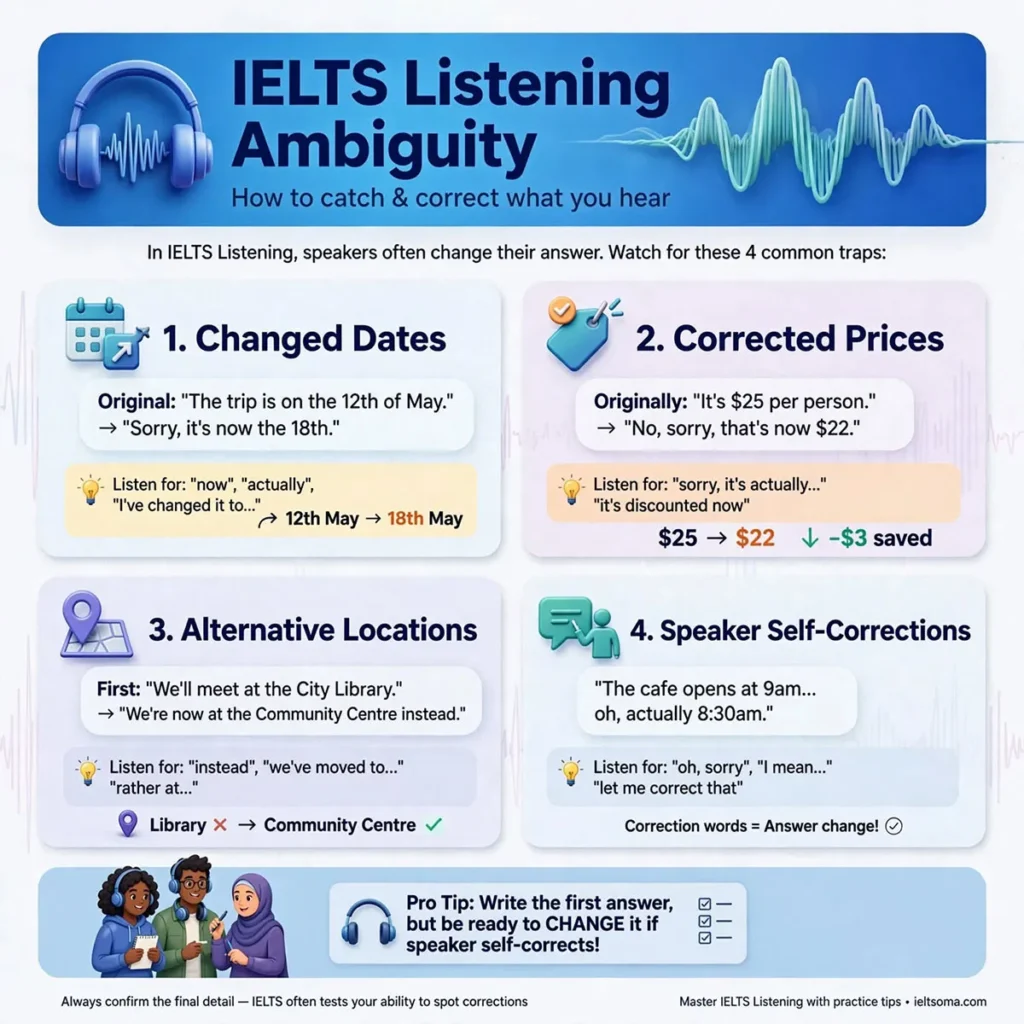
“The seminar will be held in Room 12. Sorry, I mean Room 20 because Room 12 is being used for another event.”
If the question asks for the seminar room, the correct answer is Room 20.
The first answer was not necessarily meaningless. It was simply replaced.
Watch for expressions such as:
- actually
- sorry
- I mean
- rather
- instead
- but
- however
- no
- that’s not correct
- we’ve changed it
- we’ve decided to
- originally
- now
These expressions can signal contrast, correction or a change in information.
Do not automatically assume that every word following one of these expressions is the answer. Instead, listen to the complete idea.
Example
Question:
The new appointment is on ______.
Recording:
“We originally arranged it for Monday, but unfortunately the doctor isn’t available then. Could you come on Wednesday instead?”
Answer: Wednesday
A weaker strategy is:
Hear “Monday” → write Monday.
A stronger strategy is:
Hear Monday → recognise it as the original arrangement → hear the change → choose Wednesday.
That distinction is central to IELTS Listening Ambiguity.
2. Separate Distractors from Answers
IELTS Listening may include information that sounds relevant but does not answer the question.
Official IELTS guidance specifically warns candidates about distractors in Listening tasks, particularly where alternative but incorrect information appears in the recording.
Consider this example:
“We looked at the city centre first, but parking was too difficult there. We then considered the northern site, although it was too expensive. In the end, we chose the location near the university.”
Question:
Where will the new centre be located?
You heard three possible locations.
- city centre
- northern site
- near the university
Only one represents the final decision.
A useful question to ask yourself
When you hear a possible answer, ask:
“Is the speaker giving this information, rejecting it, comparing it, or confirming it?”
This single question can prevent many mistakes.
Do not reward an option simply because you heard its exact words.
Reward the information that matches the speaker’s intended meaning.
3. Use the Question to Resolve Uncertainty
When you encounter IELTS Listening Ambiguity, do not rely only on the recording.
The question itself provides valuable context.
Suppose the question says:
The museum opens at ______ on Saturdays.
Before listening, you already know the answer is probably a time.
Now imagine the recording says:
“During the week, we’re open from nine, although on Saturdays we don’t open until ten.”
You are less likely to become confused because you were listening for a time connected specifically with Saturdays.
Prediction reduces the number of possibilities your brain has to consider.
Before each question group, identify:
- what information is missing
- what type of answer is expected
- which words are likely to be paraphrased
- whether several options may be discussed
- whether a number, name, place or date is likely
For example:
The research project focuses mainly on ______.
You can predict that the answer is likely to be a topic, subject or noun phrase.
This does not mean guessing the answer.
It means preparing your attention.
4. Do Not Expect the Recording to Use the Same Words
Another major source of IELTS Listening Ambiguity is paraphrasing.
The question may use one expression while the recording uses another.
For example:
Question:
Why was the original plan unsuccessful?
Recording:
“The first approach didn’t work because the equipment was too expensive.”
The question says unsuccessful.
The speaker says didn’t work.
The meaning is essentially the same.
If you listen only for the exact words in the question, you may miss the answer.
Train yourself to recognise relationships such as:
| Question wording | Possible recording wording |
|---|---|
| increased | went up |
| reduced | went down |
| difficult | challenging |
| unsuccessful | didn’t work |
| postponed | delayed |
| inexpensive | affordable |
| approximately | about |
| required | needed |
You do not need to memorise endless synonym lists.
Instead, practise recognising meaning.
This is especially important in multiple-choice and matching tasks, where several options may be mentioned but only one accurately represents the speaker’s meaning. Official IELTS materials confirm that Listening tests a range of skills, including understanding specific points and main ideas.
5. When Two Answers Seem Possible, Look for Evidence
Sometimes ambiguity remains even after careful listening.
This is where many candidates make a dangerous mistake: they choose an answer based on emotion.
They think:
“I have a feeling it is B.”
Instead, look for evidence.
Suppose you hear:
“The hotel originally charged £120 per night. However, guests who book directly through the website receive a discount, so the current price is £95.”
If the question asks:
How much do guests pay when booking directly online?
There are two prices.
The correct answer is £95 because the question establishes the condition: booking directly through the website.
Use a three-part check
When two answers seem possible, ask:
1. What exactly does the question ask?
Look at the condition, time, person, location or purpose.
2. What does the speaker finally establish?
Look for confirmation or correction.
3. Which answer has direct support?
Choose the answer supported by the complete meaning rather than the first matching word.
This is particularly useful for:
- prices
- dates
- times
- locations
- names
- multiple-choice options
- changes to plans
- comparisons between alternatives
6. Do Not Let One Ambiguous Question Destroy the Next Three
This is perhaps the most important mental skill.
The IELTS Listening recording does not wait for you.
If you spend 15 seconds thinking about Question 17, you may miss Questions 18 and 19.
The official IELTS format states that questions follow the order of information in the recording.
Use this to your advantage.
If you cannot resolve an answer quickly:
- Make your best evidence-based choice.
- Mark it mentally or move on.
- Return your attention to the next question.
- Continue following the recording.
Do not keep replaying the previous sentence in your head.
There is no replay.
British Council guidance similarly emphasises making notes as you go because the recording cannot simply be replayed during the test.
The 3-second rule
You do not need to literally count three seconds during the test.
Think of it as a mental principle:
If the evidence is sufficient, decide. If it is not, make your best choice and keep listening.
A missed question is one lost opportunity.
A missed question followed by three more because you were still thinking about it is a much bigger problem.
7. Train Specifically for Ambiguity
Many candidates practise IELTS Listening by repeatedly completing full tests.
That is useful, but it does not necessarily train your ability to handle ambiguity.
You should sometimes practise the specific problem.
Exercise 1: Correction spotting
Listen to short conversations and identify every time the speaker changes information.
For example:
“The appointment is at 2 p.m. — sorry, I mean 2:30.”
Your task is to identify:
- original information
- correction signal
- final information
Exercise 2: Distractor identification
After completing a Listening question, return to the transcript.
Underline every piece of information that could have confused you.
For example:
£40 → £60 → £55
Then identify why the final answer is £55.
Exercise 3: Two-option decision practice
Create questions where two possible answers appear in the recording.
Your goal is not simply to find the correct answer.
Your goal is to explain why the other answer is wrong.
This develops much stronger listening judgement.
Exercise 4: Paraphrase recognition
Take a question and compare it with the relevant sentence in the transcript.
Write down:
Question wording → Recording wording → Shared meaning
For example:
Question: Why was the event postponed?
Recording: The organisers had to delay the event because of bad weather.
Shared meaning: postponed = delayed.
Exercise 5: Miss-and-move practice
During practice, deliberately leave one question unanswered.
Continue listening and answer the following questions.
This teaches your brain that missing one answer does not mean the entire test is lost.
IELTS Listening Ambiguity by Question Type
Ambiguity can appear differently depending on the task.
| Question type | Common ambiguity | Best response |
|---|---|---|
| Multiple choice | Several options mentioned | Identify the speaker’s final meaning |
| Matching | Several people or items discussed | Track who said or did what |
| Form completion | Corrected names, numbers or details | Listen for confirmation and spelling |
| Note completion | Similar supporting details | Follow the structure of the notes |
| Table completion | Competing figures or categories | Match information to the correct category |
| Map labelling | Similar locations | Follow directions from the starting point |
| Sentence completion | Paraphrased information | Focus on meaning and grammar |
| Short answer | Several possible facts | Match the answer precisely to the question |
The official IELTS Listening format includes multiple choice, matching, plan/map/diagram labelling, form/note/table/flow-chart completion, sentence completion and short-answer questions.
Understanding the task type makes ambiguous information easier to manage because you know what kind of evidence matters.
Common Mistakes When Dealing With IELTS Listening Ambiguity
Mistake 1: Choosing the first answer you hear
The first number or name may be an initial plan rather than the final answer.
Better approach: listen for confirmation or correction.
Mistake 2: Assuming repeated words mean the answer
Hearing an option exactly as written does not automatically make it correct.
Better approach: understand the relationship between the information and the question.
Mistake 3: Changing an answer without evidence
Some candidates hear another possibility and immediately change their original answer.
Better approach: change your answer only when the recording gives you a reason.
Mistake 4: Trying to understand every word
This creates unnecessary mental pressure.
Better approach: identify the information required by the question.
Mistake 5: Getting stuck
One difficult question can become several missed questions.
Better approach: make the best decision available and follow the recording.
Mistake 6: Ignoring grammar
In completion questions, the sentence structure can help identify what type of answer belongs in the gap.
Better approach: read the complete sentence, not just the blank.
Mistake 7: Treating uncertainty as failure
You will not always feel completely certain.
Better approach: learn to make evidence-based decisions under time pressure.
Academic and General Training IELTS: Does Ambiguity Strategy Change?
No.
The Listening test is the same for IELTS Academic and IELTS General Training. The major differences between the two versions are in Reading and Writing.
Therefore, the same approach to IELTS Listening Ambiguity applies to both test types.
Whether you are preparing for university admission, professional registration, employment or migration, you should train yourself to:
- recognise corrections
- identify distractors
- follow the question order
- understand paraphrases
- predict answer types
- make decisions quickly
- recover after missed answers
The goal is not to make the Listening test perfectly predictable.
The goal is to become comfortable when the information is not immediately obvious.
A Simple IELTS Listening Ambiguity Strategy
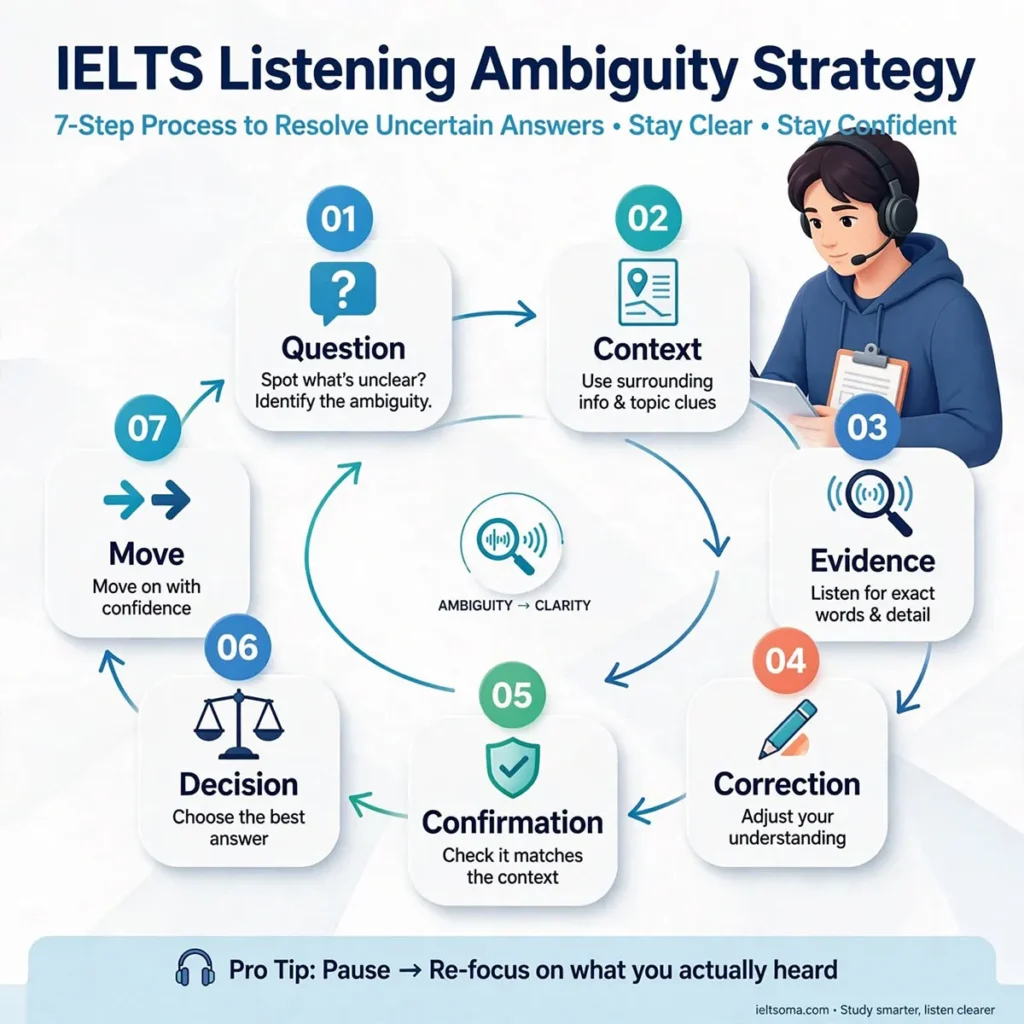
When you hear information that seems confusing, use this sequence:
Question
What exactly am I being asked?
Context
Who, where, when or under what condition?
Evidence
What information does the speaker provide?
Correction
Does the speaker change or reject anything?
Confirmation
What does the speaker finally establish?
Decision
Which answer best matches the complete meaning?
Move
Can I continue listening without getting stuck?
Think of it as:
Question → Context → Evidence → Correction → Confirmation → Decision → Move
With practice, this becomes automatic.
How to Practise IELTS Listening Ambiguity in Your Daily Study
You do not need to spend an entire study session on ambiguity.
A 30-minute session can be enough.
First 10 minutes: Focused listening
Listen to a short IELTS section or suitable English recording.
Pay particular attention to changes, corrections and contrasting information.
Next 10 minutes: Question practice
Complete IELTS Listening questions.
Mark every question where:
- you were uncertain
- two answers seemed possible
- you changed your answer
- you noticed a correction
- you fell for a distractor
Final 10 minutes: Error analysis
Review the transcript.
For every uncertain question, identify:
What did I hear?
What confused me?
What was the correct interpretation?
What signal did I miss?
This approach turns ambiguity into a trainable skill.
For broader IELTS Listening preparation, it is also useful to combine this work with structured practice tests and detailed error analysis rather than simply counting your score. IELTS Listening Test Mistakes: 15 Costly Errors
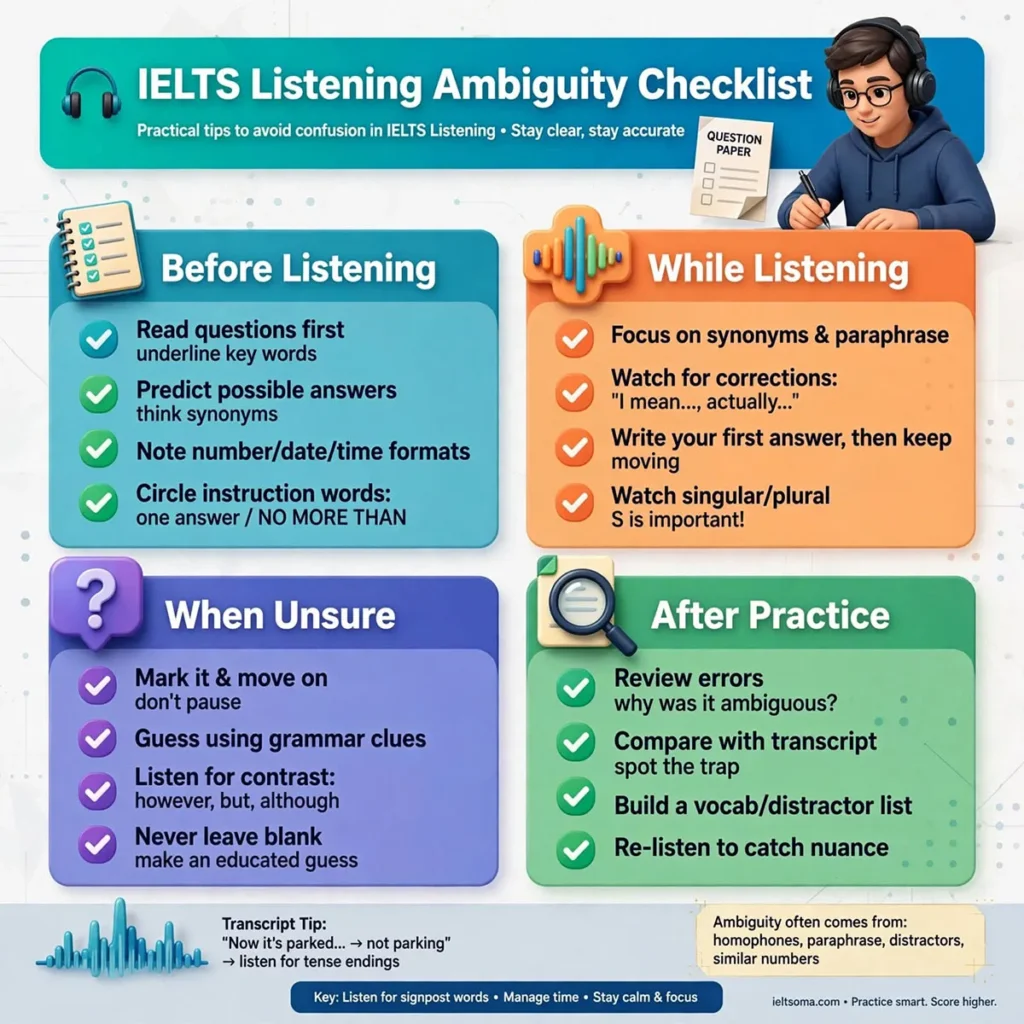
Quick Checklist Before Your Next IELTS Listening Test
Before the recording begins, remind yourself:
- Read the question carefully.
- Predict the type of information required.
- Listen for meaning rather than identical words.
- Expect speakers to discuss alternatives.
- Watch for corrections.
- Do not assume the first answer is correct.
- Check the context around an answer.
- Use evidence when two options seem possible.
- Keep following the question order.
- Do not spend too long on one missed answer.
- Keep listening after making a mistake.
- Review your uncertain answers after practice.
- Record recurring ambiguity mistakes in an error log.
The objective is not to eliminate uncertainty.
It is to handle uncertainty without losing control of the test.
Frequently Asked Questions About IELTS Listening Ambiguity
What is IELTS Listening Ambiguity?
IELTS Listening Ambiguity refers to situations where information in the recording seems unclear, conflicting or potentially confusing. It commonly occurs when speakers correct themselves, discuss several alternatives, change plans or provide distracting information.
How can I deal with two possible answers in IELTS Listening?
First, return to the exact wording of the question. Then check the context, listen for corrections or contrast, and identify which answer is supported by the speaker’s final meaning. Do not choose an answer simply because you heard the same word.
Are distractors common in IELTS Listening?
Distracting information can appear in IELTS Listening, particularly when speakers mention an alternative before correcting or rejecting it. Candidates should listen for the relationship between information rather than selecting the first familiar word they hear.
What should I do if I am not sure about an IELTS Listening answer?
Make the best evidence-based choice you can and continue listening. Spending too long on one uncertain question can cause you to miss information for subsequent questions.
Does IELTS Listening use different accents?
Yes. Official IELTS guidance states that candidates may hear different accents, including British, Australian, New Zealand and North American accents.
Is IELTS Listening the same for Academic and General Training?
Yes. The Listening test is the same for Academic and General Training candidates. The Reading and Writing tests are the components that differ.
Should I try to understand every word in IELTS Listening?
No. Your objective is to understand the information needed to answer the questions accurately. Trying to process every word can overload your attention, particularly when the recording moves quickly.
How can I improve my ability to handle ambiguous information?
Practise correction spotting, distractor identification, paraphrase recognition and evidence-based decision-making. Review the transcript after practice and identify exactly what caused your uncertainty.
Can I improve IELTS Listening without taking full tests every day?
Yes. Full tests are useful for measuring performance, but targeted exercises can be more effective for fixing specific weaknesses such as distractors, corrections, numbers, paraphrasing or concentration.
Final Takeaway
IELTS Listening Ambiguity is not something you need to fear.
In fact, once you understand how ambiguity works, confusing moments become easier to manage.
A speaker may mention one date and then change it.
They may give two prices.
They may discuss several possible locations.
They may introduce an option and later reject it.
Your job is not to panic when this happens.
Your job is to follow the meaning.
Ask what the question requires. Listen for context. Watch for corrections. Separate distractors from confirmed information. Use evidence when two answers seem possible.
And if you still cannot decide?
Make your best choice and keep listening.
The strongest Listening candidates are not necessarily those who understand every word. They are candidates who can process information efficiently, recognise what matters and recover quickly when something goes wrong.
That is the real skill behind IELTS Listening Ambiguity.
With deliberate practice, uncertainty stops being a reason to lose concentration and becomes simply another part of the Listening task you know how to handle.
Further Useful Links: