Imagine looking at a map in the IELTS Listening test and hearing:
“Starting from the main entrance, walk straight ahead. The café is on your right, just opposite the information centre…”
You have only a few seconds to understand the direction, locate the correct place and select the answer.
That is exactly why IELTS Listening Map Labelling can feel difficult.
The problem is usually not vocabulary alone. You need to listen, understand movement and location, keep track of where you are on the map, and avoid attractive but incorrect options—all while the recording continues.
The good news is that map questions become much easier when you stop treating them as ordinary listening questions and start treating them as a navigation task.
This guide explains how to answer IELTS Listening map questions, how to follow directions confidently, which location words matter most, how to recover if you get lost, and the IELTS Listening plan map labelling strategy that can make your practice more effective.
Table of Contents
What Is IELTS Listening Map Labelling?
IELTS Listening Map Labelling is a question type in which you listen to a description of a location and identify places on a map or plan.
The visual might show:
- a park
- a university campus
- a shopping centre
- a museum
- a town
- a building
- a festival site
- a tourist attraction
- a residential area
The official IELTS test format describes this as plan/map/diagram labelling. You may need to complete labels on a visual by selecting answers from a list, depending on the task. The skill being tested includes understanding a description of a place, relating spoken information to a visual and following directions.
The Listening test is the same for Academic and General Training candidates, so the same map-labelling techniques apply to both.
Where do map questions usually appear?
Map and plan questions are commonly associated with Part 2, where the recording may involve a single speaker describing a place or giving information about local facilities. The official IELTS sample material, for example, includes a Part 2 recording in which a tour guide describes different places in a US town.
However, your main objective should not be to memorise where the question appears. Focus on recognising the task and preparing your navigation strategy.
Why Are IELTS Listening Map Questions Difficult?
Map questions combine several skills at once.
You must:
- Understand the speaker’s directions.
- Identify your starting point.
- Follow movement across the map.
- Recognise location and direction expressions.
- Distinguish similar places.
- Ignore distractors.
- Keep listening even if you miss one answer.
A learner might understand every individual word in this sentence:
“The library is just beyond the café, on the left.”
Yet still select the wrong location because they are looking at the wrong part of the map.
That is why successful IELTS Listening Map Labelling depends on both listening and visual tracking.
1. Study the Map Before the Recording Starts
Your first job is not to find the answers.
Your first job is to understand the map.
Use the preparation time to identify:
- the title
- the entrance
- roads or paths
- buildings
- landmarks
- compass directions
- numbered questions
- answer options
- obvious starting points
If the map contains a large building labelled Library, for example, notice its position before the recording begins.
You are creating a mental reference point.
Look for the starting point
The starting point may be indicated by:
- an entrance
- an arrow
- a gate
- a road
- a reception desk
- a clearly labelled building
The official IELTS guidance specifically recommends identifying a likely starting place and checking whether an arrow or entrance indicates where the description begins.
This small step can make a huge difference.
If the speaker says:
“Let’s begin at the main entrance…”
you should immediately know where to look.
2. Learn the Language of Directions
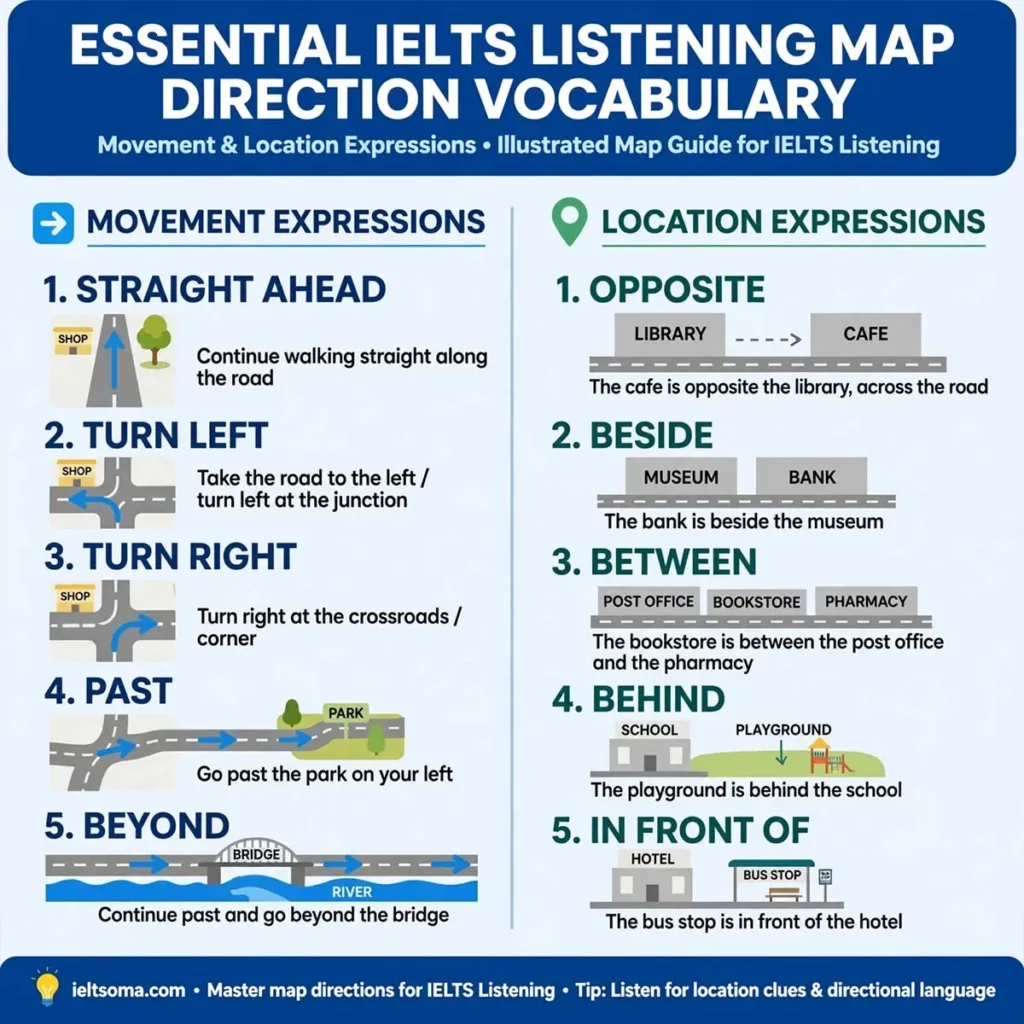
One of the most important parts of how to answer IELTS Listening map questions is recognising direction language instantly.
You do not want to translate every phrase in your head while the recording is playing.
Common movement expressions
| Expression | Meaning |
|---|---|
| go straight ahead | Continue forward |
| walk straight on | Continue in the same direction |
| turn left | Change direction to the left |
| turn right | Change direction to the right |
| take the first left | Use the first left-hand route |
| take the second right | Use the second right-hand route |
| continue past | Move beyond a location |
| go through | Move from one side to another |
| cross the road | Move across the road |
| follow the path | Continue along the marked route |
Common location expressions
| Expression | Meaning |
|---|---|
| next to | Beside |
| opposite | Across from |
| near | Close to |
| between | In the middle of two things |
| beside | Immediately next to |
| behind | At the back of |
| in front of | Ahead of |
| adjacent to | Next to |
| at the end of | At the furthest point |
| in the corner | Located in a corner |
You should also be comfortable with compass directions such as:
- north
- south
- east
- west
- north-east
- south-west
The official IELTS guidance recommends checking whether a compass is shown because compass directions may be used in the recording.
3. Follow the Speaker’s Route—Don’t Just Listen for Places
This is one of the most important changes you can make.
Weak listeners wait to hear:
“The answer is the café.”
Strong listeners follow the route.
For example:
“From the main gate, walk along the central path. You’ll pass the information centre on your left. Continue towards the lake, and the café is just before the bridge.”
You should mentally track:
Main gate → central path → information centre → lake → café → bridge
The answer is not simply a word you hear.
It is a location you reach.
The moving-point technique
Imagine that your pencil, finger or eyes are the person walking through the map.
As the speaker gives directions, move your attention accordingly.
For example:
“Start at the entrance.”
Locate it.
“Walk straight ahead.”
Move forward.
“Turn right at the library.”
Change direction.
“The sports centre is on your left.”
Look to the left.
This creates a connection between the audio and the visual.
The official IELTS guidance similarly recommends following the route on the map as you listen and marking your position so that you can recover if you become lost.
4. Use Landmarks as Anchors
A landmark is a fixed point that helps you understand where you are.
Common landmarks include:
- entrance
- reception
- café
- library
- car park
- lake
- bridge
- fountain
- main road
- information centre
- sports hall
Suppose the recording says:
“The new exhibition room is opposite the library.”
You do not need to search the entire map.
Find the library first.
Then look directly opposite it.
Why landmarks matter
A landmark gives you a reference point.
Instead of thinking:
“Where is the exhibition room?”
think:
“Where is the library, and what is opposite it?”
That is much faster.
5. Pay Attention to Changes in Direction
IELTS map questions often require you to follow several directions in sequence.
For example:
“Walk towards the main building, turn left at the end of the corridor and then take the second door on your right.”
There are three stages:
Walk forward → turn left → second door on right
Missing one stage can put you in the wrong location.
Words such as these deserve special attention:
- then
- after that
- before
- next
- finally
- until
- once you reach
- after passing
- just before
- just beyond
These words help you understand the sequence of the route.
6. Watch for Distractors
Distractors are one of the biggest traps in Listening.
You may hear several place names that appear on the map, but not every place mentioned is an answer.
For example:
“The café used to be beside the library, but it has now moved to the area opposite the sports centre.”
If you select the library because you heard it first, you have fallen into the trap.
The speaker gave you an old location and then corrected it.
Listen for correction language
Be especially alert when you hear:
- but
- however
- actually
- instead
- rather
- although
- no, that’s not…
- I mean…
- it used to be…
- originally…
- now…
- has been moved to…
These expressions often signal that the information is changing.
Example
“The information desk is beside the entrance. Actually, they’ve moved it, and it’s now opposite the café.”
The correct location is the new location, not the first one mentioned.
The official IELTS guidance also warns candidates about distractors and notes that alternative but incorrect answers may be mentioned in the recording.
7. Don’t Panic If You Miss One Answer
This is perhaps the most important psychological strategy.
Imagine you miss Question 14.
Many candidates continue thinking:
“What did the speaker say? Where was it? Did I hear the answer?”
Meanwhile, the recording has moved to Question 15.
Now they miss another answer.
Then another.
One missed answer becomes three.
Instead:
Mark your best guess, move on and continue following the speaker.
You may be able to return to the question later if time permits.
The official IELTS guidance also recommends guessing unanswered questions because there is no penalty for an incorrect answer.
The IELTS Listening Plan Map Labelling Strategy
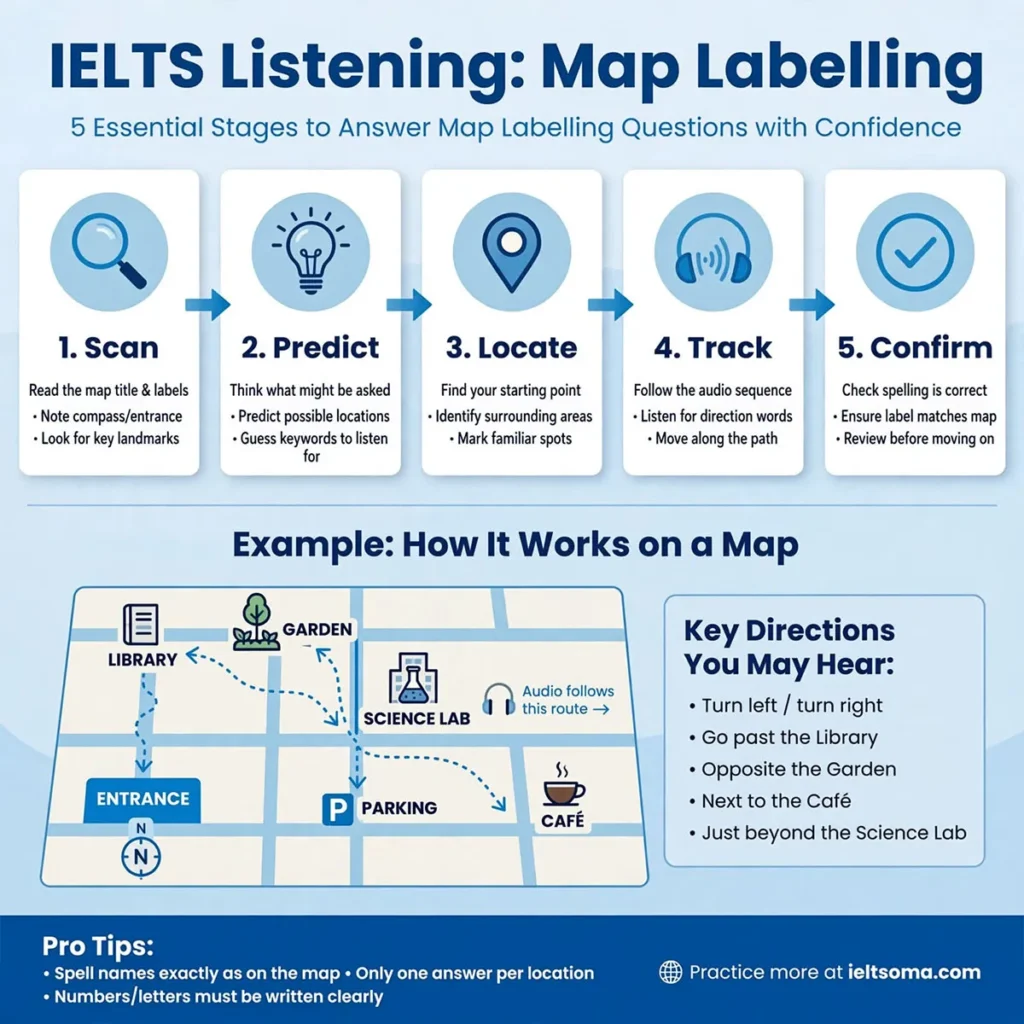
A practical IELTS Listening plan map labelling strategy can be reduced to five stages:
Stage 1: Scan
Look at the entire map.
Identify:
- starting point
- major landmarks
- roads
- paths
- compass
- answer choices
Stage 2: Predict
Think about the language you are likely to hear.
If you see a building beside a road, expect expressions such as:
next to the road
opposite the entrance
on the left
just beyond the car park
Stage 3: Locate
When the recording begins, identify where the speaker starts.
Do not start searching randomly.
Stage 4: Track
Follow the route continuously.
Move your eyes or pencil as the speaker describes movement.
Stage 5: Confirm
When you reach a possible answer, check the surrounding landmarks before selecting it.
This five-stage process prevents you from treating each question as an isolated vocabulary test.
A Practical Example
Imagine a simple map containing:
- Main Entrance
- Café
- Library
- Garden
- Sports Centre
- Car Park
The speaker says:
“Starting at the main entrance, walk straight ahead along the main path. The café is on your right. Continue past the café and turn left at the library. The sports centre is immediately ahead.”
How should you process this?
Step 1
Start at the Main Entrance.
Step 2
Move straight along the main path.
Step 3
Identify the Café on the right.
Step 4
Continue past it.
Step 5
Turn left at the Library.
Step 6
Look ahead.
The Sports Centre is there.
Notice that you are not trying to memorise the whole recording.
You are converting the recording into a route.
Map Vocabulary You Should Know
Building a strong vocabulary bank can make map questions much easier.
Position
- beside
- next to
- opposite
- between
- near
- behind
- in front of
- inside
- outside
- adjacent to
- surrounded by
Movement
- go straight
- turn left
- turn right
- walk towards
- continue along
- pass
- cross
- enter
- exit
- head towards
- proceed
Distance
- nearby
- a short distance from
- a little further
- just beyond
- immediately after
- several metres away
Compass language
- north
- south
- east
- west
- north-east
- north-west
- south-east
- south-west
Do not simply memorise these words.
Practise hearing them in complete sentences.
What If the Map Has Letters Instead of Question Numbers?
IELTS map tasks can be presented in different formats.
For example, the numbered questions may appear on the map while the answer choices are listed separately. In another format, letters representing possible answers may appear on the map while the questions are shown elsewhere.
The official IELTS guidance specifically points out these different presentations and explains that the placement of the question numbers can provide clues about how the information may be organised.
Therefore, before the recording begins, determine:
What do the letters represent?
and
What do the numbers represent?
Do not assume that the speaker will describe every letter in alphabetical order.
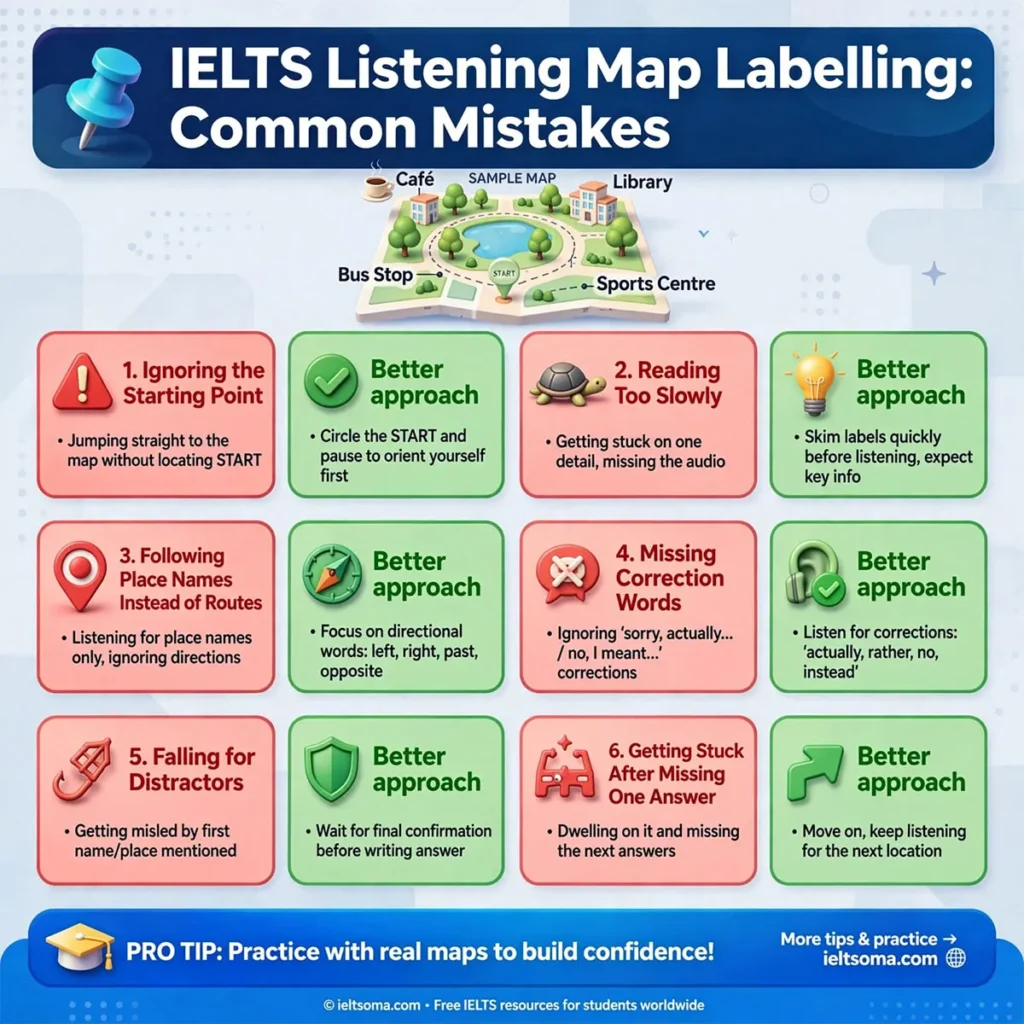
Common IELTS Listening Map Labelling Mistakes
Mistake 1: Reading the map too late
If you wait until the recording starts, you waste valuable processing time.
Better approach: Scan the map during the preparation period.
Mistake 2: Ignoring the starting point
Without a starting point, directions become confusing.
Better approach: Identify the entrance, arrow or obvious starting location immediately.
Mistake 3: Listening only for exact answers
A place may be mentioned as a landmark rather than as the answer.
Better approach: Follow the relationship between places.
Mistake 4: Getting stuck on one question
This causes a chain reaction of missed answers.
Better approach: Guess, move forward and recover.
Mistake 5: Ignoring correction language
The first place mentioned may not be the final answer.
Better approach: Pay attention after words such as “but”, “actually” and “now”.
Mistake 6: Not using the map visually
Listening without tracking the map creates unnecessary mental pressure.
Better approach: Move your eyes or pencil along the route.
How to Practise IELTS Listening Map Questions
Randomly completing dozens of map questions is not necessarily the most effective practice.
Instead, practise the skill in stages.
Practice 1: Direction vocabulary
Take a simple map and describe routes aloud.
For example:
“Walk straight ahead, turn right and continue past the library.”
Then trace the route.
Practice 2: Listen without answering
Play a map recording and focus only on following the route.
Do not worry about the answers.
Ask yourself:
Where am I now?
Practice 3: Listen and mark
Repeat the exercise while marking the route.
Compare your route with the transcript afterwards.
Practice 4: Timed practice
Eventually, practise under realistic conditions.
Use official IELTS sample materials where possible. IELTS provides sample Listening tasks, including plan/map/diagram labelling tasks with answer keys and transcripts.
Practice 5: Analyse your mistakes
Do not simply record:
“I got 5/7.”
Instead, identify the reason for each mistake.
Was it:
- vocabulary?
- direction?
- distraction?
- losing your position?
- misreading the map?
- missing a correction?
- poor concentration?
That diagnosis tells you what to practise next.
A 10-Minute Daily Map Practice Routine
You do not need an hour every day to improve this specific skill.
Try this:
Minutes 1–2: Study a map and identify landmarks.
Minutes 3–4: Review direction vocabulary.
Minutes 5–7: Complete one short map-listening task.
Minutes 8–10: Check the transcript and analyse mistakes.
The final three minutes are particularly valuable.
Ask:
“At exactly what point did I lose the route?”
That question helps you improve much faster than simply checking the answer key.
IELTS Listening Map Labelling: Quick Strategy Checklist
Before the recording:
- Read the instructions.
- Check the title.
- Find the starting point.
- Identify major landmarks.
- Check for a compass.
- Understand what the letters and numbers represent.
- Scan the answer options.
During the recording:
- Follow the speaker’s route.
- Track your position visually.
- Listen for direction words.
- Listen for landmarks.
- Watch for corrections.
- Be alert to distractors.
- Move on quickly if you miss an answer.
After the recording:
- Check every answer.
- Confirm spelling where applicable.
- Analyse your mistakes.
- Guess any unanswered questions.
FAQs About IELTS Listening Map Labelling
How do I answer IELTS Listening map questions?
Start by studying the map before the recording begins. Identify the starting point, landmarks and directions. Then follow the speaker’s route rather than listening only for individual place names. Mark your position mentally or on the map as you listen.
What vocabulary is important for IELTS Listening Map Labelling?
Important vocabulary includes direction words such as straight ahead, turn left, turn right, opposite, beside, behind, in front of, between, beyond, and past. Compass directions such as north, south, east and west can also be useful.
Are IELTS Listening map questions always in Part 2?
Map and plan questions are commonly associated with Part 2, particularly when a speaker describes a place or local facilities. However, candidates should focus on recognising the task type rather than relying on memorising a particular position in the test. Official IELTS sample material includes map/plan/diagram labelling in a Part 2 recording.
What should I do if I get lost during a map question?
Do not stop listening while trying to reconstruct the previous answer. Make a quick guess if necessary and focus on the next landmark or direction you hear. The official IELTS advice also recommends guessing unanswered questions because incorrect answers do not receive a penalty.
How can I improve my IELTS Listening plan map labelling strategy?
Practise identifying starting points, following routes, recognising direction expressions and using landmarks as reference points. Then analyse your mistakes using the transcript to determine whether you lost the route because of vocabulary, concentration, directions or a distractor.
Can I write on the IELTS Listening question paper?
For the paper-based test, IELTS guidance states that candidates are allowed to draw on the Listening question paper. This can be useful for tracing the route or marking your position.
Is map labelling the same for Academic and General Training IELTS?
The Listening test is the same for IELTS Academic and IELTS General Training, so the same map-labelling techniques can be used for both versions.
Final Thoughts
IELTS Listening Map Labelling becomes much less intimidating when you stop trying to remember every word.
Your goal is to follow the journey.
Find the starting point. Identify the landmarks. Listen for movement. Track the route. Watch for corrections and distractors. If one answer disappears, keep moving.
The most effective IELTS Listening plan map labelling strategy is therefore not simply about memorising more vocabulary. It is about building a reliable connection between what you hear and where you are on the map.
Practise that connection repeatedly, and map questions can become one of the more predictable parts of your Listening preparation.
Useful Links: