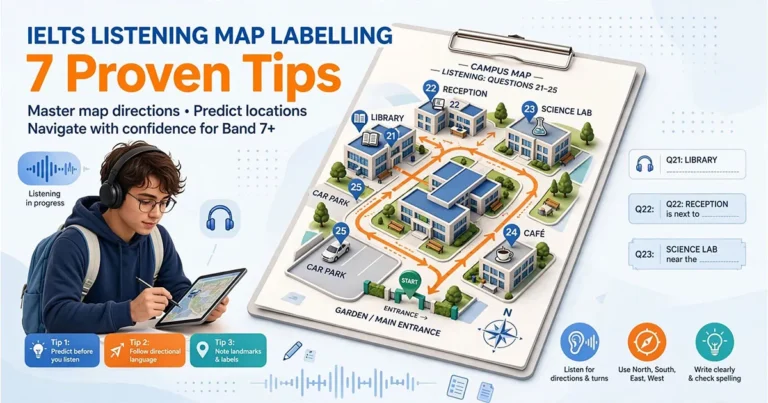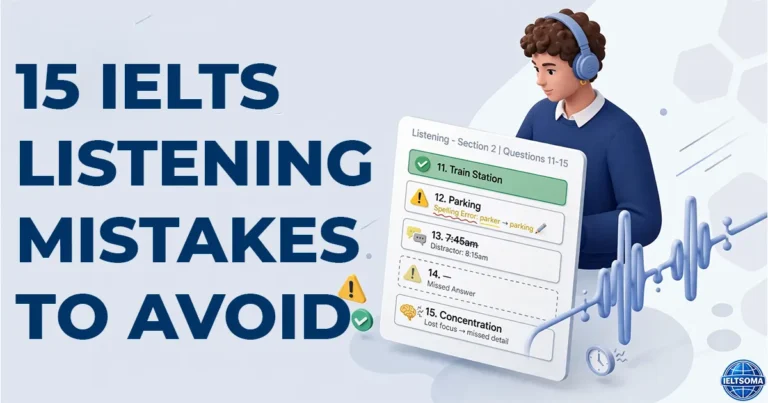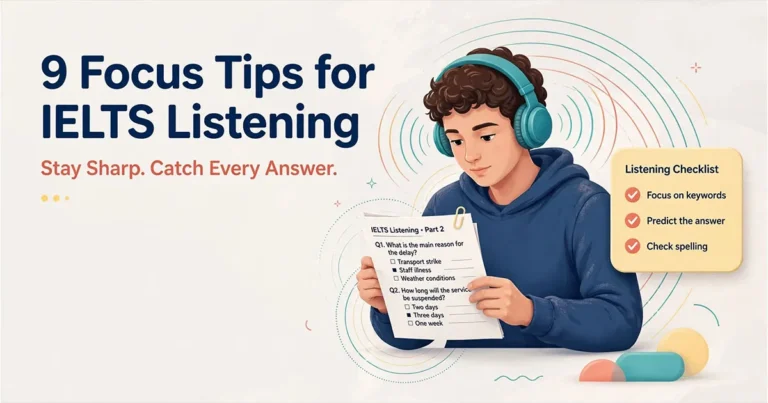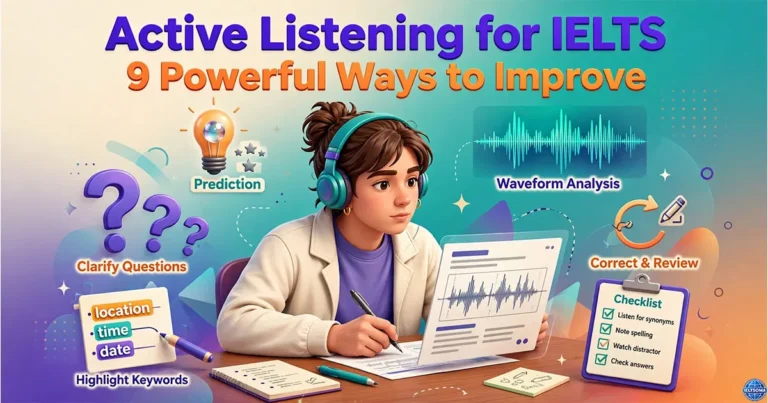
If you can understand English when reading it but struggle when someone speaks quickly, changes pronunciation, or uses an unfamiliar accent, your problem may not be vocabulary. It may be real-time listening.
That is where podcasts can become one of the most useful tools in your IELTS preparation.
When used strategically, podcasts can help you Improve IELTS Listening with Podcasts by exposing you to natural speech, different accents, connected speech, topic-specific vocabulary, paraphrasing, and longer stretches of spoken English.
But there is a catch.
Simply putting on an English podcast and listening passively for 30 minutes is not an effective IELTS strategy. You need to listen with a purpose, analyse what you hear, and gradually train your brain to process spoken English without translating every sentence.
This guide explains exactly how to use podcasts for IELTS Listening, which podcast features matter most, how to combine podcasts with official IELTS practice, and how to turn a few minutes of daily listening into measurable progress.
Table of Contents
Can Podcasts Really Improve IELTS Listening?
Yes, podcasts can support IELTS Listening preparation, particularly when they are used alongside IELTS-specific practice.
The reason is simple: IELTS Listening requires you to understand spoken English in real time. You hear the recordings only once, and the test includes a range of situations and accents. The official IELTS format has four parts and 40 questions, covering everyday, social, educational and training contexts.
Podcasts provide regular exposure to those underlying listening skills.
They can help you practise:
- Understanding speech at natural speed
- Recognising different accents
- Following a conversation or extended monologue
- Identifying the main idea
- Listening for specific details
- Recognising paraphrases
- Predicting information
- Understanding vocabulary from context
- Following changes in topic or speaker attitude
- Staying focused for several minutes at a time
However, podcasts do not replace IELTS practice tests.
A candidate who listens to podcasts every day but never practises IELTS question types may still struggle with note completion, multiple choice, matching, map labelling or sentence completion.
Think of podcasts as listening-skill training, while IELTS practice tests are exam-specific training.
You need both.
How to Improve IELTS Listening with Podcasts
The most effective approach is to turn passive listening into active listening.
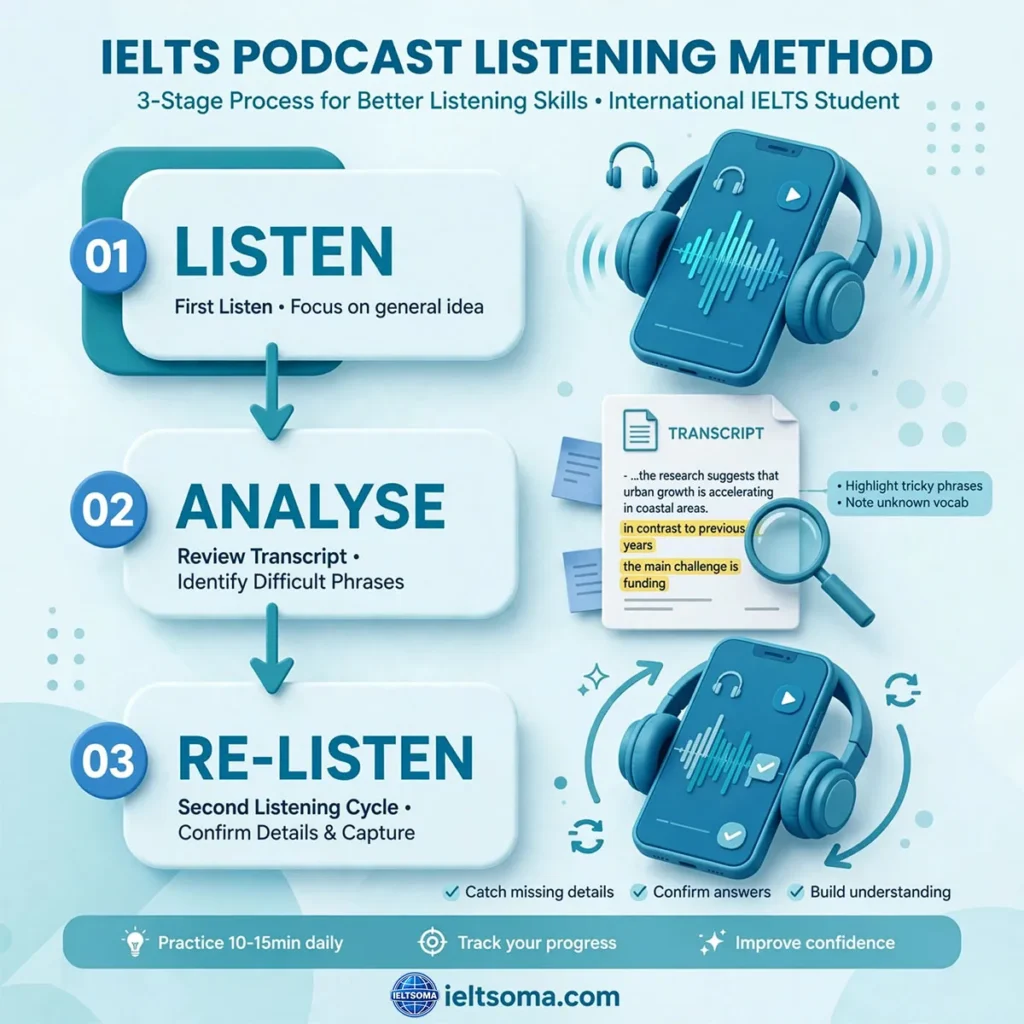
Instead of pressing play and allowing the podcast to run in the background, use a three-stage process:
Listen → Analyse → Re-listen
During the first listen, concentrate on meaning.
During the analysis stage, identify words, phrases, pronunciation features and information you missed.
During the second listen, check whether you can now understand the difficult sections.
This simple change can make your podcast practice far more productive.
1. Choose Podcasts at the Right Difficulty
One of the biggest mistakes IELTS candidates make is choosing material that is either far too easy or far too difficult.
If you understand almost every word, the podcast may not challenge your listening ability enough.
If you understand only 30–40% of it, you may spend the entire session feeling lost.
A useful starting point is material where you understand the general meaning even though you occasionally miss words or phrases.
Look for podcasts covering:
- Education
- Science
- Technology
- Environment
- Health
- Society
- Culture
- Work
- Travel
- History
- Current affairs
These subjects are useful because they expose you to vocabulary and ideas that can overlap with the broader language demands of IELTS.
For example, suppose you hear:
“The city has introduced a congestion charge to discourage people from driving into the centre.”
You may already know city and driving, but you also encounter:
- introduced
- congestion charge
- discourage
- driving into the centre
The goal is not to memorise every word.
The goal is to become comfortable understanding meaning from a continuous stream of speech.
2. Start with Short Podcast Segments
You do not need to listen to a 45-minute episode every day.
In fact, shorter sessions can be more effective when you are developing your listening skills.
Start with a five- to ten-minute segment.
Listen once without subtitles or a transcript.
Then ask yourself:
- What was the main topic?
- Who was speaking?
- What was the speaker’s main point?
- Which details did I remember?
- Which parts were difficult?
Do not immediately look at the transcript.
Give your brain a chance to process what it heard.
This is particularly useful for candidates who tend to panic whenever they miss one sentence.
In the real IELTS Listening test, you cannot stop the recording and go back. Official IELTS guidance states that recordings are heard once only.
Podcast practice should therefore train you to keep listening even when you miss something.
3. Use Transcripts as a Learning Tool
Transcripts are extremely valuable, but only if you use them at the right stage.
Do not read the transcript while listening for the first time.
Instead:
First listen
Listen without reading.
Focus on the overall meaning.
Second stage
Write down the words or phrases you think you missed.
Transcript check
Read the transcript and identify exactly where your understanding broke down.
Final listen
Listen again while focusing on those difficult sections.
This process helps you discover why you missed the information.
Perhaps you did not know the word.
Perhaps you knew the word but did not recognise it when spoken.
Perhaps the speaker connected several words together.
Or perhaps you lost concentration for two seconds.
Those are very different problems and require different solutions.
4. Train Your Ear for Connected Speech
Many IELTS candidates know a large amount of English vocabulary but still struggle with listening because spoken English does not always sound like written English.
Native and proficient speakers often connect, reduce or weaken sounds.
For example:
“Did you” may sound closer to “didja” in natural conversation.
“Want to” may sound like “wanna” in informal speech.
“Going to” can sound like “gonna” in conversational English.
You do not need to imitate every informal pronunciation.
You need to recognise it.
This is one reason podcast listening can be valuable. You repeatedly hear English as it is naturally spoken rather than encountering only carefully pronounced textbook sentences.
When reviewing a transcript, choose two or three sentences that were difficult to hear.
Listen again.
Then listen while following the transcript.
Finally, listen without looking at it.
This trains your brain to connect the written form with the spoken form.
5. Use Podcasts to Practise Different Accents
IELTS Listening is not limited to one variety of English.
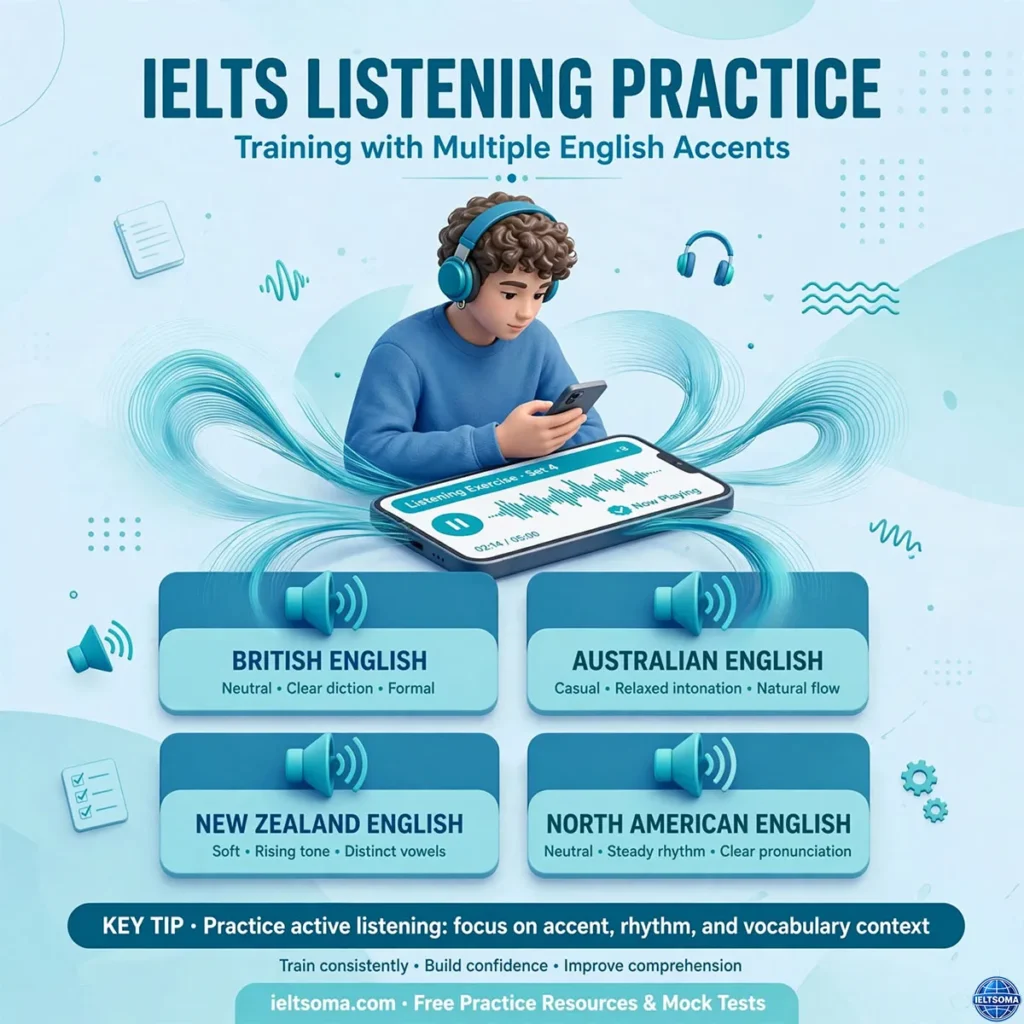
Official IELTS information states that candidates may encounter accents including British, Australian, New Zealand and North American English.
That means listening exclusively to one familiar accent can create a weakness.
You should gradually broaden your exposure.
For example:
| Listening exposure | What it can train |
|---|---|
| British English | Pronunciation, vocabulary and natural conversation |
| Australian English | Accent familiarity and vowel differences |
| New Zealand English | Accent recognition |
| North American English | Rhythm, reductions and conversational speech |
| International speakers | Adaptability to different pronunciation patterns |
Do not obsess over identifying the country of the speaker.
Your objective is much more practical:
Can you understand the information accurately despite the accent?
That is the skill that matters.
6. Practise Prediction Before You Listen
Prediction is one of the most transferable skills between podcast practice and IELTS Listening.
Before starting a podcast segment, read its title or description.
Ask:
- What will the speaker probably discuss?
- What vocabulary might appear?
- Will this probably be an interview, discussion or monologue?
- What information might the speaker provide?
For example, if the podcast is about university accommodation, predict words such as:
- rent
- deposit
- room
- facilities
- contract
- location
- transport
- landlord
- tenant
You are not trying to guess the exact words.
You are preparing your brain for the semantic field.
The same principle applies during IELTS.
Before each recording begins, use the information in the questions to predict what type of answer might be required.
Official IELTS sample materials include tasks such as multiple choice, matching, plan/map/diagram labelling, form completion, note completion, table completion, flow-chart completion, summary completion, sentence completion and short-answer questions.
Prediction helps you listen with a target rather than waiting passively for information.
7. Turn Podcast Listening into IELTS Question Practice
This is where podcast practice becomes considerably more powerful.
After listening to a podcast segment, create your own mini IELTS-style questions.
For example, imagine you listen to a podcast about renewable energy.
Write:
Question 1: What is the speaker’s main reason for supporting solar power?
Question 2: Which problem does the speaker mention?
Question 3: What example does the speaker give?
Question 4: Complete the sentence:
The cost of solar technology has ______ significantly in recent years.
Now listen again and find the answers.
You can create:
- Note-completion questions
- Sentence-completion questions
- Multiple-choice questions
- Short-answer questions
- Matching questions
- Summary-completion questions
This exercise forces you to identify the types of information that IELTS questions commonly target.
It also teaches you to distinguish between important information and supporting detail.
8. Practise Paraphrasing, Not Just Keywords
A common IELTS Listening trap is expecting the recording to repeat the exact wording from the question.
It often does not.
The question might say:
“The course is suitable for people with limited experience.”
The speaker might say:
“You don’t need much previous experience to enrol.”
The meaning is similar, but the vocabulary is different.
Podcast practice is excellent for developing this skill.
After listening to a segment, choose three important statements and rewrite them using different words.
For example:
Original idea:
The company reduced its energy consumption.
Possible paraphrase:
The business now uses less energy than before.
Or:
Original idea:
The project was delayed because of funding problems.
Possible paraphrase:
Financial difficulties caused the project to be postponed.
This habit develops your ability to recognise meaning rather than simply matching individual words.
9. Build a 20-Minute Podcast Routine
You do not need hours of podcast practice.
A focused 20-minute routine can be enough to complement your IELTS preparation.
Try this:
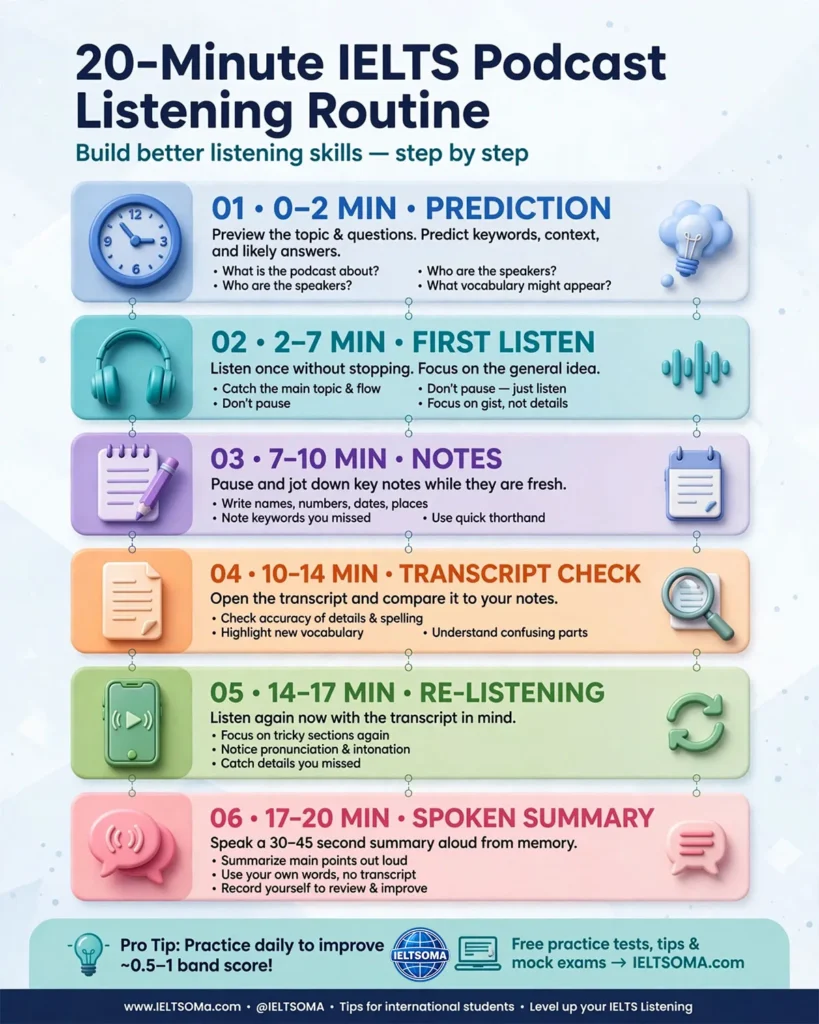
| Time | Activity |
|---|---|
| 0–2 minutes | Read the title and predict the topic |
| 2–7 minutes | Listen without transcript |
| 7–10 minutes | Write the main ideas and difficult words |
| 10–14 minutes | Check the transcript |
| 14–17 minutes | Re-listen to difficult sections |
| 17–20 minutes | Summarise what you heard aloud |
The final step is important.
Give yourself a 30–60 second spoken summary.
For example:
“The speaker discussed the impact of remote work. The main advantage was flexibility, although the speaker also mentioned communication difficulties…”
You are now combining Listening with Speaking.
That makes the practice more valuable than simply consuming audio.
A Practical 4-Week Podcast Plan for IELTS
If you want to Improve IELTS Listening with Podcasts, consistency matters more than marathon sessions.
Week 1: Build comprehension
Listen for 10–15 minutes a day.
Focus on:
- Main ideas
- Familiar vocabulary
- Speaker purpose
- General meaning
Do not worry about understanding every word.
Week 2: Add transcripts
Continue listening daily.
After each first listen, check the transcript.
Record recurring problems such as:
- Unknown vocabulary
- Fast speech
- Connected speech
- Numbers
- Names
- Weak pronunciation
Week 3: Add IELTS-style tasks
Create questions based on podcast segments.
Practise:
- Multiple choice
- Sentence completion
- Note completion
- Short answers
- Summary completion
Week 4: Combine podcasts with IELTS tests
Use podcasts for general listening development.
Use official IELTS practice tests for exam-specific performance.
For example:
Monday: Podcast + vocabulary
Tuesday: IELTS Listening practice
Wednesday: Podcast + transcript analysis
Thursday: IELTS question-type practice
Friday: Podcast + spoken summary
Saturday: Full IELTS Listening practice
Sunday: Review mistakes
This balance prevents you from becoming good at listening generally but underprepared for the actual test.
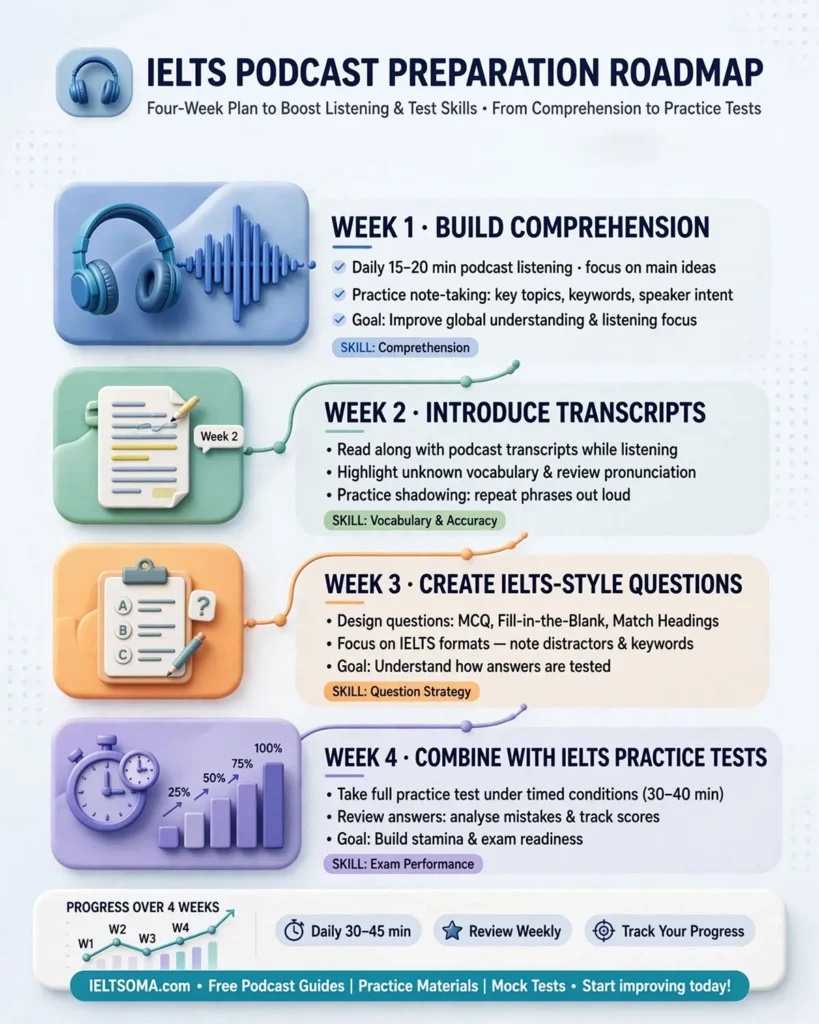
Progress from general listening exposure to IELTS-specific practice over four focused weeks.
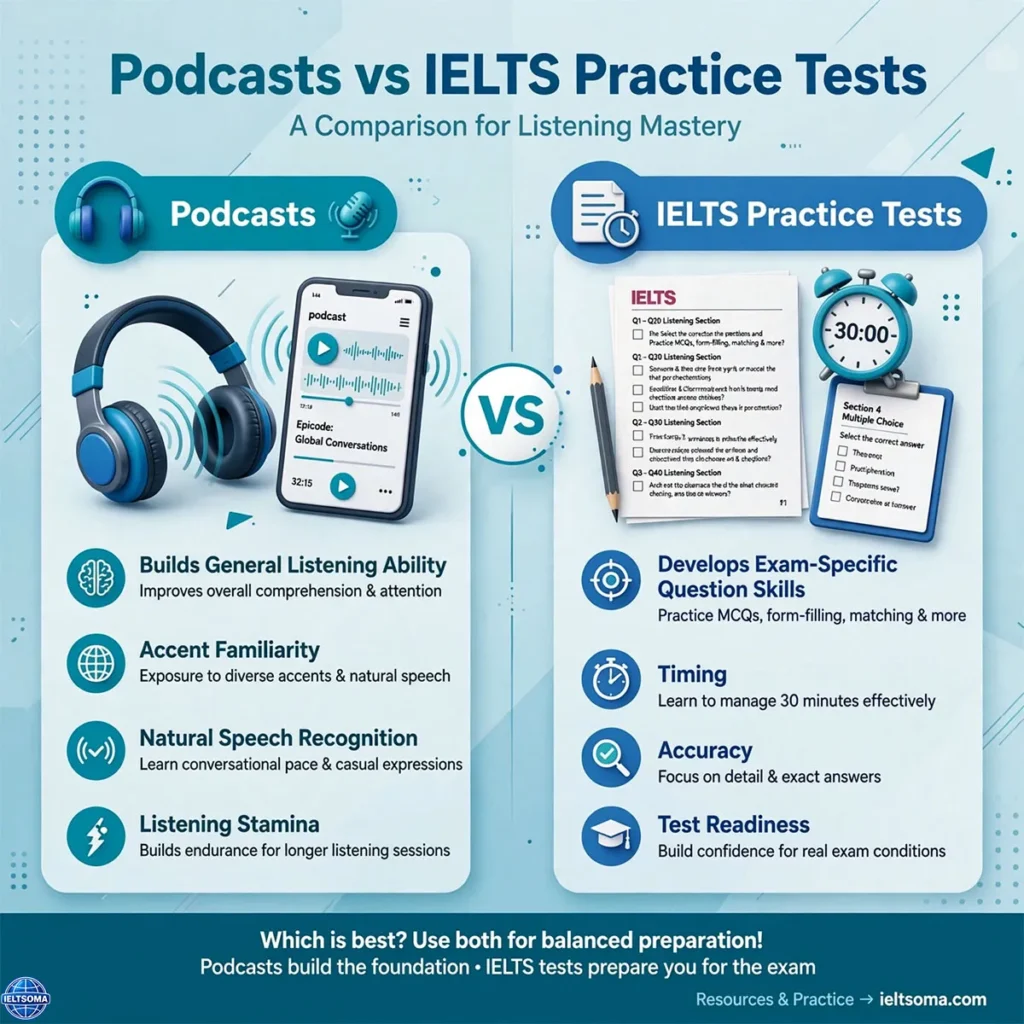
Podcasts vs IELTS Practice Tests: Which Is Better?
They serve different purposes.
| Podcasts | IELTS practice tests |
|---|---|
| Build general listening ability | Build exam-specific skills |
| Provide natural spoken English | Replicate IELTS task formats |
| Expose you to varied topics | Test your ability to answer questions |
| Improve listening stamina | Improve timing and accuracy |
| Develop accent familiarity | Measure exam performance |
| Help recognise natural speech | Help identify your IELTS weaknesses |
The best approach is not podcasts or IELTS tests.
It is podcasts + IELTS tests.
Use podcasts to strengthen the underlying listening skill and official IELTS materials to measure whether that skill transfers to the exam.
Common Mistakes When Using Podcasts for IELTS
Listening passively
Having a podcast playing while you work, exercise or travel can provide exposure, but it should not be your only listening practice.
Active listening is more demanding and more useful for deliberate improvement.
Using subtitles immediately
If you read the transcript from the beginning, you may end up testing your reading ability instead of your listening ability.
Listen first.
Check later.
Choosing extremely difficult content
You do not need to understand university-level lectures immediately.
Increase difficulty gradually.
Focusing on every unknown word
You will always encounter unfamiliar vocabulary.
Learn to continue listening and use context.
Never doing IELTS practice
Podcasts cannot teach you every exam-specific skill.
You still need timed IELTS Listening practice.
Repeating the same episode endlessly
Repetition is useful, but eventually you need fresh material.
A good balance is to analyse selected difficult episodes deeply while regularly introducing new audio.
How Long Should You Listen to Podcasts for IELTS?
For most candidates, 15–30 minutes of focused podcast listening per day is a practical starting point.
The exact amount depends on your current level, target band and preparation schedule.
Quality matters more than simply counting minutes.
Twenty minutes of active listening, transcript analysis and re-listening can be more useful than an hour of background audio.
If your IELTS test is approaching, keep podcast practice as a supplement rather than allowing it to replace full listening tests.
Should IELTS Academic and General Training Candidates Use Different Podcasts?
They can use many of the same podcasts because the Listening test is the same for IELTS Academic and IELTS General Training. Official IELTS guidance confirms that Listening and Speaking are shared by both test types, while Reading and Writing differ.
However, your wider preparation can be adapted.
Academic candidates may benefit from additional exposure to:
- University discussions
- Lectures
- Science
- Research
- Education
- Technology
- Environment
General Training candidates can also benefit from:
- Workplace conversations
- Customer service
- Travel
- Accommodation
- Employment
- Community issues
- Everyday situations
Do not make the mistake of listening only to material labelled “IELTS Academic” or “IELTS General Training”.
The underlying listening skills are transferable.
How to Know Whether Your Listening Is Improving
Do not judge progress only by how comfortable a podcast feels.
Track measurable indicators.
Once a week, record:
- How much of a five-minute segment you understood
- How many key details you could recall
- How many words you recognised from speech
- How accurately you answered your own questions
- Which accents caused difficulty
- Which question types caused problems in IELTS practice
Most importantly, compare your podcast work with your IELTS practice scores.
If your general comprehension improves but your IELTS score does not, your problem may be exam technique rather than basic listening ability.
That is a useful diagnosis.
The Best Way to Combine Podcasts with IELTS Preparation
A strong listening routine has three layers.
Layer 1: General exposure
Use podcasts, interviews, talks and other authentic English audio.
Purpose: build comprehension and listening stamina.
Layer 2: Focused listening
Use transcripts, vocabulary analysis, pronunciation analysis and re-listening.
Purpose: identify and correct weaknesses.
Layer 3: IELTS practice
Complete official IELTS Listening tasks under realistic conditions.
Purpose: measure exam performance.
This three-layer approach is much more effective than repeatedly taking mock tests without analysing why you made mistakes.
IELTS itself provides official sample materials that allow candidates to become familiar with the test format, question types and timed practice.
Frequently Asked Questions
Can I improve IELTS Listening with podcasts alone?
No. Podcasts can significantly support your listening development, but they should not replace IELTS-specific practice. Use podcasts to build general listening ability and official IELTS materials to practise the actual test.
How many minutes of podcasts should I listen to for IELTS?
Start with around 15–30 minutes of focused listening per day. Consistency and active analysis are more important than simply listening for a large number of hours.
Should I use transcripts when listening to podcasts?
Yes, but use them after your first listening attempt. A transcript is most useful for identifying exactly what you missed and understanding why you missed it.
Are podcasts useful for IELTS Band 7?
They can be useful as part of a broader Band 7 preparation strategy. Candidates targeting higher bands should combine general listening exposure with detailed IELTS practice, error analysis and regular timed tests.
Which podcast accent is best for IELTS?
There is no single “best” accent. IELTS candidates should become comfortable with a range of accents because the Listening test can include British, Australian, New Zealand and North American accents.
Should I listen to podcasts while travelling or exercising?
Background listening can increase exposure to English, but it should complement focused practice. When possible, set aside some uninterrupted time to listen actively and analyse difficult sections.
Is podcast listening useful for both IELTS Academic and General Training?
Yes. The Listening test is the same for both IELTS Academic and IELTS General Training. Your podcast topics can be adjusted according to your wider preparation needs, but the core listening skills remain relevant to both tests.
Final Takeaway
Podcasts are not a magic shortcut to a higher IELTS Listening band.
Used properly, however, they can become a powerful part of your preparation.
The key is to stop treating podcasts as entertainment and start treating selected episodes as listening training.
Listen without the transcript.
Predict what you may hear.
Identify the main ideas.
Notice paraphrases.
Analyse connected speech.
Check the transcript.
Re-listen.
Then test yourself with IELTS-style questions.
Most importantly, combine this work with official IELTS practice so you can see whether your improved listening ability is translating into better exam performance.
If you want to Improve IELTS Listening with Podcasts, consistency will take you further than occasional marathon sessions. A focused 20-minute routine repeated several times a week can gradually make natural English feel less like a stream of unfamiliar sounds and more like meaningful information you can follow.
For more structured IELTS preparation strategies, explore the IELTSOMA guides on IELTS Preparation Tips and IELTS Vocabulary Contextual Learning.
Further Reading: