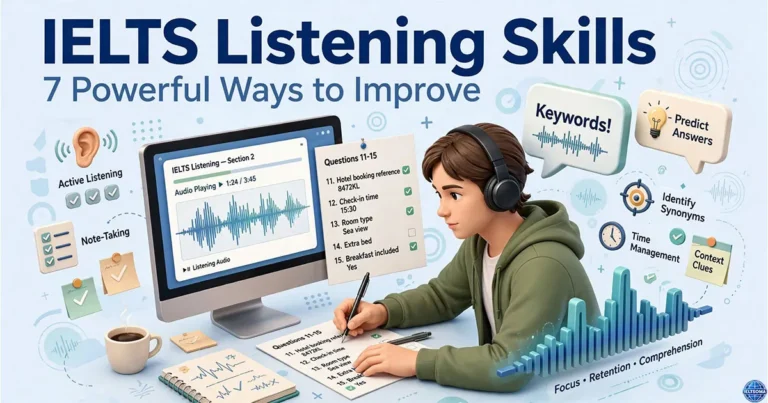
Have you ever understood an English recording perfectly during practice, only to miss several answers because your mind wandered for a few seconds? Perhaps you were thinking about an earlier question when the speaker had already moved on to the next one.
This is a common challenge in IELTS Listening. You may know plenty of English vocabulary and understand different accents, yet still lose marks because you cannot maintain your attention throughout the recording.
The solution is not simply to concentrate harder. You need a practical system for preparing your attention, following the recording, recovering from distractions and keeping your mind focused on the next answer.
These IELTS Listening Focus and Concentration strategies will help you listen more actively, manage distractions and develop the mental discipline needed to perform consistently under exam conditions.
Table of Contents
Why Focus and Concentration Matter in IELTS Listening
The IELTS Listening test contains four parts and 40 questions. You hear each recording only once, so missing a crucial detail can cost you a mark. The test assesses several abilities, including understanding specific information, following ideas, recognising speakers’ opinions and interpreting meaning.
According to the official IELTS Listening test format, the Listening test is the same for Academic and General Training candidates.
This means you need to maintain attention across different situations, from everyday conversations to academic discussions.
Poor concentration can affect your score in several ways:
- Missing key information: You may fail to notice a name, date, price or location.
- Thinking about previous answers: You continue worrying about a missed question while the recording provides information for the next one.
- Reading too slowly: You are still trying to understand a question when the relevant information is spoken.
- Falling for distractors: You hear an initial suggestion but miss the speaker’s correction or final decision.
- Losing track of speakers: You confuse different opinions during a conversation.
- Mental fatigue: Your attention becomes less reliable towards the end of the test.
The key is to understand that concentration is not just about keeping your mind still. It is about directing your attention towards the information that matters at the right moment.
9 IELTS Listening Focus Tips to Improve Your Concentration
1. Read the Questions Before the Recording Starts
One of the most effective ways to improve concentration for IELTS Listening is to know what information you need before you hear it.
When you read the questions in advance, you give your brain a clear listening objective. Instead of trying to understand every word, you can pay attention to relevant details.
For example, consider this question:
The guided tour begins at ________.
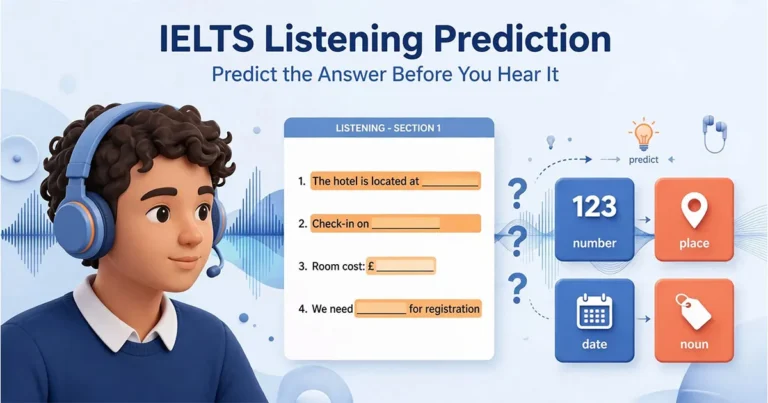
Before the recording starts, identify what you need to hear: a time.
You can then focus on expressions such as:
- at half past nine
- at 10.15
- just before eleven
- at midday
You do not need to memorise the entire sentence. You simply need to recognise the time when it appears.
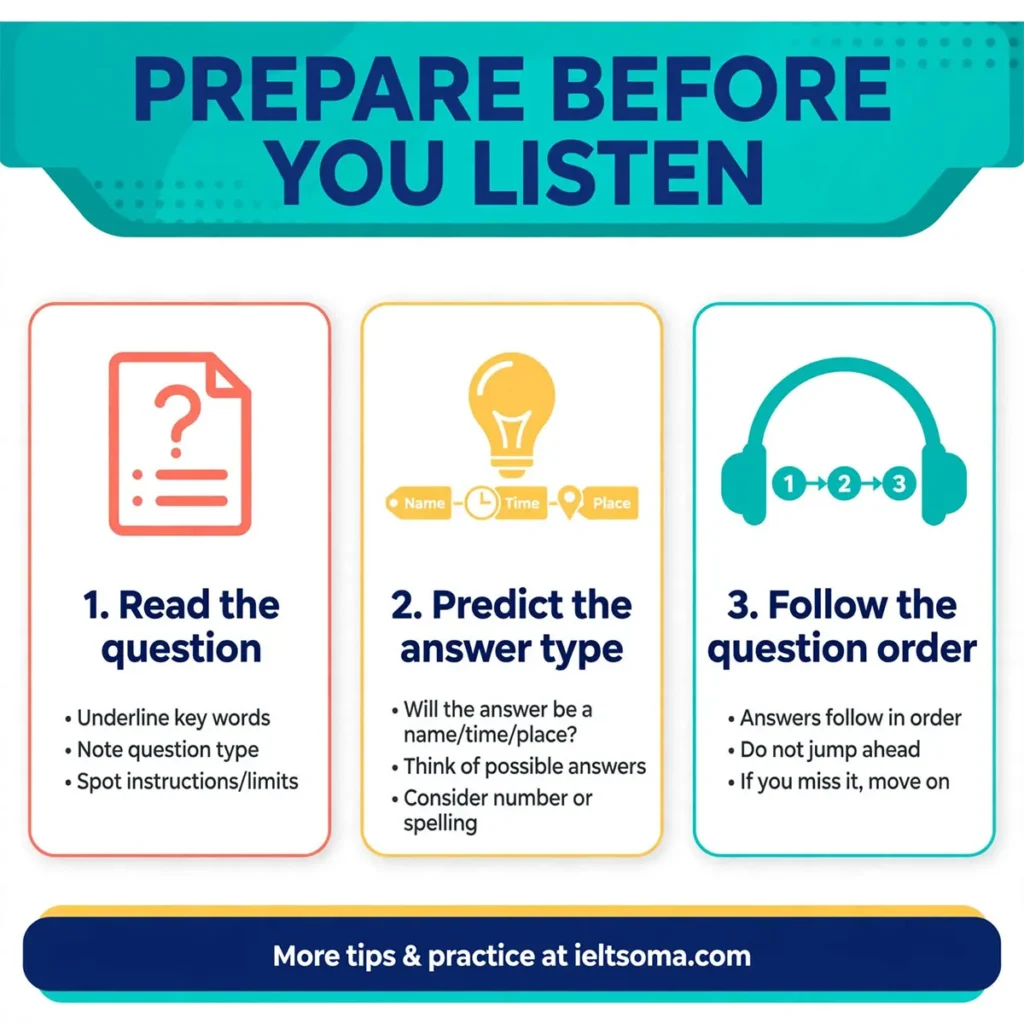
Use your preparation time to:
- Read the upcoming questions quickly.
- Underline or mentally identify important keywords.
- Predict the type of information required, such as a name, date, number or place.
- Notice the order of the questions.
- Move your eyes to the next question before the recording reaches it.
Do not spend too long analysing one question. Your objective is to prepare your attention, not solve the task before listening.
2. Listen for Meaning, Not Just Exact Words
A major reason candidates lose focus during IELTS Listening is that they listen for the exact words printed in the questions.
However, speakers often express the same idea using different vocabulary. If you wait for a particular keyword, you may miss the answer when it is paraphrased.
Suppose the question says:
Why did the student choose the accommodation?
You might expect to hear the word choose or accommodation. Instead, the speaker says:
“I decided to stay there because it was within walking distance of the university.”
The answer concerns the location, even though the speaker does not repeat the question’s wording.
To strengthen your concentration:
- Predict synonyms and paraphrases before listening.
- Focus on the meaning of each statement.
- Listen for relationships between ideas.
- Avoid waiting for one specific word.
- Notice when a speaker explains a reason, gives an example or introduces a contrast.
This approach is especially useful in Parts 3 and 4, where the language may be more complex and speakers develop ideas rather than simply provide isolated facts.
3. Train Yourself to Move On After a Missed Answer
This is one of the most important IELTS Listening focus tips.
Imagine you miss Question 14. You start wondering whether the answer was mentioned earlier. While you are thinking about it, the recording moves to Question 15. You miss that answer too, then become even more anxious.
One missed answer has now affected two or three questions.
The solution is to practise deliberately releasing a missed question.
Use this three-step recovery method:
Step 1: Accept the gap. If you cannot identify the answer immediately, do not keep searching your memory.
Step 2: Leave a temporary note. If appropriate for your test interface, mark the question for review or leave a blank space to complete later.
Step 3: Return to the next question. Shift your eyes and attention to the next available prompt and listen for new information.
For example:
You miss the name of a building in Question 18. Rather than replaying the conversation in your head, prepare for Question 19, which asks about the building’s opening hours.
You may still recover the earlier answer if you remember it later. However, you should not sacrifice information that is being spoken now.
Expert tip: During practice, measure how quickly you recover after a distraction, not just how many questions you answer correctly. Recovery is a trainable listening skill.
4. Follow the Recording with Your Eyes
Your eyes can help direct your attention. If you are looking at the wrong part of the question paper or screen, you may struggle to connect the spoken information with the correct answer.
During the recording, follow the questions in sequence.
For completion tasks, move your eyes towards the next gap when you hear the information relevant to the current one. For multiple-choice questions, keep the options in view and listen for the meaning that matches the recording.
Consider this example:
Question 21: The library closes at ________.
Question 22: Students must show their ________ at the entrance.
When the speaker gives the closing time, complete Question 21. Then shift your attention towards Question 22, listening for the required document or item.
Avoid reading every option repeatedly while the speaker is talking. That divides your attention between reading, interpreting and listening.
Practise moving your eyes ahead without losing track of the audio. Over time, this can help you anticipate the next question more efficiently.
5. Recognise Distractors and Changes in Information
Sometimes a speaker mentions one answer and then corrects it. If you focus only on the first detail you hear, you may select the wrong answer.
For example:
“We originally planned to hold the workshop on Tuesday, but the instructor is unavailable, so it will take place on Thursday.”
If the question asks for the final date, the answer is Thursday, not Tuesday.
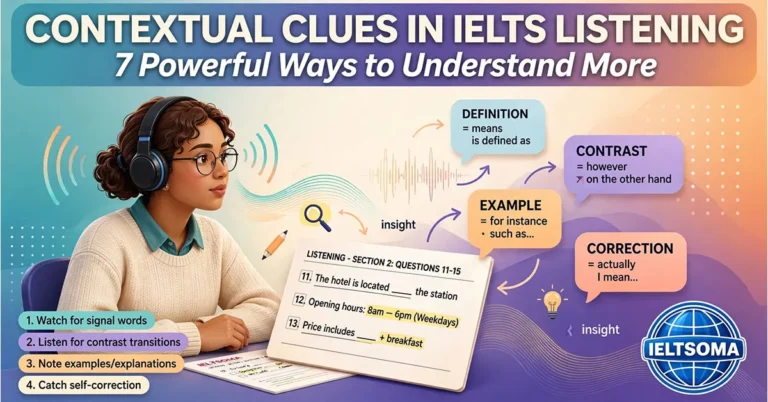
Listen carefully for expressions such as:
- but
- however
- actually
- instead
- rather than
- I changed my mind
- we’ve decided to
- the original plan was
These expressions can signal a change, contrast or correction.
A useful practice exercise is to listen to short conversations and identify three things:
- What information was mentioned first?
- What changed or was corrected?
- What was the final decision?
This trains you to follow the speaker’s meaning rather than react to the first familiar word.
The British Council’s IELTS Listening preparation guidance also recommends listening carefully for meaning, including changes in decisions and negative expressions.
6. Practise Listening in Short, Focused Sessions
Listening to English for an hour while checking messages, browsing websites or doing other tasks is not necessarily effective preparation.
For concentration training, begin with short sessions in which listening is your only task.
Try this progression:
| Practice stage | Listening duration | Main objective |
|---|---|---|
| Stage 1 | 5 minutes | Maintain attention without checking your phone |
| Stage 2 | 10 minutes | Follow a conversation and identify key details |
| Stage 3 | 15–20 minutes | Track questions while listening |
| Stage 4 | Full practice section | Maintain attention under test-like conditions |
| Stage 5 | Full Listening test | Practise consistent focus across all four parts |
These durations are a suggested training routine, not official IELTS requirements. Adjust them to your current ability and gradually increase the challenge.
After each session, ask yourself:
- When did my attention drift?
- What triggered the distraction?
- Did I miss information because of vocabulary, speed or mind-wandering?
- How quickly did I return to the task?
This helps you identify the real problem rather than assuming that every incorrect answer is caused by poor English.
7. Remove Distractions Before You Begin
Your study environment affects how easily you can direct your attention.
If notifications keep appearing, people are talking nearby or you repeatedly pause the recording, you are not practising the same conditions you will face during a timed test.
Before a session:
- Put your phone on silent or place it out of reach.
- Close unnecessary browser tabs.
- Choose a quiet place where possible.
- Prepare your questions and materials before starting.
- Avoid pausing or replaying audio during timed practice.
- Take a short break between demanding sessions if needed.
If your home is noisy, use the quietest available space and practise under realistic conditions when possible.
You should also practise with a range of English accents and speaking styles. Familiarity with different voices can reduce the extra effort required to understand the recording, leaving more attention available for the questions.
Remember that the goal is not to eliminate every distraction from your life. It is to build the ability to focus on the task when it matters.
8. Manage Anxiety and Avoid Panic
Anxiety can consume the attention you need for listening. You may worry about your target band score, the difficulty of the recording or the possibility of making mistakes.
This creates a second task in your mind: listening to the recording while monitoring your own fear.
Use a simple routine before each practice session:
- Sit comfortably and relax your shoulders.
- Take a few slow, comfortable breaths.
- Remind yourself that you only need to handle the current question.
- Begin reading the prompts and identifying the information required.
During the recording, keep your attention on what the speaker is saying rather than judging your performance.
Avoid thoughts such as, “I have already missed two answers, so this section is ruined.”
Replace them with a practical instruction: “The next question is asking for a location. Listen for the place name.”
This does not guarantee that you will never feel anxious. It gives you a clear action to take when anxiety appears.
If you frequently experience severe anxiety that affects daily life as well as exam preparation, consider seeking appropriate professional support.
9. Review Your Mistakes Instead of Repeating Tests Blindly
Taking more practice tests does not automatically improve concentration. The benefit comes from understanding what happened during each attempt.
After completing a listening exercise, classify your errors.
| Error category | What happened? | What to practise |
|---|---|---|
| Attention lapse | You stopped following the recording | Short, focused listening sessions |
| Vocabulary gap | You did not know a key word | Vocabulary and paraphrase practice |
| Distractor | You selected an initial answer that was later changed | Corrections, contrast and negative expressions |
| Question tracking | You lost your place | Following prompts in sequence |
| Slow reading | You were still reading when the answer appeared | Timed question-preview exercises |
| Spelling or detail | You heard the answer but wrote it incorrectly | Accuracy and answer-checking practice |
| Fatigue | Your attention weakened towards the end | Gradual endurance training |
Listen to the relevant passage again after completing the timed attempt. Identify the exact moment when the answer appeared and determine why you missed it.
For example, if you heard the correct information but selected a different option, your problem may be interpretation rather than concentration.
If you never noticed the information because you were thinking about an earlier question, your main target should be attention recovery.
This distinction makes your preparation more efficient.
How to Improve Concentration for IELTS Listening: A Daily Routine
You do not need to spend hours on concentration exercises. A consistent, targeted routine can help you practise the specific skills that the test requires.
Try the following 30-minute schedule.
| Time | Activity | Purpose |
|---|---|---|
| 3 minutes | Prepare your environment and preview the questions | Reduce distractions and establish a listening goal |
| 7 minutes | Complete a short listening task without pausing | Practise sustained attention |
| 5 minutes | Check answers and classify errors | Identify your weaknesses |
| 10 minutes | Replay selected sections and analyse missed details | Understand why answers were missed |
| 5 minutes | Complete a fresh short exercise | Apply what you learned |
As your performance improves, replace some short exercises with full-length Listening practice. Do not rely exclusively on familiar recordings because memorising their answers is not the same as developing listening ability.
A Seven-Day IELTS Listening Concentration Plan
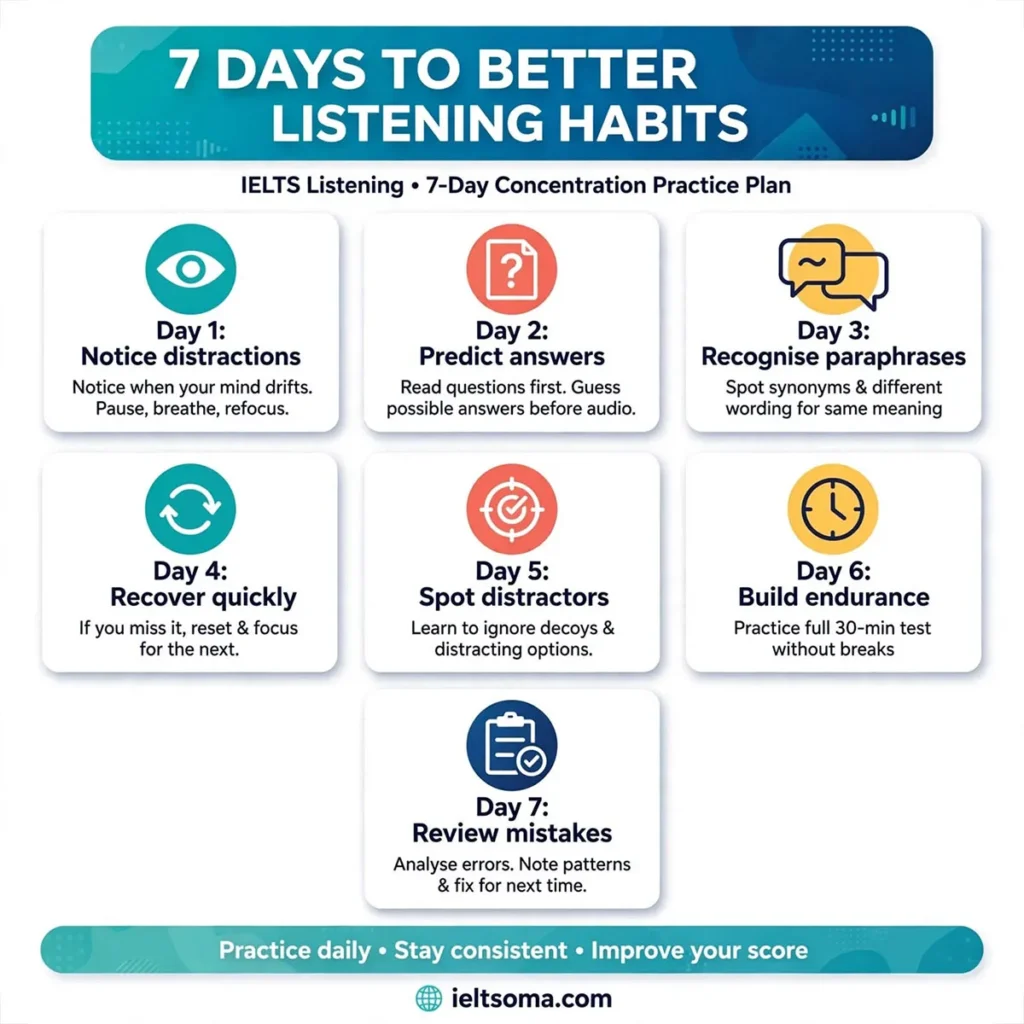
If you need a structured starting point, follow this seven-day plan.
| Day | Main focus | Practice task |
|---|---|---|
| 1 | Identify attention problems | Complete a short listening task and record when you lose focus |
| 2 | Predict answer types | Preview questions and identify whether each answer requires a name, time, place or other detail |
| 3 | Follow paraphrases | Listen for meaning rather than exact keywords |
| 4 | Recover from missed answers | Deliberately move on when you cannot identify an answer |
| 5 | Recognise distractors | Practise listening for corrections and changes of decision |
| 6 | Build endurance | Complete a longer timed listening exercise without unnecessary breaks |
| 7 | Review and measure progress | Complete a fresh practice section and compare your error patterns |
This is a suggested routine, not a guarantee of a particular band score. Repeat the cycle while adapting the activities to your weaknesses.
The most useful measure of progress is not simply how long you study. It is whether you miss fewer answers for attention-related reasons and recover more quickly when your mind wanders.
What to Do If You Lose Focus During IELTS Listening
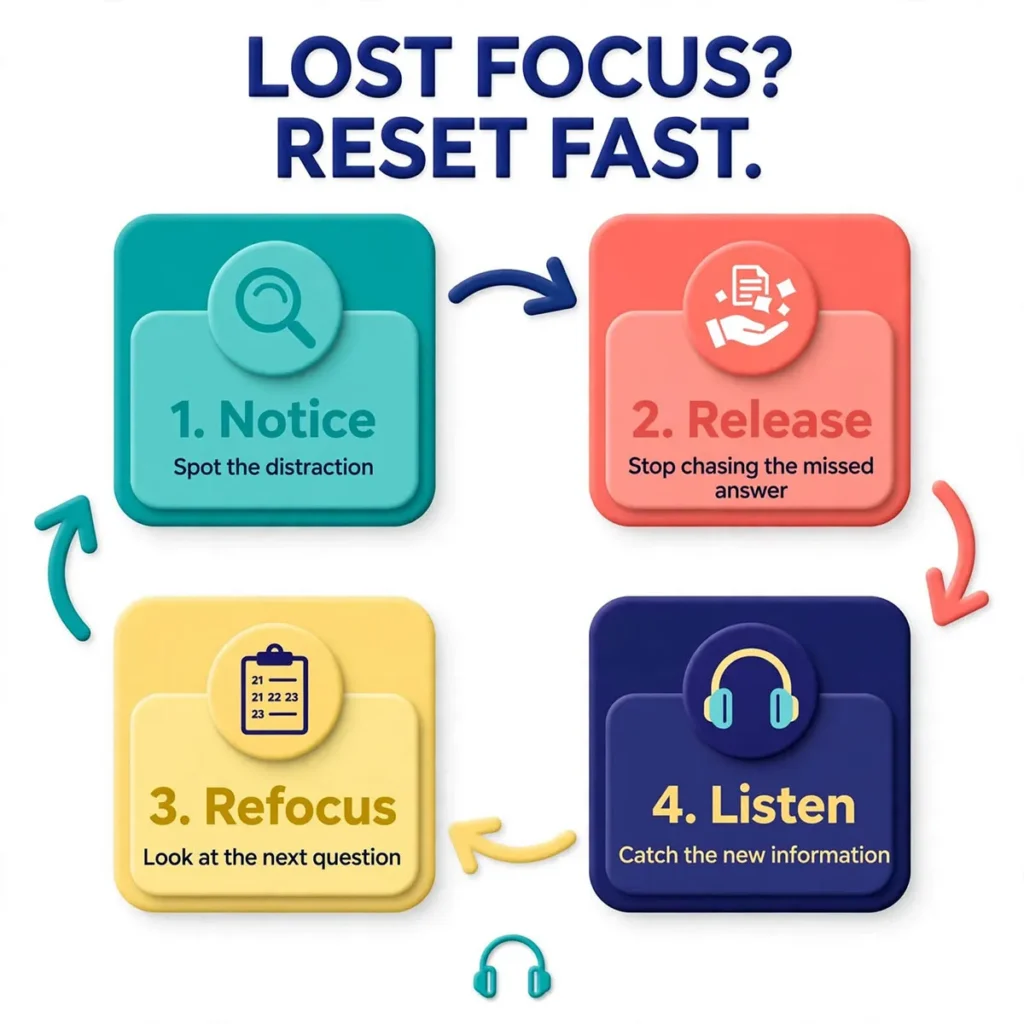
Even well-prepared candidates can experience a brief lapse in attention. The important thing is to prevent one lapse from turning into a chain of missed answers.
Use this quick recovery sequence:
Notice → Release → Refocus → Listen
- Notice: Recognise that your mind has wandered.
- Release: Stop trying to reconstruct everything you missed.
- Refocus: Look at the current or next question.
- Listen: Identify what information you need and follow the speaker again.
Do not rewind the recording mentally while new information is being presented.
If you are practising, note the question where your attention drifted and investigate the cause after the exercise. If you are taking the actual test, return to the task immediately.
You should also resist the urge to panic when you hear an unfamiliar word. You may still understand the main idea or find the answer through context.
Concentration is not perfect attention every second. It is the ability to notice when attention has slipped and bring it back to the task.
Common Mistakes That Damage IELTS Listening Concentration
Avoid these habits if you want your practice to produce better results.
Trying to understand every word: The test measures your ability to understand relevant information, not to transcribe the entire recording. Focus on the question and the speaker’s meaning.
Spending too long on one question: A missed answer is frustrating, but the next answer may be available immediately. Protect your attention by moving on.
Reading all the options repeatedly: Analyse the options before listening, then concentrate on the recording. Repeated reading during the audio can cause you to miss key details.
Practising only when you feel motivated: Consistency matters. Short, focused sessions are often easier to maintain than occasional, exhausting study sessions.
Checking answers without analysing mistakes: A score tells you what happened, but error analysis helps explain why.
Assuming every mistake is caused by poor concentration: Weak vocabulary, unfamiliar accents, difficulty understanding paraphrases and spelling errors require different solutions. Diagnose the actual problem before choosing an exercise.
Using recordings that are too easy: Familiar, slow material may be useful at first, but it will not fully prepare you for the pace and variety of the IELTS test.
Frequently Asked Questions
1. How can I improve concentration for IELTS Listening?
Preview the questions, predict the type of information required, listen for meaning and practice moving on when you miss an answer. Use short, distraction-free sessions before gradually increasing the duration and difficulty. Review errors to distinguish attention problems from vocabulary or comprehension gaps.
2. Why do I lose focus during IELTS Listening even when I understand English?
You may be mentally translating, worrying about earlier answers, reading too slowly or trying to understand every word. These habits compete with the attention needed to follow the recording. Practice tracking questions, recognizing paraphrases and returning to the next question after a lapse.
3. What should I do if I miss an answer in IELTS Listening?
Do not spend the rest of the recording searching for it. Leave the question temporarily, shift your attention to the next prompt and continue listening. During practice, review the missed section afterwards to find out whether the problem was vocabulary, interpretation or attention.
4. How long should I practice IELTS Listening every day?
A useful starting point is 20–30 minutes of focused practice, including answer review. The ideal duration depends on your current level, available time and weaknesses. Gradually add longer sections and full practice tests to build endurance without sacrificing the quality of your review.
5. Does listening to English music improve IELTS Listening concentration?
It may help you become more comfortable with English sounds, but listening to music alone is not a substitute for IELTS practice. Use focused exercises that require you to identify details, follow ideas, recognize corrections and answer questions. Choose practice material that reflects the skills tested in IELTS.
6. How can I concentrate during IELTS Listening Part 4?
Read the prompts quickly before the recording, identify the topic and predict the information required for each gap. Listen for signposting expressions such as firstly, in contrast and as a result. Follow the development of the lecture instead of trying to understand every unfamiliar term.
7. Can I improve IELTS Listening concentration in one week?
You can begin improving your routine and identifying attention problems within a week, but the amount of progress varies. Use a seven-day plan to practice question prediction, paraphrase recognition, recovery from missed answers and error analysis. Continue practicing afterwards to make the habits more reliable.
Final Advice: Train Your Attention, Not Just Your Ears
Improving IELTS Listening performance requires more than learning vocabulary or completing endless practice tests. You also need to direct your attention, follow the questions efficiently and recover when something goes wrong.
Start with three habits: preview the questions, move on quickly after a missed answer and review the reasons for your mistakes. Add focused practice sessions and gradual endurance training as these habits become more natural.
Remember, IELTS Listening Focus and Concentration is not about never losing attention. It is about learning to return your attention to the information that matters before the next opportunity passes.
Practise this skill consistently, and you will give yourself a stronger foundation for listening accurately and confidently on test day.
Useful Links: