Choosing the right word can make the difference between writing that sounds natural and writing that sounds forced.
Many IELTS candidates believe better vocabulary means using longer, more sophisticated words. They memorise lists of synonyms, learn impressive expressions and try to insert them into every essay. Yet this approach can create inaccurate word choices, unnatural collocations and inappropriate language.
Matching vocabulary to writing means choosing words that fit your meaning, sentence, topic, tone and purpose.
That skill is particularly important because IELTS examiners assess Lexical Resource, including the range of vocabulary, its accuracy and appropriacy, precision of word choice, collocations, spelling and word formation.
Whether you are taking IELTS Academic or General Training, the goal is not to make every sentence sound complicated. The goal is to make every important word work.
Table of Contents
What Does Matching Vocabulary to Writing Mean?
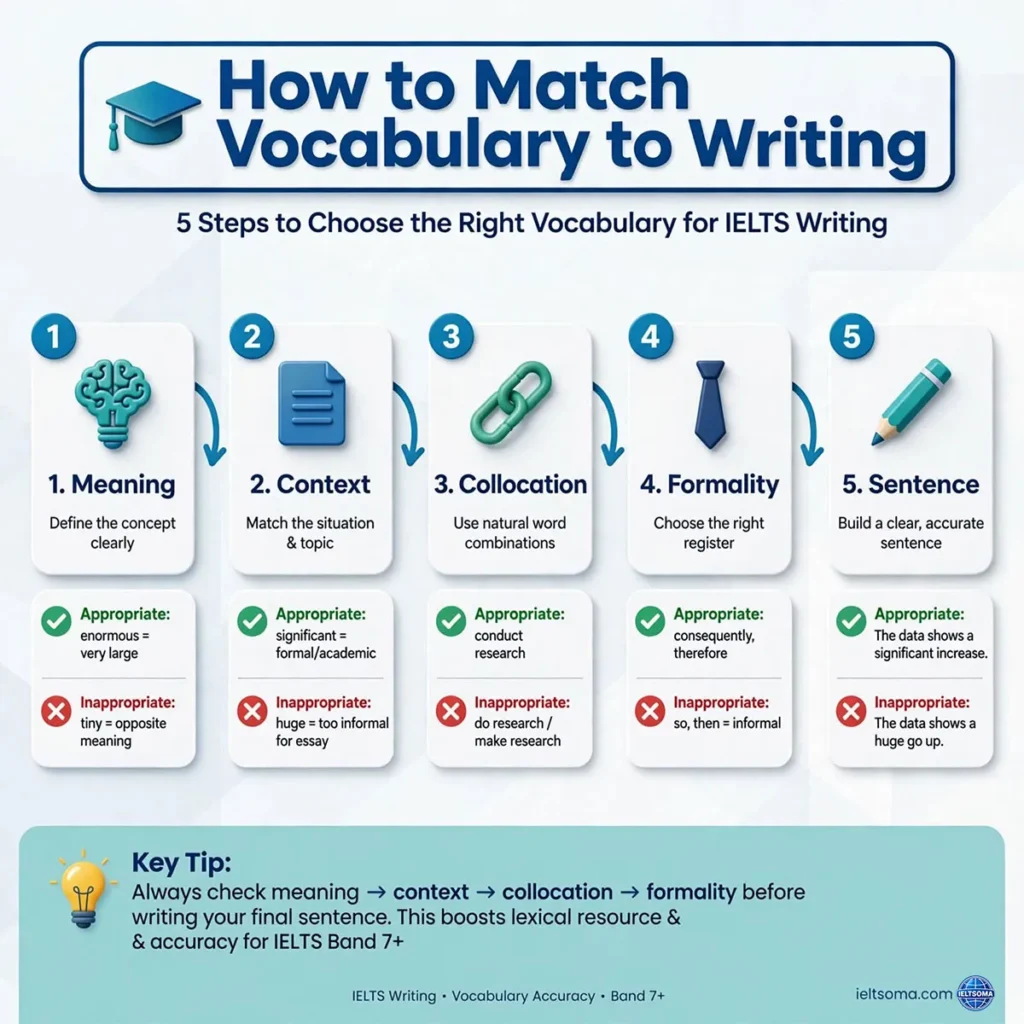
Matching vocabulary to writing means selecting language that is appropriate for the specific idea and context you are expressing.
Consider these two sentences:
Technology is good for education.
Digital learning platforms can improve access to educational resources.
The second sentence is not necessarily better simply because it contains more advanced vocabulary. It is better because the vocabulary communicates a more specific meaning.
For example:
- good is broad and vague.
- improve identifies the type of benefit.
- digital learning platforms identifies the subject more precisely.
- access to educational resources explains the specific benefit.
This is the principle you should apply throughout your IELTS Writing.
The official IELTS guidance describes Lexical Resource as including vocabulary range, adequacy and appropriacy, precision of word choice, collocations, idiomatic expressions and sophisticated phrasing.
Why Is Matching Vocabulary to Writing Important in IELTS?
Vocabulary is one of the four assessment criteria used to evaluate IELTS Writing, alongside Task Achievement or Task Response, Coherence and Cohesion, and Grammatical Range and Accuracy.
For example, an IELTS Task 2 essay about environmental protection may require words such as:
- emissions
- conservation
- renewable energy
- environmental damage
- carbon footprint
- sustainable development
- government regulation
However, knowing these words is not enough.
You must know how and when to use them.
Compare:
Governments should make strong measures to reduce emissions.
with:
Governments should take effective measures to reduce carbon emissions.
The first sentence contains an understandable idea, but make measures is an unnatural collocation. The second uses the natural combination take measures.
This is why vocabulary knowledge should include more than definitions.
You need to understand the relationships between words.
1. Match Vocabulary to the Exact Meaning
One of the most common vocabulary mistakes in IELTS Writing is choosing a word that is similar in meaning but not identical.
Suppose you want to describe a serious problem.
You could write:
Traffic congestion is a big problem in major cities.
Or:
Traffic congestion is a significant problem in major cities.
Or:
Traffic congestion is a critical issue requiring immediate attention.
These expressions are related, but they do not communicate exactly the same strength or meaning.
Significant means important or considerable.
Critical suggests that something is extremely important or potentially serious.
Therefore, do not choose a synonym simply because a dictionary lists it as an alternative.
Ask:
Does this word communicate exactly what I mean?
A useful vocabulary test
Before using a new word, create three sentences with it.
Then ask:
- Is the meaning correct?
- Does it fit the topic?
- Does it sound natural?
- Is the level of formality appropriate?
If you cannot confidently answer these questions, choose a simpler word.
2. Match Vocabulary to the IELTS Topic
Different IELTS questions require different vocabulary.
You would not use exactly the same vocabulary for an essay about education, public transport and international tourism.
For example, an education essay might require:
- academic performance
- educational institutions
- vocational training
- access to education
- learning opportunities
- curriculum
- teaching methods
An environmental essay may require:
- carbon emissions
- renewable energy
- climate change
- environmental protection
- natural resources
- sustainable development
- ecological damage
A transport essay could involve:
- public transport
- traffic congestion
- road infrastructure
- private vehicles
- commuting
- fuel consumption
- urban mobility
This does not mean you should memorise hundreds of isolated words.
Instead, build vocabulary around common IELTS themes and learn how the words function in real sentences.
3. Match Vocabulary to Formality
The correct vocabulary also depends on the level of formality required.
Academic Writing Task 1 generally requires an academic or semi-formal/neutral style, while General Training Task 1 may involve letters requiring different levels of formality depending on the situation. Task 2 requires an essay in both tests.
Compare:
A lot of people think governments should spend more money on schools.
with:
Many people believe that governments should allocate greater funding to education.
Both communicate a similar idea, but the second is more appropriate for formal academic writing.
However, be careful.
Formal does not mean unnecessarily complicated.
You do not need to replace every ordinary word with a sophisticated synonym.
For example:
Children are a fundamental demographic cohort within contemporary society.
This sounds unnecessarily complicated.
A natural alternative is:
Children are an important part of society.
The second sentence is clearer and more direct.
Good IELTS vocabulary should sound educated, not artificial.
4. Learn Vocabulary Through Collocations
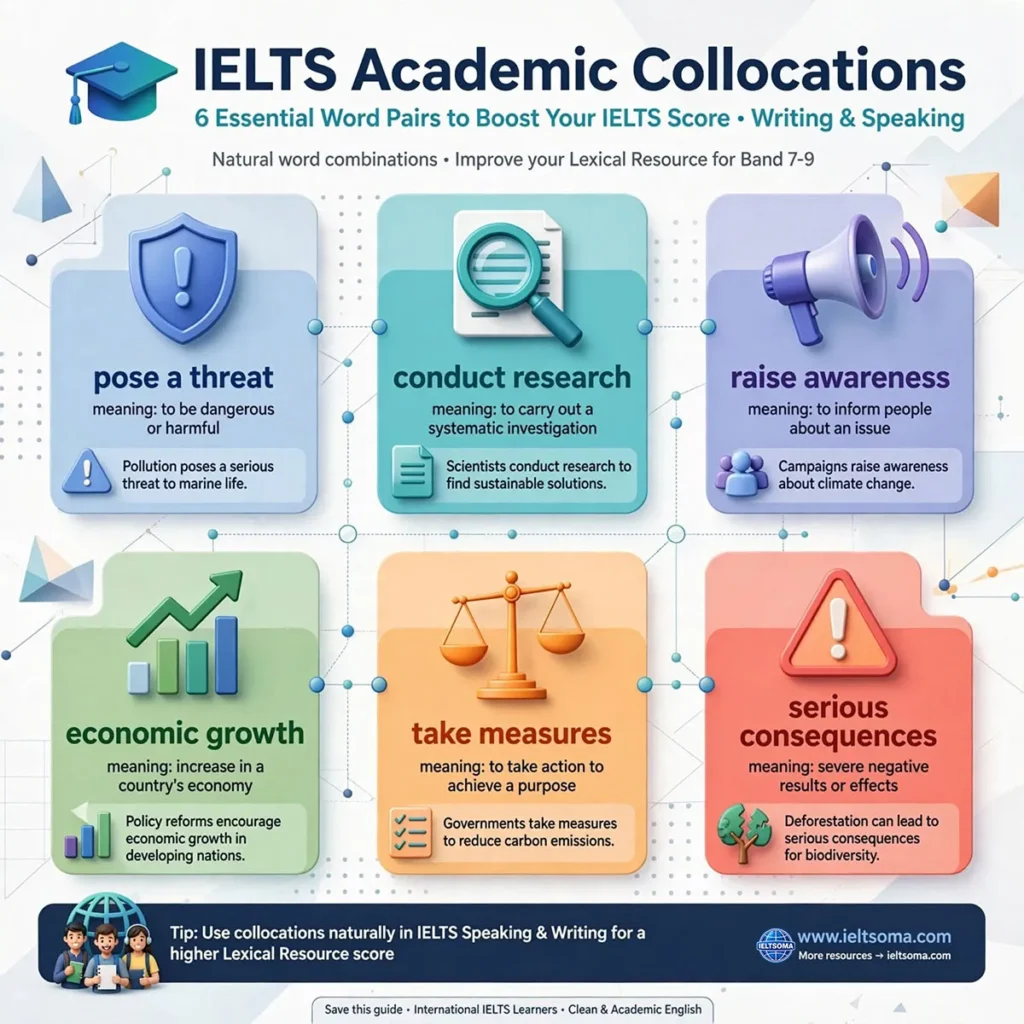
One of the best ways to improve matching vocabulary to writing is to learn collocations.
A collocation is a combination of words that commonly occur together.
For example:
- make a decision
- conduct research
- take measures
- raise awareness
- reach an agreement
- pose a threat
- play a role
- achieve a goal
- economic growth
- serious consequences
- significant impact
- highly effective
Knowing the individual words is not enough.
You may know research and make, but native English normally uses:
conduct research
rather than:
make research
Similarly:
take action
is natural, while:
do action
is not.
The official IELTS Writing guidance specifically identifies control and use of collocations as part of Lexical Resource.
Build vocabulary as phrases
Instead of learning:
consequence = result
learn:
have serious consequences
Then use it:
Excessive dependence on private vehicles can have serious consequences for urban air quality.
This gives you vocabulary that is immediately usable in writing.
5. Match Vocabulary to the Sentence
A word may be suitable for a topic but unsuitable for a particular sentence.
For example, consider the word consume.
It works naturally with:
consume energy
consume large quantities of water
consume processed food
But you would not normally write:
People consume a bus to work.
Instead:
People use a bus to travel to work.
The topic may be transport, but the verb must match the noun and meaning.
This is why you should study vocabulary in sentences rather than memorising isolated definitions.
Compare these examples
Incorrect or unnatural:
Governments can consume effective policies.
Better:
Governments can introduce effective policies.
Incorrect:
The government should make strict measures.
Better:
The government should take strict measures.
More natural:
The government should implement effective measures.
The objective is not to find the most sophisticated verb.
It is to find the verb that naturally fits the sentence.
6. Match Vocabulary to Your Argument
Vocabulary should also reflect the strength of your argument.
This becomes particularly important in IELTS Writing Task 2.
Compare:
Governments must completely ban private cars.
with:
Governments could consider restricting private car use in densely populated areas.
The first statement is absolute.
The second is more cautious.
If your argument is based on a possibility rather than certainty, words such as could, may, might, potentially and likely can help you communicate the appropriate degree of certainty.
Similarly, be careful with words such as:
- always
- never
- everyone
- nobody
- completely
- inevitably
These words make very strong claims.
Use them only when your argument genuinely supports them.
Precise vocabulary helps you express not only what you think but also how strongly you think it.
7. Use Synonyms Without Losing Precision
Synonyms are useful for avoiding unnecessary repetition, but they should not be treated as interchangeable words.
Consider:
Many people believe that online education is beneficial. This belief is becoming increasingly common.
You could potentially replace beneficial with:
- advantageous
- valuable
- useful
- effective
- positive
But these words are not identical.
For example:
Online education is effective.
means that it achieves a desired result.
Online education is advantageous.
focuses more on its benefits.
Online education is useful.
is broader and less specific.
Therefore, ask:
Which word best expresses my intended meaning?
That is more important than simply asking:
Which synonym can I use to avoid repetition?
The official IELTS descriptors emphasise precision and appropriacy rather than vocabulary variety alone.
8. Match Vocabulary to Academic Task 1
Matching vocabulary to writing is especially important in IELTS Academic Task 1 because the vocabulary you need depends on the visual information.
For charts and graphs, you may need vocabulary for:
Increases
- increase
- rise
- grow
- climb
- surge
Example:
The percentage of households with internet access increased steadily between 2010 and 2020.
Decreases
- decrease
- decline
- fall
- drop
- decrease gradually
Example:
The figure declined gradually after 2015.
Stability
- remain stable
- remain unchanged
- level off
- remain constant
Example:
The proportion remained relatively stable throughout the final five years.
Comparisons
- higher than
- lower than
- considerably greater than
- approximately twice as high as
- slightly below
The important point is that you should select vocabulary according to the relationship shown in the data.
Do not describe a small increase as a dramatic surge.
Do not call a stable figure a decline.
Vocabulary must accurately represent the visual information.
9. Match Vocabulary to General Training Task 1
General Training Task 1 requires a letter, so vocabulary selection depends heavily on the relationship between the writer and recipient.
For example, a letter to a close friend can use a more informal tone:
I was really pleased to hear about your new job.
A formal complaint to a company requires different language:
I am writing to express my dissatisfaction with the service I received.
The vocabulary is not simply more difficult in the second example.
It is better matched to the situation.
Before writing a General Training letter, identify:
- Who are you writing to?
- Why are you writing?
- What relationship do you have with the recipient?
- How formal should the language be?
- What action do you want the reader to take?
Then choose vocabulary accordingly.
A Simple Method for Matching Vocabulary to Writing
You can use this five-step process whenever you learn or use new vocabulary.
Step 1: Identify the meaning
Know exactly what the word means.
Step 2: Check the context
Find out where the word is normally used.
Step 3: Learn its collocations
Record the words that commonly appear with it.
Step 4: Check the formality
Decide whether it is appropriate for academic, formal, neutral or informal writing.
Step 5: Use it yourself
Write two or three original sentences using the word naturally.
For example:
Word: significant
Common combinations:
- significant increase
- significant impact
- significant improvement
- significant proportion
Example:
Investment in public transport can have a significant impact on urban congestion.
Now the vocabulary is not simply memorised. It has become usable.
Common Vocabulary Mistakes in IELTS Writing
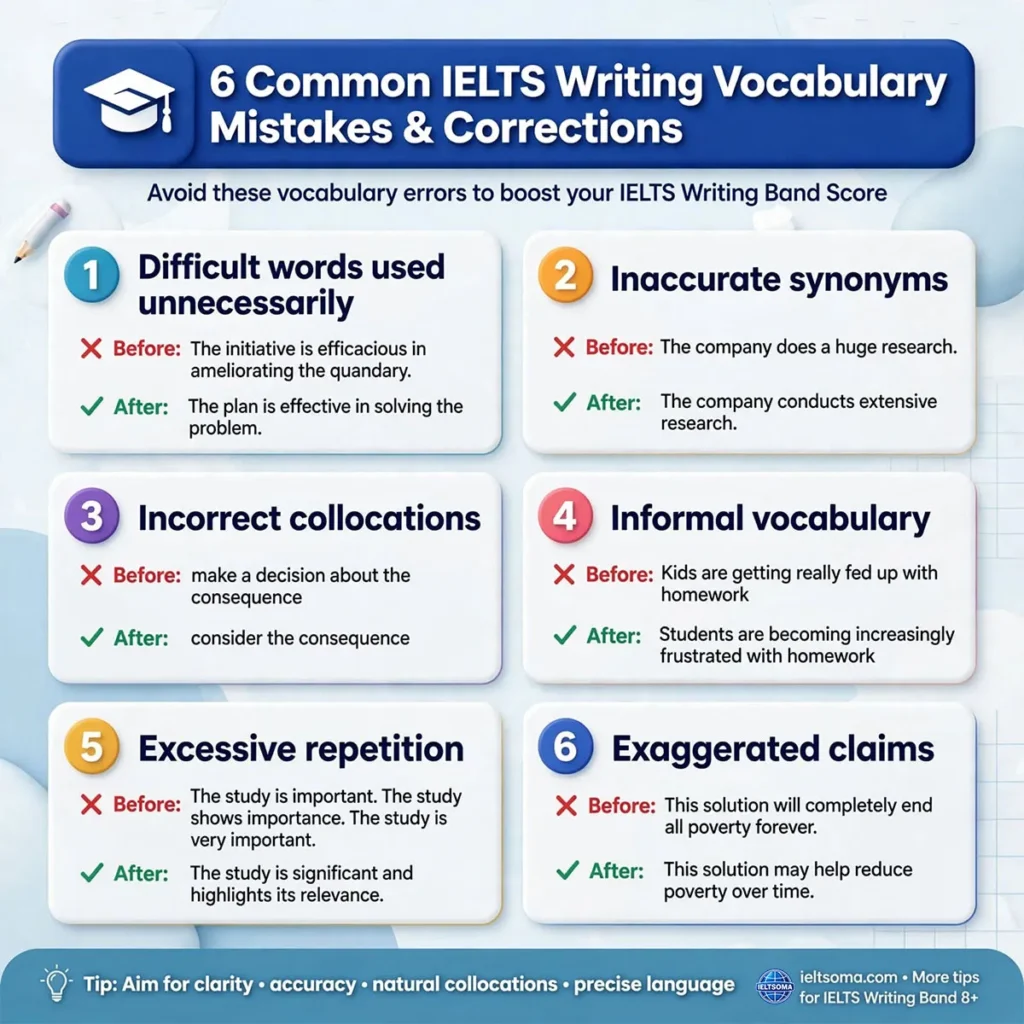
Using difficult words unnecessarily
Trying to impress the examiner can backfire.
Governments should ameliorate the deleterious ramifications of vehicular proliferation.
This sentence may look sophisticated, but it is unnecessarily complicated.
A clearer version is:
Governments should reduce the harmful effects of excessive car use.
Using a synonym without checking its meaning
A thesaurus can provide alternatives, but it cannot decide whether the alternative fits your sentence.
Always check the context.
Ignoring collocation
Knowing individual words does not guarantee natural English.
Study combinations such as make a decision, conduct research and take measures.
Using informal expressions in formal writing
Avoid unnecessarily conversational expressions such as:
- kids
- loads of
- stuff
- a lot of people reckon
- things are getting worse
Choose language that suits the task.
Repeating the same word too frequently
Repetition can make vocabulary appear limited.
However, do not replace every repeated word with a synonym.
Sometimes repetition is clearer and more natural.
Choosing vocabulary before choosing the idea
Do not build your argument around words you want to use.
First decide what you want to say.
Then choose the vocabulary that expresses that idea accurately.
A Practical Vocabulary Exercise
Take one common IELTS topic such as technology.
Start with a basic sentence:
Technology is good for students.
Now ask what you actually mean.
Perhaps you mean that technology provides students with better access to information.
Rewrite it:
Digital technology can give students greater access to educational information.
Now develop it further:
Digital technology can give students greater access to educational information, allowing them to study independently and use a wider range of online resources.
Notice the process.
You did not simply replace good with a difficult synonym.
You identified the precise meaning and selected vocabulary to express it.
That is the essence of matching vocabulary to writing.
How to Practise Matching Vocabulary to Writing
A strong practice routine does not require memorising enormous vocabulary lists.
Try this approach:
- Choose one IELTS topic.
- Select 10 useful words or phrases.
- Learn their common collocations.
- Check whether they are formal, neutral or informal.
- Write five original sentences.
- Write one short paragraph using several of them.
- Check whether each word genuinely fits its context.
- Record any mistakes in a personal vocabulary notebook.
For example, if your topic is education, you might study:
- educational resources
- academic performance
- vocational training
- equal access
- learning opportunities
- acquire knowledge
- develop skills
- improve employability
- teaching methods
- higher education
Then use them in context rather than memorising them as a list.
This approach also helps turn passive vocabulary into active vocabulary.
Matching Vocabulary to Writing: A Quick Checklist
Before submitting your IELTS Writing response, ask:
- Have I chosen words that accurately express my meaning?
- Does my vocabulary match the topic?
- Is the level of formality appropriate?
- Have I used natural collocations?
- Have I avoided unnecessary repetition?
- Have I checked word forms?
- Have I checked spelling?
- Have I avoided words that I do not fully understand?
- Are my claims appropriately strong or cautious?
- Does my vocabulary sound natural rather than memorised?
If you can answer yes to most of these questions, your vocabulary is probably doing its job.
Frequently Asked Questions
What does matching vocabulary to writing mean?
Matching vocabulary to writing means selecting words that accurately express your intended meaning and fit the topic, sentence, context, tone and purpose of the task.
Is advanced vocabulary necessary for a high IELTS Writing score?
No. A high score requires appropriate, accurate and flexible vocabulary rather than simply difficult words. Official IELTS criteria assess range as well as accuracy, appropriacy and precision.
How can I choose the right synonym in IELTS Writing?
First identify the exact meaning you want to express. Then check whether the synonym has the same meaning, works naturally in the sentence and matches the required level of formality.
Why are collocations important in IELTS Writing?
Collocations help you combine words naturally. IELTS explicitly considers control and use of collocations within the Lexical Resource criterion.
Should I use synonyms to avoid repetition?
Yes, when appropriate. However, do not replace a word simply because it appears twice. A precise repeated word can be better than an inaccurate or unnatural synonym.
How can I improve my vocabulary for IELTS Writing?
Learn vocabulary in context, study collocations, practise paraphrasing, write original sentences, review your mistakes and gradually build topic-specific vocabulary.
Does vocabulary affect both IELTS Academic and General Training Writing?
Yes. Lexical Resource is one of the Writing assessment criteria for both Academic and General Training. The specific vocabulary and tone required, however, can differ according to the task.
Final Thoughts
Matching vocabulary to writing is one of the most useful skills you can develop for IELTS.
Do not measure your vocabulary by the number of difficult words you can memorise.
Measure it by how accurately you can communicate an idea.
A strong IELTS writer knows when to use increase instead of surge, important instead of an unnecessarily complicated synonym, take measures instead of an unnatural combination, and a cautious expression instead of an absolute claim.
The objective is simple:
Choose the right word for the right meaning in the right context.
That is what makes vocabulary precise, natural and effective.
When you practise vocabulary this way, you are not merely learning more English. You are developing the lexical control that can make your IELTS Writing clearer, more flexible and more convincing.
Further Readings: