Many IELTS candidates understand the question, have relevant ideas and know enough vocabulary, yet still struggle to achieve their target Writing band score. One common reason is that their essays do not develop ideas clearly. They may introduce an argument but fail to explain it, repeat the same point in different words, or provide examples without showing why those examples matter.
IELTS Writing Body Paragraphs are where you demonstrate your ability to explain ideas, support arguments and organise information logically. A strong introduction tells the examiner what your essay will discuss, while effective body paragraphs show how well you can develop that discussion.
Whether you are preparing for IELTS Academic or General Training, learning how to write IELTS body paragraphs can help you produce clearer, more coherent and better-supported responses. The exact approach depends on the task: an Academic Writing Task 2 essay and a General Training Task 2 essay both require a clear argument, relevant support and logical progression.
This guide explains the ideal body paragraph structure, practical development techniques, model examples, common mistakes and strategies you can apply under exam conditions.
Table of Contents
1. What Are IELTS Writing Body Paragraphs?
IELTS Writing body paragraphs are the main sections of your essay. They develop the central ideas that answer the question and support your overall position.
In Writing Task 2, candidates must write at least 250 words. You should normally aim for two well-developed body paragraphs, although three may be appropriate when the question and your ideas justify them. There is no official rule requiring every essay to contain exactly two body paragraphs.
A well-written body paragraph should:
- Present one clear main idea.
- Explain how that idea answers the question.
- Support the explanation with a reason, consequence or relevant example.
- Connect logically with the essay’s overall argument.
- Avoid unnecessary repetition and unrelated details.
For example, consider this question:
Some people believe that governments should invest more money in public transport than in roads. To what extent do you agree or disagree?
A weak paragraph might simply state that public transport is useful and that governments should spend more money on it.
A developed paragraph would explain how investment in buses and trains can reduce dependence on private cars, why this matters in congested cities, and how the change could benefit commuters.
The difference is not the complexity of the vocabulary. It is the quality of the explanation.
2. The IELTS Writing Body Paragraph Structure
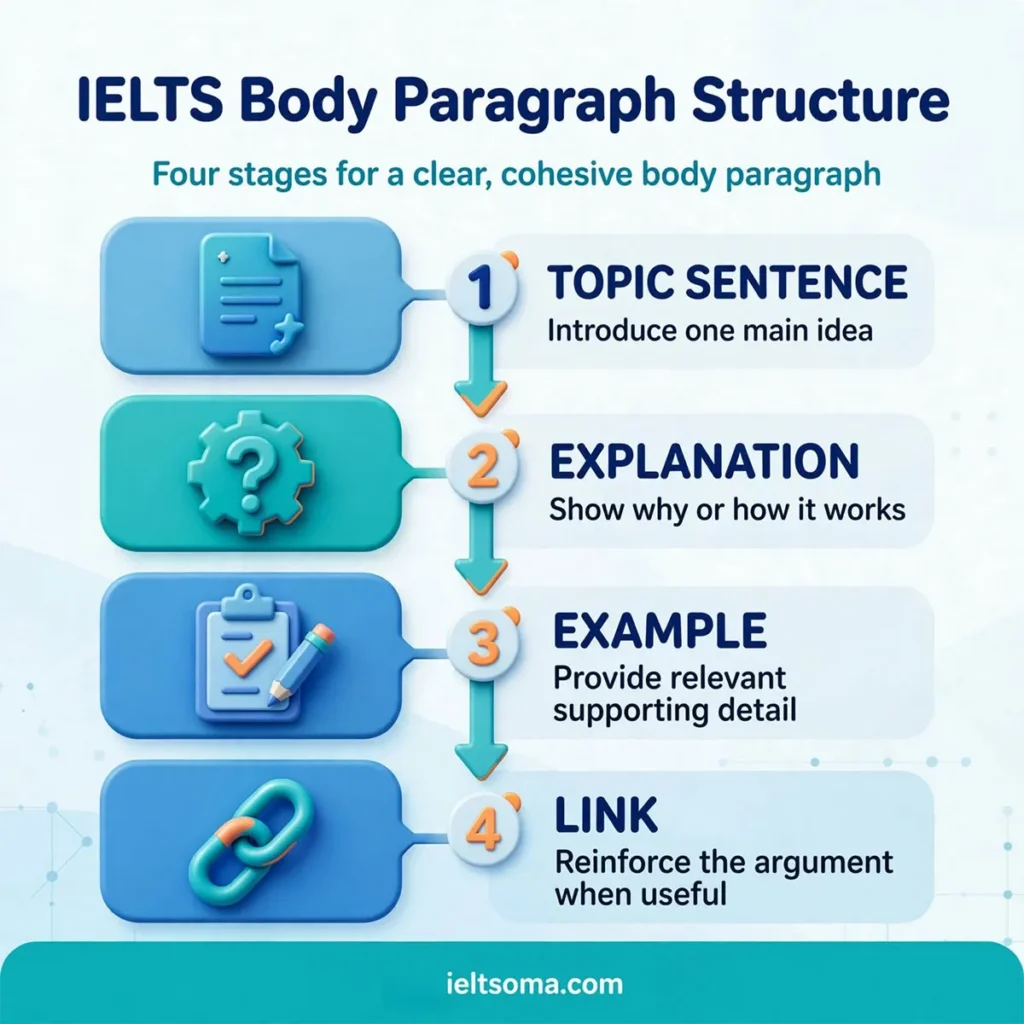
A practical IELTS Writing body paragraph structure contains four elements: a topic sentence, an explanation, supporting evidence or an example, and a concluding or linking sentence where useful.
You do not have to include all four as separate sentences in every paragraph. They are building blocks, not a rigid formula.
A. Topic sentence: Introduce the main idea
The topic sentence tells the reader what the paragraph will discuss. It should relate directly to the essay question and contribute to your position or response.
Example:
One major advantage of investing in public transport is that it can reduce traffic congestion in large cities.
This sentence presents one specific benefit. The reader can anticipate that the paragraph will explain how public transport reduces congestion.
Avoid vague openings such as:
There are many advantages to this idea.
This tells the reader very little and does not identify the paragraph’s central point.
B. Explanation: Show why the idea makes sense
After introducing the main idea, explain how or why it is true. This is the stage many candidates neglect.
Example:
When reliable buses and trains are affordable and accessible, more commuters may choose them instead of driving individual cars. Consequently, fewer private vehicles need to use busy roads during peak hours.
The explanation creates a logical connection between public transport and reduced congestion.
You can develop an idea by explaining its cause, mechanism, consequence, significance or practical implications.
C. Example or supporting detail: Make the idea concrete
Examples help demonstrate how your argument works in practice. They can be hypothetical, general or based on familiar situations, provided they are relevant and plausible.
Example:
For instance, if a city increases the frequency of trains on routes connecting residential areas with business districts, commuters may find it easier to leave their cars at home.
This example illustrates the point without requiring a complicated statistic or a named research study.
You do not need to invent percentages, research findings or expert quotations to make your argument convincing. A clear explanation supported by a relevant example is often sufficient.
D. Link or concluding sentence: Reinforce the paragraph’s purpose
A final sentence can summarise the reasoning or connect it to the essay question.
Example:
Therefore, improving public transport can help cities manage congestion more effectively than relying exclusively on road expansion.
This reinforces the paragraph’s argument. However, a linking sentence is not compulsory if the preceding explanation already completes the point naturally.
The complete structure in action
Topic sentence: One major advantage of investing in public transport is that it can reduce traffic congestion in large cities.
Explanation: When reliable buses and trains are affordable and accessible, more commuters may choose them instead of driving individual cars. Consequently, fewer private vehicles need to use busy roads during peak hours.
Example: For instance, increasing train frequency on routes between residential areas and business districts may encourage more workers to leave their cars at home.
Link: Therefore, improving public transport can help cities manage congestion more effectively.
Notice how every sentence contributes to one central argument. That unity is essential to effective paragraph development.
3. How to Develop Ideas in an IELTS Essay
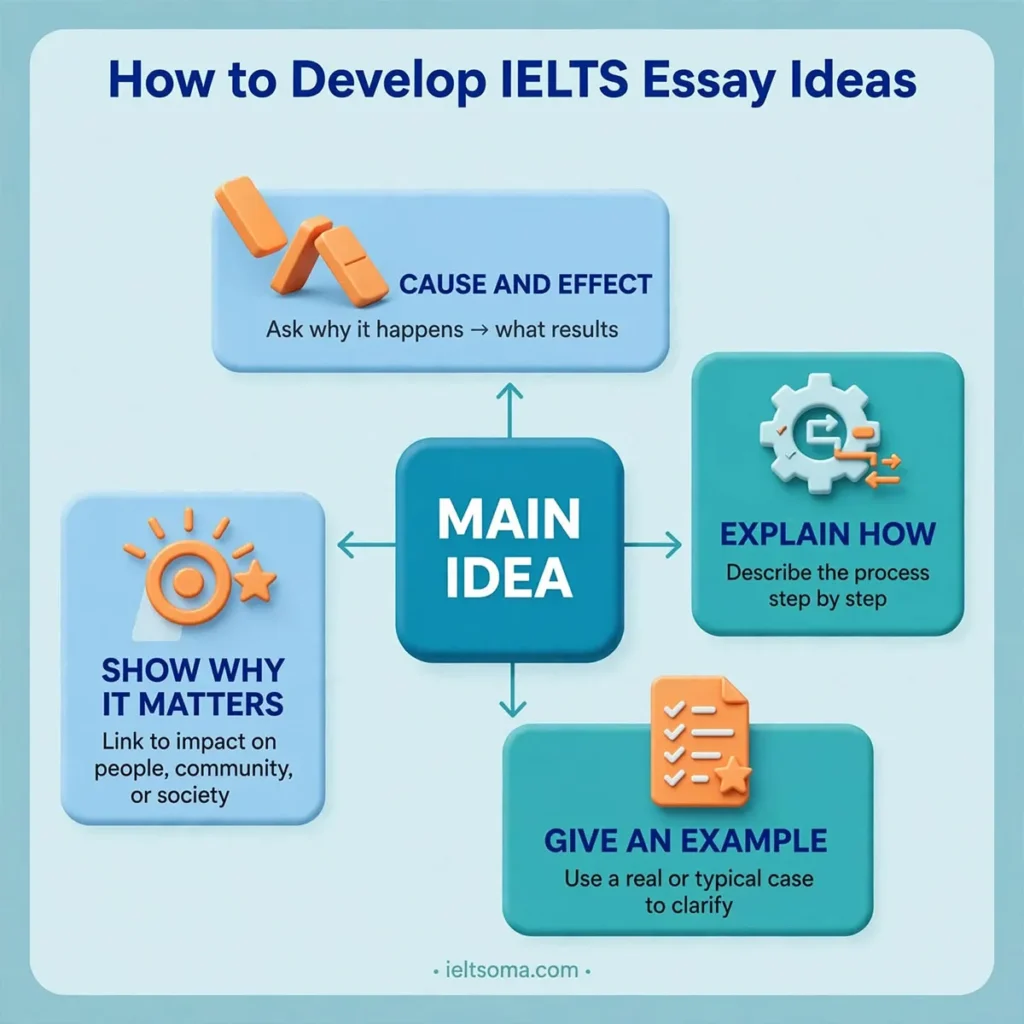
Knowing how to develop ideas in an IELTS essay is more valuable than memorising long lists of linking phrases. Your goal is to move from a simple statement to a convincing explanation.
Use the following five techniques.
Technique 1: Explain the cause and effect
Ask yourself two questions:
- Why does this happen?
- What happens as a result?
Suppose your main idea is that school sports benefit students.
A basic statement is:
Sport is good for students.
A developed explanation is:
Regular participation in sport can improve students’ physical fitness and give them opportunities to practise teamwork. These experiences may also help them cooperate more effectively during group assignments.
The second version explains the benefits and shows how one benefit may lead to another.
Technique 2: Explain the mechanism
A mechanism describes how something produces a particular result.
For example:
Online learning can make education more accessible because students can attend lessons without travelling to a physical classroom. This flexibility may be especially useful for people who live far from educational institutions or need to combine study with employment.
The paragraph explains the process connecting online learning with accessibility.
Technique 3: Compare alternatives
Comparison is useful when the question asks you to discuss advantages and disadvantages, evaluate two approaches or express a preference.
For example:
Although private cars offer flexibility, reliable public transport can carry more passengers using limited road space. For this reason, improving bus and rail services may be a more practical way to manage congestion in densely populated areas.
The comparison supports a clear argument rather than simply listing two options.
Technique 4: Use a relevant example
Examples make abstract ideas easier to understand.
Main idea: Flexible working arrangements can benefit employees.
Development:
Employees who can adjust their working hours may be better able to manage childcare responsibilities or attend appointments. For example, a parent who starts work earlier may be able to collect a child from school without reducing their working hours.
The example illustrates the benefit. It does not introduce a new argument unrelated to the topic.
Technique 5: Explain the wider significance
Sometimes, an argument becomes more convincing when you show why the point matters.
For example:
Teaching financial literacy at school can help teenagers understand budgeting, saving and borrowing before they begin managing their own money. This early knowledge may help them make more informed financial decisions as adults.
The final sentence explains the broader importance of the original idea.
Expert tip: After writing each main point, ask, “Why does this matter?” If you cannot answer that question clearly, the paragraph may need more development.
4. Seven Powerful Tips for Better IELTS Writing Body Paragraphs
Tip 1: Give each paragraph one central purpose
A paragraph should develop one main idea rather than contain several unrelated arguments.
Suppose you are discussing the disadvantages of working from home. One paragraph could focus on social isolation, while another discusses difficulties separating professional and personal responsibilities.
Combining isolation, transport costs, environmental protection and workplace productivity in one paragraph would make the argument harder to follow.
You can include supporting details that relate to the same main point, but each detail should contribute to that point.
Tip 2: Answer the exact question
A well-developed paragraph can still be ineffective if it does not address the task.
If the question asks whether you agree or disagree, your paragraphs should support your position. If it asks you to discuss both views and give your opinion, you must address both perspectives and make your own position clear.
Before writing a paragraph, identify which part of the question it answers.
For example, a question about whether university education should be free cannot be fully answered by discussing the general benefits of education. Your paragraph must connect those benefits to the issue of tuition fees or access to university.
Tip 3: Explain before adding another idea
Candidates sometimes write several short claims without developing any of them.
Weak development:
Exercise improves health. It reduces stress. It helps people lose weight. It is good for everyone.
Better development:
Regular exercise can improve physical health by strengthening muscles and supporting cardiovascular fitness. It may also help people manage stress because physical activity provides an opportunity to relax and establish a healthy routine.
The improved version explains two related benefits instead of simply listing them.
Tip 4: Use linking words selectively
Linking expressions help readers understand relationships between ideas, but they cannot replace logical development.
Useful expressions include:
- Adding a related point: Furthermore, In addition
- Explaining a reason: This is because, One reason for this is
- Showing a result: Consequently, As a result
- Introducing an example: For example, For instance
- Showing contrast: However, In contrast
- Conceding a point: Although, Even though
Do not begin every sentence with a linking phrase. Often, a clear relationship between two sentences is enough.
For example, “This can reduce commuting time” may connect naturally to the preceding sentence without requiring “Therefore” or “Consequently”.
Tip 5: Support your ideas with specific details
Specific explanations are usually more convincing than broad claims.
Weak:
Technology has many benefits for education.
Stronger:
Educational platforms allow students to review recorded lessons and revisit difficult concepts at their own pace. This can be particularly helpful when learners need additional time to understand complex material.
The stronger version identifies a practical benefit and explains its relevance.
Tip 6: Use vocabulary you can control
Complex vocabulary is useful when it expresses your meaning accurately. However, an unfamiliar word used incorrectly can make an argument less clear.
Compare:
Public transport facilitates the amelioration of vehicular congestion.
with:
Reliable public transport can reduce the number of cars on busy roads.
The second sentence communicates the idea more directly. You should prioritise precision, natural collocations and grammatical control rather than replacing familiar words with unnecessarily complicated alternatives.
Tip 7: Check the paragraph’s internal logic
Read each paragraph independently and ask:
- Is the main idea clear?
- Does every sentence relate to it?
- Have I explained why the idea is valid?
- Is the example relevant?
- Does the reasoning make sense from beginning to end?
If a sentence does not contribute to the central argument, remove it or move it to a more appropriate paragraph.
5. IELTS Writing Body Paragraph Examples
The following examples demonstrate how paragraph development changes according to the question type. They are illustrative model answers, not official IELTS examiner responses or guaranteed band-score samples.
Example 1: Agree or disagree essay
Question: Some people believe that public libraries are no longer necessary because information is available online. To what extent do you agree or disagree?
Model body paragraph:
One reason public libraries remain valuable is that they provide access to educational resources for people who cannot afford reliable internet access or personal devices. Although online information is widely available, accessing it may require a suitable device, a stable connection and sometimes a paid subscription. Public libraries can offer computers, internet access, books and a quiet environment for study at little or no direct cost to visitors. For example, students from low-income households may use library facilities to research assignments and prepare for examinations. Therefore, libraries can help reduce inequalities in access to information, even as digital resources become more common.
Why it works:
- The topic sentence presents one clear argument.
- The explanation identifies practical barriers to online access.
- The example demonstrates how libraries can help a particular group.
- The final sentence links the argument to the wider issue.
Example 2: Discuss both views essay
Question: Some people think children should begin formal education at a very young age, while others believe they should start school later. Discuss both views and give your opinion.
Model body paragraph:
Those who support an early start to formal education argue that children can develop foundational academic skills before reaching primary school. Structured activities may introduce basic literacy, numeracy and classroom routines, helping children become familiar with learning in a group. For instance, age-appropriate lessons involving stories, counting and simple problem-solving can encourage children to practise these skills in a supportive setting. However, the value of early education depends partly on how it is delivered; activities that are too demanding may not suit every child’s developmental needs. Consequently, early education is most useful when it balances foundational learning with play and social development.
Why it works:
The paragraph develops the argument in favour of early education while acknowledging a relevant limitation. The qualification adds nuance without abandoning the paragraph’s central focus.
In an actual essay, you would also need to discuss the opposing view and give a clear overall opinion.
Example 3: Advantages and disadvantages essay
Question: More people are working from home rather than travelling to an office. What are the advantages and disadvantages of this development?
Model body paragraph:
A significant advantage of working from home is that it can reduce the time and money employees spend commuting. Workers who no longer travel to an office every day may save on public transport fares, fuel and parking, while also gaining more time for family responsibilities or personal activities. For example, someone who previously spent an hour travelling in each direction could use some of that time for exercise, childcare or additional rest. These savings may improve work-life balance, particularly for employees with long commutes. Nevertheless, the extent of the benefit depends on individual circumstances, including home-working costs and the nature of the job.
Why it works:
The paragraph follows one main advantage from the initial claim through explanation and an illustrative example. The final qualification prevents the argument from sounding universal.
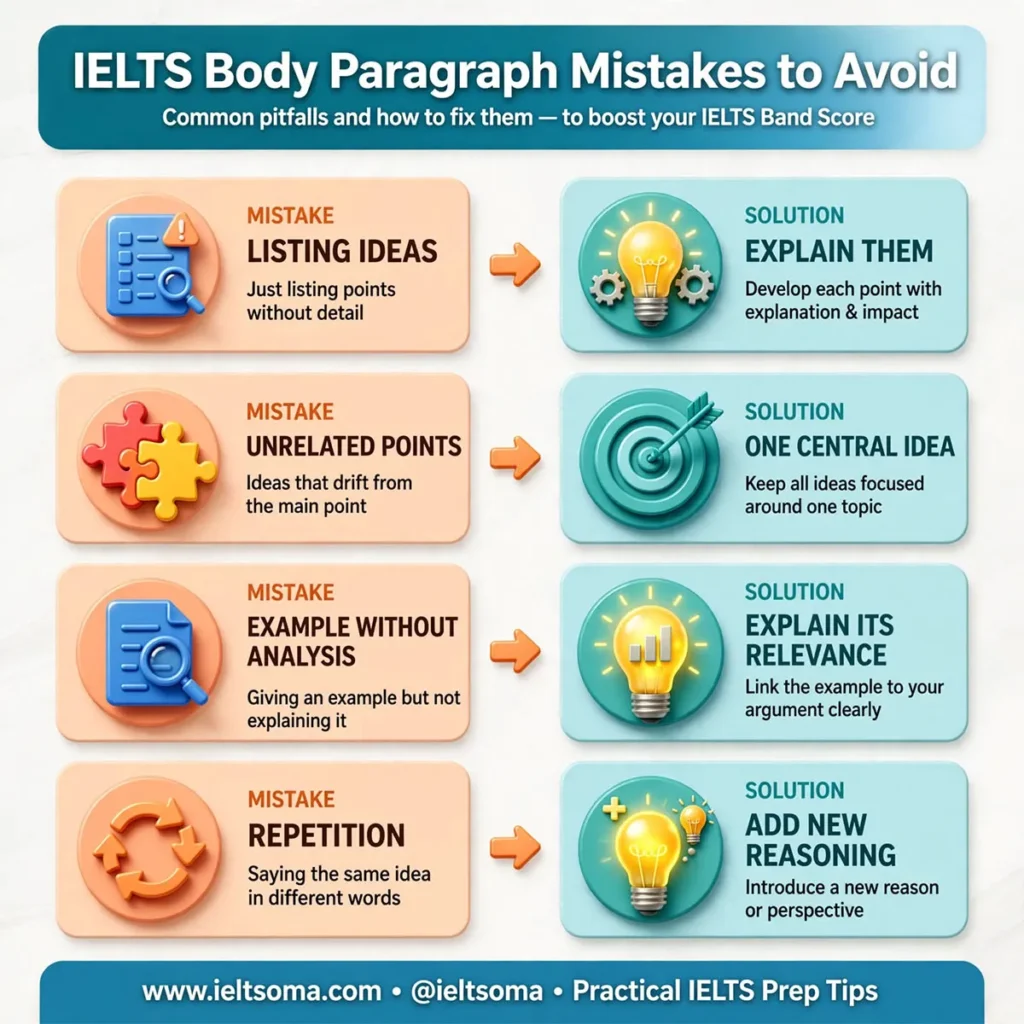
6. Common Mistakes in IELTS Writing Body Paragraphs
Avoid these frequent problems when preparing for IELTS Writing Task 2.
| Mistake | Why it weakens the paragraph | How to improve it |
|---|---|---|
| Listing ideas without explanation | The argument remains superficial | Explain the cause, mechanism or consequence |
| Including several unrelated points | The paragraph loses unity | Focus on one central idea |
| Giving an example without explaining it | The relevance may be unclear | Connect the example to your argument |
| Repeating the topic sentence | The paragraph makes little progress | Add new reasoning or supporting detail |
| Using memorised phrases mechanically | The writing may sound unnatural or fail to answer the question | Choose expressions that fit the actual relationship between ideas |
| Making unsupported absolute claims | The argument may be too broad | Use appropriately qualified language |
| Adding irrelevant information | The paragraph drifts away from the task | Check each sentence against the question |
Another common problem is assuming that a longer paragraph is automatically better. Length does not guarantee development. A concise paragraph with a clear argument and convincing explanation can be more effective than a much longer paragraph filled with repetition.
7. How Long Should an IELTS Body Paragraph Be?
There is no official fixed word count for an IELTS Writing Task 2 body paragraph.
As a practical starting point, many candidates can aim for approximately 80–120 words per paragraph when writing an essay of around 250–300 words. This is a planning guideline, not an IELTS scoring rule.
Your paragraph length should depend on the question, the number of ideas required and how much explanation each idea needs.
A simple essay plan might look like this:
| Essay section | Approximate word count |
|---|---|
| Introduction | 40–50 |
| Body paragraph 1 | 90–110 |
| Body paragraph 2 | 90–110 |
| Conclusion | 30–40 |
| Total | 250–310 |
Do not force every paragraph to reach an exact number of words. If your argument is complete in 85 words, adding repetitive sentences merely to reach 100 words is unlikely to help.
Likewise, if a paragraph requires additional explanation to answer the question fully, do not cut an important point just to follow a target length.
8. How Body Paragraphs Affect Your IELTS Writing Band Score
IELTS Writing is assessed using four criteria: Task Response, Coherence and Cohesion, Lexical Resource, and Grammatical Range and Accuracy.
Body paragraphs contribute to all four, although each criterion measures a different aspect of your writing.
- Task Response: Your paragraphs need to address the question and develop relevant main ideas with appropriate support.
- Coherence and Cohesion: Ideas should follow a logical order, and relationships between sentences should be clear.
- Lexical Resource: You need an appropriate range of vocabulary, used accurately and naturally.
- Grammatical Range and Accuracy: Your sentences should demonstrate suitable grammatical variety and control.
A paragraph with sophisticated vocabulary but weak reasoning does not automatically demonstrate strong writing. Similarly, excellent organisation cannot fully compensate for an essay that fails to address the task.
For detailed assessment information, consult the official IELTS Writing band descriptors. Use them to understand the published assessment criteria rather than relying on memorized paragraph formulas.
9. A Simple Planning Method for Exam Day
When time is limited, you need a repeatable process that helps you generate and organise ideas quickly.
Use this five-step method before writing each body paragraph.
Step 1: Identify the paragraph’s purpose.
Decide which part of the question the paragraph will answer.
Step 2: Write one main idea.
Express the central argument in a single sentence.
Step 3: Ask why or how.
Add one or two sentences explaining the reasoning behind your point.
Step 4: Add supporting detail.
Use a relevant example, consequence, comparison or practical explanation if it strengthens the argument.
Step 5: Check the connection.
Make sure the paragraph supports your overall position and does not introduce an unrelated argument.
For example, if your point is that cycling infrastructure can improve urban transport, your plan might be:
- Main idea: Dedicated cycle lanes can encourage more people to cycle.
- Explanation: Safer routes reduce cyclists’ exposure to motor traffic.
- Example: Protected lanes connecting residential areas with workplaces may make cycling a more practical commuting option.
- Link: This can reduce dependence on cars for some journeys.
You can prepare this outline in a few minutes and then turn it into a coherent paragraph.
10. Frequently Asked Questions About IELTS Writing Body Paragraphs
How many body paragraphs should I write in IELTS Writing Task 2?
Two well-developed body paragraphs are a practical choice for many essays. However, there is no official requirement to write exactly two. Choose a structure that answers every part of the question and allows you to develop your ideas clearly within the available time.
What is the correct IELTS Writing body paragraph structure?
A useful structure is a topic sentence followed by an explanation and relevant supporting detail or an example. A concluding or linking sentence can be added when it helps complete the argument. The structure should remain flexible enough to suit different essay questions.
How do I write IELTS body paragraphs if I have few ideas?
Start with one relevant point rather than trying to generate several sophisticated arguments. Ask why the point is true, how it works, who it affects and what consequences it creates. These questions often reveal enough material to develop a clear paragraph.
Do I need examples in every body paragraph?
No. Examples can make arguments clearer, but they are not compulsory in every paragraph. A precise explanation, comparison or logical consequence may provide sufficient support. Use examples when they add meaningful detail rather than inserting them mechanically.
Can I use personal examples in IELTS Writing Task 2?
You can use a personal or hypothetical example if it is relevant and supports your argument. However, you should not let a personal anecdote replace a proper explanation. The focus should remain on answering the question rather than narrating an unrelated experience.
How long should an IELTS Writing body paragraph be?
There is no official paragraph word limit. Approximately 80–120 words can be a useful planning range for many candidates, but the paragraph should be long enough to develop its main idea and concise enough to avoid repetition.
How can I improve my IELTS Writing body paragraphs quickly?
Practice developing one main idea at a time. Write a topic sentence, explain the reasoning, add relevant support and review the paragraph for clarity. When checking your work, focus on logical development and relevance before trying to replace ordinary vocabulary with more complex expressions.
Are linking words necessary in every sentence?
No. Linking words should clarify relationships between ideas, not decorate every sentence. Overusing expressions such as “Furthermore”, “Moreover” and “Therefore” can make your writing repetitive. Use them where they genuinely improve the flow.
Final Checklist: Are Your Body Paragraphs Ready?
Before moving to the next paragraph, check the following:
- The paragraph addresses the essay question.
- The opening sentence introduces one clear main idea.
- The main idea is explained rather than merely stated.
- Supporting details or examples are relevant.
- The sentences follow a logical order.
- Vocabulary and linking expressions are natural.
- The paragraph does not repeat the same point unnecessarily.
- The argument supports my overall position.
Strong IELTS Writing body paragraphs are built through clear thinking, relevant explanations and careful organisation—not by memorising a fixed formula. Practise turning simple ideas into well-supported arguments, and review how each sentence contributes to the paragraph’s purpose.
With consistent practice, you can make your essays easier to follow, develop your arguments more effectively and demonstrate the writing skills IELTS examiners assess.
Further Reading: