Have you ever understood an IELTS essay question but struggled to think of anything to write? You are not alone. Many candidates know enough English to express their opinions, yet lose valuable time trying to invent convincing arguments.
IELTS Writing brainstorming is the skill of generating, selecting and organising relevant ideas before you begin writing. You do not need extraordinary knowledge, complicated arguments or impressive statistics. You need a reliable method for finding two or three sensible points and explaining them clearly.
In IELTS Writing Task 2, your ideas must answer the question, support your position and develop logically. Spending a few minutes planning can help you avoid repetition, organise your paragraphs and finish within the time limit.
This guide explains seven practical IELTS Writing brainstorming techniques, shows you how to use them with real essay-style questions, and provides a timed exercise to help you practice generating ideas under exam conditions.
Table of Contents
What Is IELTS Writing Brainstorming?
IELTS Writing brainstorming is the process of producing possible arguments, reasons, examples and solutions in response to an essay question before deciding which points to include in your answer.
For example, consider this question:
Some people believe that public transport should be free in cities. To what extent do you agree or disagree?
You might initially think of several ideas:
- Free transport could reduce traffic congestion.
- People on low incomes could travel more easily.
- Governments would need to find money to cover operating costs.
- Services might become overcrowded if demand increased.
You do not need to use every idea. Instead, choose the strongest points that support your position and can be explained with relevant examples.
The purpose of brainstorming is not to produce a long list. It is to find enough relevant material to build a clear, well-supported essay.
Why Is Brainstorming Important in IELTS Writing Task 2?
IELTS Writing Task 2 requires you to respond to a point of view, argument or problem in at least 250 words. You have approximately 40 minutes for the task, so spending too long searching for ideas can leave insufficient time for writing and checking.
Effective brainstorming helps you:
- Answer the question accurately: You identify what the examiner is asking instead of writing generally about the topic.
- Develop stronger arguments: You can explain why a point matters rather than simply listing opinions.
- Avoid repetition: Each body paragraph can have a distinct central idea.
- Improve coherence and cohesion: Your arguments follow a logical order.
- Manage your time: A brief plan gives you a clear direction before you start writing.
Brainstorming does not directly guarantee a higher band score. Its value is that it supports the skills assessed in IELTS Writing Task 2, particularly Task Response and Coherence and Cohesion, while helping you express your ideas accurately.
7 Smart IELTS Writing Brainstorming Techniques
You do not need to use all seven methods for every question. Learn them, experiment with them during practice, and select the technique that helps you generate relevant ideas most quickly.
1. Use the 5W1H Method to Generate Ideas for IELTS Essays
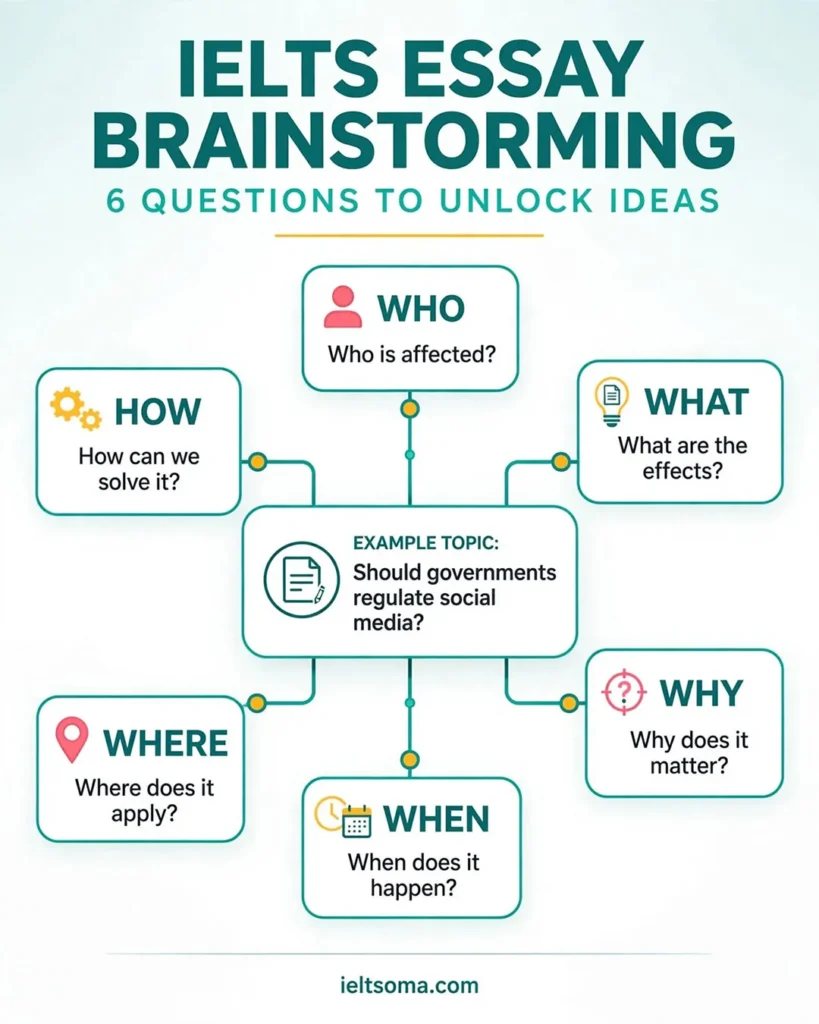
The 5W1H method uses six questions to explore a topic:
- Who? Who is affected by the issue?
- What? What is happening or what could change?
- Why? Why does the issue occur?
- When? When is the issue most relevant?
- Where? Where does the problem occur?
- How? How could the situation improve?
This technique is particularly useful when you cannot think of ideas for an IELTS essay because the topic initially seems too broad.
Example question:
Many people believe that children should spend less time using electronic devices. Do you agree or disagree?
Apply the questions:
| Question | Possible idea |
|---|---|
| Who? | Children, parents and teachers |
| What? | Excessive screen time |
| Why? | Entertainment and educational activities increasingly use screens |
| When? | During evenings and before bedtime |
| Where? | At home and in schools |
| How? | Set reasonable limits and encourage outdoor activities |
Now select the ideas that directly support your opinion.
If you agree that children should reduce recreational screen time, you could develop two arguments: excessive use may reduce physical activity, and using devices late at night may interfere with healthy sleep routines.
You do not need to include all six categories in your essay. They are prompts for generating ideas, not a required essay structure.
Best for: Education, technology, health, family life and social issues.
2. Use the Cause–Effect–Solution Technique
Many IELTS questions concern social problems, environmental challenges, education, employment or public health. For these topics, think about causes, consequences and possible solutions.
Create three short lists:
- Causes: Why does the problem happen?
- Effects: What happens as a result?
- Solutions: What could individuals, organisations or governments do?
Example question:
Traffic congestion is becoming a serious problem in many cities. What are the causes of this problem, and what measures can be taken to solve it?
| Causes | Effects | Solutions |
|---|---|---|
| Heavy reliance on private cars | Longer commuting times | Improve public transport |
| Urban population growth | Increased air pollution | Encourage car-sharing |
| Limited transport alternatives | Lost working hours | Develop safer cycling routes |
Choose one or two causes and one or two realistic solutions, depending on the question’s requirements.
You can then develop a cause-and-effect chain:
More people rely on private cars → more vehicles occupy the roads → traffic moves more slowly → commuters spend longer travelling.
This chain gives you material for a complete paragraph because each point explains the next.
Be careful, however: if a question asks only for your opinion, do not automatically write a causes-and-solutions essay. Always follow the actual instructions.
Best for: Problem–solution essays, causes-and-effects questions and environmental or urban issues.
3. Think About Individuals, Society and Government
When you cannot think of ideas for an IELTS essay, change your perspective. Ask how the issue affects three different levels:
- Individuals: How does it affect people’s lives, choices, money, health or opportunities?
- Society: What are the consequences for communities, businesses or social equality?
- Government: What responsibilities, policies or public services are involved?
Example question:
Some people think that university education should be free for everyone. To what extent do you agree or disagree?
| Perspective | Possible argument |
|---|---|
| Individuals | Free tuition reduces the financial burden on students |
| Society | More people may gain access to skilled professions |
| Government | Funding universal free tuition requires public money |
Suppose you partly disagree with the idea that university should be free for everyone. You could argue that financial support should prioritise students from low-income households because they face the greatest barriers to higher education.
This approach helps you identify more than one side of a debate without forcing you to include every possible argument.
Best for: Government policy, education, public spending, healthcare and social equality.
4. Use the Advantages and Disadvantages Method
When a question asks you to discuss both views or evaluate the advantages and disadvantages of something, divide your brainstorming page into two columns.
Example question:
More employees are being allowed to work from home. Do the advantages outweigh the disadvantages?
| Advantages | Disadvantages |
|---|---|
| Less time spent commuting | Reduced face-to-face interaction |
| Greater flexibility | Difficulty separating work and home life |
| Potential savings on travel | Some jobs require physical attendance |
Next, evaluate the points rather than merely counting them.
For example, saving commuting time might allow employees to spend more time with their families. However, remote work may also make communication more difficult for teams that depend on frequent collaboration.
Your task is to decide which side has the stronger arguments and explain why.
Remember that an advantages-and-disadvantages question may require a judgement about which side outweighs the other. Your plan must make that judgement clear if the question asks for it.
Best for: Technology, employment, online learning, urban living and modern lifestyles.
5. Generate Ideas Through Examples From Everyday Life
You do not need to be an expert in politics, economics, medicine or environmental science to write a convincing IELTS essay.
Start with familiar situations: your education, workplace, local community, public transport, shopping habits or experiences with technology.
Example question:
Some people believe that schools should teach practical skills, such as cooking and managing money, rather than concentrating mainly on academic subjects. Do you agree or disagree?
Think about everyday situations:
- Young adults may leave home without knowing how to prepare affordable meals.
- Students who understand budgeting may manage their first salaries more responsibly.
- Academic subjects remain essential for careers that require specialised knowledge.
These observations can become relevant arguments when you explain their significance.
For instance:
Teaching basic financial management at school could help young adults make more responsible spending decisions. Students who understand budgeting, saving and borrowing may be better prepared to manage their money when they begin earning independently.
This is stronger than simply writing, “Money skills are useful.”
You can use a realistic hypothetical example if you do not have a personal experience to describe. Avoid inventing statistics, named research studies or supposedly factual events to make your argument appear more authoritative.
Best for: Education, work, family, health, money and lifestyle topics.
6. Use Mind Mapping to Explore a Broad Topic
Mind mapping is a visual brainstorming technique. Write the main topic in the centre of a page and add branches for related ideas.
For example, the topic technology might have these branches:
- Education: online learning, digital resources, unequal access
- Employment: remote work, automation, productivity
- Communication: instant contact, reduced face-to-face interaction
- Health: medical advances, sedentary lifestyles
- Environment: energy consumption, electronic waste
When you encounter a technology-related question, you can explore the relevant branches instead of starting from nothing.
However, do not treat a mind map as a ready-made essay. A branch such as “online learning” is only a topic. You must turn it into an argument that answers the question.
For example:
Online learning can make education more accessible because students in remote areas may attend lessons without travelling long distances.
This statement provides a clear argument and a reason that you can develop further.
Best for: Broad topics that appear in many IELTS essay questions, including technology, education, the environment and society.
7. Use the Idea–Reason–Example Method
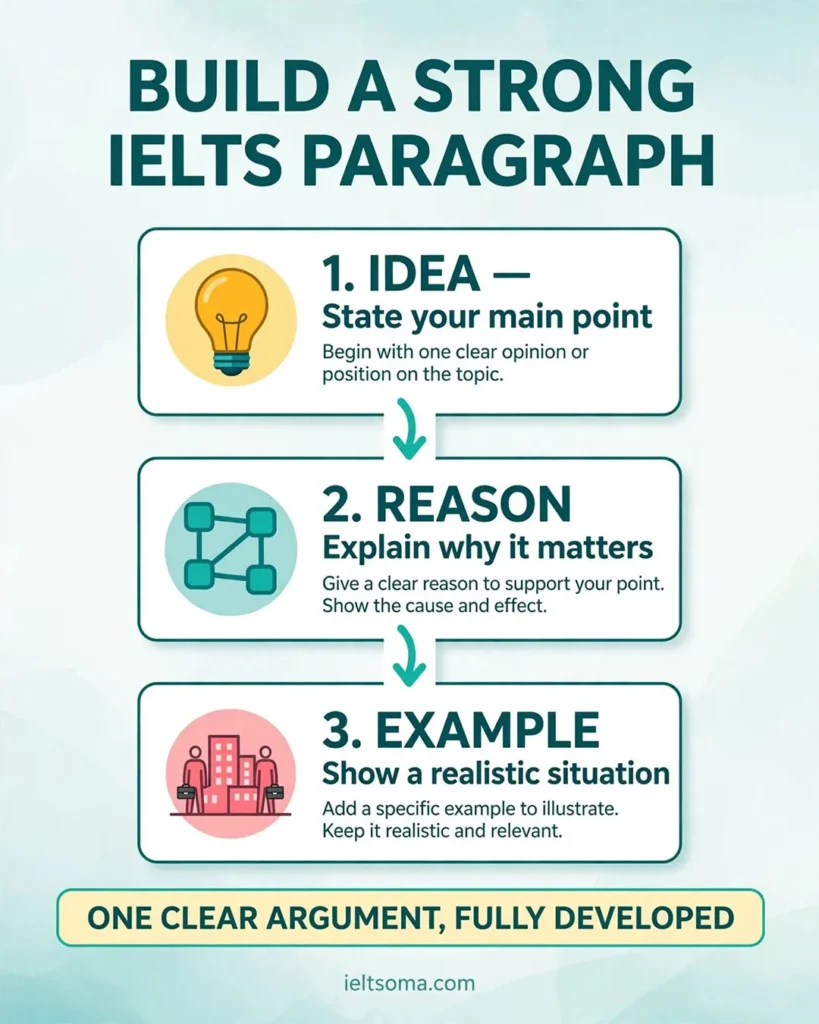
Generating an idea is only the first step. You also need to develop it into a convincing paragraph.
Use this simple structure:
- Idea: State your main argument.
- Reason: Explain why it is true or important.
- Example: Illustrate the argument with a relevant situation.
You can also add a consequence or implication if it strengthens the explanation.
Example question:
Some people believe that public libraries are no longer necessary because people can access information online. Do you agree or disagree?
Idea: Public libraries remain valuable because not everyone has reliable internet access.
Reason: People from disadvantaged backgrounds may lack suitable devices, affordable connectivity or a quiet place to study.
Example: A student who shares a computer with several family members may use a local library to access online learning resources and complete assignments.
Result: Libraries can help reduce unequal access to educational opportunities.
These notes can become a developed body paragraph:
Public libraries remain valuable because they provide access to educational resources for people who cannot afford suitable technology at home. Although information is widely available online, not everyone has a reliable internet connection or a quiet place to study. For example, a student who shares a computer with several family members may depend on a local library to research assignments and complete online lessons. Libraries can therefore help reduce inequalities in access to education.
Notice how the paragraph develops one central argument rather than introducing several unrelated ideas.
Best for: Almost every IELTS Writing Task 2 question, especially when you have ideas but struggle to explain them fully.
How to Brainstorm for Different IELTS Essay Question Types
Different questions require different kinds of thinking. Identify the task before selecting your brainstorming method.
| Essay question type | What to brainstorm | Useful technique |
|---|---|---|
| Agree or disagree | Reasons supporting your position | Individuals, society and government |
| Discuss both views | Arguments for each view and your position | Advantages and disadvantages |
| Advantages and disadvantages | Benefits, drawbacks and their relative importance | Two-column comparison |
| Problems and solutions | Causes, effects and practical measures | Cause–effect–solution |
| Two-part question | Separate ideas for each question | 5W1H |
| Positive or negative development | Benefits, risks and overall judgement | Advantages and disadvantages |
The question type guides your planning, but it does not dictate your opinion. Read the complete prompt, identify every instruction, and brainstorm only ideas that help answer it.
The official IELTS guidance on understanding Writing Task 2 questions is useful for learning how to interpret prompts and avoid memorized answers that do not address the task.
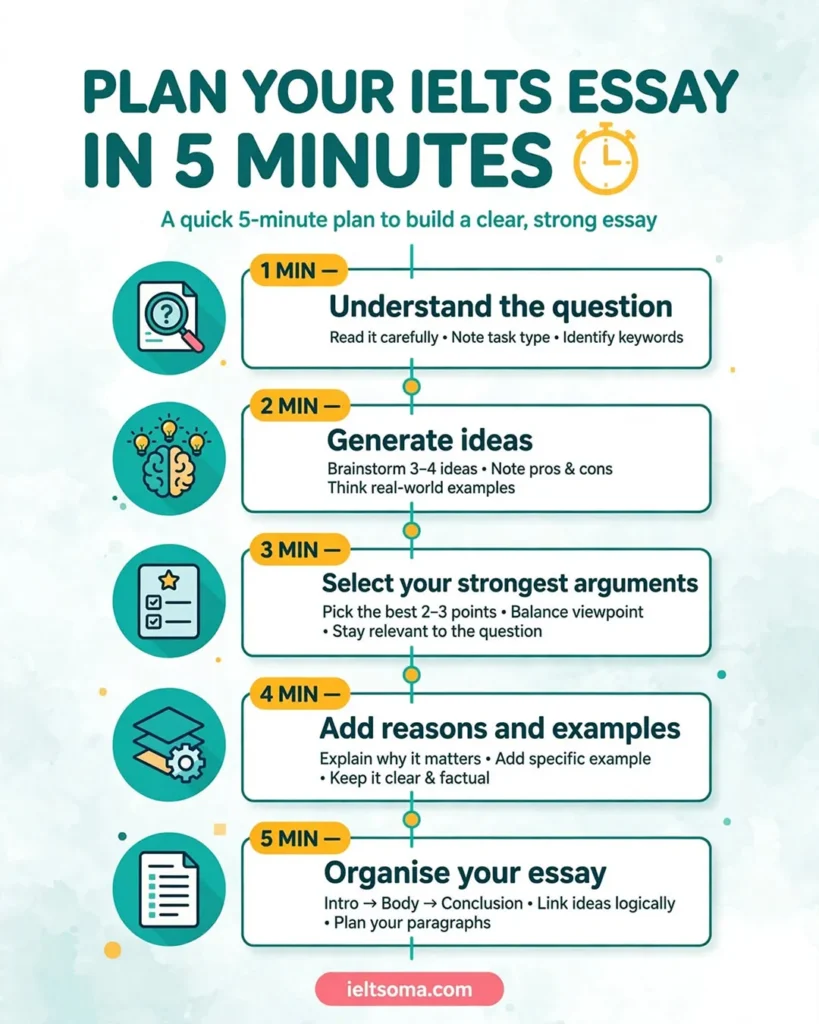
A 5-Minute IELTS Writing Brainstorming Plan
You do not need to spend ten or fifteen minutes planning a single essay. Practise generating a focused plan in approximately five minutes, then adjust your timing according to your writing speed.
Minute 1: Understand the question
Underline the topic, instruction words and every part of the task.
For example:
Some people think that governments should spend more money on public parks and sports facilities than on entertainment venues. To what extent do you agree or disagree?
Identify the key issue: how governments should allocate public money between recreational facilities.
Minute 2: Generate possible ideas
Write short notes without trying to form perfect sentences.
- Parks: exercise, mental well-being, community activities
- Sports facilities: healthier lifestyles, access for young people
- Entertainment venues: cultural events, tourism, local employment
- Costs: construction, maintenance and public demand
Minute 3: Select your strongest arguments
Choose the points that best support your position.
Suppose you largely agree with prioritising parks and sports facilities.
- Argument 1: They can encourage physical activity and improve public health.
- Argument 2: They can provide accessible recreational spaces for families and young people.
You might acknowledge that entertainment venues also benefit communities, but you do not need to develop every possible point.
Minute 4: Add explanations and examples
Expand your two arguments:
- Parks and sports facilities → more opportunities for exercise → potentially healthier communities.
- Free or affordable public spaces → more opportunities for children and families to participate in recreation → broader community access.
A realistic example could involve a neighbourhood park offering a safe place for children to play and adults to exercise without paying for private membership.
Minute 5: Organise the essay
Prepare a short outline:
- Introduction: Paraphrase the question and state your position.
- Body paragraph 1: Public health benefits.
- Body paragraph 2: Accessibility and community benefits, with a brief acknowledgement of entertainment venues.
- Conclusion: Restate why public recreational facilities deserve greater priority.
You now have a direction for your essay without writing the entire response during the planning stage.
What to Do When You Cannot Think of Ideas for an IELTS Essay
Sometimes a topic feels unfamiliar, or your mind goes blank despite understanding the question. Instead of panicking, use this recovery process.
Step 1: Simplify the question.
Rewrite it in everyday English. If the question asks whether governments should invest more in public transport, think: “Would better buses and trains benefit people enough to justify the cost?”
Step 2: Identify who is affected.
Consider students, parents, employees, businesses, older people or local communities. Choose only the groups relevant to the question.
Step 3: Ask why the issue matters.
Think about time, money, health, safety, opportunity, convenience, equality or the environment. These are starting points, not automatic arguments.
Step 4: Think of one realistic situation.
Imagine how the policy or issue could affect an ordinary person. A concrete situation often reveals a useful argument.
Step 5: Choose the easiest relevant idea to explain.
The strongest essay idea is not necessarily the most original. A straightforward point that you can explain logically is often more useful than a complicated argument you cannot develop accurately in English.
For example, if you cannot think of sophisticated arguments about renewable energy, you could explain how solar power may reduce reliance on fossil fuels while acknowledging that installing renewable energy systems can be expensive.
You do not need specialist scientific knowledge to develop that point sensibly.
Common IELTS Brainstorming Mistakes to Avoid
1. Generating too many ideas
A long list can become a distraction. If you have eight possible arguments but only enough time to develop two properly, select the strongest two.
2. Writing ideas that do not answer the question
A question about whether university education should be free is not an invitation to discuss education in general. Every main argument must help answer the specific question.
3. Choosing complicated ideas you cannot explain
An argument involving complex economic policy may sound impressive, but it is not useful if you cannot explain it clearly. Prioritise relevance, logic and accurate language.
4. Repeating the same argument in different words
“Public transport is cheap”, “buses save money” and “people spend less on travelling” may express essentially the same point. Develop one argument fully rather than presenting these as three separate ideas.
5. Confusing an example with an explanation
An example illustrates your point; it does not always explain why the point is valid. State the argument, explain its logic, and then provide an example when useful.
6. Memorising complete essays
Memorised essays can fail to address the actual question. Prepare flexible topic vocabulary, common arguments and brainstorming techniques instead of trying to predict the exact essay you will receive.
7. Spending too long planning
Brainstorming should make writing easier, not consume the entire task. Use a timer during practice and move to writing once you have a clear position and enough material for your main paragraphs.
A 7-Day Practice Plan to Improve IELTS Writing Brainstorming
The best way to improve is to practise generating ideas separately from writing complete essays. This lets you build speed without having to produce 250 words every time.
| Day | Practice task | Target |
|---|---|---|
| 1 | Brainstorm three education questions | Find two relevant arguments per question |
| 2 | Practise 5W1H on technology topics | Generate at least five possible ideas |
| 3 | Use cause–effect–solution for environmental issues | Find two causes and two solutions |
| 4 | Brainstorm both sides of social questions | Produce two arguments for each side |
| 5 | Turn notes into Idea–Reason–Example outlines | Develop two complete paragraph plans |
| 6 | Complete three timed brainstorming exercises | Finish each plan in about five minutes |
| 7 | Write one full Task 2 essay | Use your plan and review the finished essay |
After each exercise, ask yourself:
- Did I answer every part of the question?
- Are my arguments relevant and distinct?
- Can I explain each point clearly?
- Have I included a realistic example where it helps?
- Can I organise the ideas into logical paragraphs?
Keep a notebook of recurring topics and the arguments you discover through practice. Review it to build familiarity, but always adapt your ideas to the wording of the actual question.
IELTS Writing Brainstorming Practice Question
Try the following question without looking at the sample plan first.
Question:
Some people believe that children should learn how to manage money at school. Others think this should be the responsibility of parents. Discuss both views and give your own opinion.
Set a timer for five minutes. Write brief notes under these headings:
- View 1: Schools should teach money management.
- View 2: Parents should teach money management.
- My opinion: Which approach is more effective, or should both contribute?
- Examples: What practical situation could support each view?
Sample brainstorming notes
Schools should teach it
- Structured lessons can teach budgeting, saving and responsible borrowing.
- All students can access basic financial education, regardless of their home circumstances.
- Example: Students practise planning a monthly budget using a limited income.
Parents should teach it
- Children can learn through everyday spending decisions.
- Parents can explain financial choices in the context of their family’s circumstances.
- Example: A parent helps a teenager compare prices and save for a purchase.
My position
- Both have useful roles.
- Schools can provide consistent foundational knowledge, while parents can reinforce it through everyday experience.
These notes provide enough material for an essay that discusses both views and states a clear position. During practice, compare your own ideas with the sample and ask whether your arguments are relevant, logical and sufficiently developed.
FAQs About IELTS Writing Brainstorming
1. How can I generate ideas quickly for an IELTS essay?
Read the question carefully, identify its main issue, and use a simple technique such as 5W1H, cause–effect–solution or individuals–society–government. Choose two strong, relevant arguments and briefly note how you will explain them.
2. How long should I spend brainstorming in IELTS Writing Task 2?
Aim to spend approximately five minutes planning a Task 2 essay during practice. The exact time depends on your writing speed but leave enough time to write at least 250 words and check your response within the recommended 40-minute allocation.
3. What should I do if I cannot think of ideas for an IELTS essay?
Simplify the question, identify who is affected, and consider consequences involving health, money, time, education, safety or opportunity. Choose an ordinary situation that illustrates your point rather than searching for an advanced or unusual argument.
4. Do IELTS essay ideas need to be original?
No. Your arguments do not need to be unique or groundbreaking. They should be relevant to the question, logically explained and supported appropriately. Clear development matters more than trying to impress the examiner with an unusual opinion.
5. Can I use personal examples in IELTS Writing Task 2?
Yes, when they are relevant and help explain your argument. You can also use realistic hypothetical examples. The priority is to support your point clearly rather than inventing personal experiences or statistics.
6. Should I brainstorm both sides of every IELTS essay question?
Not necessarily. For a question asking whether you agree or disagree, you can develop a clear position without giving equal space to the opposing view. For a question explicitly asking you to discuss both views, you must address both sides.
7. Is brainstorming more important than vocabulary in IELTS Writing?
They serve different purposes. Brainstorming helps you select and organize relevant ideas, while vocabulary helps you express them precisely. A strong essay needs both clear reasoning and appropriate language, alongside effective organization and grammatical accuracy.
8. Can I prepare IELTS essay ideas before the exam?
Yes. Practicing common themes such as education, technology, health, the environment, employment and government spending can help you generate ideas faster. However, use your preparation as a flexible knowledge base rather than memorizing complete essays that may not answer the question.
Final Thoughts: Make Brainstorming a Habit
Effective IELTS Writing brainstorming is not about thinking of as many ideas as possible. It is about finding a few relevant arguments, selecting the strongest ones and developing them logically.
Start by practising the 5W1H method, cause–effect–solution and Idea–Reason–Example. Use a timer, keep your notes brief, and focus on arguments you can explain accurately.
With regular practice, you can spend less time staring at the question and more time writing a clear, well-organised essay.
Your next step: Choose one IELTS Writing Task 2 question today and spend five minutes brainstorming before writing anything. Review whether your two strongest ideas answer the question directly and can each support a complete body paragraph. Repeat this exercise with different topics until the process becomes familiar.
Further Reading: