Using idiomatic expressions for IELTS Writing can make your vocabulary more flexible and natural, but only when the expressions genuinely fit the context. Memorising a long list of colourful idioms and forcing them into every essay is not a reliable way to achieve a higher band score.
For IELTS Writing, the better approach is to understand which expressions are appropriate for formal or semi-formal writing, what they actually mean, and how to use them accurately.
The official IELTS Writing criteria assess Lexical Resource partly through the range, accuracy and appropriacy of vocabulary, including collocations, idiomatic expressions and sophisticated phrasing. At Band 7, candidates demonstrate some ability to use less common or idiomatic items, while Band 8 descriptors refer to skilful use of uncommon and/or idiomatic items when appropriate.
That last phrase — “when appropriate” — is crucial.
Table of Contents
Are Idiomatic Expressions Useful in IELTS Writing?
Yes, but they should be used selectively.
An idiomatic expression is a phrase whose meaning cannot always be understood simply by interpreting each individual word. For example, “a double-edged sword” describes something that has both advantages and disadvantages.
However, IELTS Writing is not a test of how many idioms you can remember.
Examiners assess your overall ability to communicate ideas accurately and appropriately. Lexical Resource considers vocabulary range, precision, appropriacy, collocations, idiomatic expressions and the effect of vocabulary errors on communication.
This means that one well-used expression can be more valuable than five unnatural ones.
Compare:
The widespread use of social media is a double-edged sword because it provides useful information but can also create serious distractions.
This is appropriate for an argumentative essay.
Now compare it with:
Social media is a piece of cake and people should bite the bullet to use it.
The second sentence contains idiomatic language, but the expressions do not communicate the intended ideas naturally.
The goal is not to sound idiomatic. The goal is to sound precise, natural and appropriate.
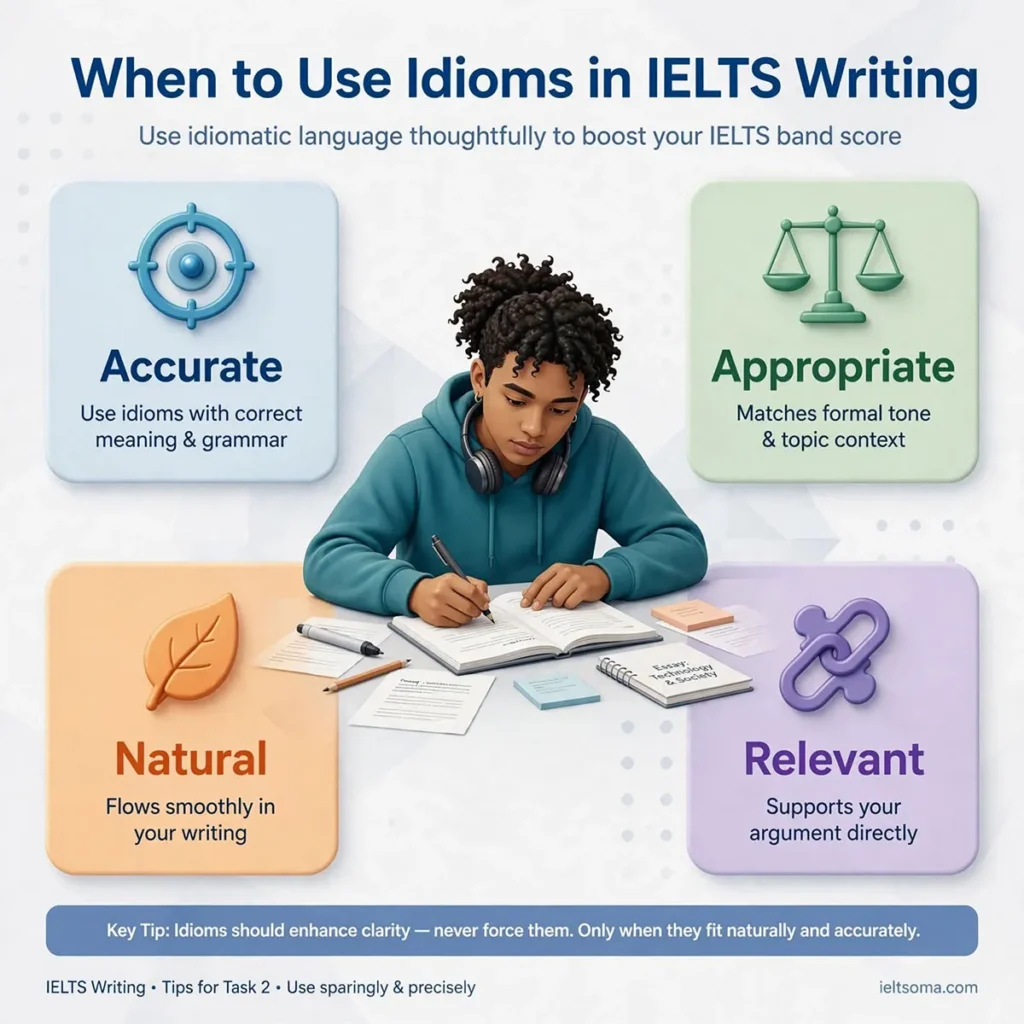
25 Idiomatic Expressions for IELTS Writing
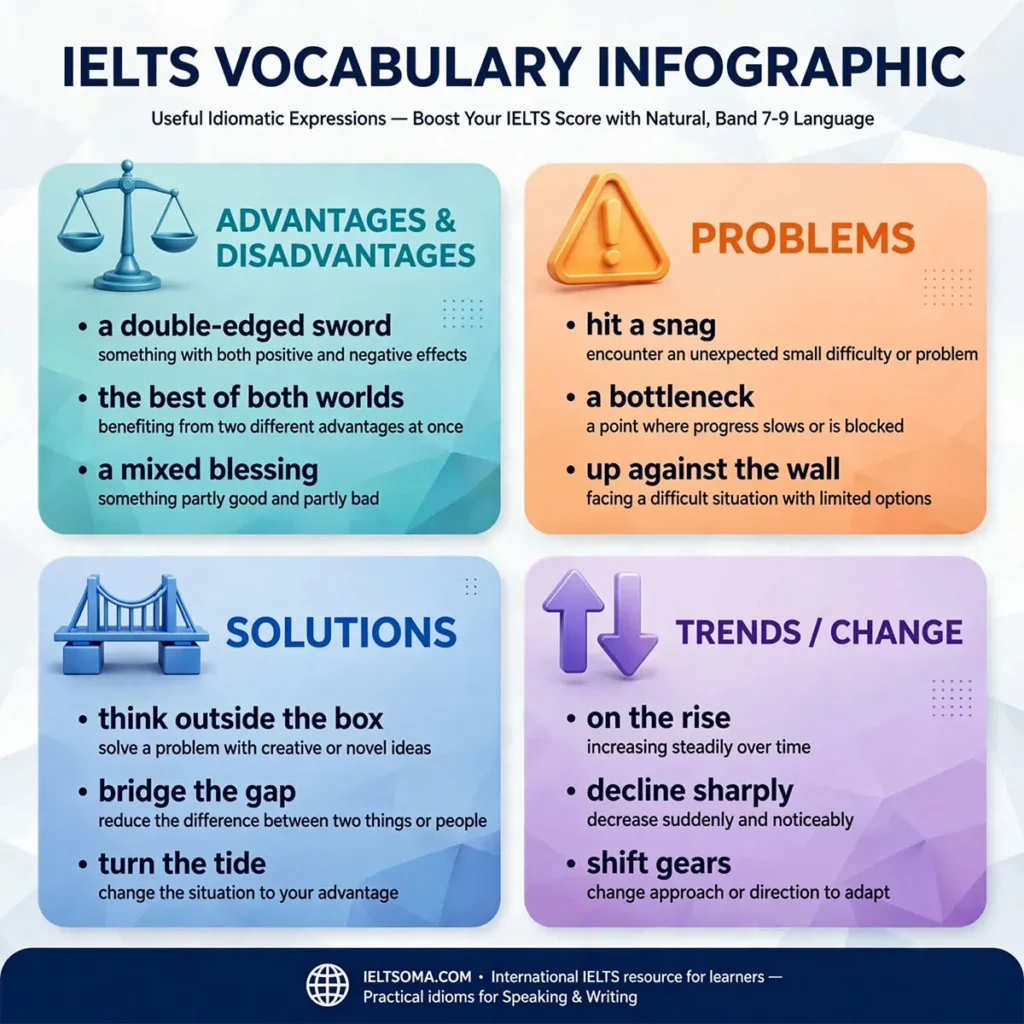
The following expressions can be useful in appropriate contexts, particularly in IELTS Writing Task 2. They should not be treated as compulsory phrases.
| Idiomatic expression | Meaning | Example |
|---|---|---|
| a double-edged sword | something with both advantages and disadvantages | Technology can be a double-edged sword. |
| a growing concern | an issue becoming increasingly worrying | Air pollution is a growing concern in major cities. |
| a blessing in disguise | something that seems negative but produces a positive result | Remote work proved to be a blessing in disguise for some employees. |
| a mixed blessing | something with both positive and negative effects | Urbanisation can be a mixed blessing. |
| a major stumbling block | an important obstacle | High tuition fees can be a major stumbling block for students. |
| the tip of the iceberg | only a small visible part of a larger problem | Unemployment may be only the tip of the iceberg. |
| a vicious cycle | a situation in which one problem causes another | Poverty can create a vicious cycle of poor education and limited employment. |
| a vicious circle | a repeating cycle of negative consequences | Debt and unemployment can form a vicious circle. |
| pave the way for | create conditions that make something possible | Investment in education can pave the way for economic development. |
| go hand in hand | develop or occur together | Economic growth and environmental responsibility should go hand in hand. |
| play a pivotal role | have a very important role | Schools play a pivotal role in developing social skills. |
| at the heart of | at the central point of an issue | Public transport is at the heart of many urban planning debates. |
| a matter of concern | an issue that causes worry | Food security is increasingly a matter of concern. |
| in the long run | over an extended period | Investment in renewable energy may be costly initially but beneficial in the long run. |
| in the short term | over a limited period | The policy may create difficulties in the short term. |
| bear in mind | remember or consider something | Policymakers should bear in mind the needs of low-income families. |
| strike a balance | find an acceptable middle position | Governments must strike a balance between development and conservation. |
| bridge the gap | reduce a difference between two groups or situations | Better education can help bridge the gap between social groups. |
| on the rise | increasing | The number of people working remotely is on the rise. |
| on the decline | decreasing | Some traditional industries are on the decline. |
| a key driving force | an important factor causing change | Technological innovation is a key driving force behind economic growth. |
| at the expense of | achieved by sacrificing something else | Economic development should not occur at the expense of public health. |
| the root cause | the fundamental cause of a problem | Policymakers should address the root causes of homelessness. |
| set the stage for | create conditions for something to happen | Early investment can set the stage for long-term economic growth. |
| stand the test of time | remain effective or successful for a long period | Effective public transport systems can stand the test of time when properly maintained. |
Which Idioms Are Best for IELTS Writing?
Not every common English idiom belongs in an IELTS essay.
Expressions such as “piece of cake”, “break a leg”, “under the weather” and “hit the sack” are common in everyday conversation, but they are generally unsuitable for most formal IELTS Writing Task 2 essays.
Instead, prioritise expressions that naturally occur in academic, professional or analytical contexts.
For example:
Less suitable:
Governments need to bite the bullet and solve this problem.
More appropriate:
Governments need to take decisive action to address this problem.
The second sentence is not an idiom, but it may be a better choice because it is precise, formal and directly communicates the argument.
This distinction matters because IELTS assesses whether vocabulary is appropriate for the task and context, not whether it sounds impressive. British Council guidance similarly emphasises vocabulary variety, collocation, word formation, precision and contextual understanding.
Idiomatic Expressions for IELTS Writing Task 2
Task 2 is where idiomatic expressions are most likely to be useful.
You may be discussing education, technology, health, the environment, employment, transport, crime or another social issue. Carefully selected expressions can help you express relationships between ideas.
1. For discussing advantages and disadvantages
Use:
- a double-edged sword
- a mixed blessing
- at the expense of
Example:
Artificial intelligence is a double-edged sword: it can increase productivity while also creating uncertainty about employment.
This expression works because the sentence clearly presents two opposing consequences.
2. For discussing problems
Useful expressions include:
- a growing concern
- the root cause
- a major stumbling block
- the tip of the iceberg
- a vicious cycle
Example:
The rising cost of housing is a growing concern, particularly among younger adults.
Or:
Treating the symptoms of poverty without addressing its root causes is unlikely to produce lasting improvements.
These expressions can help you describe problems without relying repeatedly on words such as problem, issue and difficulty.
3. For discussing solutions
Consider:
- pave the way for
- bridge the gap
- set the stage for
- strike a balance
Example:
Expanding access to vocational education could pave the way for greater employment opportunities.
Another example:
Governments should strike a balance between economic growth and environmental protection.
The important point is that the expression supports the idea rather than replacing it.
Idiomatic Expressions for IELTS Writing Task 1
Task 1 requires greater caution.
In Academic Writing Task 1, you describe visual information such as graphs, charts, tables, diagrams or processes. The language should be objective and precise.
Idioms are rarely necessary when describing data.
Instead of trying to write:
The percentage of car users went through the roof.
write:
The percentage of car users increased dramatically.
Similarly:
The number of visitors was on the rise.
may be acceptable in some contexts, but:
The number of visitors increased steadily.
is often more precise when the chart actually shows a steady increase.
What about General Training Task 1?
General Training Task 1 involves writing a letter, and the appropriate style depends on whether the situation is personal, semi-formal or formal.
This gives you slightly more flexibility.
For example, in a personal letter, conversational expressions may be more natural. However, in a formal complaint or request, informal idioms should generally be avoided.
The question itself should determine your tone.
Formal Alternatives to Common Informal Idioms
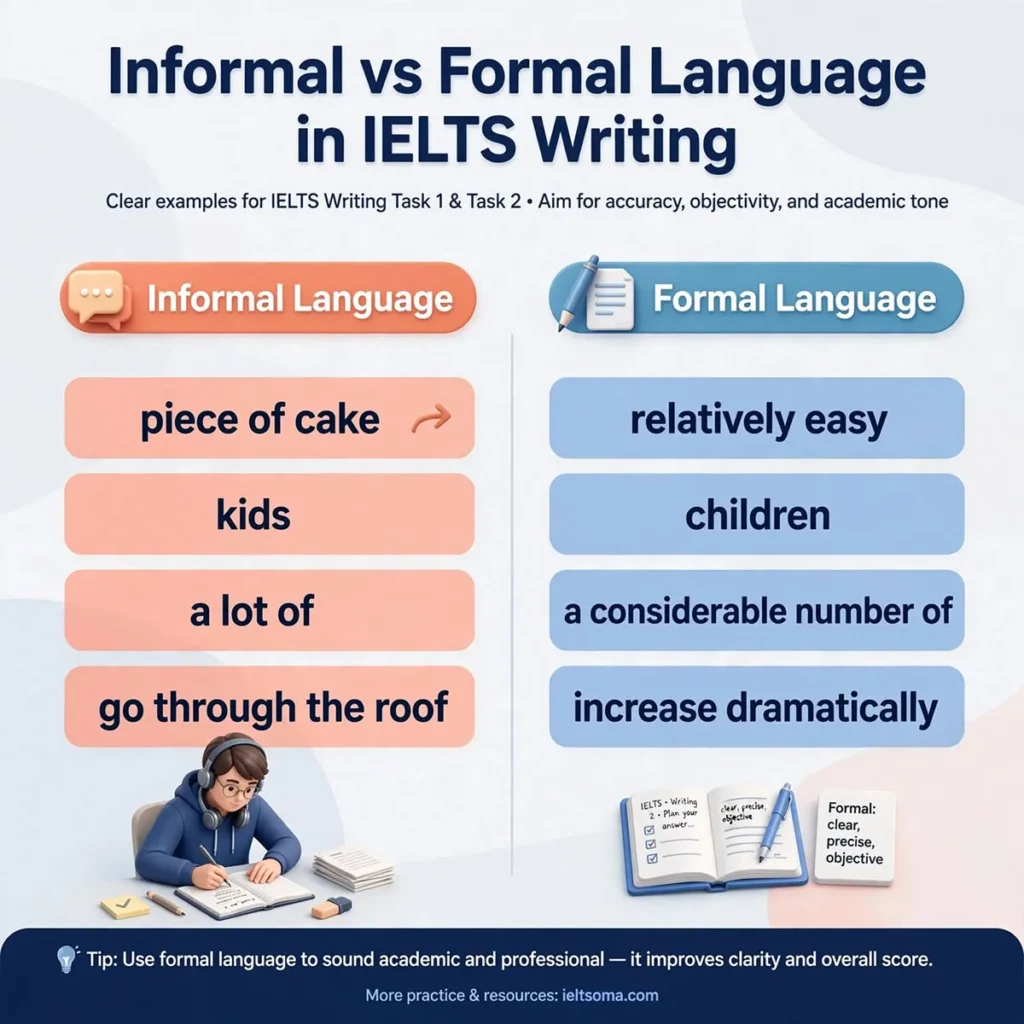
If you know an informal idiom but are unsure whether it belongs in your essay, replace it with a precise formal expression.
| Informal expression | Better IELTS alternative |
|---|---|
| a piece of cake | relatively easy |
| kids | children |
| a lot of | a considerable number/amount of |
| hit the nail on the head | identify the issue accurately |
| the bottom line | the main consideration |
| in a nutshell | in summary |
| a tough nut to crack | a difficult problem |
| go through the roof | increase dramatically |
| call it a day | stop the activity |
| get the ball rolling | initiate the process |
This does not mean informal idioms are always grammatically wrong. The issue is appropriacy.
IELTS Writing evaluates whether your vocabulary suits the task and topic. Official IELTS guidance specifically identifies appropriacy, precision and collocation as important aspects of Lexical Resource.
How Many Idiomatic Expressions Should You Use?
There is no official rule saying that you must use a particular number of idioms.
This is one of the most important things IELTS candidates should understand.
You will not automatically receive a higher score because you have inserted three, five or ten idiomatic expressions.
The official Band 7 descriptor refers to some ability to use less common and/or idiomatic items, while Band 8 refers to skilful use of uncommon and/or idiomatic items when appropriate.
Therefore, quality matters more than quantity.
For a 250–300-word Task 2 essay, one or two genuinely natural expressions may be enough. You might use none if the topic does not provide a natural opportunity.
A well-written essay with precise vocabulary is stronger than an essay filled with memorised idioms.
How to Use Idioms Naturally
Follow these five steps.
Step 1: Understand the exact meaning
Do not memorise an expression without understanding it.
For example, “a double-edged sword” does not simply mean “something good”.
It describes something that has both beneficial and harmful effects.
Step 2: Learn the grammatical pattern
Some expressions have fixed structures.
For example:
at the expense of + noun/gerund
Correct:
Economic growth should not occur at the expense of environmental protection.
Not:
Economic growth should not occur at the expense environmental protection.
Understanding the structure reduces grammatical errors.
Step 3: Learn common collocations
An expression should be learned with the words that naturally surround it.
For example:
strike a balance between A and B
bridge the gap between A and B
pave the way for + noun/gerund
Learning expressions as complete patterns is often more useful than memorising isolated vocabulary. British Council guidance recommends learning words in combination and paying attention to context because this can reduce errors in word combinations.
Step 4: Check the register
Ask yourself:
Would this expression sound natural in an academic or formal discussion?
If the answer is no, choose another expression.
Step 5: Use it only when it improves the sentence
Before inserting an idiom, ask:
Does this expression make my meaning clearer, more precise or more natural?
If it does not, leave it out.
Common Mistakes with Idiomatic Expressions
1. Memorising entire essays
Some candidates memorise essays containing idioms and attempt to adapt them to every question.
This often produces unnatural writing because the expression does not genuinely belong to the argument.
Build vocabulary around topics and ideas instead.
2. Using too many idioms
An essay containing an idiom in almost every paragraph can sound artificial.
Academic writing generally benefits from controlled vocabulary rather than constant figurative language.
3. Using the wrong meaning
For example, using “a blessing in disguise” to describe something that is entirely positive is incorrect.
The expression implies that something initially appears negative but ultimately produces a benefit.
4. Mixing idioms
Avoid combining parts of different expressions.
For example:
Governments should hit the nail on the ball.
This mixes “hit the nail on the head” with “get the ball rolling”.
The result is incorrect.
5. Translating expressions from your first language
An expression that works naturally in another language may not have an equivalent structure in English.
Direct translation can produce unusual or confusing sentences.
Learn English expressions in English, with examples and context.
6. Choosing an idiom instead of a precise word
If “increase significantly” communicates your meaning better than “go through the roof”, use the former.
IELTS is testing your ability to communicate effectively, not your ability to entertain the examiner.
Idioms vs Collocations: What Should You Learn?
For most IELTS candidates, collocations deserve at least as much attention as idiomatic expressions.
A collocation is a combination of words that naturally occur together.
For example:
- pose a threat
- address an issue
- reach a conclusion
- make a significant contribution
- strong economic growth
- heavy traffic
- renewable energy sources
These combinations can make your writing sound natural without relying on colourful idioms.
British Council IELTS guidance specifically recommends learning words in combination and understanding how vocabulary works in context.
A useful vocabulary strategy is therefore:
Topic vocabulary → collocations → precise synonyms → appropriate idiomatic expressions
rather than:
Long list of idioms → memorise → force into essay
A Better Way to Practise Idiomatic Expressions for IELTS Writing
Use a three-column vocabulary notebook.
| Expression | Meaning | Your example |
|---|---|---|
| strike a balance | find a suitable middle position | Governments must strike a balance between development and conservation. |
| bridge the gap | reduce a difference | Scholarships can bridge the gap between wealthy and disadvantaged students. |
| a double-edged sword | something with positive and negative effects | Social media can be a double-edged sword for young people. |
Then practise each expression in different contexts.
For example, “strike a balance” can be used with:
- economic growth and environmental protection
- work and family life
- public safety and individual freedom
- technological development and privacy
This approach develops flexibility rather than simple memorisation.
A Quick IELTS Writing Exercise
Take this sentence:
Technology has advantages and disadvantages.
Improve it using appropriate vocabulary:
Technology is a double-edged sword, offering substantial benefits while also creating new social and economic challenges.
Now consider the following:
Governments should develop cities but protect the environment.
A stronger version could be:
Governments need to strike a balance between urban development and environmental protection.
The purpose of these changes is not to make the sentence more complicated. It is to make the meaning more precise and natural.
Final Checklist for Using Idioms in IELTS Writing
Before submitting your essay, ask yourself:
- Does the expression fit the topic?
- Do I know its exact meaning?
- Have I used the correct grammatical structure?
- Is the expression appropriate for the level of formality?
- Does it collocate naturally with the surrounding words?
- Does it make my meaning clearer?
- Have I used too many idioms?
- Would a precise non-idiomatic expression be better?
- Have I checked spelling and grammar?
- Does the expression sound natural rather than memorised?
If an idiom fails one of these checks, replace it.
Key Takeaway
Idiomatic expressions for IELTS Writing can strengthen your Lexical Resource, but only when they are accurate, natural and appropriate to the context.
Do not approach idioms as a checklist for achieving Band 7 or Band 8. The official IELTS descriptors do not prescribe a fixed number of idioms. Instead, higher bands require flexible, precise and appropriate vocabulary, with idiomatic or uncommon language used skilfully when suitable.
For most candidates, the best strategy is to master a small collection of useful expressions, learn their grammatical patterns and collocations, and practise applying them to different IELTS topics.
One natural expression is better than five forced ones.
And precise vocabulary is always more valuable than vocabulary that merely looks impressive.
Frequently Asked Questions
Are idiomatic expressions necessary for a high IELTS Writing score?
No. There is no requirement to use a specific number of idioms. Idiomatic expressions are one part of Lexical Resource, which also considers vocabulary range, precision, appropriacy, collocations and errors.
How many idioms should I use in IELTS Writing Task 2?
There is no official number. Use an expression only when it fits naturally. For many essays, one or two appropriate expressions may be sufficient, while some topics may not require idioms at all.
Can idioms improve my IELTS Writing band score?
They can contribute to your Lexical Resource when used accurately and appropriately. However, simply adding idioms does not guarantee a higher score. IELTS assesses your overall vocabulary performance rather than counting idioms.
Should I use idioms in IELTS Academic Writing Task 1?
Usually, idioms should be used very cautiously in Academic Task 1. Precise language for describing trends, comparisons, quantities and processes is generally more appropriate than conversational idioms.
Can I use idioms in General Training Writing Task 1?
It depends on the letter. General Training Task 1 can require personal, semi-formal or formal language, so your vocabulary should match the required tone.
Is “a double-edged sword” good for IELTS Writing?
Yes, when the subject genuinely has both positive and negative consequences. For example, technology, social media and globalisation can sometimes be described as a double-edged sword.
Are informal idioms bad for IELTS?
Not necessarily, but many conversational idioms are unsuitable for formal academic writing. Always consider the task, audience and register before using an expression.
Are collocations more important than idioms?
They are both useful, but candidates should not neglect collocations. Natural word combinations are an important part of vocabulary development, and British Council IELTS guidance recommends learning vocabulary in combination and context.
What is the biggest mistake when using idioms in IELTS?
The biggest mistake is forcing memorised idioms into an essay simply to appear advanced. If an expression sounds unnatural or does not precisely communicate the intended meaning, a simpler and more accurate phrase is usually better.
Further Reading Links:
- Academic Writing Genres for IELTS: 7 Essential Types
- Academic Vocabulary for IELTS: 7 Powerful Ways to Build It
- IELTS Writing Collocation Practice: 25 Powerful Ways to Improve Your Vocabulary
- IELTS Speaking Practice Tips: 15 Powerful Ways to Improve
- IELTS Writing Task Vocabulary: 25 Powerful Words
- IELTS Writing Band Descriptors
- IELTS Writing Key Assessment Criteria