Writing an effective IELTS Writing Task 2 introduction does not require memorising a complicated template. What you need is a clear understanding of the question, a focused response, and a concise statement that tells the examiner what your essay will argue or discuss.
A strong introduction gives your essay direction from the beginning. It shows that you understand the task, establishes your position when required, and prepares the reader for the ideas that will follow.
For both IELTS Academic and General Training, Task 2 requires at least 250 words and should normally take about 40 minutes. The task asks you to respond to a point of view, argument or problem, and your response is assessed partly on how clearly and fully you address the task.
So, how do you write an IELTS Task 2 introduction that is clear, relevant and effective?
The answer is simpler than many candidates think.
Table of Contents
What Is an IELTS Writing Task 2 Introduction?
The introduction is the first paragraph of your essay. Its main purpose is to introduce the topic and show the examiner how you are going to respond to the question.
A good IELTS essay introduction structure usually contains two essential elements:
- A brief introduction to the topic
- A clear thesis statement or position
Depending on the question, you may also briefly indicate the main points that your essay will discuss.
For example, consider this question:
Some people believe that university education should be free for everyone. To what extent do you agree or disagree?
A weak introduction might simply repeat the question:
Some people believe that university education should be free for everyone. This essay will discuss whether university education should be free.
This does not demonstrate much understanding or establish a meaningful position.
A stronger version would be:
Access to higher education is often seen as an important factor in creating equal opportunities in society. Although providing free university education could reduce financial barriers, I believe that governments should prioritise affordable access rather than making all university education completely free.
This introduction gives the reader useful context and, more importantly, establishes the writer’s position.
Why the Introduction Matters in IELTS Writing Task 2
The introduction is only one part of your essay, so it cannot compensate for weak body paragraphs or poor development of ideas. However, it establishes the direction of your entire response.
The official IELTS assessment criteria state that Task Response considers how fully candidates respond to the task, how relevant and well-supported their ideas are, and how clearly they open the discourse and establish their position.
This means your introduction should help answer three questions:
- What is the essay about?
- What exactly is the question asking?
- What is your answer or position?
If the examiner has to guess your position after reading the introduction, the opening is probably not sufficiently clear.
A good introduction therefore acts like a roadmap. It does not need to explain every argument, but it should make the direction of your essay easy to understand.
IELTS Essay Introduction Structure
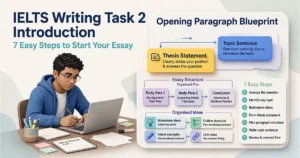
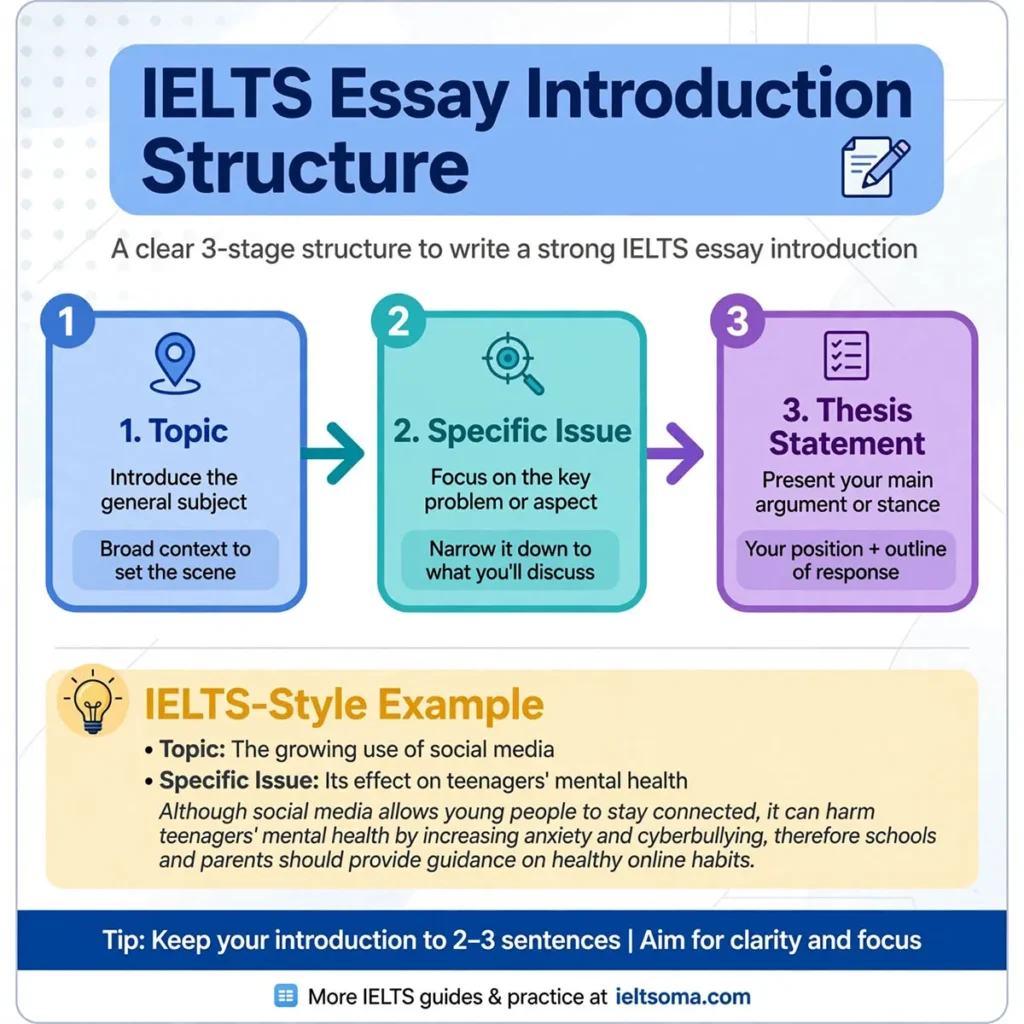
A practical IELTS essay introduction structure can be reduced to this:
Sentence 1: Introduce the topic
Briefly present the subject in your own words.
Sentence 2: Give your thesis statement
State your answer, position, or the main direction of your response.
For some questions, you may use a third sentence to indicate the main areas you will discuss.
Basic structure
Topic → Specific issue → Thesis statement
For example:
The role of technology in education has expanded considerably in recent years. While digital learning provides greater flexibility and access to educational resources, I believe that traditional classroom teaching remains essential because it offers direct interaction and structured support.
The first sentence introduces the general topic.
The second sentence narrows the discussion and provides the position.
That is often enough.
You do not need a long introduction simply because the essay must contain at least 250 words.
How to Write an IELTS Task 2 Introduction
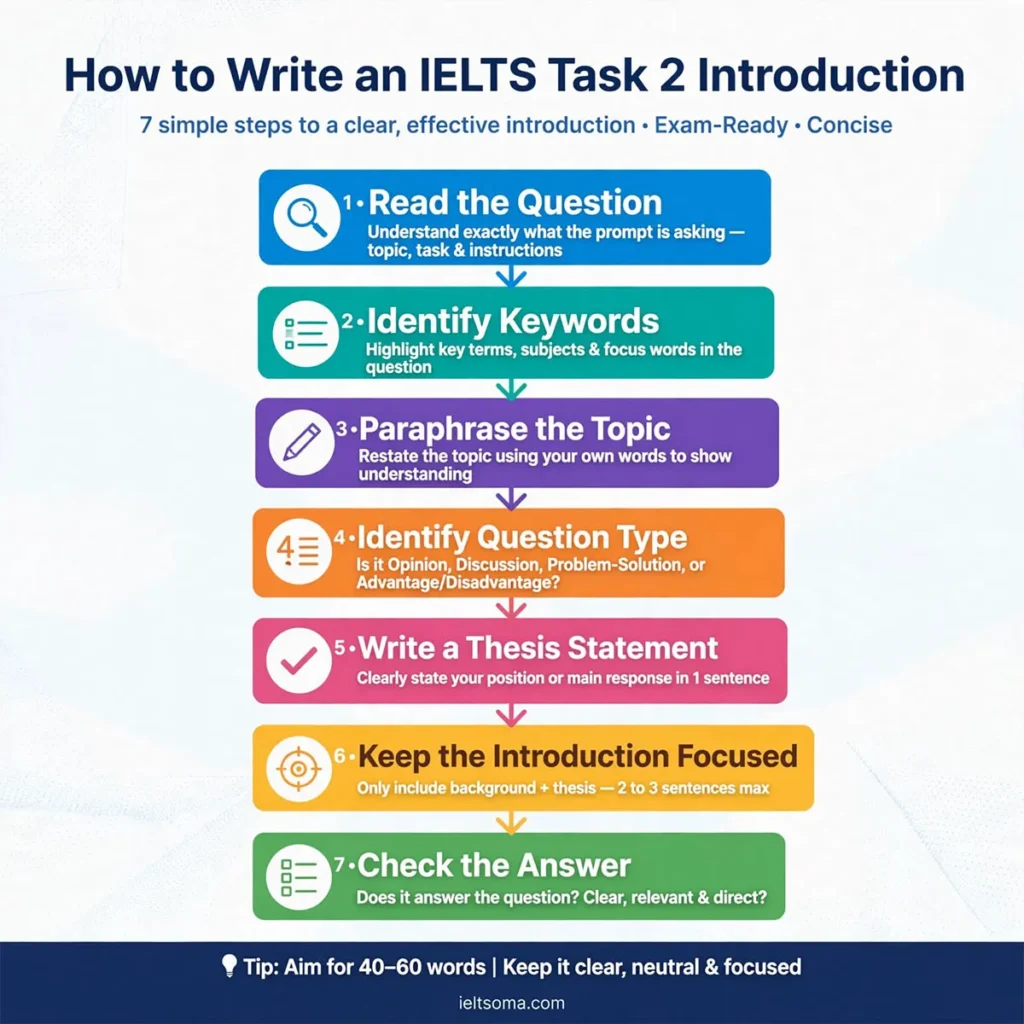
Here is a seven-step method you can use when practising how to write IELTS Task 2 introduction paragraphs.
1. Read the Entire Question Carefully
Before writing anything, identify exactly what the question requires.
Do not begin by automatically writing a memorised introduction.
IELTS Task 2 questions can ask you to:
- agree or disagree with a statement
- discuss both views and give your opinion
- discuss advantages and disadvantages
- discuss causes and solutions
- answer two direct questions
- evaluate a problem or proposed solution
The official IELTS guidance emphasises the importance of reading the prompt carefully and addressing all parts of the task.
For example:
Some people believe that governments should spend more money on public transport rather than building new roads. To what extent do you agree or disagree?
The important information includes:
Topic: government spending
Two alternatives: public transport and new roads
Task: give your degree of agreement or disagreement
Your introduction should reflect that exact task.
2. Identify the Key Words
Underline or mentally identify the words that determine the scope of the question.
For example:
Many people believe that children should begin learning a foreign language at primary school rather than secondary school. Do the advantages of this development outweigh the disadvantages?
Important concepts include:
- children
- foreign language
- primary school
- secondary school
- advantages
- disadvantages
- outweigh
These details determine what your essay should discuss.
Avoid turning a specific question into a general essay about education or language learning.
3. Paraphrase the Topic
The first sentence can introduce the topic using different vocabulary and grammatical structures.
Original:
Many people believe that children should begin learning a foreign language at primary school.
Possible paraphrase:
There is increasing discussion about the appropriate age at which children should begin studying a foreign language.
Notice that the meaning remains the same, but the sentence is not simply copied.
However, do not paraphrase for the sake of changing every word.
A good paraphrase is accurate first and sophisticated second.
4. Identify the Question Type
Before writing your thesis statement, determine exactly what you have been asked to do.
For example:
| Question type | What your introduction should establish |
|---|---|
| Agree/disagree | Your position |
| Discuss both views | The two perspectives + your position if requested |
| Advantages/disadvantages | The focus of the comparison |
| Causes/solutions | The problem and direction of the response |
| Two-part question | The subjects you will answer |
| Positive/negative development | Your overall evaluation |
This step prevents one of the most common IELTS mistakes: writing an introduction that sounds appropriate but does not actually answer the question.
5. Write a Clear Thesis Statement
Your IELTS thesis statement is the most important sentence in many Task 2 introductions.
A thesis statement tells the reader what you believe or what your essay will establish.
For an agree/disagree question:
I largely agree that governments should invest more heavily in public transport because this can reduce congestion and improve access to employment.
For a discussion question:
Although both approaches have advantages, I believe that encouraging people to use public transport is a more sustainable solution.
For a causes-and-solutions question:
This problem is largely caused by rapid urbanisation and inadequate planning, and it can be addressed through better public transport and housing policies.
The thesis does not need to sound dramatic.
It needs to be clear, relevant and defensible.
6. Keep the Introduction Focused
A common mistake is trying to put the entire essay into the introduction.
You do not need to explain your examples, statistics, detailed arguments or conclusions at this stage.
Compare these two approaches.
Overloaded:
There are many reasons why public transport is important, including reducing traffic congestion, lowering pollution, helping poor people travel to work, reducing fuel consumption, improving public health, creating jobs and making cities more attractive, and this essay will discuss all of these issues.
Focused:
Although improving public transport can require substantial investment, I believe it provides greater long-term benefits by reducing congestion and making urban travel more efficient.
The second version gives the reader direction without trying to write the body paragraphs prematurely.
7. Check That Your Introduction Answers the Question
Before moving to Body Paragraph 1, ask yourself:
Have I answered the actual question?
If the question asks:
To what extent do you agree or disagree?
your position should be clear.
If it asks:
Do the advantages outweigh the disadvantages?
you should establish your overall judgement.
If it asks:
What are the causes of this problem and what solutions can you suggest?
your introduction should make it clear that your essay will address both causes and solutions.
This final check takes only a few seconds but can prevent an introduction from going in the wrong direction.
How to Write a Strong IELTS Thesis Statement
An IELTS thesis statement should normally be specific enough to show your position but concise enough to leave room for development in the body paragraphs.
Consider this question:
Some people believe that working from home should become the standard way of working for most employees. To what extent do you agree or disagree?
Weak thesis statement
I agree with this statement.
The position is clear, but the reader learns almost nothing else.
Better thesis statement
I largely agree that working from home should become more common because it can improve flexibility and reduce commuting.
This is much more informative.
Another strong option
Although remote work is not suitable for every occupation, I believe it should become a more common arrangement because it can provide employees with greater flexibility while reducing unnecessary commuting.
This position is nuanced without becoming unclear.
A thesis statement does not have to use phrases such as:
This essay will discuss…
In many cases, directly stating your position sounds more natural and authoritative.
IELTS Task 2 Introduction Examples
Let’s examine several examples to see how the structure changes according to the question.
Example 1: Agree or Disagree
Question:
Some people think that schools should teach children how to manage money. To what extent do you agree or disagree?
Introduction:
Financial decisions affect people throughout their lives, yet many young people receive little formal education about managing money. I strongly agree that schools should teach basic financial skills because this can help students make responsible decisions about saving, spending and borrowing.
The first sentence introduces the issue.
The second establishes the writer’s position and previews the reasoning.
Example 2: Discuss Both Views
Question:
Some people believe that university students should study whatever subjects they are interested in, while others think they should only study subjects that are useful for future employment. Discuss both views and give your own opinion.
Introduction:
University education can be viewed either as an opportunity for personal intellectual development or as preparation for a career. While allowing students to pursue their interests can encourage motivation and creativity, I believe universities should maintain a balance between personal interests and subjects with clear employment opportunities.
This introduction identifies both perspectives and gives an opinion.
Example 3: Advantages and Disadvantages
Question:
More employees are working from home rather than travelling to offices. Do the advantages of this trend outweigh the disadvantages?
Introduction:
Working from home has become increasingly common in many occupations, reducing the need for employees to travel to a central workplace. Although remote working can create communication and collaboration challenges, I believe its advantages, particularly greater flexibility and reduced commuting time, outweigh these disadvantages.
The final sentence directly answers the question.
Example 4: Causes and Solutions
Question:
Many cities are experiencing serious traffic congestion. What are the causes of this problem, and what solutions can you suggest?
Introduction:
Traffic congestion has become a major problem in rapidly growing cities, where the number of private vehicles often increases faster than transport infrastructure. This problem is mainly caused by car-dependent lifestyles and inadequate public transport, but it can be reduced through improved mass transit systems and policies that discourage unnecessary car use.
The introduction identifies both the causes and the direction of the solutions.
Example 5: Two-Part Question
Question:
Many young people spend a large amount of their free time using smartphones. Why is this the case? Is this a positive or negative development?
Introduction:
Smartphones have become a central part of young people’s leisure time because they provide convenient access to entertainment and social interaction. Although these devices can offer educational and social benefits, I believe excessive smartphone use is generally a negative development because it can reduce physical activity and face-to-face interaction.
The writer addresses both parts of the question.
Common Mistakes in an IELTS Writing Task 2 Introduction
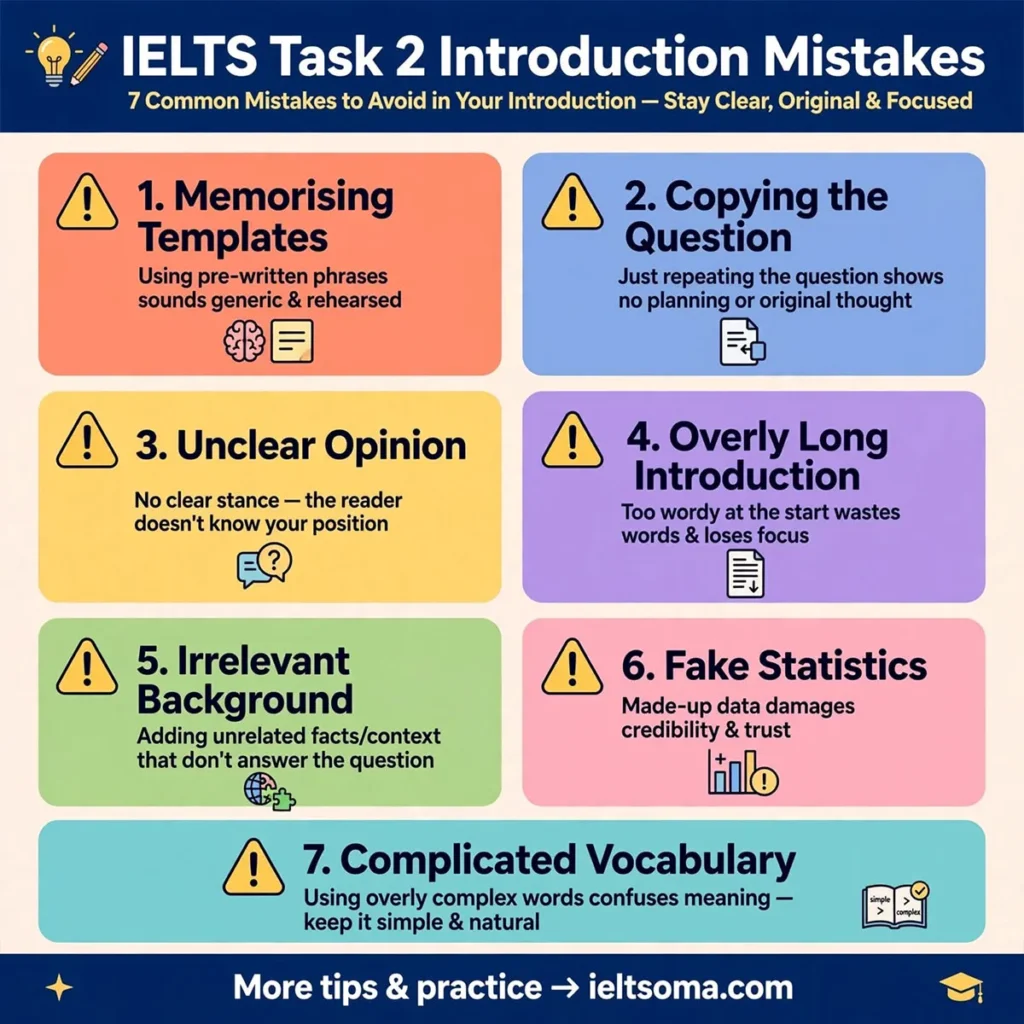
1. Memorising a Universal Template
Memorised introductions can be tempting because they make the first paragraph feel easier.
However, a fixed introduction can become disconnected from the actual question.
IELTS itself advises candidates to respond directly to the task rather than relying on memorised essays or formulaic responses that do not appropriately address the prompt.
Learn a structure, not a paragraph.
2. Copying the Question
Changing only one or two words is not effective paraphrasing.
Instead, understand the meaning first and reconstruct the sentence naturally.
3. Giving an Unclear Opinion
For questions requiring a position, avoid vague statements such as:
There are arguments on both sides.
That may be true, but it does not tell the examiner what you think.
4. Making the Introduction Too Long
A Task 2 introduction does not need to be a mini-essay.
Two well-developed sentences are often enough. A third sentence may be useful when it adds genuine direction.
5. Adding Irrelevant Background Information
Avoid starting with sweeping claims such as:
Since the beginning of human civilisation, education has been an important part of society.
This consumes time without helping answer the question.
Start closer to the actual issue.
6. Using Fake Statistics
Do not invent statistics simply to make an introduction sound academic.
A clear argument is more useful than an unsupported percentage.
7. Using Overly Complicated Vocabulary
An introduction filled with unfamiliar words is not automatically a high-band introduction.
Use precise vocabulary that you can control accurately.
A Simple Formula for IELTS Task 2 Introductions
If you need a practical formula during preparation, use:
Sentence 1: Paraphrase the topic.
Sentence 2: Give your position or explain the direction of the essay.
For some questions:
Sentence 3: Briefly indicate the main areas that will be discussed.
For example:
The increasing use of artificial intelligence has generated debate about its impact on employment. Although AI may replace some routine jobs, I believe it will also create new opportunities by increasing demand for specialised skills.
That’s enough.
There is no requirement to make every introduction complicated.
How Long Should an IELTS Task 2 Introduction Be?
There is no official rule stating that your introduction must contain a particular number of words.
The important requirement is that the complete Task 2 response contains at least 250 words and addresses the task appropriately. IELTS recommends spending approximately 40 minutes on Task 2.
As a practical target, many candidates can write an effective introduction in roughly 40–70 words.
Do not increase the length simply to reach a particular number.
Your time is usually better spent developing strong body paragraphs with relevant explanations and examples.
Should You Use a Thesis Statement in Every IELTS Essay?
You should establish the direction of your response clearly, but the exact form of the thesis depends on the question.
For an opinion essay, your position should be explicit.
For a discussion essay, you may need to introduce both views and then state your own position.
For a problem-and-solution essay, the introduction should establish the problem and indicate the direction of the response.
For a two-part question, make sure the introduction reflects both questions.
The key principle is simple:
Your introduction should make the examiner understand your response before they reach Body Paragraph 1.
IELTS Writing Task 2 Introduction Checklist
Before moving to your first body paragraph, check your introduction against this list:
- Have I understood the exact question?
- Have I paraphrased the topic accurately?
- Have I avoided copying the question?
- Have I identified the correct question type?
- Have I answered every part that needs addressing?
- Is my position clear where one is required?
- Is my thesis statement specific?
- Have I avoided irrelevant background information?
- Have I avoided memorised or unnatural phrases?
- Is the introduction concise?
- Does it lead naturally into my body paragraphs?
If the answer is yes, your introduction is doing its job.
Frequently Asked Questions About IELTS Writing Task 2 Introduction
How do I write an IELTS Task 2 introduction?
Start by identifying the exact topic and question requirements. Paraphrase the topic in your first sentence, then give a clear thesis statement or establish the direction of your response. Avoid memorised introductions and unnecessary background information.
What is the IELTS essay introduction structure?
A useful structure is topic + specific issue + thesis statement. Most introductions can be completed in two or three sentences, depending on the question.
What is an IELTS thesis statement?
An IELTS thesis statement is a sentence that clearly communicates your position or the main direction of your response. In opinion questions, it should make your level of agreement or disagreement clear.
Should I write a background statement in my IELTS introduction?
You can provide brief background context, but it should be directly relevant to the question. There is no benefit in adding general historical or social information simply to make the introduction longer.
Can I memorise an IELTS Task 2 introduction?
It is better to memorise a flexible structure rather than a complete paragraph. IELTS guidance specifically warns against relying on memorised responses that do not appropriately address the question.
How many sentences should an IELTS Task 2 introduction have?
There is no fixed number. Two clear sentences are often sufficient, while three may be appropriate when a brief overview adds useful direction. Focus on relevance and clarity rather than sentence count.
Should my thesis statement include my main reasons?
It can. Including your main reasons can make your position clearer and create a natural link to the body paragraphs. However, you do not need to list every argument you will make.
Is a longer introduction better for IELTS?
No. The introduction should establish the topic and direction of the essay efficiently. Spending too much time writing an elaborate opening can leave less time for developing and supporting your main ideas.
Final Takeaway
A successful IELTS Writing Task 2 introduction is not about producing the most impressive-looking paragraph. It is about demonstrating from the beginning that you understand the question and know exactly what you are going to argue or discuss.
Use this simple process:
Understand the question → identify the task → paraphrase the topic → write a clear thesis → move to your main arguments.
Most importantly, do not memorise a paragraph and try to force it onto every question. Build the habit of responding to the actual prompt in front of you.
A clear introduction gives your essay a clear direction—and that makes it much easier to develop relevant, logically organised ideas throughout the rest of your response.
For official information about the IELTS Writing test and assessment criteria, candidates can consult the IELTS Writing test preparation resources provided by IELTS.
Further Reading: