If you keep losing marks in IELTS Writing despite having good vocabulary and grammar, the problem may not be your English. You may simply not be answering the task well enough.
Task Achievement in IELTS Writing measures how successfully you fulfil the requirements of Writing Task 1. It is not simply about writing a lot, using sophisticated vocabulary, or producing grammatically complex sentences. Your response needs to address what the question actually asks, select the right information, present it clearly, and use an appropriate format.
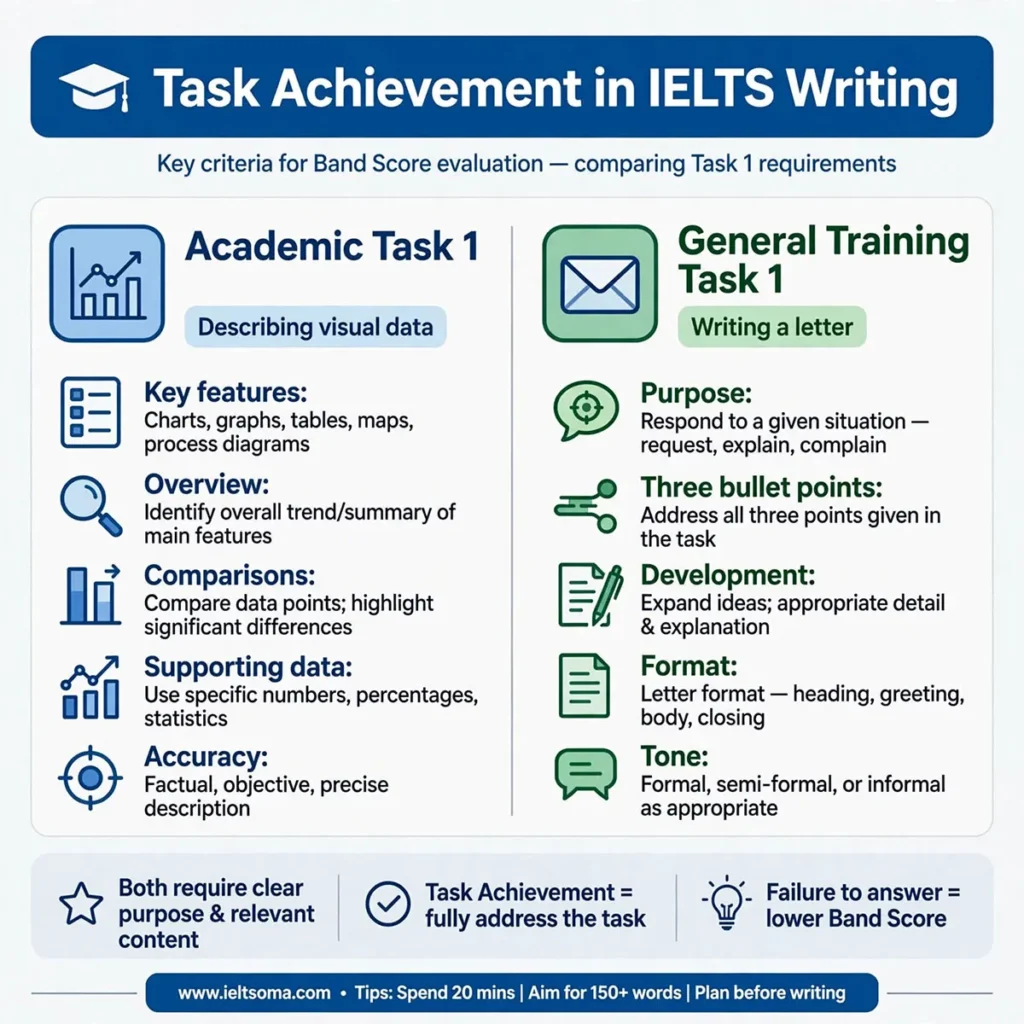
For Academic IELTS, this means selecting and reporting the main features of a graph, chart, table, map, process or diagram. For General Training IELTS, it means writing a letter that clearly fulfils its purpose, covers the required bullet points and uses an appropriate tone.
Understanding Task Achievement can therefore make your preparation much more focused. Instead of trying to make every sentence sound impressive, you can concentrate on the things an IELTS examiner is actually looking for.
Table of Contents
What Is Task Achievement in IELTS Writing?
Task Achievement in IELTS Writing is the assessment criterion used to evaluate how effectively you complete Writing Task 1.
IELTS examiners consider whether your response fulfils the requirements of the task accurately, appropriately and relevantly. Task Achievement is one of the four criteria used to assess Writing, alongside Coherence and Cohesion, Lexical Resource, and Grammatical Range and Accuracy.
The four criteria are assessed for each task, although Task 2 contributes twice as much as Task 1 to the overall Writing score.
For Task 1, the emphasis is different depending on whether you take Academic or General Training IELTS.
| IELTS test | Task 1 | What Task Achievement focuses on |
|---|---|---|
| Academic | Graph, chart, table, map, process or diagram | Selecting and reporting key features, comparisons, overview and supporting details |
| General Training | Letter | Purpose, bullet points, appropriate development, format and tone |
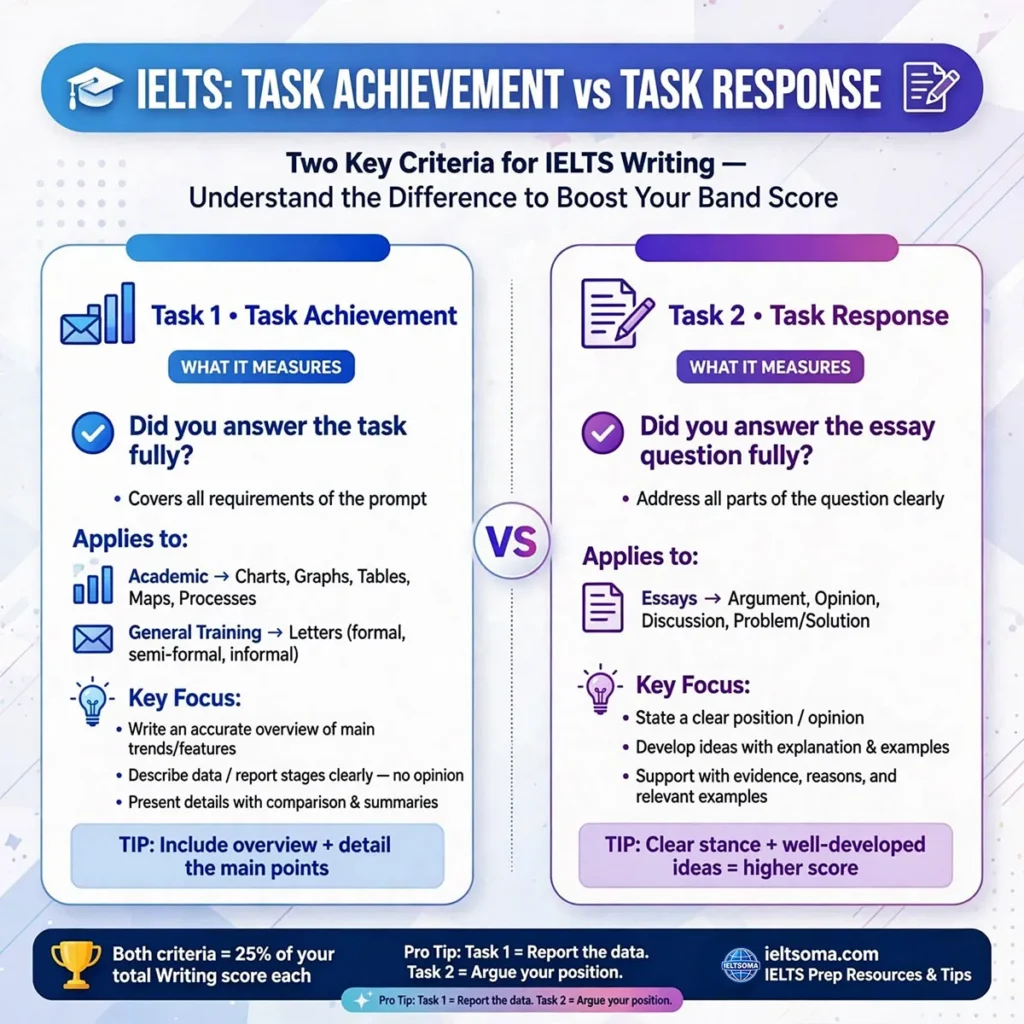
A crucial distinction is that Task Achievement applies to Writing Task 1. In Writing Task 2, the corresponding criterion is called Task Response.
This distinction matters because the skills being assessed are not identical.
Why Task Achievement Matters
You can have strong vocabulary and accurate grammar but still receive a disappointing Writing score if your response does not properly fulfil the task.
For example, imagine an Academic Task 1 question containing a line graph with five categories. A candidate might describe every small change in the graph using advanced vocabulary but fail to identify the most important overall trends.
That response may demonstrate language ability, but it does not necessarily demonstrate strong Task Achievement.
The same problem can occur in General Training Task 1. A candidate might write an impressive formal letter but overlook one of the three bullet points.
The lesson is simple:
Do not confuse good English with a complete IELTS answer.
Your language matters, but your first responsibility is to answer the question.
7 Ways to Improve Task Achievement in IELTS Writing
1. Understand Exactly What the Question Requires
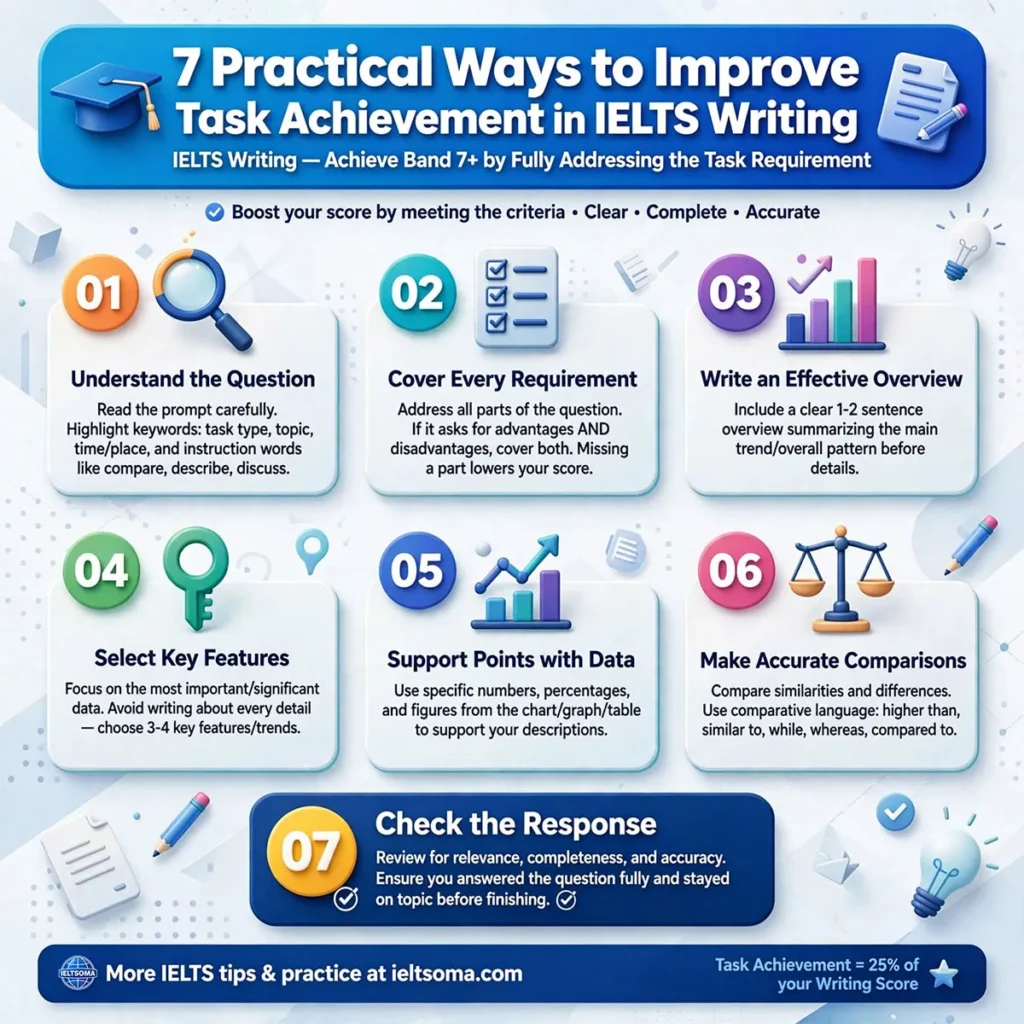
Before writing, spend a short amount of time analysing the task.
Do not immediately start writing because you recognise the question type.
For Academic Task 1, identify:
- What type of visual information is presented?
- What time period is shown, if applicable?
- What units are being used?
- Which categories or features are included?
- What are the most significant changes, differences or stages?
- Are comparisons required?
For General Training Task 1, identify:
- Who are you writing to?
- Why are you writing?
- What are the three bullet points?
- What does each bullet point actually require?
- Should the letter be personal, semi-formal or formal?
- What tone is appropriate?
This analysis prevents one of the most damaging IELTS Writing mistakes: answering the question you think you have been asked rather than the question actually on the page.
2. Cover Every Requirement
One of the most effective ways to improve Task Achievement is to make sure that nothing important is left unanswered.
This is particularly important in General Training Task 1, where the question normally gives you three bullet points.
Suppose the task asks you to:
- Describe a problem.
- Explain why it is causing difficulties.
- Suggest improvements.
You should address all three.
However, simply mentioning each point is not always enough. You need to develop the functions appropriately and relevantly.
For example:
I have been experiencing several problems with my accommodation.
This introduces the issue but may not adequately explain the problems.
A stronger response could explain what the problems are and how they affect the writer.
The same principle applies to Academic Task 1. You need to select the important information rather than randomly describing whatever feature you notice first.
3. Learn How to Write an Effective Overview
For Academic IELTS Task 1, the overview is one of the most important parts of a high-quality response.
An overview summarises the main features of the visual information without becoming a list of minor details.
For example, imagine a graph showing changes in the number of people using four types of transport over several decades.
A weak overview might say:
The graph shows the number of people using different types of transport.
This merely repeats what the visual represents.
A stronger overview identifies the major trends:
Overall, car use increased considerably over the period, while the use of bicycles declined. Bus travel fluctuated but remained relatively stable compared with the other forms of transport.
The second version gives the reader the bigger picture.
According to official IELTS guidance, a clear overview is particularly important for achieving Band 7 or higher in Academic Task 1.
4. Select Key Features Instead of Describing Everything
A common mistake is believing that a high Task Achievement score requires mentioning every number, category or small change.
It does not.
Your job is to select the most important information.
Imagine a bar chart contains eight categories. You do not necessarily need to describe all eight individually.
Instead, look for:
- The highest figures
- The lowest figures
- Major increases
- Major decreases
- Significant similarities
- Important differences
- Notable exceptions
- Overall patterns
Then support those observations with relevant data.
For example:
The proportion of students studying online was highest among postgraduate learners, at approximately 70%, compared with just under 40% of undergraduates.
This is more useful than listing every figure without explaining what makes them significant.
The official Academic Task 1 guidance specifically emphasises selecting key features, making comparisons where relevant, providing sufficient supporting detail and reporting information accurately.
5. Use Data to Support Your Main Points
Academic Task 1 is based on information supplied in the question. Your response should therefore support important observations with appropriate figures or other relevant details.
Consider this example:
The number of visitors increased significantly.
This identifies a trend but provides little evidence.
A stronger version is:
The number of visitors increased significantly, rising from approximately 20,000 in 2010 to nearly 50,000 in 2020.
The second sentence allows the examiner to see exactly how the trend is being interpreted.
However, avoid turning your response into a catalogue of numbers.
Data should support your key observations rather than replace them.
A useful pattern is:
Main feature → comparison or trend → supporting figure
For example:
The figure for private car ownership was considerably higher than that for public transport, at 65% compared with only 30%.
This combines observation, comparison and evidence.
6. Make Accurate Comparisons
Many Academic Task 1 questions contain multiple categories, years or groups specifically so that you can identify relationships between them.
Do not treat the visual as a collection of unrelated numbers.
Look for comparisons.
For example:
In 2015, the figure for domestic tourism was approximately twice as high as the figure for international tourism.
This is more informative than simply saying:
Domestic tourism was 60%, while international tourism was 30%.
Both statements contain the same basic information, but the first explicitly highlights the relationship between the figures.
When appropriate, compare:
- Highest and lowest values
- Similar categories
- Different time periods
- Largest and smallest changes
- Groups with similar patterns
- Categories that move in opposite directions
Good comparison helps demonstrate that you have understood the information rather than merely copied numbers from the visual.
7. Check Your Response Against the Task Before Finishing
Reserve a few minutes at the end of the Writing test to check your answer.
Do not spend all your remaining time searching for sophisticated vocabulary.
Instead, ask:
Task Achievement checklist
- Did I answer every part of the task?
- Did I write at least 150 words for Task 1?
- Did I include an overview in Academic Task 1?
- Did I select the main features?
- Did I make relevant comparisons?
- Did I support important points with appropriate data?
- Did I report information accurately?
- Did I cover all three bullet points in General Training Task 1?
- Is the purpose of my letter clear?
- Is my tone appropriate?
- Did I use the correct format?
This final check can prevent avoidable omissions.
Task Achievement in Academic IELTS Task 1
Academic Task 1 requires you to summarise visual information in your own words.
You may be asked to describe:
- Line graphs
- Bar charts
- Pie charts
- Tables
- Maps
- Processes
- Diagrams
- Combinations of visual information
The response should normally contain an introduction, an overview and supporting paragraphs.
A practical structure is:
Introduction
Paraphrase the question.
Overview
Identify the most important overall trends, differences, stages or changes.
Body paragraph 1
Describe the first group of important features and support them with relevant data.
Body paragraph 2
Describe the remaining important features and make useful comparisons.
This structure is not a rigid formula. The best organisation depends on the visual information.
For a process, for example, you may need to organise your response according to the stages rather than comparing numerical categories.
The important point is that your structure should help the examiner understand the information easily.
Task Achievement in General Training IELTS Task 1
General Training Task 1 is different.
You are given a situation and asked to write a letter. The letter may be personal, semi-formal or formal depending on the relationship and purpose.
The official IELTS guidance states that Task Achievement includes clearly explaining the purpose of the letter, fully addressing the three bullet points, extending the functions appropriately and relevantly, using an appropriate format and maintaining an appropriate tone.
Consider this task:
You recently bought something online but the item arrived damaged.
You may be asked to:
- Explain what you purchased.
- Describe the problem.
- Say what you would like the company to do.
A weak response might mention all three points briefly.
A stronger response develops each one with relevant details.
For example, instead of:
The item was damaged. I want a replacement.
You could explain what was damaged, when the parcel arrived, why the condition is unacceptable and what solution you expect.
The objective is not to make the letter unnecessarily long. The objective is to fulfil the purpose effectively.
Task Achievement vs Task Response
One of the most common sources of confusion is the difference between Task Achievement and Task Response.
| Criterion | IELTS Writing Task 1 | IELTS Writing Task 2 |
|---|---|---|
| Assessment criterion | Task Achievement | Task Response |
| Academic | Visual description | Essay |
| General Training | Letter | Essay |
| Main focus | Fulfil the requirements of the task | Respond to and develop the essay question |
| Important elements | Key features, overview, comparisons, relevant detail | Position, ideas, development, evidence and examples |
IELTS uses Task Achievement for Task 1 and Task Response for Task 2. Both criteria essentially ask whether you have successfully responded to the task, but they assess different aspects of performance.
This distinction is important when preparing for IELTS because the strategies you use for a graph or letter should not simply be transferred to an essay.
Common Task Achievement Mistakes
Writing too much detail
More information does not automatically mean better Task Achievement.
If you describe every small fluctuation in a graph, your answer may become difficult to follow and leave less space for the most significant features.
Missing the overview
In Academic Task 1, some candidates write an introduction and immediately move into detailed figures.
Without a clear overview, the examiner may not see that you understand the overall picture.
Ignoring a bullet point
In General Training Task 1, failing to address one of the required points can seriously weaken your response.
Read every bullet point carefully before writing.
Giving inaccurate information
A sophisticated sentence containing an incorrect figure is still a problem.
Check the visual carefully before reporting data.
Using an inappropriate tone
A letter to a close friend should not sound like a formal complaint to a government department.
Likewise, a formal letter should not use overly casual language.
Writing memorised answers
Memorised phrases can sometimes help with organisation, but a heavily memorised response may not fit the actual task.
Your writing should respond specifically to the information presented.
Confusing the overview with the introduction
An introduction tells the reader what the visual shows.
An overview tells the reader what the most important features are.
They serve different purposes.
How to Reach Band 7 in Task Achievement
If Band 7 is your target, focus on completeness, selection, accuracy and relevance, rather than trying to make every sentence complicated.
For Academic Task 1:
- Paraphrase the task accurately.
- Provide a clear overview.
- Select the most significant features.
- Make relevant comparisons.
- Support observations with appropriate figures.
- Avoid irrelevant details.
- Report information accurately.
For General Training Task 1:
- Make the purpose of the letter clear.
- Address all three bullet points.
- Develop each required function.
- Use an appropriate format.
- Maintain an appropriate tone.
- Add relevant details rather than unrelated information.
The official IELTS Band 7 descriptor for Academic Task 1 expects the response to cover the requirements of the task, present a clear overview, identify and appropriately highlight key features, and provide supporting detail.
A Simple Strategy for Exam Day
When the Writing Task 1 question appears, use this five-step process.
Step 1: Analyse
Spend a few minutes understanding exactly what the question asks.
Step 2: Identify
Find the key features, trends, comparisons or required letter functions.
Step 3: Plan
Decide what information belongs in each paragraph.
Step 4: Write
Develop the response logically and support important points with relevant information.
Step 5: Check
Before moving on, check that you have actually completed the task rather than simply written good English.
This approach is particularly useful because Task 2 contributes twice as much as Task 1 to the overall Writing score, so spending excessive time on Task 1 can create another problem. IELTS recommends approximately 20 minutes for Task 1 and 40 minutes for Task 2.
Final Task Achievement Checklist
Before submitting your IELTS Writing test, remember this:
For Academic Task 1:
- Answer the question directly.
- Include a clear overview.
- Select important features.
- Make meaningful comparisons.
- Use relevant figures or supporting details.
- Avoid unnecessary detail.
- Check your data for accuracy.
For General Training Task 1:
- Make your purpose clear.
- Address all three bullet points.
- Develop each point appropriately.
- Use the correct level of formality.
- Maintain a consistent tone.
- Include relevant details.
- Check that the letter fulfils its purpose.
Frequently Asked Questions
What is Task Achievement in IELTS Writing?
Task Achievement is the criterion used to assess how effectively you fulfil the requirements of IELTS Writing Task 1. For Academic Task 1, this includes selecting and reporting key features, providing an overview, making relevant comparisons and supporting information appropriately. For General Training Task 1, it includes fulfilling the purpose of the letter, covering the bullet points, developing the required functions and using an appropriate format and tone.
Is Task Achievement used for IELTS Writing Task 2?
No. IELTS uses Task Response for Writing Task 2. Task Achievement is used for Writing Task 1.
How can I improve Task Achievement in IELTS Writing?
Start by analysing the question carefully. Make sure you answer every requirement, select relevant information, provide sufficient supporting detail and avoid irrelevant material. Academic candidates should pay particular attention to the overview and key features, while General Training candidates should ensure that all bullet points, the purpose and the tone are properly addressed.
Do I need an overview in Academic IELTS Task 1?
Yes. A clear overview is an important part of a strong Academic Task 1 response, particularly for higher band scores. The overview should summarise the most significant trends, changes, differences or stages rather than repeat individual figures.
How many words should I write for IELTS Writing Task 1?
You should write at least 150 words for Task 1. Writing substantially more is not automatically beneficial, and spending too much time on Task 1 can reduce the time available for Task 2, which carries twice the weight of Task 1 in the Writing score.
Does good grammar guarantee a high Task Achievement score?
No. Grammar is assessed separately under Grammatical Range and Accuracy. A response can contain strong grammar and vocabulary but still lose marks if it does not properly fulfil the task requirements.
What is the biggest Task Achievement mistake?
One of the biggest mistakes is failing to answer the task completely. Candidates sometimes focus on vocabulary, grammar or individual details while overlooking an important requirement, such as the overview in Academic Task 1 or one of the bullet points in General Training Task 1.
Can memorised phrases improve Task Achievement?
Memorised phrases may help you organise your writing, but they cannot replace task-specific content. Your response needs to address the actual information and requirements in the question.
Your Goal: Answer the Task, Not Just Write More
Strong IELTS Writing is not about filling the page with impressive vocabulary.
It is about communicating the right information clearly and appropriately.
When you understand Task Achievement in IELTS Writing, your preparation becomes much more targeted. You know what to look for in Academic Task 1, what your General Training letter needs to accomplish, and which mistakes can prevent an otherwise strong piece of writing from reaching its potential.
Before your next practice test, ask yourself one question:
“Have I fully answered the task?”
If the answer is yes, you are already working on one of the most important foundations of a strong IELTS Writing performance.