If you’re preparing for the International English Language Testing System (IELTS), you’ve probably searched for an IELTS FAQ at least once. Whether you’re taking the Academic or General Training version, having answers to the most frequently asked questions can save you time, reduce stress, and help you prepare more effectively.
This comprehensive IELTS FAQ guide answers the most common questions from candidates worldwide. It covers everything from the test structure and scoring system to preparation tips, registration, test day rules, and common mistakes.
Whether you’re aiming for Band 6, 7, 8, or even Band 9, understanding these essential IELTS questions and answers will help you approach the exam with confidence.
Table of Contents
What Is IELTS?
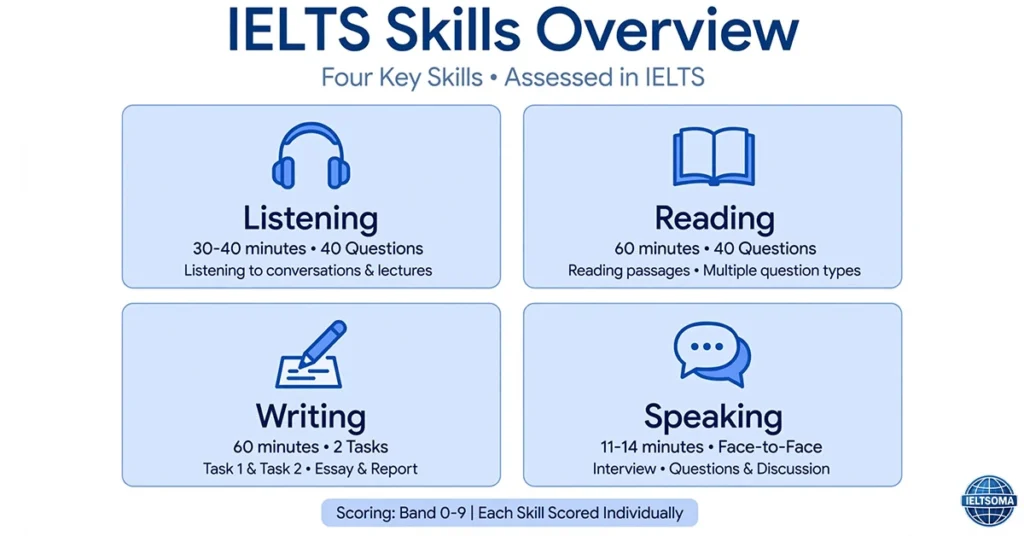
The International English Language Testing System (IELTS) is one of the world’s most widely recognized English language proficiency tests. It evaluates your ability to communicate in English across four key language skills:
- Listening
- Reading
- Writing
- Speaking
Millions of people take IELTS every year for:
- Studying abroad
- Immigration
- Employment
- Professional registration
- Permanent residency applications
The test is accepted by thousands of universities, employers, immigration authorities, and professional organizations around the world.
IELTS FAQ: What Are the Different Types of IELTS?
One of the most common IELTS FAQ questions is about the available test types.
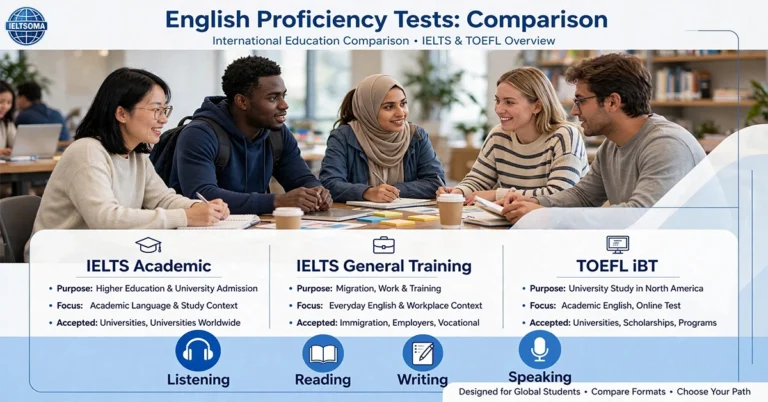
IELTS Academic
IELTS Academic is designed for people who plan to:
- Study at a university
- Apply for higher education
- Register with professional organizations
- Pursue academic careers
The Reading and Writing sections focus on academic topics and analytical writing.
IELTS General Training
IELTS General Training is suitable for candidates who plan to:
- Work abroad
- Migrate to another country
- Complete vocational training
- Gain work experience
The Reading and Writing tasks focus on everyday workplace and social situations.
Both versions include the same Listening and Speaking tests.
IELTS FAQ: Which IELTS Test Should I Take?
Choosing the correct IELTS test depends on your goals.
| Goal | Recommended Test |
|---|---|
| University admission | IELTS Academic |
| Student visa | Usually IELTS Academic |
| Immigration | Usually IELTS General Training |
| Employment | Depends on employer |
| Professional registration | Usually IELTS Academic |
Always check the requirements of the organization or immigration authority before booking your test.
IELTS FAQ: What Is the IELTS Test Format?
The IELTS exam has four sections.
| Section | Time |
|---|---|
| Listening | 30 minutes |
| Reading | 60 minutes |
| Writing | 60 minutes |
| Speaking | 11–14 minutes |
The total test time is approximately 2 hours and 45 minutes.
The Speaking test may take place on the same day or within several days before or after the written test.
IELTS FAQ: How Is IELTS Scored?
IELTS uses a 9-band scoring system.
Each section receives an individual band score:
- Listening
- Reading
- Writing
- Speaking
These scores are averaged to produce your Overall Band Score.
| Band | Level |
|---|---|
| 9 | Expert User |
| 8 | Very Good User |
| 7 | Good User |
| 6 | Competent User |
| 5 | Modest User |
| 4 | Limited User |
Many universities require Band 6.5 or Band 7, while immigration authorities may have different requirements.
IELTS FAQ: Is There a Pass or Fail in IELTS?
No.
IELTS does not have a pass or fail result.
Instead, you receive an Overall Band Score between 0 and 9.
Different organizations set their own minimum score requirements.
For example:
- One university may require Band 6.5.
- Another university may require Band 7.5.
- An employer may only require Band 6.
Your objective should be to achieve the score required for your chosen university, employer, or immigration program.
IELTS FAQ: How Long Is an IELTS Score Valid?
Your IELTS Test Report Form (TRF) is generally valid for two years from the test date.
Many universities and immigration authorities only accept IELTS results that are less than two years old.
If your score expires, you will normally need to take the test again.
IELTS FAQ: What Is the Difference Between Paper-Based and Computer-Delivered IELTS?
One of the most common IELTS FAQ questions is whether the paper-based test is easier than the computer-delivered test.
The answer is simple: both tests are equally difficult.
The content, question types, scoring criteria, and band scores are exactly the same. The only difference is how you complete the Listening, Reading, and Writing sections.
| Feature | Paper-Based IELTS | Computer-Delivered IELTS |
|---|---|---|
| Writing | Handwritten | Typed |
| Reading | Paper booklet | Computer screen |
| Listening | Paper answer sheet | Computer |
| Speaking | Face-to-face with examiner | Face-to-face with examiner |
| Difficulty | Same | Same |
| Band Score | Same | Same |
Choose the format you feel most comfortable using.
IELTS FAQ: How Can I Register for IELTS?
Registering for IELTS is straightforward.
The typical process includes:
- Choose the IELTS test type.
- Select your preferred test format.
- Pick a nearby test centre or an available computer-delivered location.
- Select your preferred test date.
- Complete your registration.
- Upload the required identification document.
- Pay the examination fee.
- Receive your confirmation email.
Book your test well in advance, especially during peak admission seasons.
IELTS FAQ: How Much Does IELTS Cost?
The IELTS test fee varies depending on the country and test centre.
Prices may change over time, so always check the official IELTS website or your local test centre before registering.
Besides the examination fee, you should also consider possible expenses such as:
- Preparation materials
- Coaching classes
- Transportation
- Retesting if necessary
IELTS FAQ: How Many Times Can I Take IELTS?
There is no limit.
You can take IELTS as many times as necessary.
Many candidates improve their score after identifying their weak areas and following a structured study plan.
If your first result is lower than expected, focus on improving the sections where you lost marks before booking another test.
IELTS FAQ: Which IELTS Section Is the Most Difficult?
This depends on the individual candidate.
However, many test takers report that these sections are the most challenging:
- Academic Reading
- Writing Task 2
- Time management
- Listening with unfamiliar accents
Your strengths and weaknesses will determine which section requires the most attention.
IELTS FAQ: How Can I Improve My IELTS Listening Score?
Improving Listening requires regular exposure to spoken English.
Here are some practical tips:
- Listen to English podcasts every day.
- Watch English news channels.
- Practice with IELTS Listening tests.
- Learn to predict answers before listening.
- Improve your spelling.
- Become familiar with British, Australian, Canadian, New Zealand, and American accents.
Consistency is more important than studying for many hours occasionally.
IELTS FAQ: How Can I Improve My IELTS Reading Score?
Reading is often challenging because of time pressure.
To improve your Reading score:
- Read English newspapers daily.
- Practice skimming and scanning techniques.
- Expand your vocabulary naturally.
- Learn common IELTS question types.
- Avoid spending too much time on one question.
- Practice completing Reading tests within 60 minutes.
Regular timed practice is one of the most effective ways to improve.
IELTS FAQ: How Can I Improve My IELTS Writing Score?
Writing is one of the lowest-scoring sections for many candidates.
You can improve by:
- Learning the assessment criteria.
- Practising Task 1 and Task 2 regularly.
- Using clear paragraph structures.
- Supporting your ideas with examples.
- Avoiding memorized essays.
- Checking grammar before submitting your answers.
Receiving feedback from an experienced teacher can help you identify recurring mistakes.
IELTS FAQ: How Can I Improve My IELTS Speaking Score?
Many candidates worry about the Speaking test.
Remember that the examiner wants to evaluate your ability to communicate naturally.
Helpful tips include:
- Speak clearly.
- Extend your answers.
- Avoid one-word responses.
- Practice speaking English daily.
- Improve your pronunciation naturally.
- Don’t memorize complete answers.
Confidence grows with regular speaking practice.
IELTS FAQ: What Are the Most Common IELTS Mistakes?
Many candidates lose valuable marks because of avoidable mistakes.
Common mistakes include:
- Not reading instructions carefully.
- Poor time management. (Read our IELTS Time Management Tips: 17 Proven Ways to Boost Your Band Score)
- Leaving questions unanswered.
- Memorizing essays.
- Writing fewer than the required number of words.
- Ignoring spelling mistakes.
- Using overly complex vocabulary incorrectly.
- Speaking too little during the interview.
Avoiding these mistakes alone can improve your overall band score.
IELTS FAQ: Academic vs General Training
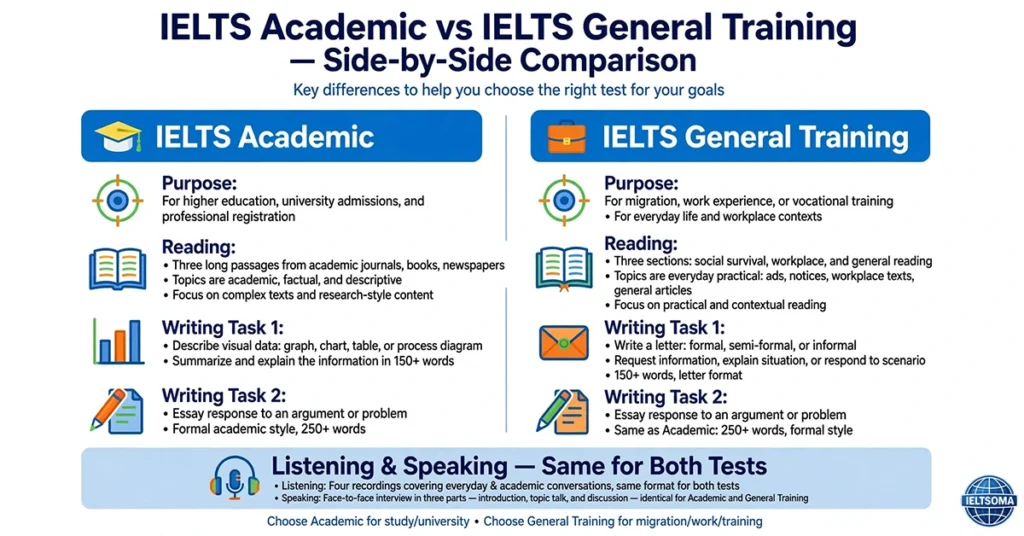
Choosing the correct IELTS test is essential.
| Feature | Academic | General Training |
|---|---|---|
| Purpose | Higher education | Immigration and work |
| Reading | Academic texts | Everyday texts |
| Writing Task 1 | Report or graph | Letter |
| Writing Task 2 | Essay | Essay |
| Listening | Same | Same |
| Speaking | Same | Same |
| Scoring | Same | Same |
Always verify which version your university, employer, or immigration authority requires.
IELTS FAQ: Can I Retake Only One IELTS Section?
In some countries, eligible candidates may be able to retake a single skill through the IELTS One Skill Retake option.
However, availability depends on your location and the organizations accepting your scores.
Always confirm whether your institution accepts One Skill Retake before choosing this option.
IELTS FAQ: How Soon Will I Receive My Results?
Results depend on the test format.
Generally:
- Computer-delivered IELTS results are available sooner.
- Paper-based IELTS results usually take a little longer.
Your official test provider will notify you when your results are ready.
IELTS FAQ: Can I Request a Recheck?
Yes.
If you believe your score does not accurately reflect your performance, you can request an Enquiry on Results (EOR).
Your test will be reviewed by qualified examiners.
If your score changes, your Test Report Form will be updated.
IELTS FAQ: What Happens If I Arrive Late?
Arriving late may prevent you from taking the examination.
To avoid unnecessary stress:
- Arrive at least 30–45 minutes early.
- Carry your identification document.
- Read your confirmation instructions carefully.
Being punctual helps you begin the test calmly and confidently.
IELTS FAQ: Best Preparation Tips
Preparing for IELTS successfully requires consistency rather than last-minute studying.
Here are some practical tips:
- Create a realistic study schedule.
- Practice every language skill daily.
- Take full-length mock tests.
- Learn from your mistakes.
- Build your vocabulary through reading.
- Improve grammar gradually.
- Watch English news and documentaries.
- Read newspapers and magazines.
- Practice speaking with friends or teachers.
- Stay healthy and sleep well before the exam.
Frequently Asked Questions About IELTS
Is IELTS harder than TOEFL?
Neither test is objectively harder. The better option depends on your strengths, preferred test format, and the requirements of your chosen institution.
Can I use a calculator during IELTS?
No. Calculators are not permitted during the IELTS examination.
Is handwriting important in IELTS?
Yes. For paper-based IELTS, your handwriting should be clear and easy for examiners to read.
Can I write in capital letters?
Yes. Many candidates use capital letters for the Listening and Reading answer sheets.
What happens if I miss an answer?
There is no penalty for guessing. It is better to attempt every question than leave blanks.
Is grammar important?
Absolutely. Grammar contributes significantly to your Writing and Speaking band scores.
How many words should I write?
Write at least:
150 words for Writing Task 1
250 words for Writing Task 2
Writing fewer than the minimum word count may affect your score.
Should I memorize essays?
No.
Examiners can often recognize memorized responses, which may reduce your score.
Can I prepare for IELTS in one month?
If your English level is already strong, one month of focused preparation may be sufficient. Otherwise, allow more time for gradual improvement.
What Band Score is considered good?
A Band 7 or higher is considered a strong score by many universities and employers, although the required score varies depending on your purpose.
Final Thoughts
Preparing for IELTS doesn’t have to feel overwhelming. By understanding the answers to these common IELTS FAQ questions, you’ll know what to expect before, during, and after your test.
Whether you’re taking IELTS Academic or General Training, success comes from consistent preparation, regular practice, and familiarity with the test format. Focus on improving all four language skills, complete practice tests under timed conditions, and learn from your mistakes.
Remember, IELTS is designed to assess your real English communication skills—not your ability to memorize answers. With the right preparation strategy and enough practice, you can achieve the band score required for your academic, professional, or immigration goals.
Useful Links: