You can complete hundreds of IELTS practice questions and still feel stuck.
Why?
Because practice without useful feedback can repeat the same mistakes again and again.
Imagine writing ten IELTS essays but making the same grammar errors in all ten. Or practising Speaking every day without realizing that your answers are too short, your ideas are difficult to follow, or your pronunciation needs attention.
That is where IELTS Preparation Feedback becomes powerful.
Good feedback does more than tell you whether an answer is right or wrong. It shows you what you are doing well, what is limiting your performance, why the problem is happening, and what you should practise next.
Whether you are preparing for IELTS Academic or IELTS General Training, learning how to receive, understand, and apply feedback can make your preparation much more focused.
This guide explains how to use IELTS Preparation Feedback effectively across all four skills, how to evaluate feedback quality, and how to turn comments into a practical improvement plan.
Table of Contents
What Is IELTS Preparation Feedback?
IELTS Preparation Feedback is specific information about your performance during IELTS practice that helps you identify strengths, weaknesses, mistakes, and opportunities for improvement.
Useful feedback should be connected to the skills and assessment criteria relevant to the IELTS task.
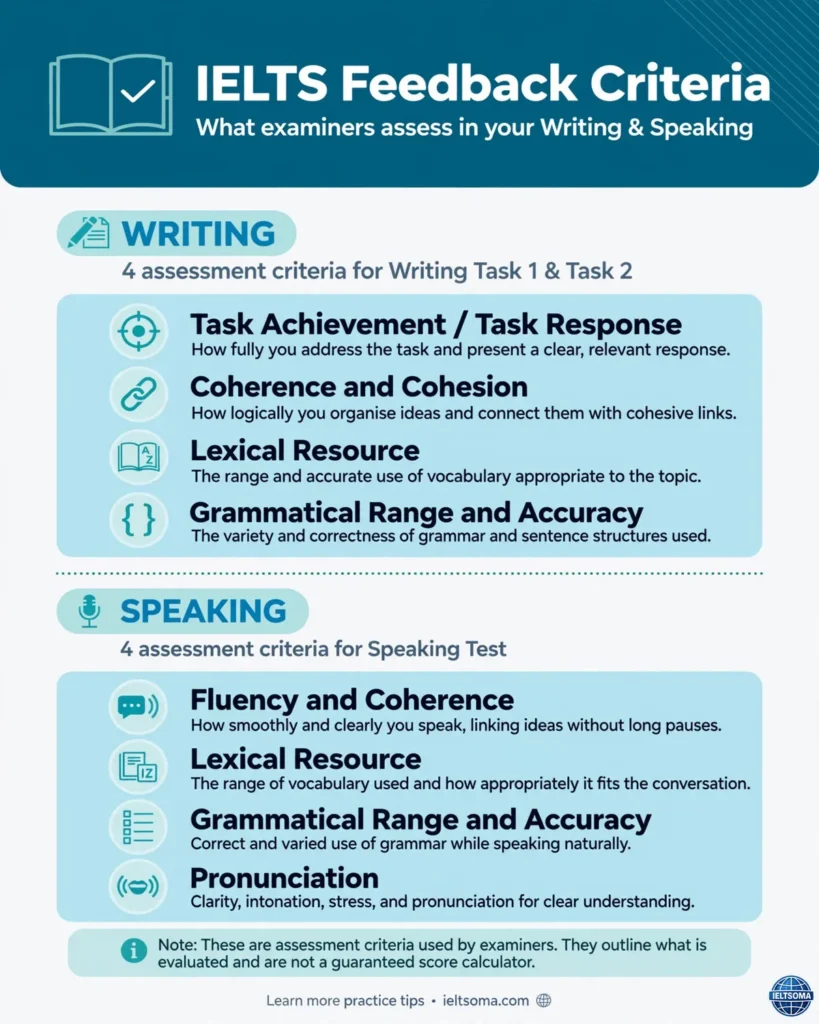
For Writing, official IELTS assessment criteria include Task Achievement or Task Response, Coherence and Cohesion, Lexical Resource, and Grammatical Range and Accuracy. Speaking is assessed through Fluency and Coherence, Lexical Resource, Grammatical Range and Accuracy, and Pronunciation.
For Reading and Listening, feedback can focus on incorrect answers, question types, timing, comprehension problems, spelling, and the reasons behind mistakes.
The most useful feedback answers three questions:
- What did I do well?
- What needs improvement?
- What should I do differently next time?
Why IELTS Preparation Feedback Matters
Many candidates practise repeatedly but do not analyse their performance.
They may complete another Reading test after getting a low score, write another essay after receiving a disappointing result, or record another Speaking answer without examining what went wrong.
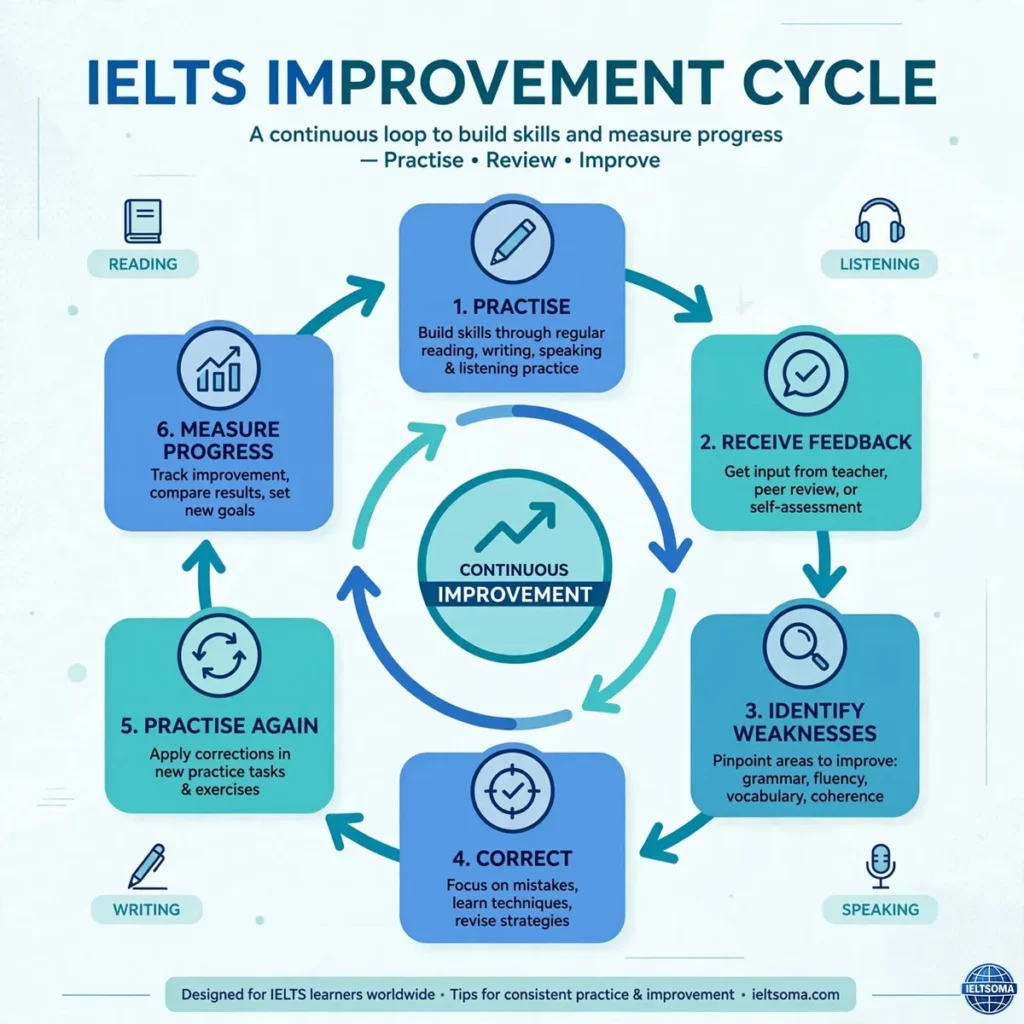
That creates a practice loop without an improvement loop.
Effective IELTS Preparation Feedback breaks this cycle.
Instead of simply saying “your grammar needs improvement,” useful feedback might identify repeated problems with articles, subject-verb agreement, verb tense, sentence structure, or punctuation.
Instead of saying “your Speaking needs more fluency,” good feedback can identify excessive hesitation, repetitive language, unclear transitions, or difficulty extending answers.
Specific feedback creates a specific action.
1. Get Feedback Based on IELTS Criteria
One of the first things you should ask when receiving IELTS Preparation Feedback is whether the feedback is connected to the official assessment criteria.
This matters because IELTS performance is not judged simply on whether an English teacher “likes” your answer.
For Writing, the official criteria cover four areas. IELTS states that each criterion is considered when examiners assess Writing, with Task 2 carrying greater weight than Task 1.
For Speaking, the four criteria are equally weighted according to official IELTS information.
Ask your reviewer to separate feedback into categories such as:
- Task response or task achievement
- Coherence and cohesion
- Vocabulary
- Grammar
- Fluency
- Pronunciation
This makes your feedback much easier to act upon.
2. IELTS Writing Feedback
Writing is one area where detailed IELTS Preparation Feedback can be particularly valuable.
Official IELTS Writing criteria evaluate how effectively you respond to the task, organise ideas, use vocabulary, and control grammar.
Instead of asking only, “What band would you give me?”, ask:
- Did I answer every part of the question?
- Is my position clear?
- Are my main ideas developed?
- Are my examples relevant?
- Is the paragraph structure logical?
- Is my vocabulary accurate and appropriate?
- Which grammar errors occur repeatedly?
For Academic Writing Task 1, feedback should also examine whether your response presents an appropriate overview and accurately describes or compares the important information.
For General Training Task 1, feedback should consider whether your letter achieves its purpose and uses an appropriate style.
Task 2 requires a different type of response in both tests, so your feedback should match the test you are actually taking.
3. IELTS Speaking Feedback
Speaking is difficult to improve when you cannot hear yourself objectively.
Record your answers and obtain IELTS Preparation Feedback from a knowledgeable teacher, tutor, or qualified reviewer when possible.
Ask for feedback on:
- Fluency
- Coherence
- Vocabulary
- Grammar
- Pronunciation
- Answer development
- Repetition
- Hesitation
Do not focus only on accent.
The official Speaking criteria include pronunciation, but the assessment also considers fluency and coherence, vocabulary, and grammatical range and accuracy.
A useful feedback comment is specific.
For example:
“Your answer is understandable, but you frequently pause while searching for vocabulary.”
This gives you a clear target.
You can then practise speaking around familiar topics, recording yourself again, and checking whether those pauses become less frequent.
4. IELTS Reading Feedback
Reading feedback should go beyond your final score.
Suppose you score 30 out of 40.
The important question is not simply, “How can I get 35?”
Ask:
Why did I lose those 10 marks?
Categorise your mistakes.
You may have problems with:
- Matching headings
- True/False/Not Given
- Multiple choice
- Matching information
- Sentence completion
- Summary completion
- Time management
- Vocabulary
- Misreading instructions
This type of IELTS Preparation Feedback reveals patterns.
If most errors come from one question type, dedicate targeted practice to that type instead of completing unrelated tests.
5. IELTS Listening Feedback
Listening feedback works in a similar way.
When you get an answer wrong, identify the reason.
Did you:
- Miss the information?
- Fail to predict the answer?
- Lose concentration?
- Misunderstand a paraphrase?
- Make a spelling mistake?
- Write more words than permitted?
- Confuse two speakers?
- Lose your place in the recording?
The difference between these problems matters.
For example, if you understood the answer but spelled it incorrectly, more listening comprehension practice may not solve the problem.
You need spelling and answer-format practice.
That is why detailed IELTS Preparation Feedback is more useful than simply looking at an answer key.
6. Use an IELTS Error Log
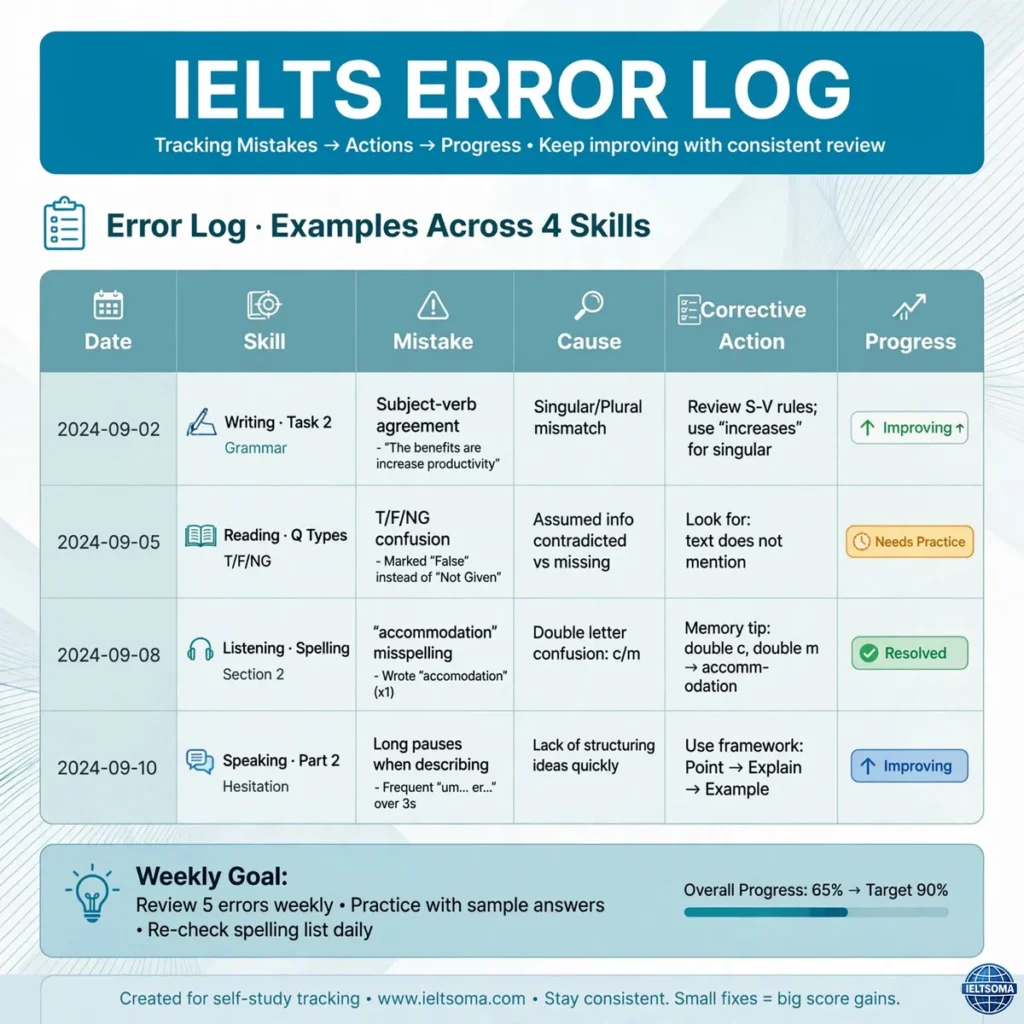
An error log can turn feedback into a long-term improvement system.
Create a simple table:
| Date | Skill | Mistake | Cause | Corrective Action |
|---|---|---|---|---|
| 10 Aug | Writing | Article error | Grammar | Review articles |
| 12 Aug | Reading | T/F/NG error | Misinterpretation | Practise question type |
| 14 Aug | Speaking | Long pauses | Vocabulary retrieval | Timed speaking practice |
Every time you receive IELTS Preparation Feedback, add important recurring problems to your log.
After a few weeks, review the patterns.
If the same mistake appears repeatedly, it should become a priority.
7. Ask for Specific Feedback
“Please check my IELTS essay” is not always the best feedback request.
Make your request specific.
For example:
“Please identify my three most important Writing weaknesses and give me one example of how to improve each.”
Or:
“Please assess my Speaking response for fluency, vocabulary, grammar, and pronunciation, then identify the most important issue to practise.”
Specific questions produce more useful IELTS Preparation Feedback.
They also prevent you from becoming overwhelmed by a long list of minor corrections.
8. Understand IELTS Band Descriptors
Band descriptors help you understand what different performance levels look like.
Official IELTS materials provide Writing and Speaking assessment information and band descriptors to help test takers and teachers understand performance expectations.
Use them as a reference when reviewing your work.
However, avoid turning descriptors into a checklist of phrases to memorise.
Your objective is to understand the characteristics of effective performance and develop the underlying skills.
Good IELTS Preparation Feedback should help connect your actual performance to those criteria.
9. Turn Feedback Into an Action Plan
Feedback has little value if you read it once and never use it.
After receiving IELTS Preparation Feedback, choose your top priorities.
For example:
Problem: Ideas are not sufficiently developed.
Action: For the next five Task 2 essays, develop each main idea with an explanation and relevant example.
Or:
Problem: Frequent hesitation in Speaking.
Action: Complete three two-minute recorded responses each week and review pauses.
Keep your action plan small.
Trying to fix 15 weaknesses simultaneously can make preparation unfocused.
Choose the two or three issues most likely to improve your performance.
10. Compare Your IELTS Practice Over Time
One piece of feedback is a snapshot.
Several pieces of feedback can show a trend.
Keep previous essays, Speaking recordings, Reading results, and Listening results.
Review them periodically.
Ask:
- Are the same errors still appearing?
- Are my answers more organised?
- Is my vocabulary more accurate?
- Am I making fewer grammar mistakes?
- Are my Reading errors concentrated in fewer question types?
- Is my Speaking more fluent?
- Am I completing tasks within the required time?
This makes IELTS Preparation Feedback measurable.
You are no longer asking, “Am I improving?”
You have evidence to examine.
11. Avoid Too Much IELTS Feedback
More feedback is not always better.
If five different people review the same essay and give conflicting advice, you may become confused rather than improve.
For example, one person might suggest shorter paragraphs while another recommends longer paragraphs. One reviewer may prefer a particular phrase while another considers it unnecessary.
Focus on consistent, criteria-based feedback.
You do not need to change every sentence simply because someone suggests an alternative.
Prioritise errors that affect clarity, task fulfilment, organisation, vocabulary accuracy, grammar, fluency, or pronunciation.
High-quality IELTS Preparation Feedback should make your preparation clearer, not more confusing.
12. Use Self-Feedback for IELTS Preparation
You can develop useful self-assessment habits even when a teacher is unavailable.
After completing an IELTS Writing task, wait briefly and review it with fresh eyes.
For Writing, check:
- Did I answer every part?
- Is my position clear?
- Does each paragraph have a clear purpose?
- Are ideas supported?
- Are vocabulary choices accurate?
- Which grammar errors repeat?
For Speaking, record yourself and listen without reading a script.
For Reading and Listening, analyse every wrong answer rather than simply recording the score.
Self-review cannot replace every form of expert feedback, but it can make you a more independent learner.
13. Teacher vs Automated IELTS Feedback
Technology can provide useful support, particularly for identifying patterns, checking language, or generating practice.
However, automated feedback should be treated as a tool rather than an unquestionable final judgement.
A system may identify a grammar problem quickly, but context matters.
For high-stakes preparation, particularly for Writing and Speaking, feedback from a suitably qualified human teacher or experienced IELTS professional can provide additional context and explain why a particular issue matters.
The best approach may be to combine tools intelligently.
Use technology for frequent practice and preliminary review, then use expert IELTS Preparation Feedback for deeper evaluation where appropriate.
14. Academic vs General Training Feedback
Your feedback should match your IELTS test.
Academic and General Training candidates share the Listening and Speaking components, but their Reading and Writing tasks differ.
For example, Academic Writing Task 1 requires candidates to describe visual information, while General Training Writing Task 1 requires candidates to respond to a situation, such as writing a letter.
Therefore, an Academic candidate should receive feedback relevant to Academic Task 1.
A General Training candidate should receive feedback relevant to the General Training letter task.
Task 2 also needs to be evaluated against the specific requirements of the prompt.
Always tell your reviewer which IELTS test you are preparing for.
15. How Often Should You Get IELTS Feedback?
There is no universal schedule that works for every candidate.
The ideal frequency depends on your current level, target band, test date, weaknesses, and available study time.
The important principle is to allow enough time to apply feedback before requesting more feedback.
For example, you could:
- Complete a Writing task.
- Receive feedback.
- Identify two weaknesses.
- Practise those weaknesses.
- Write another task.
- Compare the results.
- Adjust your strategy.
This creates a feedback cycle instead of a feedback collection habit.
How Do I Know If IELTS Feedback Is Useful?
Useful IELTS Preparation Feedback is specific, evidence-based, understandable, and actionable.
A strong feedback comment identifies the issue and explains what to do next.
Weak feedback:
“Your vocabulary is weak.”
Better feedback:
“Your vocabulary is understandable, but several words are used in unnatural combinations. Review collocations related to the topic and replace repeated general words with accurate expressions.”
The second comment gives you a direction for improvement.
When reviewing feedback, ask:
Can I turn this comment into a specific study activity?
If yes, the feedback is probably useful.
Can IELTS Preparation Feedback Guarantee a Higher Band?
No.
Feedback can identify weaknesses and suggest ways to improve, but it cannot guarantee a particular IELTS band score.
Your result depends on your performance on test day and multiple factors, including your ability to respond to the tasks, communicate effectively, manage time, and demonstrate the required language skills.
Even official IELTS assessment materials describe performance through criteria and band descriptors rather than guaranteeing a particular outcome.
Treat feedback as a tool for improvement—not a promise of a score.
Frequently Asked Questions About IELTS Preparation Feedback
What is the best IELTS Preparation Feedback?
The best feedback is specific, connected to IELTS assessment criteria, supported by examples, and followed by a clear improvement action.
How can I get IELTS Writing feedback?
You can use teacher or tutor feedback, self-review against IELTS criteria, practice with reliable assessment resources, and appropriate digital tools. For important decisions, use feedback from a suitably qualified professional.
Is IELTS Speaking feedback important?
Yes. Speaking can be difficult to evaluate objectively on your own. Feedback can help identify issues with fluency, vocabulary, grammar, pronunciation, hesitation, and answer development.
Can I give myself IELTS feedback?
Yes. Self-assessment is useful for identifying repeated errors and tracking progress. However, self-feedback has limitations because you may not notice problems that another experienced reviewer can identify.
Should Academic and General Training candidates receive different feedback?
Yes, particularly for Reading and Writing. The task requirements differ between Academic and General Training, so feedback needs to reflect the test type you are taking.
How often should I get IELTS Preparation Feedback?
There is no fixed frequency. Get feedback often enough to identify problems, but allow time to apply the advice before requesting another detailed review.
Should I focus on every correction I receive?
No. Prioritise recurring or important problems that affect task fulfilment, clarity, organisation, vocabulary, grammar, fluency, or pronunciation.
Is automated IELTS feedback accurate?
Automated tools can be useful for practice and preliminary analysis, but they should not automatically be treated as equivalent to an official IELTS score or expert human assessment.
Can feedback help me move from Band 6 to Band 7?
Feedback can help you identify the differences between your current performance and your target performance, but improvement is not guaranteed. The key is applying feedback through targeted practice.
Final Thoughts
Effective IELTS Preparation Feedback is not about collecting more comments.
It is about discovering what is limiting your performance and what you should do next.
Whether you are preparing for IELTS Academic or General Training, build a simple cycle:
Practise → Receive feedback → Identify priorities → Correct → Practise again → Measure progress.
Use official IELTS assessment criteria as an important reference, keep an error log, ask specific questions, and avoid changing your strategy every time someone gives you a different opinion.
Most importantly, do not let feedback become another pile of study material.
Turn it into action.
That is when IELTS Preparation Feedback becomes a genuine part of your preparation strategy rather than just another score or comment on a practice test.
Further Reading: