If you have ever felt that the IELTS exam ends before you finish answering all the questions, you are not alone. Many candidates understand English well but still lose valuable marks because they cannot manage their time effectively. Learning IELTS Time Management Tips can help you complete every section with greater confidence, reduce stress, and maximize your band score.
Whether you are preparing for IELTS Academic or IELTS General Training, developing a smart time management system is just as important as improving your grammar and vocabulary. Every section of the IELTS exam has strict time limits, leaving little room for hesitation or poor planning.
This comprehensive guide from IELTSOMA explains practical IELTS Time Management Tips that have helped thousands of candidates become more organized during their preparation and on exam day. You’ll discover how to allocate your time, avoid common mistakes, and create habits that improve your performance across Listening, Reading, Writing, and Speaking.
Table of Contents
Why IELTS Time Management Matters
Many IELTS candidates focus only on improving their English skills. While language ability is essential, effective time management often separates a Band 6.5 candidate from someone who achieves Band 7.5 or higher.
The IELTS exam measures not only your English proficiency but also your ability to perform under strict time constraints.
Good time management helps you:
- Complete every question.
- Reduce exam anxiety.
- Leave time for reviewing answers.
- Avoid rushing through difficult questions.
- Maintain concentration throughout the test.
Poor time management, on the other hand, often leads to unanswered questions, careless mistakes, and unnecessary stress.
Understanding the IELTS Exam Timing
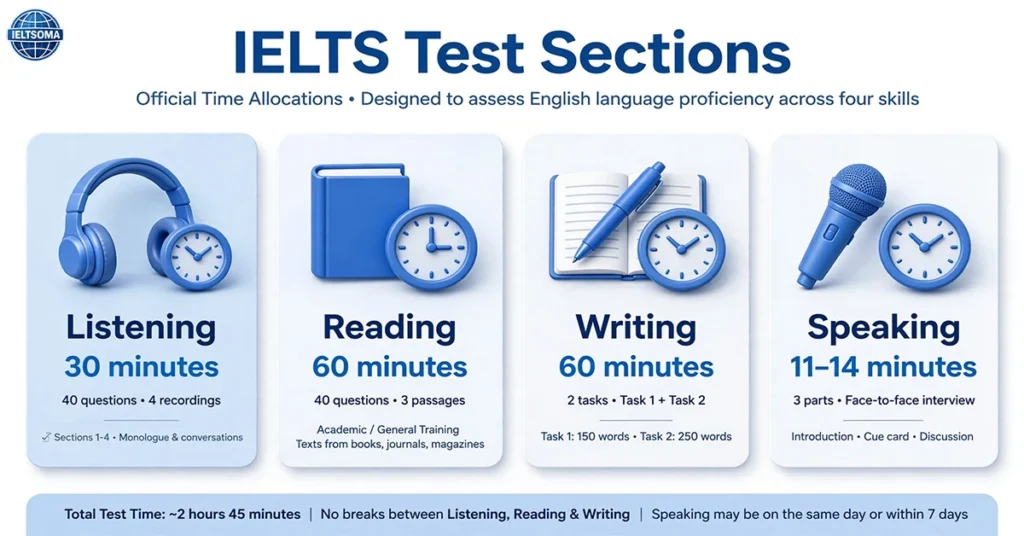
Before applying any IELTS Time Management Tips, you should understand exactly how much time you have for each section.
| IELTS Section | Time Available |
|---|---|
| Listening | 30 minutes (+ transfer time on paper-based test) |
| Reading | 60 minutes |
| Writing | 60 minutes |
| Speaking | 11–14 minutes |
Notice something important.
The Reading and Writing sections give you no extra time to think after the clock stops. Every minute matters.
Common Time Management Mistakes
Many candidates unknowingly waste valuable minutes because of poor habits.
Here are some of the biggest mistakes.
Spending Too Long on One Question
One difficult question should never cost you several easy ones.
If you’re stuck, make your best choice, move forward, and return later if time allows.
Reading Every Word
In the Reading section, many candidates read passages like novels.
Instead, learn to skim for the main idea and scan for specific information.
Starting Writing Task 2 Too Late
Task 2 carries more weight than Task 1.
Candidates who spend too much time on Task 1 often struggle to complete their essay properly.
Not Checking the Clock
Looking at the timer every few minutes helps you stay on schedule.
Waiting until the last ten minutes usually means you’ve already lost control of your timing.
No Practice Under Real Exam Conditions
Many students solve practice questions without timing themselves.
Then, on exam day, they are surprised by how quickly one hour passes.
IELTS Time Management Tips for Listening
The Listening test moves quickly.
Once the recording continues, you cannot pause it.
These IELTS Time Management Tips will help you stay ahead.
Read the Questions Before the Audio Starts
Use every second before each section begins.
Read:
- The instructions.
- Question types.
- Number limits.
- Keywords.
Knowing what information you’re listening for improves both speed and accuracy.
Underline Keywords
Focus on:
- Names
- Dates
- Locations
- Numbers
- Actions
- Opinions
These keywords help your brain identify important information as you listen.
Keep Listening Even If You Miss an Answer
Many candidates panic after missing one answer.
Instead of worrying about it, immediately focus on the next question.
The recording never waits.
Write Quickly
Develop clear, fast handwriting if taking the paper-based IELTS.
Avoid spending extra time making your writing look perfect.
Accuracy matters more than appearance.
Use the Transfer Time Wisely
If you’re taking the paper-based test, use the answer transfer time to:
- Correct spelling
- Check grammar
- Ensure singular and plural forms are correct
- Confirm question numbers
These small checks can prevent avoidable mistakes.
IELTS Time Management Tips for Reading
The Reading section is where many candidates lose the most marks.
You have 60 minutes to answer 40 questions across three passages.
Every minute counts.
Divide Your Time
A practical schedule looks like this.
| Activity | Time |
|---|---|
| Passage 1 | 18 minutes |
| Passage 2 | 20 minutes |
| Passage 3 | 22 minutes |
This approach leaves a small buffer for reviewing answers.
Skim Before Reading
Spend about one minute identifying:
- Main idea
- Headings
- Paragraph structure
- Topic changes
This makes it easier to locate answers later.
Scan Instead of Reading Everything
Scanning means searching for specific information instead of reading every sentence.
Look for:
- Numbers
- Names
- Dates
- Technical terms
- Repeated keywords
Professional readers rarely read every word.
They search strategically.
Move On Quickly
Some questions are intentionally challenging.
If one question takes more than one minute, guess if necessary and continue.
Returning later is usually more productive than getting stuck.
Watch the Clock Every 15 Minutes
A simple checkpoint system keeps you on track.
For example:
- After 15 minutes, you should be finishing Passage 1.
- After 35 minutes, Passage 2 should be nearly complete.
- After 55 minutes, you should be reviewing answers.
This habit prevents unpleasant surprises.
IELTS Time Management Tips for Writing

Many candidates lose marks because they don’t divide their 60 minutes effectively.
Remember:
Task 2 contributes more to your Writing band score than Task 1.
Follow the 20–40 Rule
An effective time allocation is:
| Task | Recommended Time |
|---|---|
| Task 1 | 20 minutes |
| Task 2 | 40 minutes |
Sticking to this structure ensures you dedicate more attention to the task with greater weighting.
Spend Five Minutes Planning
Don’t begin writing immediately.
Instead:
- Understand the question.
- Identify the task type.
- Brainstorm ideas.
- Organize your structure.
- Decide your examples.
A clear plan often saves more time than it takes.
Avoid Perfectionism
Some candidates rewrite entire paragraphs.
This wastes valuable minutes.
If a sentence is understandable and grammatically correct, keep moving.
Your goal is a complete, coherent response—not a flawless first draft.
Leave Time for Proofreading
Reserve the final three to five minutes for checking:
- Grammar
- Spelling
- Punctuation
- Word count
- Missing words
- Paragraph structure
Even small corrections can improve your final score.
A Weekly Time Management Plan for IELTS Preparation
Learning IELTS Time Management Tips is not only about exam day. It begins during your preparation.
A balanced weekly schedule helps you build consistency without feeling overwhelmed.
Monday
- Reading practice (60 minutes)
- Vocabulary review (30 minutes)
- Error analysis (20 minutes)
Tuesday
- Listening practice
- Dictation exercises
- Pronunciation practice
Wednesday
- Writing Task 1
- Grammar revision
- Timed writing practice
Thursday
- Reading under timed conditions
- Review incorrect answers
- Learn new vocabulary from passages
Friday
- Writing Task 2
- Essay correction
- Improve introductions and conclusions
Saturday
- Full Listening test
- Speaking practice with a partner or tutor
- Review mistakes
Sunday
- Complete a full IELTS mock test under exam conditions.
- Analyze performance.
- Adjust your study plan for the following week.
Following a structured schedule like this helps transform IELTS Time Management Tips from theory into daily habits, making effective timing feel natural by the time you sit the real exam.
Advanced IELTS Time Management Tips for Higher Band Scores
Once you have mastered the basics, the next step is to refine your approach. These advanced IELTS Time Management Tips can help you work more efficiently and stay calm under pressure.
Prioritize Easy Questions First
Not every question has the same difficulty level.
If you come across a challenging question, don’t let it consume your time. Answer the easier questions first to secure as many marks as possible. You can always return to difficult questions if time permits.
Use the “One-Minute Rule”
A useful strategy is the one-minute rule.
If you cannot make progress on a question within about one minute, move on. This prevents one difficult question from affecting the rest of your test.
Practice with a Visible Timer
Many candidates use practice books without timing themselves.
Instead, always keep a timer visible during practice sessions. This helps you develop an internal sense of pacing and reduces the pressure you’ll feel on test day.
Review Your Mistakes
Completing practice tests is only half the process.
Spend time reviewing:
- Why an answer was incorrect.
- Whether time pressure caused the mistake.
- How you could answer faster next time.
- Which question types consistently slow you down.
Learning from mistakes is one of the most valuable IELTS Time Management Tips you can apply.
Time Management Tips for the IELTS Speaking Test
Although the Speaking test is much shorter than the other sections, good time management still plays an important role.
Listen Carefully Before Answering
Don’t rush to answer before understanding the examiner’s question.
Taking a second to think often leads to clearer and more relevant responses.
Keep Your Answers Balanced
Very short answers can limit your score, while overly long answers may become repetitive.
Aim to:
- Answer the question directly.
- Add supporting details.
- Give an example when appropriate.
- Finish naturally.
Organize Your Part 2 Response
For the Speaking Part 2 cue card, use the one-minute preparation time wisely.
You can quickly note:
- Main idea
- Two or three supporting points
- One personal example
- A concluding thought
Having a simple structure makes it much easier to speak confidently for the full two minutes.
How to Build Speed Without Losing Accuracy
Many candidates believe they simply need to work faster.
In reality, speed should develop naturally through consistent practice.
Here are effective ways to improve both speed and accuracy.
Complete Timed Practice Tests
Simulate the real IELTS exam as closely as possible.
- Use official timing.
- Avoid interruptions.
- Work in a quiet environment.
- Don’t pause the timer.
The more realistic your practice, the more comfortable you’ll feel on exam day.
Improve Your Reading Speed
Reading English articles, newspapers, and magazines regularly helps you process information more quickly.
Focus on identifying:
- Main ideas
- Supporting details
- Opinions
- Facts
This habit directly supports the Reading section.
Expand Your Vocabulary
A stronger vocabulary means you spend less time trying to understand unfamiliar words.
Try learning new vocabulary in context rather than memorizing isolated word lists.
Develop Writing Templates
You should not memorize complete essays.
However, having flexible structures for introductions, body paragraphs, and conclusions can save valuable time during the Writing test.
Exam Day Time Management Checklist
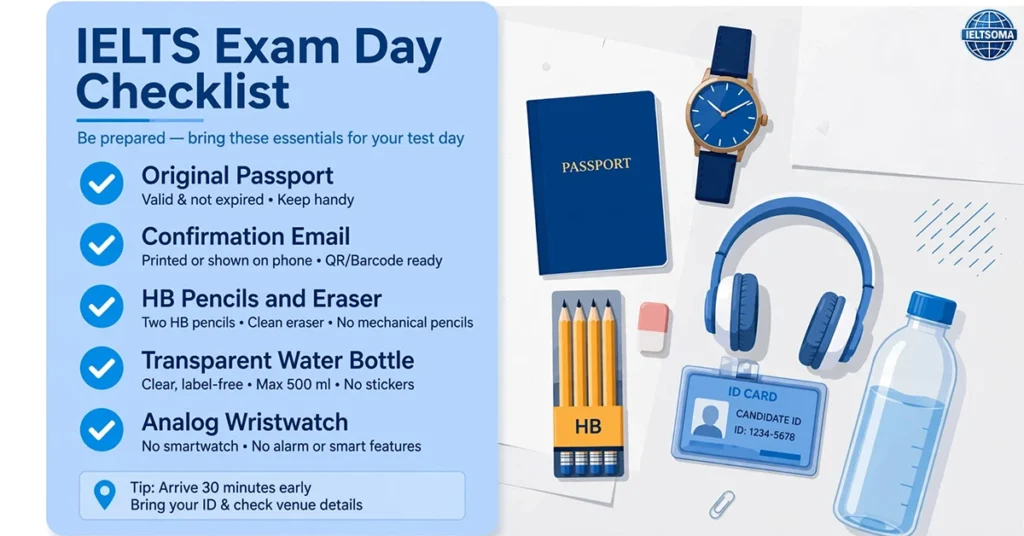
Use this checklist before entering the examination room.
- Sleep well the night before.
- Arrive early.
- Bring the required identification.
- Read every instruction carefully.
- Keep an eye on the clock.
- Don’t panic after one difficult question.
- Move forward confidently.
- Leave time for checking your work.
- Stay focused until the exam ends.
Following these IELTS Time Management Tips can help you remain composed throughout the test.
Mistakes to Avoid During the IELTS Exam
Even well-prepared candidates sometimes lose marks because of avoidable mistakes.
Ignoring Instructions
Always check:
- Maximum number of words.
- Required format.
- Singular or plural answers.
- Spelling requirements.
A correct answer written in the wrong format may still receive no marks.
Spending Too Much Time Checking One Answer
Double-checking is useful.
Checking the same answer five times is not.
Trust your preparation and continue moving forward.
Panicking After a Difficult Section
Every IELTS candidate encounters difficult questions.
The important thing is not allowing one challenge to affect your performance in the remaining sections.
Forgetting to Review
Even two or three minutes of review can help you catch:
- Missing answers
- Spelling mistakes
- Grammar errors
- Incorrect question numbers
These small corrections can make a noticeable difference to your overall score.
Frequently Asked Questions
What are the best IELTS Time Management Tips for beginners?
The best IELTS Time Management Tips include practicing under timed conditions, following a fixed schedule for each section, learning to skim and scan in Reading, planning before writing, and reviewing your answers whenever possible.
How much time should I spend on IELTS Writing Task 1 and Task 2?
A good approach is to spend approximately 20 minutes on Task 1 and 40 minutes on Task 2 because Task 2 contributes more to your overall Writing score.
Can time management improve my IELTS band score?
Yes. Effective time management allows you to answer more questions accurately, reduces stress, and ensures you complete every section, all of which can contribute to a higher band score.
How can I practice IELTS Time Management Tips at home?
Use official IELTS practice materials, set a timer for every practice session, avoid interruptions, and review both your mistakes and the time spent on each task.
Are these IELTS Time Management Tips suitable for Academic and General Training?
Yes. Most IELTS Time Management Tips apply to both IELTS Academic and IELTS General Training. The Reading passages differ, but effective time management strategies remain largely the same.
How often should I take a full IELTS mock test?
Taking one full mock test each week is a good starting point. As your exam date approaches, consider increasing the frequency to build stamina and confidence.
What is the biggest time management mistake in IELTS?
One of the biggest mistakes is spending too much time on a single difficult question. Moving on and returning later, if time allows, is usually a more effective strategy.
How early should I start practicing IELTS Time Management Tips?
Start as early as possible. Building good timing habits over several weeks or months is much more effective than trying to improve your speed just a few days before the exam.
Suggested Links
- IELTS Reading Section Strategy
- IELTS Listening Section Strategies
- IELTS FAQ: 75 Powerful Answers to Boost Your Band Score
- Official IELTS exam format
Final Thoughts
Success in the IELTS exam is not determined by English ability alone. Your ability to use time wisely can significantly influence your final band score. By applying these IELTS Time Management Tips consistently during your preparation and on exam day, you’ll become more confident, organized, and efficient across Listening, Reading, Writing, and Speaking.
Remember that improvement comes through regular practice, honest self-evaluation, and a structured study routine. Instead of rushing through practice tests, focus on building habits that allow you to manage every minute effectively.
At IELTSOMA, we encourage every learner to combine strong English skills with smart exam strategies. With the right preparation and these proven IELTS Time Management Tips, you’ll be better equipped to perform at your best and move closer to your target IELTS band score.