A high IELTS score rarely comes from simply doing more practice tests. It comes from knowing exactly what the test measures, understanding your weaknesses, practising the right skills, and learning how to perform under exam conditions.
Comprehensive IELTS preparation gives you a structured way to improve all four skills—Listening, Reading, Writing and Speaking—while avoiding the common mistake of spending most of your study time on the areas you already find comfortable.
Whether you are preparing for IELTS Academic or IELTS General Training, your preparation should begin with the same question:
What score do I need, and what do I need to do consistently to achieve it?
Once you know your target, you can build a preparation strategy around your current level, test type, available study time and weakest skills.
Table of Contents
What Is Comprehensive IELTS Preparation?
Comprehensive IELTS preparation means preparing for the complete test rather than concentrating on isolated question types or memorising model answers.
A strong preparation programme normally includes:
- Understanding the IELTS test format
- Setting a realistic target band score
- Assessing your current English level
- Developing Listening skills
- Improving Reading speed and comprehension
- Building Writing accuracy and organisation
- Developing Speaking fluency, vocabulary and pronunciation
- Learning IELTS question types
- Completing timed practice
- Analysing mistakes
- Improving weak areas
- Completing full mock tests
- Preparing for test-day conditions
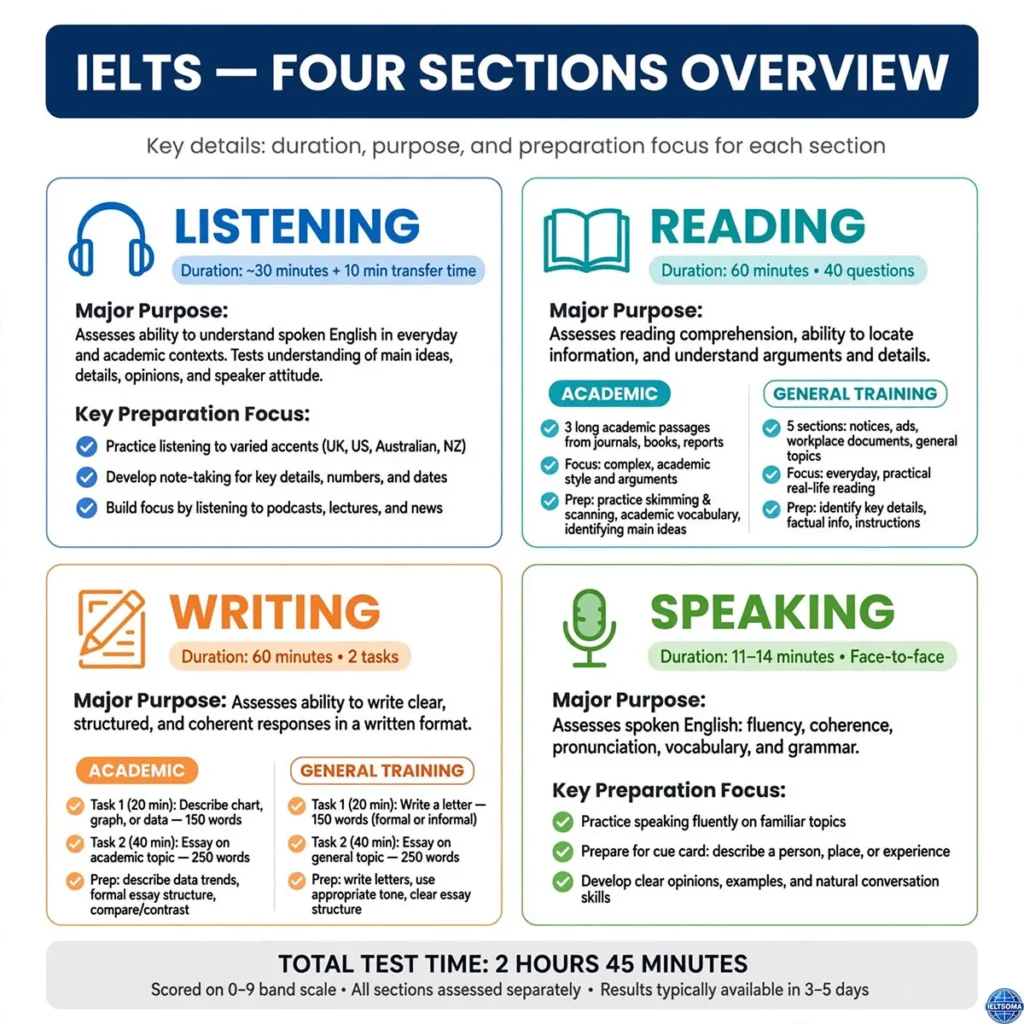
IELTS has four sections: Listening, Reading, Writing and Speaking. Listening and Speaking are the same in Academic and General Training, while Reading and Writing differ between the two tests.
This difference matters. A candidate preparing for General Training should not simply copy an Academic preparation plan, particularly for Reading and Writing.
1. Choose the Right IELTS Test First
Before you start serious preparation, make sure you are preparing for the correct test.
IELTS Academic is generally intended for people planning to study at undergraduate or postgraduate level or seeking certain professional registrations. IELTS General Training is commonly used for migration, work-related purposes and training or study below degree level. Your institution, employer or immigration authority should confirm which test you need.
The distinction can be summarised like this:
| Feature | IELTS Academic | IELTS General Training |
|---|---|---|
| Listening | Same | Same |
| Speaking | Same | Same |
| Reading | Academic texts | Everyday, workplace and general-interest texts |
| Writing Task 1 | Graph, chart, table, diagram or process | Letter |
| Writing Task 2 | Essay | Essay |
| Typical purpose | Higher education and professional registration | Migration, work and below-degree study |
Do not choose your test simply because one appears easier. Choose the test that matches your actual purpose.
2. Set Your Target Band Score
Your preparation becomes much more effective when you have a specific target.
For example, “I want to improve my English” is too broad. A more useful goal would be:
“I need an overall 7.0, with at least 6.5 in every section.”
Your target should include both your overall band requirement and any minimum individual section requirements.
IELTS reports scores for Listening, Reading, Writing and Speaking, as well as an overall band score. The overall score is calculated by averaging the four component scores and rounding according to IELTS scoring rules.
For example:
| Listening | Reading | Writing | Speaking | Overall |
|---|---|---|---|---|
| 7.0 | 7.0 | 6.5 | 7.0 | 7.0 |
This means you should not automatically aim for exactly the minimum score in every section. If one skill is currently weaker, improving your stronger skills can sometimes give you more flexibility—but you must still satisfy any minimum section requirements imposed by your university, employer or organisation.
3. Take a Diagnostic IELTS Test
One of the biggest preparation mistakes is starting with weeks of practice without first discovering your weaknesses.
Take a diagnostic test before creating your study plan.
Ideally, complete:
- One Listening test
- One Reading test
- One Writing Task 1
- One Writing Task 2
- One Speaking practice session
Do the Listening and Reading tests under timed conditions.
For Writing, do not simply count grammar mistakes. Look at whether you:
- Answered every part of the question
- Developed your ideas
- Organised information logically
- Used appropriate vocabulary
- Controlled grammar accurately
- Maintained the appropriate style
For Speaking, record yourself answering questions. Listen again and identify pauses, repetition, pronunciation problems, limited vocabulary and grammatical errors.
Your diagnostic test should answer a simple question:
Where are the marks being lost?
That information should determine your study priorities.
4. Build Listening Skills, Not Just Listening-Test Skills
IELTS Listening contains four parts with 40 questions, and recordings are heard once. Different English accents may be used.
That makes active listening essential.
Instead of completing practice tests every day, combine test practice with general listening development.
A practical Listening routine
Spend part of your study time listening to authentic English such as:
- Interviews
- Lectures
- Educational videos
- Podcasts
- Discussions
- News programmes
After listening, ask yourself:
- What was the main idea?
- Which details were important?
- Did the speaker change their opinion?
- Which words were difficult to recognise?
- Did the speaker use a synonym for an expected answer?
Then practise IELTS question types such as:
- Multiple choice
- Matching
- Form completion
- Note completion
- Table completion
- Summary completion
- Sentence completion
- Map or diagram labelling
Official IELTS practice materials include these types of tasks.
A useful habit is to review every incorrect answer rather than simply checking your score.
If you got 30 out of 40, the important question is not “Why did I get 30?”
It is:
Why did I lose the other 10 marks?
5. Improve Reading Through Strategy and Language
IELTS Reading is not simply a vocabulary test.
You need to understand the passage, locate relevant information efficiently and distinguish between similar ideas.
Academic and General Training Reading use different material. General Training Reading includes everyday texts, workplace material and a longer general-interest text, while Academic Reading uses texts appropriate to an academic context.
Develop three abilities together:
Skimming
Read quickly to understand the general purpose and structure of a passage.
Scanning
Search for specific information such as names, dates, figures or keywords.
Detailed reading
Slow down when you need to understand an argument, comparison, qualification or complex relationship.
Do not assume that the exact words in the question will appear in the passage.
IELTS frequently tests your ability to recognise paraphrases and synonyms.
For example:
Question: The project was completed earlier than expected.
The passage might say:
The development finished ahead of schedule.
The vocabulary is different, but the meaning is similar.
Keep an error log
For every incorrect Reading answer, record:
| Problem | Example |
|---|---|
| Vocabulary | Unknown word |
| Paraphrasing | Could not recognise equivalent meaning |
| Location | Could not find relevant paragraph |
| Question type | Misunderstood instructions |
| Logic | Chose an answer based on assumption |
| Time | Spent too long on one question |
This transforms practice into learning.
6. Treat Writing as a Skill You Must Develop
Writing is often the section where candidates discover that knowing English is not enough.
You need to answer the specific task, organise your ideas effectively and use language accurately.
IELTS Writing is assessed using criteria including task achievement or response, coherence and cohesion, lexical resource, and grammatical range and accuracy. Task 2 carries greater weight than Task 1.
Academic Writing
Academic Writing Task 1 may involve a graph, table, chart, diagram or process. Task 2 requires an essay responding to a point of view, argument or problem.
General Training Writing
General Training Task 1 requires a letter, while Task 2 is an essay. Task 1 requires at least 150 words and Task 2 at least 250 words.
A useful preparation cycle is:
Plan → Write → Check → Get feedback → Rewrite
Do not write an essay once and immediately move to another topic.
The rewriting stage is where much of the improvement happens.
For example, if your problem is weak idea development, rewriting the same essay with stronger explanations and examples can be more valuable than writing five unrelated essays.
7. Make Speaking Practice Regular
Speaking improves through frequent use, not occasional practice the night before the exam.
The IELTS Speaking test lasts approximately 11–14 minutes and consists of three parts. Part 2 includes one minute of preparation followed by a longer individual talk, while Part 3 involves a more detailed discussion.
Practise all three parts.
Speaking Part 1
Focus on giving natural, developed answers rather than memorised speeches.
Instead of:
“Yes, I like reading.”
Try:
“Yes, I enjoy reading, particularly non-fiction because I like learning about subjects that I know very little about.”
Speaking Part 2
Practise organising your answer quickly.
Use the preparation minute to note:
- Main idea
- Key details
- Example
- Personal reaction
Speaking Part 3
Move beyond personal experience.
Practise explaining:
- Why something happens
- Advantages and disadvantages
- Causes and effects
- Changes over time
- Possible solutions
- Future developments
Speaking assessment considers fluency and coherence, lexical resource, grammatical range and accuracy, and pronunciation.
That means speaking faster is not the objective.
Clear, coherent communication is.
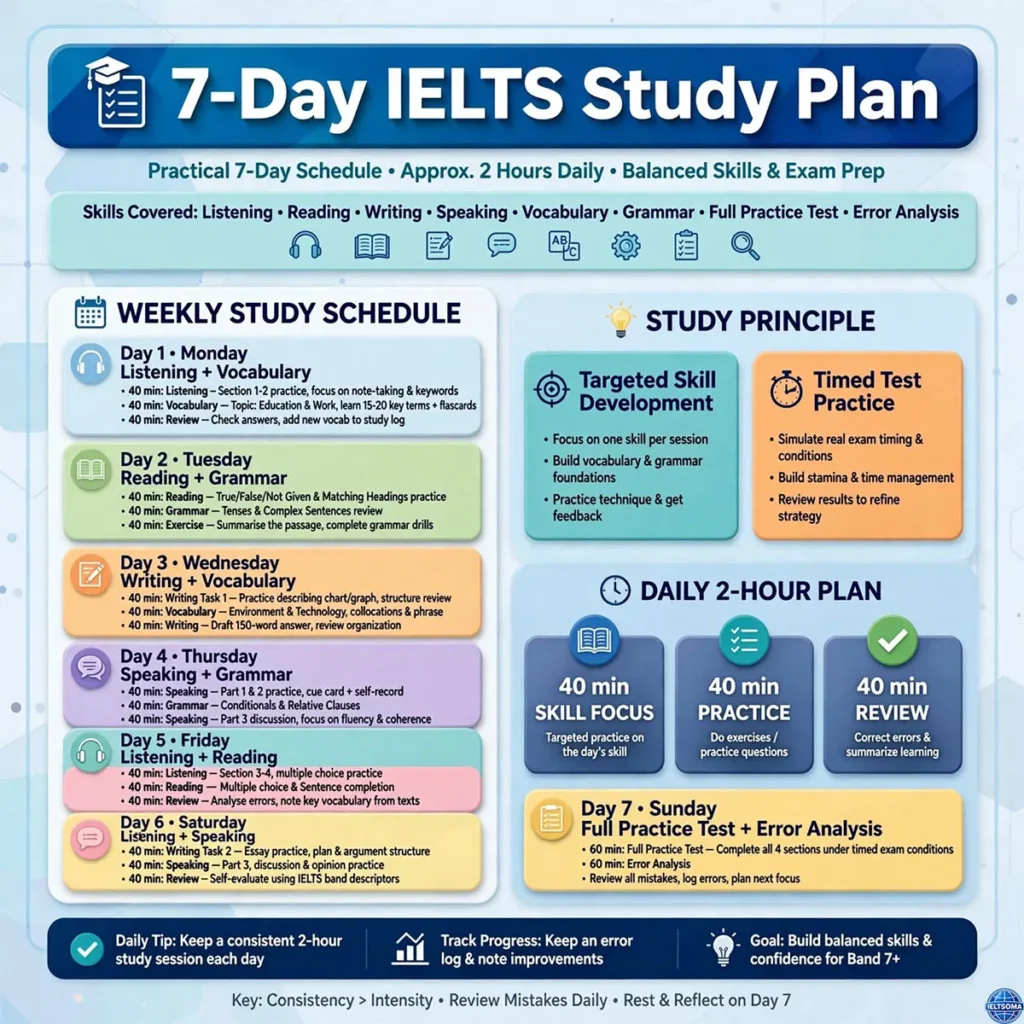
8. Use a Balanced Weekly IELTS Study Plan
A good study plan should give extra time to your weaknesses without neglecting your stronger skills.
Here is a practical example for a candidate studying approximately two hours per day:
| Day | Main Focus | Secondary Focus |
|---|---|---|
| Monday | Listening | Speaking |
| Tuesday | Reading | Vocabulary |
| Wednesday | Writing | Grammar |
| Thursday | Listening | Reading |
| Friday | Writing | Speaking |
| Saturday | Full practice test | Error analysis |
| Sunday | Weakest skill | Review |
You can adjust the schedule according to your target and available time.
If Writing is your weakest skill, it makes sense to spend more time writing than Listening.
If your Reading score is already strong but Speaking is weak, do not spend most of your preparation time doing Reading tests simply because they feel comfortable.
The 70/30 rule for practice
A useful approach is to divide your preparation roughly into:
- 70% targeted skill development
- 30% test practice and timed work
As your exam approaches, you can gradually increase the proportion of full timed practice.
9. Turn Every Practice Test Into a Lesson
Completing practice tests without reviewing mistakes can create the illusion of progress.
A better cycle is:
Test → Score → Analyse → Correct → Practise → Retest
Suppose you score 26/40 in Reading.
Do not immediately take another test.
First determine why those 14 answers were lost.
Perhaps:
- 4 were caused by vocabulary
- 3 by True/False/Not Given confusion
- 2 by poor time management
- 3 by matching headings
- 2 by careless errors
Now your next study session has a purpose.
This is one of the most important principles of comprehensive IELTS preparation:
Your mistakes should determine what you practise next.
Common IELTS Preparation Mistakes
Avoid these habits if you want your preparation to be efficient.
1. Memorising complete essays
Memorised essays can become unsuitable when the actual question changes. Develop ideas, structures and language that you can adapt instead.
2. Learning long vocabulary lists
Knowing an advanced word does not help if you cannot use it accurately.
Learn vocabulary in context and practise collocations.
3. Doing unlimited practice tests
More tests do not automatically mean more improvement.
Analyse mistakes after each test.
4. Ignoring pronunciation
Speaking performance is not only about vocabulary and grammar. Pronunciation is one of the assessed Speaking criteria.
5. Studying only your strongest skill
Comfortable practice is not necessarily productive practice.
Give your weakest skill deliberate attention.
6. Never practising under time pressure
Knowing the material at home is different from performing within the IELTS time limits.
Introduce timed practice progressively.
How Long Should You Prepare for IELTS?
There is no universal number of weeks that guarantees a particular band score.
Your preparation time should depend on:
- Current English proficiency
- Target band score
- Weakest skills
- Previous IELTS experience
- Daily study time
- Familiarity with IELTS question types
A candidate already close to the target may need focused test preparation, while someone with significant language weaknesses may need a longer period of English development.
A useful progression is:
Assess → Plan → Build skills → Practise → Get feedback → Retest
Do not choose a preparation period simply because someone else improved in that amount of time.
Use Official IELTS Practice Materials
Your preparation should include reliable practice materials.
The official IELTS website provides sample questions and practice resources for both Academic and General Training candidates. These materials can help you understand the test format, experience question types, practise under timed conditions and review answers.
Use official materials particularly when you want to understand:
- Question formats
- Test structure
- Timing
- Sample tasks
- Assessment criteria
- Expected response requirements
You can supplement these with other reputable learning resources, but your preparation should always remain connected to the actual IELTS test format.
Your Final Two Weeks Before IELTS
The final stage should be about consistency rather than panic.
Two weeks before
Focus on:
- Timed section practice
- Writing feedback
- Speaking practice
- Listening accuracy
- Reading time management
- Reviewing recurring mistakes
One week before
Reduce experimentation.
Work with strategies that you already know.
Complete realistic practice sessions and make sure you understand the instructions for each section.
The day before
Do not attempt to learn hundreds of new words or complete several full tests.
Review your key strategies, prepare what you need for test day and get enough rest.
Your goal is to arrive mentally prepared—not exhausted.
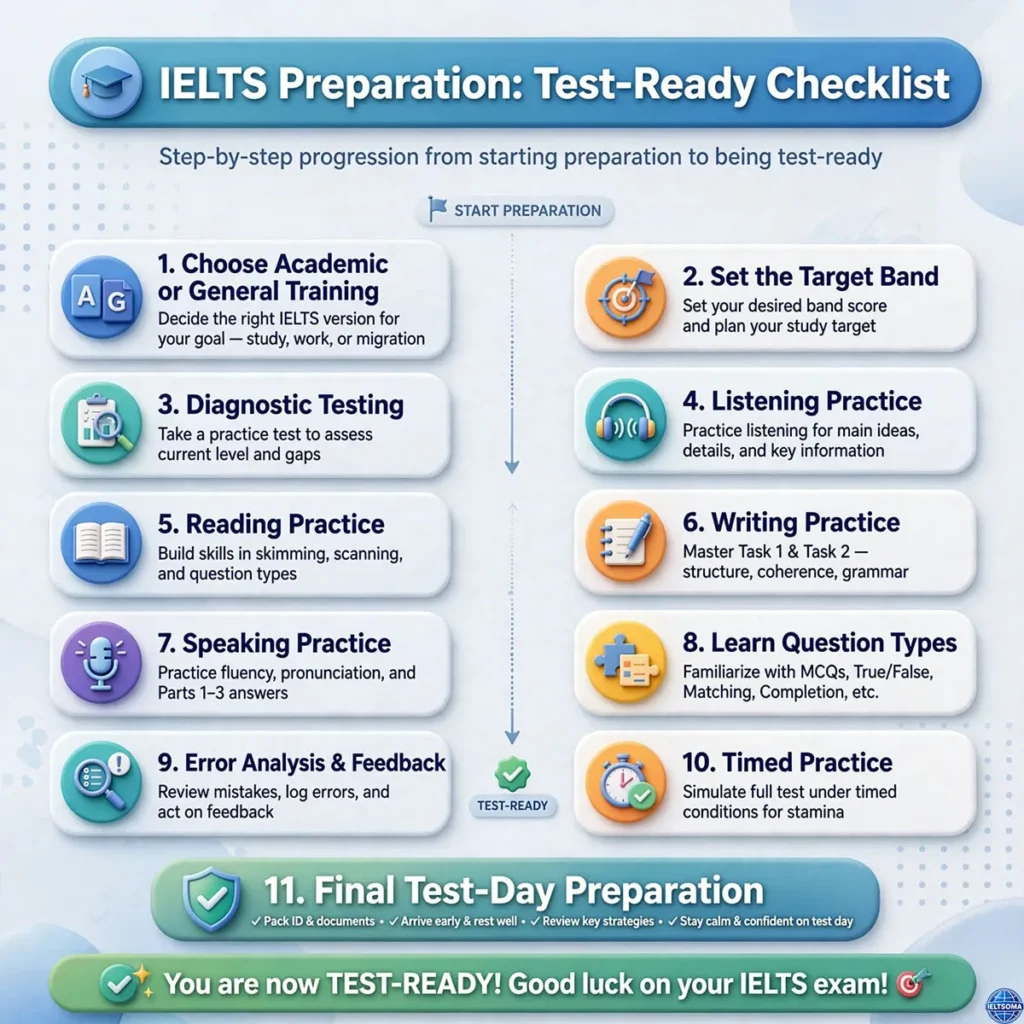
A Simple Comprehensive IELTS Preparation Checklist
Before your test, make sure you can answer “yes” to most of these questions:
- I know whether I need Academic or General Training.
- I know my required overall band score.
- I know whether I have minimum section requirements.
- I have completed a diagnostic test.
- I know my weakest skill.
- I understand the four IELTS sections.
- I have practised every major question type.
- I regularly practise Listening.
- I practise Reading under time limits.
- I have written both types of Writing tasks relevant to my test.
- I receive feedback on my Writing.
- I practise Speaking regularly.
- I record and review some Speaking practice.
- I keep an error log.
- I have completed full timed practice.
- I know how I will manage my time.
- I have reviewed official IELTS sample materials.
Frequently Asked Questions About Comprehensive IELTS Preparation
What is the best way to prepare for IELTS?
The best approach combines English-language development with IELTS-specific practice. Assess your current level, identify weaknesses, practise each skill, analyse mistakes and gradually introduce timed full tests.
How many hours a day should I study for IELTS?
There is no fixed number that works for everyone. Consistent, focused study is more valuable than simply counting hours. Two focused hours can be more productive than four hours of unfocused practice.
Can I prepare for IELTS by myself?
Yes. Self-study can work well when you have reliable materials, a structured plan and a method for identifying mistakes. Writing and Speaking can be more difficult to evaluate independently, so professional feedback can be particularly useful for those skills.
Should I prepare differently for IELTS Academic and General Training?
Yes. Listening and Speaking are the same, but Reading and Writing differ. Your preparation should therefore reflect the specific test you are taking.
How can I improve my IELTS band score quickly?
First identify the specific reasons you are losing marks. Improving a recurring weakness is generally more productive than completing random practice tests.
Is practising past IELTS tests enough?
No. Practice tests are useful for learning the format and measuring progress, but they should be combined with language development, strategy work, error analysis and feedback.
How can I improve IELTS Writing?
Study the assessment criteria, practise planning and developing ideas, improve vocabulary and grammar in context, and obtain feedback on your writing. Rewrite essays after identifying weaknesses instead of simply producing more essays.
How can I improve IELTS Speaking?
Practise speaking frequently, record yourself, develop answers rather than memorising them, work on pronunciation and practise explaining and supporting opinions. Include all three parts of the Speaking test in your preparation.
Final Takeaway
Comprehensive IELTS preparation is not about doing the largest number of practice tests. It is about making every study session purposeful.
Know your target. Choose the correct test. Assess your starting point. Build each of the four skills. Learn how IELTS questions work. Analyse your mistakes. Get feedback where necessary. Then practise under realistic conditions.
Most importantly, let your performance guide your preparation.
If your Reading score is improving but Writing remains below your target, shift your attention. If your Listening is strong but Speaking lacks fluency, change your practice balance.
The strongest preparation plan is not necessarily the most complicated one.
It is the one that consistently turns weaknesses into strengths.
Further Reading:
- IELTS Reading Question Types: 14 Essential Tasks & Tips
- Academic Vocabulary for IELTS: 7 Powerful Ways to Build It
- IELTS Speaking Practice Tips: 15 Powerful Ways to Improve
- IELTS Reading Section Strategy: 11 Proven Ways to Score Higher
- IELTS Listening Section Strategies: 11 Powerful Tips
- Official IELTS sample test questions and practice materials