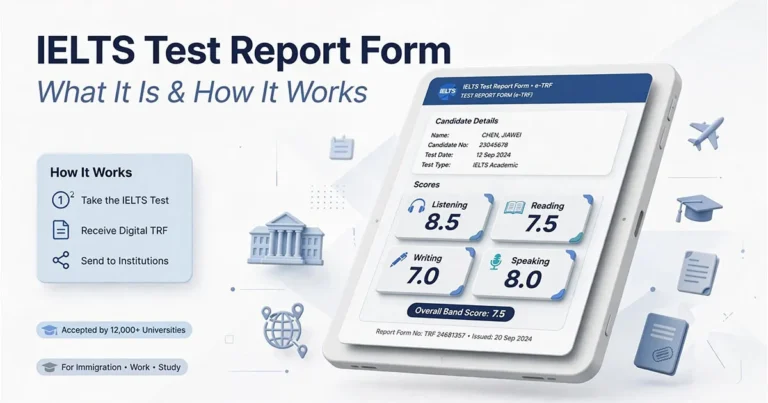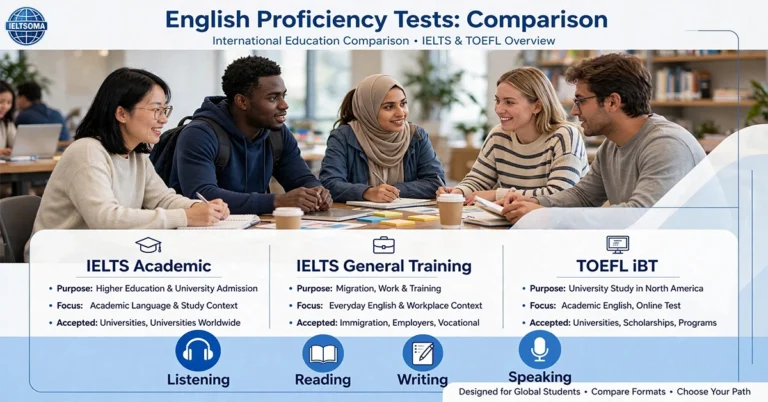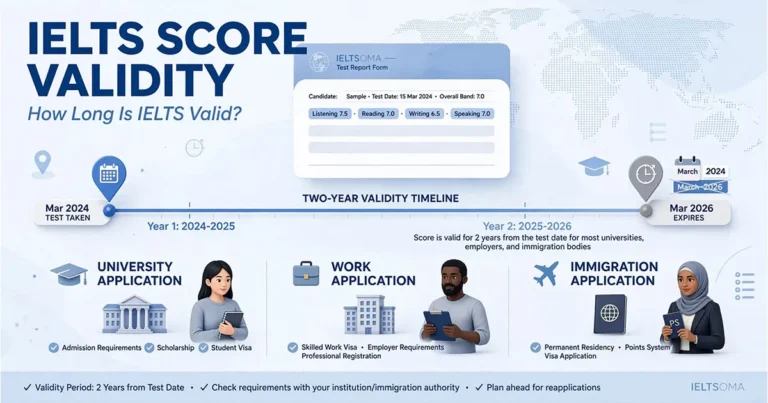
If you’re planning to study abroad, migrate, or work in an English-speaking country, understanding the IELTS Band Score Guide is essential. Your IELTS band score determines whether you meet the language requirements of universities, employers, and immigration authorities.
Many candidates prepare for months but still feel confused about how their final IELTS score is calculated. Some believe every section is scored the same way, while others misunderstand how the overall band is rounded. This comprehensive IELTS Band Score Guide explains everything in simple language so you know exactly how IELTS scoring works and what you can do to achieve your target band.
Whether you’re aiming for Band 6, Band 7, Band 8, or even the perfect Band 9, this guide will help you understand the scoring system and prepare more effectively.
Table of Contents
What Is an IELTS Band Score?
An IELTS band score measures your English language proficiency on a scale from Band 0 to Band 9. Instead of assigning percentages or letter grades, IELTS evaluates your ability to communicate in English through four language skills:
- Listening
- Reading
- Writing
- Speaking
Each module receives its own band score, and these four scores are averaged to calculate your overall IELTS band.
The IELTS Band Score Guide uses half-band increments, meaning your scores can be:
- 5.0
- 5.5
- 6.0
- 6.5
- 7.0
- 7.5
- 8.0
- 8.5
- 9.0
This scoring system provides a more accurate assessment of your English proficiency than a simple pass-or-fail exam.
For example:
| Module | Band Score |
|---|---|
| Listening | 7.5 |
| Reading | 7.0 |
| Writing | 6.5 |
| Speaking | 7.0 |
Overall Score:
(7.5 + 7.0 + 6.5 + 7.0) ÷ 4 = 7.0
Understanding this calculation is one of the most important parts of the IELTS Band Score Guide because even a half-band improvement in one section can raise your overall score.
Why the IELTS Band Score Guide Matters
Many universities, employers, and immigration programs have minimum IELTS requirements.
For example:
- Undergraduate programs often require Band 6.0 or 6.5.
- Master’s programs frequently ask for Band 6.5 to 7.5.
- Professional registration may require Band 7.0 or higher.
- Immigration pathways often specify minimum scores for each module.
Knowing how scores are awarded allows you to focus your preparation where it matters most.
Instead of studying randomly, the IELTS Band Score Guide helps you identify the skills that contribute directly to higher band scores.
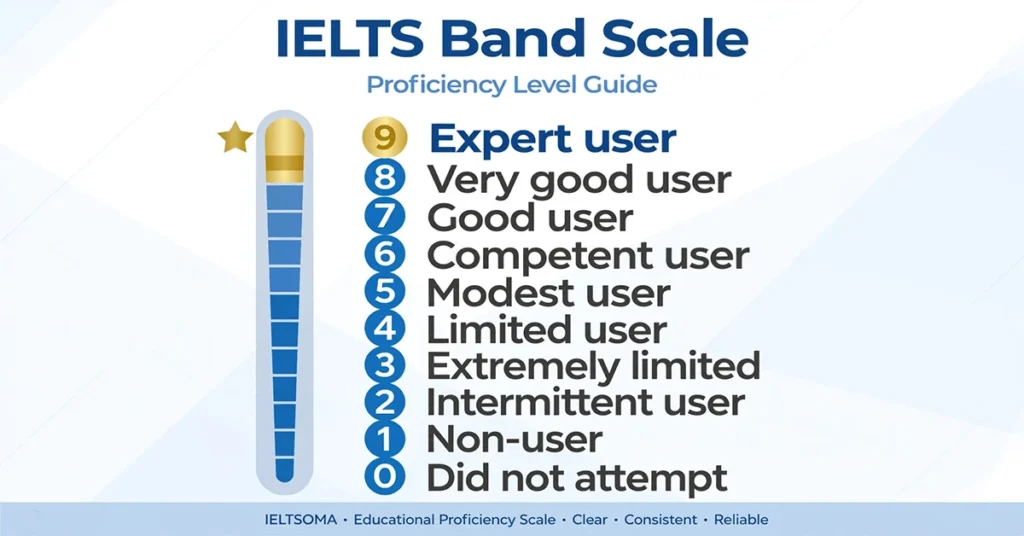
IELTS Band Score Chart
The following chart explains what each IELTS band means.
| Band | Skill Level | Description |
|---|---|---|
| 9 | Expert User | Fully operational command of English with complete accuracy and fluency. |
| 8 | Very Good User | Excellent command with only occasional inaccuracies. |
| 7 | Good User | Strong command with some misunderstandings in unfamiliar situations. |
| 6 | Competent User | Effective communication despite occasional errors. |
| 5 | Modest User | Partial command of English with noticeable mistakes. |
| 4 | Limited User | Basic competence in familiar situations only. |
| 3 | Extremely Limited User | Conveys and understands only general meaning. |
| 2 | Intermittent User | Great difficulty understanding spoken and written English. |
| 1 | Non User | Limited to a few isolated words. |
| 0 | Did Not Attempt | No assessable information provided. |
According to the IELTS Band Score Guide, every band reflects your ability to understand, speak, read, and write English in real-world situations.
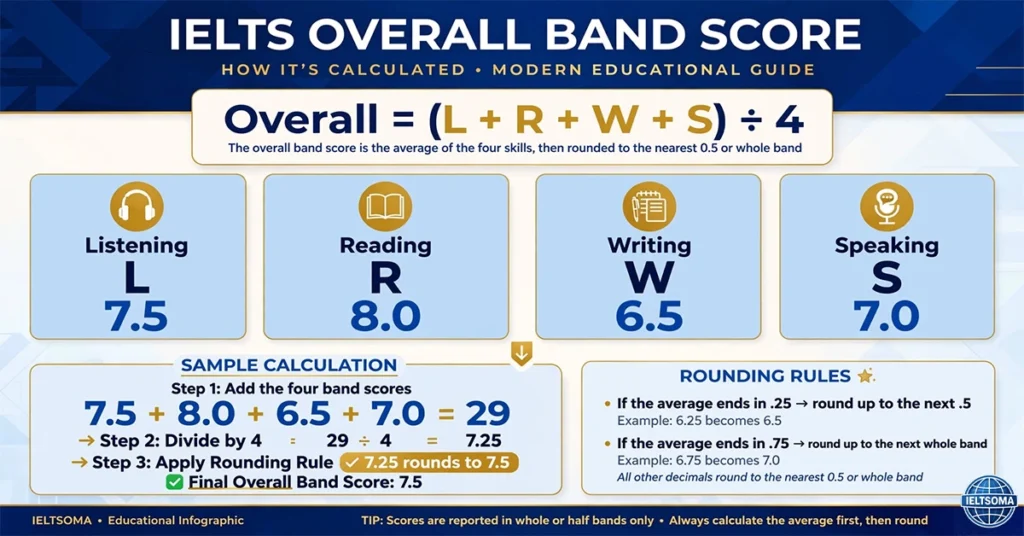
How IELTS Overall Band Scores Are Calculated
Many students assume the highest or lowest section determines the final score. That isn’t true.
The IELTS Band Score Guide calculates your overall band by averaging the scores from all four modules.
Step 1: Score Each Module
Each section receives an independent band score.
- Listening
- Reading
- Writing
- Speaking
Step 2: Calculate the Average
Add the four scores together and divide by four.
Example:
Listening: 8.0
Reading: 7.5
Writing: 6.5
Speaking: 7.5
Average:
8.0 + 7.5 + 6.5 + 7.5 = 29.5
29.5 ÷ 4 = 7.375
Step 3: Apply IELTS Rounding Rules
The IELTS Band Score Guide follows these rounding rules:
| Average | Final Band |
|---|---|
| 6.25 | 6.5 |
| 6.50 | 6.5 |
| 6.75 | 7.0 |
| 7.25 | 7.5 |
| 7.75 | 8.0 |
Understanding these rules helps candidates estimate their expected results more accurately after taking the exam.
IELTS Listening Band Score Guide
Listening consists of 40 questions.
Each correct answer earns one mark.
Your raw score is converted into an IELTS band score.
The conversion isn’t a percentage. Instead, IELTS uses a conversion table that maps your raw score to a band.
A typical conversion looks like this:
| Correct Answers | Approximate Band |
|---|---|
| 39–40 | 9.0 |
| 37–38 | 8.5 |
| 35–36 | 8.0 |
| 32–34 | 7.5 |
| 30–31 | 7.0 |
| 26–29 | 6.5 |
| 23–25 | 6.0 |
| 18–22 | 5.5 |
| 16–17 | 5.0 |
Although slight variations may occur across test versions, this table gives a reliable estimate for planning your preparation.
Tips to Improve Your Listening Score
- Listen carefully before writing.
- Read the questions before the recording starts.
- Practice recognizing paraphrasing.
- Improve spelling accuracy.
- Learn to identify distractors.
- Practice with different English accents.
- Review mistakes after every practice test.
Following these strategies consistently can significantly improve your Listening performance.
IELTS Reading Band Score Guide
The IELTS Band Score Guide explains that Reading scoring differs slightly between Academic and General Training because the difficulty of the passages is not the same.
Academic Reading
Academic Reading contains three long passages taken from books, journals, magazines, and newspapers.
Approximate conversion:
| Correct Answers | Approximate Band |
|---|---|
| 39–40 | 9.0 |
| 37–38 | 8.5 |
| 35–36 | 8.0 |
| 33–34 | 7.5 |
| 30–32 | 7.0 |
| 27–29 | 6.5 |
| 23–26 | 6.0 |
General Training Reading
General Training Reading is generally considered more accessible, so the raw score requirements for each band are usually higher.
Approximate conversion:
| Correct Answers | Approximate Band |
|---|---|
| 40 | 9.0 |
| 39 | 8.5 |
| 37–38 | 8.0 |
| 36 | 7.5 |
| 34–35 | 7.0 |
| 32–33 | 6.5 |
| 30–31 | 6.0 |
These tables help candidates estimate their performance during mock tests and identify how many additional correct answers are needed to reach the next band.
Common Reading Mistakes
Many candidates lose marks because they:
- Ignore keywords.
- Miss paraphrased information.
- Spend too much time on difficult questions.
- Fail to follow word limits.
- Misread True, False, and Not Given questions.
- Guess answers without referring back to the passage.
Avoiding these mistakes is one of the easiest ways to improve your Reading score without dramatically increasing study time.
IELTS Writing Band Score Guide
Unlike Listening and Reading, Writing is assessed by trained IELTS examiners rather than through right-or-wrong answers.
The IELTS Band Score Guide evaluates Writing using four equally weighted assessment criteria.
Task Achievement (Task Response)
This criterion measures whether you fully answer the question and develop your ideas clearly.
High-scoring responses:
- Address every part of the task.
- Present relevant ideas.
- Support arguments with examples.
- Stay focused throughout the essay.
Coherence and Cohesion
Examiners assess how logically your ideas are organized.
A strong essay should include:
- Clear paragraphs.
- Logical progression.
- Appropriate linking words.
- Smooth transitions.
- Easy-to-follow arguments.
Candidates often lose marks by overusing connectors or writing overly long paragraphs.
The next section of this guide explains the remaining Writing assessment criteria, the IELTS Speaking Band Score Guide, expert preparation strategies, common myths, FAQs, and practical tips to help you achieve your target IELTS band score.
Lexical Resource
Lexical Resource measures the range and accuracy of your vocabulary. According to the IELTS Band Score Guide, examiners look for your ability to use words naturally, accurately, and appropriately.
To score well in this criterion, you should:
- Use a wide range of vocabulary.
- Choose words that fit the context.
- Avoid repeating the same words frequently.
- Use collocations naturally.
- Minimize spelling mistakes.
- Demonstrate flexibility with synonyms and paraphrasing.
Remember, using difficult words unnecessarily does not guarantee a higher band. Instead, focus on using precise vocabulary that communicates your ideas clearly.
Grammatical Range and Accuracy
This criterion evaluates how accurately and flexibly you use grammar.
A higher band score requires:
- A variety of sentence structures.
- Accurate punctuation.
- Correct verb tenses.
- Proper subject-verb agreement.
- Minimal grammatical errors.
Simple sentences are perfectly acceptable when used correctly. Combining simple, compound, and complex sentences naturally is often more effective than forcing advanced grammar into every paragraph.
How to Improve Your Writing Score
The IELTS Band Score Guide recommends developing strong writing habits rather than memorizing essays.
Some effective strategies include:
- Practice writing under timed conditions.
- Learn how to structure Task 1 and Task 2 responses.
- Expand your academic vocabulary.
- Review examiner feedback whenever possible.
- Read high-quality sample essays.
- Proofread your work before time runs out.
- Practice writing every day, even if only for 20 minutes.
Consistent practice is one of the biggest factors separating Band 6 candidates from those achieving Band 7 or higher.
IELTS Speaking Band Score Guide
The Speaking test is a face-to-face interview with a certified IELTS examiner and lasts approximately 11 to 14 minutes.
According to the IELTS Band Score Guide, your performance is evaluated using four equally weighted criteria.
Fluency and Coherence
This criterion measures how naturally you speak.
Examiners consider:
- Your ability to speak without excessive pauses.
- Logical organization of ideas.
- Appropriate use of linking expressions.
- Confidence during conversation.
Speaking continuously is important, but quality matters more than speed.
Lexical Resource
The examiner evaluates your vocabulary range and your ability to choose suitable words during conversation.
Strong candidates:
- Use topic-specific vocabulary.
- Paraphrase when they cannot remember a word.
- Avoid repeating the same expressions.
- Speak naturally instead of memorizing answers.
Grammatical Range and Accuracy
Grammar is assessed throughout the interview.
You should demonstrate:
- Different sentence structures.
- Accurate grammar.
- Appropriate verb tenses.
- Correct articles and prepositions.
Small mistakes are acceptable, but frequent grammatical errors reduce your band score.
Pronunciation
Pronunciation is not about having a British, American, Australian, or Canadian accent.
Instead, the IELTS Band Score Guide focuses on whether your speech is easy to understand.
Examiners assess:
- Clarity.
- Stress.
- Intonation.
- Rhythm.
- Individual sounds.
A clear and natural speaking style is more important than trying to imitate another accent.
IELTS Academic vs General Training Band Scores
Many candidates wonder whether Academic and General Training have different band scores.
The answer is both yes and no.
The scoring scale remains exactly the same for both tests:
- Band 0 to Band 9.
- Half-band increments.
- Four language skills.
- Overall band calculated by averaging all four modules.
However, the Reading module uses different conversion tables because the Academic Reading passages are generally more challenging.
Listening, Writing, Speaking, and the overall band calculation follow the same scoring system.
Understanding this distinction is an important part of the IELTS Band Score Guide because many candidates compare scores from different test versions without realizing the Reading conversion differs.
What IELTS Band Score Do You Need?
The ideal IELTS score depends on your goals.
Here is a general guide.
| Purpose | Recommended Overall Band |
|---|---|
| Foundation Programs | 5.0–5.5 |
| Diploma Programs | 5.5–6.0 |
| Bachelor’s Degree | 6.0–6.5 |
| Master’s Degree | 6.5–7.5 |
| Professional Registration | 7.0–8.0 |
| Competitive Immigration Programs | 6.5–8.0 |
Always check the specific requirements of your university, employer, licensing authority, or immigration program before taking the test.
Common IELTS Band Score Myths
Many misconceptions surround IELTS scoring. Understanding the truth can help you prepare more effectively.
Myth 1: Difficult Vocabulary Guarantees a High Score
Reality: Vocabulary should be accurate and appropriate. Misusing advanced words can lower your score.
Myth 2: Speaking Faster Increases Your Band
Reality: Fluency is about natural communication, not speaking quickly.
Myth 3: Memorized Essays Always Score Well
Reality: Examiners are trained to recognize memorized responses. These often receive lower marks because they fail to address the task properly.
Myth 4: Grammar Must Be Perfect
Reality: Even Band 8 and Band 9 candidates occasionally make small mistakes. The key is demonstrating a wide range of accurate grammar.
Myth 5: One Poor Section Doesn’t Matter
Reality: Since your overall band is an average of all four modules, a low score in one section can reduce your final result.
Understanding these myths makes the IELTS Band Score Guide easier to apply during your preparation.

Expert Tips to Improve Your IELTS Band Score
If your target is Band 7 or above, follow these practical strategies.
Build a Daily Study Routine
Study consistently instead of cramming during the final week.
Practice Under Exam Conditions
Complete full-length mock tests using official timing.
Review Your Mistakes
Learning from mistakes is often more valuable than completing another practice test.
Improve Your Vocabulary Naturally
Read newspapers, books, academic articles, and reputable websites.
Focus on Weak Areas
Spend extra time improving the section where you consistently score the lowest.
Learn Time Management
Many candidates lose marks simply because they run out of time.
Use Official Practice Materials
Practice with authentic IELTS-style questions to become familiar with the exam format.
Seek Professional Feedback
Writing and Speaking improve much faster when you receive constructive feedback from experienced teachers or qualified mentors.
Frequently Asked Questions
What is the highest IELTS band score?
The highest possible score is Band 9, which represents an expert level of English proficiency.
How is the IELTS overall band score calculated?
The overall score is calculated by averaging your Listening, Reading, Writing, and Speaking band scores. The final result is then rounded according to IELTS rounding rules.
Is Band 7 considered a good IELTS score?
Yes. Band 7 is widely accepted by universities, employers, and immigration authorities in many English-speaking countries.
Can I get different scores in each module?
Yes. Each module is assessed independently, so your Listening, Reading, Writing, and Speaking scores may all differ.
Is IELTS Academic harder than General Training?
The Academic Reading module is generally more challenging, but both tests use the same Band 0–9 scoring scale.
Can I improve my IELTS score in one month?
Improvement depends on your current level, study habits, and target score. With focused preparation, many candidates improve by half a band or more, though individual results vary.
How many questions can I get wrong for Band 7?
The number varies by module and test version. For Listening and Reading, Band 7 typically requires around 30–32 correct answers, although conversion tables may vary slightly.
Is there a pass or fail score in IELTS?
No. IELTS does not have a pass or fail result. Instead, you receive a band score that reflects your English language proficiency.
Final Thoughts
Understanding the IELTS Band Score Guide is one of the most effective ways to prepare for the IELTS exam. When you know how each section is assessed, how the overall score is calculated, and what examiners expect, you can create a focused study plan that targets your weaknesses and maximizes your strengths.
Whether your goal is studying abroad, professional registration, employment, or immigration, improving your understanding of the IELTS Band Score Guide can help you prepare more strategically and approach the exam with greater confidence.
Rather than chasing shortcuts or memorizing answers, focus on consistent practice, authentic learning materials, and regular feedback. Over time, these habits will help you develop stronger English skills and increase your chances of achieving your desired IELTS band score.
Further Reading: