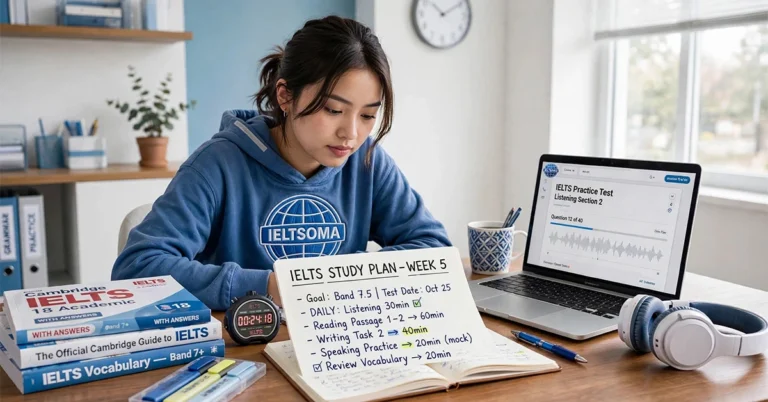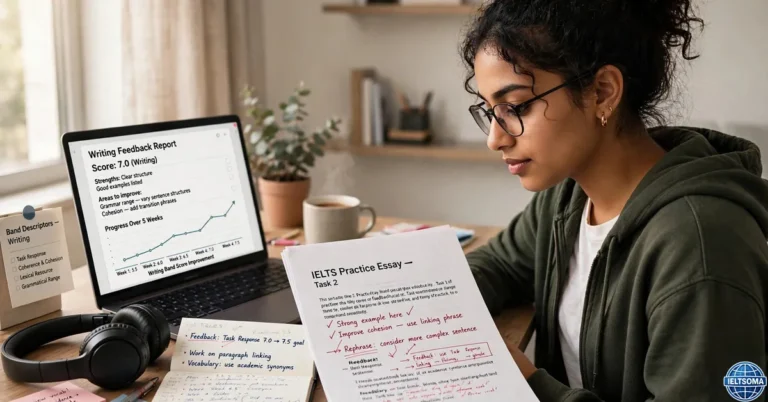
IELTS preparation is usually associated with vocabulary lists, practice tests, grammar exercises and speaking drills. But there is another skill that can affect how effectively you use all of that preparation: the ability to stay present when pressure rises.
You may know the answer but panic and change it.
You may understand a Reading passage but lose concentration after one difficult question.
You may have good Speaking vocabulary but become so focused on making mistakes that your fluency suffers.
This is where mindfulness techniques for IELTS can become useful.
Mindfulness does not replace English practice, exam strategies or mock tests. Instead, it can help you develop a calmer approach to preparation and test-day pressure by training you to notice your thoughts, physical reactions and attention without immediately reacting to them.
Research on mindfulness-based interventions has found evidence of reduced test anxiety, although results should be interpreted carefully because studies vary in quality and there are limitations in the research. A 2024 meta-analysis covering 1,275 participants found a moderate-to-large reduction in test anxiety among participants receiving mindfulness-based interventions, while also noting possible publication bias and unexplained differences between studies.
For an IELTS candidate, the practical question is simple:
How can you use mindfulness without turning it into another complicated study task?
Here are nine practical techniques.
Table of Contents
What Are Mindfulness Techniques for IELTS?
Mindfulness techniques for IELTS are simple practices that help you bring your attention back to the present moment during IELTS preparation or the test itself.
They may involve:
- controlled breathing
- brief body awareness
- focused listening
- observing thoughts without reacting
- mindful study breaks
- present-moment attention
- visualisation
- deliberate transitions between tasks
- short pre-test routines
The purpose is not to eliminate every nervous thought.
You are likely to feel some pressure before an important examination. The more realistic goal is to prevent anxiety from controlling your attention and decisions.
For example, imagine you are completing an IELTS Reading test and encounter a difficult question.
An unhelpful reaction might be:
“I don’t understand this. I’m going to fail.”
A mindful response is different:
“This question is difficult. I notice that I am becoming tense. I will take one breath, check the evidence and decide what to do next.”
The question has not changed.
Your response to it has.
Why Mindfulness Can Help During IELTS Preparation
IELTS requires sustained attention across four skills: Listening, Reading, Writing and Speaking. The official IELTS format includes all four sections, although Academic and General Training differ in Reading and Writing.
That means mental control matters throughout your preparation.
Mindfulness may be particularly useful when you:
- lose concentration quickly
- overthink mistakes
- become anxious before mock tests
- panic when you see unfamiliar vocabulary
- worry excessively about your band score
- become frustrated during difficult practice
- struggle to return to a task after making an error
A systematic review of mindfulness interventions among undergraduate students found that many studies reported beneficial effects, particularly in areas such as anxiety, stress and depression, although the researchers also identified limitations in the existing evidence.
Think of mindfulness as a supporting skill, not an IELTS shortcut.
You still need to develop vocabulary, grammar, pronunciation, comprehension and test strategies.
1. Use the 60-Second Breathing Reset
You do not need a 30-minute meditation session every time you feel nervous.
A simple 60-second breathing reset can be enough to interrupt an unhelpful cycle of thoughts.
Try this during IELTS preparation:
- Stop what you are doing.
- Put both feet comfortably on the floor.
- Relax your shoulders.
- Breathe normally.
- Notice the sensation of breathing.
- Count several slow breaths.
- Return your attention to your task.
Do not try to force yourself to become completely relaxed.
The goal is simply to stop for a moment and deliberately redirect your attention.
Example
You are about to start a full Reading practice test.
Instead of immediately opening the passage while thinking about your target band score, spend one minute settling your attention.
Then begin.
This creates a clear psychological transition between ordinary life and focused IELTS practice.
2. Practise Mindful Listening
One of the most useful mindfulness techniques for IELTS can be integrated directly into Listening practice.
IELTS Listening recordings are played once, so losing concentration can be costly. The official IELTS format contains four parts with 10 questions in each part.
Mindful listening means deliberately paying attention to what you hear instead of allowing your thoughts to drift.
During practice, notice:
- the speaker’s voice
- changes in tone
- pauses
- important words
- transitions
- numbers and names
- corrections
- changes in information
More importantly, notice when your attention disappears.
Suppose you miss one answer.
A common reaction is:
“I missed it. What was the answer? Maybe I should keep thinking about it.”
Now you are mentally reviewing the previous question while the recording continues.
A better response is:
“I missed that one. Return to the recording.”
This is mindfulness in action.
You acknowledge the mistake without allowing it to consume the next several questions.
3. Use the “Notice and Return” Technique in Reading
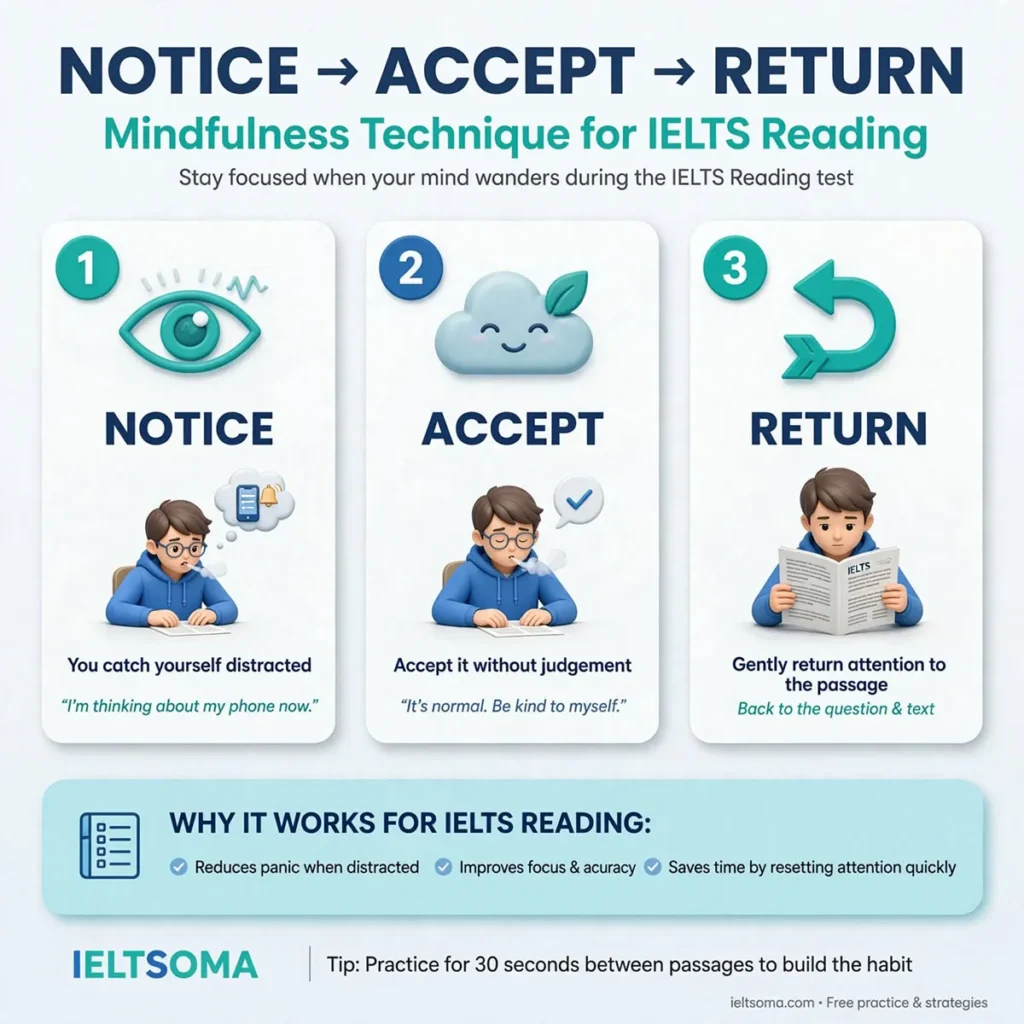
IELTS Reading requires sustained concentration, particularly when passages contain unfamiliar subjects or complex ideas.
Mindfulness can be used through a simple cycle:
Notice → Accept → Return
For example:
Notice:
“I am thinking about how many questions I have left.”
Accept:
“That thought is there.”
Return:
“Back to the paragraph.”
You do not need to fight the thought.
Trying desperately not to think about something can actually make you more aware of it.
Instead, notice the distraction and redirect your attention.
This is particularly useful when you are practising for 60 minutes and your concentration starts declining.
4. Practise Mindful Writing Before You Start
Writing can create a different type of pressure.
You have a limited amount of time, you need to organise ideas, and you must pay attention to vocabulary, grammar, coherence and task requirements.
Instead of immediately writing after reading the question, give yourself a short transition period.
For example:
Step 1: Read the question carefully.
Step 2: Take one or two deliberate breaths.
Step 3: Identify what the question is actually asking.
Step 4: Decide your main position or ideas.
Step 5: Begin writing.
The purpose is not to waste valuable exam time.
It is to prevent your first reaction from controlling your answer.
This is especially useful when a Task 2 question initially seems difficult.
Instead of:
“I have no ideas.”
try:
“This question looks challenging. What exactly is it asking me to discuss?”
That small change can make the problem feel more manageable.
5. Use Mindful Speaking Practice
IELTS Speaking is particularly suitable for mindfulness because the test requires you to respond in real time.
The Speaking test lasts 11–14 minutes and consists of three parts. Part 2 gives you one minute to prepare before you speak for up to two minutes.
During practice, notice what happens immediately before you speak.
Do you:
- rush your first sentence?
- worry about grammar?
- mentally translate?
- search for impressive vocabulary?
- become distracted by the examiner?
- panic when you cannot remember a word?
Mindfulness can help you notice these reactions without automatically following them.
Try this exercise
Choose a Speaking Part 2 topic.
Give yourself one minute to prepare.
Before speaking, take one calm breath.
Then begin.
If you forget a word, do not stop mentally searching for the perfect expression.
Paraphrase.
If you make a small grammar mistake, continue.
If your answer is not perfect, keep communicating.
The goal is to train yourself to remain present while speaking.
6. Turn Mistakes Into Mindfulness Practice
Mistakes are unavoidable during IELTS preparation.
The important question is what happens immediately afterwards.
Consider two candidates.
Candidate A
“I got that wrong again. I’m terrible at IELTS.”
The mistake becomes a judgement about personal ability.
Candidate B
“I got that wrong. Why?”
The mistake becomes information.
The second approach is much more useful.
After a practice question, pause before checking the answer.
Ask:
- What did I choose?
- Why did I choose it?
- What evidence did I notice?
- What did I overlook?
- What will I do differently next time?
This creates a more objective relationship with mistakes.
You are no longer simply collecting wrong answers.
You are studying your decision-making process.
That is particularly valuable for IELTS because some errors are caused by test technique rather than a lack of English knowledge.
7. Create a Mindful Study Transition
Many candidates move directly from one activity to another.
They finish work, check their phone, answer messages and immediately start an IELTS practice test.
Their body may be sitting at the desk, but their attention is somewhere else.
Create a short transition ritual.
It might take only two minutes:
- put your phone away
- clear your desk
- sit comfortably
- take several deliberate breaths
- identify today’s objective
- begin
For example:
“For the next 30 minutes, I am practising IELTS Listening Part 3. My goal is to identify distractors.”
That is more effective than:
“I need to study IELTS.”
The first statement gives your attention a specific destination.
8. Use Mindfulness on Test Day
Test-day mindfulness should be simple.
This is not the time to experiment with a complicated routine that you have never practised before.
Instead, use techniques you have already incorporated into your preparation.
Before the test:
- breathe slowly for a short period
- relax your shoulders
- remind yourself of your task
- focus on what you can control
During the test:
- focus on the current question
- avoid predicting your final score
- recover quickly after mistakes
- keep your attention on the task
After one difficult question, do not mentally calculate how many marks you may have lost.
That information cannot help you answer the next question.
Your attention is more valuable when it is directed towards the question in front of you.
9. Build a Five-Minute Mindfulness Routine
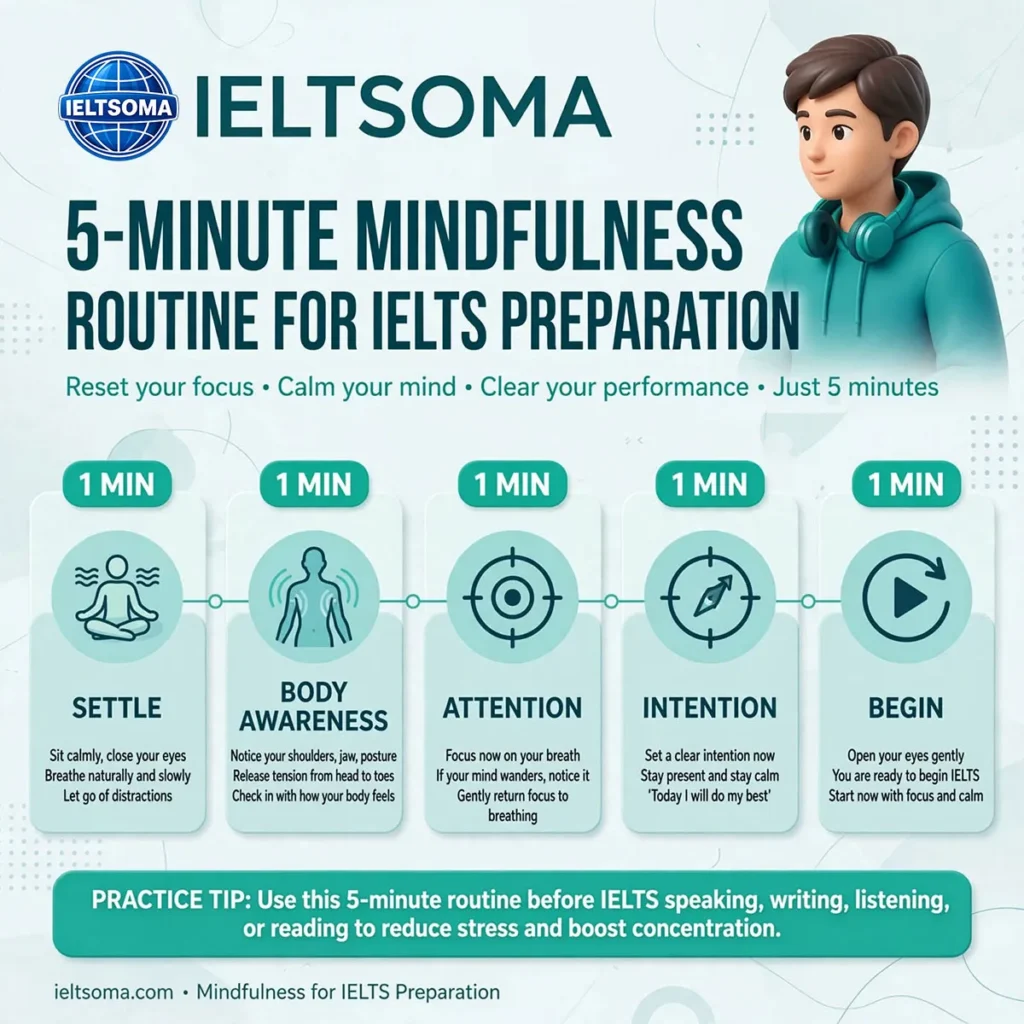
If you want to make mindfulness part of your IELTS preparation, consistency is more useful than complexity.
Try this five-minute routine before a study session:
Minute 1: Settle
Sit comfortably and notice your breathing.
Minute 2: Body awareness
Notice tension in your shoulders, jaw, hands or forehead.
Relax what you can.
Minute 3: Attention
Focus on one sensation, such as breathing.
When your mind wanders, gently return.
Minute 4: Intention
Decide exactly what you will practise.
For example:
“Today I will practise IELTS Reading matching headings.”
Minute 5: Begin
Start the task without judging how well you will perform.
This routine can become a consistent signal to your brain that focused study is beginning.
Mindfulness Techniques for IELTS: Which Technique Should You Use?
Different IELTS problems may respond better to different techniques.
| IELTS challenge | Useful mindfulness technique | Main purpose |
|---|---|---|
| Panic before a mock test | 60-second breathing reset | Settle attention |
| Losing focus in Listening | Notice and return | Recover concentration |
| Getting distracted in Reading | Present-moment awareness | Return to the passage |
| Feeling overwhelmed in Writing | Mindful transition | Clarify the task |
| Speaking too quickly | Breath awareness | Slow down and stay present |
| Overthinking mistakes | Observe without judgement | Prevent spiralling |
| Study-session distractions | Five-minute routine | Establish focus |
| Test-day nerves | Familiar breathing routine | Regain composure |
There is no requirement to use every technique.
Choose the one that matches your actual problem.
Mindfulness Is Not a Replacement for IELTS Preparation
This distinction matters.
Mindfulness may help with attention, stress or test anxiety, but it cannot teach you how to structure an IELTS essay, recognise paraphrases in Reading or produce accurate pronunciation.
You still need deliberate skills practice.
A balanced IELTS preparation plan should include:
- vocabulary development
- grammar practice
- Listening practice
- Reading practice
- Writing feedback
- Speaking practice
- mock tests
- error analysis
- time management
- mindfulness or other useful focus techniques
Think of mindfulness as supporting your preparation rather than replacing it.
Research on mindfulness and academic performance is encouraging, but it does not justify promising that mindfulness alone will increase an IELTS band score. A systematic review of mindfulness and academic performance found relationships with several useful outcomes, but the evidence base is varied.
Common Mistakes When Using Mindfulness for IELTS
Mindfulness itself can become another source of pressure if you approach it incorrectly.
Avoid these mistakes.
Trying to eliminate all anxiety
You do not need to feel completely calm.
The objective is to function effectively even when some nervousness is present.
Spending too much time meditating
A five-minute routine can be useful.
You do not need to spend an hour meditating instead of studying English.
Using mindfulness to avoid difficult practice
Mindfulness should help you approach challenging tasks, not escape from them.
Expecting instant results
Attention is a skill that develops through repetition.
Practising only on test day
A technique is more useful when it is familiar.
Practise it during ordinary study sessions first.
Becoming frustrated by wandering thoughts
A wandering mind is normal.
The practice is noticing the distraction and returning your attention.
A Simple IELTS Mindfulness Plan for One Week
You can introduce these techniques gradually.
| Day | Practice |
|---|---|
| Monday | 60-second breathing reset before studying |
| Tuesday | Mindful Listening during one practice section |
| Wednesday | Notice and return during Reading |
| Thursday | Mindful planning before Writing |
| Friday | One mindful Speaking practice |
| Saturday | Five-minute routine before a mock test |
| Sunday | Review which technique helped most |
After the week, keep the techniques that genuinely help.
You do not need to turn mindfulness into another checklist of tasks.
How to Combine Mindfulness With Effective IELTS Strategies
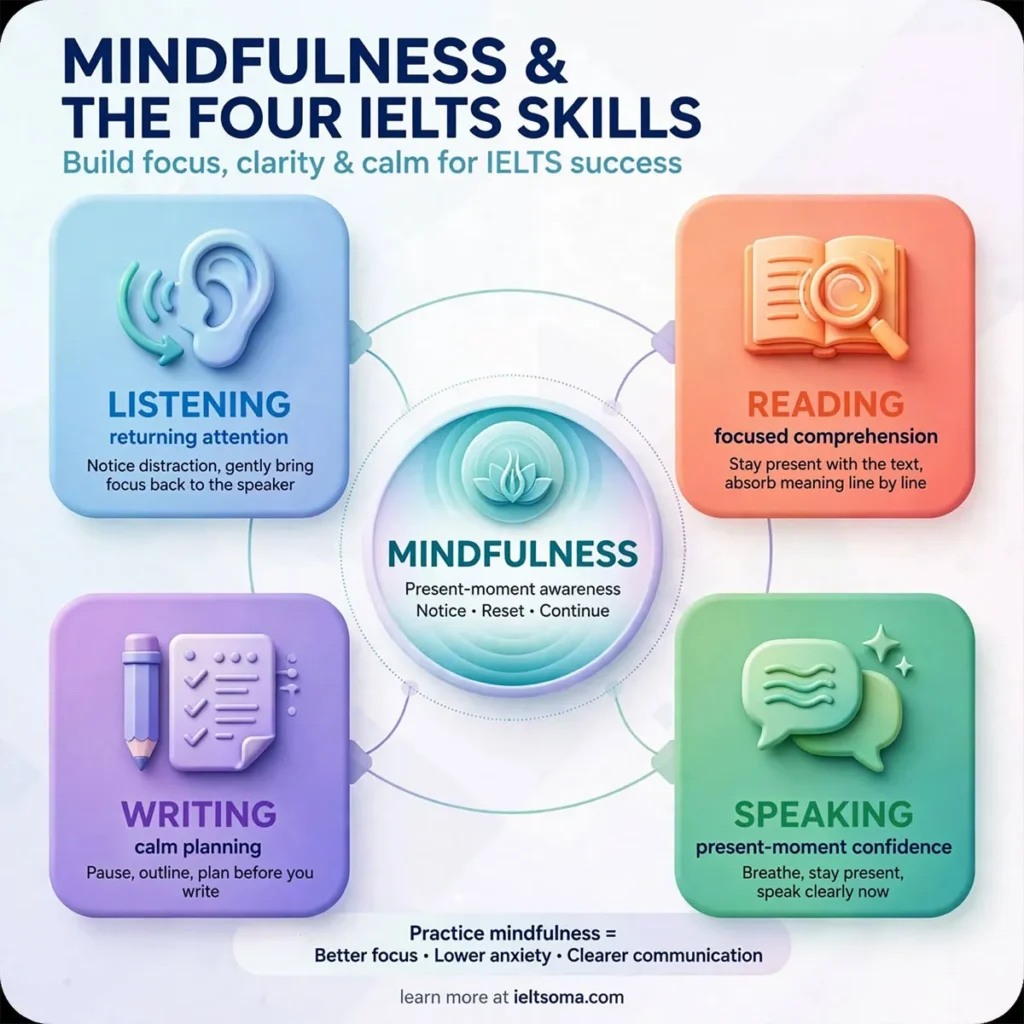
The strongest approach combines mental control with practical exam technique.
For example, during Listening:
Mindfulness:
Notice when your attention wanders and return.
IELTS strategy:
Follow the questions and watch for paraphrasing and distractors.
During Reading:
Mindfulness:
Return attention to the passage when distracted.
IELTS strategy:
Skim, scan, identify evidence and manage time.
During Writing:
Mindfulness:
Pause and clarify the question.
IELTS strategy:
Plan your response and organise ideas logically.
During Speaking:
Mindfulness:
Stay present rather than worrying about mistakes.
IELTS strategy:
Answer directly, extend ideas and use appropriate vocabulary and grammar.
The two approaches complement each other.
Frequently Asked Questions About Mindfulness Techniques for IELTS
Can mindfulness help with IELTS exam anxiety?
Mindfulness-based interventions may help reduce test anxiety. A 2024 meta-analysis found a moderate-to-large reduction in test anxiety across the studies included, although the researchers noted limitations including publication bias and variation between studies.
Can mindfulness improve my IELTS band score?
Mindfulness should not be viewed as a direct band-score technique. It may support attention, emotional regulation and preparation habits, but your IELTS score still depends on your performance in the assessed language skills.
How long should I practise mindfulness before IELTS?
You can begin with just one to five minutes. Consistency is more important than using a long routine. Choose a technique that you can comfortably repeat during preparation.
Can I use mindfulness during the IELTS test?
Yes, in the sense that you can deliberately return your attention to the task, regulate your breathing and avoid becoming absorbed in distracting thoughts. However, you should practise these habits before test day so they feel natural.
What is the best mindfulness technique for IELTS Speaking?
Breath awareness combined with present-moment attention can be useful. Before answering, take a natural breath and focus on the question rather than worrying about your score or trying to produce a perfect sentence.
Can mindfulness help me concentrate during IELTS Listening?
It may help you practise returning your attention when it wanders. This is particularly relevant because IELTS Listening recordings are played once.
Should mindfulness replace IELTS mock tests?
No. Mock tests are essential for developing familiarity with the test format, timing and question types. Mindfulness can complement that practice.
What should I do if I panic during an IELTS practice test?
Pause briefly if your test conditions allow it, take a controlled breath, acknowledge what happened and return to the current task. Do not spend several minutes mentally replaying the previous question.
Your IELTS Mindfulness Checklist
Before your next IELTS study session, ask:
- Have I chosen one clear study objective?
- Can I put distractions away?
- Have I taken a moment to settle my attention?
- Can I notice when my mind wanders?
- Can I return to the task without judging myself?
- Can I treat mistakes as information?
- Am I practising the actual IELTS skills I need?
- Do I have a simple routine I can repeat consistently?
You do not need perfect concentration.
You need the ability to return to the task.
That is a much more realistic and useful goal.
Final Takeaway
IELTS preparation is not only about what you know.
It is also about how effectively you can use what you know when the clock is running and pressure is present.
Mindfulness techniques for IELTS can give you practical ways to manage attention, respond more calmly to mistakes and stay focused during preparation and test situations.
Start small.
Use a 60-second breathing reset. Practise mindful Listening. Notice when your attention wanders during Reading. Take a moment to understand a Writing question before reacting. Stay present during Speaking practice. Treat mistakes as information rather than proof that you cannot succeed.
Most importantly, do not expect mindfulness to replace serious IELTS preparation.
Use it alongside vocabulary development, language practice, mock tests, feedback and proven test strategies.
The goal is not to walk into the IELTS test with an empty mind and zero anxiety.
The goal is to walk in knowing how to return your attention to the task when pressure tries to take it somewhere else.
That is a skill worth practising long before test day.
Further Reading: