Choosing between IELTS and TOEFL can feel like a bigger decision than it should be.
You may have heard that IELTS is easier, TOEFL is better for American universities, IELTS is better for immigration, or TOEFL is more academic. Some of these statements may contain a small amount of truth in certain situations, but none of them gives you the complete picture.
This IELTS vs TOEFL Comparison explains the differences that actually matter before you book your English proficiency test.
Both tests assess the four essential English skills: Reading, Listening, Speaking, and Writing. However, they differ in test format, Speaking experience, question types, scoring, and the purposes for which different versions are designed.
There is also an important 2026 update that test takers should know. TOEFL iBT introduced a new test format and a 1–6 scoring scale on January 21, 2026. During the transition period, TOEFL score reports also provide comparable information using the previous 0–120 scale.
IELTS is also changing its delivery model in 2026, with IELTS announcing that paper-based testing will be discontinued from mid-2026, although timelines vary by market.
So, should you take IELTS or TOEFL?
The answer depends on your destination, purpose, institution, English strengths, preferred test environment, and the exact test your organization accepts.
Table of Contents
IELTS vs TOEFL Comparison at a Glance
| Feature | IELTS | TOEFL iBT |
|---|---|---|
| Skills tested | Reading, Listening, Writing, Speaking | Reading, Listening, Writing, Speaking |
| Main IELTS versions | Academic and General Training | TOEFL iBT |
| Speaking format | Face-to-face with an examiner | Computer-based |
| IELTS scoring | 0–9 band scale | 1–6 scale for tests from January 21, 2026 |
| Previous TOEFL scale | Not applicable | 0–120, with comparable information during transition |
| Academic purpose | IELTS Academic | TOEFL iBT |
| General/migration pathway | IELTS General Training may be appropriate for eligible purposes | Acceptance depends on the organization |
| Delivery | Computer delivery is becoming standard | Computer-based |
| Best choice | Depends on destination and strengths | Depends on destination and strengths |
This table gives you the basic IELTS vs TOEFL Comparison, but the details are more important than the headlines.
What Is IELTS?
IELTS stands for the International English Language Testing System.
It measures English proficiency through four components:
- Listening
- Reading
- Writing
- Speaking
One major feature of IELTS is that candidates can take different versions depending on their purpose.
IELTS Academic is designed primarily for higher education and professional registration.
IELTS General Training is intended for purposes such as migration, work-related situations, training, and study below degree level, depending on the relevant requirements.
IELTS uses a 0–9 band scale. Candidates receive individual scores for each skill and an overall band score.
This makes IELTS particularly important for candidates who need to meet a specific overall band or minimum score in individual skills.
For IELTS test takers, choosing the correct test type is just as important as choosing between IELTS and TOEFL.
What Is TOEFL iBT?
TOEFL stands for the Test of English as a Foreign Language.
TOEFL iBT evaluates Reading, Listening, Speaking, and Writing with an emphasis on English used in academic and educational environments.
The test underwent major changes on January 21, 2026.
The updated TOEFL iBT includes an adaptive testing experience, updated tasks, and a new 1–6 score scale. ETS also states that the updated test takes approximately two hours, although adaptive testing means the exact experience can vary.
The updated TOEFL includes tasks such as:
- Completing words
- Reading in daily-life contexts
- Reading academic passages
- Listening and choosing a response
- Listening to conversations
- Listening to announcements
- Listening to academic talks
- Building sentences
- Writing an email
- Writing for an academic discussion
- Listening and repeating
- Taking an interview
Therefore, any IELTS vs TOEFL Comparison published before January 2026 should be checked carefully before you rely on it.
IELTS Academic vs General Training: Which One Do You Need?
Before deciding between IELTS and TOEFL, IELTS candidates must identify the correct IELTS version.
This is one of the most important parts of an IELTS vs TOEFL Comparison.
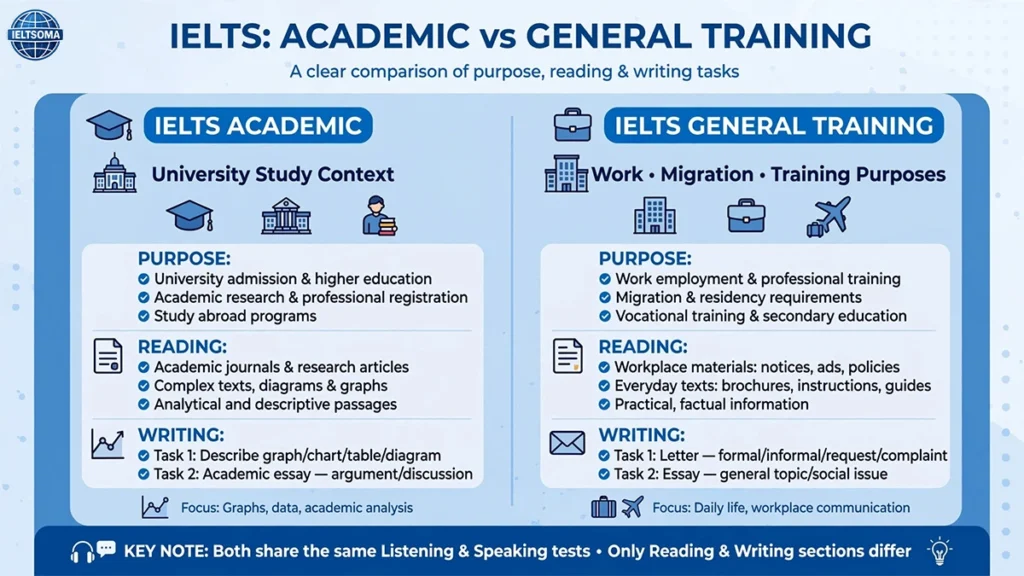
IELTS Academic
IELTS Academic is generally used when you need English-language evidence for higher education or professional registration.
If you are applying for an undergraduate or postgraduate program, check whether your university requires or accepts IELTS Academic.
IELTS General Training
IELTS General Training is designed for situations such as migration, work-related purposes, training, and study below degree level, depending on the destination and specific requirement.
The Listening and Speaking components are the same in IELTS Academic and General Training.
However, Reading and Writing are different.
That means someone preparing for IELTS General Training should not simply use IELTS Academic Reading and Writing materials.
This is also where IELTS differs significantly from TOEFL.
TOEFL iBT is designed primarily around academic English, while IELTS offers a dedicated General Training pathway for specific non-degree and migration-related purposes.
IELTS vs TOEFL Comparison by Test Format
The two tests measure similar core abilities, but the experience of demonstrating those abilities is different.
Your familiarity with a particular format can have a major effect on your preparation.
Let’s compare the four skills.
IELTS vs TOEFL Comparison: Reading
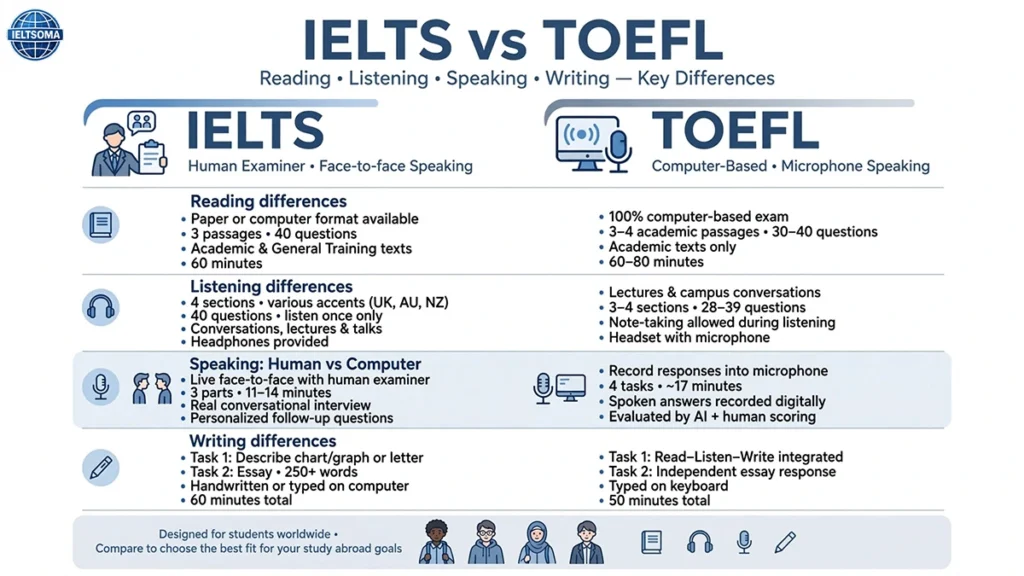
IELTS Reading varies according to whether you take Academic or General Training.
IELTS Academic Reading uses texts appropriate for people entering higher education or professional environments.
IELTS General Training Reading focuses more on everyday, workplace, and general-interest contexts.
The updated TOEFL Reading section includes both daily-life and academic reading contexts. ETS describes the updated Reading section as adaptive and lists a base timing of approximately 30 minutes.
For an IELTS candidate, the biggest consideration is question-type familiarity.
If you have already spent months practicing IELTS Reading, switching to TOEFL means learning a different examination system.
Your general English ability may transfer, but your test strategy will not transfer perfectly.
That is why the best IELTS vs TOEFL Comparison should examine the actual tasks, not simply compare the reputation of the exams.
IELTS vs TOEFL Comparison: Listening
IELTS Listening includes four parts and 40 questions.
Candidates hear the recordings once, and IELTS uses a range of English accents. (IELTS)
This means IELTS candidates should develop flexible listening skills rather than becoming dependent on one particular accent.
The updated TOEFL Listening section includes tasks involving responses, conversations, announcements, and academic talks.
The difference is not necessarily that one test has “harder English.”
The bigger difference is how you are required to process the information and respond to it.
If you are already comfortable with IELTS Listening question types, staying with IELTS may make your preparation more efficient.
IELTS vs TOEFL Comparison: Speaking
Speaking is one of the most noticeable differences between the tests.
IELTS Speaking is a face-to-face interview with an examiner.
The IELTS Speaking test has three parts and normally takes approximately 11–14 minutes.
The examiner assesses areas such as:
- Fluency and coherence
- Lexical resource
- Grammatical range and accuracy
- Pronunciation
In Part 2, candidates receive a topic and have one minute to prepare before speaking for up to two minutes.
Part 3 then develops the topic into a broader discussion.
The updated TOEFL Speaking section is computer-based and includes tasks such as Listen and Repeat and Take an Interview.
This creates a major personal-preference difference.
If you communicate naturally when talking directly to another person, IELTS Speaking may feel more comfortable.
If you prefer a computer-based environment and feel less pressure without a face-to-face examiner, TOEFL may feel more suitable.
Neither experience is automatically easier.
IELTS vs TOEFL Comparison: Writing
Writing is another area where the tests have different requirements.
IELTS Academic Writing has two tasks.
Task 1 requires a response to visual information, while Task 2 requires an essay.
IELTS General Training Writing also has two tasks, but Task 1 is a letter rather than an Academic Task 1 report. Task 2 is an essay. (IELTS)
IELTS Writing Task 2 carries greater weight than Task 1 when calculating the Writing band score.
The updated TOEFL Writing section uses three task types:
- Build a Sentence
- Write an Email
- Write for an Academic Discussion
ETS lists a base time of approximately 23 minutes for the updated Writing section.
This is an important difference for candidates.
Someone who has developed strong IELTS essay-writing skills should not assume that those skills automatically produce a strong TOEFL score.
Likewise, a TOEFL candidate moving to IELTS should learn IELTS-specific Writing requirements before attempting the test.
IELTS vs TOEFL Comparison: Scoring
Scoring is especially important in 2026.
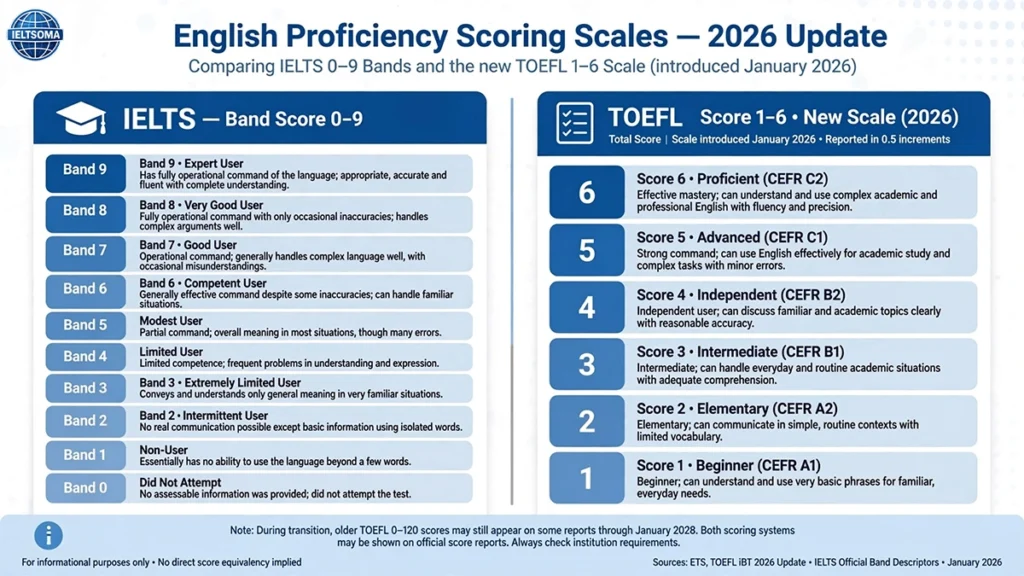
IELTS continues to report results using a 0–9 band scale.
TOEFL iBT tests taken from January 21, 2026 use a 1–6 scale in half-point increments. ETS states that candidates receive scores for the four sections and an overall score.
During the transition period, TOEFL score reports also provide a comparable overall score using the previous 0–120 scale.
That means you may still see 0–120 TOEFL scores when researching universities or comparing older requirements.
IELTS vs TOEFL Score Comparison
For the previous TOEFL 0–120 scale, ETS’s published comparison table gives these approximate IELTS Academic overall equivalents:
| TOEFL iBT 0–120 | IELTS Academic |
|---|---|
| 118 | 9.0 |
| 115 | 8.5 |
| 110 | 8.0 |
| 102 | 7.5 |
| 94 | 7.0 |
| 79 | 6.5 |
| 60 | 6.0 |
| 46 | 5.5 |
| 35 | 5.0 |
| 32 | 4.5 |
| 0–31 | 0–4 |
These are comparison ranges, not a guarantee that a candidate would receive exactly the same result on both tests.
ETS also advises institutions not to use comparison tables alone to establish admissions cut scores. (ETS)
The key takeaway is simple:
Do not use an old TOEFL-to-IELTS chart without checking whether it refers to the old TOEFL 0–120 scale or the current 2026 TOEFL 1–6 scale.
IELTS vs TOEFL Comparison: Which Is Easier?
The question “Is IELTS easier than TOEFL?” is one of the most common searches around English proficiency tests.
But there is no universal answer.
Difficulty depends on your English level and your ability to perform under a particular test format.
IELTS May Suit You If:
- You prefer face-to-face Speaking.
- You communicate naturally in an interview.
- You are already familiar with IELTS question types.
- You want the option of IELTS Academic or General Training.
- You are comfortable with the IELTS Writing format.
- You have strong strategies for IELTS Reading and Listening.
TOEFL May Suit You If:
- You prefer computer-based testing.
- You are comfortable typing.
- You prefer academic English contexts.
- You are comfortable speaking into a computer.
- Your target institution accepts TOEFL.
- You have practiced the current 2026 TOEFL format.
The most accurate IELTS vs TOEFL Comparison therefore does not declare a universal winner.
The better test is the one that matches your destination and your strengths.
IELTS vs TOEFL Comparison for University Admission
If your primary goal is university admission, compare IELTS Academic with TOEFL iBT.
IELTS Academic is designed for higher education and professional registration purposes. (IELTS)
TOEFL iBT is also widely used for university admissions and focuses on academic English.
However, you should never choose a test based only on the country where you want to study.
The correct process is:
- Find your university’s official admissions page.
- Find the English-language requirement.
- Confirm IELTS Academic acceptance.
- Confirm TOEFL iBT acceptance.
- Check the minimum overall score.
- Check minimum section scores.
- Check your specific program.
- Check whether the institution has updated its TOEFL requirements for the 2026 scoring system.
A university may accept both tests but set different minimum requirements.
Another institution may accept one test for a particular program but not another.
Always verify the current requirement directly with the score recipient.
IELTS vs TOEFL Comparison for Immigration
Immigration requires a different approach.
If you are taking an English test for migration, do not automatically compare IELTS Academic with TOEFL.
IELTS General Training is specifically designed for several migration and non-degree purposes, although the exact test required depends on the immigration pathway and destination.
The most important rule is:
Check the immigration authority’s current requirements before booking your test.
A university accepting TOEFL does not mean an immigration authority will accept that same test for your particular visa pathway.
Likewise, an IELTS score accepted for university admission does not automatically satisfy every immigration requirement.
Requirements can change, so use the official government or immigration source for your destination.
IELTS vs TOEFL Comparison for Different Test Takers
Your personal strengths should be part of your decision.
If You Are a Strong Conversational Speaker
IELTS may feel more natural because Speaking is conducted directly with an examiner.
However, conversational confidence alone is not enough.
IELTS Speaking evaluates specific criteria including fluency, vocabulary, grammar, and pronunciation.
If You Prefer Computers
TOEFL may be appealing if you are comfortable completing your assessment digitally.
However, IELTS is also moving increasingly toward computer delivery.
IELTS announced that paper-based testing will no longer be offered from mid-2026, with exact timelines varying between markets.
If You Need IELTS General Training
IELTS deserves particularly close consideration because it offers a dedicated General Training test.
This is an important difference that generic “IELTS vs TOEFL” comparisons sometimes overlook.
If You Are Applying to University
Compare the exact requirements of the universities and programs on your application list.
If both tests are accepted, then your preferred test format can become an important deciding factor.
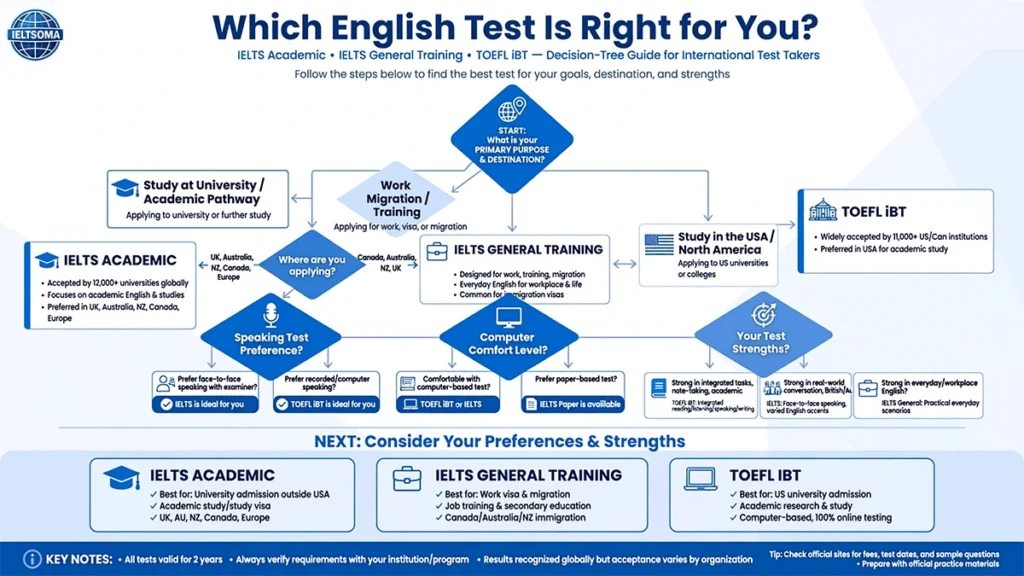
IELTS vs TOEFL Comparison: How to Choose the Right Test
Use this simple decision process.
Step 1: Identify Your Purpose
Ask why you need the English test.
Is it for:
- University admission?
- Immigration?
- Professional registration?
- Employment?
- Training?
- Another official purpose?
Your purpose should determine which tests you investigate.
Step 2: Check Your Destination’s Requirements
Go directly to the official organization receiving your score.
Do not rely only on an article, social media post, forum comment, or advice from a friend.
Step 3: Compare the Test Formats
Ask yourself:
- Do I prefer a human Speaking examiner?
- Do I prefer computer-based Speaking?
- Am I comfortable typing?
- Which Writing format suits me?
- Which Reading question types suit me?
- Can I understand different English accents?
- How well do I perform under strict time pressure?
Step 4: Take Diagnostic Practice Tests
Before registering, complete a practice test for each acceptable option.
This can reveal something that a general comparison cannot:
Which test actually produces the stronger performance for you?
Your English level may remain the same, but your test score can change because of format familiarity.
Step 5: Commit to One Test
Once you have confirmed that your chosen test is accepted, focus your preparation.
Learn the question types.
Practice under timed conditions.
Review your mistakes.
Improve your weakest skill.
Complete full practice tests.
Switching between IELTS and TOEFL repeatedly can make preparation less efficient.
IELTS vs TOEFL Comparison: One Skill Retake
Another feature that may influence an IELTS candidate’s decision is IELTS One Skill Retake.
Where available and where eligibility conditions are met, IELTS One Skill Retake allows candidates to retake one skill rather than repeating the complete test.
The available skill can be Listening, Reading, Writing, or Speaking.
IELTS states that the retake must be completed within 60 days of the original test and that candidates should check whether their intended organization accepts One Skill Retake results.
Availability varies by location.
Therefore, do not assume that every university, immigration authority, or professional organization accepts One Skill Retake.
IELTS vs TOEFL Comparison: Common Mistakes
Mistake 1: Believing IELTS Is Always Easier
There is no universal evidence that every candidate will find IELTS easier.
Your strengths matter.
Mistake 2: Assuming TOEFL Is Only for the USA
TOEFL is used internationally.
Check the actual institution rather than relying on country stereotypes.
Mistake 3: Ignoring IELTS Academic vs General Training
This can lead to completely inappropriate Reading and Writing preparation.
Make sure you know which IELTS test you need.
Mistake 4: Using Outdated TOEFL Information
TOEFL changed significantly in January 2026.
If an article describes only the old 0–120 format, verify its information against current ETS material. (ETS)
Mistake 5: Comparing Scores Without Checking the Scale
Current TOEFL uses a 1–6 scale, while older TOEFL results and comparison information may use 0–120.
Always establish which version you are looking at.
Mistake 6: Choosing Before Checking Acceptance
This is perhaps the most expensive mistake.
Never spend weeks preparing for an English test before confirming that the organization you need to satisfy accepts it.
IELTS vs TOEFL Comparison: Final Verdict
The winner of the IELTS vs TOEFL Comparison is not the same for everyone.
If you are an IELTS candidate, start with your actual goal.
For university admission, compare IELTS Academic and TOEFL iBT against your university’s official requirements.
For relevant migration pathways, investigate IELTS General Training and compare it against the exact requirements of your destination.
If you prefer speaking directly to another person, IELTS Speaking may feel more natural.
If you prefer a computer-based environment, TOEFL may suit you better.
If you already have extensive IELTS preparation, switching tests may not make sense unless there is a specific advantage for your destination or circumstances.
The smartest decision is therefore not:
“Which test is easier?”
It is:
“Which accepted test matches my purpose, destination, strengths, and preferred test format?”
That is the question that should guide your decision.
Before booking, verify the latest requirements with your university, immigration authority, professional organization, or employer.
Then choose one test and prepare strategically.
Frequently Asked Questions
Is IELTS easier than TOEFL?
Neither IELTS nor TOEFL is universally easier. IELTS may suit candidates who prefer a face-to-face Speaking interview, while TOEFL may suit candidates who prefer a computer-based environment. Your preparation and familiarity with the test format also matter.
Which is better, IELTS or TOEFL?
Neither is automatically better. The correct choice depends on your destination, purpose, institution requirements, personal strengths, and preferred test format.
Is IELTS better for immigration?
IELTS General Training is designed for several migration-related purposes, but whether it is the correct test depends on your specific immigration pathway. Always check the current official requirement for your destination.
Is IELTS Academic better than TOEFL for university?
Both may be accepted by universities. IELTS Academic is designed for higher education, while TOEFL iBT focuses on academic English. Check your specific university and program before choosing.
What is the IELTS equivalent of TOEFL 100?
On the previous TOEFL 0–120 scale, ETS’s comparison information places 94 around IELTS 7.0 and 102 around IELTS 7.5. Current TOEFL iBT tests use a 1–6 scale from January 21, 2026, so older 0–120 comparisons should be interpreted carefully.
Does TOEFL still use a 120-point scale?
The current TOEFL iBT introduced a 1–6 score scale on January 21, 2026. During a two-year transition period, TOEFL score reports also provide comparable information using the previous 0–120 scale.
Is IELTS Speaking harder than TOEFL Speaking?
It depends on your preferences. IELTS Speaking involves a face-to-face examiner, while the updated TOEFL Speaking section is computer-based. Candidates who prefer direct conversation may prefer IELTS, while candidates who prefer speaking to a computer may prefer TOEFL.
Can IELTS General Training be used for university admission?
IELTS General Training is not simply interchangeable with IELTS Academic. Academic institutions often specify IELTS Academic for higher education. Check the exact requirement of your university and program.
Can I retake only one IELTS skill?
IELTS One Skill Retake allows eligible candidates in participating locations to retake one of the four skills. You must also verify that the organization receiving your result accepts One Skill Retake.
Which test should I take in 2026?
First check which tests your destination accepts. Then compare the current test formats, scoring systems, and your personal strengths. Do not choose based only on older IELTS vs TOEFL comparisons because TOEFL changed significantly in January 2026.
Conclusion
The IELTS vs TOEFL Comparison becomes much simpler when you stop looking for a universal winner.
IELTS may be the stronger fit if you prefer its Speaking format, need IELTS General Training for an eligible purpose, or already have strong IELTS preparation.
TOEFL may be the stronger fit if your institution accepts it and you prefer its computer-based academic testing environment.
But your first step should always be the same:
Check the official requirement before booking your test.
Once you know which tests are accepted, compare the format and choose the one that gives you the best opportunity to demonstrate your English.
For IELTS candidates, the right preparation is not just about improving English.
It is about understanding the exact test you are taking.
Further Reading: