Whether you dream of studying at a world-class university, advancing your career overseas, or immigrating to an English-speaking country, demonstrating your English language skills is often an essential step. One of the most widely accepted ways to do this is through the International English Language Testing System (IELTS).
Recognized by more than 12,500 organizations worldwide, IELTS is trusted by universities, employers, professional bodies, and immigration authorities. A strong IELTS score can open doors to educational opportunities, international careers, and new beginnings across the globe.
In this guide, you’ll learn what IELTS is, why it matters, the different test types, and practical tips to help you prepare confidently.
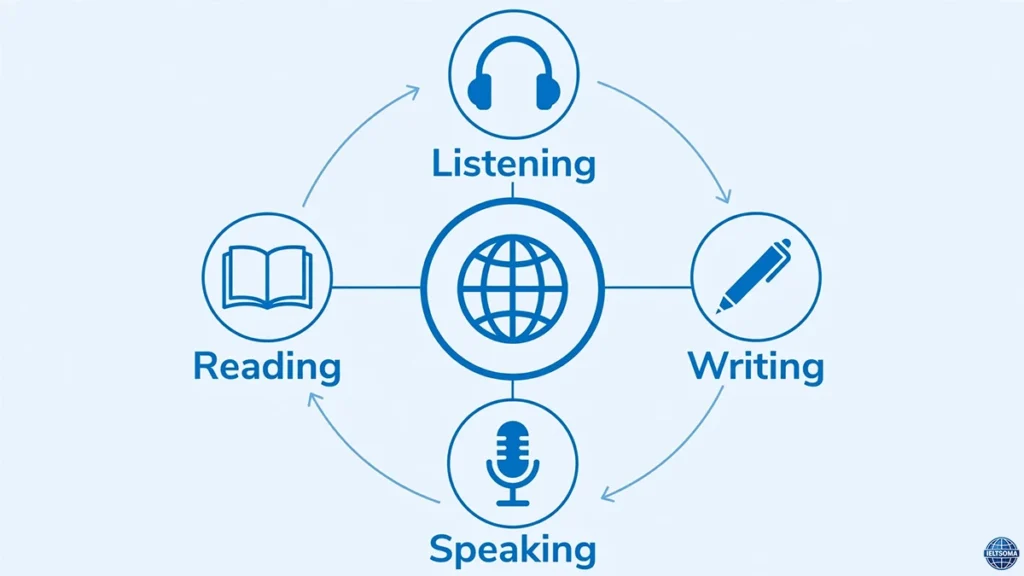
Table of Contents
What Is IELTS?
The International English Language Testing System (IELTS) is a standardized English language proficiency test designed for people who want to study, work, or live in countries where English is the primary language.
This test assesses your ability to communicate effectively in four essential language skills:
- Listening
- Reading
- Writing
- Speaking
The test is jointly managed by the British Council, IDP: IELTS, and Cambridge English, ensuring consistent standards and global recognition.
Unlike many language tests, IELTS focuses on practical, real-life communication, making it an accurate assessment of how well you can use English in academic, professional, and everyday situations.
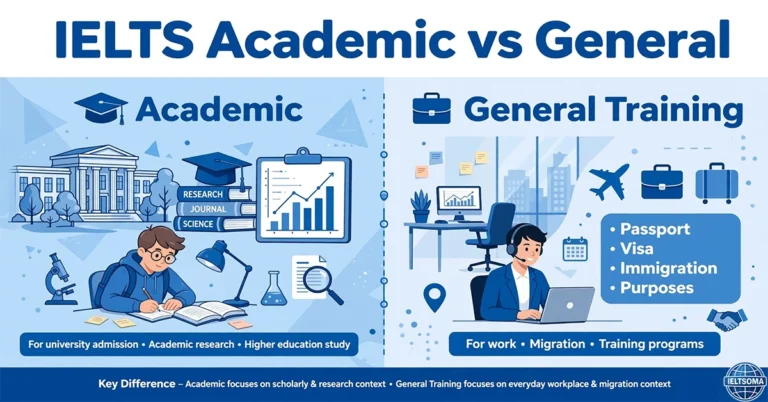
IELTS Academic vs IELTS General Training
Before registering, it’s important to choose the correct version of the test.
| Academic | General Training |
|---|---|
| For university admission | For immigration |
| Higher education | Employment |
| Academic reading passages | Everyday reading materials |
| Academic writing tasks | Practical writing tasks |
Choose IELTS Academic if you’re applying to universities or professional registration programs.
Choose IELTS General Training if you’re applying for immigration, work, or secondary education.
Always check the requirements of your university, employer, or immigration authority before booking your test.
IELTS Test Format
The IELTS exam consists of four sections.
| Section | Duration | Purpose |
|---|---|---|
| Listening | 30 minutes | Understand spoken English in different situations |
| Reading | 60 minutes | Assess reading comprehension |
| Writing | 60 minutes | Evaluate written communication |
| Speaking | 11–14 minutes | Assess spoken English through a face-to-face interview |
You can choose between computer-delivered and paper-based in many locations. The content, scoring, and difficulty level are the same for both formats.
Why Does IELTS Matter?
1. Study Abroad Opportunities
Thousands of universities require IELTS scores as part of their admissions process. A competitive score can improve your chances of being accepted into undergraduate, postgraduate, and doctoral programs.
2. Career Advancement
Many international employers use IELTS scores to assess communication skills, especially in professions where English proficiency is essential.
3. Immigration
Countries such as Canada, Australia, New Zealand, and the United Kingdom often require IELTS results for visa and immigration applications.
4. Global Recognition
IELTS is accepted by more than 12,500 organizations worldwide, making it one of the most trusted English language tests available.
5. Reliable Assessment
Rather than testing grammar alone, IELTS measures how effectively you can communicate in real-life situations, including conversations, academic study, workplace communication, and everyday interactions.
Understanding IELTS Band Scores
IELTS uses a 9-band scoring system.
Each section receives an individual band score, and these are averaged to produce your overall band score.
As a general guide:
- Band 5 – Modest English user
- Band 6 – Competent user
- Band 7 – Good user
- Band 8 – Very good user
- Band 9 – Expert user
Different universities, employers, and immigration programs have different score requirements.
For example, many universities require an overall score between 6.5 and 7.0, while some highly competitive programs may require even higher scores.

Top Tips for IELTS Success
Familiarize Yourself with the Test Format
Understanding the structure of each section helps reduce anxiety and improves confidence on test day.
Practice using official sample questions so you know exactly what to expect.
Develop Strong Time Management Skills
Time management is one of the biggest challenges in IELTS.
Practice completing each section within the official time limits so you become comfortable working under exam conditions.
Expand Your Vocabulary
Learning new vocabulary improves both your writing and speaking scores.
Instead of memorizing long word lists, learn words in context by reading newspapers, articles, books, and listening to English podcasts.
Improve Your Grammar Naturally
Accurate grammar helps communicate your ideas clearly.
Focus on using a variety of sentence structures rather than trying to write overly complex sentences.
Practice Speaking Every Day
Speaking English regularly builds fluency and confidence.
Try:
- Speaking with friends
- Language exchange partners
- Recording yourself
- Practicing common IELTS speaking questions
Take Mock Tests
Full-length practice tests help identify your strengths and weaknesses while improving stamina for the real exam.
Seek Professional Guidance
If you’re struggling with certain sections, consider working with an experienced IELTS tutor or joining a preparation course that provides personalized feedback.
Common IELTS Mistakes to Avoid
Many candidates lose valuable marks because of avoidable mistakes.
Some of the most common include:
- Not reading instructions carefully
- Poor time management
- Writing fewer than the required number of words
- Memorizing speaking answers
- Poor handwriting (paper-based test)
- Weak paragraph organization
- Failing to proofread writing tasks
Avoiding these simple mistakes can significantly improve your final band score.
Official IELTS Preparation Resources
To ensure you’re practicing with reliable materials, use official IELTS resources whenever possible.
Recommended resources include:
- Official IELTS practice tests
- British Council preparation materials
- IDP IELTS study resources
- Cambridge IELTS practice books
- Official IELTS sample questions and videos
These resources reflect the actual exam format and provide the most accurate preparation experience.
Expert Insight
Preparing for IELTS isn’t just about studying English—it’s about learning how the test works.
Many candidates improve by half or even a full band score simply by understanding the marking criteria, managing their time effectively, and practicing consistently with authentic materials.
Regular practice over several weeks is usually more effective than intensive cramming during the final few days before the exam.
Frequently Asked Questions
Can I take IELTS on a computer?
Yes. from Mid 2026, IELTS is computer based only however a few test centers may still be offering paper based IELTS.
How long is an IELTS score valid?
An IELTS score is generally valid for two years from the date of your test.
Can I retake IELTS if I’m unhappy with my score?
Yes. There is no limit to the number of times you can take the IELTS test. Many candidates improve their score after additional preparation.
Is IELTS difficult?
The difficulty depends on your current level of English and how well you prepare. Understanding the test format and practicing consistently can make a significant difference.
Is One Skill Retake available?
In some countries and test centers, IELTS offers One Skill Retake, allowing eligible candidates to retake only one section of the test instead of the entire exam. Availability varies by location, so check with your local IELTS test provider.
Conclusion
The IELTS exam is much more than an English language test—it’s a gateway to international education, career advancement, and global mobility.
Whether you’re planning to study abroad, pursue better job opportunities, or begin a new chapter in another country, achieving a strong IELTS score can help turn your goals into reality.
Success in IELTS comes from consistent practice, understanding the exam format, and building confidence in all four language skills. By preparing strategically and using official resources, you’ll be well equipped to perform at your best on test day.
Take the first step today, stay committed to your preparation, and let your IELTS journey open the door to exciting opportunities around the world.

Ready to begin your IELTS journey? Explore our beginner-friendly IELTS guides, practical study tips, and preparation resources to build your confidence and move one step closer to your study, work, or immigration goals.