You have taken your IELTS test, received your band scores, and now you see the term IELTS Test Report Form (TRF) everywhere.
But what exactly is a TRF? Is it the same as your online IELTS result? What information does it contain? Can you download it? How do universities, employers and immigration authorities verify it? And what happens if you lose it or your score changes after a remark?
Your IELTS Test Report Form is the official document that confirms your IELTS result. It records your overall band score and your individual scores for Listening, Reading, Writing and Speaking. Depending on how and where you took IELTS, your TRF may be provided as a paper document or as an electronic Test Report Form (eTRF).
This guide explains the IELTS TRF step by step, including what appears on it, how it works, how to share it and what you should do after receiving it.
Table of Contents
What Is an IELTS Test Report Form (TRF)?
An IELTS Test Report Form is the official document that reports your IELTS test results.
It provides evidence of the result you achieved in your IELTS test and can be shared with organisations that recognise IELTS, including educational institutions, employers and organisations involved in migration or professional applications. These organisations can use the IELTS Results Service to verify your result.
In simple terms:
IELTS TRF = your official IELTS result document.
It is not simply a screenshot of your score or an informal online result. The TRF is the document used to confirm your official IELTS performance.
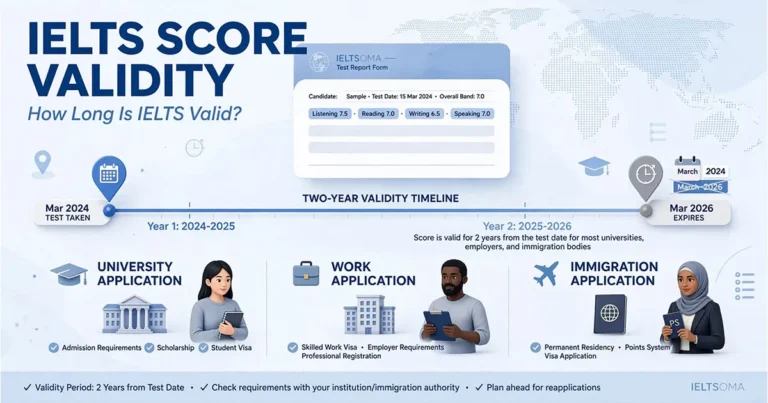
For example, if your result is:
| IELTS skill | Band score |
|---|---|
| Listening | 7.5 |
| Reading | 7.0 |
| Writing | 6.5 |
| Speaking | 7.0 |
| Overall | 7.0 |
These scores will be reported on your IELTS Test Report Form.
The exact appearance and delivery method of the TRF can vary according to the test centre, test format and country.
What Information Is on an IELTS TRF?
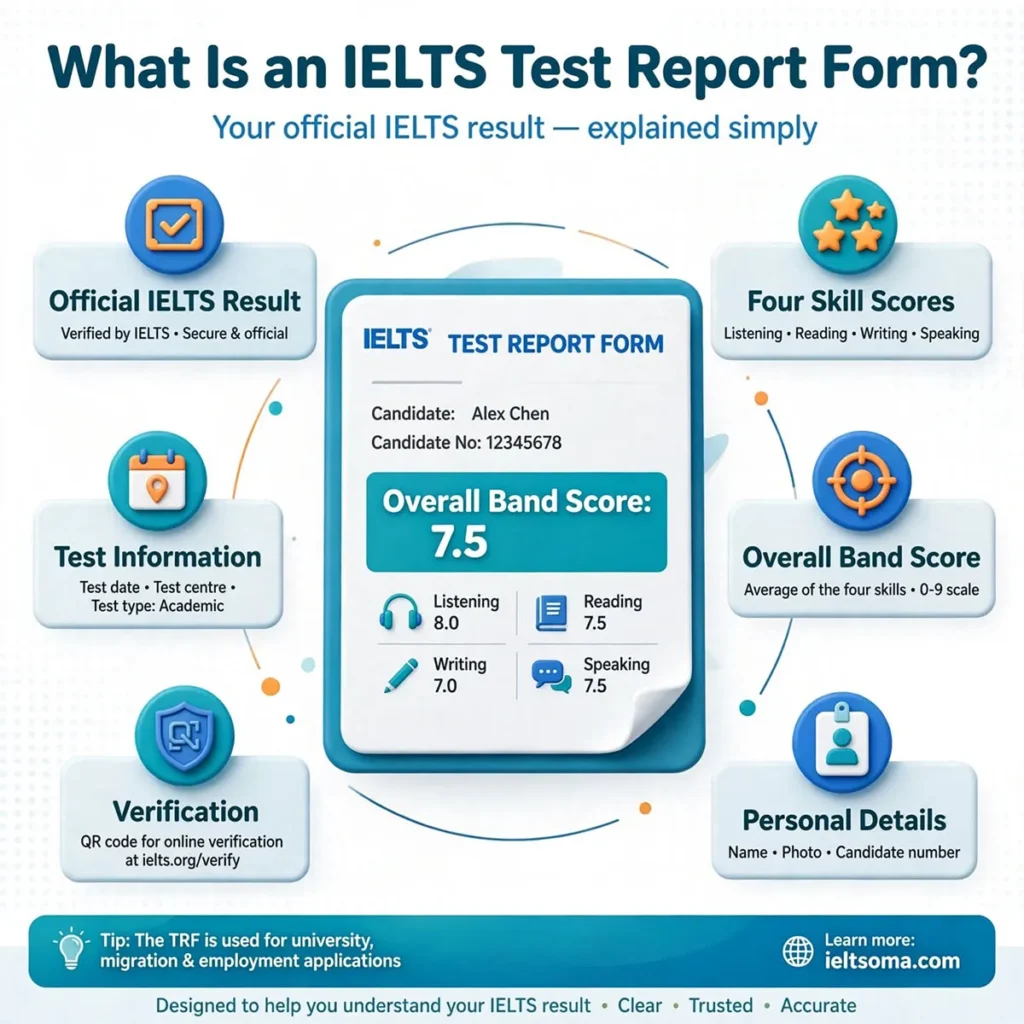
An IELTS TRF contains important information that identifies both you and your test result.
An IELTS Test Report Form generally includes:
- Your personal details
- Your photograph
- Your test date and test information
- Your test type, such as Academic or General Training
- Your Listening band score
- Your Reading band score
- Your Writing band score
- Your Speaking band score
- Your overall band score
- Information used to verify the result
- Your TRF reference or identification details
Official IELTS information confirms that the TRF records your overall result as well as the four individual skill scores. IDP also describes the TRF as including personal details, test information and a unique reference number that organisations can use when verifying results.
Your Four Skill Scores
The IELTS Test Report Form does not only show your overall band score.
It reports your performance in:
- Listening
- Reading
- Writing
- Speaking
You also receive an overall band score.
This distinction matters because an organisation may have requirements for individual skills as well as an overall score.
For example, a university might require an overall IELTS score of 7.0 while also specifying that no individual skill should be below 6.5.
In that situation, an overall 7.0 by itself does not tell the complete story. The organisation will need to see your individual scores on the TRF.
IELTS Test Report Form vs IELTS Online Result
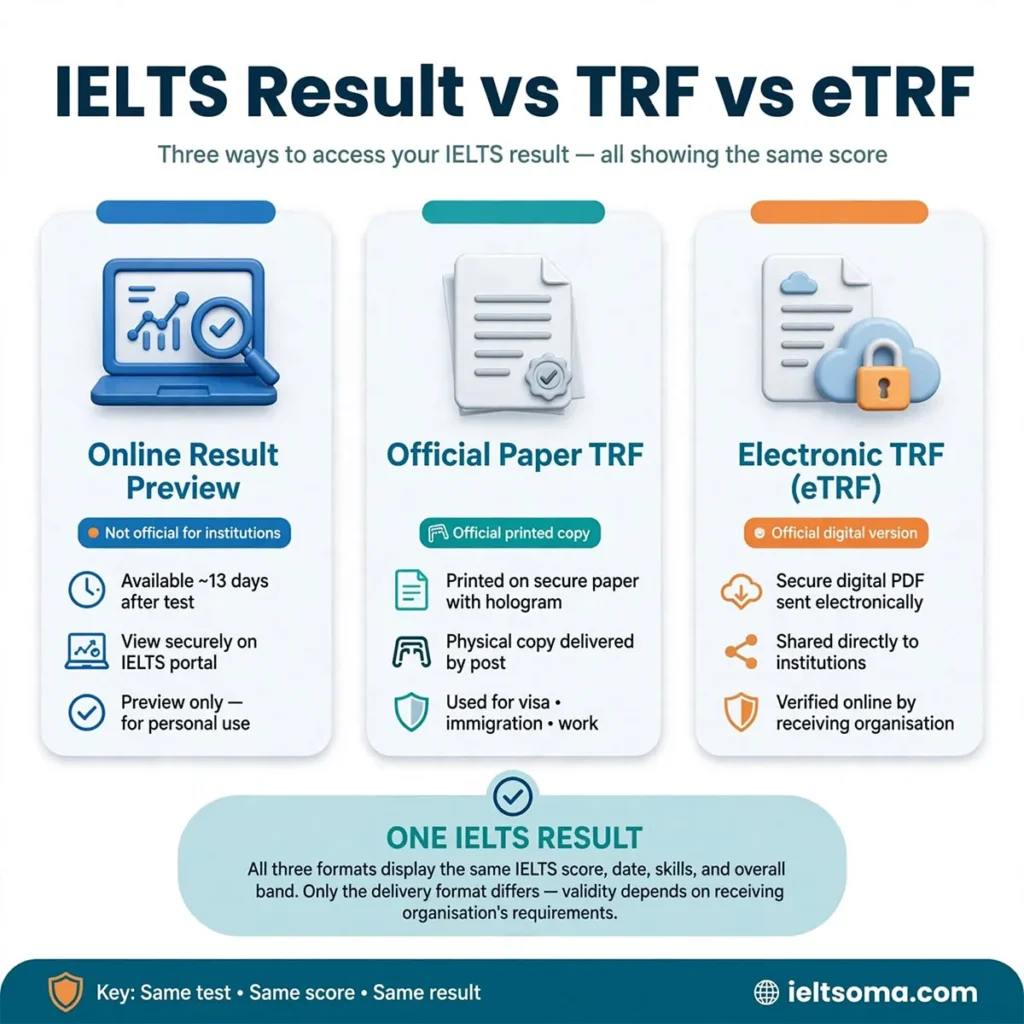
One of the most common misunderstandings is assuming that an online score preview and the official TRF are exactly the same thing.
They are related, but you should treat the official Test Report Form as the formal evidence of your result.
IELTS states that your Test Report Form is the official confirmation and proof of your test results. IDP similarly states that online results can be provisional until the official TRF is received.
Think of the process like this:
Take IELTS → Results released → View result online → Receive/access official TRF → Share result with organisations
Your online result is useful for checking your score, but when a university, employer or immigration authority asks for official IELTS evidence, follow that organisation’s instructions for submitting or verifying your TRF.
What Is an eTRF?
An eTRF is an electronic Test Report Form.
It is essentially the digital version of the IELTS Test Report Form. IDP describes an eTRF as the same IELTS TRF delivered digitally, while IELTS confirms that results may be provided as either a paper TRF or a digital eTRF depending on the test arrangement.
If you take IELTS on computer at an eligible centre, you may be able to download your eTRF from your IELTS profile. British Council also states that candidates taking IELTS on computer or IELTS Online can receive their TRF electronically through the Test Taker Portal.
So:
TRF = Test Report Form
eTRF = electronic Test Report Form
The important point is that an eTRF is not a different IELTS test result. It is a digital form of the official result document.
How Does the IELTS TRF Work?
The process is straightforward.
Step 1: You Take Your IELTS Test
You complete the IELTS test you registered for, such as:
- IELTS Academic
- IELTS General Training
- IELTS for UKVI
- IELTS UKVI Life Skills, where applicable
- Other IELTS formats available in your location
The exact result-delivery arrangements depend on the test type and test centre.
Step 2: Your Test Is Marked
Your Listening, Reading, Writing and Speaking performances are assessed according to the IELTS assessment and scoring procedures.
Each skill receives a band score, and these are used to calculate your overall band score.
Step 3: Your Result Is Released
Your result becomes available according to the timeframe associated with your test.
IELTS currently states that IELTS on Computer results are generally available in 1–5 days, while IELTS Online results are available in 6–8 days. IELTS for UKVI is also listed as 1–5 days, while UKVI Life Skills can take up to 9 days.
Paper-based and other local arrangements can have different timelines, so candidates should check the instructions provided by their test centre.
Step 4: You Access Your TRF
Depending on your test arrangement, you may receive a paper TRF, download an eTRF, or access your result through the relevant test-taker portal.
For example, British Council states that candidates can download an electronic TRF through the Test Taker Portal when available, while IDP provides eTRFs through eligible IELTS profiles.
Step 5: You Share Your Result
You can then provide your IELTS result to the organisation you are applying to.
Some organisations accept electronic delivery, while others may request a particular form of official documentation.
Always check the receiving organisation’s instructions rather than assuming that every university, employer or government authority accepts the same submission method.
How Do Universities and Organisations Verify an IELTS TRF?
A major purpose of the IELTS Test Report Form is result verification.
When you apply to a university, employer or immigration authority, the organisation may need to confirm that your IELTS result is genuine.
IELTS provides a Results Service that allows recognising organisations to verify IELTS results.
This is one reason you should never alter, edit or recreate an IELTS TRF yourself.
For example, changing a score on a PDF or image does not create a valid IELTS result. The receiving organisation can use official verification procedures to check the result against IELTS records.
Why Is TRF Verification Important?
Consider two applicants:
Applicant A submits an official IELTS result.
Applicant B submits an edited image showing a higher band score.
The receiving organisation does not have to rely solely on the document’s appearance. Official result verification can be used to establish whether the reported IELTS result corresponds with the test provider’s records.
This protects both institutions and genuine test takers.
How Long Is an IELTS TRF Valid?
IELTS results are generally considered valid for two years, although the organisation receiving your result makes its own decision about whether to accept a result and for how long. British Council states that an IELTS result is valid for two years.
This creates an important distinction:
IELTS result validity: generally two years.
Organisation’s acceptance policy: may have its own requirements.
For example, an institution may have additional rules about how recent your IELTS result must be when you apply.
Therefore, if you took IELTS more than a year ago, do not simply assume that your result is unacceptable—or that it is automatically accepted. Check the requirements of the organisation receiving your application.
How Do You Get Your IELTS TRF?
The method depends on your test provider, location and test format.
For many candidates, the process involves accessing results through an online test-taker portal. Candidates who receive an electronic TRF may be able to download the document directly.
IDP’s current information for Pakistan, for example, states that eligible candidates taking IELTS on Computer can download an eTRF from their IELTS profile after results are released.
British Council similarly states that candidates can access and download an electronic TRF through the Test Taker Portal when applicable.
If you cannot access your result or TRF, contact the test centre where you took IELTS.
How Many IELTS TRFs Do You Get?
The number and method of obtaining additional TRFs can depend on the test provider and destination.
For example, IDP states that test takers normally receive one copy of the Test Report Form, with specific exceptions and procedures for additional copies or sending results to organisations.
British Council states that it can send copies of paper TRFs directly to recognising organisations and can also send electronic TRFs to eligible organisations through its systems.
The practical lesson is simple:
Do not assume you should make and send multiple unofficial copies yourself.
If an institution requires an official IELTS result, check whether it wants you to upload your eTRF, send a TRF, or have IELTS send the result directly.
What If You Lose Your IELTS TRF?
If you lose a paper Test Report Form, contact the test centre or IELTS organisation that issued your result.
Do not create your own replacement document.
The available options depend on the provider and the circumstances. For example, IDP advises candidates who have lost their TRF to contact the test centre that issued the results.
If your result is available electronically, you may have access to the eTRF through your IELTS account, depending on your test arrangement.
If your test centre has closed, procedures may still exist for obtaining additional TRFs. IDP, for example, provides procedures for certain candidates whose test centre has closed.
What Happens If Your IELTS Score Changes After a Remark?
Suppose you receive your IELTS Test Report Form and believe your score does not accurately reflect your performance.
You may be able to request an Enquiry on Results (EOR).
If your score changes following the review, a new Test Report Form is issued.
IDP states that if a band score changes after an Enquiry on Results, the candidate receives a new TRF.
This is important when submitting an application.
If your result changes, make sure you use the updated official result and follow the receiving organisation’s instructions about replacing or updating the previously submitted result.
What Happens After IELTS One Skill Retake?
IELTS One Skill Retake allows eligible test takers to retake one of the four IELTS skills rather than repeating the entire test.
If you take an eligible One Skill Retake, you receive another official Test Report Form showing the updated score for the retaken skill alongside the results for the other skills from the original test.
IDP explains that the original TRF remains valid and that the candidate can choose whether to use the original or new TRF, subject to the receiving organisation accepting One Skill Retake results.
This last point matters.
Before relying on a One Skill Retake TRF for an application, check whether the specific university, employer, professional body or immigration authority accepts it.
Common IELTS TRF Mistakes to Avoid
Getting your IELTS score is exciting, but don’t rush through the next stage.
Avoid these mistakes.
1. Treating an online score preview as your only official document
Use the official TRF or eTRF according to the requirements of the organisation receiving your application.
2. Editing your TRF
Never modify your score, personal details or other information on the document.
If something is incorrect, contact your IELTS test centre.
3. Sending your result without checking the institution’s requirements
Some organisations have specific procedures for receiving IELTS scores.
Check whether they require:
- An uploaded eTRF
- A paper TRF
- Direct electronic delivery
- Direct verification through IELTS
- A particular test type
4. Forgetting your individual scores
Do not focus only on your overall band.
Universities, employers and professional organisations may have minimum requirements for individual skills.
5. Assuming every IELTS result is accepted for every purpose
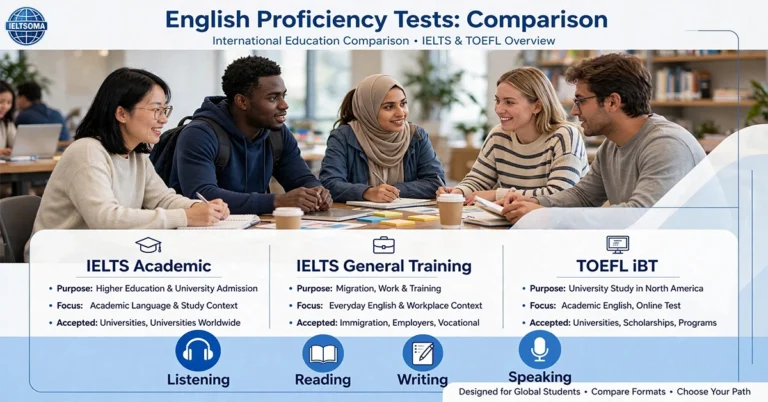
IELTS Academic, General Training, UKVI and other IELTS tests can serve different purposes.
Always check the exact requirement of the organisation you are applying to.
IELTS TRF: A Simple Example
Imagine that Sara takes IELTS Academic and receives:
- Listening: 8.0
- Reading: 7.5
- Writing: 7.0
- Speaking: 7.5
- Overall: 7.5
Her IELTS Test Report Form records these results.
Sara then applies to a university.
The university does not simply need to know that Sara “got 7.5”. It may need to see the official result and verify it.
If the university accepts electronic IELTS results, Sara may be able to provide her eTRF or have her result sent through an official IELTS results system.
If the university has a minimum Writing requirement of 7.0, the individual scores on the TRF allow the university to check that requirement.
That is why the TRF is more than a simple statement of your overall score.
IELTS TRF Checklist for Test Takers
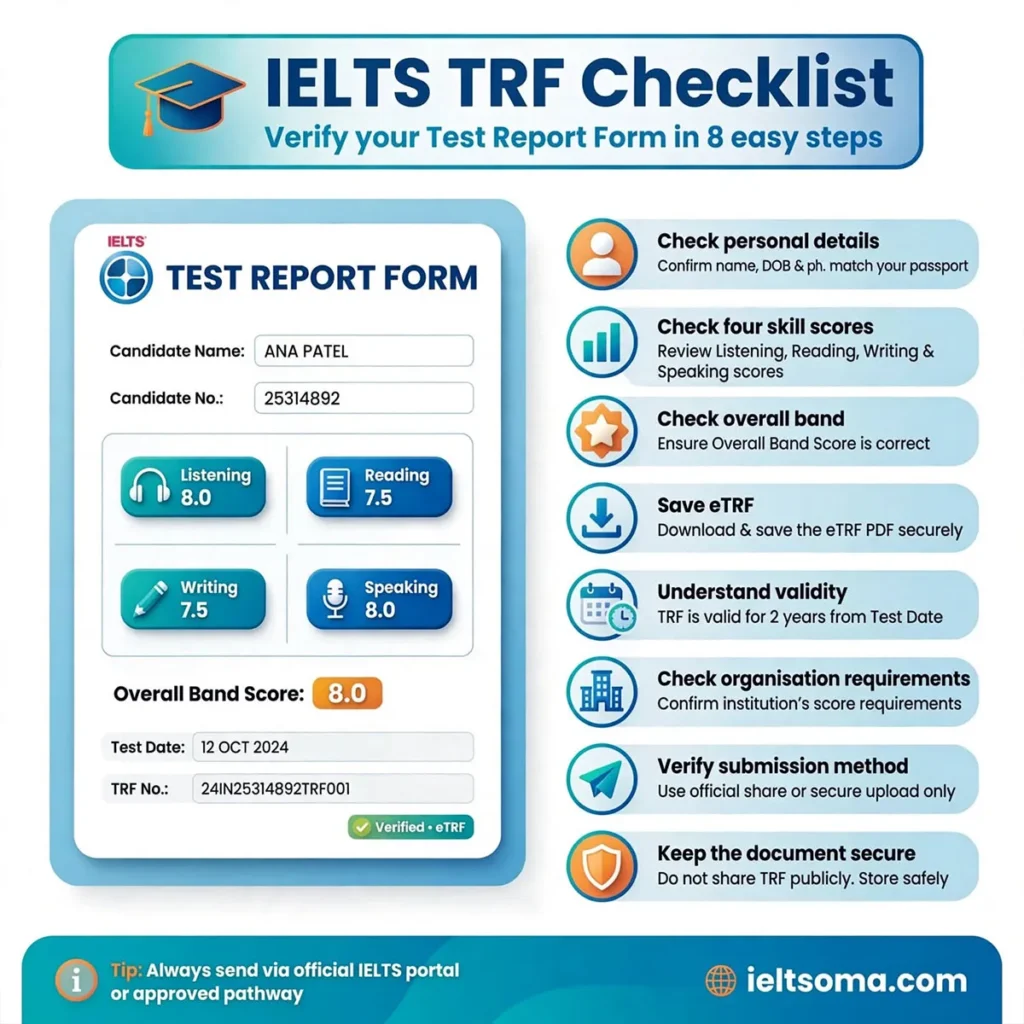
After receiving your IELTS result, check the following:
- Your name is correct.
- Your date of birth and personal details are correct.
- Your test type is correct.
- Your test date is correct.
- Your Listening score is correct.
- Your Reading score is correct.
- Your Writing score is correct.
- Your Speaking score is correct.
- Your overall band score is correct.
- You know whether you have a paper TRF or eTRF.
- You have saved your electronic TRF securely if one was issued.
- You have checked the receiving organisation’s IELTS requirements.
- You know how the organisation wants your result submitted.
- You have checked the relevant validity requirements.
Frequently Asked Questions About IELTS Test Report Form
What is IELTS TRF?
The IELTS Test Report Form (TRF) is the official document confirming your IELTS result. It reports your individual Listening, Reading, Writing and Speaking scores as well as your overall band score.
Is IELTS TRF the same as the IELTS result?
The TRF is the official document that reports your IELTS result. You may be able to view your scores online before or alongside receiving the official TRF, but organizations may require official IELTS documentation or verification.
What does IELTS TRF stand for?
IELTS TRF stands for IELTS Test Report Form.
What is an eTRF?
An eTRF is an electronic version of the IELTS Test Report Form. It contains the official IELTS result in digital form.
Can I download my IELTS TRF?
If you are eligible for an electronic TRF, you may be able to download it through your IELTS, IDP or British Council test-taker account, depending on where and how you took the test.
How long is an IELTS TRF valid?
IELTS results are generally valid for two years. However, the organization receiving your result may have its own rules, so always check its current requirements.
Does the IELTS TRF show individual scores?
Yes. Your IELTS Test Report Form shows your scores for Listening, Reading, Writing and Speaking, as well as your overall band score.
Can universities verify an IELTS TRF?
Yes. Recognizing organizations can use the IELTS Results Service to verify IELTS results.
What happens if my IELTS score changes after a remark?
If your score changes after an Enquiry on Results, a new Test Report Form is issued.
Can I use an IELTS TRF for immigration?
IELTS results are used for various purposes, including migration, but the exact IELTS test and score requirements depend on the immigration authority and visa category. Always check the official requirements for your specific application.
Final Thoughts: Keep Your IELTS TRF Safe
Your IELTS Test Report Form is the official record of the result you achieved in your test.
It tells universities, employers and other recognising organisations more than your overall band score. It provides your individual skill scores and the information needed to identify and verify your IELTS result.
Once your result is released, don’t simply look at the overall band and move on.
Check the details on your TRF, save your eTRF securely if you receive one, understand how your chosen organisation wants to receive IELTS results, and keep track of the relevant validity requirements.
Most importantly, remember that IELTS TRF explained simply means the official document that proves and reports your IELTS test result.
When you understand how the TRF works, the process of using your IELTS score for university, employment or other applications becomes much clearer.
Further Reading: