You achieved your IELTS band score, received your Test Report Form, and are ready to use it for university admission, immigration, work, or professional registration. Then comes an important question: how long is IELTS valid?
The short answer is two years under the standard IELTS recommendation.
However, there is an important detail many test takers miss: IELTS does not simply impose one universal expiry rule for every organisation. IELTS recommends that a result demonstrates English-language ability for a maximum of two years, while organisations that accept IELTS may have their own policies about how long they will accept a result.
That means knowing your IELTS score validity period is not enough. Before using an older result, you should check the requirements of the university, immigration authority, employer, professional body, or other organisation receiving your score.
This guide explains exactly how IELTS score validity works, how to calculate the validity period, whether an IELTS certificate expires, and what to do if your result is more than two years old.
Table of Contents
How Long Is IELTS Valid?
IELTS recommends that an IELTS test result be considered valid for two years from the date you took the test.
This recommendation is based on research concerning second-language loss, sometimes called language attrition. IELTS explains that an individual’s English ability can change over time, so a result from several years ago may not accurately represent their current language ability.
For most test takers, therefore, the practical answer to how long is IELTS valid is:
IELTS results are generally considered valid for two years from the test date.
However, there is an important distinction between the IELTS recommendation and the acceptance policy of the organisation to which you are applying.
IELTS states that organisations can choose to accept results for a longer period. Therefore, an older IELTS result is not automatically unusable in every situation.
Always check the current requirement of the organization before relying on an older score.
IELTS Score Validity Period Explained
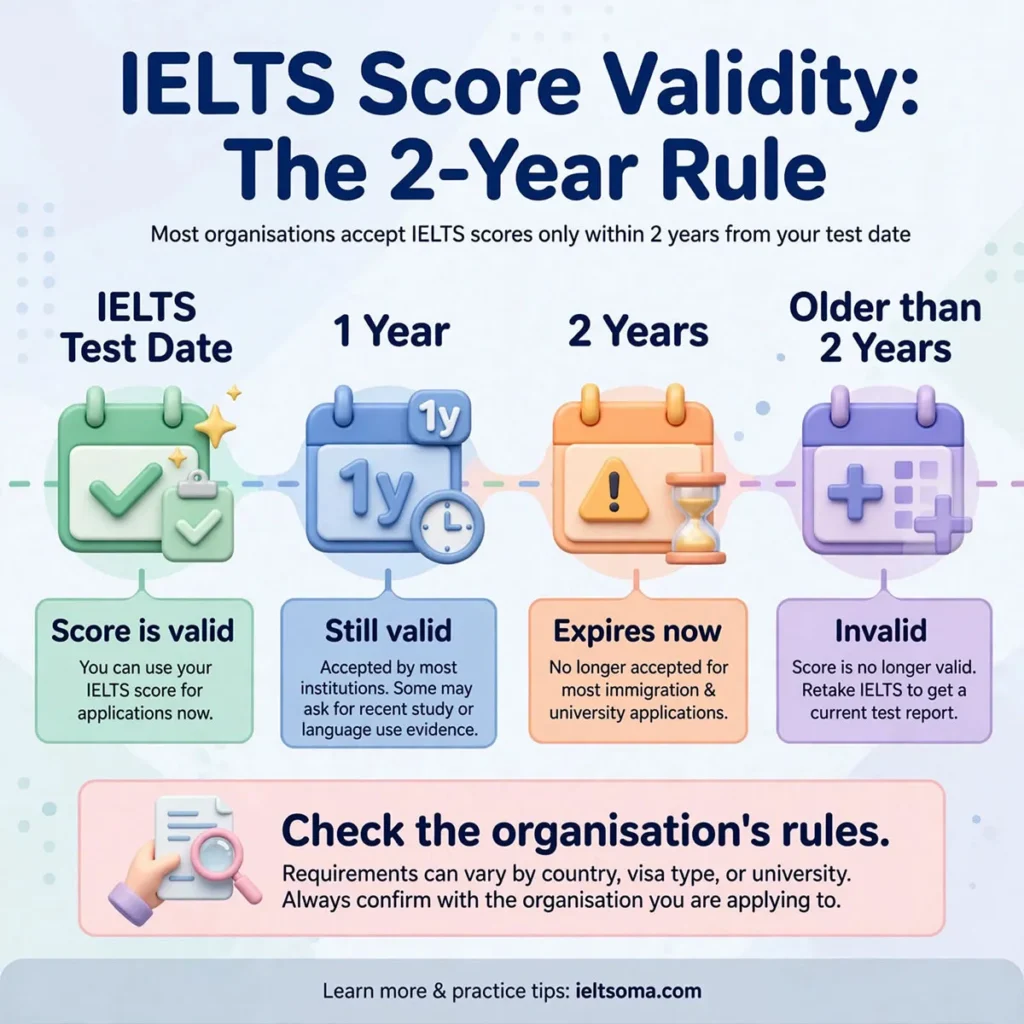
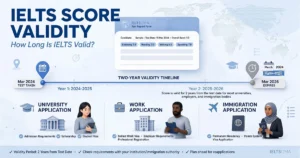
The IELTS score validity period is normally understood as two years from the date of your IELTS test.
For example, suppose you took IELTS on 10 October 2026.
Your two-year period would run to approximately 10 October 2028.
If you were applying to a university in 2027, your result would normally fall comfortably within the recommended period. If you were applying in late 2028, however, you would need to check the institution’s specific requirements and the exact date rules it applies.
This is why it is better to think about IELTS validity in terms of your test date and application date, rather than simply the date printed on your Test Report Form.
IELTS validity at a glance
| Question | General answer |
|---|---|
| How long is IELTS valid? | IELTS recommends a maximum of two years |
| When does the period start? | From the IELTS test date |
| Does every organisation have exactly the same rule? | No |
| Can an organisation accept an older result? | Some organisations may choose to |
| Should you check before applying? | Yes |
| Can an old result be verified? | IELTS can verify older Test Report Forms, subject to its verification/data-retention policies |
The safest approach is simple: check the organisation’s current IELTS requirement before submitting your result.
How Long Is an IELTS Certificate Valid?
Many candidates search for how long IELTS certificate valid because they think of the Test Report Form as a certificate with a fixed expiry date.
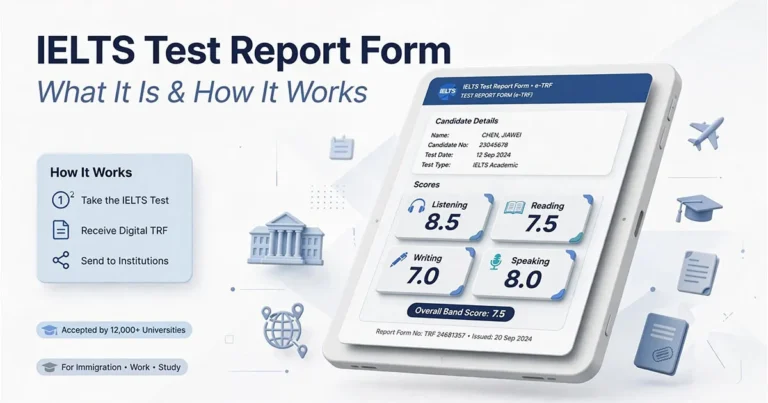
In practice, IELTS provides a Test Report Form (TRF) as official confirmation of your test results. Your result shows your overall band score and the individual scores for Listening, Reading, Writing and Speaking.
The more useful question is not whether the physical document itself suddenly becomes invalid, but whether the organisation you are applying to will accept the result based on how old it is.
IELTS recommends a two-year period for demonstrating English-language ability.
So, if your IELTS result is more than two years old, do not automatically assume that every university, employer, immigration authority, or professional organisation will reject it. Instead, check that organisation’s current rules.
Does IELTS Expire After Two Years?
The word “expire” can be misleading.
People often say that an IELTS certificate expires after two years, but IELTS’ official wording is more nuanced. IELTS recommends that a result demonstrates English-language ability for a maximum period of two years, while recognising organisations can decide whether to accept results for longer.
This distinction matters.
For example, an organisation may state:
- IELTS results must be less than two years old.
- IELTS results must be valid on the application date.
- IELTS results must be valid on a particular registration date.
- Older results may be considered if the applicant can demonstrate continued English-language use.
- A specific IELTS test type or score may be required.
These requirements can differ according to the purpose of your application.
Therefore, do not rely only on a general statement such as “IELTS lasts two years.” Find the exact requirement for your application.
Why Is the IELTS Score Validity Period Two Years?
The two-year recommendation is connected with the possibility of second-language loss or attrition.
Language ability is not necessarily static. A person who has achieved a particular level of English may maintain that ability, improve it, or experience some decline depending on how much they use English and the circumstances in which they use it.
IELTS therefore recommends a maximum two-year period as a general indication of how recently the candidate’s English ability was assessed.
IELTS research has also examined how institutions in different sectors use validity periods. The two-year period is described as the predominant approach across the organisations examined in that research, although exceptions exist.
This is particularly relevant when an organisation needs recent evidence of English proficiency.
Does IELTS Academic Have the Same Validity Period?
Yes, the general IELTS recommendation applies to IELTS results rather than creating a separate standard validity period simply because you took IELTS Academic.
IELTS Academic is commonly used for higher education and certain professional purposes.
If you took IELTS Academic on 15 March 2026, the standard IELTS recommendation would treat the result as evidence of English ability for up to two years.
However, the university or professional body may have its own application deadline and score-age requirements.
For example, an institution might require your IELTS result to have been obtained within two years of a particular date rather than simply asking whether your result is “still valid.”
Always read the institution’s current admissions requirements.
Does IELTS General Training Have the Same Validity?
The general two-year IELTS recommendation also applies to IELTS General Training results.
IELTS General Training is commonly used for purposes such as work, migration, and professional contexts, depending on the requirements of the destination country or organisation.
The important issue is not simply whether your result is Academic or General Training. You must also make sure that you took the correct IELTS test for your purpose.
For example, an organisation may require IELTS Academic when you have taken General Training, or a specific immigration route may require a particular IELTS test.
A result can therefore be within its recommended validity period and still not meet an organisation’s requirements if you took the wrong test type.
IELTS Validity for UK Visas and Immigration
If you are using IELTS for UK immigration, do not rely solely on the general two-year explanation.
UK government rules can specify particular requirements for an approved Secure English Language Test (SELT).
GOV.UK currently states that approved English-language test results used for relevant immigration or nationality applications must have been awarded in the two years before the date of application.
The exact test and level required depend on the immigration route.
If you need IELTS for UK Visas and Immigration, check the current GOV.UK requirements before booking your test and again before submitting your application.
This is especially important because immigration requirements can change independently of general IELTS guidance.
What If Your IELTS Result Is More Than Two Years Old?
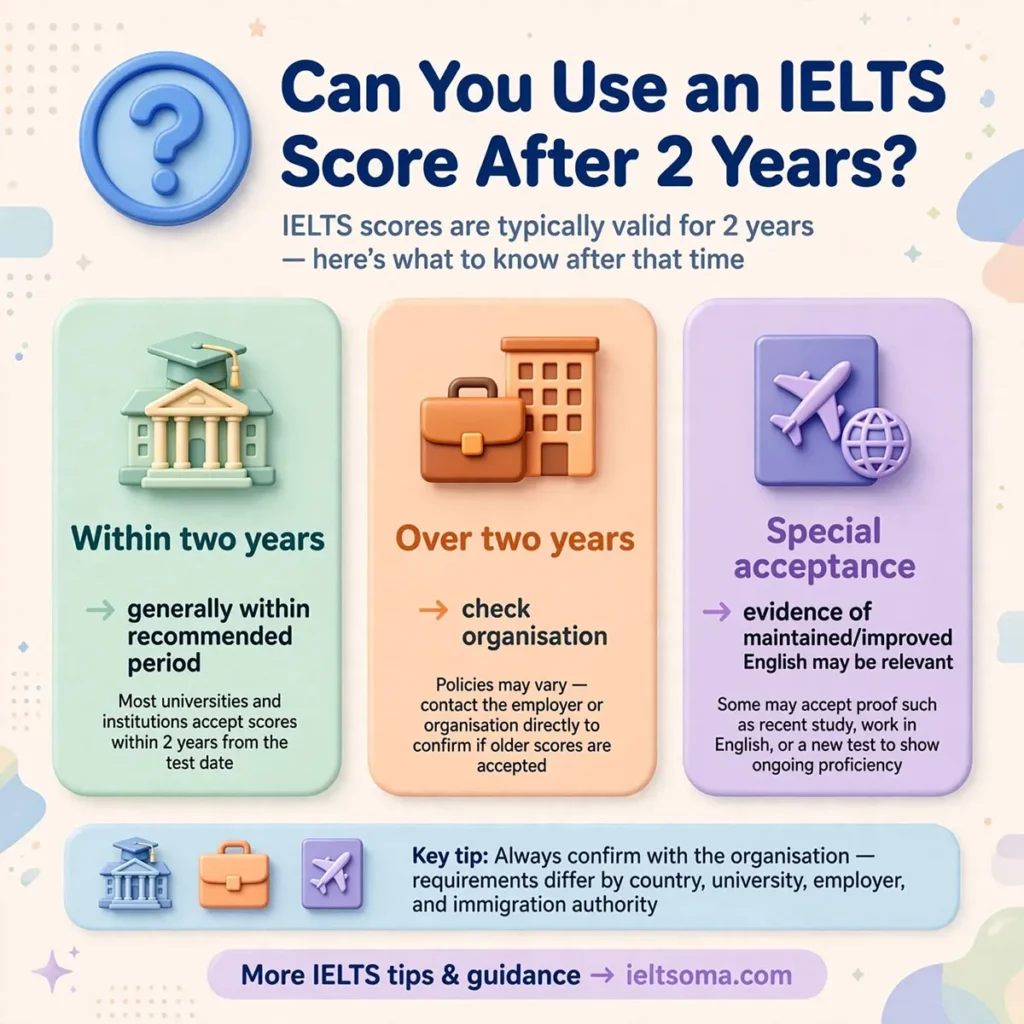
Suppose you took IELTS three years ago and still have your original Test Report Form.
Should you take IELTS again?
There is no universal answer because the organisation receiving your result determines what it will accept.
IELTS recommends that a Test Report Form more than two years old should only be accepted when accompanied by evidence that the test taker has actively maintained or attempted to improve their English.
However, an organisation may have its own policy.
Before booking another test, check:
- The organisation’s current IELTS requirements.
- The maximum age it permits for IELTS results.
- Whether the result must be valid on the application date.
- Whether it accepts older IELTS results under specific conditions.
- Whether your original test type is accepted.
- Whether your required band score applies to the overall score, individual skills, or both.
If the organisation requires a result within two years, an older score may mean that you need to take IELTS again.
Can You Use an Old IELTS Score If Your English Has Not Changed?
This is one of the most common questions about IELTS score validity.
You may feel that your English has remained strong since you took the test. You might use English every day at work, study in English, read extensively, or communicate with English speakers regularly.
That can be relevant if an organisation considers older results.
However, you should not assume that continued English use automatically extends the validity of your IELTS result.
The organisation receiving your application decides whether evidence of continued English use is sufficient and whether an older IELTS result can be accepted.
If its policy says that the IELTS result must be within two years, you should follow that requirement.
Does Your IELTS Band Score Change After Two Years?
Your original IELTS band score does not simply change because two years have passed.
For example, if you achieved:
- Listening: 7.5
- Reading: 7.0
- Writing: 6.5
- Speaking: 7.0
- Overall: 7.0
those are the scores you received in that test.
The issue after two years is not that the number printed on your Test Report Form changes. The issue is whether an organisation considers the result sufficiently recent to demonstrate your current English ability.
This distinction is important when someone says, “My IELTS score expired.”
Usually, what they mean is that the result is now outside the organisation’s accepted validity period.
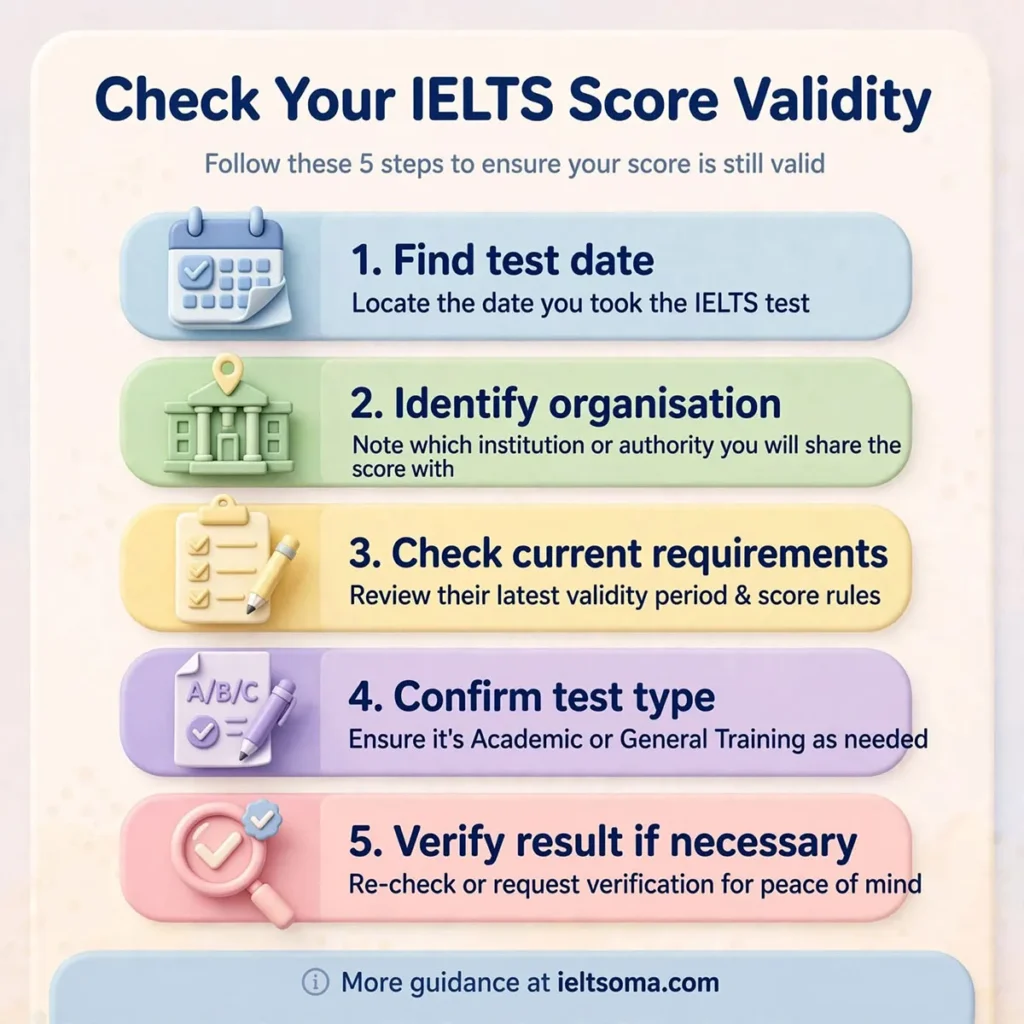
How to Check Your IELTS Score Validity
If you are unsure whether your result can still be used, follow this process.
1. Find your IELTS test date
Look at your Test Report Form and identify the date on which you took the test.
Do not confuse the test date with the date on which you received your results.
2. Identify the organisation
Determine exactly where you intend to submit the IELTS result.
It could be:
- A university
- College or educational institution
- Immigration authority
- Employer
- Professional registration body
- Government organisation
- Scholarship provider
3. Read its current IELTS requirement
Look specifically for wording concerning:
- IELTS validity
- Test date
- Score age
- Application date
- Accepted test types
- Minimum band scores
4. Check whether your test type is accepted
Make sure the organisation accepts the version of IELTS you took.
5. Verify your result if required
Organisations that accept IELTS can use the IELTS Results Service to verify a candidate’s result.
This is important because the Test Report Form is evidence of your result, while the receiving organisation may independently verify the score.
Common IELTS Score Validity Mistakes
Mistake 1: Assuming every organisation uses exactly two years
Two years is the standard IELTS recommendation, but organisations can establish their own acceptance policies.
Better approach: Check the organisation’s current requirements.
Mistake 2: Counting two years from the result-release date
Candidates sometimes calculate validity from the day they received their score.
Better approach: Use the test date and then confirm how the receiving organisation defines its validity requirement.
Mistake 3: Ignoring the test type
A valid IELTS score is not necessarily the correct IELTS score for every purpose.
Better approach: Confirm whether you need Academic, General Training, IELTS for UKVI, or another approved test.
Mistake 4: Waiting until the application deadline
If your result is approaching the end of its accepted period, leaving the check until the last minute can create unnecessary problems.
Better approach: Check the requirement well before submitting your application.
Mistake 5: Assuming an old result is automatically worthless
An older result may be accepted by some organisations under their own rules.
Better approach: Check directly with the organisation before booking another IELTS test.
IELTS Score Validity: Practical Examples
Example 1: University application
Maria took IELTS Academic in August 2026 and plans to apply to a university in May 2027.
Her result is less than two years old at the time of application. She should still check the university’s exact requirements, including any rules concerning the application deadline or programme.
Example 2: Immigration application
Ahmed took an approved IELTS SELT in January 2026 and plans to submit a relevant UK immigration application in December 2027.
Because UK immigration requirements specify a two-year window for approved English-language test results, he should check whether his test meets the applicable requirement on the application date.
Example 3: Older IELTS result
Sofia took IELTS more than two years ago and has continued working in an English-speaking environment.
She should not assume that her result is automatically accepted or automatically rejected. She should check the receiving organisation’s policy and whether it permits older results with evidence of continued English use.
Frequently Asked Questions About IELTS Score Validity
How long is IELTS valid?
IELTS recommends that test results be considered valid for two years from the test date. However, organizations can establish their own acceptance policies, so always check the organization you are applying to.
How long IELTS certificate valid?
Your IELTS Test Report Form records your test result, while the accepted age of that result depends on the organization receiving it. IELTS recommends a two-year period for demonstrating English-language ability.
Is IELTS valid for 3 years?
IELTS recommends a maximum period of two years, but some organizations may choose to accept older results. Check the specific organization’s current policy rather than assuming a three-year result will be accepted.
Can I use IELTS after 2 years?
Possibly, depending on the organization. IELTS recommends that results older than two years should only be accepted with evidence that the candidate has actively maintained or attempted to improve their English. The final acceptance decision belongs to the organization receiving the result.
Does IELTS validity depend on Academic or General Training?
The standard two-year IELTS recommendation applies to IELTS results generally. However, the organization may require a specific IELTS test type, so check both the score-age requirement and the test type.
Is IELTS valid for UK immigration?
For relevant UK immigration and nationality applications using an approved SELT, GOV.UK states that the test must have been awarded within the two years before the application date. Always check the current requirements for your particular immigration route.
Can universities accept IELTS scores older than two years?
Some organizations may choose to accept older IELTS results. The decision depends on the university or institution’s current policy.
Do IELTS scores expire?
It is more accurate to say that IELTS recommends a two-year period for demonstrating English-language ability. Whether an older result is accepted depends on the organization using the result.
Final IELTS Score Validity Checklist
Before using an IELTS result, ask yourself:
- When did I take IELTS?
- Is my result within the standard two-year period?
- What organisation am I applying to?
- What does its current IELTS policy say?
- Am I using the correct IELTS test type?
- Does the organisation require the result to be valid on the application date?
- Do I need a specific overall or individual band score?
- Does the organisation require a particular form of IELTS or SELT?
- If my result is more than two years old, does the organisation have an exception policy?
The key takeaway is straightforward: IELTS recommends a two-year validity period for demonstrating English-language ability, but the organisation receiving your score has the final say on whether it accepts an older result.
If your IELTS result is approaching two years old and you are planning to use it for university admission, immigration, work, or professional registration, check the receiving organisation’s current requirements before assuming you need to retake the test.
That small check can prevent an unnecessary IELTS booking—and can also prevent you from relying on a result that your chosen organization will not accept.
Recommended Links:
- IELTS vs TOEFL Comparison: Which Test Is Better?
- IELTS Test Report Form (TRF): What It Is and How It Works
- IELTS — How long is my IELTS score valid?