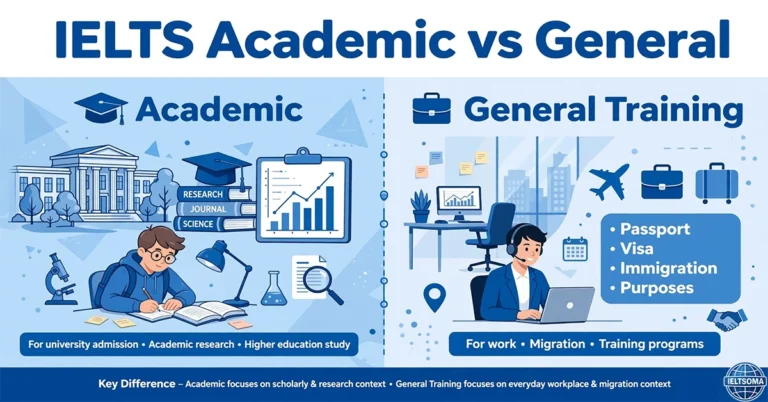
If you’re searching for IELTS for Beginners, you’re in the right place. Whether you’re planning to study abroad, immigrate, or work in an English-speaking country, understanding the IELTS exam is the first step toward achieving your goal. Many first-time test takers feel overwhelmed because they don’t know where to begin. The good news is that with the right guidance, preparation strategy, and consistent practice, anyone can build the skills needed to succeed.
This beginner-friendly guide by IELTSOMA explains everything you need to know about the IELTS test. You’ll learn what the exam is, how it is structured, which version you should take, how each section works, and the best preparation strategies for beginners. By the end of this guide, you’ll have a clear roadmap to begin your IELTS journey with confidence. This IELTS for Beginners guide is designed to help you understand the exam step by step and build confidence from day one.
Table of Contents
What Is IELTS?
The International English Language Testing System (IELTS) is one of the world’s most recognized English language proficiency tests. It evaluates how well you can use English in academic, professional, and everyday situations. Every IELTS for Beginners study plan should start with understanding the purpose of the exam.
More than 12,500 organizations worldwide accept IELTS scores, including:
- Universities
- Immigration authorities
- Government agencies
- Professional licensing bodies
- Employers
If English is not your first language, IELTS helps demonstrate your ability to communicate effectively in English.
For anyone researching IELTS for Beginners, understanding the purpose of the exam is the foundation of successful preparation.
Why Is IELTS Important?
IELTS can open doors to opportunities around the world. Depending on your goals, you may need an IELTS score to:
- Study at international universities
- Apply for student visas
- Immigrate to countries like Canada, Australia, New Zealand, or the UK
- Secure employment overseas
- Meet professional registration requirements
A good IELTS score can significantly improve your chances of achieving these goals. For anyone researching IELTS for Beginners, knowing why the exam matters helps you stay motivated throughout your preparation.
IELTS Academic vs IELTS General Training
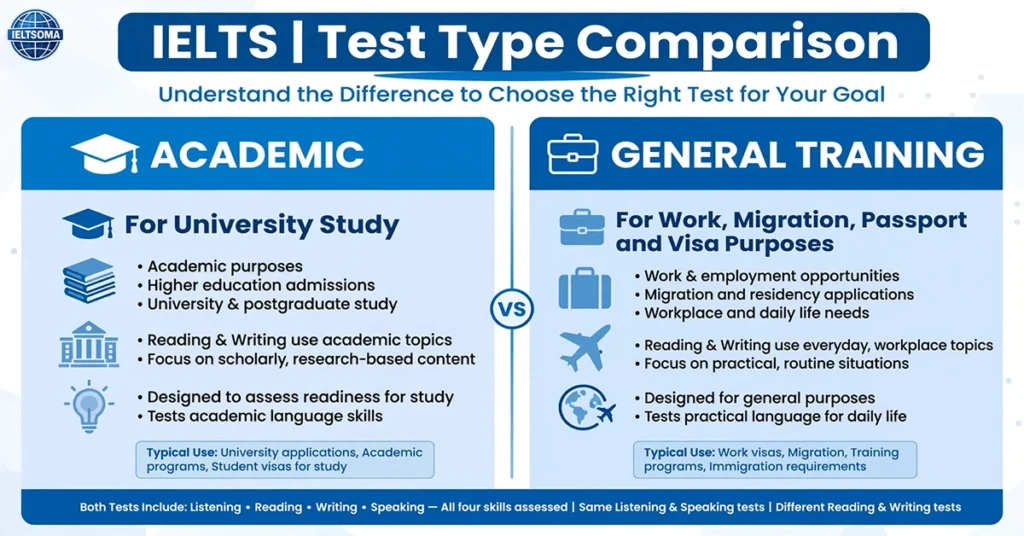
One of the biggest questions about IELTS for Beginners is choosing the correct test.
IELTS Academic
The Academic test is designed for people who want to:
- Study at universities
- Apply for higher education
- Register with professional organizations
The Reading and Writing sections contain more academic content.
IELTS General Training
The General Training test is intended for candidates who want to:
- Migrate abroad
- Work overseas
- Complete secondary education
- Join vocational training
The Listening and Speaking tests are the same as Academic IELTS, while Reading and Writing focus on everyday English. Choosing the right test is one of the first decisions in every IELTS for Beginners journey.
IELTS Test Format
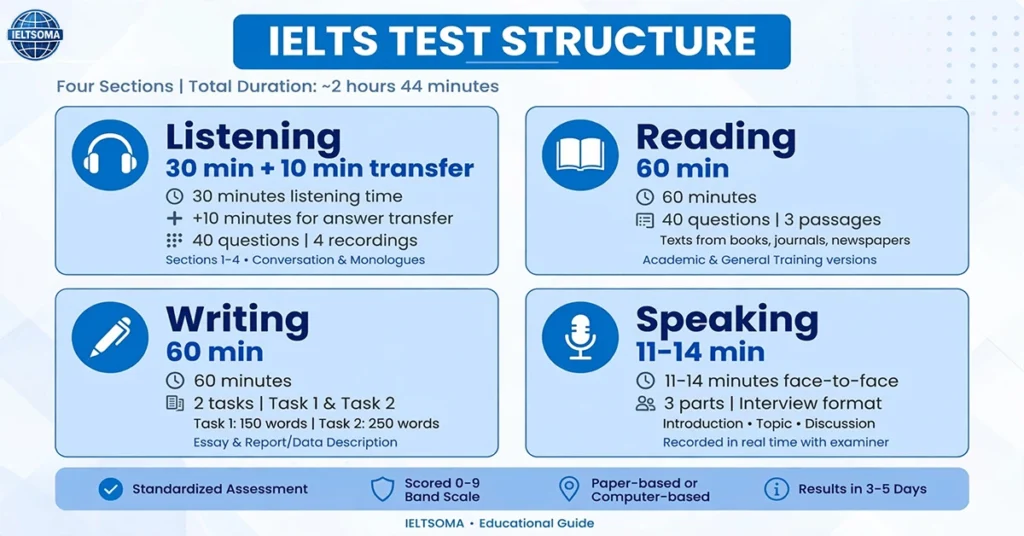
Before preparing, every beginner should understand the IELTS exam structure.
| Section | Questions | Time |
|---|---|---|
| Listening | 40 | 30 minutes (+10 minutes transfer for paper-based) |
| Reading | 40 | 60 minutes |
| Writing | 2 Tasks | 60 minutes |
| Speaking | 3 Parts | 11–14 minutes |
Understanding the format is one of the most important steps in learning IELTS for Beginners.
IELTS Listening for Beginners
Listening is the first section of the IELTS exam.
You will hear four recordings that become progressively more difficult.
These recordings include:
- Daily conversations
- Social situations
- Educational discussions
- Academic lectures
Tips for Beginners
- Listen carefully from the beginning.
- Read the questions before the recording starts.
- Watch out for synonyms.
- Check spelling carefully.
- Practice listening every day.
Good resources include:
- BBC Learning English
- TED Talks
- Podcasts
- IELTSOMA Listening practice materials
Daily exposure to English greatly improves listening ability. Regular listening practice is essential for success in IELTS for Beginners preparation.
IELTS Reading for Beginners
Reading measures your ability to understand written English.
You’ll answer 40 questions based on several passages.
Question types include:
- Multiple choice
- Matching headings
- True/False/Not Given
- Sentence completion
- Summary completion
- Short answers
Reading Tips
- Don’t read every word.
- Learn skimming.
- Practice scanning.
- Build your vocabulary.
- Manage your time carefully.
One of the biggest mistakes beginners make is spending too much time on difficult questions.
Move on and return later if needed.
IELTS Writing for Beginners
Many students believe writing is the hardest part of IELTS.
Fortunately, it becomes much easier once you understand what examiners expect.
IELTS Academic Writing
Task 1 involves describing:
- Graphs
- Charts
- Tables
- Maps
- Processes
Task 2 requires writing an essay.
IELTS General Training Writing
Task 1 requires writing a letter.
Task 2 requires writing an essay similar to Academic IELTS.
Beginner Writing Tips
- Understand the question.
- Plan before writing.
- Write clear paragraphs.
- Use linking words naturally.
- Check grammar.
- Leave time for proofreading.
Practice writing every week to build confidence.
IELTS Speaking for Beginners
Speaking is conducted as a face-to-face interview with a certified examiner.
It consists of three parts.
Part 1
General questions about:
- Home
- Family
- Work
- Studies
- Hobbies
Part 2
You receive a cue card and speak for up to two minutes.
Part 3
The examiner asks more detailed questions related to Part 2.
Speaking Tips
- Speak naturally.
- Don’t memorize answers.
- Extend your responses.
- Use varied vocabulary.
- Stay confident even if you make mistakes.
Fluency is more important than speaking quickly.
IELTS Band Score Explained
IELTS uses a band score from 0 to 9.
| Band | Level |
|---|---|
| 9 | Expert User |
| 8 | Very Good User |
| 7 | Good User |
| 6 | Competent User |
| 5 | Modest User |
| 4 | Limited User |
Most universities require between 6.0 and 7.5, although requirements vary.
Understanding the scoring system helps beginners set realistic goals.
Common Mistakes Beginners Make
Many students preparing for IELTS for Beginners repeat the same mistakes.
Avoid these common errors:
- Starting preparation too late
- Ignoring vocabulary development
- Memorizing essays
- Not practicing speaking
- Skipping mock tests
- Poor time management
- Neglecting grammar
- Not reviewing mistakes
Recognizing these mistakes early can save valuable preparation time.
How Long Should Beginners Prepare?
Preparation time depends on your current English level.
A general guide:
| English Level | Recommended Preparation |
|---|---|
| Beginner | 4–6 months |
| Intermediate | 2–3 months |
| Upper Intermediate | 1–2 months |
Daily practice is more effective than studying only on weekends.
Even one focused hour each day can lead to significant improvement over time.
Best Study Plan for IELTS Beginners
A structured study plan helps beginners stay consistent.
Monday
- Listening practice
- Vocabulary
- Grammar
Tuesday
- Reading passages
- Skimming practice
Wednesday
- Writing Task practice
- Grammar review
Thursday
- Speaking practice
- Pronunciation
Friday
- Full Reading section
- Vocabulary revision
Saturday
- Mock Listening test
- Writing correction
Sunday
- Full IELTS practice test
- Analyze mistakes
Consistency is the key to improving every skill.
Essential Vocabulary for IELTS Beginners
Instead of memorizing thousands of words, focus on high-frequency vocabulary.
Study words related to:
- Education
- Environment
- Technology
- Health
- Travel
- Society
- Work
- Crime
- Culture
- Science
Learn:
- Synonyms
- Collocations
- Phrasal verbs
- Common academic expressions
Vocabulary growth directly improves all four IELTS skills.
Grammar Topics Every Beginner Should Learn
Strong grammar makes your writing and speaking more accurate.
Focus on:
- Present tenses
- Past tenses
- Future forms
- Conditionals
- Passive voice
- Relative clauses
- Articles
- Prepositions
- Modal verbs
- Subject-verb agreement
Remember that accuracy matters more than using complex grammar.
Can Beginners Get Band 7 or Higher?
Absolutely.
Many successful candidates start as complete beginners.
What separates successful students is:
- Regular practice
- Quality feedback
- Consistency
- Learning from mistakes
- Using reliable study materials
Band 7 is achievable with dedication and smart preparation.

12 Powerful IELTS Tips for Beginners
If you’re preparing for IELTS for Beginners, following the right strategy from the beginning can save you months of frustration. These practical tips will help you build a strong foundation and improve your confidence before test day.
1. Understand the IELTS Test Format
Before solving practice questions, learn how each section works. Knowing the exam format reduces stress and helps you manage your time effectively.
Study:
- Question types
- Time limits
- Marking criteria
- Band score descriptors
The more familiar you are with the exam, the more confident you’ll feel.
2. Set a Realistic Band Score Goal
Every candidate has different goals.
For example:
- Band 5.5–6.0: Many colleges and diploma programs
- Band 6.5: Many undergraduate university programs
- Band 7.0+: Competitive universities and skilled migration
- Band 8.0+: Highly competitive academic and professional opportunities
Knowing your target score helps you focus your preparation.
3. Improve Your English Every Day
The IELTS exam measures your English ability—it isn’t just a test of memorization.
Spend at least 30–60 minutes daily:
- Reading English articles
- Listening to podcasts
- Watching English videos
- Speaking in English
- Writing short paragraphs
Small daily improvements produce big long-term results.
4. Learn Vocabulary in Context
Avoid memorizing long word lists.
Instead:
- Learn words from articles.
- Write your own example sentences.
- Practice synonyms.
- Learn collocations.
- Review vocabulary regularly.
For example, instead of memorizing the word important, learn alternatives such as:
- Significant
- Essential
- Crucial
- Vital
- Fundamental
This naturally improves your Writing and Speaking scores.
5. Practice Under Real Exam Conditions
Many beginners only practice casually.
Instead:
- Use a timer.
- Complete full sections.
- Avoid distractions.
- Check your answers honestly.
Timed practice improves speed and accuracy.
6. Focus on Your Weakest Skill
After every mock test, ask yourself:
- Is Listening my weakest area?
- Do I struggle with Reading?
- Is Writing lowering my score?
- Am I nervous during Speaking?
Spend extra time improving your weakest skill while maintaining your strengths.
7. Learn from Your Mistakes
Don’t simply check the correct answers.
Ask yourself:
- Why was my answer wrong?
- Did I misunderstand the question?
- Did I run out of time?
- Was it a vocabulary issue?
- Did I make a grammar mistake?
Keeping an error notebook is an excellent habit for every IELTS beginner.
8. Build Strong Grammar Foundations
Good grammar improves every part of the exam.
Practice:
- Sentence structure
- Articles
- Verb tenses
- Subject-verb agreement
- Complex sentences
- Linking words
Accuracy is more valuable than complexity.
9. Practice Speaking Aloud
Reading answers silently won’t improve your speaking skills.
Instead:
- Record yourself.
- Answer cue card questions.
- Speak for two minutes every day.
- Listen to your recordings.
- Improve pronunciation naturally.
Confidence grows through regular speaking practice.
10. Read Different Types of English
Read:
- Newspapers
- Magazines
- Blogs
- Scientific articles
- Opinion pieces
This improves vocabulary, comprehension, and reading speed.
11. Take Full Mock Tests
Mock tests help you:
- Build stamina
- Improve time management
- Reduce exam anxiety
- Track progress
- Identify weaknesses
Try taking one complete IELTS practice test every week during the final month before your exam.
12. Stay Consistent
Consistency beats cramming.
Studying one hour every day is usually more effective than studying seven hours only once a week.
For anyone preparing for IELTS for Beginners, consistent practice is the secret to long-term improvement.
Best Books for IELTS Beginners
Choosing the right resources can make your preparation much easier.
Here are some of the most trusted books for beginners:
- Cambridge IELTS Series
- The Official Cambridge Guide to IELTS
- IELTS Trainer
- Barron’s IELTS
- Collins Skills for IELTS
- Oxford Word Skills
- English Grammar in Use by Raymond Murphy
These books provide authentic practice and reliable explanations.
Best Free Online Resources
You don’t always need expensive courses to prepare effectively.
Explore high-quality resources from:
- IELTSOMA
- British Council
- IELTS by IDP
- Cambridge English
- BBC Learning English
- TED Talks
- Voice of America Learning English
Using official materials helps you become familiar with real IELTS questions and exam standards.
IELTS Exam Day Checklist
Preparing for exam day is just as important as studying.
Before leaving home, make sure you have:
- Valid identification document
- Test confirmation details
- Water (if allowed by the test centre)
- Comfortable clothing
- Arrived early
Avoid:
- Staying up late the night before
- Skipping breakfast
- Panicking if you don’t know an answer
- Spending too much time on one question
Stay calm, manage your time, and trust your preparation.
Frequently Asked Questions
Below are some of the most common questions about IELTS for Beginners.
Is IELTS difficult for beginners?
No. IELTS may seem challenging at first, but with consistent preparation and a clear study plan, beginners can steadily improve their English skills and achieve their target band score.
How long does it take to prepare for IELTS?
Preparation depends on your current English level.
Most beginners need approximately four to six months of regular study, while intermediate learners often require two to three months.
Can I prepare for IELTS without coaching?
Yes.
Many candidates successfully prepare independently using official practice materials, online resources, mock tests, and structured study plans.
Which IELTS module should I take?
Choose IELTS Academic if you plan to study at a university or register with a professional organization.
Choose IELTS General Training if you’re applying for work, migration, or vocational training.
What is a good IELTS score?
A good score depends on your goals.
Many universities require Band 6.5 or higher, while immigration and employment requirements vary by country and organization.
Is grammar important in IELTS?
Yes.
Grammar affects both your Writing and Speaking scores. Using accurate grammar consistently is more beneficial than attempting overly complex sentence structures.
Can I improve my IELTS score quickly?
Improvement depends on your starting level, study habits, and consistency. Focusing on weak areas, practicing regularly, and using reliable study materials can help you make steady progress.
How often should I take practice tests?
Aim to complete one full-length mock test every one to two weeks during the early stages of preparation. Increase this to one full mock test each week as your exam approaches.
Final Thoughts
Starting your IELTS journey may feel overwhelming, but every successful candidate begins somewhere. The key is to build a strong foundation, understand the exam format, practice consistently, and learn from your mistakes.
This guide to IELTS for Beginners has covered the essential information you need to begin your preparation with confidence. Whether you’re taking the Academic or General Training test, developing your English skills gradually will produce lasting results.
At IELTSOMA, we’re committed to helping learners around the world prepare smarter—not harder. Continue practicing every day, use trusted study resources, and monitor your progress regularly. With patience, discipline, and the right guidance, achieving your target IELTS band score is entirely possible.
Good luck with your IELTS journey!
Further Reading: