Whether you are preparing for the IELTS Academic or General Training test, one of the smartest things you can do is Enhance IELTS Vocabulary Skills before your exam. A strong vocabulary helps you communicate your ideas clearly, understand complex reading passages, answer listening questions accurately, write impressive essays, and speak confidently during the interview.
Many IELTS candidates believe that learning thousands of difficult words is the key to success. However, the IELTS exam does not reward candidates simply for using advanced vocabulary. Instead, examiners look for appropriate, accurate, and natural word usage.
If your goal is to achieve Band 7, Band 8, or even Band 9, you need a vocabulary improvement strategy that focuses on quality rather than quantity.
In this guide, you will learn practical techniques to Enhance IELTS Vocabulary Skills, avoid common vocabulary mistakes, and build a vocabulary that improves performance in every section of the IELTS test.
Table of Contents
Why It Is Important to Enhance IELTS Vocabulary Skills
Vocabulary affects all four IELTS modules.
A larger vocabulary allows you to:
- Understand difficult Reading passages.
- Follow conversations in the Listening test.
- Express opinions naturally in Speaking.
- Write clear and well-developed essays in Writing Task 1 and Task 2.
- Avoid repeating the same words.
- Demonstrate lexical resource, one of the official IELTS marking criteria.
Candidates with limited vocabulary often struggle to explain ideas, even when they know the correct answer. Learning new words gives you more confidence and allows you to communicate more effectively.
How Vocabulary Is Assessed in IELTS
One of the four marking criteria for Speaking and Writing is Lexical Resource.
The examiner looks for your ability to:
- Use a wide range of vocabulary.
- Choose words accurately.
- Use less common vocabulary naturally.
- Avoid unnecessary repetition.
- Understand collocations.
- Use appropriate synonyms.
- Spell words correctly.
- Use correct word forms.
Remember that using complicated words incorrectly can reduce your score. It is always better to use simple vocabulary accurately than advanced vocabulary incorrectly.
Enhance IELTS Vocabulary Skills by Learning Words in Context
One of the biggest mistakes candidates make is memorizing long vocabulary lists.
For example, many learners write:
Happy = delighted = joyful = cheerful = pleased
Although these words appear similar, they are not always interchangeable.
Instead, learn vocabulary inside complete sentences.
For example:
- She was delighted to receive the scholarship.
- The children looked cheerful during the festival.
- He seemed pleased with his IELTS result.
Learning vocabulary in context helps you understand:
- Meaning
- Grammar
- Natural usage
- Common expressions
- Collocations
This method makes new words easier to remember and easier to use correctly.
Read Every Day to Enhance IELTS Vocabulary Skills
Reading is one of the fastest ways to improve vocabulary naturally.
Good reading materials include:
- English newspapers
- News websites
- Science articles
- Travel magazines
- Educational blogs
- University websites
- IELTS preparation materials
While reading:
- Highlight unfamiliar words.
- Guess their meaning from the context.
- Confirm the meaning using a dictionary.
- Write the word in your vocabulary notebook.
- Create your own sentence.
Reading regularly exposes you to authentic English and helps you understand how vocabulary is used by native speakers.
Build a Personal IELTS Vocabulary Notebook
Instead of keeping random word lists, organize your vocabulary notebook into categories.
For example:
Education
- Curriculum
- Tuition
- Scholarship
- Graduate
- Undergraduate
- Qualification
- Assignment
- Lecture
Environment
- Pollution
- Deforestation
- Conservation
- Biodiversity
- Renewable energy
- Sustainability
- Ecosystem
- Climate change
Technology
- Artificial intelligence
- Innovation
- Automation
- Cybersecurity
- Digital literacy
- Smartphone
- Software
- Online learning
Health
- Nutrition
- Obesity
- Vaccination
- Mental health
- Healthcare
- Diagnosis
- Treatment
- Lifestyle
Organizing vocabulary by topic helps you remember words that frequently appear in IELTS Speaking and Writing questions.
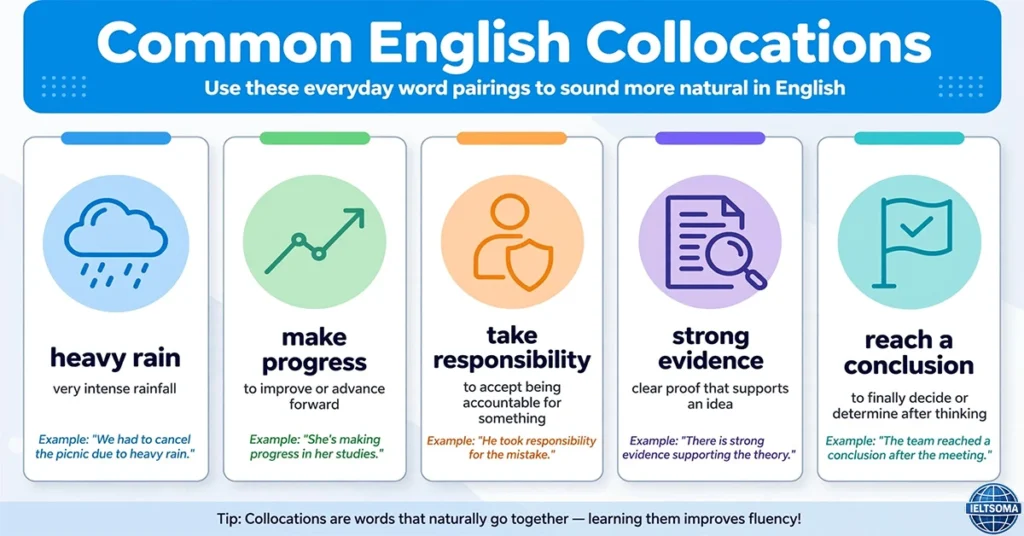
Learn Collocations Instead of Single Words
Collocations are words that naturally go together.
Native English speakers use collocations automatically.
Examples include:
| Word | Natural Collocation |
|---|---|
| Make | Make progress |
| Take | Take responsibility |
| Reach | Reach a conclusion |
| Heavy | Heavy traffic |
| Strong | Strong evidence |
| Serious | Serious problem |
| Raise | Raise awareness |
| Solve | Solve an issue |
Learning collocations improves fluency because your English sounds more natural.
Instead of saying:
Big rain
Say:
Heavy rain
Instead of:
Strong possibility
Say:
High probability
These small improvements can significantly improve your IELTS Speaking and Writing performance.
Enhance IELTS Vocabulary Skills Using Synonyms
The IELTS exam frequently paraphrases words.
For example:
| Question Word | Possible Synonym |
|---|---|
| Important | Significant |
| Difficult | Challenging |
| Increase | Rise |
| Decrease | Decline |
| Problem | Issue |
| Improve | Enhance |
| Advantage | Benefit |
| Disadvantage | Drawback |
If you know several synonyms for common words, you will understand Reading passages more easily and avoid repetition in Writing.
However, remember that synonyms are not always identical.
Always learn how each synonym is used in real sentences.
Master Word Families
Learning one word should help you learn several related words.
For example:
| Noun | Verb | Adjective | Adverb |
|---|---|---|---|
| Success | Succeed | Successful | Successfully |
| Beauty | Beautify | Beautiful | Beautifully |
| Education | Educate | Educational | Educationally |
| Improvement | Improve | Improved | Impressively |
| Decision | Decide | Decisive | Decisively |
Understanding word families allows you to choose the correct form during Writing and Speaking.
For example:
Incorrect:
Pollution is increase every year.
Correct:
Pollution is increasing every year.
Or:
There has been a significant increase in pollution.
Learn Vocabulary by IELTS Topics
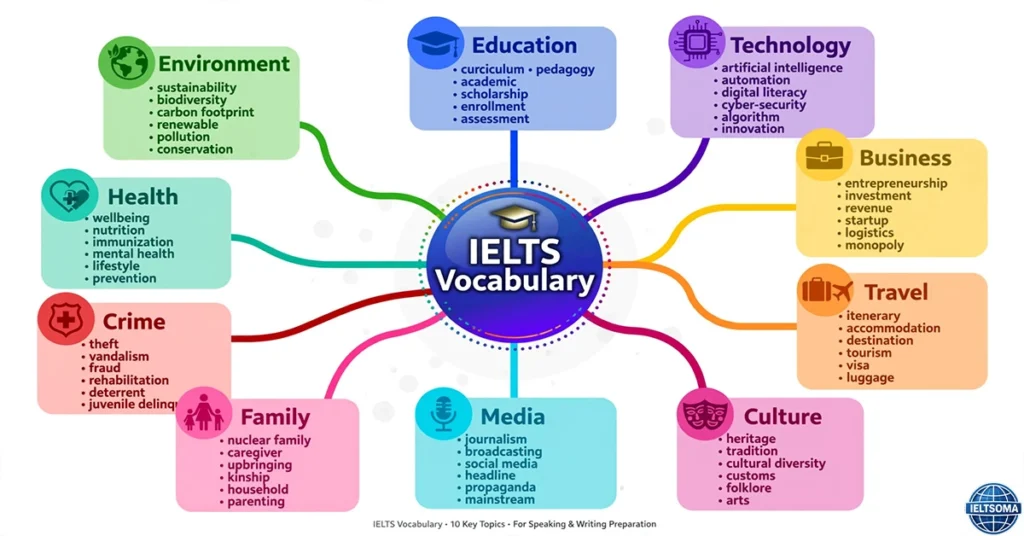
Certain topics appear repeatedly in the IELTS exam.
Focus your learning around these themes:
- Education
- Environment
- Technology
- Health
- Crime
- Society
- Transportation
- Culture
- Tourism
- Work
- Business
- Family
- Media
- Sports
- Housing
- Food
- Science
- Climate Change
- Communication
- Globalization
For each topic:
- Learn 20–30 useful words.
- Learn common collocations.
- Learn useful phrases.
- Practice speaking using those words.
- Write short paragraphs using them.
This approach prepares you for both Speaking and Writing tasks.
Use Flashcards to Enhance IELTS Vocabulary Skills
Flashcards are one of the most effective memorization tools.
You can use paper flashcards or digital apps.
Each flashcard should include:
Front
Word:
Sustainable
Back
Meaning:
Able to continue without damaging the environment.
Collocations:
- Sustainable development
- Sustainable energy
- Sustainable farming
Example:
Many countries are investing in sustainable energy sources.
Review your flashcards every day.
Frequent revision moves vocabulary from short-term memory into long-term memory.
Practice Active Vocabulary Instead of Passive Vocabulary
Many IELTS candidates recognize hundreds of words but rarely use them.
This is called passive vocabulary.
Your goal should be active vocabulary.
For every new word you learn:
- Say it aloud.
- Write three sentences.
- Use it during speaking practice.
- Include it in practice essays.
- Review it several times during the week.
The more often you actively use a word, the easier it becomes to remember during the IELTS exam.
Avoid Memorizing Rare or Unnatural Words
Some students spend weeks memorizing words that native speakers rarely use.
Examples include:
- Perspicacious
- Obfuscate
- Pulchritudinous
- Ubiquitous (used correctly only in specific contexts)
Using uncommon vocabulary incorrectly can make your English sound unnatural.
Instead, focus on high-frequency academic and everyday vocabulary that appears regularly in IELTS materials.
Quality always beats quantity.
Improve Pronunciation Alongside Vocabulary
Knowing a word is not enough if you cannot pronounce it correctly.
When learning new vocabulary:
- Listen to native pronunciation.
- Repeat several times.
- Learn the word stress.
- Practice using the word in sentences.
For example:
Photograph
Photography
Photographic
These words have different stress patterns.
Correct pronunciation helps improve your Speaking score while also increasing confidence during the interview.
Use an English-English Dictionary
Many learners rely on direct translation.
Although translation can help beginners, advanced IELTS preparation is more effective with English-English dictionaries.
Benefits include:
- Better understanding of meaning.
- Correct pronunciation.
- Example sentences.
- Common collocations.
- Word forms.
- Natural usage.
Reading definitions in English also improves comprehension skills for the Reading module.
Practice Writing with New Vocabulary
The fastest way to remember vocabulary is to use it.
Choose one IELTS topic every day and write a short paragraph using five to ten new words.
For example, if today’s topic is technology, include vocabulary such as:
- Innovation
- Automation
- Artificial intelligence
- Productivity
- Digital transformation
- Cybersecurity
- Efficiency
Writing regularly strengthens your vocabulary and prepares you for IELTS Writing Task 2.
Use New Vocabulary During IELTS Speaking Practice
Speaking practice is one of the most effective ways to Enhance IELTS Vocabulary Skills because it forces you to recall words quickly and naturally.
When practising with a teacher, study partner, or by recording yourself, challenge yourself to include newly learned vocabulary without making your speech sound memorized.
For example, instead of saying:
I like technology because it is useful.
You could say:
I believe technological innovation has significantly improved our daily lives by increasing productivity and making communication more efficient.
Notice how the second response sounds more natural and demonstrates a wider lexical range.
Choose one IELTS topic each day and speak for two minutes using topic-specific vocabulary.
Popular speaking topics include:
- Education
- Health
- Environment
- Travel
- Technology
- Hobbies
- Family
- Shopping
- Sports
- Culture
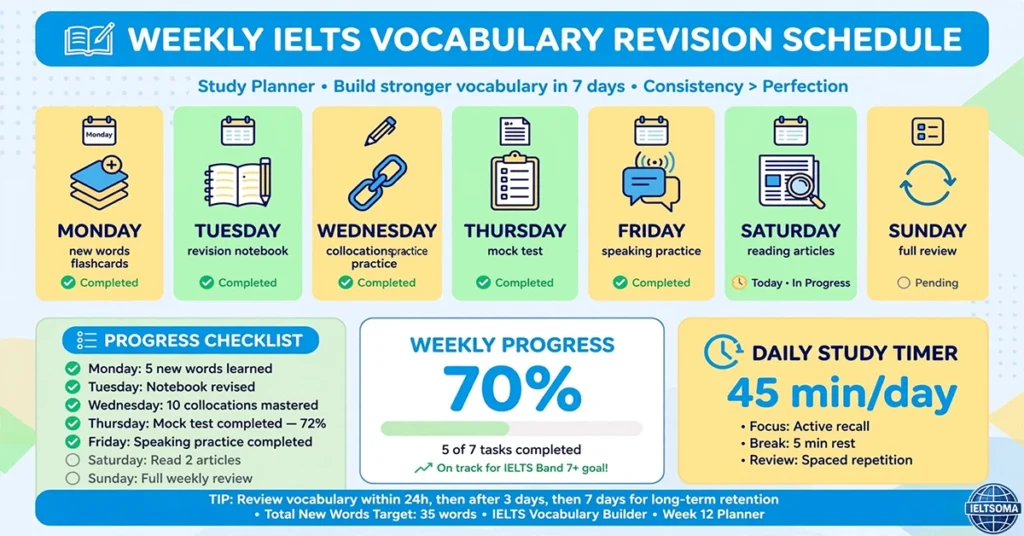
Enhance IELTS Vocabulary Skills with Daily Revision
Learning new words is only half the process.
Without regular revision, you are likely to forget much of what you have learned within a few days.
A simple revision schedule can make a significant difference.
- Review new words on the same day.
- Revise them again after one day.
- Review after three days.
- Review after one week.
- Review after two weeks.
- Review once a month.
This method helps transfer vocabulary from short-term memory to long-term memory.
Even spending 15–20 minutes a day reviewing vocabulary can greatly improve your retention.
Learn Common Academic Vocabulary
Academic vocabulary appears frequently in IELTS Reading and Writing.
Here are some useful words that every IELTS candidate should know.
| Word | Meaning |
|---|---|
| Significant | Important or noticeable |
| Establish | To create or set up |
| Demonstrate | To show clearly |
| Evaluate | To assess carefully |
| Participate | To take part |
| Illustrate | To explain with examples |
| Evidence | Facts that support an idea |
| Impact | Effect or influence |
| Benefit | Advantage |
| Challenge | Difficulty or obstacle |
Try to use these words naturally when writing essays instead of relying on basic alternatives.
Topic-Based Vocabulary Examples
Education
Useful vocabulary:
- Curriculum
- Literacy
- Scholarship
- Tuition fees
- Online learning
- Academic achievement
- Distance education
- Vocational training
Example sentence:
Online learning has made higher education more accessible for students living in remote areas.
Environment
Useful vocabulary:
- Renewable energy
- Climate change
- Conservation
- Pollution
- Recycling
- Carbon emissions
- Sustainable development
- Biodiversity
Example sentence:
Governments should invest more in renewable energy to reduce carbon emissions.
Health
Useful vocabulary:
- Healthcare
- Nutrition
- Obesity
- Preventive medicine
- Physical activity
- Mental wellbeing
- Vaccination
- Balanced diet
Example sentence:
Regular physical activity plays an important role in maintaining good mental wellbeing.
Technology
Useful vocabulary:
- Artificial intelligence
- Cybersecurity
- Automation
- Innovation
- Digital literacy
- Productivity
- Software
- Smart devices
Example sentence:
Artificial intelligence is transforming many industries by improving efficiency and reducing costs.
Common Vocabulary Mistakes in IELTS
Many candidates lose marks because they misuse vocabulary.
Avoid these common mistakes.
Using Words You Do Not Fully Understand
Advanced vocabulary is helpful only when used correctly.
Incorrect:
Pollution is a delicious problem.
Correct:
Pollution is a serious environmental problem.
Repeating the Same Word
Poor example:
The problem is big. This big problem affects many people. The big problem continues.
Improved version:
The issue is significant. This major challenge affects millions of people and continues to grow.
Incorrect Word Forms
Incorrect:
The government should encouragement education.
Correct:
The government should encourage education.
Or:
The government should provide encouragement for education.
Overusing Memorized Expressions
Examiners can easily recognise memorised phrases.
Instead of memorising complete essays, learn useful vocabulary and practise applying it naturally in different contexts.
Best Daily Routine to Enhance IELTS Vocabulary Skills
A consistent daily routine is far more effective than studying for several hours only once a week.
Here is an example of a productive 45-minute vocabulary routine.
| Activity | Time |
|---|---|
| Read an English article | 10 minutes |
| Learn five to ten new words | 10 minutes |
| Write example sentences | 10 minutes |
| Speaking practice | 10 minutes |
| Vocabulary revision | 5 minutes |
Following this routine consistently for a few months can dramatically expand your vocabulary.
Useful Vocabulary Resources
There are many excellent resources available for IELTS vocabulary improvement.
Consider using:
- Cambridge IELTS books
- BBC Learning English
- British Council IELTS resources
- Cambridge Dictionary
- Oxford Learner’s Dictionary
- English news websites
- Podcasts designed for English learners
- Academic articles on topics commonly found in IELTS
Use reliable resources rather than random vocabulary lists found online.
How Vocabulary Helps in Each IELTS Module
Listening
A broader vocabulary helps you recognise paraphrased words and understand conversations more accurately.
For example, the recording may use the word “purchase” while the question uses “buy.”
Recognising these similarities improves your Listening score.
Reading
The Reading test frequently replaces keywords with synonyms.
Candidates with stronger vocabulary can identify these paraphrases more quickly, saving valuable time.
Writing
A varied vocabulary allows you to:
- Present ideas more clearly.
- Avoid repetition.
- Demonstrate lexical resource.
- Write more persuasive arguments.
Speaking
Candidates with a wider vocabulary can answer questions more fluently, describe experiences in greater detail, and explain opinions more naturally.
Sample IELTS Vocabulary Exercise
Choose one topic and write five sentences using the target vocabulary.
Topic: Environment
Target words:
- Conservation
- Sustainable
- Renewable
- Pollution
- Biodiversity
Example:
Governments should encourage sustainable development by investing in renewable energy projects. These initiatives reduce pollution while protecting biodiversity and supporting long-term conservation efforts.
Repeat this exercise with different IELTS topics to build confidence before test day.
Frequently Asked Questions
How many words should I learn for IELTS?
There is no fixed number. Instead of aiming for thousands of words, focus on learning high-frequency vocabulary, collocations, and topic-specific words that commonly appear in IELTS.
Is advanced vocabulary necessary for Band 7 or Band 8?
Not necessarily. Examiners reward accurate, appropriate, and natural vocabulary more than unnecessarily difficult words.
Should I memorise vocabulary lists?
Vocabulary lists can help, but learning words in context through reading, listening, speaking, and writing is much more effective.
How long does it take to improve IELTS vocabulary?
With consistent daily practice, many candidates notice significant improvement within two to three months.
Can reading alone improve vocabulary?
Reading is one of the best methods, but combining it with writing, speaking, and revision produces much better results.
Final Thoughts
Choosing to Enhance IELTS Vocabulary Skills is one of the best investments you can make in your IELTS preparation. Vocabulary influences every part of the exam, from understanding Reading passages and Listening recordings to producing high-quality responses in Speaking and Writing.
Instead of trying to memorise thousands of difficult words, focus on learning useful vocabulary in context, practising collocations, studying word families, and using new words regularly in your daily English practice.
Remember that consistency is far more important than intensity. Reading a little every day, reviewing your vocabulary notebook, speaking on different IELTS topics, and writing short paragraphs with newly learned words will gradually strengthen your lexical resource and improve your overall confidence.
With the right strategy and regular practice, you will not only Enhance IELTS Vocabulary Skills but also increase your chances of achieving the IELTS band score you need for study, work, or immigration.
Start today, stay consistent, and let your expanding vocabulary become one of your greatest strengths on IELTS test day.
Further Link(s):