
Getting an IELTS Band 6 is a solid achievement, but moving from Band 6 to 7 is where many test takers get stuck. You may understand most questions, communicate reasonably well and still find that your score refuses to move.
The reason is simple: IELTS Band 6 to 7 improvement is not mainly about studying more English. It is about changing the quality of your performance.
At Band 6, you can generally communicate effectively despite some mistakes. At Band 7, you are expected to handle more complex language, develop ideas more clearly and demonstrate greater control. IELTS describes Band 6 as “competent” and Band 7 as “good”.
This guide gives you a practical IELTS Band 6 to 7 study plan for Listening, Reading, Writing and Speaking, including what to change, what to practise and how to measure progress.
Table of Contents
What Changes Between IELTS Band 6 and 7?
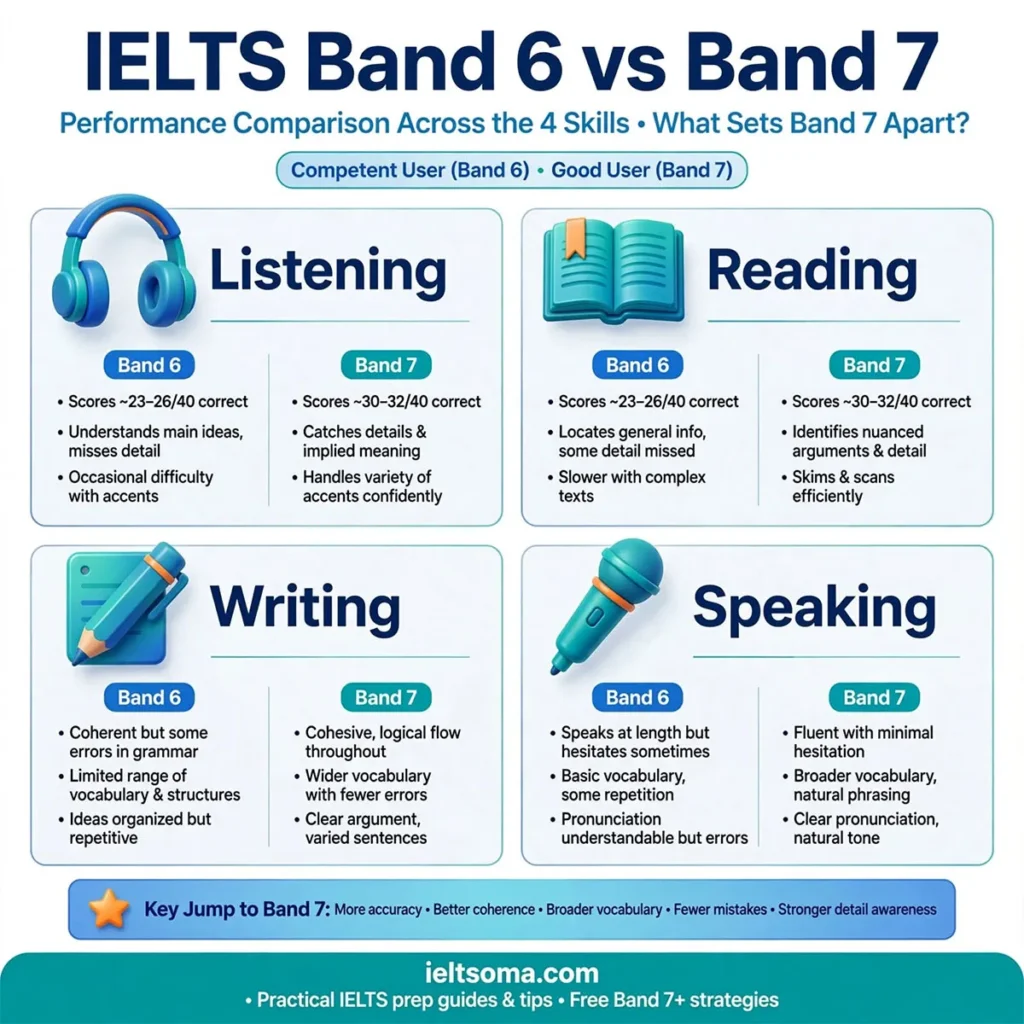
The jump from Band 6 to 7 is not simply one extra point on the IELTS scale. It represents a noticeable improvement in how consistently you use English.
| Area | Typical Band 6 performance | What you need for Band 7 |
|---|---|---|
| Vocabulary | Adequate range, but repetition or inappropriate word choice | More flexible vocabulary and better collocation |
| Grammar | Mix of simple and complex structures with noticeable errors | Wider range with more frequent accurate sentences |
| Writing | Ideas may be relevant but insufficiently developed | Ideas are logically developed and supported |
| Speaking | Can communicate but may hesitate or struggle with longer discussion | Can maintain longer turns and develop ideas more flexibly |
| Reading | Understands the general meaning but loses marks on detail or inference | More accurate reading of detail, paraphrase and relationships |
| Listening | Understands much of the recording but misses answers through distraction or paraphrase | Better prediction, attention and recognition of changing information |
The official IELTS scoring system confirms that the four skills are assessed separately, while the overall score is calculated from the four section scores.
So your first task is not to study everything equally.
You need to discover where your missing marks are.
Step 1: Find Out Why You Are Getting Band 6
Before starting an IELTS Band 6 to 7 study plan, take a realistic diagnostic test.
Do not simply look at your overall score.
Record your performance like this:
| Skill | Current score | Target | Main problem |
|---|---|---|---|
| Listening | 6.5 | 7.0 | Missed answers after distraction |
| Reading | 6.0 | 7.0 | Matching headings |
| Writing | 6.0 | 7.0 | Weak idea development |
| Speaking | 6.5 | 7.0 | Hesitation and limited flexibility |
This tells you where your effort should go.
For Listening and Reading, keep an error log. For every wrong answer, identify the reason:
- I did not understand the question.
- I did not recognise the paraphrase.
- I lost concentration.
- I chose the wrong option.
- I made a spelling mistake.
- I ran out of time.
- I misunderstood the passage.
- I changed a correct answer unnecessarily.
For Writing and Speaking, compare your performance against the official assessment criteria rather than asking whether your English “sounds good”.
IELTS Writing is assessed using Task Achievement or Task Response, Coherence and Cohesion, Lexical Resource, and Grammatical Range and Accuracy. Task 2 carries more weight than Task 1.
Step 2: Set a Specific Band 7 Target
Do not make your goal simply:
“I want Band 7.”
Make it measurable.
For example:
“I need 7 in every skill, so I will raise Reading from 6 to 7, Writing from 6 to 7, Speaking from 6.5 to 7 and maintain Listening at 7.”
This matters because an overall Band 7 does not necessarily mean you have Band 7 in every skill.
IELTS calculates the overall band from the average of Listening, Reading, Writing and Speaking scores.
Therefore, check the score requirements of your university, employer, professional body or immigration authority before deciding what your individual targets should be.
IELTS Band 6 to 7 Listening Improvement
Listening is often one of the quickest areas to improve because the scoring system is based on correct answers.
The IELTS Listening test contains 40 questions, with each correct answer receiving one mark. IELTS notes that the exact raw-score boundary for a band can vary slightly between test versions; around 30 correct answers is typically associated with Band 7.
But simply doing more practice tests is not enough.
1. Analyse every wrong answer
Suppose you scored 26/40.
Do not immediately take another test.
Instead, investigate the 14 mistakes.
If eight were caused by missing paraphrases, your problem is not general listening ability. You need to improve your ability to connect spoken language with the wording used in the question.
For example:
Question: The company experienced a significant increase in sales.
Recording: Sales rose considerably during the second quarter.
You need to recognise:
- significant = considerable
- increase = rise
- sales = sales
2. Predict before listening
Before the recording begins, examine the surrounding words and predict what type of answer is required.
Ask:
- Is it a name?
- Number?
- Date?
- Place?
- Noun?
- Adjective?
- Singular or plural?
Prediction reduces the amount of information your brain has to process.
3. Stop translating everything
At Band 6, some learners mentally translate the recording into their first language. This can make you too slow.
Instead, train yourself to understand the meaning directly in English.
4. Practise with transcripts
After completing a listening exercise:
- Check your answers.
- Identify mistakes.
- Listen again without the transcript.
- Read the transcript.
- Find the exact point where you lost the answer.
- Listen again.
This turns one practice exercise into several learning activities.
IELTS Band 6 to 7 Reading Improvement
For Academic Reading, IELTS reports that Band 6 is typically around 23 correct answers out of 40, while Band 7 is around 30. For General Training Reading, the raw-score requirements are different. These figures are approximate because boundaries can vary between test versions.
That means moving from Band 6 to 7 can require a substantial improvement in accuracy.
Focus on why answers are wrong
If you regularly score 23–25, simply completing another ten passages will not necessarily take you to 30.
Analyse your mistakes by question type:
- Matching Headings
- True/False/Not Given
- Yes/No/Not Given
- Multiple Choice
- Matching Information
- Sentence Completion
- Summary Completion
- Matching Features
Then identify your weakest category.
Learn to recognise paraphrasing
Reading questions rarely copy the passage word for word.
For example:
Question: The number of international students increased rapidly.
Passage: There was a sharp rise in overseas enrolments.
The important relationships are:
- international students → overseas students
- increased → rise
- rapidly → sharp
Band 7 performance requires you to recognise these relationships reliably.
Do not read every word at the same speed
Use a flexible reading strategy.
Read the passage quickly enough to understand its structure, then slow down when you reach the relevant section.
You should know:
- what each paragraph is mainly about
- where particular information is located
- how the writer’s argument develops
- where names, dates and examples appear
Your objective is not to memorise the passage.
It is to locate and interpret the evidence needed to answer the questions.
IELTS Band 6 to 7 Writing: The Biggest Challenge
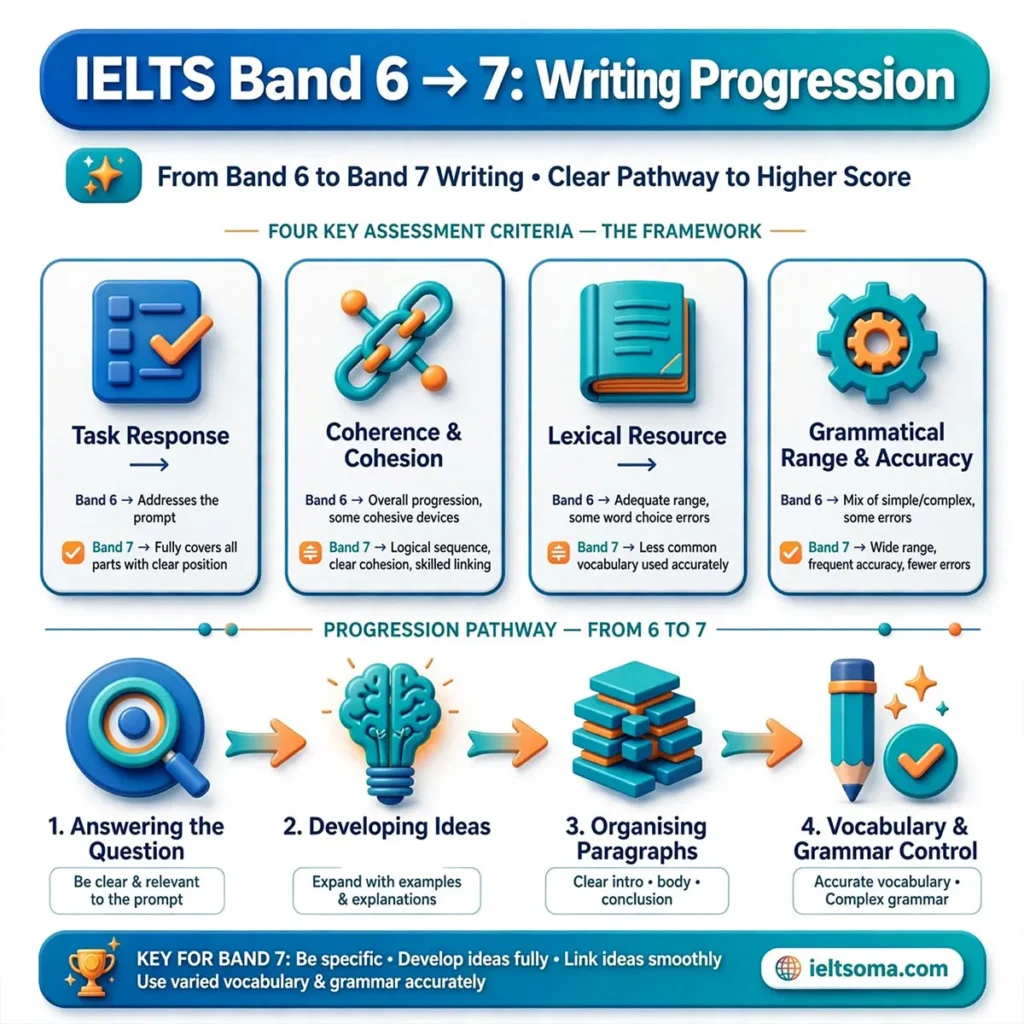
For many candidates, Band 6 to 7 Writing is the hardest part of the improvement journey.
The reason is that Band 7 requires more than grammatical correctness.
IELTS assesses Writing through four criteria, and Task 2 has greater weighting than Task 1.
The official descriptors show an important difference.
At Band 6, main ideas are relevant but some may be insufficiently developed or unclear. At Band 7, ideas need to be logically organised and developed with appropriate support.
1. Answer the whole question
One of the fastest ways to remain at Band 6 is to answer only part of the task.
Before writing, identify exactly what the question requires.
For example:
Some people believe university education should be free for everyone. To what extent do you agree or disagree?
Your essay needs a clear position.
Do not write a generally relevant essay about education.
Write an essay that answers this specific question.
2. Develop your ideas
This is one of the most important differences between Band 6 and Band 7.
A weak paragraph might say:
Public transport should be improved because it can reduce traffic congestion.
That is a reasonable idea, but it is not fully developed.
A stronger version explains the mechanism:
Public transport should be improved because reliable buses and trains can persuade commuters to leave their cars at home. If public transport is frequent, affordable and convenient, fewer people may depend on private vehicles for daily journeys. This can reduce the number of cars on major roads and consequently ease congestion during peak hours.
The improvement is not simply “better vocabulary”.
The idea has been explained and extended.
3. Build paragraphs around one main idea
A useful Band 6 to 7 Writing structure is:
Topic sentence → Explanation → Example → Result or implication
For example:
One major advantage of remote working is that it can reduce commuting time. Employees who work from home do not need to spend hours travelling between their homes and offices. For example, a worker who previously spent 90 minutes commuting each day could use that time for family responsibilities or additional work. As a result, remote working may improve both productivity and work-life balance.
The structure makes the logic easy to follow.
4. Stop memorising complicated sentences
Memorised templates can make writing sound unnatural and may not help you respond accurately to the actual task.
Instead, learn flexible structures.
For example:
- One major reason is that…
- This is particularly significant because…
- A clear example of this can be seen in…
- As a result,…
- This suggests that…
- From a broader perspective,…
Use them when they genuinely improve the relationship between ideas.
5. Improve grammar through accuracy, not complexity alone
Band 7 does require a range of structures, but complexity without control is dangerous.
A paragraph full of ambitious sentences containing errors is not automatically better than a paragraph using clear, accurate structures.
Practise:
- complex sentences
- relative clauses
- conditionals
- concessive clauses
- passive structures
- accurate articles
- subject-verb agreement
- punctuation
- noun phrases
The goal is controlled variety.
The official Writing criteria specifically assess grammatical range and accuracy.
Band 6 to 7 Speaking Improvement
Speaking at Band 6 can feel frustrating because you may know what you want to say but struggle to express it smoothly.
The official Speaking criteria are:
- Fluency and Coherence
- Lexical Resource
- Grammatical Range and Accuracy
- Pronunciation
The criteria are equally weighted.
1. Extend your answers
For Part 3 especially, do not stop after giving an opinion.
Use:
Answer → Reason → Example → Result
Question:
Why do some people prefer working from home?
Answer:
I think flexibility is one of the main reasons. People can organise their working day around other responsibilities, such as childcare or household tasks. For example, a parent may be able to start work earlier and finish earlier instead of spending time commuting. This can make working from home particularly attractive to people with family commitments.
The answer develops naturally rather than sounding memorised.
2. Practise long turns
The Band 7 Speaking descriptor expects candidates to keep going and produce longer turns without noticeable effort, although some hesitation or self-correction can still occur.
Record yourself answering questions for two minutes.
Then listen for:
- long pauses
- repeated words
- unfinished sentences
- excessive “um” and “you know”
- repeated vocabulary
- unclear pronunciation
- grammar mistakes
Choose one problem at a time.
Do not try to eliminate every mistake immediately.
3. Learn vocabulary in phrases
Do not memorise isolated lists such as:
beneficial, detrimental, significant, crucial
Learn useful combinations:
- have a significant impact on
- pose a serious challenge
- play an important role in
- highly beneficial for
- a major contributing factor
This improves naturalness and collocation.
4. Do not try to sound like a native speaker
Band 7 does not require a native accent.
Your priority is clear, intelligible communication with effective pronunciation, stress and intonation.
A Practical 6-Week IELTS Band 6 to 7 Study Plan
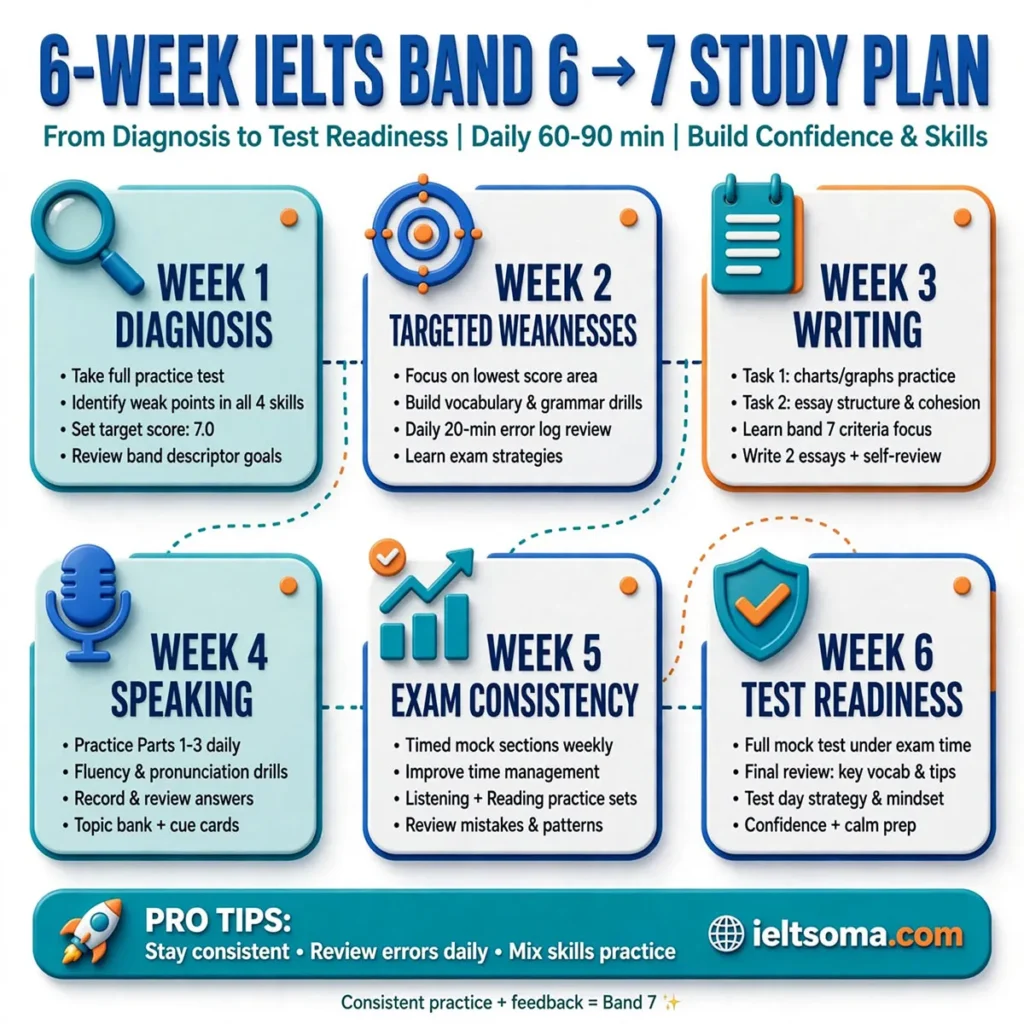
If you are currently around Band 6, use the following structure for six weeks.
| Week | Main objective | What to do |
|---|---|---|
| 1 | Diagnose weaknesses | Full test + error analysis |
| 2 | Fix major weaknesses | Target weakest question types and language problems |
| 3 | Improve Writing | Timed Task 1/Task 2 + detailed correction |
| 4 | Improve Speaking | Recorded answers + Part 2 and Part 3 practice |
| 5 | Build exam consistency | Full timed sections + targeted correction |
| 6 | Test readiness | Full mocks + final error review |
Suggested daily routine
60–90 minutes per day:
20 minutes — Vocabulary and grammar
Learn vocabulary in context and review recurring grammar errors.
20 minutes — Listening or Reading
Complete a focused exercise rather than always taking a full test.
30 minutes — Writing or Speaking
Alternate between productive skills.
10–20 minutes — Error review
Review your personal error log.
The most important part is the final stage.
Do not simply record your score. Record what caused the mistake.
How to Know You Are Ready for Band 7
Do not judge readiness from one unusually good practice test.
Look for consistency.
For example:
- Listening repeatedly around Band 7
- Reading repeatedly around Band 7
- Writing assessed around Band 7 using the official criteria
- Speaking consistently demonstrating Band 7 characteristics
Your practice results should also come from realistic, timed conditions.
If you score 7 once and 6 several times, you have probably improved, but you have not yet demonstrated reliable Band 7 performance.
Common Mistakes When Trying to Move from Band 6 to 7
Mistake 1: Learning thousands of vocabulary words
More vocabulary does not automatically produce a higher band.
Learn words that you can use accurately and naturally.
Mistake 2: Doing practice tests every day
Practice tests are useful for measurement, but they are not the same as learning.
Analyse mistakes and practise the underlying skill.
Mistake 3: Ignoring Writing
A candidate may improve Listening and Reading substantially while Writing remains at 6.
If Writing is your weakest skill, give it disproportionate attention.
Mistake 4: Memorising essays
Memorised material can become irrelevant to the question and may make your writing less natural.
Build flexible ideas and structures instead.
Mistake 5: Chasing difficult grammar
Complex grammar is useful only when you can control it.
Accuracy comes first.
Mistake 6: Speaking only with a partner
Conversation is useful, but recorded self-practice allows you to hear your own problems.
Record, review, identify one weakness and repeat.
The Band 6 to 7 Mindset
The most useful question is not:
“How can I study more?”
Ask:
“Why am I losing marks?”
That change in thinking is crucial.
If you lose Reading marks because you confuse False with Not Given, practise that distinction.
If your Writing remains at Band 6 because your ideas are underdeveloped, work on explanation and support.
If your Speaking score is limited by hesitation, practise extended answers rather than memorising vocabulary lists.
If Listening mistakes happen because you miss paraphrases, train paraphrase recognition.
Your preparation should become increasingly diagnostic and targeted.
IELTS Band 6 to 7: A Simple Weekly Checklist
At the end of each week, ask yourself:
- What was my strongest skill?
- What was my weakest skill?
- What type of question caused the most mistakes?
- Which grammar errors did I repeat?
- Which vocabulary did I use incorrectly?
- Did I complete timed Writing practice?
- Did I record Speaking practice?
- Did I analyse my mistakes?
- Did my practice scores improve consistently?
- What is the one problem I should attack next week?
If you can answer these questions honestly, your preparation becomes much more focused.
FAQs About Improving IELTS from Band 6 to 7
Is it difficult to improve IELTS from Band 6 to 7?
It can be challenging, but it is achievable with targeted preparation. The difficulty depends on which skill is limiting your score. A candidate with strong Listening and Reading but Band 6 Writing may need a very different plan from someone who has Band 6 in all four skills.
How long does it take to improve IELTS from Band 6 to 7?
There is no fixed number of weeks that guarantees a one-band improvement. Your starting ability, study time, weaknesses and consistency all matter. A diagnostic test is more useful than choosing an arbitrary deadline.
What is the best IELTS Band 6 to 7 study plan?
A strong plan combines diagnostic testing, targeted practice, error analysis and regular full tests. Spend more time fixing your weakest skill rather than dividing your study time equally across all four skills.
How can I improve Band 6 to 7 Writing?
Focus on fully answering the question, developing and supporting main ideas, organizing paragraphs logically, improving vocabulary through accurate collocations and increasing grammatical range without sacrificing accuracy. These areas directly relate to the official Writing assessment criteria.
How can I improve my IELTS Speaking from Band 6 to 7?
Practice developing answers rather than giving short responses. Record yourself, review hesitation and repetition, expand your vocabulary through phrases and collocations, and practice both simple and complex grammatical structures.
Should I memorize Band 7 vocabulary?
No. Memorizing sophisticated words without knowing how to use them can lead to inappropriate word choice. It is better to learn useful vocabulary in phrases and practice using it accurately.
Can I get Band 7 with some grammar mistakes?
Yes. Band 7 does not mean perfect English. The official descriptors allow some errors, provided the candidate demonstrates a sufficiently broad range of structures and frequent error-free sentences.
Should I take another IELTS test if I get Band 6?
That depends on why you received Band 6. If your score reflects a genuine skill gap, another test without changing your preparation may produce the same result. Identify the weaknesses first and retest when your performance becomes consistently stronger.
Final Takeaway
Moving from IELTS Band 6 to 7 is less about becoming perfect in English and more about becoming consistently effective.
At Band 6, you may communicate successfully but still show weaknesses in development, accuracy, flexibility or control.
At Band 7, you need to demonstrate stronger performance across the assessment criteria: clearer development of ideas, more flexible language, greater grammatical control, stronger comprehension and more confident communication.
So build your preparation around one principle:
Find the reason you are losing marks, practise that specific weakness, measure the result, and repeat.
That is far more effective than simply completing test after test.
A Band 7 goal becomes much more realistic when your study plan is based on evidence from your own performance rather than a generic list of IELTS tips.
Further Reading: