The right IELTS result can help you take an important step towards studying overseas, but choosing the test and achieving the required score are only part of the process. You also need to understand your university’s English-language requirements, the expectations of your chosen course, and the deadlines that could affect your application.
For students planning to study in the UK, Australia, Canada, the USA or another international destination, IELTS for Study Abroad is about more than reaching a particular band score. It means selecting an accepted test, preparing for the correct format, and meeting the requirements of the institution and any relevant immigration authority.
This guide explains how to choose between IELTS Academic and IELTS General Training, understand the IELTS score for studying abroad, set a realistic target, and prepare effectively before test day.
Table of Contents
1. What Is IELTS for Study Abroad?
IELTS, the International English Language Testing System, assesses your ability to use English in academic, social and professional contexts. Universities and other educational institutions use IELTS results to help determine whether applicants have the English-language skills needed for their intended studies.
The test assesses four skills:
- Listening: understanding spoken English, including conversations and academic discussions.
- Reading: locating information, understanding arguments and interpreting written texts.
- Writing: presenting ideas clearly, organizing information and developing arguments.
- Speaking: communicating fluently, explaining opinions and discussing familiar and abstract topics.
Your performance is reported using band scores from 0 to 9. You receive an overall band score and individual scores for the four skills.
IELTS is accepted by thousands of educational institutions worldwide. However, acceptance does not mean that every institution requires the same score or accepts every version of the test. Always check the requirements of your intended university and programme.
For example, a university might require an overall band score of 6.5, while a particular programme requires 7.0 or sets additional minimum scores for individual skills.
The practical lesson is simple: choose your target score based on your intended course, not on a general internet recommendation.
2. Which IELTS Test Should You Take for Study Abroad?
Choosing the correct test is one of the most important steps in your application. Booking the wrong version can cost you money and delay your plans.
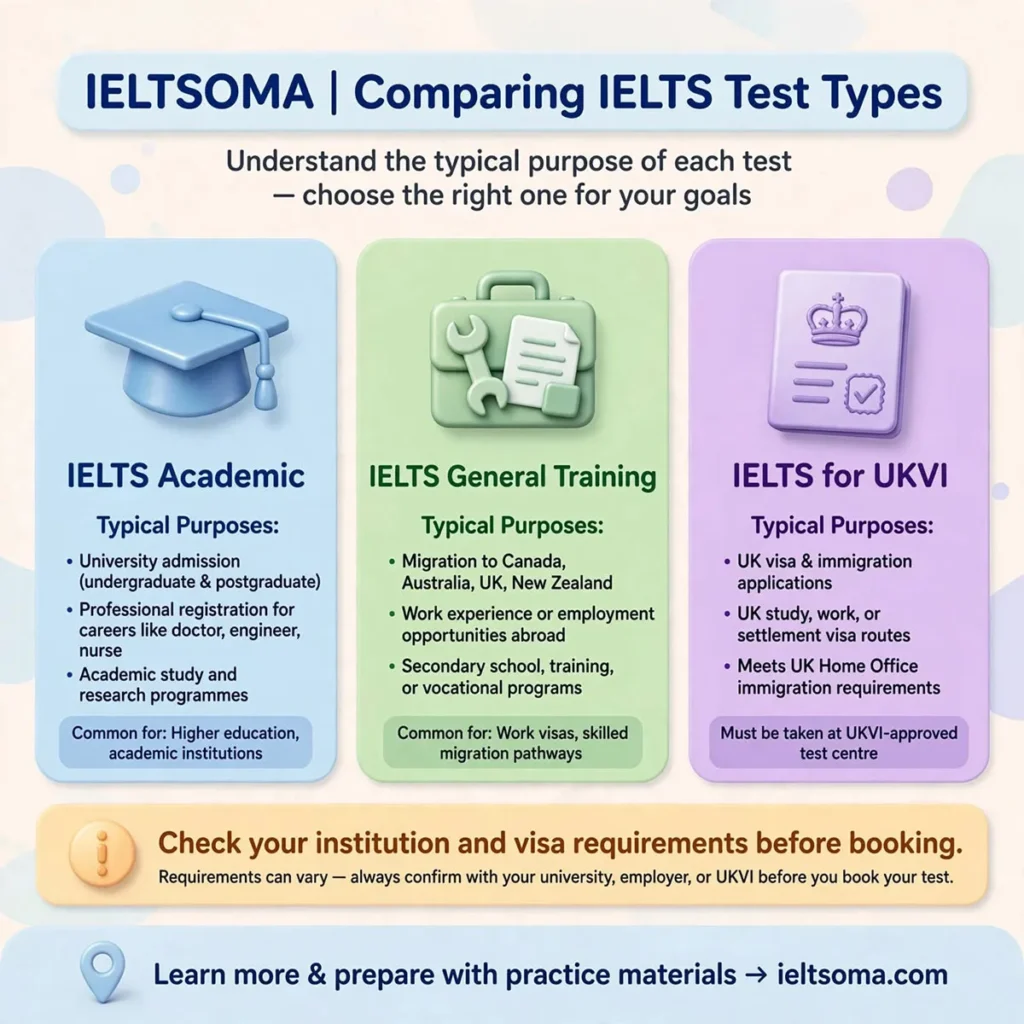
IELTS Academic
IELTS Academic is generally the appropriate test for students applying to universities and higher-education programmes where English-language proficiency must be demonstrated.
It assesses the language skills needed for academic study, including understanding complex texts, interpreting information, presenting arguments and discussing ideas.
You may need IELTS Academic if you are applying for:
- An undergraduate degree.
- A master’s degree or other postgraduate qualification.
- A doctoral programme.
- Certain foundation or pathway programmes.
- Some professional registration programmes.
However, do not assume that every foundation course or university pathway accepts the standard Academic test. Some programmes have specific testing requirements.
IELTS General Training
IELTS General Training focuses more on everyday English, workplace communication and social contexts. It is commonly used for certain migration, employment-related and below-degree study purposes.
For most conventional university degree applications, IELTS Academic is the starting point to investigate. General Training should not be selected simply because you expect it to be easier.
Before booking, verify the test type listed by your university or admissions department.
IELTS for UKVI
IELTS for UK Visas and Immigration (UKVI) is relevant to certain UK visa routes and approved English-language testing requirements.
It is not automatically necessary for every international student travelling to the UK. The appropriate test depends on your course, institution, visa route and the applicable rules.
For example, some degree-level applicants attending a licensed student sponsor can meet the relevant English-language requirement through their university’s assessment, subject to the applicable rules. Other applicants may need an approved Secure English Language Test (SELT).
Check the official IELTS test types guide and the applicable UK Student visa guidance before booking.
IELTS test choice at a glance
| Test | Main purpose | What to check |
|---|---|---|
| IELTS Academic | Higher education and academic study | Whether your course accepts it |
| IELTS General Training | Migration, workplace and certain below-degree study purposes | Whether your intended programme explicitly accepts it |
| IELTS for UKVI | Specific UK visa-related English-language requirements | Whether your visa route requires a SELT and which version is approved |
The key distinction is that university admission and immigration are related but separate processes. Satisfying one English-language requirement does not necessarily satisfy the other.
3. What IELTS Score Do You Need for Studying Abroad?
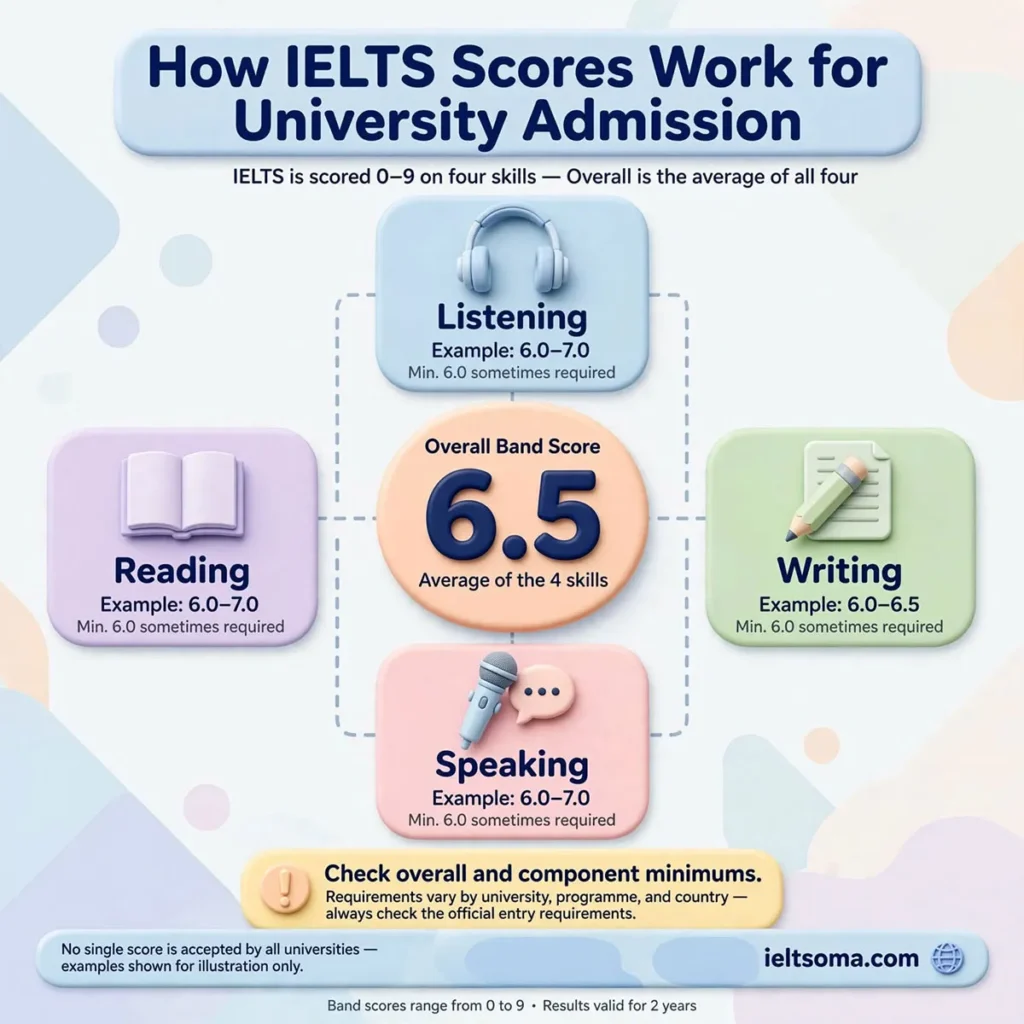
There is no single IELTS score that guarantees admission to every university abroad. Your required result depends on the institution, degree level, subject, programme and sometimes the individual skill scores.
When researching IELTS for study abroad, distinguish between three requirements:
- Overall band score: the combined result reported on your Test Report Form.
- Minimum component scores: the lowest permitted score in Listening, Reading, Writing and Speaking.
- Additional conditions: any course-specific, university-specific or visa-related English-language requirements.
Typical IELTS score ranges for study abroad
The following table is a planning guide, not a list of universal admission standards.
| Overall IELTS score | How to interpret it when planning |
|---|---|
| 5.5 | May be considered by selected pathway or preparatory programmes, subject to their individual requirements. |
| 6.0 | May meet the English-language requirement for some programmes, but restrictions on individual skills can apply. |
| 6.5 | A useful initial research target for many prospective degree applicants, although it will not meet every course requirement. |
| 7.0 | May be required for programmes with higher English-language expectations. |
| 7.5 or above | May be specified by particular programmes or institutions with demanding language requirements. |
These ranges are illustrative. They do not establish admission eligibility, and you should not choose a test target solely from this table.
IELTS itself advises institutions to set entry scores according to their own programs and requirements. You can read the official IELTS guidance on entry scores for further context.
Overall score versus individual band scores
Suppose a university specifies these requirements:
- Overall IELTS: 6.5.
- Listening: 6.0 minimum.
- Reading: 6.0 minimum.
- Writing: 6.0 minimum.
- Speaking: 6.0 minimum.
A candidate could achieve an overall score that appears sufficient but still fail to meet the requirement if one component falls below the specified minimum.
Consider this illustrative profile:
| Skill | Candidate’s score |
|---|---|
| Listening | 7.0 |
| Reading | 7.0 |
| Writing | 5.5 |
| Speaking | 6.5 |
The average of these four scores is 6.5. Under IELTS rounding conventions, this produces an overall band of 6.5. However, if the university requires at least 6.0 in every component, the candidate would not meet the stated Writing requirement.
This is why you should always check both the overall score and the minimum component scores.
How to find the exact score for your course
Follow these steps before starting your preparation:
- Visit the official website of your intended university.
- Find the English-language requirements for your specific course.
- Check the overall IELTS band required.
- Record the minimum score for each component.
- Check whether different requirements apply to undergraduate and postgraduate applicants.
- Confirm whether the university accepts your intended IELTS test format.
- Check whether the requirement differs for conditional offers, pathway courses or particular visa routes.
Do not rely exclusively on university rankings, education agents, social media posts or requirements published for previous admission cycles. The current course page and admissions office are the appropriate sources for confirmation.
4. IELTS Requirements for International Students by Destination
IELTS requirements for international students vary by destination and institution. A country may have different rules for university admission, immigration, professional registration and preparatory courses.
The following overview explains what to investigate rather than prescribing a universal band score for an entire country.
United Kingdom
UK universities set English-language requirements according to their courses and admissions policies. Some programmes accept IELTS Academic, while particular visa routes or course arrangements may require a specific approved test.
Before applying, confirm:
- Your course’s overall and component band requirements.
- Whether your institution can assess your English proficiency for the relevant purpose.
- Whether your visa route requires an approved SELT.
- Whether the test must be taken at a specified test centre or through an approved delivery method.
Official starting point: UK Student visa guidance .
Australia
Australian universities and higher-education providers publish their own English-language entry requirements. The score may differ according to the course, institution and qualification.
Check the English-language requirements for your exact programme, and separately verify any applicable student visa requirements through the official Australian immigration website.
Official starting point: Australian Department of Home Affairs .
Canada
Canadian universities and colleges determine their own language requirements. A university may have one general admission standard and higher requirements for particular programmes, such as those involving extensive academic writing or communication.
Confirm whether your intended institution accepts IELTS Academic and whether it specifies minimum component scores.
If your application involves immigration or another regulated process, check the relevant official Canadian government requirements separately.
Official starting point: Government of Canada .
United States
US universities, colleges and graduate schools establish their own English-proficiency policies. Some accept IELTS, while accepted tests, minimum scores and exemption rules vary between institutions and programmes.
Review the international admissions page for your intended university rather than assuming that one score applies throughout the country.
Official starting point: EducationUSA .
Other international destinations
IELTS may also be accepted by institutions in Ireland, New Zealand and countries where degree programmes are taught in English.
For any destination, verify the following before booking:
- Whether IELTS is accepted by your institution.
- Which IELTS test type is required.
- The minimum overall and component scores.
- Whether the result meets any relevant visa requirement.
- The deadline by which you must submit an acceptable result.
The destination matters, but the exact institution and course are usually the most useful starting points for determining your admission score.
5. How to Prepare for IELTS for Study Abroad
A useful preparation plan begins with your current ability and your target score. Studying for a fixed number of weeks without assessing your weaknesses can waste valuable time.
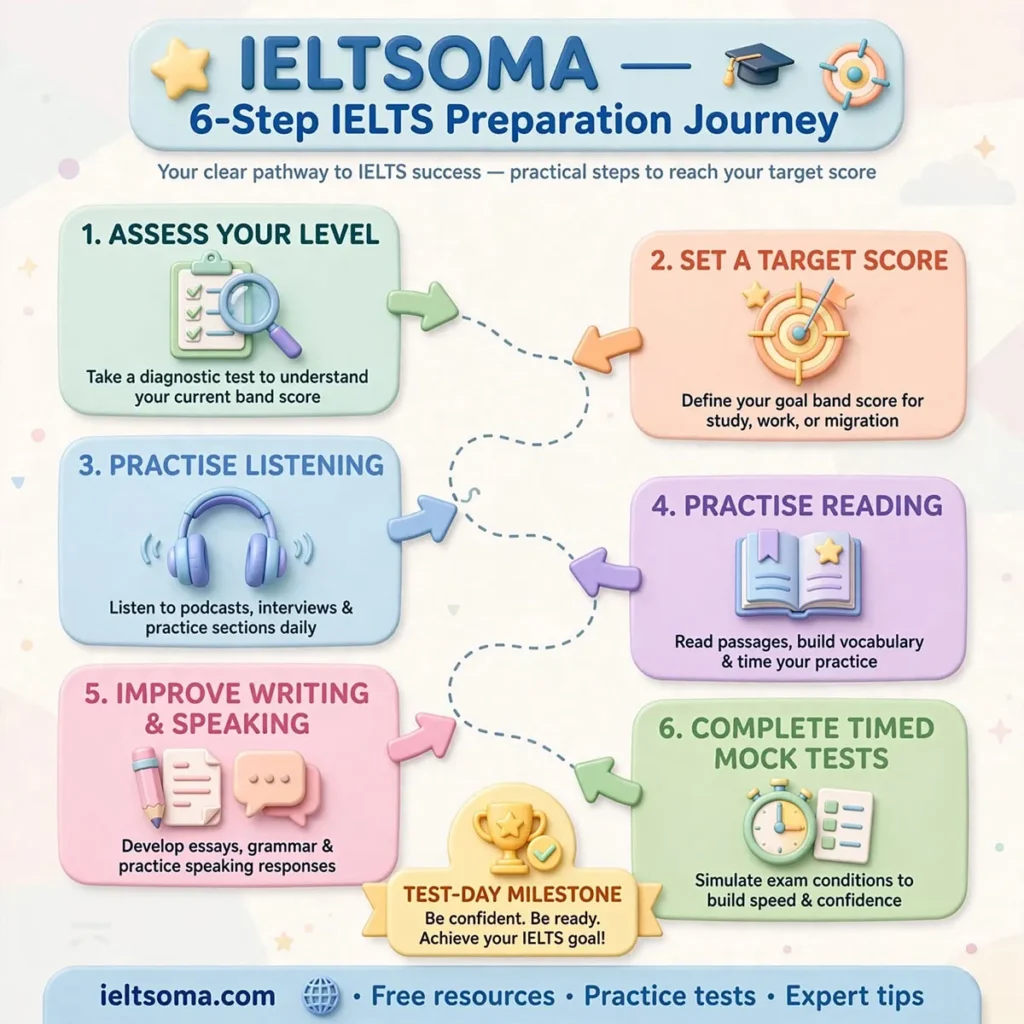
Step 1: Set a realistic target
Write down the requirements for your intended course.
For example:
- Required overall score: 6.5.
- Minimum Writing score: 6.0.
- Minimum score in other components: 6.0.
This target gives your preparation a clear purpose. If your current Writing score is 5.0, you may need to devote more time to task response, organisation, grammar and vocabulary than to Listening.
Step 2: Complete a diagnostic practice test
Take a realistic practice test before beginning intensive preparation.
Record your estimated performance in all four skills. For Writing and Speaking, use appropriate assessment criteria or obtain feedback from a qualified teacher where possible. Self-assessment alone may not identify recurring weaknesses accurately.
Your diagnostic results should help you answer three questions:
- Which skill is furthest from the required score?
- Which mistakes occur repeatedly?
- How much time can you realistically dedicate to preparation each week?
Use these answers to build your study schedule.
Step 3: Improve IELTS Listening
Listening requires you to follow spoken information, recognise paraphrases and identify details while the recording continues.
Practise by:
- Reading questions before the recording begins.
- Predicting the type of answer required, such as a date, name or number.
- Listening for synonyms rather than expecting the exact words in the question.
- Practising different English accents.
- Reviewing incorrect answers and identifying why you missed them.
- Following spelling, word-limit and grammatical instructions carefully.
For example, if a question asks for the cost of a course, the recording might say, “The fee comes to £240.” You need to recognise that fee expresses the same idea as cost.
After each practice session, revisit difficult sections and listen again with the transcript where available.
Step 4: Build IELTS Reading skills
Academic study involves reading articles, textbooks, research and other complex material. IELTS Reading tests several skills that are useful for handling such texts.
Develop your ability to:
- Skim a passage to identify its main ideas.
- Scan for dates, names, figures and specific details.
- Recognise synonyms and paraphrases.
- Identify the writer’s opinion and purpose.
- Distinguish between information stated in the text and information that merely seems plausible.
- Manage the time available for each passage.
Avoid reading every sentence at the same speed. Instead, choose a strategy that suits the question type.
For example, Matching Headings questions require you to understand the main idea of a paragraph. Searching for one familiar keyword is rarely sufficient because several headings may contain similar vocabulary.
Step 5: Strengthen IELTS Writing
Writing can require particular attention because a candidate may communicate ideas well but still lose marks through weak organisation, limited development or inaccurate grammar.
For Academic Writing, practise both tasks:
- Task 1: describing and comparing visual information, such as charts, tables, graphs, maps or processes.
- Task 2: presenting and developing a response to an essay question.
Focus on task achievement or task response, coherence and cohesion, lexical resource, and grammatical range and accuracy.
For instance, an essay introduction should establish your position when the question requires one. The body paragraphs should then explain and support your ideas rather than simply listing opinions.
Do not memorise entire essays to reproduce them in the test. Learn flexible structures, practise responding to unfamiliar questions and use feedback to identify recurring problems.
Step 6: Practise IELTS Speaking
Your speaking score reflects more than the number of advanced words you use. Fluency, coherence, vocabulary, grammar and pronunciation all matter.
Build a routine that includes:
- Answering Part 1 questions in complete but natural responses.
- Practising one-minute preparation for Part 2 cue cards.
- Speaking for up to two minutes on a topic without memorising a script.
- Developing reasons, examples and comparisons for Part 3 discussions.
- Recording yourself and reviewing hesitation, repetition and pronunciation.
- Practising with a partner or teacher who can give specific feedback.
For example, when discussing the benefits of studying abroad, you could explain how exposure to different teaching methods might develop independence, then give a realistic example.
Aim to communicate ideas clearly and naturally rather than forcing complicated vocabulary into every answer.
Step 7: Take timed mock tests
As test day approaches, complete full practice tests under realistic conditions.
Use them to assess:
- Whether you can finish each section within the time limit.
- Whether your accuracy drops towards the end.
- Whether you can maintain concentration.
- Whether your Writing responses meet the task requirements.
- Whether your Speaking answers remain coherent under pressure.
Review each test carefully. Completing more tests without analysing your mistakes can reinforce the same weaknesses.
6. How Long Should You Prepare for IELTS?
There is no preparation period that suits every candidate. The time you need depends on your current English proficiency, target band, study routine and familiarity with the test.
Use the following as a flexible planning framework rather than a guaranteed timetable.
| Preparation stage | Main objective |
|---|---|
| Initial assessment | Identify your current level and weak skills. |
| Foundation building | Improve grammar, vocabulary, comprehension and fluency. |
| IELTS-specific practice | Learn question types, task requirements and time-management techniques. |
| Timed practice | Complete sections and full mock tests under realistic conditions. |
| Final review | Address recurring mistakes and confirm test-day arrangements. |
If your current scores are close to your target, focused practice may be sufficient. If you have substantial gaps in grammar, vocabulary or comprehension, you may need a longer period of general English development alongside IELTS preparation.
A practical weekly routine could include Listening and Reading practice on alternate days, several Writing tasks with feedback, and short Speaking sessions throughout the week.
Consistency matters more than completing a large amount of practice in a single sitting.
7. Common Mistakes to Avoid When Applying to Study Abroad
Even a candidate with strong English skills can encounter avoidable problems when preparing an international university application.
Booking the wrong IELTS test
Do not automatically book IELTS Academic or IELTS General Training without confirming the requirements of your intended institution and, where applicable, immigration authority.
Better approach: Verify the accepted test type before paying the test fee.
Targeting only the overall band score
A satisfactory overall score may not compensate for a component score below the university’s minimum.
Better approach: Keep the overall and individual band requirements visible throughout your preparation.
Assuming every university in a country has identical requirements
Admission policies vary by institution and course. Requirements for a general undergraduate programme may differ from those for a postgraduate degree or a professionally regulated course.
Better approach: Check the precise course page and contact admissions if the published information is unclear.
Taking the test too close to the application deadline
You need time to receive your result, arrange any required retest and submit your application documents. Processing arrangements and result availability can vary by test format and location.
Better approach: Work backwards from your university’s deadline and allow a reasonable buffer.
Ignoring Writing and Speaking feedback
These skills involve several assessment criteria. Repeating practice tasks without understanding why marks are being lost may produce little improvement.
Better approach: Obtain targeted feedback, identify patterns and rewrite or repeat tasks using that feedback.
Relying on memorised answers
Memorised Speaking responses can sound unnatural or fail to address the question. Memorised Writing material may also be irrelevant to the task.
Better approach: Learn useful structures and practise developing original answers in response to different questions.
Assuming an IELTS result guarantees admission
IELTS demonstrates English-language proficiency; it does not replace academic qualifications, application documents, financial requirements or other conditions.
Better approach: Treat IELTS as one part of your complete study-abroad application.
8. IELTS Test Results, Validity and Application Timing
When planning IELTS for study abroad, consider not only the score you need but also when you will take the test and how the result will be used.
IELTS results are commonly treated as valid for two years by recognising organisations, but the accepting institution or relevant authority determines its own rules for the evidence it accepts. Do not assume that every university, scholarship provider or immigration authority applies identical validity rules.
If you already have an IELTS result, check whether it will be accepted for your intended intake and application date.
You should also confirm:
- When the university needs your result.
- How you must submit or share your score.
- Whether the institution requires verification through an official results service.
- Whether a retest is necessary if your score is insufficient.
- Whether your chosen test format is accepted for your specific purpose.
For current test formats and preparation resources, start with the official IELTS website .
9. Your Study-Abroad IELTS Checklist
Use this checklist before booking your test and submitting your university application.
Application readiness
[ ] Choose your preferred country and shortlist universities.
[ ] Identify the exact course and intended intake.
[ ] Confirm that the institution accepts IELTS.
[ ] Verify whether IELTS Academic, General Training or a specific approved test is required.
[ ] Record the overall band and minimum component scores.
[ ] Check the relevant visa-related English-language requirements separately.
[ ] Take a diagnostic test and identify weak skills.
[ ] Create a realistic preparation timetable.
[ ] Practise all four skills and review your mistakes.
[ ] Complete timed mock tests before the exam.
[ ] Book your test early enough to allow for results and a possible retest.
[ ] Check result submission instructions and application deadlines.
10. Frequently Asked Questions About IELTS for Study Abroad
Is IELTS compulsory for studying abroad?
No, not in every case. Some universities accept alternative English-language tests or evidence of prior education in English, while others require IELTS or specify particular conditions for exemptions. Check the admissions policy of your intended institution.
What is the IELTS score for studying abroad?
There is no universal score. Some programs may accept an overall band of 6.0, while others require 6.5, 7.0 or higher. Minimum component scores can also apply. Your intended course’s published requirements should determine your target.
Is IELTS Academic better than IELTS General Training for international students?
Neither test is universally better. IELTS Academic is generally the relevant choice for higher-education admission, whereas General Training serves different purposes, including migration and certain below-degree study routes. Choose the version your institution requires.
Can I study abroad with IELTS 5.5?
Possibly, depending on the institution, program and any pathway or preparatory arrangements available. A score of 5.5 should not be assumed to satisfy direct admission requirements for a particular degree. Check both the overall and individual band requirements.
Is IELTS 6.5 enough for a master’s degree abroad?
It may be sufficient for some master’s programes, but others require a higher score or minimum results in specific components. Always consult the English-language requirements for the exact postgraduate course.
Do all four IELTS components need the same score?
No. Universities can set an overall band requirement and separate minimum scores for Listening, Reading, Writing and Speaking. You must satisfy the precise combination specified by your institution.
Can I use one IELTS result to apply to several universities?
Often, yes, provided each institution accepts the test type, result and score you achieved and the result meets its requirements. Check each university’s submission process and any applicable result-validity rules.
How should I prepare for IELTS for study abroad?
Start by confirming your target score and completing a diagnostic test. Then practise Listening, Reading, Writing and Speaking, focus on your weakest skills, review mistakes and complete timed mock tests. Obtain feedback on Writing and Speaking where possible.
Should I take IELTS before applying to a university?
That depends on the institution’s admissions process. Some applicants must provide evidence of English proficiency with their application, while others may receive a conditional offer and submit the result later. Check the deadlines and conditions for your intended intake before deciding when to test.
Final Thoughts
Preparing for IELTS for study abroad begins with a clear understanding of your academic destination and its requirements. Once you know the accepted test, overall band and component minimums, you can build a preparation plan around a specific and achievable target.
Do not choose a score simply because it is commonly recommended, and do not book a test until you have checked which version you need. Use official university and government information to confirm admission and visa requirements, then focus your preparation on the skills that need the most improvement.
With careful planning, consistent practice and a clear understanding of the application process, you can approach IELTS with greater confidence and take a more organised step towards your international education goals.
Useful Links: