Scoring Band 7 in IELTS is a significant achievement. It shows that you can communicate effectively in English, understand complex ideas and handle most test situations confidently. Yet, moving from Band 7 to Band 8 can feel surprisingly difficult.
You may complete practice tests regularly, know a wide range of vocabulary and understand the exam format, but your score remains the same. Why?
The answer is often not that you need to learn dramatically more English. Instead, you need to identify the small but recurring weaknesses that prevent your performance from reaching a higher level.
Improving your IELTS Band 7 to 8 performance requires greater accuracy, more precise language, stronger control of ideas and fewer avoidable mistakes. The exact changes depend on whether your weakest area is Listening, Reading, Writing or Speaking.
This guide explains how to improve IELTS from Band 7 to 8 with practical techniques, skill-specific strategies, a structured study plan and methods for measuring progress.
Table of Contents
1. Understand the Real Difference Between IELTS Band 7 and 8
The first step is to understand what your current score tells you.
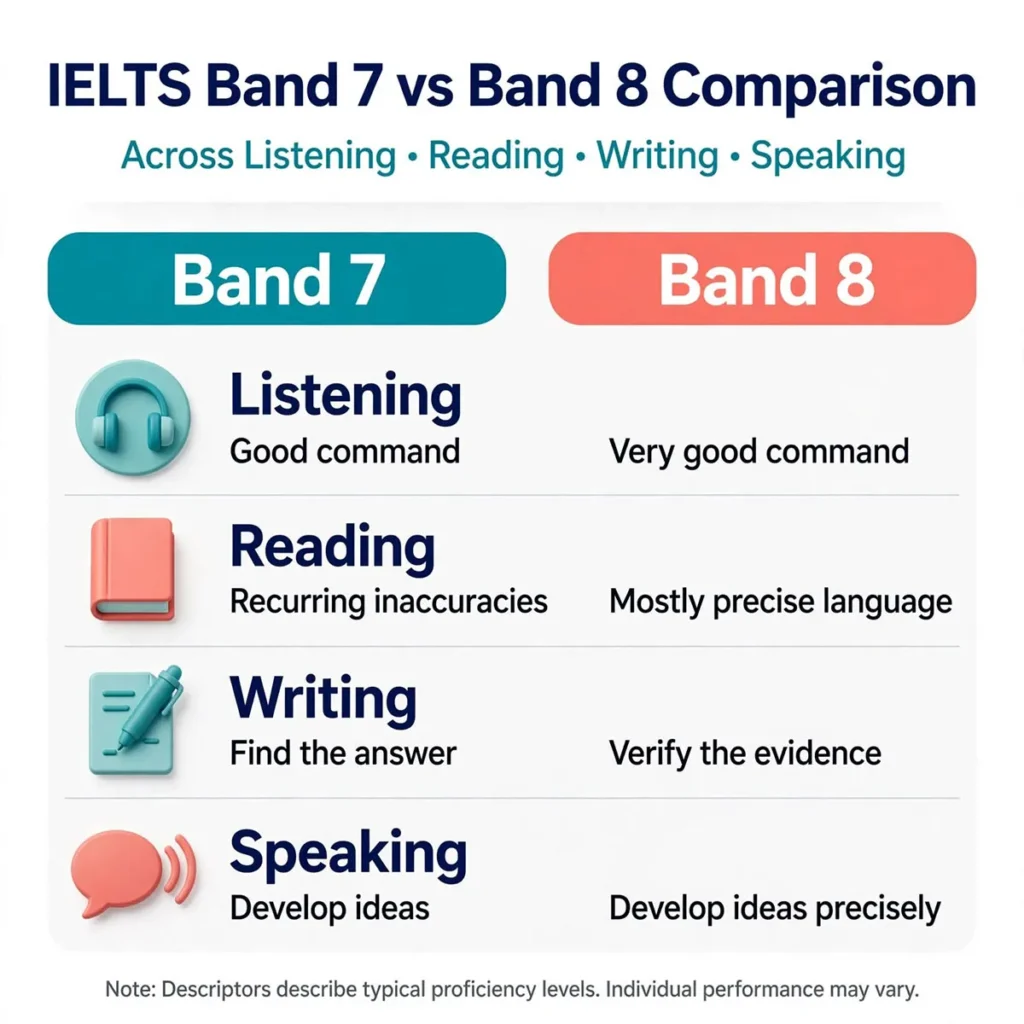
According to the official IELTS scoring descriptions, Band 7 represents a good command of English, while Band 8 represents a very good command. Band 8 candidates generally handle complex language and detailed reasoning well, with only occasional unsystematic inaccuracies or inappropriate usage.
The difference is not simply about using more advanced vocabulary or writing longer answers. It is about performing more consistently and accurately across different tasks.
| Area | Typical Band 7 challenge | What to aim for at Band 8 |
|---|---|---|
| Listening | Missing occasional details, distractors or paraphrases | Recognising key information accurately, including subtle changes in meaning |
| Reading | Losing marks through misinterpretation, timing or careless errors | Locating evidence precisely and distinguishing subtle differences in meaning |
| Writing | Ideas are relevant but may be insufficiently developed or contain recurring language errors | Clear, fully developed arguments with precise vocabulary and strong grammatical control |
| Speaking | Generally fluent but with occasional awkward phrasing, hesitation or imprecise word choice | Natural, coherent communication with flexible vocabulary and mostly accurate grammar |
These are practical training targets, not guaranteed descriptions of every candidate at either band. Your actual strengths and weaknesses must be assessed against the official criteria.
Why Band 7 candidates often stop improving
Several habits can keep a capable candidate at Band 7.
- Repeating familiar practice: Completing test after test without analysing mistakes.
- Ignoring small errors: Treating a few lost marks as unimportant instead of identifying their causes.
- Memorising vocabulary: Learning sophisticated words without mastering their meaning, collocations or grammatical patterns.
- Practising strengths disproportionately: Spending more time on Listening or Reading because those sections feel easier.
- Avoiding detailed feedback: Assuming that an answer is good because it sounds fluent or looks well organised.
The solution is to replace general practice with deliberate practice. Every session should target a weakness, test a specific improvement and produce evidence of progress.
2. Diagnose Your Weaknesses Before Changing Your Study Routine
Before deciding how to improve IELTS from Band 7 to 8, establish why your score is not increasing.
Start with a timed practice test under realistic conditions. Complete all four sections if possible, and record your results separately. For Writing and Speaking, obtain feedback that uses the official assessment criteria rather than relying only on your own judgement.
Then review your performance.
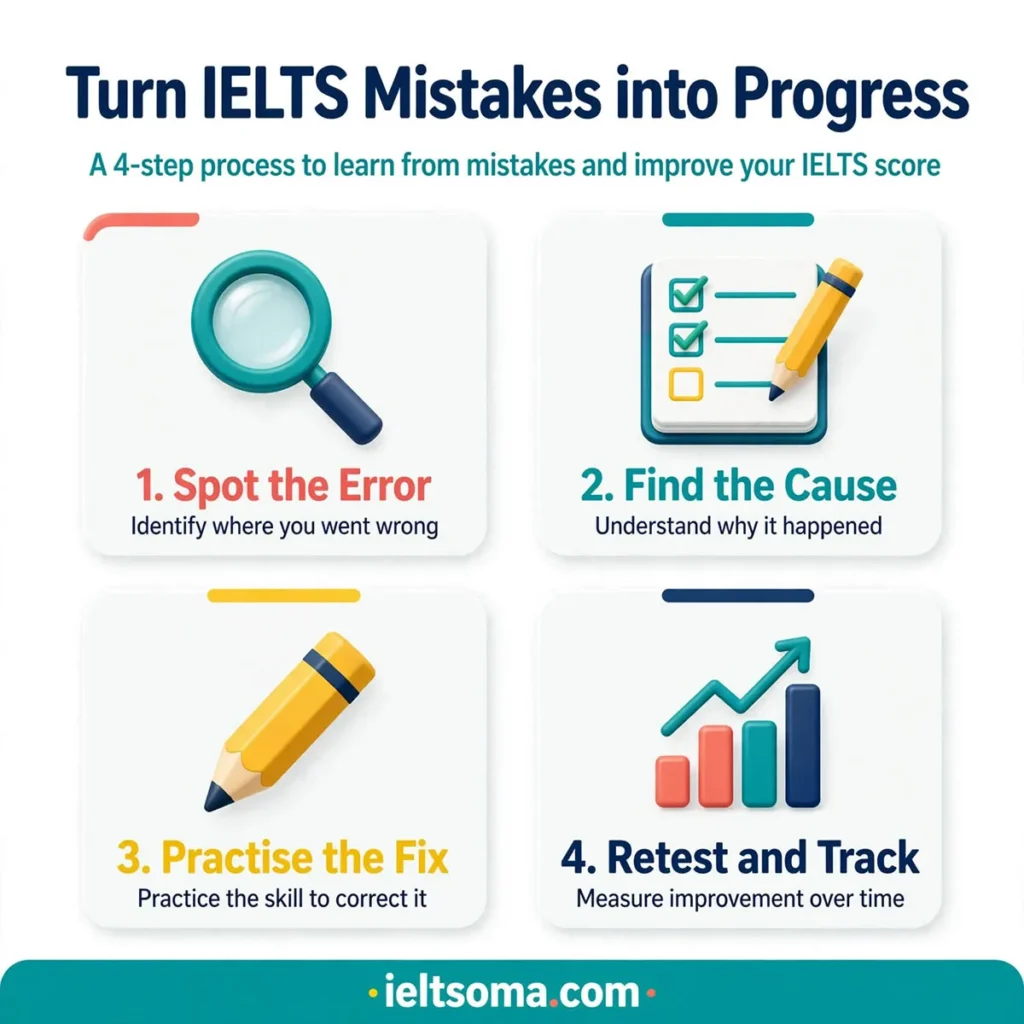
Create a personal error log
An error log records not just what went wrong, but why it happened and how you will prevent it from happening again.
| Skill | Error | Likely cause | Corrective action |
|---|---|---|---|
| Listening | Missed a changed appointment time | Followed the first answer instead of the correction | Practise distractors and changes of plan |
| Reading | Selected False instead of Not Given | Assumed information that the passage did not confirm | Require explicit textual evidence |
| Writing | Essay body paragraph lacked development | Gave an opinion without explaining its consequences | Practise explanation and supporting examples |
| Speaking | Repeated the same general adjectives | Limited control of topic-specific vocabulary | Learn and use natural collocations in context |
After every practice session, classify your errors into categories such as vocabulary, grammar, comprehension, task understanding, time management, spelling or concentration.
Look for patterns across several attempts. One mistake may be accidental; the same mistake appearing repeatedly is a training priority.
Identify the weakness with the greatest impact
Suppose your Listening and Reading performance is already strong, but Writing remains weaker. Spending most of your study time on additional listening tests may improve confidence without significantly improving your overall result.
Instead, allocate more time to the skill that limits your target score.
Expert tip: Do not measure progress by the number of practice questions completed. Measure it by the number of recurring errors you have eliminated.
3. Improve IELTS Listening from Band 7 to 8
At this level, the challenge is often not understanding the general conversation. It is capturing exact information while processing the next part of the recording.
A candidate may understand a discussion about a university course but miss the final date after a speaker corrects an earlier suggestion. Another may identify the right idea but write an incorrect spelling or word form.
Train yourself to recognise distractors
IELTS Listening recordings often include information that changes, qualifies or contradicts an initial statement. You must follow the speaker’s final meaning rather than select the first familiar word.
Consider this example:
“We originally planned to meet on Thursday, but the room isn’t available then. Let’s make it Friday morning instead.”
If the question asks when the meeting will take place, Thursday is a distractor. Friday morning is the final arrangement.
To improve:
- Predict the type of information required before listening, such as a date, place, number or noun.
- Listen for corrections and contrast signals, including but, actually, instead and rather than.
- Practise identifying paraphrases rather than waiting for the exact words in the question.
- Review the transcript after each exercise and locate the precise sentence containing the answer.
- Record whether each lost mark resulted from misunderstanding, distraction, spelling or a failure to follow instructions.
Use a more analytical review method
Do not listen to the same recording repeatedly without a purpose.
After completing the questions, check the answers and listen again to the sections you missed. Compare what you heard with the transcript. Identify the word, phrase or pronunciation feature that caused the problem.
For example, if you repeatedly miss connected speech, practise short sections and notice how words blend together. If you lose your place when speakers provide several details, practise following the recording while keeping track of question numbers.
Aim for accuracy first, then consistency under timed conditions.
Track your raw score
IELTS Listening contains 40 questions, with one mark for each correct answer. Around 35 correct answers is a commonly cited benchmark for Band 8, although exact conversion can vary between test versions.
Use this as a guide rather than a guarantee. Your goal should be to achieve a consistently strong result across several different practice tests, not to rely on one unusually easy recording.
4. Improve IELTS Reading from Band 7 to 8
Moving from Band 7 to 8 in Reading requires more than faster reading. You need to locate relevant evidence efficiently and interpret it without adding assumptions.
The most useful change is to stop treating questions as vocabulary-matching exercises.
Focus on meaning, not identical words
IELTS Reading questions frequently paraphrase information from the passage. The question may use one expression while the text communicates the same idea using different vocabulary or sentence structure.
For example:
Question: The company reduced the number of employees working at its regional offices.
Passage: Following a decline in revenue, the organisation streamlined its regional workforce.
The wording differs, but the underlying meaning is similar. Recognising this relationship is more useful than searching only for identical words.
Build a paraphrase notebook containing expressions from real practice passages. Include the original phrase, its equivalent wording and the sentence context.
Eliminate unsupported interpretations
True/False/Not Given and Yes/No/Not Given questions are particularly useful for training precise reading.
- True / Yes: The passage supports the statement.
- False / No: The passage contradicts the statement.
- Not Given: The passage does not provide enough information to establish whether the statement is true.
For example, if a passage states that a library introduced longer opening hours, you cannot conclude that visitor numbers increased unless the text provides that information.
That conclusion may be reasonable in real life, but IELTS Reading tests what the passage supports.
Improve your time management
Use a repeatable process:
- Read the instructions carefully.
- Identify the question type and the information required.
- Scan for names, dates, key terms and likely paraphrases.
- Read the relevant passage section closely.
- Confirm that the evidence supports your answer.
- Move on if a question is consuming too much time, then return to it if possible.
Practise under timed conditions, but do not rush every exercise. Untimed analysis helps you understand why an answer is correct; timed practice tests whether you can apply that understanding efficiently.
For Academic Reading, around 35 correct answers out of 40 is a commonly cited Band 8 benchmark. General Training Reading typically requires more correct answers for the same band. Exact requirements vary by test version.
5. Improve IELTS Writing from Band 7 to 8
Writing is often where candidates need the most targeted feedback because a response can sound impressive while still falling short in one or more assessment criteria.
IELTS Writing is assessed through four criteria:
- Task Achievement for Task 1 or Task Response for Task 2
- Coherence and Cohesion
- Lexical Resource
- Grammatical Range and Accuracy
Each criterion matters. Sophisticated vocabulary cannot compensate fully for an unclear position, weak idea development or frequent grammatical errors.
Change the way you develop ideas
For Task 2, a strong body paragraph should do more than state an opinion and provide a general example. It should explain the reasoning behind the claim.
Consider the topic of public transport.
Less developed example:
“Governments should improve public transport because it is good for the environment. Many people use cars, and this creates pollution.”
The position is understandable, but the reasoning is brief.
More developed example:
“Governments should invest in reliable public transport because it can reduce dependence on private cars. When buses and trains offer convenient routes at affordable prices, commuters have a practical alternative to driving. This can reduce the number of vehicles on busy roads and help limit transport-related emissions.”
The second example develops the causal relationship between public investment, commuter behaviour and environmental benefits. It also uses relevant vocabulary without forcing unnecessarily complex expressions into every sentence.
The lesson is not to make every paragraph longer. It is to make each idea sufficiently clear, relevant and supported.
Improve grammatical accuracy, not just complexity
Candidates sometimes believe that Band 8 requires complicated sentences throughout an essay. In reality, variety and control are more valuable than complexity for its own sake.
Compare:
- Less controlled: “Although public transport is cheaper, but many people still prefer cars.”
- More accurate: “Although public transport is cheaper, many people still prefer cars.”
The first sentence contains an unnecessary conjunction. The second communicates the same contrast correctly.
During editing, check for recurring problems such as:
- Articles and countable or uncountable nouns
- Subject–verb agreement
- Verb tense consistency
- Sentence fragments and run-on sentences
- Commas and other punctuation
- Incorrect prepositions and collocations
Keep a record of your five most frequent grammar errors. Review those patterns before writing your next timed response.
Use vocabulary precisely
Band 8 vocabulary does not mean replacing every ordinary word with an unusual synonym.
For example, mitigate the adverse ramifications may be less effective than reduce the negative effects if the simpler phrase expresses your meaning more naturally.
Build vocabulary around common IELTS themes such as education, technology, health, the environment, employment and urban development. Learn collocations, grammatical patterns and examples rather than isolated words.
For each new expression, ask:
- What does it mean in context?
- Is it formal, neutral or informal?
- Which words naturally occur with it?
- Can I use it accurately in a sentence of my own?
Use feedback systematically
After writing an essay, review it against the four criteria. Ideally, ask a qualified IELTS teacher or experienced assessor to identify the weaknesses that most affect your score.
Rewrite selected paragraphs after receiving feedback. Compare the original and revised versions to understand whether you improved idea development, organisation, vocabulary or accuracy.
For Task 1, practise selecting and grouping the most important information rather than describing every detail. Academic candidates should prioritise clear overviews and meaningful comparisons in reports. General Training candidates should focus on fully addressing the purpose, tone and required points of the letter.
Remember that Writing Task 2 carries more weight than Task 1 in the overall Writing score. Your study plan should reflect that.
6. Improve IELTS Speaking from Band 7 to 8
A Band 7 speaker can generally sustain a conversation and discuss a range of topics. To move closer to Band 8, focus on communicating precisely, developing ideas coherently and using language flexibly.
The aim is not to sound like a different person. It is to make your English more natural and controlled.
Extend answers with relevant detail
In Speaking Part 1, a direct answer followed by a reason or a small example is often enough.
Question: Do you enjoy reading?
Basic answer: “Yes, I enjoy reading because it is relaxing.”
More developed answer: “Yes, especially in the evening. Reading helps me unwind after a busy day, and I usually choose non-fiction books because I enjoy learning about unfamiliar subjects.”
The second response develops the answer naturally without becoming a memorised speech.
For Part 2, organise your one-minute preparation around a few connected points. Develop the topic with specific details and a clear sequence rather than trying to memorise a complete response.
For Part 3, practise explaining opinions, comparing alternatives, considering consequences and acknowledging different perspectives.
Replace vague words with precise expressions
Words such as good, bad, nice and interesting are useful, but repeating them for every topic limits precision.
Instead of saying, “The experience was very good,” you might say, “The experience was rewarding because it gave me an opportunity to work independently.”
Choose vocabulary that communicates the specific meaning you intend. Do not insert idioms or advanced expressions simply to impress the examiner.
Work on fluency, pronunciation and grammatical control
Record yourself answering unfamiliar questions for two or three minutes. Review the recording and note:
- Long pauses caused by searching for vocabulary
- Repeated words and unnecessary fillers
- Grammar errors that occur in longer sentences
- Unclear word stress or sentence rhythm
- Ideas that are difficult to follow
Practise expressing the same idea in different ways. This develops flexibility and helps you paraphrase when you cannot immediately recall a word.
You do not need to eliminate every hesitation or acquire a particular accent. Your priority is clear, natural communication that is easy to understand.
7. Follow a Practical IELTS Band 7 to 8 Study Plan
A useful IELTS Band 7 to 8 study plan should prioritise your weakest areas while maintaining your stronger skills.
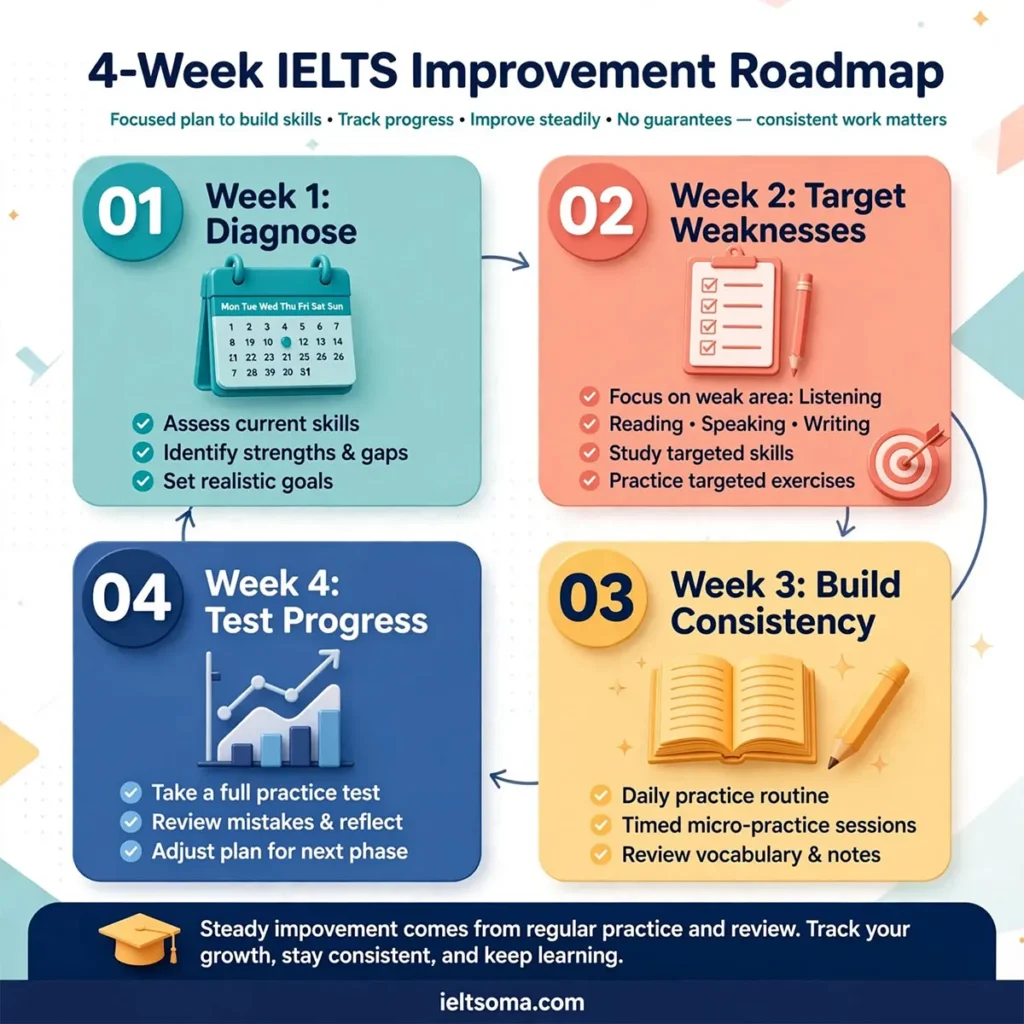
The following four-week framework assumes that you already perform around Band 7 and can study for approximately 90 minutes a day, six days a week. Adjust the duration according to your schedule and the evidence from your practice tests.
| Week | Main objective | What to do |
|---|---|---|
| Week 1 | Diagnose weaknesses | Complete a timed diagnostic test, review all errors and select two priority areas |
| Week 2 | Target recurring problems | Practise specific question types, rewrite essays, review grammar and analyse listening transcripts |
| Week 3 | Improve consistency | Complete timed sections, record speaking answers and seek feedback on productive skills |
| Week 4 | Test progress | Complete realistic mock tests, compare results with Week 1 and revise the remaining weaknesses |
A sample 90-minute daily routine
| Activity | Time |
|---|---|
| Review previous errors and vocabulary | 10 minutes |
| Practise your weakest skill | 35 minutes |
| Practise a second skill | 25 minutes |
| Analyse answers or review feedback | 15 minutes |
| Record progress and set the next target | 5 minutes |
Use the schedule flexibly. If Writing is your weakest skill, allocate more time to drafting, feedback and rewriting. If Reading accuracy is the problem, focus on evidence, paraphrasing and question types that repeatedly cause mistakes.
Reserve at least one session each week for a timed assessment or a realistic mock test.
Important: Four weeks is a planning framework, not a promise that you will gain a full band in that period. Progress depends on your current proficiency, the cause of your weaknesses, the quality of your practice and the time available.
8. Avoid These Common Mistakes When Targeting Band 8
The following habits can waste study time even when your English is already strong.
1. Taking endless mock tests without reviewing them
A test reveals your weaknesses; analysing it helps you correct them. Review incorrect answers and investigate why you selected them.
2. Learning long lists of advanced words
Memorised vocabulary is of limited value if you cannot use it naturally. Learn fewer expressions in greater depth.
3. Overcomplicating your Writing
Long sentences and rare words do not automatically improve your score. Prioritise clear reasoning, precise vocabulary and grammatical control.
4. Memorising complete Speaking answers
Prepared language may sound unnatural when the question changes. Practise flexible ideas and useful expressions instead of scripted speeches.
5. Ignoring your strongest skills completely
You still need to maintain Listening, Reading, Writing and Speaking. A balanced result requires continued practice across all four sections.
6. Treating one practice score as proof of readiness
Performance can vary between tests. Look for consistent results and, for Writing and Speaking, reliable feedback against the official assessment criteria.
9. Measure Progress and Know When to Book Your Test
Progress towards Band 8 should be demonstrated through evidence, not confidence alone.
Maintain a weekly record of your practice results. Include Listening and Reading raw scores, Writing feedback by criterion, Speaking observations and the recurring errors you have corrected.
A useful progress tracker might look like this:
| Measure | Week 1 | Week 2 | Week 3 | Week 4 |
|---|---|---|---|---|
| Listening score / 40 | Record | Record | Record | Record |
| Reading score / 40 | Record | Record | Record | Record |
| Writing priorities | Identify | Review | Reassess | Reassess |
| Speaking priorities | Identify | Review | Reassess | Reassess |
| Repeated errors | List | Reduce | Check | Check |
Do not rely exclusively on the table’s raw numbers. Review whether your errors are becoming less frequent and whether you can maintain accuracy under time pressure.
Before booking your test, consider whether your practice results consistently meet your target, your productive skills have been assessed realistically and you can complete the test without major time-management problems.
If you need an overall Band 8 rather than Band 8 in every section, check how your individual scores contribute to the overall result. IELTS calculates the overall band from the average of the four component scores, rounded to the nearest half or whole band according to its scoring rules. An overall Band 8 does not necessarily mean you scored Band 8 in all four skills.
Always confirm the minimum individual skill scores required by your university, employer or immigration authority. A high overall score may not meet a requirement for a specific component.
Frequently Asked Questions
1. How long does it take to improve IELTS from Band 7 to 8?
There is no fixed timeframe. Some candidates improve after several weeks of targeted practice, while others need months of additional language development. Your timeline depends on the weaknesses holding you back, the quality of your feedback and the consistency of your practice.
2. Is IELTS Band 8 much harder than Band 7?
Band 8 requires a stronger and more consistent performance, particularly in accuracy, flexibility and handling complex language. The challenge is often correcting small recurring weaknesses rather than learning an entirely new set of test techniques.
3. What is the best strategy for IELTS Band 7 to 8 in Writing?
Start by identifying which assessment criterion is limiting your score. Practise developing relevant ideas, organising arguments logically, using vocabulary precisely and correcting recurring grammatical errors. Obtain feedback and rewrite your work instead of simply completing more essays.
4. How many correct answers do I need for Band 8 in Listening and Reading?
Around 35 out of 40 is a commonly cited Band 8 benchmark for Listening and Academic Reading. General Training Reading usually requires more correct answers for the same band. Exact conversions can vary, so consult official IELTS scoring guidance.
5. Should I use advanced vocabulary to get Band 8 in Speaking?
Use a wide range of vocabulary flexibly and accurately, but do not force uncommon words or idioms into your answers. Precise, natural expressions that communicate your meaning clearly are more useful than impressive-sounding language used incorrectly.
6. Can I achieve an overall Band 8 without Band 8 in every skill?
Yes. The overall score is calculated from the average of Listening, Reading, Writing and Speaking, then rounded according to IELTS scoring rules. However, individual institutions may require minimum scores in specific skills, so check their requirements.
7. Should I take a mock test every day?
Not necessarily. Frequent testing without detailed review can reinforce the same mistakes. Combine timed practice with focused exercises, error analysis, feedback and revision. Take full mock tests when they provide useful evidence of your readiness.
8. What should I do first if my IELTS score has been stuck at Band 7?
Complete a realistic diagnostic assessment and identify your two most significant weaknesses. Review your mistakes, create an error log and devote the next two weeks to targeted practice before reassessing your performance.
Final Thoughts: Make Every Practice Session Count
Moving from IELTS Band 7 to 8 is not about studying harder without a clear direction. It is about understanding exactly what prevents you from performing at a higher level and addressing those weaknesses systematically.
Analyse your mistakes, practise with a specific purpose, seek reliable feedback and track your progress across all four skills. Replace vague goals such as “improve my English” with measurable targets such as reducing careless Reading errors, developing stronger essay arguments or using more precise language in Speaking.
Most importantly, do not confuse complicated English with effective English. Clear reasoning, accurate language, relevant answers and consistent performance are the foundations of a stronger IELTS result.
Your next step: Complete a diagnostic test, identify your two weakest areas and build your study schedule around them. When your practice results demonstrate consistent progress, you will have a much clearer basis for deciding whether you are ready to aim for Band 8.
Further Reading: