What if the reason you keep forgetting IELTS vocabulary is not that your memory is weak—but that you are learning words in the wrong way?
Many IELTS candidates spend hours memorizing long vocabulary lists. They underline difficult words, copy definitions into notebooks, and repeatedly read the same lists. Yet when the examiner asks a question, they suddenly cannot remember the right word. Even worse, they may remember the word but use it incorrectly.
This is where IELTS Vocabulary Contextual Learning can make a major difference.
Instead of learning a word as an isolated definition, you learn how it works inside a sentence, topic, phrase, collocation, or real-life situation. You learn what normally comes before and after it, which grammar patterns it follows, what words it commonly combines with, and when it sounds natural.
For IELTS Academic and General Training candidates, this approach is particularly useful because vocabulary is not simply about knowing difficult words. IELTS assesses how effectively you use language to communicate meaning. Official IELTS assessment criteria for Writing and Speaking include lexical resource, which considers the range, accuracy, and appropriateness of vocabulary.
In this guide, you will learn seven practical IELTS Vocabulary Contextual Learning strategies that can help you turn passive vocabulary into words you can actually recognize, remember, and use.
Table of Contents
Why IELTS Vocabulary Contextual Learning Matters
Vocabulary is not a collection of separate words. It is a network.
When you learn the word significant, for example, knowing that it means “important” is only the beginning.
You also need to understand expressions such as:
- a significant increase
- a significant decline
- a significant difference
- significant changes
- statistically significant results
- a significant impact on society
This is why IELTS Vocabulary Contextual Learning is more useful than simply memorizing “significant = important.”
Context gives a word a purpose.
Consider this sentence:
The government introduced significant changes to the public transport system.
You can learn several things at once:
- significant describes the importance or scale of the changes.
- significant changes is a natural word combination.
- introduced changes is another useful combination.
- public transport system gives the sentence a clear topic.
- The sentence could be relevant to an IELTS Writing Task 2 discussion about transport.
This creates stronger connections in your memory.
IELTS Speaking and Writing require you to communicate ideas, not simply demonstrate that you have memorized difficult vocabulary. Contextual learning therefore helps you move from “I know this word” to “I know how to use this word.”
What Is IELTS Vocabulary Contextual Learning?
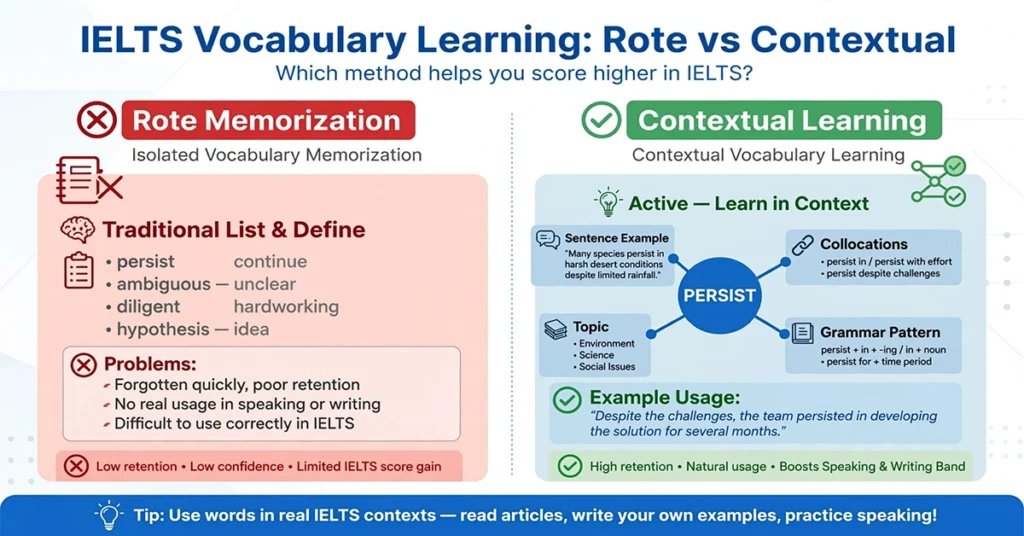
IELTS Vocabulary Contextual Learning means learning IELTS vocabulary through meaningful contexts instead of studying words as isolated definitions.
A context can be:
- a complete sentence
- a paragraph
- a conversation
- an IELTS reading passage
- a speaking answer
- a writing paragraph
- a common collocation
- a topic
- a real-world situation
- a word family
- a question-and-answer exchange
For example, instead of recording:
Allocate = distribute
you could record:
Governments should allocate more funding to public healthcare.
Now the word is connected to a subject, grammatical structure, and useful IELTS-style idea.
You can then build related examples:
Universities should allocate more resources to research facilities.
Families may allocate a larger proportion of their income to housing.
This is the central idea behind IELTS Vocabulary Contextual Learning: the word becomes part of a usable language pattern.
Why Memorizing Long IELTS Word Lists Often Fails
Vocabulary lists are not automatically bad.
The problem is relying on them as your main learning method.
Suppose you memorize 100 words in one week. You may recognize many of them immediately after studying. However, recognition does not always mean active knowledge.
There is a major difference between:
“I have seen this word before.”
and:
“I can use this word accurately in an IELTS answer.”
This difference matters.
Imagine that you memorize the word mitigate and its definition: “to make something less severe.”
During your IELTS Speaking test, the examiner asks whether governments should take action against climate change.
You know the word mitigate, but you are unsure whether to say:
Governments should mitigate climate change.
or:
Governments should take measures to mitigate the effects of climate change.
The second sentence provides a clearer and more natural context.
This is why IELTS Vocabulary Contextual Learning focuses on usage rather than recognition alone.
The goal is not to collect hundreds of impressive words.
The goal is to develop a smaller but more useful vocabulary that you can apply accurately.
How Context Changes the Meaning of a Word
English words often have several meanings.
The surrounding words tell you which meaning is intended.
Consider the word address.
You might say:
Please write your home address on the form.
Here, address is a location.
But you could also say:
The government must address the problem of unemployment.
Here, address means deal with or respond to a problem.
If you memorize only one definition, you may misunderstand the word when you encounter it in IELTS Reading or Listening.
IELTS Vocabulary Contextual Learning trains you to look at the words around an unfamiliar term.
Ask yourself:
- What is the topic?
- What words are near the target word?
- Is the word being used as a noun, verb, adjective, or adverb?
- What grammatical structure follows it?
- Is the meaning positive, negative, neutral, or dependent on the situation?
- Does it commonly appear with particular words?
These questions transform vocabulary study into a deeper language-learning process.
7 Powerful IELTS Vocabulary Contextual Learning Strategies
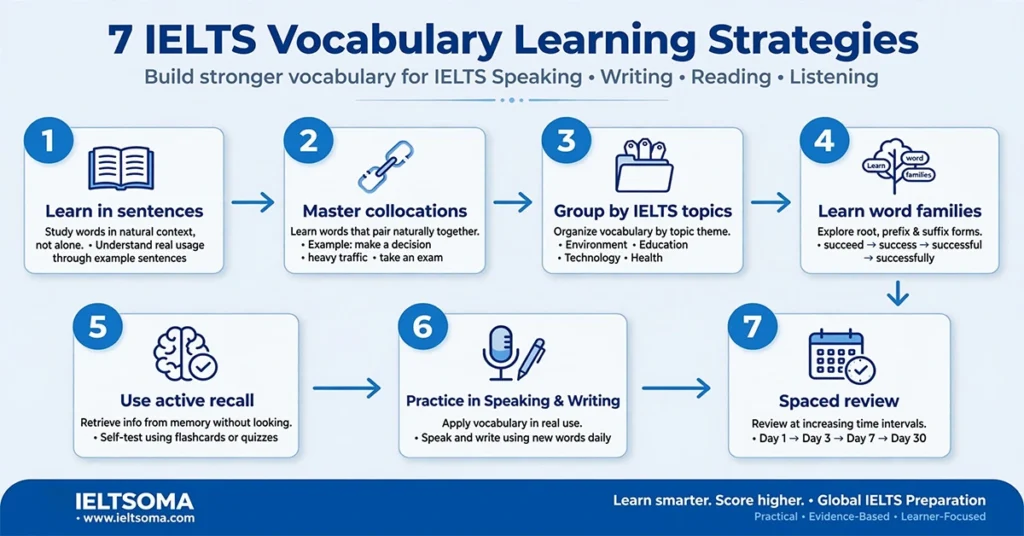
1. Learn Words Inside Real Sentences
One of the simplest ways to apply IELTS Vocabulary Contextual Learning is to stop recording words without sentences.
Instead of:
Sustainable — able to continue for a long time
write:
Cities need sustainable transport systems to reduce traffic congestion and air pollution.
Then create another sentence:
Sustainable tourism can protect local environments while supporting communities.
Now you understand the word in multiple contexts.
When creating vocabulary notes, use this format:
Word: sustainable
Meaning: able to continue without causing unacceptable long-term damage
Collocation: sustainable development
Example: Governments should promote sustainable development in rapidly growing cities.
Topic: Environment / Development
This method takes slightly longer than writing a translation, but it gives your brain more information to connect with the word.
2. Learn Collocations, Not Isolated Words
Collocations are words that commonly occur together.
For IELTS preparation, collocations are extremely valuable because they help you produce language that sounds natural.
For example, do not learn only:
economic
Learn combinations such as:
- economic growth
- economic development
- economic inequality
- economic pressure
- economic stability
- economic consequences
Likewise, instead of learning only pose, learn:
- pose a threat
- pose a challenge
- pose a risk
- pose a problem
This makes IELTS Vocabulary Contextual Learning much more practical.
A useful vocabulary notebook should therefore ask:
“What words usually appear with this word?”
rather than only:
“What does this word mean?”
For example:
Vocabulary: consequence
Useful contexts:
face serious consequences
have negative consequences
long-term consequences
unintended consequences
environmental consequences
These combinations are often more useful in an IELTS response than the isolated word itself.
3. Build Vocabulary Around IELTS Topics
Another powerful part of IELTS Vocabulary Contextual Learning is organizing words by topic.
IELTS questions can cover many areas, including:
- education
- technology
- environment
- health
- transport
- employment
- crime
- government
- society
- culture
- media
- globalization
- cities
- family
- tourism
- science
Instead of creating one enormous alphabetical vocabulary list, create topic-based collections.
For example:
Environment
- renewable energy
- carbon emissions
- environmental damage
- natural resources
- climate change
- fossil fuels
- conservation efforts
- sustainable development
Then put these expressions into sentences.
Governments can reduce carbon emissions by investing in renewable energy.
Excessive consumption can place pressure on natural resources.
Conservation efforts are essential for protecting endangered species.
The topic gives your brain a framework.
When you later see an IELTS question about the environment, the vocabulary is easier to retrieve because the words are connected to a familiar conceptual area.
4. Use Context to Learn Word Families
A strong vocabulary is not only about individual words.
It is also about understanding word families.
Consider:
- economy
- economic
- economically
- economist
- economics
Now place them in context:
The economy has experienced rapid growth.
Economic growth can create new employment opportunities.
The policy is economically beneficial for small businesses.
Economists have different opinions about the proposal.
This is an important feature of IELTS Vocabulary Contextual Learning because one root can give you several useful forms.
However, do not assume that every form can be used interchangeably.
Grammar matters.
For example:
The government needs to make an economic decision.
not:
The government needs to make an economy decision.
When learning a word family, record the part of speech and an example sentence.
This helps you avoid grammatical mistakes while expanding your vocabulary.
5. Practice Active Recall With Context
Reading vocabulary repeatedly can create a false sense of progress.
Active recall is different.
Cover the target word and try to remember it from the sentence.
For example:
Governments should ________ more resources to public education.
If you have previously learned allocate, try to retrieve it.
Then check your answer.
You can make this exercise harder:
Governments should allocate more resources to ________.
Now you must produce the appropriate noun phrase.
You can also turn vocabulary into speaking prompts:
What could governments do to improve public transport?
Try to answer using:
- allocate resources
- improve infrastructure
- reduce congestion
- encourage public transport use
This makes IELTS Vocabulary Contextual Learning active rather than passive.
The more frequently you retrieve vocabulary in meaningful situations, the more prepared you are to use it when you need it.
6. Use New Vocabulary in Speaking and Writing
Learning a word is not the final step.
Using it is.
After learning five new expressions, write a short IELTS-style paragraph.
For example, suppose your vocabulary is:
- alleviate
- congestion
- infrastructure
- public transport
- investment
You could write:
Greater investment in public transport infrastructure could alleviate traffic congestion in major cities. If governments provide reliable and affordable alternatives to private cars, more residents may choose buses and trains for their daily journeys.
You have now connected five vocabulary items in one meaningful context.
For Speaking, give yourself a question:
Should governments spend more money on public transportation?
Then answer naturally.
Do not force every new word into your response.
This is a crucial principle of IELTS Vocabulary Contextual Learning.
The objective is not to make every sentence sound complicated.
The objective is to choose accurate vocabulary when it genuinely expresses your meaning.
7. Review Vocabulary Through Spaced Context
Learning vocabulary once is rarely enough.
You need repeated exposure.
However, repetition does not have to mean reading the same list every day.
Use different contexts.
For example:
Day 1: Learn the word in a sentence.
Day 2: Complete a sentence using the word.
Day 4: Use it in a speaking answer.
Day 7: Write a paragraph using it.
Day 14: Test yourself without looking at the definition.
Day 30: Use it in a timed IELTS practice answer.
This turns IELTS Vocabulary Contextual Learning into a long-term habit.
The context changes each time, while the core meaning remains connected.
That gives you more opportunities to recognize and retrieve the vocabulary.
IELTS Vocabulary Contextual Learning for Academic Test Takers
IELTS Academic is intended for people who plan to study in an English-speaking environment or need the test for certain professional registration purposes. Its Reading and Writing components differ from General Training, while Listening and Speaking are the same.
For Academic candidates, vocabulary related to formal and academic topics can be particularly useful.
Common areas include:
- education
- scientific research
- technology
- urban development
- environmental policy
- economics
- health
- social change
For example, instead of memorizing:
increase
learn several contexts:
a gradual increase in demand
a substantial increase in population
an increase in household expenditure
experience a sharp increase
In Academic Writing Task 1, vocabulary needs to match the information being described.
You might write:
The percentage of households with internet access experienced a substantial increase over the period.
The exact vocabulary must fit the data.
For Task 2, context is equally important because you need to develop arguments and explain ideas clearly. Official IELTS guidance states that lexical resource assesses how accurately and appropriately vocabulary is used.
Therefore, IELTS Vocabulary Contextual Learning should focus on precision as well as variety.
IELTS Vocabulary Contextual Learning for General Training
IELTS General Training is commonly used for migration, work experience, training, and study below degree level. Its Reading and Writing sections differ from Academic, although Listening and Speaking are the same.
General Training candidates can benefit from contextual vocabulary related to everyday and workplace situations.
Useful topic areas include:
- employment
- accommodation
- travel
- customer service
- workplace communication
- education
- community services
- transport
- health
- daily life
For example, learn complaint through context:
I would like to make a formal complaint about the poor service I received.
Then learn related expressions:
- lodge a complaint
- make a complaint
- resolve a complaint
- investigate a complaint
- respond to a complaint
This gives you vocabulary that can be used in practical situations.
General Training Writing Task 1 requires candidates to respond to a situation, often by writing a letter, while Task 2 requires a longer response to a point of view, argument, or problem.
Contextual vocabulary can help you select language that matches the purpose and situation of the task.
How to Use Contextual Learning for IELTS Speaking
IELTS Speaking is not a vocabulary competition.
Trying to insert unusually difficult words into every answer can make your speech less natural.
Instead, focus on flexible vocabulary.
For example, if the topic is technology, you might learn:
- technological advancement
- digital devices
- online communication
- access to information
- digital literacy
- privacy concerns
- technological dependence
Then practice natural sentences.
One major advantage of digital devices is that they give people immediate access to information.
However, excessive technological dependence can create privacy and social problems.
This is where IELTS Vocabulary Contextual Learning becomes particularly useful.
You are not memorizing a speech.
You are building a collection of language patterns that you can adapt to different questions.
For Part 2, create vocabulary clusters around common topics.
For example:
Describe a place you enjoy visiting.
Useful contextual vocabulary might include:
- peaceful atmosphere
- lively surroundings
- breathtaking scenery
- convenient location
- local attractions
- memorable experience
Then create your own answer rather than memorizing a model response.
The goal is flexible production.
How to Use Contextual Learning for IELTS Writing
Writing requires careful vocabulary choices.
A word may be grammatically correct but inappropriate for the context.
For example, kids may be acceptable in casual conversation, but children is generally more suitable for formal academic writing.
Similarly, instead of repeatedly using good, consider the actual meaning:
- beneficial
- effective
- advantageous
- valuable
- positive
But do not replace every occurrence of “good” with a complicated synonym.
Context determines the correct choice.
This is one of the most important lessons in IELTS Vocabulary Contextual Learning.
Suppose you are discussing public transport.
Weak:
Public transport is good for cities.
More precise:
An efficient public transport system can reduce congestion and improve mobility in densely populated cities.
The second sentence communicates more specific meaning.
The vocabulary is valuable because it is connected to a clear idea.
Official IELTS guidance emphasizes that Writing is assessed using criteria including lexical resource, coherence and cohesion, grammatical range and accuracy, and task-related criteria.
Vocabulary should therefore support your argument rather than distract from it.
How Contextual Vocabulary Helps IELTS Reading
Context is especially valuable when you encounter an unfamiliar word in IELTS Reading.
You may not know the exact definition, but surrounding information can help you infer the meaning.
Suppose a passage says:
The project was initially considered impractical because construction costs were prohibitively high. However, technological improvements later made the proposal financially viable.
Even if you do not know viable, the contrast provides clues.
The project was once impractical.
Technological improvements changed the situation.
Therefore, viable probably means something like capable of working successfully or being feasible.
This is an important reading skill.
IELTS Vocabulary Contextual Learning trains you to notice relationships between words rather than treating every unknown word as an emergency.
Look for:
- definitions
- examples
- contrasts
- cause and effect
- synonyms
- explanations
- surrounding topic information
You do not always need to know every word to understand a passage.
How Contextual Vocabulary Helps IELTS Listening
Context also helps in Listening.
IELTS Listening includes four parts and can contain everyday, social, educational, and training situations. Official IELTS information notes that recordings can feature different English accents, including British, Australian, New Zealand, and North American accents.
Before listening, think about the likely context.
If you hear a conversation about renting accommodation, you might expect vocabulary such as:
- deposit
- rent
- landlord
- tenant
- furnished
- utilities
- lease
- available
If the topic is university study, you might expect:
- assignment
- lecture
- seminar
- research
- deadline
- assessment
- supervisor
This prediction makes vocabulary easier to recognize.
You are not simply listening for individual sounds.
You are using context to anticipate meaning.
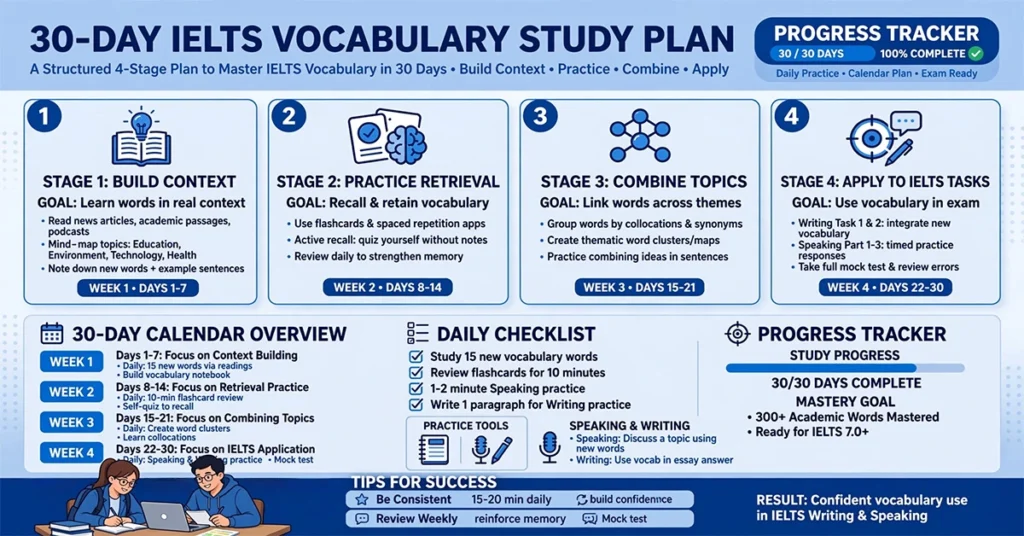
A 30-Day IELTS Vocabulary Contextual Learning Plan
A structured plan can make IELTS Vocabulary Contextual Learning easier to maintain.
Days 1–7: Build Context
Choose one IELTS topic each day.
For example:
- Day 1: Education
- Day 2: Technology
- Day 3: Environment
- Day 4: Health
- Day 5: Transport
- Day 6: Employment
- Day 7: Society
Learn around 8–12 useful words or expressions per topic.
For each item, record:
- meaning
- part of speech
- collocations
- example sentence
- related words
- topic
Days 8–14: Practice Retrieval
Stop simply reading the vocabulary.
Test yourself.
Complete sentences.
Answer questions.
Create short paragraphs.
Give one-minute speaking answers.
Your aim is to retrieve the language without looking at your notes.
Days 15–21: Combine Topics
Now mix vocabulary.
For example:
Technology + Education
Online learning platforms have expanded access to education, particularly for students who live in remote areas.
Environment + Transport
Investment in public transport could reduce carbon emissions while alleviating congestion.
This stage helps you become more flexible.
Days 22–30: Apply Vocabulary to IELTS Tasks
Use your vocabulary in timed practice.
Write an IELTS Task 2 introduction.
Write one body paragraph.
Answer Speaking Part 1 questions.
Practice a Speaking Part 2 topic.
Discuss a Part 3 question.
Review your vocabulary after each task.
Ask:
Did I use the word correctly?
Was the collocation natural?
Did the word actually improve my meaning?
Could I have chosen a simpler and more precise expression?
This final stage turns IELTS Vocabulary Contextual Learning into exam-focused practice.
Common Mistakes to Avoid
Memorizing Words Without Examples
A definition is useful, but it does not teach complete usage.
Always add context.
Learning Too Many Words at Once
A huge vocabulary list can become difficult to review.
Prioritize useful words that you can apply across multiple IELTS topics.
Forcing Advanced Vocabulary
A complicated word is not automatically a better word.
Accuracy and appropriateness matter.
Ignoring Collocations
Knowing individual words without knowing how they combine can lead to unnatural English.
Learn phrases.
Avoiding Revision
Vocabulary disappears when it is not retrieved.
Schedule regular reviews.
Memorizing Complete IELTS Answers
Memorized answers can be inflexible and may not fit the question.
Learn language patterns and ideas instead.
Learning Synonyms Without Context
Two words may be similar but not interchangeable.
Always check how each word functions in real sentences.
Focusing Only on Writing
Vocabulary should also be practiced through Speaking, Reading, and Listening.
The more contexts you encounter, the more flexible your vocabulary becomes.
Frequently Asked Questions About IELTS Vocabulary Contextual Learning
What is IELTS Vocabulary Contextual Learning?
IELTS Vocabulary Contextual Learning is a method of learning vocabulary through sentences, topics, collocations, conversations, passages, and other meaningful situations. Instead of memorizing isolated definitions, you learn how vocabulary functions in real communication.
Is contextual vocabulary learning useful for IELTS Academic?
Yes. Academic candidates can use contextual learning to develop vocabulary for subjects such as education, technology, science, environment, health, economics, and social issues. It can also help candidates understand how formal vocabulary works in sentences.
Is contextual vocabulary learning useful for IELTS General Training?
Yes. General Training candidates can apply the method to workplace, accommodation, travel, community, employment, education, and everyday situations. The vocabulary should match the context and purpose of each task.
How many IELTS vocabulary words should I learn every day?
There is no universal number that guarantees a particular IELTS band score. A practical approach is to learn a manageable group of useful words and expressions, then spend enough time reviewing and using them in context.
Should I memorize IELTS vocabulary lists?
Vocabulary lists can be useful as a source of new words, but they should not be your only learning method. Convert important words into sentences, collocations, questions, speaking responses, and writing examples.
How can I remember IELTS vocabulary for longer?
Use repeated retrieval in different contexts. Learn a word, test yourself later, use it in speaking, include it in writing, and revisit it after increasing intervals. This creates multiple connections around the vocabulary.
Should I use difficult words to get a higher IELTS score?
Not necessarily. IELTS assesses vocabulary according to factors including range, accuracy, and appropriateness. A precise, natural word is often more useful than an unnecessarily complicated word.
Can contextual learning improve IELTS Speaking vocabulary?
It can help you develop vocabulary that is easier to retrieve and apply to different topics. Practice expressions through questions and conversations rather than memorizing complete answers.
Can contextual learning improve IELTS Writing vocabulary?
It can help you understand how formal vocabulary, collocations, word families, and topic-specific expressions work together. You should still prioritize accuracy, relevance, organization, and clear development of ideas.
How can I use contextual learning for IELTS Reading?
When you meet an unfamiliar word, examine its surrounding sentences. Look for definitions, examples, contrasts, synonyms, and cause-and-effect relationships. The context may help you infer the meaning.
How can I use contextual learning for IELTS Listening?
Prepare by predicting vocabulary connected with the topic and situation. For example, accommodation conversations may include words related to rent, deposits, contracts, rooms, and facilities.
Does contextual vocabulary learning work for both IELTS tests?
Yes. IELTS Academic and General Training share the same Listening and Speaking tests, while their Reading and Writing tests differ. Contextual learning can be adapted to the vocabulary demands of each test type.
How long should I study IELTS vocabulary?
The ideal study period depends on your current vocabulary, target score, available time, and test date. Rather than studying vocabulary intensely for a few days, build a consistent routine that combines learning, retrieval, and application.
Conclusion
The biggest vocabulary mistake many IELTS candidates make is treating words as isolated objects.
A word is much more powerful when you know how it behaves.
You need to understand the sentence around it, the topic connected to it, the words it commonly combines with, the grammar it follows, and the situations in which it sounds natural.
That is the foundation of IELTS Vocabulary Contextual Learning.
Whether you are preparing for IELTS Academic or General Training, focus on useful vocabulary that you can recognize, retrieve, and apply.
Learn words in sentences.
Study collocations.
Organize vocabulary by topic.
Explore word families.
Practice active recall.
Use new expressions in Speaking and Writing.
Review them through different contexts.
Most importantly, do not measure your progress only by how many words you have memorized.
Measure it by how confidently and accurately you can use those words when you need them.
With consistent IELTS Vocabulary Contextual Learning, your vocabulary notebook can become more than a list of definitions. It can become a practical language system that supports your Reading, Listening, Writing, and Speaking preparation.
Start with one topic today.
Choose ten useful expressions.
Put each one into context.
Then use them.
That simple habit can make your vocabulary study more purposeful, more memorable, and more closely connected to real IELTS communication.
Further Reading: