Many IELTS candidates spend weeks memorising vocabulary, learning essay templates and completing practice tests—yet their Writing score refuses to move.
The problem is often not a lack of English knowledge. It is a lack of strong writing skills for IELTS.
A high-scoring IELTS response is not simply a collection of advanced words and complicated sentences. It is a clear piece of writing in which every idea has a purpose, every paragraph develops logically, vocabulary is used precisely, and grammar supports meaning rather than distracting from it.
The good news is that these skills can be trained.
Whether you are preparing for IELTS Academic or General Training, this guide explains the nine writing skills that can make the biggest difference to your performance—and shows you exactly how to practise them.
Table of Contents
What Are Strong Writing Skills for IELTS?
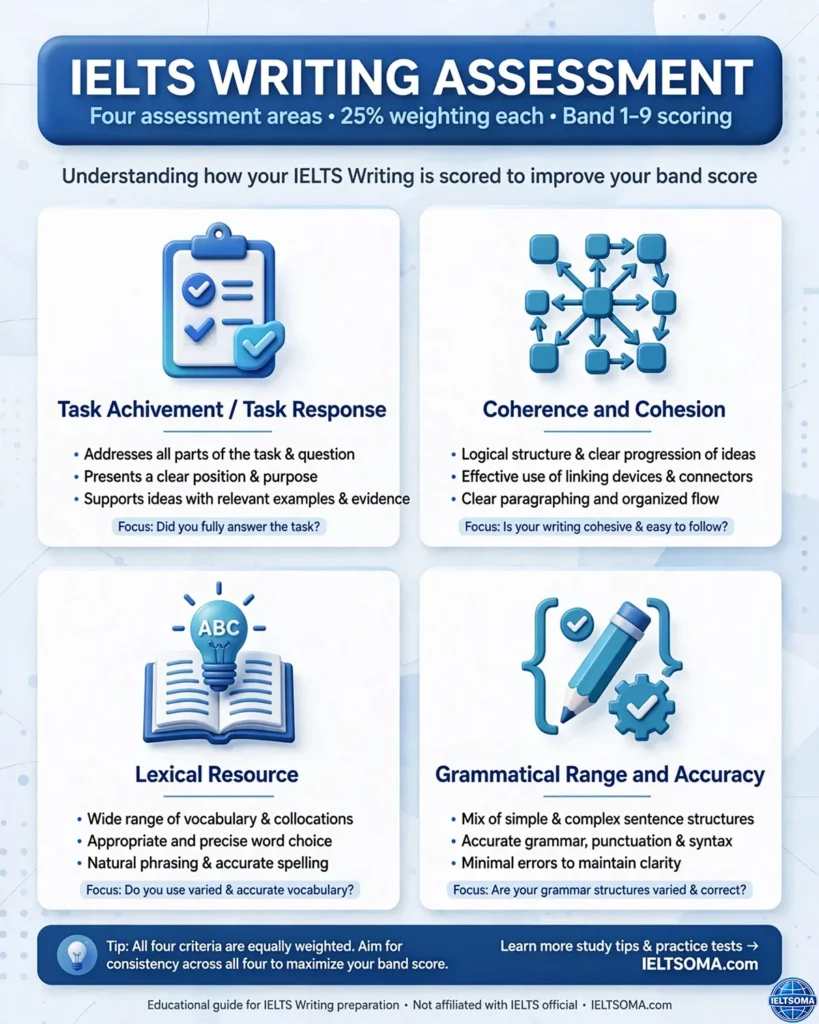
Strong writing skills for IELTS are the ability to answer the task accurately, organise ideas logically, use vocabulary precisely, and control a range of grammatical structures while maintaining clear communication.
These abilities directly correspond to the criteria IELTS examiners use to assess Writing:
- Task Achievement for Task 1
- Task Response for Task 2
- Coherence and Cohesion
- Lexical Resource
- Grammatical Range and Accuracy
The criteria apply to both Academic and General Training Writing. Task 1 differs between the two tests, while Task 2 requires an essay in both.
This means improving your writing is not about memorising one “perfect” essay. It is about developing a set of transferable skills that work across different questions.
1. Learn to Answer the Exact Question
The first of the essential strong writing skills for IELTS is also one of the most frequently overlooked: answering the question you were actually given.
A candidate can write excellent English and still lose marks if the response only partially addresses the task.
For IELTS Writing Task 2, first identify:
- The topic
- The task type
- The specific instructions
- Whether you need to give an opinion
- The ideas that must be discussed
For example:
Some people believe that university education should be free for everyone. To what extent do you agree or disagree?
A weak response might discuss the benefits of university education generally.
A stronger response directly evaluates whether university education should be free and clearly establishes a position.
Your ideas do not need to be revolutionary. They need to be relevant, developed and supported.
A simple question-analysis technique
Before writing, ask yourself:
What exactly am I being asked to do?
Then rewrite the task in your own words.
For the example above:
I need to decide how far I agree that all university education should be free.
That one sentence can prevent an entire essay from drifting away from the question.
Official IELTS guidance states that Task Response considers how fully you address the task, develop and support your ideas, maintain a clear position, and use an appropriate format.
2. Build Clear Paragraphs Around One Main Idea
Strong writers do not simply put several sentences together and call them a paragraph.
Each body paragraph should have a clear purpose.
A reliable structure is:
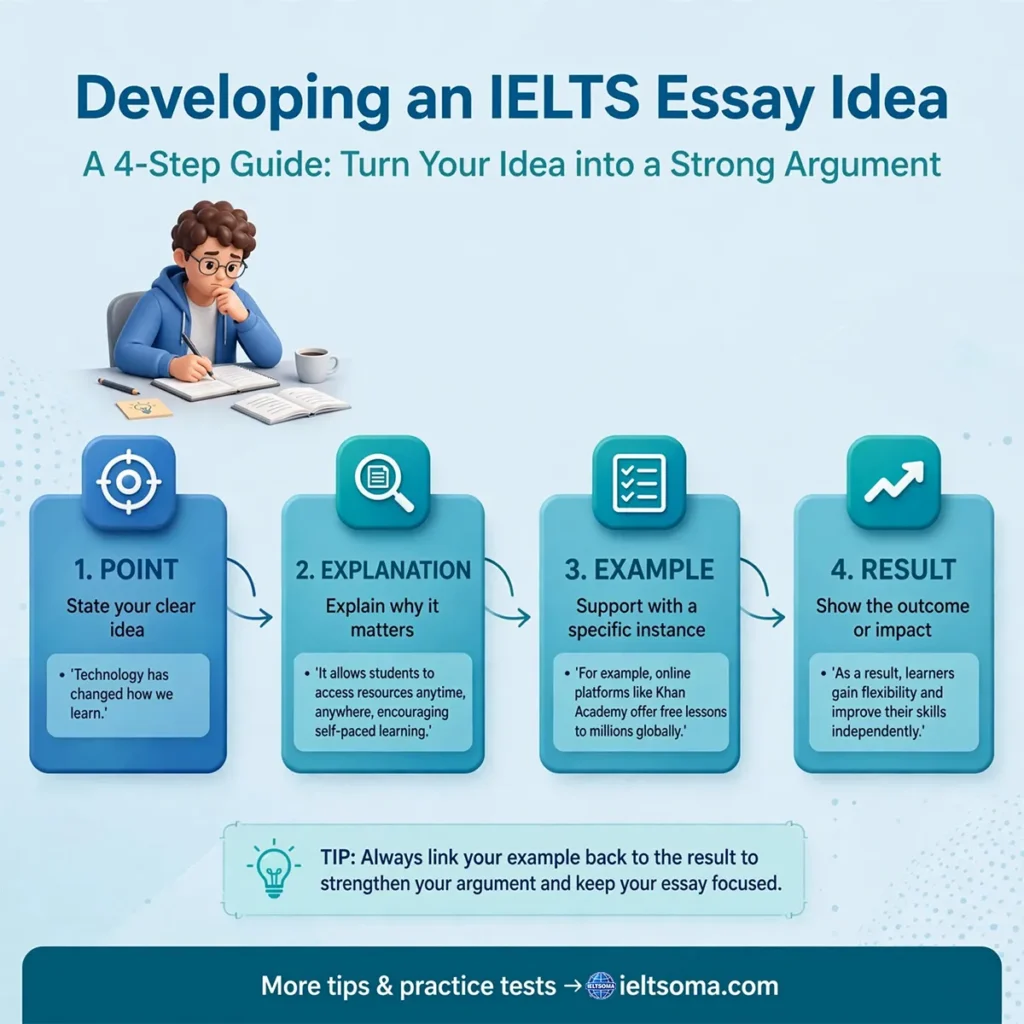
Main idea → Explanation → Example → Result or implication
Consider this example:
One major advantage of public transport is that it can reduce urban congestion. When more commuters use buses and trains instead of private cars, fewer vehicles occupy roads during peak periods. For example, cities that provide frequent and reliable rail services can encourage commuters to leave their cars at home. As a result, road networks can operate more efficiently.
Notice what happens.
The paragraph starts with one central claim, explains it, gives a realistic example, and finishes by showing the consequence.
That is much stronger than listing four unrelated advantages.
IELTS describes coherence as the logical organisation and progression of ideas, while cohesion concerns how relationships between ideas are made clear.
The one-paragraph test
After writing each body paragraph, ask:
“If I had to summarise this paragraph in seven words, could I?”
If you cannot, the paragraph may contain too many competing ideas.
3. Develop Ideas Instead of Listing Them
One of the biggest differences between an average and a strong IELTS response is idea development.
Compare these two versions.
Basic
Online education is convenient. It saves time. It is cheaper.
These statements are understandable, but they are undeveloped.
Developed
Online education can be considerably more convenient for working adults because lessons can often be accessed outside traditional classroom hours. This allows learners to study around their professional responsibilities rather than travelling to a campus several times a week.
The second version takes one idea and explains why it matters.
That is the skill you should practise.
A useful formula is:
Point → Why? → How? → Example → Why does it matter?
You do not need to use every part every time, but asking these questions forces your ideas beyond simple statements.
Example
Point: Public parks improve urban life.
Why? They provide accessible spaces for exercise and relaxation.
How? Residents can walk, run or spend time outdoors without paying for private facilities.
Example: A large public park near residential areas can give families a convenient place to exercise together.
Result: This can support healthier lifestyles and improve residents’ quality of life.
This is the kind of development that makes an argument easier to follow and more persuasive.
4. Improve Vocabulary Through Precision, Not Memorisation
Many IELTS candidates believe strong writing means using the most sophisticated vocabulary possible.
It does not.
IELTS assesses Lexical Resource, including the range, accuracy, appropriacy and precision of vocabulary. Official IELTS guidance also highlights collocation, word choice, spelling and word formation.
Consider:
Governments should ameliorate the deleterious ramifications of vehicular congestion.
It sounds advanced.
But it is unnecessarily complicated.
A clearer version is:
Governments should reduce the harmful effects of traffic congestion.
The second sentence communicates the idea more efficiently.
Build vocabulary in families
Instead of memorising isolated words, learn related forms and natural combinations.
For example:
benefit
- benefit from
- provide benefits
- significant benefit
- long-term benefits
- beneficial to
This helps you use vocabulary naturally rather than forcing memorised words into sentences.
Focus on collocation
Collocations are words that naturally occur together.
For example:
- make a decision
- pose a threat
- play a crucial role
- rapid economic growth
- highly effective
- significant impact
Knowing individual words is not enough. You need to know how those words behave in real sentences.
Enhance IELTS Vocabulary Skills: 15 Powerful Ways to Boost Your Band Score
5. Use Linking Words for Meaning, Not Decoration
A common misconception is that more linking words automatically create better cohesion.
They do not.
Consider:
Firstly, public transport is useful. Secondly, it is affordable. Moreover, it reduces pollution. Furthermore, it helps people travel.
The paragraph is heavily signposted, but the logical relationships are weak.
Good cohesion is not about decorating every sentence with “moreover”, “furthermore” and “therefore”.
Instead, make the relationship between ideas clear.
For example:
Public transport can also reduce household expenses. This is particularly relevant in cities where parking, fuel and vehicle maintenance are expensive.
Here, “This” refers naturally to the previous idea.
IELTS guidance specifically identifies reference, substitution, conjunctions and other cohesive devices as part of coherence and cohesion. It also warns indirectly against over-reliance on simple transition words.
Better rule
Use a linking device when the reader genuinely needs help understanding the relationship between ideas.
Do not use one simply because you think every sentence needs an IELTS connector.
6. Develop Grammatical Range Without Sacrificing Accuracy
Strong writing skills for IELTS require more than avoiding basic grammar mistakes.
You also need enough grammatical range to express relationships between ideas clearly.
Useful structures include:
- complex sentences
- relative clauses
- conditionals
- passive structures
- concessive clauses
- modal verbs
- comparative structures
- complex noun phrases
For example:
Basic:
Many people work remotely. They save commuting time.
Improved:
People who work remotely can save considerable commuting time, particularly when they live far from their workplace.
The second sentence combines the ideas more efficiently.
However, do not turn every sentence into a grammatical experiment.
A sentence containing three subordinate clauses is not automatically better than two clear sentences.
Official IELTS guidance says higher-band writing demonstrates a range of structures used with flexibility and accuracy. Band 7 writing may still contain some errors, provided they do not impede communication.
The 70/30 principle
During practice, aim roughly for:
- 70% reliable structures you can control confidently
- 30% more ambitious structures you are actively learning
This gives you grammatical variety without allowing experimentation to overwhelm accuracy.
7. Learn to Compare, Explain and Evaluate
Strong IELTS writing is not just about describing information.
You often need to establish relationships between ideas.
For Task 2, this can involve:
- comparing advantages and disadvantages
- explaining causes
- discussing effects
- evaluating solutions
- presenting an opinion
- challenging an argument
- weighing competing viewpoints
For Academic Writing Task 1, comparison is especially important when describing charts, graphs and tables.
Instead of writing:
The number increased in 2010. The number increased in 2011. The number decreased in 2012.
Look for relationships:
The figure rose steadily between 2010 and 2011 before falling noticeably in 2012.
That sentence communicates the trend more efficiently.
For Task 2, evaluation is equally important.
Instead of:
Working from home has advantages.
Write:
Although remote working can improve flexibility, its benefits may be limited for employees whose jobs depend on face-to-face collaboration.
Now the idea has qualification and nuance.
That ability to qualify rather than make absolute claims can make your writing more mature.
8. Master the Difference Between Academic and General Training Writing
The underlying writing skills are similar, but the tasks are not identical.
Academic Writing
Academic candidates complete:
- Task 1: a report describing visual information
- Task 2: an essay
Task 1 may involve graphs, tables, charts, diagrams or processes. You need to identify significant features and organise the information clearly.
General Training Writing
General Training candidates complete:
- Task 1: a letter
- Task 2: an essay
The letter may require a personal, semi-formal or formal tone depending on the situation.
Task 2 is an essay for both Academic and General Training.
IELTS states that Academic Task 1 involves visual information, while General Training Task 1 involves responding to a situation through a letter. Both require at least 150 words for Task 1 and 250 words for Task 2.
Why this matters
A candidate who writes a perfectly structured Academic Task 1 response may still struggle with General Training Task 1 because the purpose, tone and organisation are different.
So practise the specific task type, not just “IELTS writing” in general.
9. Edit Your Writing Like an Examiner
Writing practice without editing is one of the least efficient ways to improve.
If you write an essay, receive no feedback and immediately write another essay, you may simply repeat the same mistakes.
Instead, reserve time to analyse your response.
Look for five things:
Task
Did I answer every part of the question?
Organisation
Can I identify the main idea of every paragraph?
Vocabulary
Did I repeat the same words unnecessarily?
Grammar
Which errors keep appearing?
Clarity
Could a reader understand my meaning immediately?
Create an error log.
For example:
| Error | Incorrect | Correct | Future action |
|---|---|---|---|
| Article | “government should provide solution” | “the government should provide a solution” | Check articles |
| Collocation | “make a research” | “conduct research” | Learn collocations |
| Verb form | “people prefers” | “people prefer” | Check subject-verb agreement |
| Preposition | “depend of” | “depend on” | Record fixed phrases |
After several practice essays, patterns will emerge.
Perhaps you repeatedly misuse articles.
Perhaps your vocabulary is strong but your examples are too short.
Perhaps your paragraphs lack clear topic sentences.
That information is far more valuable than simply knowing your latest practice score.
A 4-Week Plan to Build Strong Writing Skills for IELTS
You do not need to write a full essay every day.
A focused four-week system can be more productive.
Week 1: Build sentence control
Focus on:
- sentence boundaries
- subject-verb agreement
- articles
- verb tenses
- punctuation
- simple and complex sentence structures
Write 10–15 sentences each day using vocabulary from common IELTS topics.
Week 2: Build paragraphs
Practise one body paragraph at a time.
Use:
Point → Explanation → Example → Result
Do not worry about writing a complete essay yet.
Your goal is to make every paragraph coherent and developed.
Week 3: Build complete responses
Write:
- 2 Task 2 essays
- 2 Academic Task 1 reports or General Training Task 1 letters
After each response, identify your three most important weaknesses.
Do not try to fix everything simultaneously.
Week 4: Add exam pressure
Complete timed writing sessions.
For Task 2, practise working within approximately 40 minutes. For Task 1, practise within approximately 20 minutes.
Then spend several minutes reviewing your work.
Remember that Task 2 carries twice the weight of Task 1 in the overall Writing score, so your preparation should reflect that weighting.
Common Writing Mistakes That Hold Candidates Back
Memorising entire essays
Memorised essays can become irrelevant to the question and may produce unnatural writing.
Learn structures and language patterns instead.
Using vocabulary you cannot control
An advanced word used incorrectly is worse than a simpler word used precisely.
Writing huge paragraphs
Long paragraphs can hide weak organisation.
Keep each paragraph focused on a clear purpose.
Giving examples without explanation
An example is useful only when the reader understands how it supports your argument.
Using the same sentence structure repeatedly
If every sentence follows subject + verb + object, your writing can become monotonous.
Practise combining ideas using clauses and varied structures.
Writing more instead of writing better
More words do not automatically mean a higher score.
IELTS requires minimum word counts, but writing excessively long responses can reduce the time available for checking and may introduce irrelevant ideas.
Strong Writing Skills for IELTS: What Should You Prioritise?
If you are short on preparation time, prioritise these skills in order:
| Priority | Skill | Why it matters |
|---|---|---|
| 1 | Answering the task | Irrelevant or incomplete responses can seriously limit your score |
| 2 | Idea development | Strong ideas need explanation and support |
| 3 | Organisation | Logical progression makes your writing easier to follow |
| 4 | Grammar accuracy | Frequent errors can interfere with communication |
| 5 | Vocabulary precision | Correct, appropriate vocabulary is more valuable than obscure words |
| 6 | Cohesion | Readers need to understand relationships between ideas |
| 7 | Sentence variety | A controlled range demonstrates grammatical flexibility |
| 8 | Editing | Reviewing helps identify recurring errors |
This order is intentional.
Do not spend two hours memorising advanced vocabulary while ignoring the fact that your paragraphs do not answer the question.
How Long Does It Take to Improve IELTS Writing?
There is no fixed number of days required to improve an IELTS Writing score.
Progress depends on your current level, target band, frequency of practice, quality of feedback and the type of errors you make.
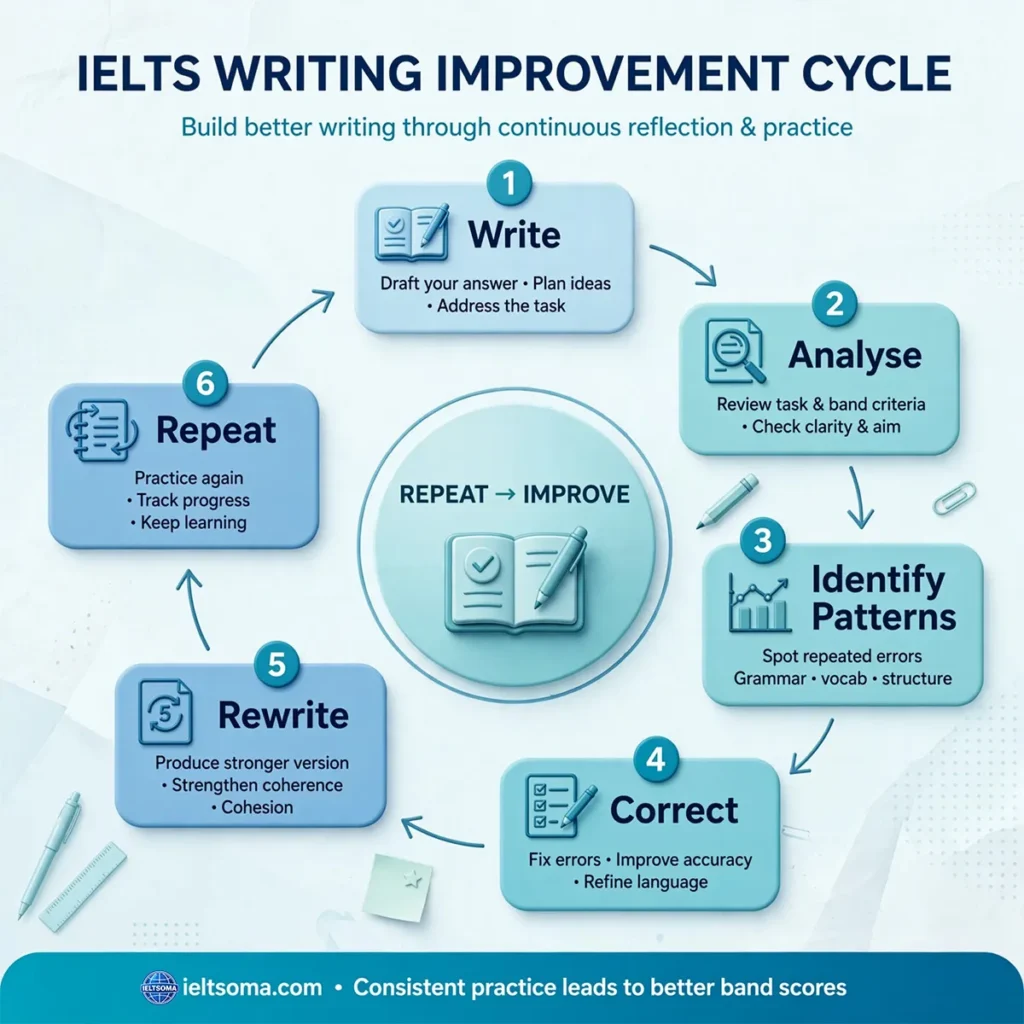
However, improvement becomes much more predictable when practice follows a cycle:
Write → Analyse → Identify patterns → Correct → Rewrite → Repeat
The key is the analysis stage.
If you discover that you repeatedly make the same four grammar errors, spending another hour writing without addressing those errors is unlikely to solve the problem.
A shorter practice session focused on those four weaknesses may be far more valuable.
How Can I Improve IELTS Writing Without Writing an Essay Every Day?
Yes.
You can develop strong writing skills through smaller exercises.
Try:
- rewriting weak sentences
- expanding one idea into a paragraph
- combining short sentences
- replacing vague vocabulary with precise alternatives
- identifying topic sentences
- correcting your old essays
- summarising a news article in 80–100 words
- writing introductions for different Task 2 questions
- writing overviews for Academic Task 1
- practising formal and informal letters for General Training
This approach lets you isolate individual skills instead of trying to improve everything at once.
Frequently Asked Questions
What are the most important writing skills for IELTS?
The most important skills are answering the task fully, organizing ideas logically, developing and supporting arguments, using vocabulary accurately and appropriately, and controlling a range of grammatical structures.
These abilities correspond closely to the official IELTS Writing assessment criteria.
How can I improve my IELTS Writing from Band 6 to Band 7?
Start by identifying exactly why your writing is currently performing at Band 6.
Then focus on the weaknesses that prevent stronger performance. For many candidates, this involves better idea development, clearer progression, more precise vocabulary, stronger grammatical control and fewer recurring errors.
Do not assume that simply adding advanced vocabulary will move you to Band 7.
Is vocabulary more important than grammar in IELTS Writing?
Neither should be treated as the single most important factor.
Lexical Resource and Grammatical Range and Accuracy are separate assessment criteria, alongside Task Achievement/Response and Coherence and Cohesion.
A sophisticated vocabulary cannot compensate for an essay that does not answer the question.
Should I use difficult words to get a high IELTS Writing score?
No.
Use vocabulary that is accurate, appropriate and precise.
A natural word used correctly is more valuable than an impressive-looking word used incorrectly.
How can I write better IELTS paragraphs?
Start each paragraph with one clear central idea. Explain that idea, support it with a relevant example where appropriate, and show its consequence or significance.
Then check whether every sentence contributes to the paragraph’s purpose.
How many words should I write in IELTS Writing?
Academic and General Training Task 1 require at least 150 words, while Task 2 requires at least 250 words. Task 2 also contributes twice as much as Task 1 to the Writing score.
Meeting the minimum is necessary, but simply writing far beyond it is not a strategy for achieving a higher band.
Can I use personal examples in IELTS Writing?
Relevant examples from your own knowledge or experience can be appropriate for Task 2. What matters is that the example supports and develops your argument rather than becoming a long personal story.
The Best Way to Build Strong Writing Skills for IELTS
Strong IELTS writing is not created by memorising hundreds of impressive words or copying model essays.
It comes from repeatedly making good decisions:
Answer the question.
Choose relevant ideas.
Develop them clearly.
Organise them logically.
Use precise vocabulary.
Control your grammar.
Check your work.
Most importantly, turn mistakes into data.
If you repeatedly make the same error, record it. If your ideas are underdeveloped, practise paragraph development. If your vocabulary sounds unnatural, study collocations in context. If your writing lacks progression, analyse how your sentences and paragraphs connect.
That is how strong writing skills for IELTS become a reliable exam skill rather than something you hope will appear on test day.
For official information about how IELTS Writing is assessed, use the IELTS Writing assessment resources and band descriptors rather than relying on unofficial scoring claims.
With focused practice, useful feedback and deliberate correction, your writing can become clearer, more precise and more controlled—and those are the qualities that matter when your work is placed in front of an IELTS examiner.