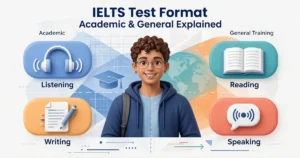
If you are preparing for IELTS, knowing the IELTS Test Format is not a minor detail—it affects how you prepare, manage your time and approach each question.
IELTS has four sections: Listening, Reading, Writing and Speaking. Listening and Speaking follow the same format in both IELTS Academic and IELTS General Training, while Reading and Writing are different.
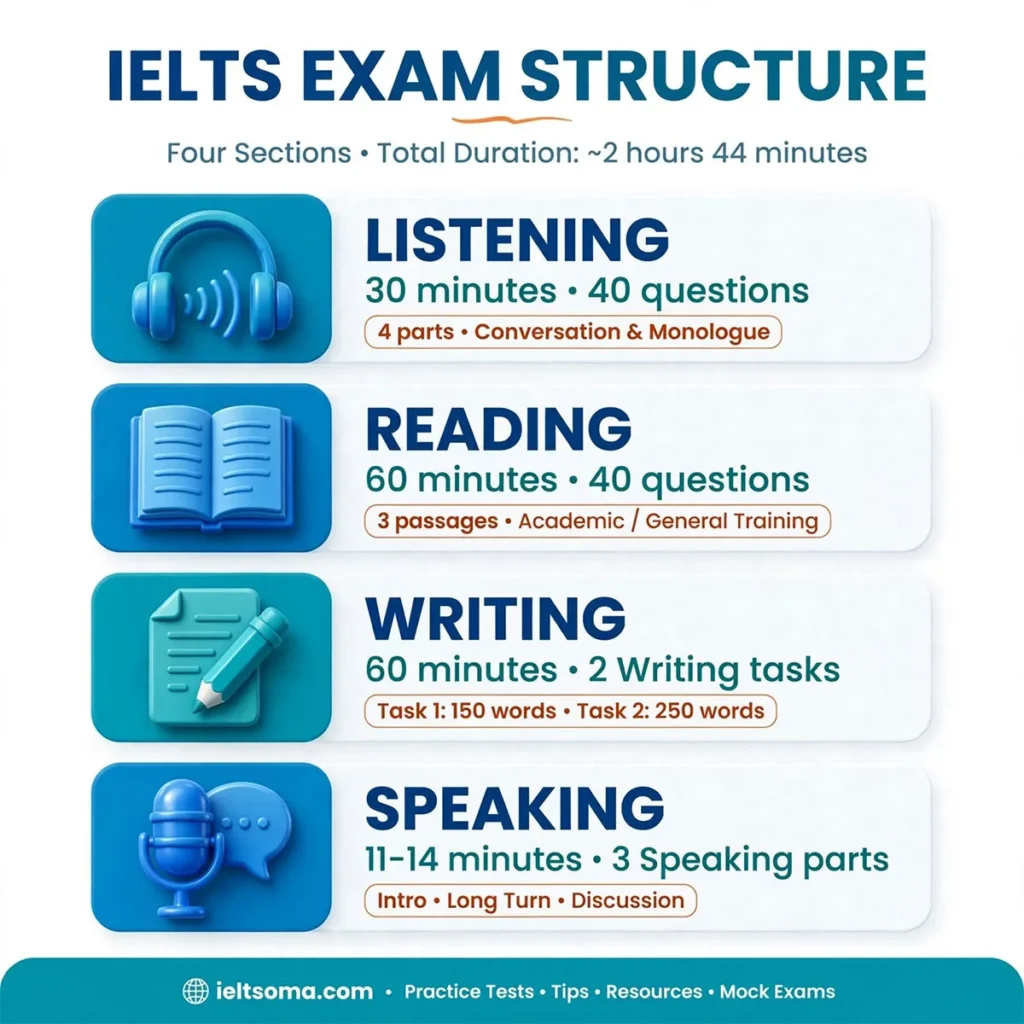
The complete test takes approximately 2 hours and 45 minutes, although the Speaking test may be scheduled separately from the other sections.
The biggest mistake is preparing for “IELTS” as though there were only one version. Your first decision should be whether you need IELTS Academic or IELTS General Training.
This guide explains the IELTS test format explained from start to finish, including timing, question types, Writing tasks, Speaking parts, scoring and the differences between Academic and General Training.
Table of Contents
IELTS Test Format at a Glance
| Section | Time | Questions/Tasks | Academic vs General |
|---|---|---|---|
| Listening | About 30 minutes | 40 questions | Same |
| Reading | 60 minutes | 40 questions | Different |
| Writing | 60 minutes | 2 tasks | Different |
| Speaking | 11–14 minutes | 3 parts | Same |
1. Choosing Between IELTS Academic and General Training
Before studying individual question types, make sure you have selected the correct test.
IELTS Academic
The IELTS Academic test format is designed primarily for people who want to study at undergraduate or postgraduate level or who need English-language assessment for certain professional registration purposes.
For example, Academic IELTS may be appropriate if you are:
- Applying to a university or higher-education institution
- Applying for postgraduate study
- Seeking professional registration where IELTS Academic is accepted
- Applying for a programme that specifically requires Academic IELTS
Always check the requirements of the university, organisation or professional body rather than assuming which test you need.
IELTS General Training
The IELTS General Training test format is commonly used for migration, work-related purposes and training or study below degree level, depending on the requirements of the organisation or immigration authority.
General Training may therefore be appropriate if you are:
- Applying for migration
- Preparing for certain work-related requirements
- Applying for training below degree level
- Meeting a specific immigration or employment requirement
The key point is simple:
Do not choose Academic or General Training based only on which one seems easier. Choose the version your institution, employer, immigration authority or professional body requires.
2. IELTS Listening Test Format
The Listening section is the same for Academic and General Training.
You listen to four recordings and answer 40 questions in total. Each part contains 10 questions. The recordings are played only once.
How the four Listening parts work
Part 1: A conversation between two speakers in an everyday social situation.
Part 2: A single speaker discussing an everyday or social situation.
Part 3: A conversation involving people in an educational or training context.
Part 4: A single speaker giving a talk on an academic subject.
Common IELTS Listening question types
You may encounter:
- Multiple choice
- Matching
- Plan, map or diagram labelling
- Form completion
- Note completion
- Table completion
- Flow-chart completion
- Summary completion
- Sentence completion
- Short-answer questions
A common trap is to focus only on hearing individual words. IELTS Listening also tests whether you can follow relationships between ideas, identify important information and recognise information that may be expressed using different words from those in the question.
Timing matters
The Listening test takes approximately 30 minutes. For the paper test, there is additional time to transfer answers to the answer sheet; the exact procedure depends on the delivery mode.
Do not assume that you can simply listen first and think about spelling later. Your answers need to meet the instructions and word limits given in the test.
Expert tip: During practice, train yourself to predict what type of answer is required before the recording reaches the relevant question.
3. IELTS Reading Test Format
Reading is where the Academic and General Training tests become substantially different.
Both versions contain 40 questions and allow 60 minutes, but the texts and task demands differ.
IELTS Academic Reading
The Academic Reading test contains three sections/texts. The material is taken from sources appropriate for an academic context, and the texts can contain complex vocabulary, ideas and styles.
You may need to deal with:
- Main ideas
- Supporting details
- Specific information
- Writer’s views or claims
- Logical relationships
- Vocabulary in context
- Matching information
- Completing summaries
- Understanding the organisation of a text
Typical question types include:
- Multiple choice
- True/False/Not Given
- Matching headings
- Matching information
- Sentence completion
- Summary completion
- Table or note completion
- Diagram labelling
- Short-answer questions
The challenge is not simply reading quickly. You need to locate relevant information accurately and distinguish between what the text actually says and what you might assume it says.
IELTS General Training Reading
The General Training Reading test also contains 40 questions, but its texts are drawn from more everyday, workplace and general-interest contexts.
The material may include:
- Notices
- Advertisements
- Workplace information
- Instructions
- General-interest texts
- Descriptive or argumentative texts
The reading skills remain important, but the context and text types differ from Academic Reading.
Academic vs General Training Reading
| Feature | Academic | General Training |
|---|---|---|
| Number of questions | 40 | 40 |
| Time | 60 minutes | 60 minutes |
| Text context | Academic/general academic | Everyday, workplace and general |
| Difficulty profile | Often greater lexical/textual complexity | More practical text types |
| Scoring scale | 9-band scale | 9-band scale |
The two Reading tests use the same 9-band scale, but the number of correct answers required for a particular band can differ.
Expert tip: Do not prepare for General Training Reading by assuming it is simply “easy IELTS Reading”. You still need strong skimming, scanning, paraphrase recognition and accuracy.
4. IELTS Writing Test Format
Writing lasts 60 minutes in both versions and contains two tasks. Task 2 carries more weight than Task 1 when the Writing band score is calculated.
However, Task 1 is where Academic and General Training differ most clearly.
IELTS Academic Writing
In Academic Writing Task 1, you describe visual information in your own words.
The visual may be:
- A graph
- A chart
- A table
- A diagram
- A process
- A combination of visual information
You must write at least 150 words, with approximately 20 minutes recommended for the task.
A strong response normally requires you to identify the key features rather than describe every single number or detail.
For example, if you receive a line graph showing changes in three categories over a 20-year period, your response should not become a list of every figure. You need to identify significant trends, comparisons and relevant details.
IELTS General Training Writing
In General Training Writing Task 1, you write a letter in response to a situation.
You may need to:
- Ask for information
- Explain a situation
- Make a request
- Respond to a problem
- Provide information
You must write at least 150 words, with approximately 20 minutes recommended.
The appropriate tone depends on the situation and relationship between the writer and recipient.
Writing Task 2
Task 2 is the same basic format for Academic and General Training.
You are given a point of view, argument or problem and must write at least 250 words. Approximately 40 minutes is recommended.
Your essay needs more than a collection of opinions. You should develop ideas clearly, organise them logically and support relevant points with explanations or examples.
How Writing is assessed
Examiners assess Writing using four main criteria:
- Task achievement / Task response
- Coherence and cohesion
- Lexical resource
- Grammatical range and accuracy
Task 2 contributes twice as much as Task 1 to the overall Writing score.
This has an important practical consequence: spending 35 minutes on Task 1 is usually a poor time-management decision.
Better approach: approximately 20 minutes for Task 1 and 40 minutes for Task 2.
5. IELTS Speaking Test Format
The Speaking test is the same for Academic and General Training.
It lasts 11–14 minutes and consists of three parts. It is conducted as an interview with a certified examiner and is recorded.
Part 1: Introduction and interview
Part 1 lasts approximately 4–5 minutes.
The examiner asks questions about familiar subjects such as:
- Home
- Family
- Work
- Studies
- Interests
- Everyday experiences
The purpose is not to give a memorised speech. You need to respond naturally and provide enough information to demonstrate your speaking ability.
Part 2: Individual long turn
You receive a topic card and have one minute to prepare.
You then speak for up to two minutes. The examiner may ask one or two brief questions after your long turn.
This is where a clear structure becomes extremely useful.
For example:
Topic → background → main details → example → result/opinion
You do not need to memorise complete answers. Instead, prepare flexible strategies that help you organise ideas quickly.
Part 3: Discussion
Part 3 lasts approximately 4–5 minutes.
The examiner asks questions connected to the Part 2 topic but moves towards broader and more abstract issues.
For a higher band, simply giving short answers is rarely enough. You need to explain, compare, justify, speculate or discuss consequences where appropriate.
How Speaking is assessed
The examiner assesses:
- Fluency and coherence
- Lexical resource
- Grammatical range and accuracy
- Pronunciation
These four criteria carry equal weighting.
Expert tip: Do not confuse speaking quickly with fluency. Clear, logically connected speech with appropriate pauses is more useful than rushing through memorised language.
6. How IELTS Scoring Works
Each section receives a band score from the IELTS 9-band scale.
You receive separate scores for:
- Listening
- Reading
- Writing
- Speaking
Your overall band score is calculated by averaging the four component scores and rounding according to IELTS scoring rules.
For example:
| Listening | Reading | Writing | Speaking | Average | Overall |
|---|---|---|---|---|---|
| 7.0 | 7.0 | 6.5 | 7.0 | 6.875 | 7.0 |
The overall score is not simply the score from your strongest section.
This is why a candidate targeting Band 7 overall should not automatically spend all their preparation time on the section they already perform well in. A weak Writing or Speaking score can pull down the overall result.
Listening and Reading raw scores
Listening and Reading each contain 40 questions, with one mark awarded for each correct answer. Raw scores are converted to the 9-band scale. The precise conversion can vary slightly between test versions.
For example, IELTS gives approximate benchmark conversions such as:
- Listening Band 6: about 23/40
- Listening Band 7: about 30/40
- Academic Reading Band 7: about 30/40
- General Training Reading Band 7: about 35/40
These are approximate rather than guaranteed score boundaries for every test version.
7. Academic vs General Training: What Really Changes?
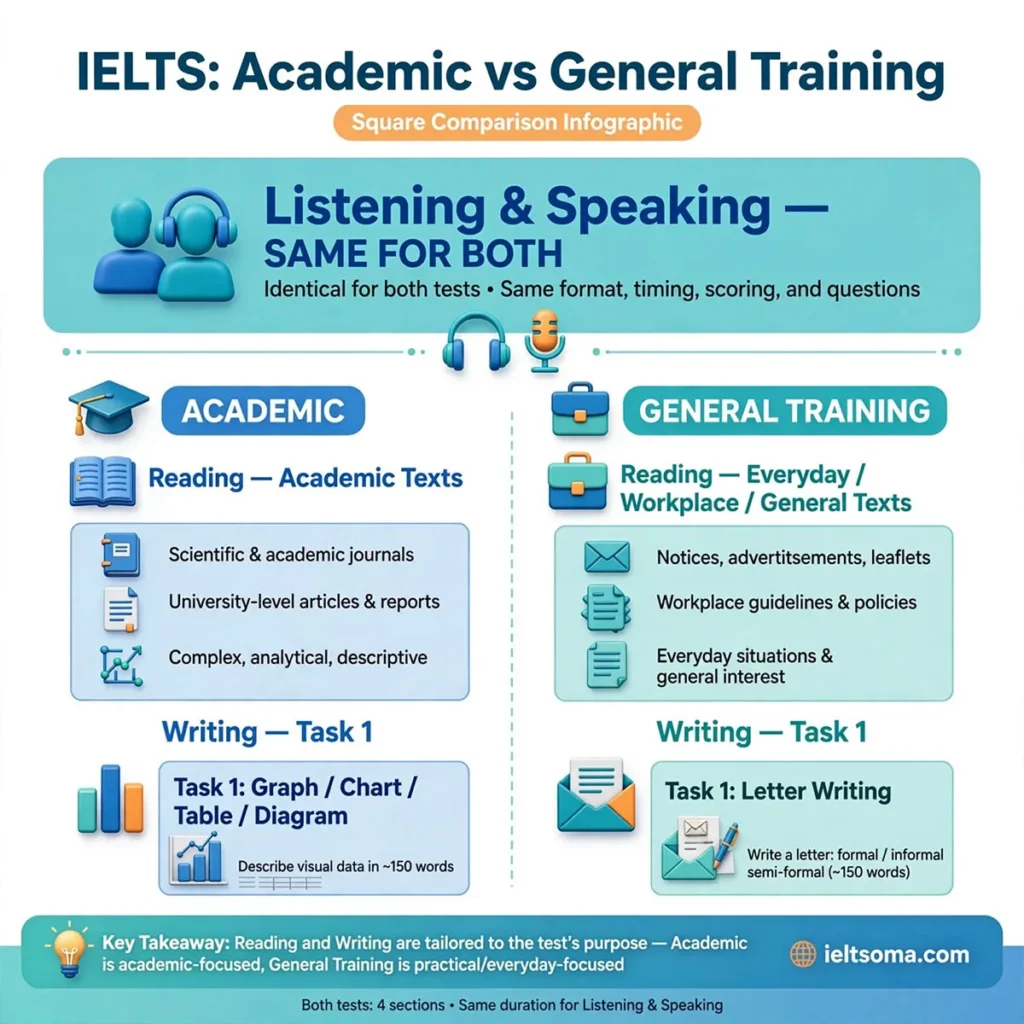
The easiest way to remember the IELTS test format explained is this:
Listening — same
Reading — different
Writing — different
Speaking — same
That gives you a simple preparation framework.
| Section | IELTS Academic | IELTS General Training |
|---|---|---|
| Listening | Same | Same |
| Reading | Academic texts | Everyday/workplace/general texts |
| Writing Task 1 | Graph, chart, table or diagram | Letter |
| Writing Task 2 | Essay | Essay |
| Speaking | Same | Same |
| Speaking duration | 11–14 minutes | 11–14 minutes |
| Listening questions | 40 | 40 |
| Reading questions | 40 | 40 |
This distinction should shape your preparation plan.
If you are taking Academic IELTS, you need dedicated preparation for visual-data description in Writing Task 1 and the academic-style Reading test.
If you are taking General Training IELTS, you need dedicated preparation for letter writing and the General Training Reading texts.
Common IELTS Test Format Mistakes
1. Preparing for the wrong IELTS test
Do not start practising until you know whether your requirement is Academic or General Training.
2. Treating Academic and General Reading as identical
They have the same number of questions and timing, but the texts and difficulty profile differ.
3. Spending too long on Writing Task 1
Task 2 has twice the weighting of Task 1, so protect enough time for your essay.
4. Memorising Speaking answers
Memorised responses can sound unnatural and may not answer the actual question.
Prepare ideas, structures and language that you can adapt instead.
5. Ignoring instructions
In Listening and Reading, instructions can specify how many words or numbers you may use. Exceeding the stated limit can cost you the mark.
6. Practising without timing yourself
Knowing the questions is not enough. You need to be able to complete them within the real test conditions.
How to Prepare for the IELTS Test Format

A good preparation plan should mirror the actual examination.
Step 1: Confirm your test type
Find out whether you need Academic or General Training.
Step 2: Learn the four-section structure
Know what happens in Listening, Reading, Writing and Speaking before you begin intensive practice.
Step 3: Practise every question type
Do not practise only your favourite questions. Your preparation should include multiple choice, matching, completion tasks, headings, diagrams and other common formats.
Step 4: Build section-specific strategies
Listening requires prediction and careful listening.
Reading requires efficient text navigation and evidence-based answers.
Writing requires organisation, development and accurate language.
Speaking requires fluent, relevant and flexible communication.
Step 5: Practise under realistic timing
Once you understand each task, complete full sections under time pressure.
Step 6: Analyse mistakes
Simply doing another practice test is not enough.
After each test, ask:
- Why was my answer wrong?
- Did I misunderstand the question?
- Did I miss a paraphrase?
- Did I make a spelling mistake?
- Did I run out of time?
- Did I misunderstand the instructions?
- Was my Writing answer insufficiently developed?
- Did I hesitate or lose coherence in Speaking?
This analysis turns practice into improvement.
Frequently Asked Questions About the IELTS Test Format
Is IELTS Academic harder than General Training?
Neither test should simply be labelled “harder”. The Reading and Writing sections are different, and the Academic Reading test can contain more complex vocabulary and styles. General Training Reading generally requires more correct answers for the same band score.
Is the Listening test the same for Academic and General Training?
Yes. The Listening test follows the same basic format for both versions, with four parts and 40 questions.
Is IELTS Speaking the same for Academic and General Training?
Yes. Both versions use the same three-part Speaking test, lasting 11–14 minutes.
What is the biggest difference between Academic and General IELTS?
The biggest differences are in Reading and Writing. Academic Writing Task 1 requires you to describe visual information, while General Training Writing Task 1 requires a letter. The Reading texts also differ substantially.
How long is the IELTS test?
The four components take approximately 2 hours and 45 minutes in total. Listening takes about 30 minutes, Reading 60 minutes, Writing 60 minutes and Speaking 11–14 minutes.
How many questions are there in IELTS?
Listening has 40 questions and Reading has 40 questions. Writing has two tasks, while Speaking consists of three parts.
Can I choose Academic or General Training myself?
You should choose the version required for your purpose. Universities, immigration authorities, employers and professional organizations may specify which IELTS test they accept.
Does Writing Task 2 matter more than Task 1?
Yes. Task 2 contributes twice as much as Task 1 to the Writing score.
Final IELTS Test Format Checklist
Before beginning your preparation, make sure you can answer these questions:
- Which test am I taking? Academic or General Training?
- Do I know the four sections? Listening, Reading, Writing and Speaking.
- Do I know the timing? Approximately 30 + 60 + 60 + 11–14 minutes.
- Do I know which sections differ? Reading and Writing.
- Do I know the Listening structure? Four parts and 40 questions.
- Do I know the Reading structure? 40 questions in 60 minutes.
- Do I know Writing Task 1? Visual information for Academic; letter for General Training.
- Do I know Writing Task 2? A discussion of a point of view, argument or problem.
- Do I know Speaking Part 2? One minute to prepare and up to two minutes to speak.
- Do I understand how my overall band is calculated?
Once the IELTS Test Format is familiar, preparation becomes much more focused. Instead of treating IELTS as one large examination, you can train the specific skills required for each section and each task type.
The most effective preparation is not simply completing hundreds of practice questions. It is understanding what each question is testing, why your answer is right or wrong, how much time you have, and how the examiner awards marks.
That is the difference between practicing IELTS and preparing strategically for IELTS.
Further Reading: