Preparing for IELTS without knowing your current level is like planning a journey without knowing your starting point. You might spend weeks memorising vocabulary, practising essays or watching listening lessons, yet still struggle to reach your target band score.
An IELTS pre-test or diagnostic test helps you avoid this problem. It gives you an initial picture of your performance in Listening, Reading, Writing and Speaking before you begin a structured preparation programme. More importantly, it helps you identify which skills need the most attention.
If your goal is Band 6.5, 7.0 or higher, you do not necessarily need to study every IELTS skill for the same amount of time. You need to understand what is holding you back and build a preparation plan around those weaknesses.
This guide explains how to take an IELTS diagnostic test before preparation, interpret your results and turn them into a practical study plan for IELTS Academic or General Training.
Table of Contents
What Is an IELTS Pre-Test or Diagnostic Test?
An IELTS pre-test is an initial assessment that helps you understand your current English proficiency and readiness for the IELTS exam. It usually involves practice tasks from the four IELTS skills, completed under realistic conditions.
Unlike a regular practice session, which focuses on learning or improving a particular skill, a diagnostic test is designed primarily to identify strengths, weaknesses and recurring errors.
For example, you might answer most Listening questions correctly but lose marks in Reading because you spend too long on difficult passages. Alternatively, you might understand English well but struggle to organise ideas in Writing Task 2.
These situations require different solutions. A diagnostic assessment helps you determine which problem deserves attention first.
A useful IELTS diagnostic test should help you answer five questions:
- What is my approximate current performance level?
- Which IELTS skill is weakest?
- Which question types cause the most difficulty?
- Are my mistakes caused by English proficiency, exam technique, timing or a combination of factors?
- What should I study first to make meaningful progress?
Remember that an online quiz or short placement test cannot reliably predict your official IELTS result on its own. Writing and Speaking require more detailed assessment than a simple multiple-choice score can provide.
7 Benefits of Taking an IELTS Diagnostic Test Before Preparation
Taking a diagnostic test before starting your preparation offers several practical advantages.
1. You discover your actual starting point
Many candidates begin IELTS preparation based on assumptions. Some believe their English is already strong enough for Band 7, while others underestimate their abilities because they lack confidence.
An IELTS pre-test replaces assumptions with evidence.
Suppose your goal is Band 7.0, but your first timed Reading practice produces many incorrect answers. Instead of immediately buying an advanced vocabulary course, investigate whether you struggle with paraphrasing, locating information, understanding complex sentences or managing time.
Your starting point should determine your next steps, not your expectations.
2. You identify IELTS weaknesses before studying
The most valuable benefit of an IELTS diagnostic test is discovering specific weaknesses rather than simply labelling a skill as weak.
For example, saying “My Writing is poor” does not tell you what to improve. Your difficulty might be related to task response, paragraph development, grammatical accuracy, vocabulary or cohesion.
Similarly, a low Listening score might result from missing numbers and names, failing to recognise paraphrases, losing concentration or making spelling mistakes.
A useful diagnosis moves from a broad observation to a specific problem you can practise.
3. You avoid wasting time on skills you already handle well
Candidates often spend too much time practising familiar question types because they feel comfortable with them.
If you consistently perform well on Listening form completion but struggle with multiple-choice questions, repeating form completion exercises may produce limited additional benefit.
A diagnostic assessment helps you allocate study time according to need. You can maintain your stronger skills while giving more attention to weaker areas.
4. You create a realistic study plan
Your preparation plan should reflect your current ability, target band and available time.
A candidate aiming for Band 6.5 with strong Listening and Reading but weaker Writing may need a different plan from someone targeting Band 7.5 who struggles with reading speed.
The pre-test benefits extend beyond identifying mistakes. It provides a basis for setting priorities, selecting suitable materials and reviewing progress.
5. You learn how timing affects your performance
Some candidates perform well when practising without time limits but lose accuracy during a timed test.
A diagnostic assessment can reveal whether you spend too long on difficult Reading questions, write excessively long introductions or hesitate during Speaking answers.
These are not necessarily language problems. They may be exam-management problems that require specific timed practice.
6. You become familiar with IELTS question types
An initial test helps you understand the format and demands of the exam.
You may discover that you can understand a passage but struggle with True/False/Not Given questions, matching headings or sentence completion. Recognising these difficulties early allows you to learn the relevant strategies before attempting many full practice tests.
7. You establish a baseline to measure improvement
Without a starting score or assessment record, it is difficult to judge whether your preparation is working.
Record your initial results, recurring mistakes and estimated skill levels. After a period of focused study, repeat comparable practice tasks.
The difference between your baseline and later performance can show whether your strategy is helping. However, remember that a change in one practice-test score may reflect differences in difficulty or test conditions rather than genuine improvement.
How to Take an IELTS Diagnostic Test Before Preparation
A reliable diagnostic assessment should resemble the real exam as closely as practical. Use official sample questions or reputable IELTS preparation materials, follow the instructions and avoid checking answers while you work.
Step 1: Confirm your IELTS test type and target score
First, establish whether you need IELTS Academic or IELTS General Training.
Listening and Speaking are the same in both versions, while Reading and Writing differ. Academic candidates should practise Academic Reading and Writing Task 1, which involves describing visual information. General Training candidates should practise General Training Reading and Writing Task 1, which involves writing a letter.
Writing Task 2 requires an essay in both versions.
Next, identify your required overall band score and any minimum score required in an individual skill. A university, employer or immigration authority may have specific requirements, so check the relevant organisation’s official guidance.
Step 2: Choose suitable diagnostic materials
Use practice tasks that reflect the IELTS format and cover all four skills.
The official IELTS sample test questions are a good starting point. The British Council also provides free IELTS practice tests for familiarizing yourself with the exam and reviewing your answers.
Choose materials with answer keys, model responses or reliable assessment guidance wherever possible.
Avoid relying exclusively on short online quizzes that test general grammar or vocabulary. These can provide useful supplementary information, but they do not represent the complete range of IELTS skills.
Step 3: Complete a timed Listening test
Complete a representative Listening practice test without pausing or replaying recordings, unless the instructions specifically allow it.
After checking your answers, classify your mistakes.
Ask yourself:
- Did I miss key information because the speaker talked quickly?
- Did I fail to recognise a paraphrase?
- Did I lose track of the recording while thinking about an earlier answer?
- Did I make spelling, plural or word-limit errors?
- Did I confuse information mentioned initially with the speaker’s final answer?
These questions help you identify the reason behind an incorrect answer.
For example, if you understood the recording but wrote an incorrect plural form, more listening practice alone may not solve the problem. You need to improve your attention to grammatical clues and answer accuracy.
Step 4: Complete a timed Reading test
Use the correct Academic or General Training Reading material and follow the prescribed time limit.
Record your raw score, but also examine the questions you answered incorrectly or left unanswered.
Look for patterns such as:
- Spending too long on one passage.
- Confusing False with Not Given.
- Choosing a heading based on one sentence rather than the main idea.
- Missing synonyms and paraphrased information.
- Reading every word instead of locating relevant information efficiently.
- Misunderstanding complex sentences.
Do not assume every wrong answer indicates poor vocabulary. Sometimes you understand the words but misinterpret the relationship between ideas, overlook a qualification or make an unsupported inference.
Step 5: Write both Writing tasks
Writing needs particular attention because a raw score is not as straightforward as counting correct answers.
Complete Writing Task 1 and Task 2 under appropriate time limits. Follow the instructions for your chosen IELTS version.
For Academic Writing Task 1, assess how accurately you select and report the main features of the visual information. For General Training Task 1, check whether you address the purpose of the letter, cover the required points and use an appropriate tone.
For Task 2, evaluate whether you answer every part of the question, develop relevant ideas, organise paragraphs logically and use accurate language.
Use the four official Writing assessment criteria as your framework:
- Task Achievement or Task Response: How effectively you fulfil the task.
- Coherence and Cohesion: How clearly you organise and connect ideas.
- Lexical Resource: How appropriately and accurately you use vocabulary.
- Grammatical Range and Accuracy: How varied and accurate your sentence structures are.
The criterion names differ between Task 1 and Task 2. Consult the official IELTS assessment criteria to understand how performance is evaluated.
If possible, ask a qualified IELTS teacher or experienced assessor to review your writing. Self-assessment can identify obvious problems, but it may not reveal subtle weaknesses in task response, language control or development.
Step 6: Record a Speaking sample
You can conduct an initial Speaking assessment by recording yourself answering representative questions from all three parts of the test.
For Part 1, answer familiar questions about your life and everyday experiences. For Part 2, prepare a cue-card response using the permitted preparation time. For Part 3, practise discussing broader ideas related to the topic.
Listen to your recording and examine the following:
- Fluency and coherence: Do you develop answers logically, or stop frequently because you cannot think of what to say?
- Lexical resource: Can you express your ideas precisely, or repeatedly rely on the same basic words?
- Grammatical range and accuracy: Can you produce a mixture of sentence structures without frequent errors?
- Pronunciation: Are your words understandable? Do stress, rhythm or individual sounds sometimes make your meaning difficult to follow?
Notice whether you give only short answers, repeat ideas, hesitate excessively or memorise phrases that do not fit the question.
A recording is useful for self-review, but it cannot provide a fully reliable official band score. Ask a qualified teacher for feedback if you need a more accurate assessment.
Step 7: Turn your results into an action plan
Once you have assessed all four skills, summarise what you discovered.
Do not stop at writing “Listening: 28/40” or “Writing: weak”. Translate each result into a problem, a likely cause and a practical next step.
For example:
| Finding | Possible cause | Preparation priority |
|---|---|---|
| Frequent Listening spelling errors | Inaccurate spelling or missed word endings | Practise transcription and answer checking |
| Slow Reading completion | Inefficient locating and reading strategies | Practise timed passages and question-specific techniques |
| Weak Writing Task 2 development | Ideas lack explanation or relevant examples | Practise planning and developing body paragraphs |
| Repeated Speaking hesitation | Limited idea development or difficulty retrieving vocabulary | Practise extending answers and recording responses |
These are starting hypotheses, not automatic diagnoses. Review your errors before deciding which explanation fits.
How to Identify Your Weakest IELTS Skill
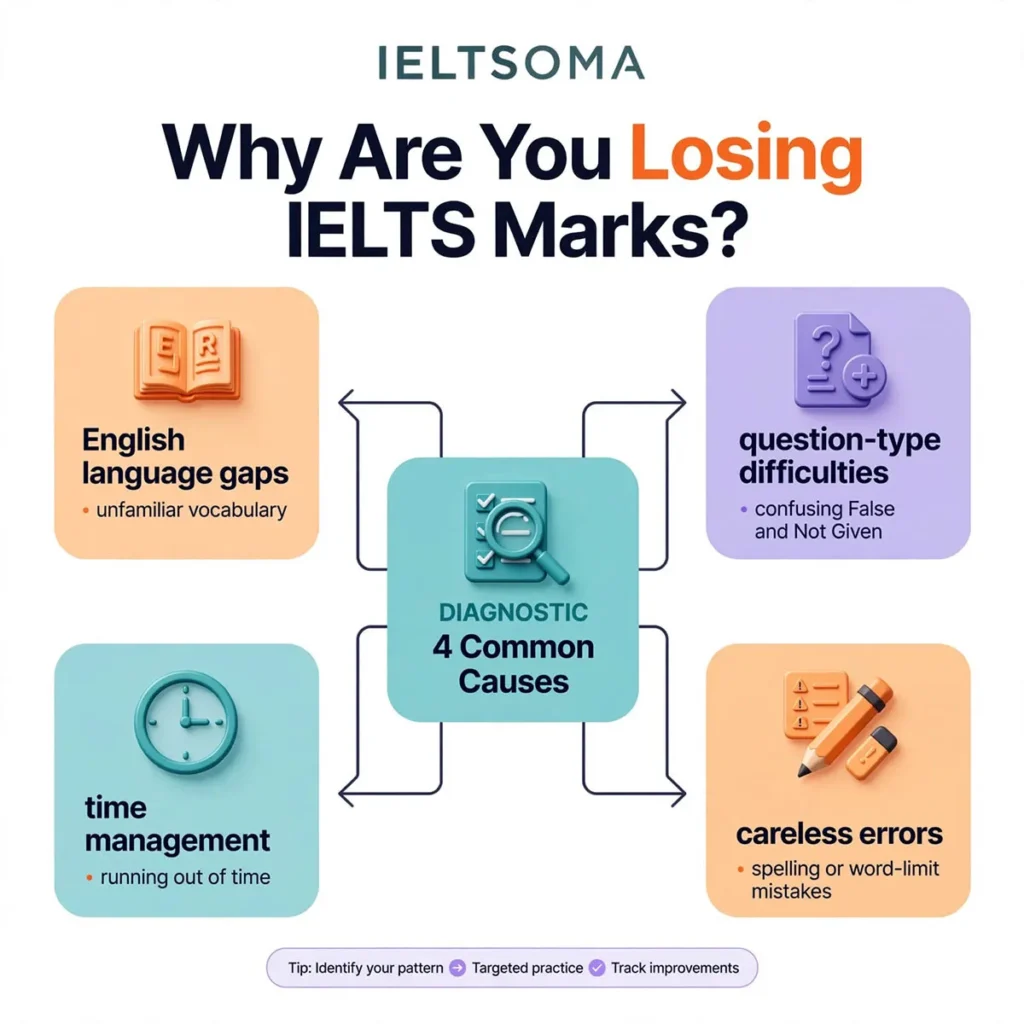
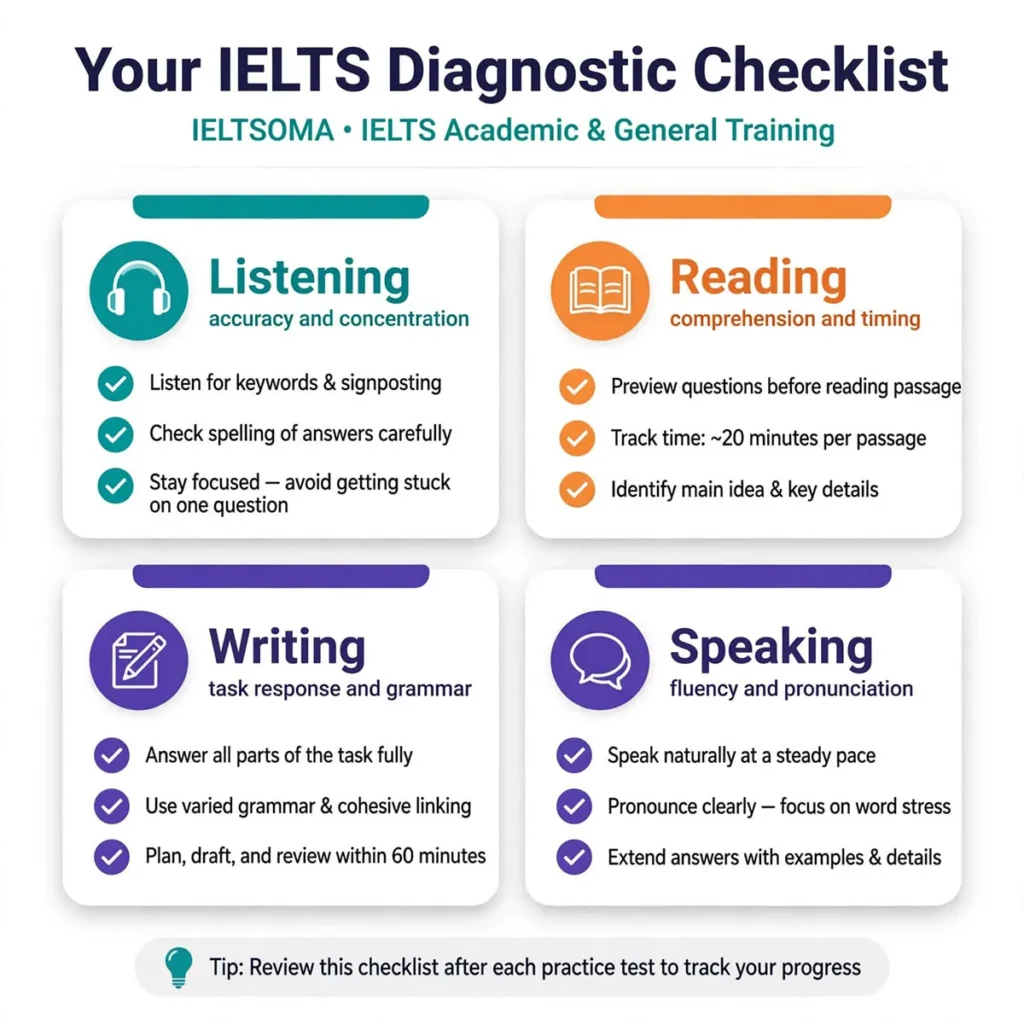
An IELTS diagnostic test should help you distinguish between a weak skill and a weak subskill.
Listening: Accuracy, attention and recognition
If your Listening score is lower than expected, identify the question types where errors occur most frequently. Check whether you struggle with multiple choice, matching, map labelling, note completion or understanding different accents.
Then review the recording or transcript, where available, to understand exactly what you missed.
Reading: Comprehension, paraphrasing and speed
Review your incorrect answers and note whether you misunderstood the text, failed to locate evidence or ran out of time.
For every incorrect answer, find the relevant passage and explain why the correct answer is supported. For True/False/Not Given questions, distinguish between information that contradicts the passage and information the passage does not establish.
Writing: Task fulfilment, development and language
Evaluate Writing Task 1 and Task 2 separately. A candidate may organise essays well but struggle to select key features in Academic Task 1, or write accurate sentences but fail to address all parts of a question.
Look for repeated errors rather than judging your entire ability from a single sentence.
Speaking: Fluency, vocabulary, grammar and pronunciation
Review your recording against the four assessment criteria. Identify whether your main difficulty is developing ideas, choosing precise vocabulary, controlling grammar or making your speech easy to understand.
A useful next step should target the weakness you actually observe, not a general belief that you need to “speak better”.
How to Interpret Your IELTS Pre-Test Results
Your diagnostic results are a guide to your starting point, not a guarantee of your official IELTS score.
Listening and Reading practice tests can provide a useful raw score when they use appropriate questions and answer keys. However, the relationship between a raw score and a band score depends on the test version and its scoring conversion.
Writing and Speaking require qualitative assessment against the relevant band descriptors. A quick online test that gives you a band score without examining your actual performance should be treated cautiously.
Use the following framework to interpret your results:
| Result pattern | What it may indicate | What to do next |
|---|---|---|
| One skill is clearly weaker | A specific skill needs more focused practice | Prioritise that skill while maintaining the others |
| All skills are below target | Broader language development or test familiarity may be needed | Build a balanced plan and review progress regularly |
| Untimed work is strong but timed work is weak | Timing or exam technique may be a major factor | Introduce realistic timed practice gradually |
| Accuracy varies considerably | Test difficulty, concentration or inconsistent technique may affect results | Complete another comparable assessment before drawing firm conclusions |
| Writing or Speaking feedback is unclear | Self-assessment may be insufficient | Seek feedback from a qualified teacher or trained assessor |
Do not compare your performance with someone else’s without considering their target score, starting level and test conditions. Your priority is to close the gap between your own current performance and the score you need.
Create a Personalised IELTS Study Plan
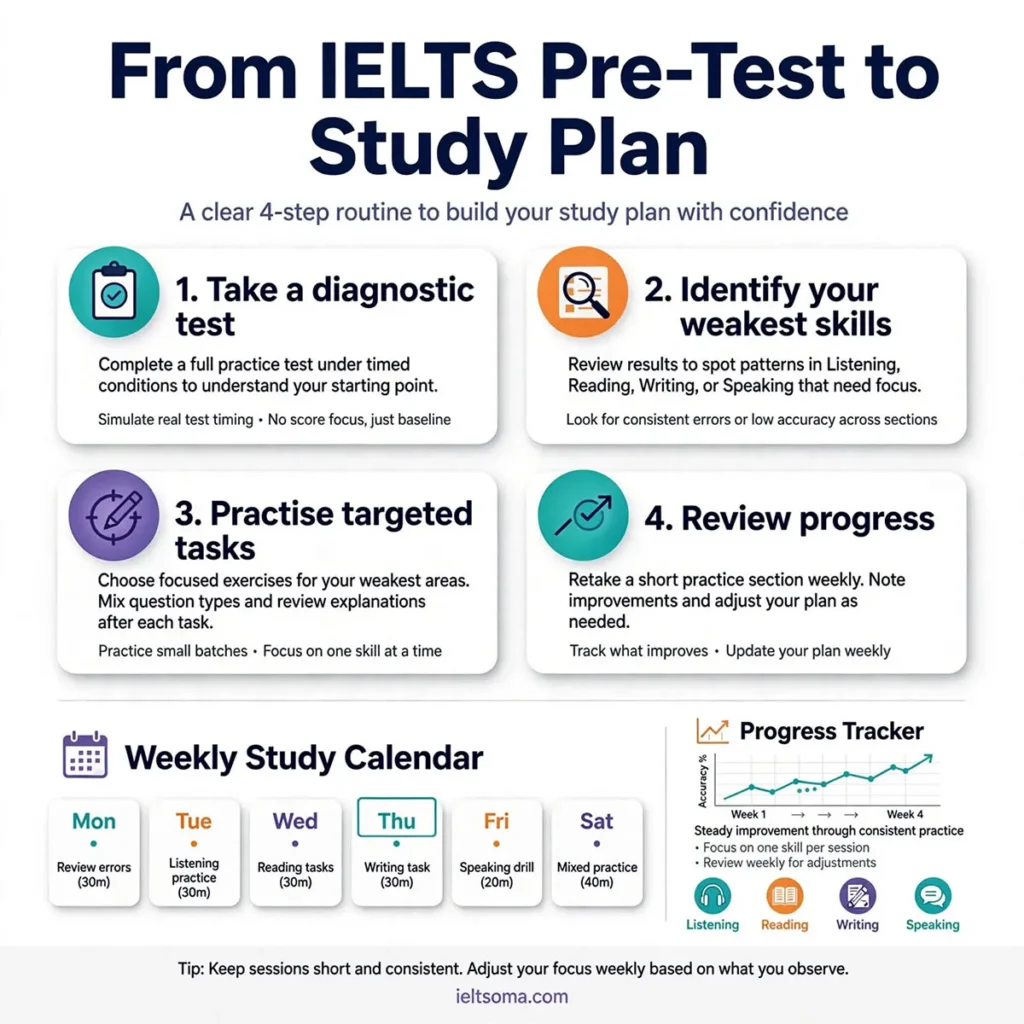
Your results become useful when they lead to consistent action.
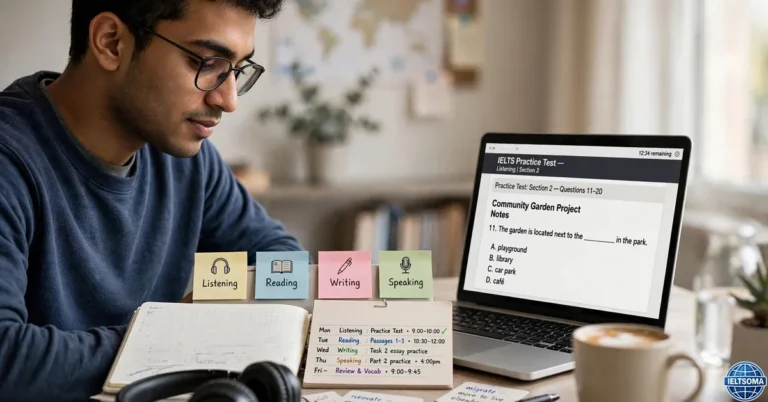
Start by choosing two or three priorities. Trying to fix every weakness simultaneously can make your preparation unfocused.
Suppose your diagnostic test suggests that Reading timing and Writing Task 2 development are your biggest challenges. You could devote more of your weekly study time to those areas while completing shorter Listening and Speaking maintenance activities.
A simple weekly plan might look like this:
| Day | Main activity | Purpose |
|---|---|---|
| Monday | Reading question-type practice | Improve accuracy on recurring problem questions |
| Tuesday | Writing Task 2 planning and body paragraphs | Develop ideas with explanations and examples |
| Wednesday | Listening practice and error review | Identify why answers are missed |
| Thursday | Timed Reading passage | Improve pacing and decision-making |
| Friday | Write a full response and review feedback | Improve task fulfilment and language control |
| Saturday | Speaking recording and self-review | Practise fluency, development and pronunciation |
| Sunday | Review errors and plan the next week | Measure progress and adjust priorities |
This is an example, not a universal timetable. Adapt it to your available time, target band and diagnostic findings.
Keep an error log with four columns: the question or task, the mistake, the reason and the corrective action. Review it weekly.
After one or two weeks of focused practice, repeat comparable tasks. After a longer period of preparation, use a fuller practice test to check whether your performance has improved across all four skills.
Common Mistakes to Avoid During an IELTS Diagnostic Test
A diagnostic assessment is only useful if you interpret it carefully. Avoid these common mistakes.
1. Studying before establishing a baseline. If you complete extensive practice and memorise strategies before your first assessment, you lose a clear picture of your starting point. Take an initial test first if possible.
2. Ignoring the time limit. Untimed practice can help you learn, but it does not reveal whether you can complete the tasks within exam conditions. Record both accuracy and timing.
3. Taking only one skill test. A strong Reading score does not establish readiness for the whole IELTS exam. Assess all four skills.
4. Treating an online estimate as an official band score. Automated quizzes may be useful for identifying basic gaps, but they cannot necessarily assess writing quality or speaking performance reliably.
5. Reviewing scores without reviewing mistakes. Knowing that you got an answer wrong is less useful than understanding why. Examine the evidence, error pattern and corrective strategy.
6. Repeating the same test until the score improves. Familiarity with questions can raise your result without demonstrating a genuine improvement in ability. Use new but comparable tasks when measuring progress.
7. Spending all your time on your weakest skill. Focused practice is valuable, but neglected skills may deteriorate. Maintain a balanced approach based on your target and progress.
Frequently Asked Questions
1. What is an IELTS diagnostic test?
An IELTS diagnostic test is an initial assessment of your Listening, Reading, Writing and Speaking skills. It helps you identify strengths, weaknesses and preparation priorities before beginning a structured study plan.
2. Should I take an IELTS pre-test before preparation?
Yes. An IELTS pre-test can help you understand your starting point, select appropriate learning materials and use your study time more efficiently. It is especially useful if you are unsure which skills need the most improvement.
3. Can I take an IELTS diagnostic test for free?
Yes. You can use official IELTS sample questions and free practice materials from recognized providers. Start with the official IELTS sample test questions and use answer keys or suitable feedback to review your performance.
4. How long should an IELTS diagnostic test take?
A full diagnostic assessment may take several hours if you assess all four skills under realistic conditions. You can divide it across separate sessions, if necessary, but a complete assessment should include Listening, Reading, Writing and Speaking.
5. Can an IELTS pre-test predict my final band score?
It can provide an indication of your current performance, but it cannot guarantee your official result. Test difficulty, scoring conversion, test-day conditions and the quality of Writing and Speaking assessment can all affect how accurately a practice result reflects your eventual score.
6. How do I identify my weakest IELTS skill?
Complete representative tasks for all four skills, review your scores and analyze recurring mistakes. For Writing and Speaking, use the official assessment criteria and seek qualified feedback where possible. Prioritize the problems that most clearly prevent you from reaching your target.
7. How often should I repeat an IELTS diagnostic test?
You do not need to repeat a full diagnostic assessment every few days. Practice individual skills more frequently and repeat comparable assessments after a meaningful period of focused study. A fuller mock test can then help you review overall progress.
8. Is an IELTS diagnostic test useful for both Academic and General Training?
Yes. The diagnostic approach applies to both versions. However, you must use the correct Reading and Writing tasks for your test type. Listening and Speaking are the same in IELTS Academic and General Training.
Final Advice: Diagnose First, Then Prepare Strategically
The most effective IELTS preparation begins with an honest assessment of your current ability. An IELTS pre-test helps you identify the difference between your present performance and your target band, while a detailed review explains which habits and skills need attention.
Start with representative tasks, assess all four skills, record your recurring errors and build a focused study plan. Use reliable materials, seek expert feedback where necessary and repeat comparable tasks to check your progress.
You do not need a perfect starting score. You need a clear starting point and a practical plan for improvement.
At IELTSOMA, the goal is to help you prepare with purpose. Find your weaknesses before you study, turn them into priorities and make every practice session count.
Further Reading: