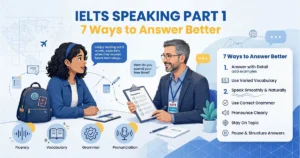
IELTS Speaking Part 1 can look easy because the questions are usually about familiar subjects: your home, work, studies, family, hobbies, food, free time or daily life.
But familiar questions can create an unexpected problem. Many candidates give answers that are too short:
Examiner: Do you enjoy cooking?
Candidate: Yes, I do.
That answer is grammatically correct, but the candidate has given the examiner very little language to assess.
A stronger response might be:
“Yes, I do. I actually enjoy cooking, especially at weekends when I have more free time. I usually prepare simple meals for my family, and I find it quite relaxing because I can experiment with different ingredients.”
The difference is not that the second answer uses complicated vocabulary. It simply gives a clear answer, adds a reason and develops the idea naturally.
That is the central skill you need in IELTS Speaking Part 1: answer the question directly, then extend your answer without sounding rehearsed.
Table of Contents
What Is IELTS Speaking Part 1?
IELTS Speaking Part 1 is the first section of the Speaking test. The examiner introduces themselves, checks your identity and asks questions about familiar topics.
Part 1 lasts approximately 4–5 minutes. The questions are designed to assess your ability to give information and express opinions about everyday topics and common experiences.
The complete IELTS Speaking test lasts 11–14 minutes and contains three parts:
| Part | Main purpose | Approximate time |
|---|---|---|
| Part 1 | Introduction and familiar-topic questions | 4–5 minutes |
| Part 2 | Individual long turn | 3–4 minutes |
| Part 3 | More general discussion | 4–5 minutes |
The Speaking test is the same for IELTS Academic and IELTS General Training.
Part 1 is not a speech or presentation. You should respond conversationally and directly to the examiner’s questions.
What Does the Examiner Assess in IELTS Speaking Part 1?
Your Speaking performance is assessed using four criteria:
- Fluency and Coherence
- Lexical Resource
- Grammatical Range and Accuracy
- Pronunciation
The four criteria are equally weighted in the Speaking score.
This explains why memorising impressive vocabulary is not enough.
A candidate might know hundreds of advanced words but still struggle if their speech contains frequent hesitation, their ideas are difficult to follow, their grammar is inaccurate or their pronunciation makes them difficult to understand.
For Part 1, concentrate on producing answers that are:
- relevant
- natural
- clear
- reasonably developed
- grammatically controlled
- easy to understand
How to Answer IELTS Speaking Part 1 Questions
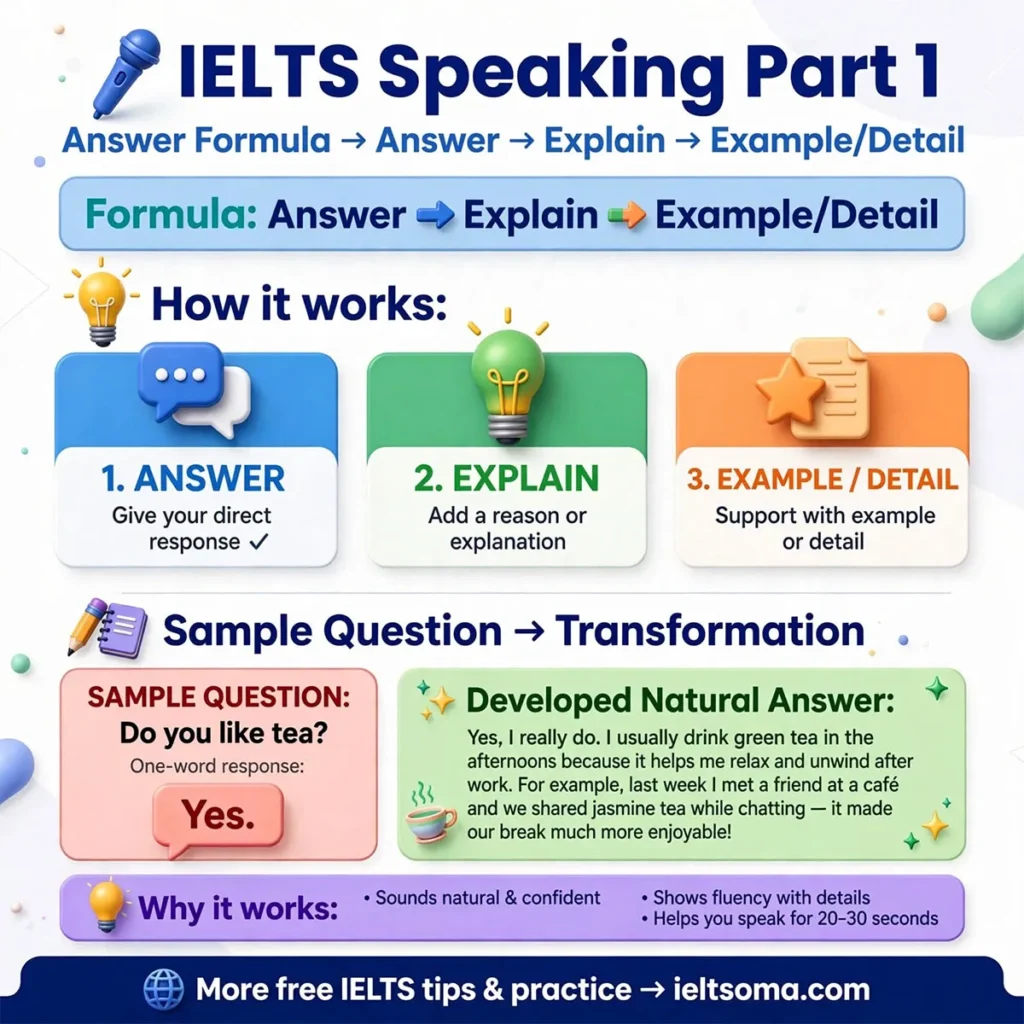
A useful approach is:
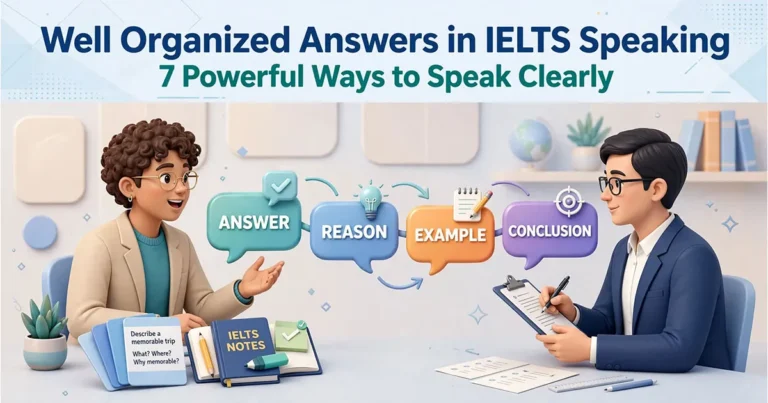
Answer → Explain → Example or Detail
You do not need to use this structure mechanically for every question. Think of it as a flexible framework that helps you avoid one-sentence answers.
Example 1: Hobbies
Question: Do you have any hobbies?
Short answer:
“Yes, I like photography.”
Extended answer:
“Yes, I’m quite interested in photography. I usually take pictures when I travel or visit interesting places in my city. I’m not a professional photographer, but I enjoy trying to capture unusual buildings and landscapes.”
The answer develops naturally:
Answer: Yes, I’m interested in photography.
Explanation: I usually take pictures when I travel.
Detail: I particularly like buildings and landscapes.
That is much more useful than simply saying, “Yes, I like photography.”
1. Give a Direct Answer First
One of the easiest ways to improve your IELTS Speaking Part 1 answers is to answer the question immediately.
Suppose the examiner asks:
Do you enjoy reading?
Avoid starting with:
“Well, actually, I suppose that depends because there are many different types of books and…”
The examiner has asked a simple question. Give your answer first.
“Yes, I really enjoy reading, especially non-fiction books.”
You can then explain why.
“I particularly like books about psychology and business because I can usually learn something practical from them.”
This makes your response easy to follow.
A simple rule
Do not make the examiner wait for your answer.
Start with your main idea, then develop it.
2. Extend Part 1 Answers with a Reason
One of the simplest ways to extend Part 1 answers is to explain why.
Consider this question:
Do you like your hometown?
Instead of:
“Yes, I like my hometown.”
Try:
“Yes, I do. I like it mainly because it’s quite peaceful, and most of my relatives still live there.”
The word because naturally creates an opportunity to develop your response.
Other useful expressions include:
- because…
- mainly because…
- one reason is that…
- I think this is because…
- the main reason is…
- probably because…
Example
Question: Do you enjoy your job?
“Yes, I do. The main reason is that I get to work with different people every day, so my work rarely feels repetitive.”
The answer is still short enough for Part 1, but it contains a clear idea and supporting explanation.
3. Add a Specific Detail
A reason is useful, but a specific detail can make your response sound much more natural.
Question: What do you usually do at weekends?
Weak:
“I usually relax at home.”
Better:
“I usually relax at home at weekends. I often watch a film or cook something with my family, especially on Sunday evenings.”
The second answer gives the examiner something concrete.
Specific details could include:
- when you do something
- where you do it
- who you do it with
- how often you do it
- what you particularly enjoy about it
For example:
“I usually go for a walk in the evening, particularly after dinner. There’s a park near my home, so I often walk there for about half an hour.”
You are not trying to sound impressive. You are simply giving the listener more information.
4. Use Personal Examples
Personal examples are particularly useful for IELTS Speaking Part 1 questions and answers because many Part 1 topics concern your own experiences.
Consider:
Do you enjoy cooking?
“Yes, I do. I learned to cook a few basic dishes when I was at university, and I’ve gradually become more interested in it. These days, I particularly enjoy making pasta because it’s quick and I can change the ingredients depending on what I have at home.”
Notice the progression:
Opinion → background → present habit → specific example
You don’t need an extraordinary story.
An ordinary experience expressed clearly is perfectly suitable.
5. Compare the Past and Present
Another effective way to extend an answer is to mention how your habits have changed.
Question: Do you watch much television?
“Not as much as I used to. When I was younger, I watched television almost every evening, but these days I usually watch programmes online when I have some free time.”
This creates development without forcing additional information.
Useful phrases include:
- I used to…
- When I was younger…
- In the past…
- These days…
- Nowadays…
- Compared with the past…
- I don’t … as much as I used to.
Example
Question: Do you like shopping?
“Yes, although I shop quite differently now. When I was younger, I enjoyed going to shopping centres with friends, but nowadays I usually buy things online because it saves time.”
This sounds conversational because the answer contains a natural change over time.
6. Explain Preferences Instead of Listing Them
Candidates sometimes respond to questions with lists.
Question: What kind of music do you like?
“I like pop, rock, classical music and jazz.”
This answers the question, but it doesn’t give the examiner much development.
A better response would be:
“I mainly listen to pop and soft rock. I tend to choose fairly relaxed music because I often listen to it when I’m working or travelling. I occasionally listen to classical music as well, particularly when I want something quieter.”
You have given:
- your main preference
- a reason
- a situation
- a secondary preference
That is a much richer response.
7. Don’t Try to Make Every Answer Long
This is one of the most important points about how to answer IELTS Speaking Part 1.
Extending an answer does not mean speaking for as long as possible.
Part 1 contains a series of questions, so the examiner needs to move through different topics. If you give a very long answer to every question, you may sound rehearsed and may prevent the examiner from asking the planned questions.
Your goal is development, not maximum length.
For many straightforward questions, two or three connected sentences may be enough.
For example:
Question: Do you like coffee?
“Yes, I do. I usually have one cup in the morning because it helps me feel more awake. I don’t drink much of it later in the day, though.”
That’s developed, but not unnecessarily long.
A Practical Formula for Extending Part 1 Answers
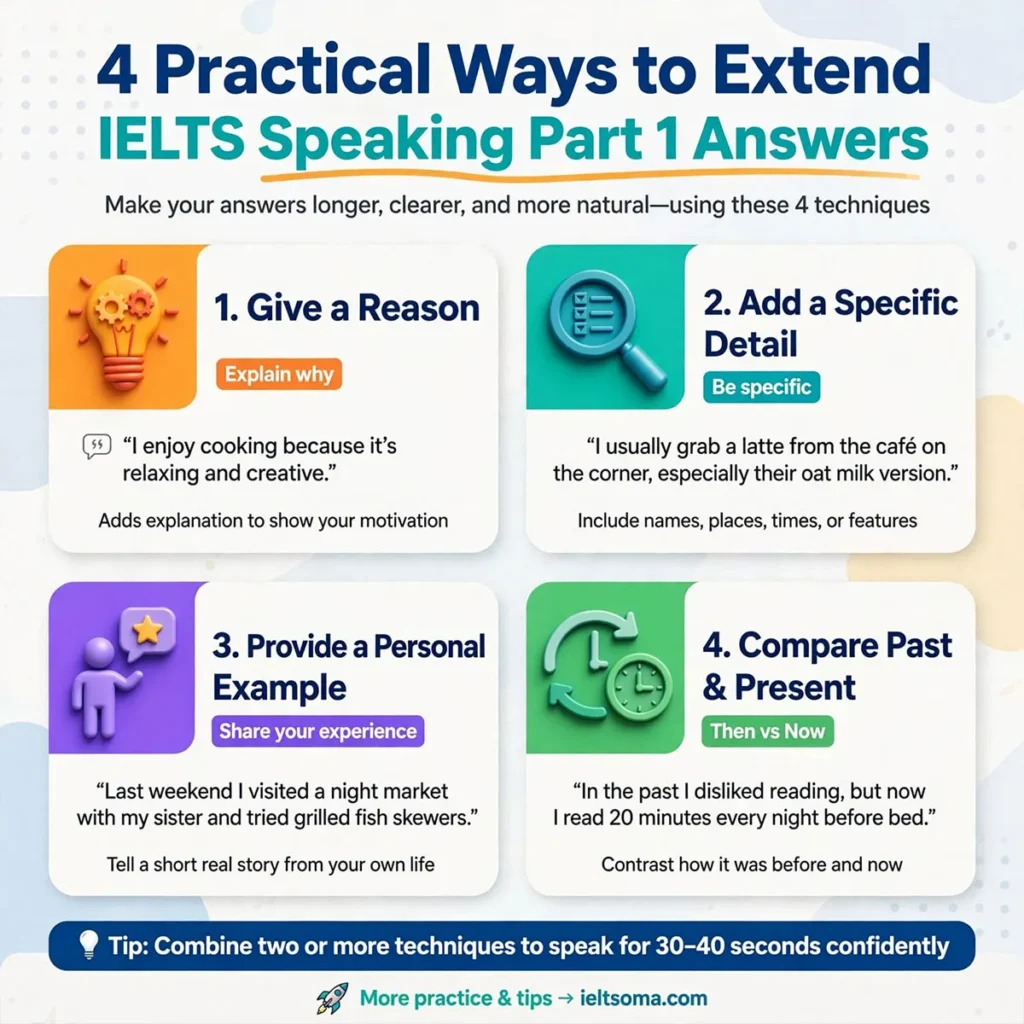
When you need more ideas, use this mental checklist:
Answer + Why + Detail + Example
You don’t have to use all four every time.
Question
Do you enjoy spending time outdoors?
Answer
“Yes, I really enjoy it.”
Why
“I find it a good way to relax after a busy day.”
Detail
“I usually go for a walk in the evening.”
Example
“There’s a small park near my home, so I sometimes walk there while listening to podcasts.”
Combined:
“Yes, I really enjoy spending time outdoors. I find it a good way to relax after a busy day, so I usually go for a walk in the evening. There’s a small park near my home, and I sometimes walk there while listening to podcasts.”
That’s a natural, developed Part 1 response.
Common IELTS Speaking Part 1 Topics
Part 1 focuses on familiar subjects, so you should prepare ideas rather than memorise complete answers.
Common areas include:
Home and Accommodation
You may be asked about:
- where you live
- your home
- your favourite room
- your neighbourhood
- things you would like to change
Work and Studies
Possible areas include:
- your job
- your studies
- favourite subjects
- future plans
- colleagues or classmates
Family and Friends
Questions may involve:
- family members
- spending time with friends
- childhood friends
- social activities
Hobbies and Free Time
You might discuss:
- reading
- music
- films
- sports
- photography
- cooking
- outdoor activities
Daily Life
Other familiar topics can include:
- mornings
- evenings
- weekends
- shopping
- food
- transport
- technology
The exact questions can vary, so memorising a fixed list of answers is not a reliable strategy.
IELTS Speaking Part 1 Questions and Answers: Sample Practice
Here are several examples showing how you can develop responses naturally.
Topic: Your Home
Question: What do you like about your home?
“I like the fact that it’s quite spacious and gets a lot of natural light. My favourite area is probably the living room because that’s where my family usually spends time together in the evening.”
Topic: Work
Question: What do you like about your work?
“I like the variety. I don’t do exactly the same thing every day, and I get the opportunity to work with different people. That keeps the job interesting for me.”
Topic: Food
Question: What kind of food do you like?
“I’m particularly fond of spicy food. I enjoy it because it has a lot of flavour, and I usually prefer meals with plenty of vegetables and different spices.”
Topic: Reading
Question: Do you enjoy reading?
“Yes, especially when I have some quiet time. I tend to read non-fiction because I like learning about new subjects, although I occasionally read novels when I want to relax.”
Topic: Weekends
Question: What do you normally do at weekends?
“I usually have a fairly relaxed weekend. I catch up on things I haven’t had time to do during the week, and I normally spend some time with my family as well.”
Notice that none of these answers depends on unusually advanced vocabulary.
The strength comes from relevance, development, clarity and natural language.
How Much Should You Speak in Part 1?
There is no official rule saying that every Part 1 answer must contain a particular number of words or sentences.
Instead, focus on giving enough information to develop your response naturally.
A useful practice target is often two to four connected sentences, but this is a preparation guideline rather than an IELTS scoring rule.
A simple question may only require two sentences.
A question that invites an opinion or explanation may naturally produce three or four.
Do not count your sentences during the actual test. Concentrate on communicating your answer.
Should You Memorise IELTS Speaking Part 1 Answers?
Memorising complete answers is risky.
The examiner may ask a question in a slightly different way, or ask a follow-up question that takes you away from your prepared response.
If you have memorised:
“My favourite hobby is reading because it allows me to broaden my horizons…”
you may become uncomfortable if the examiner asks:
“Did you enjoy reading when you were a child?”
Instead, prepare ideas, vocabulary and personal experiences.
For example, for the topic of reading, think about:
- what you read
- when you read
- where you read
- why you like it
- how your reading habits have changed
Then construct your answer naturally.
This approach also helps you respond to unfamiliar questions.
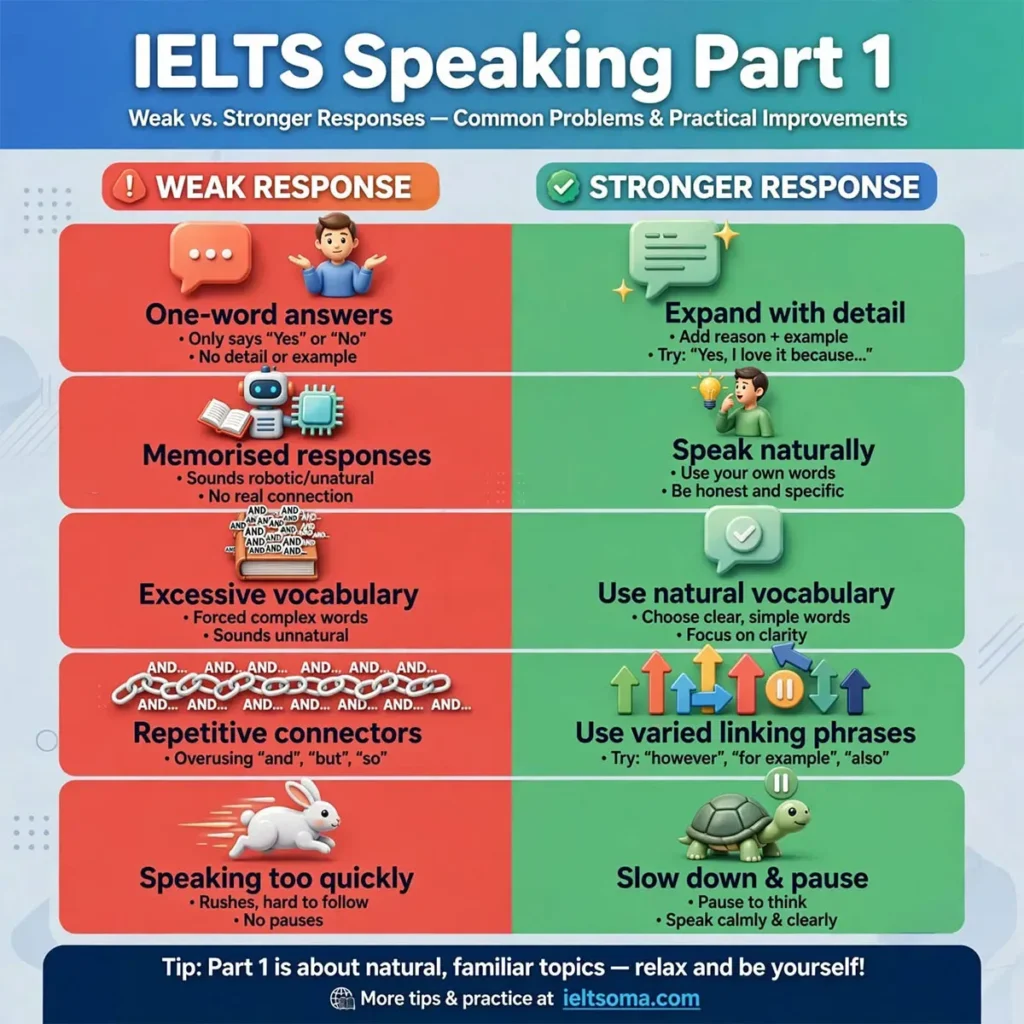
Common Mistakes in IELTS Speaking Part 1
Mistake 1: Giving One-Word Answers
“Yes.”
“No.”
“Sometimes.”
These answers may be technically responsive, but they provide little opportunity to demonstrate your speaking ability.
Add a reason or detail.
Mistake 2: Giving a Memorised Speech
A memorised response can sound disconnected from the question.
Always listen carefully to the exact question before responding.
Mistake 3: Using Advanced Vocabulary Incorrectly
Don’t choose complicated vocabulary simply because you think it sounds like Band 8 or Band 9 English.
Accurate, appropriate vocabulary is more useful than impressive-looking words used incorrectly.
Mistake 4: Repeating the Same Connectors
If every answer begins:
“Well, actually…”
and every explanation uses:
“because…”
your speech may become repetitive.
Use natural variation, but don’t force complicated linking expressions into simple conversations.
Mistake 5: Speaking Too Quickly
Fast speech is not automatically fluent speech.
The official Speaking criteria consider fluency and coherence, including the continuity and organisation of spoken language.
Aim for a comfortable pace that allows you to organise your ideas and pronounce words clearly.
Mistake 6: Avoiding Personal Answers
Part 1 is about familiar topics and your own experiences.
If the question asks about your favourite food, you don’t need to give a general lecture about global food culture.
Talk about your preferences.
How to Practise IELTS Speaking Part 1
Effective practice should simulate the actual interaction rather than simply involve reading model answers.
Try this routine:
Step 1: Choose a Topic
Select a familiar topic such as:
- home
- work
- studies
- food
- hobbies
- friends
- weekends
Step 2: Ask Yourself Five Questions
For example, for hobbies:
- What hobbies do you have?
- When did you start?
- How often do you do them?
- Why do you enjoy them?
- Have your hobbies changed?
Step 3: Answer Without Writing a Script
Speak naturally.
If you get stuck, don’t immediately stop. Try to explain the idea using simpler language.
Step 4: Record Yourself
Listen for:
- long pauses
- repeated words
- incomplete sentences
- unclear pronunciation
- grammatical errors
- answers that are too short
Step 5: Repeat the Answer
Give the same answer again, but improve one or two weaknesses.
This is much more productive than simply memorising another model answer.
A Better Way to Think About Part 1
Don’t think:
“How can I make my answer long?”
Think:
“How can I make my answer complete?”
That small change in mindset can improve your responses considerably.
For example:
Question: Do you like your city?
Incomplete:
“Yes, I do. It’s nice.”
Complete:
“Yes, I do. I particularly like the atmosphere because there are plenty of places to visit and lots of restaurants nearby. I also have most of my friends in the area, so I spend quite a lot of time there.”
The second response isn’t successful because it is long.
It works because each sentence contributes something relevant.
Expert Tips for Higher-Band Speaking
If you’re aiming for a higher Speaking band, don’t focus exclusively on adding difficult words.
Work on the four areas the IELTS Speaking assessment actually measures: fluency and coherence, lexical resource, grammatical range and accuracy, and pronunciation.
For Fluency
Practise speaking continuously without preparing every sentence in advance.
For Vocabulary
Learn useful expressions in context rather than memorising isolated synonyms.
For Grammar
Practise combining simple and more complex structures accurately.
For Pronunciation
Focus on clear speech, word stress, sentence stress, rhythm and intelligibility rather than trying to copy a particular accent.
The official criteria emphasise the ability to communicate meaning clearly and understandably.
A Simple Part 1 Answer Template
When you are unsure how to develop an answer, use:
Direct answer + reason + personal detail
For example:
Question: Do you enjoy travelling?
“Yes, I really enjoy travelling. I like it because I get to experience places that are completely different from my normal routine. I particularly enjoy visiting cities with interesting architecture and local food.”
You can also use:
Answer + past/present comparison
or:
Answer + reason + example
or:
Answer + frequency + explanation
These are frameworks, not scripts.
The objective is to help you organise your thoughts while still sounding like yourself.
FAQs About IELTS Speaking Part 1
How long is IELTS Speaking Part 1?
IELTS Speaking Part 1 lasts approximately 4–5 minutes. It consists of questions about familiar topics and everyday experiences.
How should I answer IELTS Speaking Part 1 questions?
Give a direct answer first and then develop it with a reason, explanation, example or personal detail. Avoid answers that are unnecessarily short, but don’t turn simple questions into long speeches.
How can I extend Part 1 answers?
You can extend Part 1 answers by explaining why, giving a specific detail, providing a personal example, discussing frequency or comparing your current habits with the past.
Should I memorise IELTS Speaking Part 1 questions and answers?
You should practise common topics and prepare ideas, but avoid memorising complete answers. Flexible preparation makes it easier to respond naturally when the examiner changes the wording or asks a follow-up question.
How many sentences should I speak in IELTS Speaking Part 1?
There is no official sentence requirement. As a practical preparation guideline, two to four connected sentences may be enough for many questions, depending on what the examiner asks.
What topics are common in IELTS Speaking Part 1?
Part 1 focuses on familiar subjects such as your home, family, work, studies, interests and everyday experiences.
Does IELTS Speaking Part 1 require advanced vocabulary?
No. You need vocabulary that allows you to express your meaning accurately and appropriately. The Speaking assessment considers lexical resource alongside fluency, grammar and pronunciation.
Can I give personal examples in Part 1?
Yes. Personal details and examples can help you develop an answer naturally, particularly when the question asks about your preferences, habits or experiences.
Is IELTS Speaking Part 1 the same for Academic and General Training?
Yes. The IELTS Speaking test is the same for Academic and General Training.
Final Strategy: Answer, Develop and Stay Natural
Success in IELTS Speaking Part 1 is not about producing a memorised speech or filling every answer with sophisticated vocabulary.
Listen carefully.
Answer the question directly.
Then give the examiner something more.
Explain why.
Add a specific detail.
Give a personal example when appropriate.
Compare the past and present if it genuinely fits the question.
Most importantly, keep your response natural.
A strong Part 1 answer is not necessarily the longest answer. It is an answer that communicates a clear idea, develops it appropriately and gives you the opportunity to demonstrate your English.
Before your test, practise a wide range of familiar topics, record your responses and listen critically to your own performance. Over time, you should become more comfortable developing ideas without relying on memorised scripts.
For official information about the Speaking test format and assessment, use the IELTS Speaking test format and assessment guidance.
Further Reading: