Many IELTS Listening mistakes happen before the answer is even spoken.
You look at a question, see a blank, and wait for the recording to give you the answer. By the time you recognise it, the speaker has already moved on.
A better approach is to predict what you are likely to hear before the recording reaches the question.
This does not mean trying to guess the exact answer. Instead, you use the question, surrounding words, grammar and context to anticipate the answer type. You may predict that the gap needs a price, a person’s name, a place, a date, a noun, or a plural noun. When the recording begins, your brain is listening for a much smaller target.
That is the foundation of an effective IELTS Listening prediction strategy.
Table of Contents
What Is IELTS Listening Prediction?
IELTS Listening prediction means analysing a question before or while listening and anticipating what kind of information is likely to complete the answer.
For example:
The course begins on ______.
Before listening, you can predict that the answer is probably a date, day or time.
Or:
Students must bring their own ______.
The grammar and meaning suggest that the answer is likely to be a noun, probably an object or item.
You are not predicting the exact word. You are predicting the shape of the answer.
This distinction is important because IELTS Listening recordings contain plenty of information that is irrelevant to a particular question. Prediction helps you focus your attention on the information most likely to matter.
The IELTS Listening test has four parts and 40 questions. The questions generally follow the order of the information in the recording, and the recording is heard once only. These features make preparation before each section particularly valuable.
Why Is Prediction So Important in IELTS Listening?
Imagine that you see this question:
The new library will open on ______.
You could listen to every word of the recording with equal attention.
Or you could immediately think:
Answer type: day/date
When the speaker says:
“The original plan was to open it on Monday, but because of the final safety inspection, the opening has been moved to Thursday.”
you are already listening for a day or date.
You may even notice that Monday is not the answer because the speaker corrects it.
Prediction therefore gives your listening a purpose.
It helps you:
- focus on relevant information
- recognise answers more quickly
- anticipate vocabulary
- understand the grammatical structure of a sentence
- distinguish important information from supporting details
- recover more easily when you miss a word
- reduce the mental pressure of listening to every word
Official IELTS guidance also describes anticipation as an important Listening skill and recommends using the preparation time to anticipate topics and the type of information needed.
The Most Important Rule: Predict the Answer Type
The most useful IELTS Listening answer prediction strategy is to ask:
“What kind of answer can logically fit here?”
Do not begin by asking:
“What exact word will they say?”
Start with the category.
Here are common answer types:
| Question clue | Likely answer type |
|---|---|
| The appointment is at ______. | Time |
| The meeting will take place on ______. | Day/date |
| The building is located on ______ Street. | Street/name |
| The fee is £______. | Number/price |
| Students need to bring ______. | Noun/item |
| The main problem was ______. | Noun/concept |
| The speaker describes the area as ______. | Adjective/description |
| The tour lasts ______ hours. | Number/duration |
| The first stage involves ______. | Noun/gerund |
| The programme is designed for ______. | Person/group/purpose |
This simple habit can dramatically improve your focus.
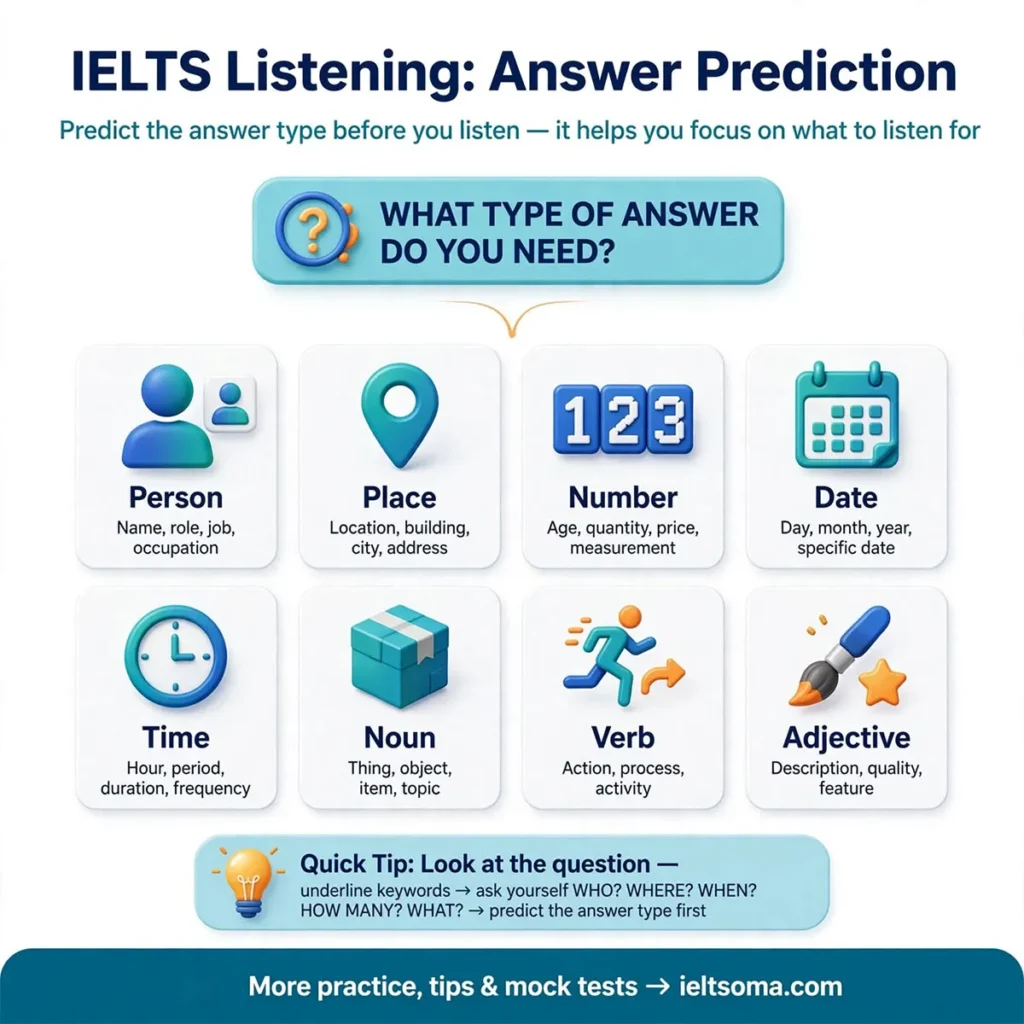
How to Predict Answers in IELTS Listening
A strong prediction process has several stages. You do not need to perform all of them consciously for every question. With practice, they become automatic.
1. Read the Question Before Listening
Use the preparation time to read ahead.
Do not simply read the questions from left to right without thinking about them.
Look for:
- key nouns
- names
- dates
- numbers
- locations
- verbs
- adjectives
- grammatical structures
- words that indicate relationships
For example:
The museum’s main entrance is next to the ______.
The phrase “next to the” is followed by a noun.
So you can predict:
Answer type = place/location
You might expect something such as:
- café
- reception
- car park
- library
- entrance
You do not need to choose one. You simply prepare your brain for a location.
2. Look at the Words Immediately Before the Gap
Grammar is one of your strongest prediction tools.
Consider:
Visitors are required to ______ their bags at reception.
After “to”, you need the base form of a verb.
Possible answers might include:
- leave
- register
- collect
- store
Now consider:
Visitors are required to leave their ______ at reception.
The grammatical prediction changes.
The answer is now likely to be a noun.
This is why students should not predict answers based only on the topic. Grammar can tell you what form the missing answer must take.
3. Look at the Words After the Gap
The words after the blank can also reveal the answer type.
For example:
The centre provides ______ for international students.
The blank is followed by “for”, so you should think about what makes sense grammatically and semantically.
Possible answers could be:
- accommodation
- support
- counselling
- information
The surrounding sentence narrows the possibilities.
4. Predict Singular or Plural
This is an especially useful part of predict answer type IELTS strategy.
Compare:
Students should bring a ______.
You expect a singular countable noun.
But:
Students should bring ______.
The answer could be plural or uncountable, depending on the rest of the sentence.
Another example:
The main causes of the problem are ______.
The phrase “causes … are” strongly suggests more than one item may be required.
This matters because a student might hear:
“The main cause was poor communication.”
but write communications because they were expecting a plural answer.
Always let the sentence structure guide your prediction.
5. Predict Numbers, Dates and Times
Numbers are common in IELTS Listening, especially in questions involving forms, bookings, schedules, prices and factual information.
For example:
The workshop starts at ______.
You should immediately expect a time.
If you see:
The total cost is £______.
you know you are listening for a price.
And:
The programme begins on ______.
suggests a day or date.
This preparation is valuable because numbers can be easy to miss when they are surrounded by other information.
The speaker may say:
“The original price was £150, but students can now register for £125.”
If you are already expecting a price, you are more likely to notice the correction and select £125 rather than the first number you hear.
6. Predict Vocabulary from the Topic
Grammar tells you the form of the answer. Context helps you predict the vocabulary.
Suppose the question is:
The university provides free ______ for new students.
If the surrounding questions are about student services, you might expect words connected with:
- accommodation
- transport
- orientation
- counselling
- information
- support
You are not trying to guess which word will appear.
You are creating a semantic field in your mind.
When the speaker uses a relevant word or synonym, it becomes easier to recognise.
This is particularly useful in Parts 3 and 4, where the vocabulary can be more academic.
7. Predict Synonyms, Not Just Exact Words
One of the biggest mistakes in IELTS Listening is expecting the recording to repeat the wording in the question.
It often will not.
For example:
Question:
The course is suitable for people who have little ______ experience.
You might predict:
Answer type = practical/work experience
But the recording may say:
“It is particularly useful for those who are new to the industry.”
The exact wording is different, but the meaning matches.
Good IELTS Listening prediction therefore includes predicting possible paraphrases.
If the question says:
- cheap → affordable
- start → begin
- problem → difficulty
- improve → enhance
- job → employment
- children → young people
- required → necessary
you should be prepared for the recording to use a related expression rather than the exact question wording.
8. Use the Question Sequence
The IELTS Listening questions generally follow the order of information in the recording.
This gives you another prediction advantage.
If you have just answered Question 12, you should normally prepare for information related to Question 13 rather than continue searching for Question 12.
For example:
12. The event takes place at ______.
13. Participants should bring ______.
14. The event finishes at ______.
Once you identify the answer to Question 12, shift your attention.
Do not keep analyzing the previous answer while the recording has moved forward.
Prediction works best when combined with forward attention.
A Practical IELTS Listening Prediction Strategy
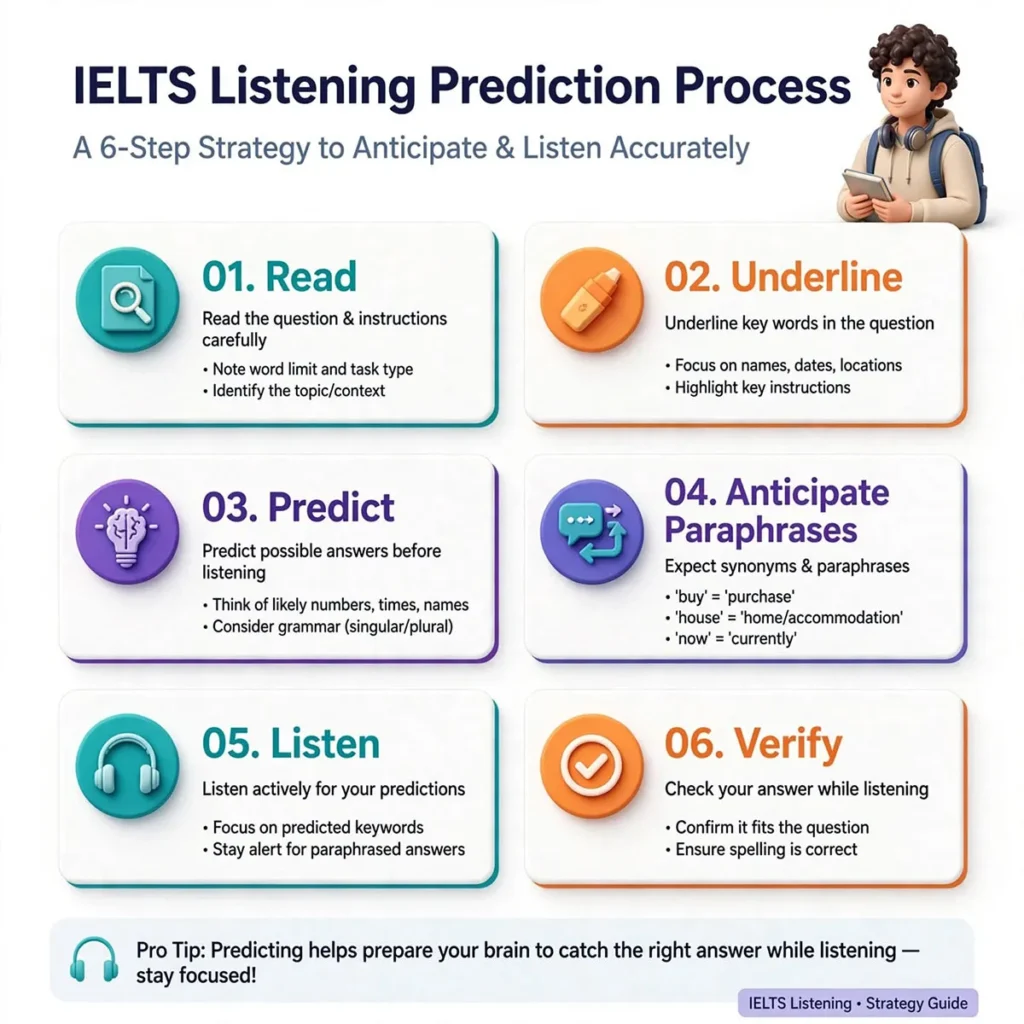
Use this six-step method whenever you practice.
Step 1: Read
Read the question carefully before the audio reaches it.
Step 2: Underline
Identify the key words that tell you what the question is about.
Step 3: Predict
Ask:
What type of answer do I need?
Then consider:
- noun?
- verb?
- adjective?
- person?
- place?
- number?
- date?
- time?
- plural?
- phrase?
Step 4: Anticipate Paraphrases
Think about words the speaker might use instead of the words in the question.
Step 5: Listen Carefully
Do not write an answer simply because it matches your prediction.
The recording decides the answer.
Your prediction is a listening guide, not evidence.
Step 6: Verify Your Answers
Keep checking your answers while listening.
Confirm that your answers fits the questions.
make sure your spellings are correct.
Example: Predicting an IELTS Listening Answer
Consider this question:
The new sports centre will provide ______ for local residents.
Before listening, analyse it.
Grammar:
The gap follows “provide”, so a noun or noun phrase is likely.
Context:
A sports centre could provide facilities, activities, equipment, classes or services.
Prediction:
Answer type = noun/noun phrase related to sports or services.
Now imagine the recording says:
“The centre will offer a range of fitness classes, including swimming, yoga and strength training.”
The answer could be fitness classes, depending on the exact task and wording.
Notice what happened.
You did not predict the exact words.
You predicted the category of information, which made the relevant part of the recording easier to identify.
Prediction for Different IELTS Listening Question Types
Prediction is useful across several Listening question types.
Form, Note, Table and Flow-Chart Completion
These are particularly suitable for prediction because the surrounding information often gives strong grammatical and contextual clues.
If you see:
Name: ______
Age: ______
Occupation: ______
Address: ______
you can predict the information type almost immediately.
The official IELTS test format includes form, note, table and flow-chart completion among its Listening task types.
Sentence Completion
Sentence completion provides excellent grammatical clues.
For example:
The project was delayed because of ______.
You can predict a noun or noun phrase describing a cause.
Multiple Choice
Prediction works differently here.
Do not immediately choose an option before listening.
Instead, identify the central difference between the options.
Suppose the choices are:
A. location
B. price
C. opening hours
Before listening, you can predict that the conversation will probably contain information allowing you to distinguish between these three possibilities.
Be particularly careful when the speaker mentions several options and then changes their mind.
Matching
Read the options before listening and identify the meaning of each.
If the options describe:
- location
- cost
- accessibility
- facilities
you can anticipate the type of information you need to associate with each person or item.
Map and Plan Labelling
Prediction is less about guessing vocabulary and more about predicting movement and location language.
Before listening, identify:
- the starting point
- entrances
- roads
- buildings
- compass directions
- obvious landmarks
Official IELTS guidance recommends using the limited preparation time to inspect the map or plan and identify useful reference points.
Be Careful: Prediction Is Not Guessing
This is the most important warning in this strategy.
Prediction does not mean inventing an answer before you hear the recording.
Suppose you see:
The hotel is ______ from the station.
You might predict:
Answer type = distance
But you should not write:
two kilometres
unless the recording actually gives that information.
Similarly, if you see:
The speaker’s main concern is ______.
you may predict:
Answer type = problem/issue
But several answers could fit grammatically.
Wait for the evidence.
Think of prediction as a filter:
Question → Prediction → Listening → Evidence → Answer
Not:
Question → Guess → Answer
Common IELTS Listening Prediction Mistakes
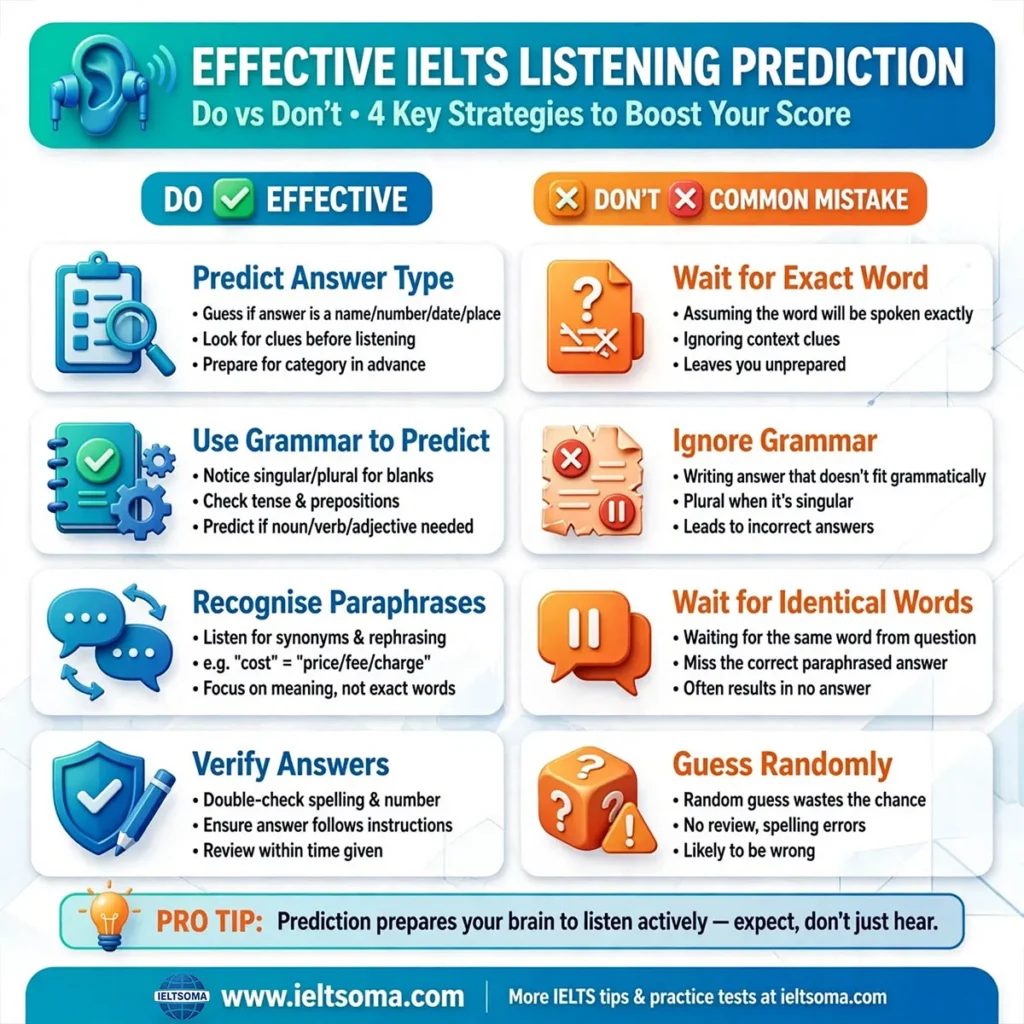
Mistake 1: Predicting the Exact Word
Prediction becomes dangerous when students become attached to their guess.
If you expect “accommodation” but hear “housing”, stay flexible.
Mistake 2: Ignoring Grammar
Students sometimes predict a topic but ignore the sentence structure.
Always ask what grammatical form can fit the gap.
Mistake 3: Writing the First Number You Hear
IELTS Listening frequently includes distracting information.
A speaker might mention an original price and then give a discounted price.
Listen for corrections and changes.
Mistake 4: Listening for Exact Words
The recording may paraphrase the question.
Train yourself to recognise meaning, not just identical vocabulary.
Mistake 5: Spending Too Long on One Question
If you miss an answer, make the best decision you can and move forward.
The next answer will not wait for you.
Mistake 6: Forgetting the Word Limit
Your prediction must still obey the instructions.
If the instruction says NO MORE THAN TWO WORDS AND/OR A NUMBER, an answer containing three words will not become correct simply because the information itself is accurate. Official IELTS guidance specifically warns test takers to follow the stated word limit.
How to Practise IELTS Listening Prediction
Do not practise prediction only by taking complete tests.
Instead, isolate the skill.
Practice 1: Answer-Type Prediction
Take 20 Listening questions without playing the audio.
For each question, write:
Answer type: ______
For example:
The lecture begins at ______.
Answer type: time
Do this until identifying answer types becomes automatic.
Practice 2: Grammar Prediction
Take sentence-completion questions and predict:
- noun
- verb
- adjective
- number
- plural noun
- noun phrase
Then check the transcript after completing the exercise.
Practice 3: Paraphrase Prediction
Underline important words in the question.
Before listening, write one or two possible synonyms.
For example:
reduce costs
Possible recording language:
cut expenses
lower expenditure
save money
This prepares you to recognise paraphrased information.
Practice 4: Transcript Analysis
After completing a Listening exercise, do not simply check your score.
Look at the transcript.
For every question, ask:
- What did I predict?
- What was the actual answer?
- What type of answer was required?
- Did the speaker paraphrase the question?
- Was there a distractor?
- What grammatical clue could I have used?
This turns a practice test into a learning exercise.
A 10-Minute Daily Prediction Routine
If your IELTS Listening score is stuck, add this short routine to your daily preparation.
Minutes 1–2:
Read 5–10 questions without audio.
Minutes 3–4:
Write the predicted answer type for each.
Minutes 5–6:
Identify likely synonyms or paraphrases.
Minutes 7–9:
Listen and complete the questions.
Minute 10:
Check your predictions against the transcript.
Your objective is not simply to get more questions correct.
You want to make your predictions faster, more accurate and more flexible.
How Prediction Can Help You Reach a Higher Listening Score
Prediction is only one component of strong Listening performance.
You also need:
- vocabulary knowledge
- pronunciation awareness
- concentration
- spelling accuracy
- understanding of paraphrases
- familiarity with question types
- the ability to follow changing speakers
- awareness of distractors
For example, IELTS reports Listening scores on a 40-question scale, with each correct answer receiving one mark before conversion to the 9-band scale. The exact number of correct answers needed for a particular band can vary slightly between test versions.
If you are aiming for Band 7, even a few additional correct answers can matter. Prediction can help because it reduces the amount of information competing for your attention.
The Best Mental Habit for IELTS Listening
Before every question, train yourself to think:
“What am I listening for?”
Not:
“What is the answer?”
That small difference changes the way you listen.
If the question requires a price, listen for numbers and currency.
If it requires a place, listen for locations.
If it requires an opinion, listen for evaluative language.
If it requires a noun, use the grammar around the gap.
If the question contains a key concept, anticipate possible paraphrases.
You are effectively giving your brain a search target before the audio starts.
IELTS Listening Prediction Checklist
Before the recording reaches a question, ask:
- What is the question about?
- What information is missing?
- What grammatical form should fit?
- Is the answer likely singular or plural?
- Could it be a number, date or time?
- What words might the speaker use instead?
- Are there likely distractors?
- What information comes immediately before and after this question?
- What is the word limit?
- Am I predicting the answer type rather than guessing the exact answer?
If you can answer these questions quickly, your prediction skill is developing.
FAQs About IELTS Listening Prediction
What does IELTS Listening prediction mean?
IELTS Listening prediction means using the question, grammar and context to anticipate what type of information you need to hear. You might predict a name, place, number, date, noun, adjective or other answer type before the recording provides the answer.
How to predict answers in IELTS Listening?
Read the question before listening, identify the key words, analyze the grammar around the gap, predict the answer type and think about possible paraphrases. Then listen for evidence rather than assuming your prediction is correct.
What is the best IELTS Listening answer prediction strategy?
The most reliable strategy is to predict the answer type first. For example, identify whether you need a number, place, person, noun, verb, date or time. Then anticipate possible vocabulary and paraphrases before listening.
How do I predict answer type in IELTS?
Look at the words immediately before and after the blank. Grammar often gives you the strongest clue. For example, “at ______” may suggest a time, while “three ______” normally requires a plural noun.
Should I guess the answer before hearing the IELTS Listening recording?
You should predict the likely answer type, but you should not commit to an exact answer without evidence. Prediction prepares your attention; the recording determines the final answer.
Does IELTS Listening prediction work for Part 4?
Yes. Prediction can be especially useful in Part 4 because you can often identify the topic, key concepts and grammatical answer types before the lecture develops. It can help you focus on important information while following a continuous monologue.
Can prediction help with multiple-choice questions?
Yes, but use it differently. Instead of predicting one option immediately, compare the options and identify the information that will distinguish them. Then listen carefully for the speaker’s actual meaning.
How can I improve my IELTS Listening prediction skills?
Practice predicting answer types without audio, analyze transcripts after listening exercises, study paraphrases and review why each answer was correct. The goal is to make the prediction process fast and automatic.
Final Takeaway
The strongest IELTS Listening candidates do not simply wait for answers to appear.
They prepare their attention before the answer arrives.
When you see a question, identify what information is missing. Use grammar to predict the answer form. Use context to predict the vocabulary field. Think about paraphrases. Then listen actively and verify your prediction against what the speaker actually says.
The key sequence is simple:
Read → Predict → Listen → Verify → Move on
Master that habit, and IELTS Listening prediction becomes much more than a test trick. It becomes a practical listening skill that helps you process spoken English more efficiently under exam conditions.
Further Reading: