You start IELTS preparation with a clear goal.
Perhaps you want a place at a university abroad. Perhaps you need a particular score for professional registration. Maybe IELTS is one of the final steps before you can work, study or move to another country.
For the first few days, everything feels exciting.
Then reality arrives.
You miss a study session. Your Reading score drops. A Writing practice test exposes the same grammar mistakes you thought you had fixed. You listen to an English recording and suddenly feel that everyone speaks faster than you can understand.
This is where staying motivated for IELTS becomes more important than simply finding another vocabulary list or practice test.
After years of helping IELTS candidates understand the test and improve their English, one lesson is clear: successful preparation is rarely about studying for hours every day. It is about knowing what you are working towards, practicing the right things consistently and continuing when your confidence temporarily falls.
This guide explains how to make that happen.
Table of Contents
Why Staying Motivated for IELTS Is So Difficult
IELTS preparation can feel like a long journey because you are developing several different skills at the same time.
IELTS assesses Listening, Reading, Writing and Speaking. Academic and General Training candidates take the same Listening and Speaking tests, while the Reading and Writing components differ.
That means your preparation can contain very different tasks.
One day you may be analysing a Reading passage. The next day you may be practising a formal letter, writing an Academic Task 1 response, recording yourself speaking or completing a Listening test.
Progress is also not always linear.
You might score 7.0 in Reading today and 6.5 tomorrow. That does not automatically mean your ability has deteriorated.
Motivation becomes difficult when candidates expect every study session to produce an obvious improvement.
Instead, think of IELTS preparation as building a skill.
Your job is not to feel motivated every day.
Your job is to keep moving forward even on the days when motivation is low.
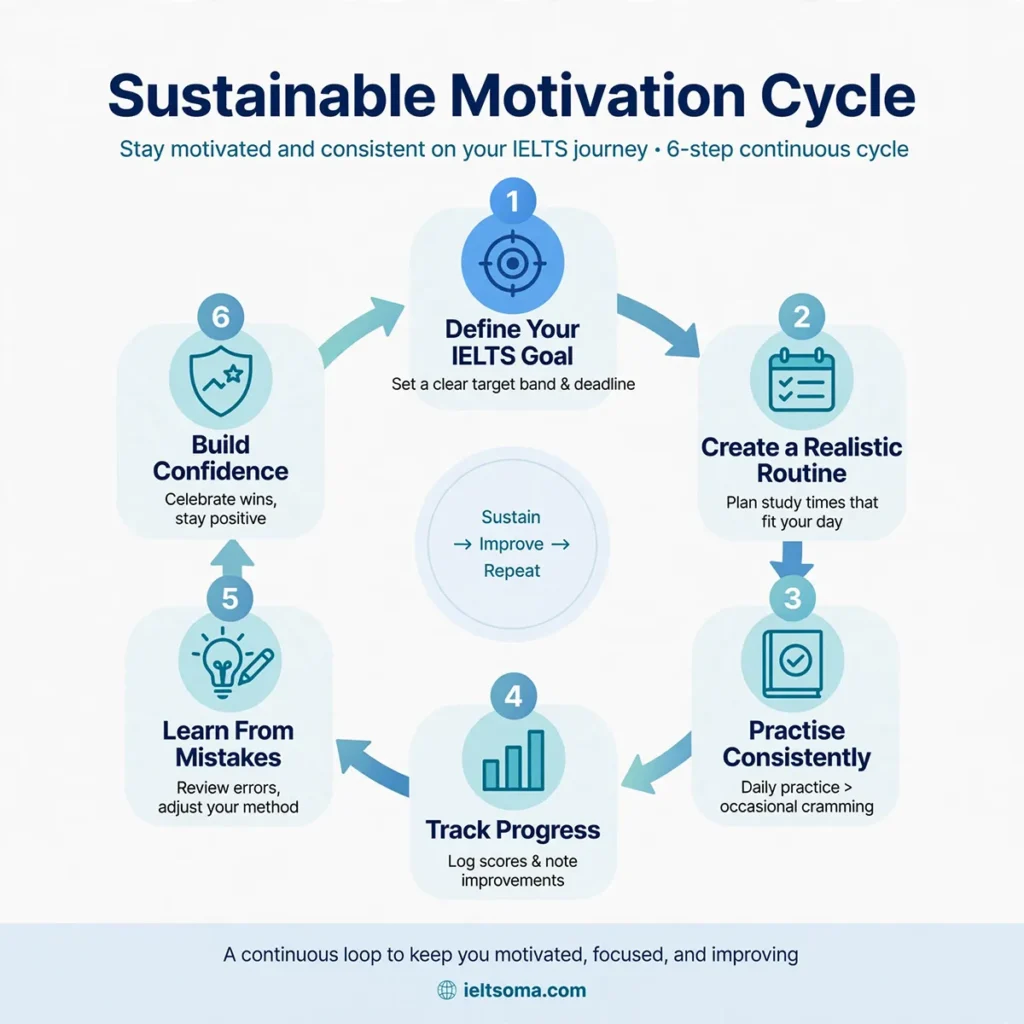
1. Connect IELTS to a Specific Life Goal
One of the strongest ways of staying motivated for IELTS is to stop thinking about IELTS as the final destination.
IELTS is usually a bridge to something else.
Ask yourself:
- What will my target IELTS score allow me to do?
- Which university, profession or opportunity am I preparing for?
- Why does achieving this score matter to me?
- What changes if I reach my target?
- What will I be able to pursue afterwards?
Write your answers somewhere you will see them regularly.
For example:
“I need an overall 7.0 because I want to meet the English-language requirement for my postgraduate application.”
That is much more powerful than:
“I need to study IELTS.”
The first statement connects daily practice with a meaningful outcome.
Your reason does not need to be dramatic. It simply needs to matter to you.
2. Set a Score Target You Can Measure
“Improve my English” is too vague to motivate effective IELTS preparation.
A better goal is specific.
For example:
Overall target: 7.0
Listening: 7.5
Reading: 7.0
Writing: 6.5
Speaking: 7.0
Your exact targets should be based on the requirements of the organisation, university, employer or immigration pathway you are applying to. Do not assume that every institution requires the same score.
Once you have a target, establish your current position.
Take an appropriate practice test under realistic conditions. Then identify the difference between your current performance and your required score.
This changes your mindset.
Instead of thinking:
“My IELTS is not good enough.”
You can think:
“My Writing needs focused improvement in organisation and grammatical accuracy.”
That is a problem you can work on.
3. Stop Waiting for Motivation
Here is one of the most important principles of staying motivated for IELTS:
Do not make motivation a requirement for studying.
Motivation comes and goes.
A routine is more dependable.
You may not feel like completing a Listening practice session after a long day at work. You may not want to write an essay after attending classes. You may prefer to scroll through social media instead of reviewing your vocabulary.
That is normal.
Make the starting point extremely small.
Tell yourself:
“I will study for just 15 minutes.”
Once you begin, continuing often becomes easier.
If you still feel exhausted after 15 minutes, you can stop or switch to a lighter activity.
The objective is to remove the psychological barrier between “I should study” and actually starting.
4. Create a Realistic IELTS Study Routine
A realistic routine is essential for staying motivated for IELTS because an unrealistic timetable eventually creates guilt.
You do not need to study every skill every day.
For example:
| Day | Main Focus | Suggested Activity |
|---|---|---|
| Monday | Reading | One timed passage + error review |
| Tuesday | Writing | Task 2 planning and one body paragraph |
| Wednesday | Listening | One practice section + transcript review |
| Thursday | Speaking | Part 2 recording + self-evaluation |
| Friday | Vocabulary & Grammar | Review mistakes and useful language |
| Saturday | Full Practice | Timed test or selected sections |
| Sunday | Review | Analyse errors and plan next week |
The important point is consistency.
A focused 45-minute session can be more useful than three distracted hours.
Your routine should fit your actual life.
If you work eight hours a day, have family responsibilities and commute regularly, do not create a timetable designed for someone with unlimited free time.
5. Track Progress Instead of Counting Study Hours
Many IELTS candidates say:
“I studied for three hours today.”
But study time alone does not tell you whether preparation was effective.
Instead, track outcomes.
For example:
- I identified five recurring Reading mistakes.
- I completed a Listening section with 31 correct answers.
- I recorded two Speaking answers and noticed repeated hesitation.
- I wrote a Task 2 introduction and improved its clarity.
- I learned ten useful words and used five correctly in sentences.
This creates evidence of progress.
Keep a simple IELTS progress log with three columns:
| Date | What I Practised | What I Improved |
|---|---|---|
| Monday | Reading: matching headings | Better identification of main ideas |
| Wednesday | Speaking Part 2 | Fewer long pauses |
| Friday | Writing Task 2 | Stronger paragraph structure |
This is especially useful when you feel that “nothing is improving”.
Your record can remind you that progress is often happening gradually.
6. Turn Weaknesses into Small Challenges
One of the biggest motivation killers is trying to fix everything at once.
Suppose your Writing score is below your target.
Do not simply write ten essays.
First identify the problem.
Is it:
- Task response?
- Coherence and cohesion?
- Vocabulary?
- Grammar?
- Paragraph organisation?
- Supporting ideas?
- Time management?
Then choose one improvement target.
For example:
This week’s challenge: Write clearer topic sentences.
You can then practise topic sentences repeatedly and review them.
Next week, focus on developing supporting ideas.
The following week, focus on grammatical accuracy.
This approach makes a large problem feel manageable.
The same principle works for Speaking, Reading and Listening.
Instead of saying “My Speaking is weak”, identify a specific behaviour you can improve.
7. Use Practice Tests Without Letting Scores Discourage You
Practice tests are useful, but they should not become a source of constant anxiety.
Official IELTS preparation materials are designed to help candidates become familiar with the test format, question types and timed conditions.
However, a practice score is information, not a judgement of your intelligence or future.
If you receive a disappointing result, ask:
What caused the mistakes?
For example:
“I got seven Reading questions wrong.”
That is not enough analysis.
Instead:
“Three errors came from True/False/Not Given questions, two came from losing track of paragraph information, and two came from rushing at the end.”
Now you have a training plan.
This mindset is crucial for staying motivated for IELTS.
Every mistake should ideally answer one question:
What should I do differently next time?
8. Protect Yourself from IELTS Burnout
More study is not always better.
If you are constantly tired, frustrated and unable to concentrate, forcing yourself through another full practice test may not be the smartest approach.
Watch for warning signs:
- You dread every study session.
- You cannot concentrate on basic tasks.
- You repeatedly make mistakes you normally avoid.
- You study for long periods but remember very little.
- You feel guilty whenever you take a break.
Rest is part of a sustainable preparation strategy.
Take breaks.
Sleep properly.
Maintain interests outside IELTS.
Exercise if it helps you manage stress.
Spend time with people who support you.
IELTS matters, but it should not consume your entire identity.
Healthy staying motivated for IELTS is about maintaining enough energy to continue preparing effectively.
9. Build Confidence Through Realistic Practice
Confidence should come from evidence, not positive thinking alone.
If your test is approaching, gradually introduce realistic conditions.
Practise with time limits.
Complete Listening and Reading tasks without unnecessary interruptions.
Practise Writing within the recommended time.
Record Speaking answers and listen back critically.
Official IELTS guidance confirms that the test assesses specific skills across the four components, so preparation should involve practising those skills rather than simply memorising general English vocabulary.
For example, if you are preparing for Writing Task 2, practise producing a complete response under time pressure.
Do not spend every session reading model essays.
You need to develop the ability to perform yourself.
That distinction can make a major difference to confidence.
Staying Motivated for IELTS in the Final Weeks
The final weeks can be psychologically difficult.
You may feel that you should be doing more.
You may compare yourself with other candidates online.
You may see someone claiming to have achieved a high band score in a few weeks and start questioning your own progress.
Do not let another person’s preparation become the standard for yours.
Instead, focus on three questions:
- What is my current level?
- What are my highest-impact weaknesses?
- What can I realistically improve before test day?
If you are already close to your target, your priority may be refinement rather than completely rebuilding your English.
If your Writing is consistently weaker than your other skills, allocate more focused practice to Writing.
If your Reading timing is causing problems, practise under timed conditions and analyse where you lose time.
The final stage should be strategic, not frantic.
Academic vs General Training: Does Motivation Strategy Change?
The basic principles of staying motivated for IELTS apply to both Academic and General Training candidates.
However, your practice materials must match the test you are taking.
IELTS Academic is designed for contexts such as undergraduate or postgraduate study and professional registration. IELTS General Training is designed around practical workplace, social and everyday contexts, including certain migration and training purposes.
Listening and Speaking are the same in Academic and General Training.
Reading and Writing are different.
Therefore, do not prepare with random materials simply because they are labelled “IELTS”.
Know your test.
Know your target.
Then make your preparation relevant to both.
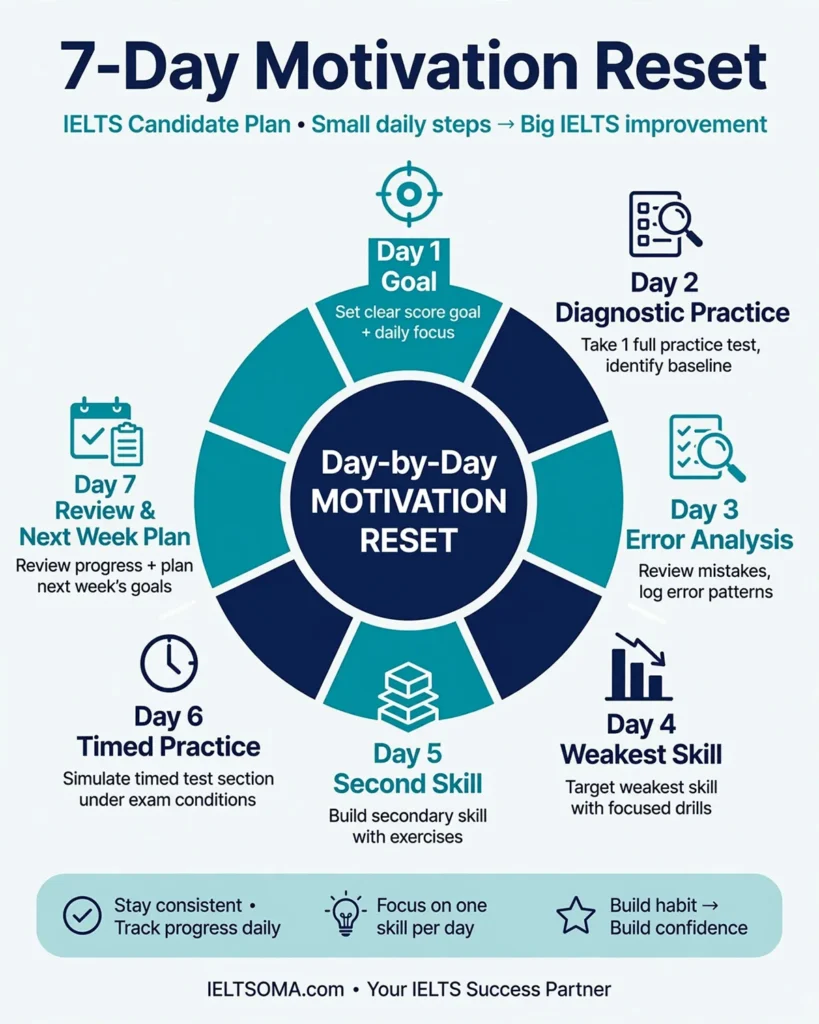
A Simple 7-Day Motivation Reset
If you have recently lost motivation, do not try to completely redesign your life overnight.
Use a seven-day reset.
Day 1: Write down your IELTS target and why it matters.
Day 2: Complete one diagnostic practice activity.
Day 3: Analyse your mistakes rather than doing another full test.
Day 4: Spend 30–60 minutes on your weakest skill.
Day 5: Practise a second skill using a specific measurable goal.
Day 6: Complete a timed activity.
Day 7: Review your progress and plan the following week.
At the end of seven days, ask:
“Am I closer to my target than I was one week ago?”
If the answer is yes, continue.
If the answer is no, adjust the strategy rather than simply studying for longer.
Frequently Asked Questions About Staying Motivated for IELTS
How do I stay motivated for IELTS when I keep getting low practice scores?
Treat low scores as diagnostic information. Identify the type and cause of your mistakes, then create a focused improvement plan. A low practice score can show you exactly where your preparation needs to change.
How many hours should I study IELTS every day?
There is no universal number of hours that guarantees a particular IELTS score. Your required preparation time depends on your current English level, target score, available time and weaknesses. A consistent, focused routine is usually more sustainable than an extreme timetable.
What should I do when I do not feel like studying IELTS?
Reduce the size of the task. Commit to 15 minutes, one Reading passage, one Speaking recording or one Writing paragraph. Starting is often easier when the task feels manageable.
How can I stay motivated for IELTS for several months?
Connect your IELTS preparation to your larger goal, track measurable progress and divide your preparation into weekly objectives. Avoid judging your progress solely by daily practice scores.
Should I take a full IELTS practice test every week?
Not necessarily. Full tests can help you practise timing and endurance, but you also need time to analyse mistakes and improve specific skills. A practice test without proper review can have limited value.
Is motivation more important than an IELTS study plan?
You need both, but a good plan reduces your dependence on motivation. When your next task is already decided, you have fewer decisions to make and can concentrate on completing the work.
How can I stay motivated for IELTS Speaking practice?
Make Speaking practice active and measurable. Record yourself, answer questions under realistic conditions, identify repeated problems and practise those specific areas again. Speaking confidence develops through repeated performance.
Can I stay motivated while preparing for Academic and General Training IELTS?
Yes. The motivation principles are the same, but your preparation should match your test type. Academic and General Training have different Reading and Writing components, so use the appropriate practice materials.
What if I have failed IELTS before?
A previous result does not define your next result. Start by identifying why you missed your target. Was the issue language ability, test strategy, timing, task response, accuracy or exam-day performance? Once you understand the problem, your next preparation cycle can become much more targeted.
Conclusion
Staying motivated for IELTS does not mean feeling excited about studying every morning.
It means having a reason to continue when the excitement disappears.
Your preparation will probably include good days and bad days. Some practice scores will surprise you. Some skills will improve faster than others. You may occasionally wonder whether your target is realistic.
That is part of the process.
Keep your goal visible.
Break large weaknesses into smaller problems.
Build a routine that fits your real life.
Measure improvement instead of obsessing over study hours.
Use practice tests to diagnose problems rather than judge yourself.
Most importantly, remember why you started.
IELTS is not simply four test sections. For many candidates, it is a step towards university, professional registration, employment, migration or another important personal goal.
You do not need perfect motivation.
You need a system that helps you keep moving.
That is the real secret to staying motivated for IELTS.
Further Reading: