If your IELTS test date is getting closer, you may not need more random study material—you need the right resources, in the right order, with a clear plan.
The best IELTS Preparation Resources help you understand the test, practise realistic tasks, identify weaknesses, and turn every study session into measurable progress.
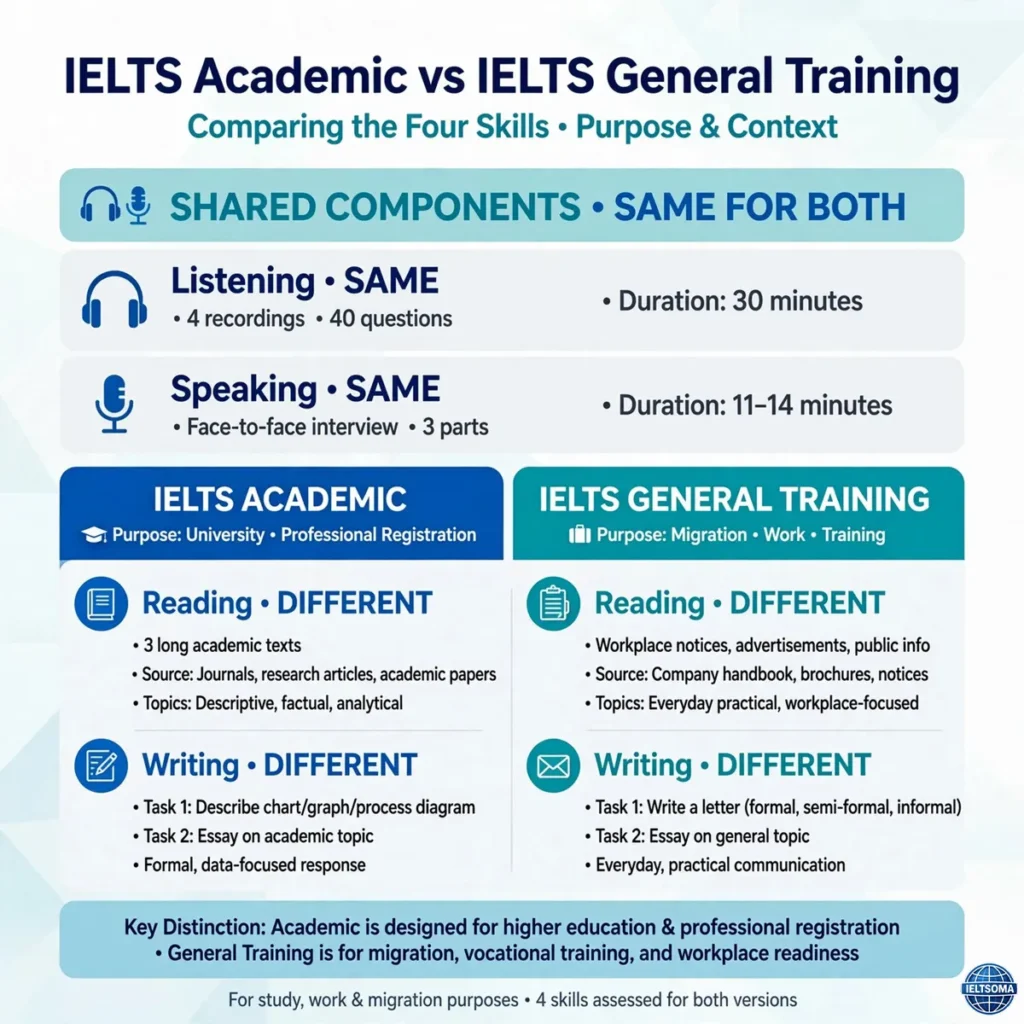
Whether you are taking IELTS Academic for university or professional registration, or IELTS General Training for migration, work, or training, your preparation should match the test you will actually take. Official IELTS guidance confirms that Listening and Speaking are the same in Academic and General Training, while Reading and Writing are different.
This guide brings the most useful IELTS Preparation Resources together so you can build a focused study system instead of jumping from one website, video, vocabulary list, or mock test to another.
Table of Contents
What Are the Best IELTS Preparation Resources?
The best IELTS Preparation Resources combine official test information, realistic practice questions, answer analysis, band-score guidance, vocabulary and grammar practice, speaking practice, and a study schedule.
Start with official IELTS materials to understand the format, then add targeted practice for the skill where you need the most improvement.
The goal is not to collect hundreds of resources. It is to use a small, reliable set consistently.
1. Official IELTS Test Format Guides
Before practising, learn exactly what you will face.
Official IELTS test-format guides explain the four skills—Listening, Reading, Writing, and Speaking—and the time allowed for each. Listening is approximately 30 minutes, Reading and Writing are 60 minutes each, and Speaking takes 11–14 minutes.
This is one of the most important IELTS Preparation Resources because knowing the structure reduces avoidable mistakes.
You should also understand which parts are shared between Academic and General Training and which are different.
For Academic candidates, Reading uses texts appropriate to an academic context, while General Training Reading focuses more on everyday, workplace, and general-interest texts. Academic and General Training Writing also use different tasks.
2. Official IELTS Sample Questions
Practice questions should resemble the real test as closely as possible. Official IELTS sample questions are therefore among the strongest IELTS Preparation Resources to use at the beginning of your preparation.
Use sample questions to learn question types, instructions, timing, and expected responses.
Do not simply check whether an answer is correct. Ask why you lost the mark and what caused the mistake.
A useful routine is:
- Complete a timed task.
- Check your answers.
- Record every error.
- Identify the reason for the error.
- Repeat a similar task later.
- Compare your new performance.
This turns practice into learning rather than repetition.
3. IELTS Listening Practice Resources
IELTS Listening rewards careful attention, prediction, spelling, and the ability to follow information as it develops.
Official IELTS guidance states that the Listening test has four parts with 10 questions in each, and recordings are heard once. Different English accents can be used, including British, Australian, New Zealand, and North American accents.
Use IELTS Preparation Resources that let you practise:
- Form and note completion
- Multiple choice
- Matching
- Map or plan labelling
- Sentence completion
- Short-answer questions
Do not listen passively.
Before the recording begins, predict the type of answer you need. During practice, underline keywords and watch the word limit carefully.
Afterward, review the transcript when available. Find the exact moment where your understanding broke down.
4. IELTS Reading Resources for Academic and General Training
Reading requires more than a large vocabulary.
You need to locate information quickly, understand paraphrasing, recognise relationships between ideas, and manage time.
Academic Reading contains texts from sources such as books, journals, magazines, newspapers, and online resources. General Training Reading includes everyday and workplace material as well as longer general-interest texts.
Strong IELTS Preparation Resources should help you practise:
- Matching headings
- Multiple choice
- True/False/Not Given
- Yes/No/Not Given
- Matching information
- Sentence completion
- Summary completion
A powerful habit is to review wrong answers by category.
Was the problem vocabulary, misreading, poor scanning, confusing Not Given with False, or running out of time?
Your error log will reveal what to fix.
5. IELTS Writing Resources
Writing is where many candidates benefit from structured feedback.
For IELTS Academic, Task 1 involves visual information, while Task 2 is an essay. General Training Writing has its own task requirements.
Because the tasks differ, choose IELTS Preparation Resources designed for your test type.
Focus on the assessment criteria rather than memorising complete essays.
Your practice should cover:
- Task response or task achievement
- Coherence and cohesion
- Lexical resource
- Grammatical range and accuracy
Practise planning before writing.
A short plan can help you organise your position, supporting ideas, examples, and paragraph structure.
After writing, review your work for repeated grammar errors, unclear sentences, weak topic development, and inaccurate word choice.
Then rewrite selected sentences. Editing is often more useful than simply producing another essay.
6. IELTS Speaking Practice Resources
Speaking improves through active use, not silent study.
The official IELTS Speaking test has three parts and lasts 11–14 minutes. Assessment includes fluency and coherence, lexical resource, grammatical range and accuracy, and pronunciation.
Useful IELTS Preparation Resources for Speaking include topic cards, recorded questions, pronunciation practice, and feedback from a competent teacher or study partner.
Try recording yourself answering questions.
Listen for:
- Long pauses
- Repeated words
- Very short answers
- Unclear pronunciation
- Repeated grammar mistakes
- Ideas that are difficult to follow
For Part 2 practice, give yourself one minute to prepare, make brief notes, and speak for up to two minutes.
The objective is not to sound memorised. It is to communicate ideas clearly and naturally.
7. IELTS Vocabulary Resources
Vocabulary should be learned in context, not as isolated word lists.
Choose IELTS Preparation Resources that help you learn collocations, word families, synonyms, common expressions, and vocabulary related to frequent topics.
Instead of memorising ten synonyms for “important,” learn how each word behaves in a sentence.
For example, phrases such as “a significant factor,” “a crucial issue,” and “an important consideration” are useful because they occur in meaningful combinations.
Keep a personal vocabulary notebook with:
- New word or phrase
- Meaning
- Example sentence
- Common collocation
- Related forms
- Your own sentence
Review the notebook repeatedly and use the vocabulary in speaking and writing.
8. IELTS Grammar Resources
You do not need complicated grammar to communicate effectively, but you do need accuracy and range appropriate to your target performance.
Use grammar-focused IELTS Preparation Resources to identify your recurring problems.
Common areas include articles, verb tenses, subject-verb agreement, prepositions, sentence boundaries, relative clauses, conditionals, and complex sentence structures.
Do not study grammar randomly.
If your writing repeatedly contains article errors, spend a week focusing on articles and editing for that specific problem.
The best grammar practice is connected to IELTS tasks. Learn a structure, write sentences with it, and then use it naturally in a paragraph.
9. IELTS Mock Tests
Full mock tests are useful, but timing matters.
Taking a full test every day can create fatigue without fixing the underlying weaknesses.
Use IELTS Preparation Resources that include timed practice and realistic conditions. Take a diagnostic test early, then schedule full mocks at sensible intervals.
After each mock test, spend at least as much attention on analysis as on the test itself.
Create a simple score tracker:
| Skill | Practice Score | Main Weakness | Next Action |
|---|---|---|---|
| Listening | — | — | Targeted practice |
| Reading | — | — | Error review |
| Writing | — | — | Feedback and rewrite |
| Speaking | — | — | Recording and feedback |
Your scores are useful only when they lead to a better study decision.
10. IELTS Answer Keys and Error Logs
Answer keys tell you what was correct.
An error log tells you why you were wrong.
That makes the error log one of the most underrated IELTS Preparation Resources.
For every important mistake, record:
- Question type
- Your answer
- Correct answer
- Reason for the mistake
- What you will do differently next time
Over time, patterns become visible.
You may discover that you lose Reading marks because you skim too quickly, Listening marks because you miss spelling, or Writing marks because your ideas are not developed enough.
11. IELTS Band Descriptors and Assessment Criteria
If you want a higher band, understand how performance is assessed.
Official IELTS materials provide information about assessment criteria for productive skills.
For Speaking, the criteria include fluency and coherence, lexical resource, grammatical range and accuracy, and pronunciation.
Use these criteria as a checklist during practice.
They help you move from “I think this answer is good” to a more objective review of what you actually did.
For Writing, study the criteria and compare your work against them. If possible, obtain qualified feedback rather than relying only on automated scores.
12. IELTS Preparation Resources for a 30-Day Plan
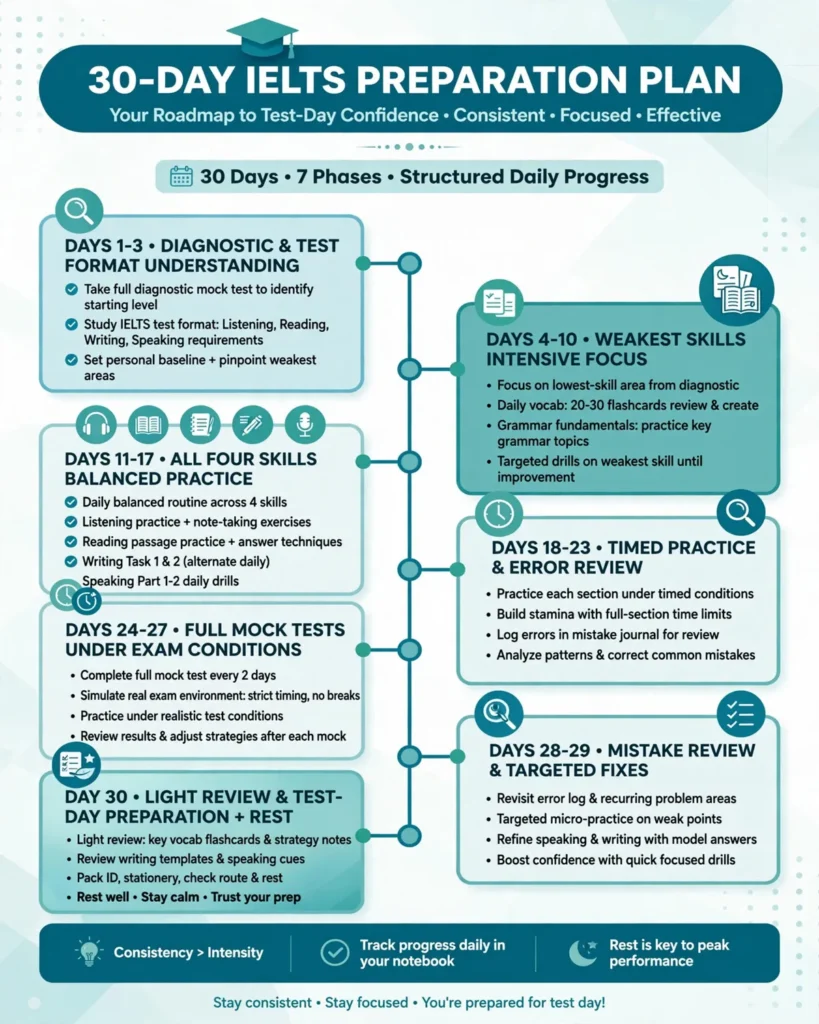
A resource becomes more useful when it fits a schedule.
For a 30-day preparation cycle, you could structure your study like this:
- Days 1–3: Learn the test format and take a diagnostic test.
- Days 4–10: Focus on your weakest two skills.
- Days 11–17: Practise all four skills with targeted tasks.
- Days 18–23: Add timed sections and intensive error review.
- Days 24–27: Complete selected full mock tests.
- Days 28–29: Review recurring mistakes and key strategies.
- Day 30: Light review, confidence building, and test-day preparation.
Adjust the plan according to your current level, target band, available study time, and test date.
13. Free IELTS Preparation Resources
You do not have to buy every course or book you see online.
Start with reliable free resources, especially official IELTS sample questions and test-format guidance. Then add carefully selected practice materials for your specific weaknesses.
Be cautious with resources that promise a guaranteed band score, sell “secret” answers, or encourage memorising complete Speaking or Writing responses.
Effective preparation should develop transferable skills.
A smaller collection of trustworthy IELTS Preparation Resources is usually more useful than a huge folder of disconnected materials.
14. Academic vs General Training Resources
One of the biggest preparation mistakes is practising the wrong version of the test.
Choose Academic if your goal requires the Academic test, such as many higher-education or professional-registration pathways.
Choose General Training when it matches your purpose, such as certain migration, work, training, or below-degree study situations.
Always check the current requirements of your university, employer, professional body, or immigration authority before booking or preparing for a specific test.
Your Listening and Speaking preparation can overlap because those sections are the same in Academic and General Training.
Your Reading and Writing practice should match your test type.
15. How to Choose the Right IELTS Preparation Resources
The best resource is not necessarily the most popular one.
Use this checklist before adding a resource to your study plan:
- Is the source trustworthy?
- Does it reflect the current test format?
- Is it designed for Academic or General Training?
- Does it include realistic practice?
- Can you review your mistakes?
- Does it explain why an answer is correct?
- Does it help you measure progress?
- Does it support your target skill and band?
If the answer is yes to most of these questions, the resource is worth considering.
How Many Hours Should You Study for IELTS?
There is no single number of study hours that guarantees a particular IELTS band.
Your preparation time depends on your current English level, target score, skill profile, test date, and how effectively you practise.
A better approach is to set weekly goals.
For example, you might complete two timed Reading sections, two Listening sessions, two Writing tasks, several Speaking recordings, and daily vocabulary or grammar review.
Track results rather than hours alone.
Ten focused hours with detailed error analysis can be more productive than ten hours of passive video watching.
What Is the Fastest Way to Improve IELTS Performance?
The fastest practical approach is to identify your biggest weaknesses, practise them with realistic tasks, review mistakes, and repeat the cycle.
Do not spend most of your time on skills you already perform well.
If your Reading is strong but Writing is weak, shift more preparation time toward Writing.
Use IELTS Preparation Resources as a system:
Learn → Practise → Analyse → Correct → Repeat.
This approach helps turn preparation into a measurable process.
Frequently Asked Questions About IELTS Preparation Resources
What are the best IELTS Preparation Resources for beginners?
Start with official IELTS test-format information, sample questions, answer keys, and assessment guidance. Then add vocabulary, grammar, Speaking, Writing, and timed practice resources based on your weaknesses.
Are free IELTS Preparation Resources enough?
Free resources can provide a strong foundation, especially official sample questions and test information. However, some candidates may benefit from additional feedback, structured courses, books, or teacher support.
Should Academic and General Training candidates use the same resources?
They can share Listening and Speaking resources because those sections are the same. Reading and Writing resources should be selected according to the specific test you are taking.
How can I improve IELTS Writing?
Practice the correct task types, study the assessment criteria, plan your answers, review grammar and vocabulary errors, and obtain useful feedback when possible. Rewriting weak sections can be especially valuable.
How can I improve IELTS Speaking at home?
Record yourself answering IELTS-style questions, practise all three Speaking parts, review your fluency and grammar, and listen for pronunciation or hesitation problems. Regular speaking practice is more useful than memorising scripts.
How often should I take an IELTS mock test?
Use a diagnostic test early in your preparation and then schedule full mock tests at appropriate intervals. Between mocks, spend time fixing the weaknesses revealed by your results.
Should I memorise IELTS Speaking answers?
Memorising complete answers is not a reliable preparation strategy. Focus instead on developing ideas, useful vocabulary, fluency, pronunciation, and the ability to respond naturally.
Can vocabulary alone increase my IELTS band score?
Vocabulary is important, but IELTS performance depends on multiple skills and assessment criteria. Vocabulary improvement should be combined with reading, listening, writing, speaking, grammar, and test-specific practice.
Final Thoughts
The right IELTS Preparation Resources can turn a confusing study journey into a clear plan.
Start with the official test format, practise realistic questions, understand the assessment criteria, track mistakes, and focus your time on the skills that need the most work.
Whether you are preparing for Academic or General Training, consistency matters more than collecting endless materials.
IELTSOMA can use this framework as a central preparation hub for learners who want practical, organised guidance. Before relying on any specific test detail, always verify current requirements and test information with official IELTS sources and the institution or authority that requires your score.
The smartest preparation is not about studying everything.
It is about studying the right things, measuring what happens, and improving deliberately.
Further Reading: