You finish work. You are tired. Your inbox is still full, tomorrow’s meetings are already on your mind, and then you remember that you promised yourself you would study IELTS for two hours tonight.
Sound familiar?
For many IELTS candidates, the biggest challenge is not a lack of motivation. It is a lack of time, energy and consistency.
Balancing Work and IELTS Study can feel impossible when you are trying to build your career, manage family responsibilities and prepare for an important English-language test at the same time. But you do not necessarily need to spend several hours studying every evening.
You need a realistic system.
The right approach is to make IELTS preparation fit around your working life rather than expecting your working life to fit around an unrealistic study timetable.
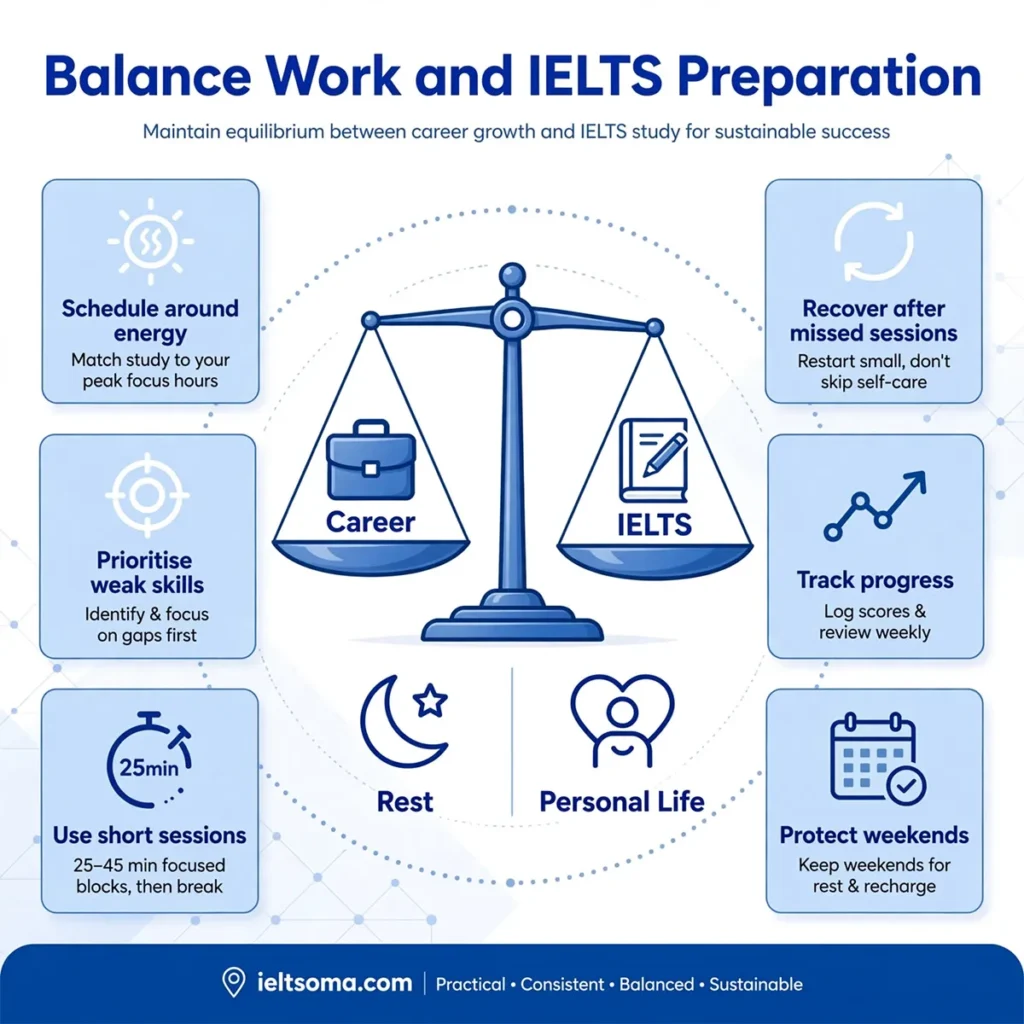
This guide explains nine practical strategies for Balancing Work and IELTS Study, including how to use short study sessions, organise your week, prioritise weak skills, use your commute and avoid burnout.
Whether you are preparing for IELTS Academic or IELTS General Training, the goal is simple: make every available study session count.
Table of Contents
Why Balancing Work and IELTS Study Is Difficult
Working and preparing for IELTS require different types of energy.
Your job may require meetings, concentration, decision-making, communication and problem-solving. By the end of the day, you may have very little mental energy left for a long Reading test or an intensive Writing session.
There may also be unexpected responsibilities.
A meeting runs late.
A deadline appears.
You need to travel.
Your family needs your attention.
You miss one study session, then another, and suddenly an entire week has disappeared.
This is why Balancing Work and IELTS Study requires flexibility rather than perfection.
Instead of asking, “How can I study for three hours every day?”, ask:
“What is the most valuable IELTS activity I can complete with the time and energy I have today?”
That small change can make your preparation much more sustainable.
How Much Time Do You Really Need for IELTS?
There is no universal number of study hours that guarantees a particular IELTS band score.
Your ideal preparation time depends on several factors:
- Your current English level
- Your target band score
- Your test date
- Your strongest and weakest skills
- Your previous IELTS experience
- How much time you can study consistently
A working professional might have only 45–90 minutes on weekdays but more time at the weekend.
That can still become a productive preparation routine.
For example:
Monday–Friday: 45–60 minutes per day
Saturday: 2 hours
Sunday: 60–90 minutes
This gives you regular exposure without turning IELTS preparation into another full-time job.
The important point is to focus on quality and consistency, not simply the number of hours recorded in a study tracker. Following are 9 tips that could help you with balancing work and study.
1. Set Your IELTS Target and Test Date
The first step in Balancing Work and IELTS Study is to establish a clear destination.
Start with your required band score.
You may need a particular overall score, or your university, employer, professional body or immigration pathway may specify minimum scores for individual skills.
Then identify your test date or approximate testing window.
Once you know the destination, you can work backwards.
For example:
Target: Band 7.0
Preparation period: 10 weeks
Weekday study: 45–60 minutes
Weekend study: 2–3 hours per day
Main weakness: Writing
This immediately gives your preparation a structure.
Without a target, you may spend weeks learning vocabulary without knowing whether you are addressing your actual weaknesses.
2. Build a Study Schedule Around Your Energy
One of the biggest mistakes busy IELTS candidates make is assuming that their best study time is always after work.
It may not be.
If your job leaves you mentally exhausted at 8 pm, forcing yourself to complete a difficult Writing task every evening may be inefficient.
Instead, identify when your concentration is strongest.
You might be able to study:
- Before work
- During lunch
- On public transport
- Immediately after work
- After dinner
- At the weekend
Then match the activity to your energy level.
For example:
High-energy period: Writing, Reading or full practice tests
Medium-energy period: Speaking practice, grammar or targeted exercises
Low-energy period: Listening, vocabulary review or error-log revision
This creates a more flexible Balancing Work and IELTS Study routine.
3. Use Short Study Sessions
You do not need to wait for a free three-hour block.
Short, focused sessions can help you maintain regular contact with English and IELTS tasks.
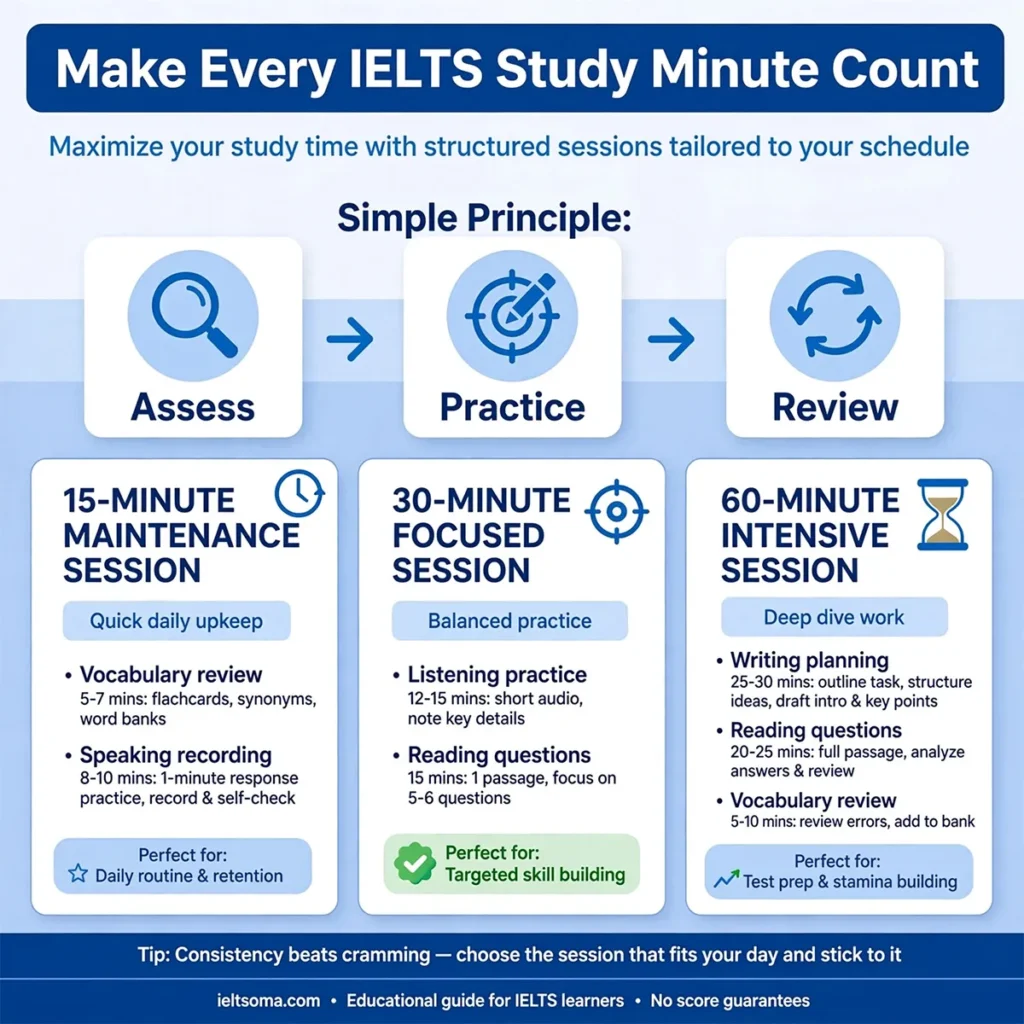
Try a 25-minute IELTS session.
For example:
5 minutes: Review yesterday’s mistakes
15 minutes: Complete a focused IELTS task
5 minutes: Check answers and record errors
You can repeat the session later if you have more time.
Another option is a 45-minute session:
10 minutes: Vocabulary or grammar
25 minutes: Main IELTS activity
10 minutes: Review and error analysis
The key is to avoid spending your entire session deciding what to study.
Prepare your task in advance.
If Tuesday is a Writing day, know exactly what you will write before Tuesday arrives.
4. Prioritise Your Weakest IELTS Skills
Busy candidates cannot afford to spend equal amounts of time on everything.
Your Balancing Work and IELTS Study strategy should therefore be based on your performance.
Start with a realistic assessment of your four skills:
| Skill | Current Performance | Target | Priority |
|---|---|---|---|
| Listening | 7.0 | 7.5 | Medium |
| Reading | 7.0 | 7.5 | Medium |
| Writing | 6.0 | 7.0 | High |
| Speaking | 6.5 | 7.0 | High |
If Writing is preventing you from reaching your target, it deserves more study time.
Do not spend most of your limited preparation time practising a skill you already perform well in simply because it feels easier.
Use your available time where it can produce the greatest improvement.
This is especially important for working professionals because every study session has an opportunity cost.
5. Turn Your Commute Into IELTS Practice
Your commute can become useful preparation time if you travel by train, bus or another form of public transport.
Listening is particularly suitable for this type of practice.
You can listen to English:
- During your morning journey
- While travelling home
- During a lunch break
- While walking
- During routine activities
However, passive listening alone should not become your entire IELTS Listening strategy.
Use some sessions actively.
Listen to a short recording and try to identify:
- Main ideas
- Specific information
- Numbers and names
- Paraphrases
- Changes in information
- Different accents
The official IELTS Listening test contains four parts and 40 questions, and recordings are heard once only. IELTS also notes that a range of accents can be used.
This means your preparation should include focused listening rather than relying only on watching English videos in the background.
Your commute can also be useful for vocabulary review.
Instead of memorising hundreds of isolated words, review useful phrases and examples that you have previously encountered.
6. Protect Your Weekends Without Wasting Them
When you work full-time, weekends can become your most valuable IELTS preparation period.
But that does not mean studying from morning until night.
A better approach is to divide your weekend into focused blocks.
For example:
Saturday
Morning: Full Reading or Listening practice
Afternoon: Review mistakes
Evening: Personal time
Sunday
Morning: Writing practice
Afternoon: Speaking practice and vocabulary
Evening: Plan the following week
This gives you meaningful IELTS practice while preserving time for rest, family and other responsibilities.
Rest is not wasted time.
If you remove every opportunity for recovery, your preparation may become difficult to sustain.
The objective is not to maximise the number of hours spent studying.
It is to maximise the amount of useful learning you can maintain over time.
7. Practise IELTS Under Real Time Limits
One of the most important parts of Balancing Work and IELTS Study is learning when to switch from general English improvement to test-specific practice.
You need both.
General English development can improve vocabulary, grammar, comprehension and communication.
IELTS practice teaches you how to apply those skills within the test structure.
For example, IELTS Reading is completed in 60 minutes. General Training Reading contains three sections and 40 questions.
IELTS Writing is also 60 minutes and contains two tasks. In Academic Writing, Task 1 requires at least 150 words and Task 2 at least 250 words.
Therefore, occasionally practising without time limits is useful when learning a new skill, but you should gradually introduce realistic timing.
Try this progression:
Stage 1: Learn the question type
Stage 2: Practise without strict timing
Stage 3: Use a relaxed time limit
Stage 4: Use the official time limit
Stage 5: Simulate test conditions
This approach can help you develop accuracy before adding pressure.
8. Track Progress Instead of Study Hours
A common mistake is to measure IELTS preparation by hours alone.
You may study for 20 hours and still repeat the same mistakes.
Instead, track outcomes.
For Reading, record:
- Number of correct answers
- Question types causing problems
- Timing
- Repeated errors
For Listening, record:
- Number of correct answers
- Spelling mistakes
- Missed information
- Distractors
- Difficulty with particular accents or question types
For Writing, track:
- Task response
- Organisation
- Vocabulary
- Grammar
- Repeated errors
- Ability to finish on time
For Speaking, review:
- Fluency
- Vocabulary
- Grammar
- Pronunciation
- Hesitation
- Ability to develop answers
IELTS Speaking is assessed using four criteria: fluency and coherence, lexical resource, grammatical range and accuracy, and pronunciation.
Your tracking system does not need to be complicated.
A simple spreadsheet or notebook is enough.
The goal is to answer one question:
Am I improving?
9. Prevent Burnout During IELTS Preparation
You cannot create an effective system for Balancing Work and IELTS Study if your schedule leaves you permanently exhausted.
Burnout can happen when you combine:
- Long working hours
- Heavy IELTS preparation
- Poor sleep
- Family responsibilities
- Constant pressure about your target score
- Unrealistic expectations
Instead, build recovery into your schedule.
Have at least some periods each week when you are not thinking about IELTS.
Avoid turning every free minute into study time.
You should also avoid comparing your preparation with people who have completely different circumstances.
A university student with a flexible timetable may have far more study time than a full-time employee.
Your plan should work for your life.
Consistency over several weeks is more valuable than an extreme schedule that lasts only a few days.
A Practical Weekly IELTS Schedule for Working Professionals
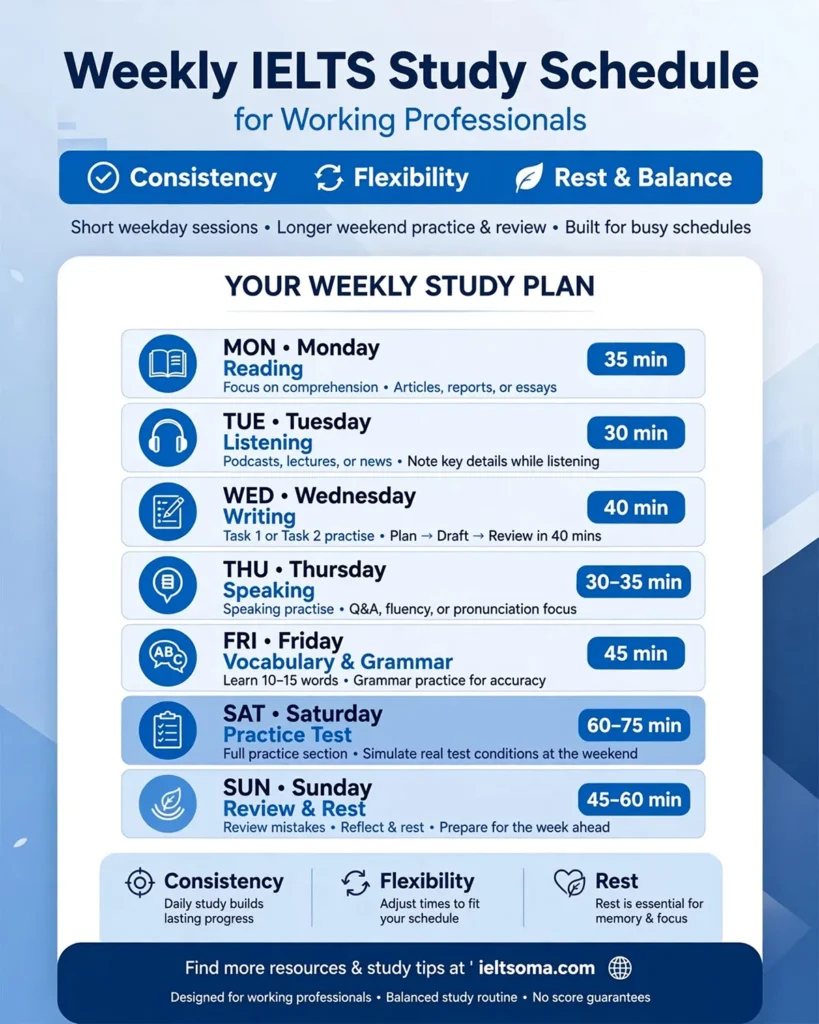
Here is an example of a manageable weekly plan.
| Day | Time | Activity | Duration |
|---|---|---|---|
| Monday | Evening | Reading practice | 45 min |
| Tuesday | Morning | Listening + review | 45 min |
| Wednesday | Evening | Writing practice | 60 min |
| Thursday | Commute/evening | Speaking + vocabulary | 30–45 min |
| Friday | Flexible | Light English practice | 30 min |
| Saturday | Morning | Timed IELTS practice | 90–120 min |
| Saturday | Later | Error analysis | 30 min |
| Sunday | Morning | Writing or Speaking | 60 min |
| Sunday | Evening | Weekly review | 20 min |
You do not have to follow this timetable exactly.
The best schedule is the one that fits your working pattern.
If you work night shifts, for example, your “morning” may actually be your afternoon.
The principle is simple:
Schedule IELTS around your life, not against it.
Academic vs General Training When Working
The overall time-management strategy can work for both IELTS Academic and General Training, but your content practice should match your test.
IELTS confirms that Listening and Speaking are the same in Academic and General Training, while Reading and Writing are different.
If You Are Taking IELTS Academic
Use your limited study time for:
- Academic Reading practice
- Academic Writing Task 1
- Writing Task 2
- Academic vocabulary in context
- Speaking development
- Listening practice
Academic Reading uses texts from sources such as books, journals, magazines, newspapers and online resources. Academic Writing Task 1 involves describing visual information such as graphs, tables, charts or diagrams.
If You Are Taking IELTS General Training
Prioritise:
- General Training Reading
- General Training Writing Task 1
- Writing Task 2
- Listening
- Speaking
- Practical vocabulary and communication
General Training Reading includes everyday and workplace-related texts, while Writing Task 1 involves responding to a situation, such as requesting information or explaining a situation.
Do not accidentally spend your limited preparation time using materials for the wrong test.
What to Do When You Miss a Study Session
This is one of the most important rules for Balancing Work and IELTS Study:
Do not turn one missed session into a missed week.
If work prevents you from studying on Wednesday, do not attempt to “punish” yourself by studying for four hours on Thursday.
Simply continue with the next planned activity.
You can also use a backup system.
Plan A
Your normal 60-minute IELTS session.
Plan B
A 30-minute shortened session.
Plan C
A 10–15-minute maintenance session.
For example, if you cannot complete a Writing task, you could spend 15 minutes planning an essay, reviewing vocabulary or correcting previous mistakes.
This keeps your IELTS routine alive even on difficult days.
How to Make Your IELTS Study More Efficient
Efficiency becomes particularly important when you are working.
Before every session, identify one specific outcome.
Instead of:
“Study IELTS.”
Write:
“Complete one Reading passage and analyse every incorrect answer.”
Instead of:
“Improve vocabulary.”
Write:
“Review 15 useful phrases from previous Writing corrections and create examples.”
Instead of:
“Practise Speaking.”
Write:
“Record answers to five Part 2 questions and identify repeated vocabulary.”
Specific tasks make it easier to start and easier to measure progress.
Official IELTS preparation materials can also help candidates become familiar with the test format, task types and timed conditions.
A Simple 4-Week Strategy for Busy IELTS Candidates
If your test is about one month away, you can organise your preparation into four stages.
Week 1: Assess
Find your current level.
Complete appropriate practice tasks.
Identify your weakest skills and question types.
Week 2: Improve
Spend most of your time addressing those weaknesses.
Build targeted practice into your weekday sessions.
Week 3: Apply
Increase timed practice.
Complete realistic Reading, Listening and Writing tasks.
Practise Speaking under conditions similar to the test.
Week 4: Simulate
Complete realistic mock tests.
Review your errors.
Practise time management.
Avoid trying to learn everything at the last minute.
Your final week should refine your performance rather than create unnecessary panic.
FAQs About Balancing Work and IELTS Study
Can I prepare for IELTS while working full-time?
Yes. Many working candidates can build IELTS preparation around their existing schedule. The key is to create realistic study sessions, prioritize weak skills and maintain consistency rather than relying on long daily sessions.
How many hours should a working professional study for IELTS?
There is no universal number of hours. Your needs depend on your current English level, target score, test date and available time. A consistent 45–60-minute weekday routine combined with longer weekend sessions can provide a practical structure.
Should I study IELTS before or after work?
Choose the period when your concentration is strongest. If you are mentally tired after work, morning study may be more effective for demanding tasks such as Writing or Reading. Use lower-energy periods for activities such as vocabulary review or listening.
How can I study IELTS if I only have one hour a day?
Divide the hour into focused activities. For example, spend 10 minutes reviewing previous mistakes, 35 minutes completing a targeted IELTS task and 15 minutes checking and analyzing your performance.
Can I improve IELTS with 30 minutes a day?
Thirty minutes can be useful, especially for maintaining regular practice and targeting a specific weakness. However, your required preparation time will depend on your starting level and target score.
How do I balance IELTS preparation with family responsibilities?
Create fixed study windows that your household knows about, but keep them realistic. You may also use shorter sessions when longer study blocks are not possible. Planning your week in advance can reduce last-minute conflicts.
Should working IELTS candidates study every day?
Daily contact with English can be useful, but you do not need an intensive IELTS session every day. Combine focused study days with lighter activities and adequate rest.
How can I avoid IELTS burnout?
Set realistic study targets, protect your sleep and include regular breaks. Avoid measuring success solely by study hours. Track actual improvements in accuracy, timing and performance.
Is IELTS Academic harder than General Training?
Academic and General Training have different Reading and Writing components, so preparation should match the test you need. Listening and Speaking are the same in both versions.
What should I do if work makes me miss IELTS practice?
Do not abandon the whole schedule. Use your backup plan, complete a shorter session if possible and return to your normal timetable at the next opportunity.
Conclusion
Balancing Work and IELTS Study is not about finding an extra five hours every day.
It is about using the time you already have more intelligently.
Start by setting your target score and test date. Identify your weakest skills. Build your timetable around your energy levels rather than simply your free time. Use short weekday sessions, make weekends productive without sacrificing recovery, and turn suitable parts of your commute into English practice.
Most importantly, track improvement rather than obsessing over study hours.
If work becomes unexpectedly busy, adjust your schedule instead of giving up.
Your IELTS preparation does not have to compete with your career. With a realistic routine, focused practice and consistent review, you can make meaningful progress while continuing to meet your professional responsibilities.
The goal is not to study all day.
The goal is to make the right study session happen consistently.
That is the foundation of successful Balancing Work and IELTS Study.
Further Links: