Your IELTS test day is not the time to discover that you have the wrong identification document, cannot find the test centre, or have spent the night trying to memorise hundreds of new words.
A good IELTS Test Day Checklist is much simpler: confirm the essentials, prepare what you need, arrive with enough time, and protect your concentration.
The final 24 hours should be about readiness, not last-minute cramming.
This guide covers exactly what to do before and on IELTS test day, including what to take to IELTS test, how to prepare for the exam morning, what to expect at the test centre, and which common mistakes can create unnecessary problems.
Whether you are taking IELTS Academic or IELTS General Training, use this checklist as your final preparation plan.
Table of Contents
IELTS Test Day Checklist at a Glance
Before leaving for the test centre, check these essentials:
| Checklist item | What to do |
|---|---|
| Identification | Take the same valid ID you used when booking |
| Test details | Confirm the date, time and location |
| Journey | Plan your route and allow extra travel time |
| Alarm | Set more than one alarm if necessary |
| Food | Eat a sensible meal before the test |
| Water | Take water according to your test centre’s rules |
| Clothing | Wear comfortable clothing |
| Electronics | Be prepared to leave phones and other belongings outside the test room |
| Watch | Do not take a watch into the test room |
| Sleep | Get a normal night’s sleep |
| Preparation | Review strategies rather than trying to learn everything |
| Instructions | Listen carefully to the supervisor |
| Timing | Manage your time throughout the test |
| Mindset | Stay calm if one question goes badly |
| Speaking | Listen carefully and answer naturally |
The exact procedures can vary between test centres, so your test centre’s instructions should always take priority.
1. Check Your IELTS Test Details the Day Before
One of the easiest mistakes to prevent is arriving at the wrong place or at the wrong time.
Check your test confirmation carefully.
Confirm:
- Test date
- Reporting time
- Test centre address
- Test type
- Test format
- Speaking test arrangements
- Any instructions sent by your test centre
Do not rely solely on an old message, screenshot or calendar entry.
IELTS advises test takers to check the time and date of their test and leave enough time to reach the test centre without rushing.
If your Listening, Reading and Writing tests and Speaking test are scheduled separately, make sure you know the arrangements for both.
A useful test-day habit
Open the location in your preferred navigation app the evening before.
Then ask yourself:
“If I had to leave home right now, would I know exactly where I was going?”
If the answer is no, solve the problem before test morning.
2. What to Take to IELTS Test Day
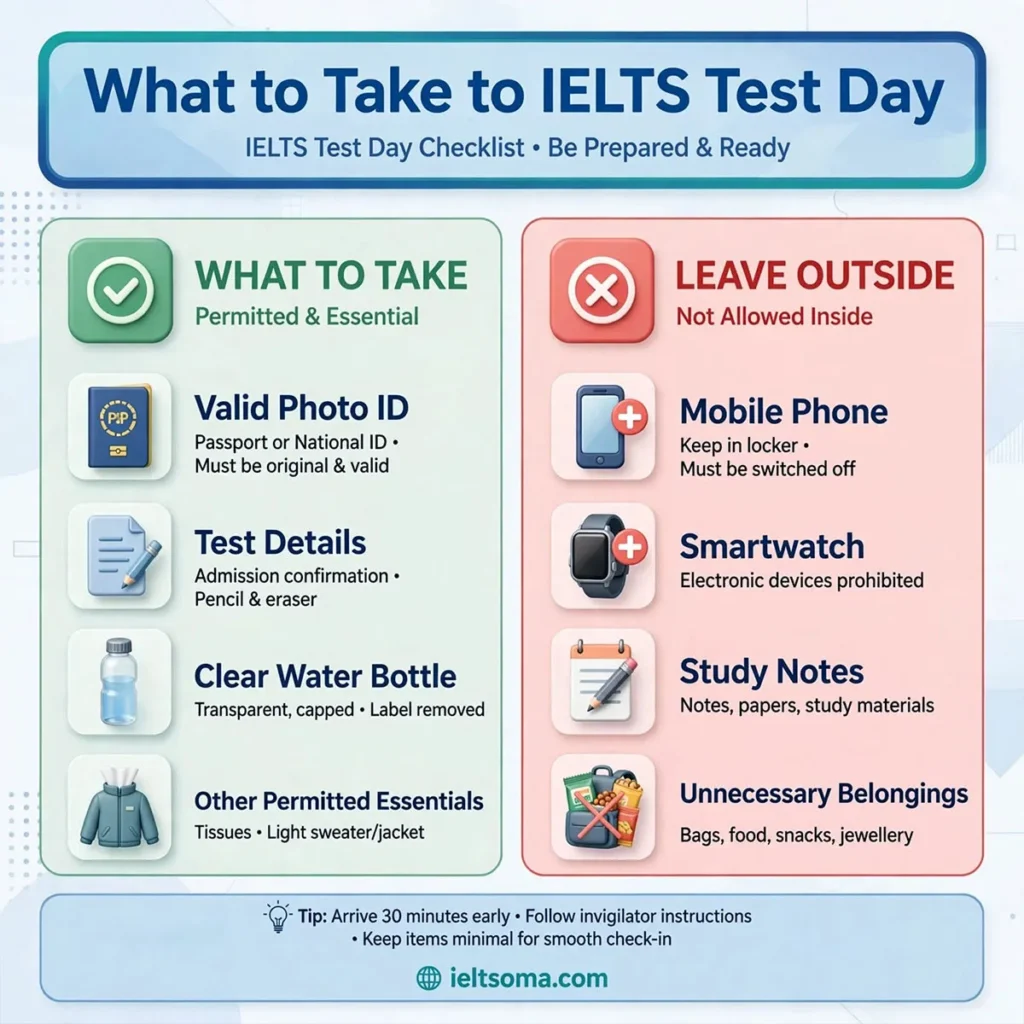
The most important item on your IELTS Test Day Checklist is your identification document.
IELTS states that you must bring the same identification document that you used when booking your test. If you bring the wrong ID or forget it, you may not be allowed to take the test.
Therefore, do not simply assume that any identification document will be accepted.
Check your booking information and your test centre’s instructions.
Your basic checklist
Before leaving home, check:
- Correct identification document
- Test confirmation/details
- Directions to the test centre
- Water in an appropriate bottle, if permitted
- Any specifically approved items required for your test arrangement
Do not fill your bag with unnecessary items.
Personal belongings generally have to be left in a designated secure area outside the test room. IELTS specifically advises test takers to switch off mobile phones and other electronic devices.
3. Do Not Assume You Can Take Everything into the Test Room
Many candidates create unnecessary anxiety by worrying about what they can carry into the examination room.
The safest approach is to follow your test centre’s instructions rather than assuming an item is permitted.
IELTS says personal belongings are left in a safe place outside the test room. Watches are not allowed in the test room; test rooms have clocks, and online tests display a clock on screen.
This means your test-day preparation should not depend on having access to:
- Your mobile phone
- Smartwatch
- Notes
- Dictionary
- Personal study materials
- Unapproved electronic devices
You should be prepared to separate yourself from your usual belongings for the duration of the test.
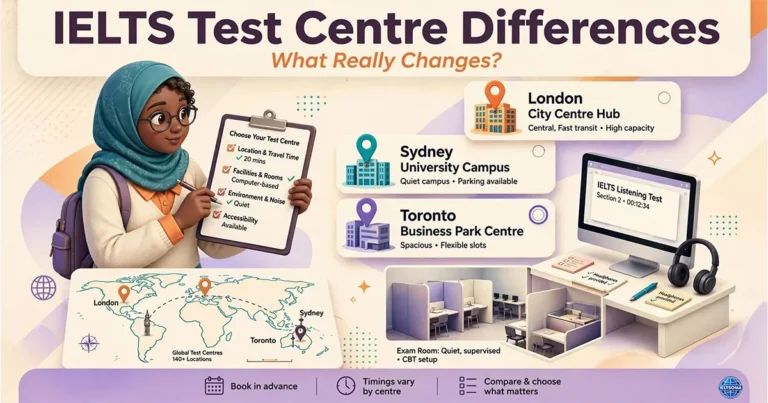
4. Plan Your Journey Before IELTS Test Day
A surprisingly large amount of test-day stress comes from transportation rather than the exam itself.
If you have never visited the test centre, consider visiting beforehand.
Check:
- How long the journey normally takes
- Where you will park, if applicable
- Which entrance you need
- Whether traffic is likely to be heavy
- How much additional time you need for unexpected delays
Do not plan to arrive at exactly the reporting time.
Build a reasonable buffer into your journey.
Arriving early gives you time to find the correct location, complete any required procedures and settle yourself mentally.
Arriving late can turn a manageable exam morning into a stressful one.
5. Get a Normal Night’s Sleep
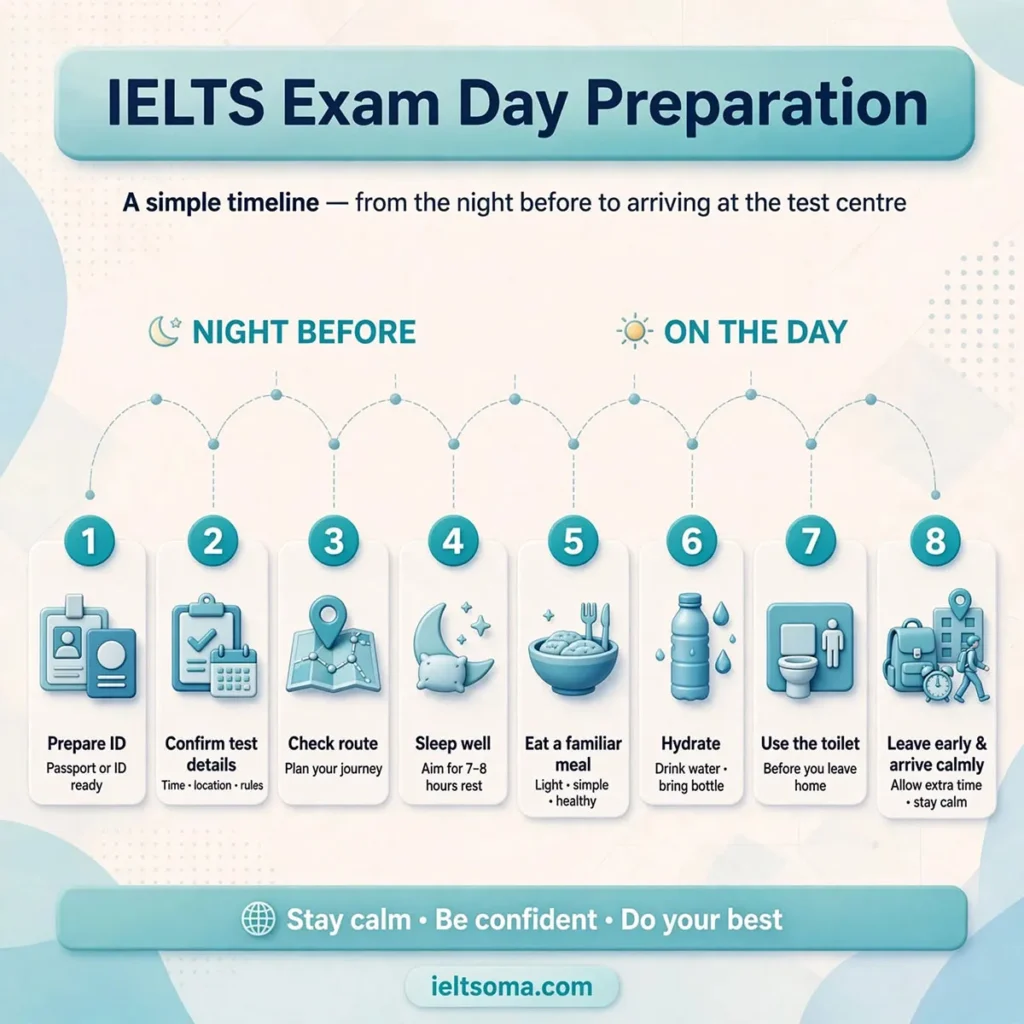
The night before IELTS is not the night for a five-hour vocabulary marathon.
Your brain needs to process information, concentrate, read accurately and produce language under time pressure.
Instead of staying awake until 3 a.m. memorising vocabulary, prepare your belongings and go to bed at a sensible time.
You do not need to feel perfectly relaxed.
You simply need to avoid deliberately making yourself exhausted.
What should you revise?
If you want a short final review, focus on:
- Common mistakes you repeatedly make
- Writing structures you already know
- Listening strategies
- Reading question techniques
- Speaking response strategies
- Timing
- Your personal weaknesses
Avoid trying to learn an enormous list of new vocabulary on the final night.
Knowing 20 useful words extremely well is more valuable than looking at 500 unfamiliar words and remembering almost none of them.
6. Eat Before the Test
IELTS recommends eating and drinking before the test. Food is not allowed in the test room, although water may be permitted in a clear or transparent bottle.
Choose something familiar rather than experimenting with an unusual meal.
Your goal is to feel:
comfortable + alert + hydrated
—not excessively full.
If you normally drink coffee, you do not necessarily need to eliminate it on test day. However, avoid dramatically changing your normal routine.
The same principle applies to food.
Test day is not the time to experiment.
7. Use the Toilet Before Entering the Test Room
This sounds obvious, but it belongs on your IELTS exam day preparation checklist.
The Listening, Reading and Writing tests are completed in one session and IELTS states that there are no breaks between these sections. The combined session takes 2 hours and 40 minutes. IELTS therefore recommends going to the toilet before entering the test room.
That is important because losing concentration during a reading passage or writing task can cost valuable time.
Use the facilities before the test begins if possible.
8. Do Not Spend the Morning Learning New Strategies
There is a major difference between reviewing a strategy and learning a completely new strategy.
On test morning, review what you already know.
For example, if you normally:
- Read the question carefully.
- Identify the key requirement.
- Plan briefly.
- Answer.
- Check where time permits.
Do exactly that.
Do not suddenly switch to a completely different approach because somebody told you about it in a social media video ten minutes before your exam.
Consistency creates confidence.
9. Your IELTS Listening Test Checklist
Before Listening begins, remind yourself of three things:
Read carefully. Predict intelligently. Keep moving.
You may encounter an answer you do not know.
Do not let one missed answer destroy the next five.
If you miss something, move on and continue listening.
A common mistake is mentally replaying the previous question while the recording has already moved to the next answer.
Your objective is not to achieve perfection on every question.
Your objective is to collect as many correct answers as possible.
Follow the supervisor’s instructions carefully. IELTS also advises candidates to read instructions before writing answers and to read questions carefully to avoid simple mistakes.
10. Your IELTS Reading Test Checklist
Reading requires controlled time management.
Do not spend five minutes fighting with one difficult question while several easier questions remain unanswered.
Remember that difficult-looking vocabulary does not automatically mean that you need to understand every word.
Focus on:
- The question
- Keywords
- Meaning
- Context
- Relationships between ideas
- Evidence in the passage
For example, if you are answering a matching headings question, your job is not to translate every sentence.
Your job is to identify the main idea of the paragraph and match it with the most appropriate heading.
A simple Reading rule
If a question is consuming too much time:
mark it → move on → return later if possible.
This prevents one difficult question from controlling your entire Reading test.
11. Your IELTS Writing Test Checklist
Before writing, read the task carefully.
This is particularly important because a beautifully written answer can still perform poorly if it does not properly address the task.
For Writing Task 2, identify:
- The topic
- The question type
- What you have been asked to discuss
- Whether you need to give an opinion
- The key ideas you will develop
For Academic Writing Task 1, identify:
- What the visual represents
- The main trends or features
- Significant comparisons
- Important figures where relevant
Do not start writing immediately just because the clock is running.
A short planning stage can prevent an unfocused answer.
IELTS teacher guidance similarly recommends analysing the Writing question carefully and planning the answer before beginning to write.
12. Do Not Panic If One Section Goes Badly
This may be the most important psychological item on your IELTS Test Day Checklist.
Suppose you leave Listening thinking:
“That was terrible.”
The next mistake is carrying that thought into Reading.
Listening is finished.
You cannot change it.
Your next opportunity is Reading.
The same applies throughout the test.
If one question goes badly, mentally close it.
Tell yourself:
“That question is finished. The next one is worth my attention.”
This simple habit can prevent one difficult moment from becoming a chain of mistakes.
13. IELTS Speaking Test Day Preparation
Your Speaking test requires a slightly different mindset.
You are having a conversation with an examiner who is assessing your spoken English.
You do not need to produce extraordinary opinions.
You need to communicate clearly and naturally.
During Speaking:
- Listen carefully to the question.
- Answer the question you were asked.
- Extend your answers appropriately.
- Give reasons and examples when useful.
- Avoid memorised speeches.
- Do not panic if you make a grammatical mistake.
- Keep communicating.
IELTS teacher guidance specifically reminds candidates that the Speaking assessment evaluates their language level, not whether the examiner agrees with their opinions.
For Part 2, use your one-minute preparation time intelligently.
Do not attempt to write a complete speech.
Instead, create a small structure of ideas that helps you keep talking.
For example:
Who → What → When → Where → Why → How you felt
This gives you a conversational path rather than a memorised script.
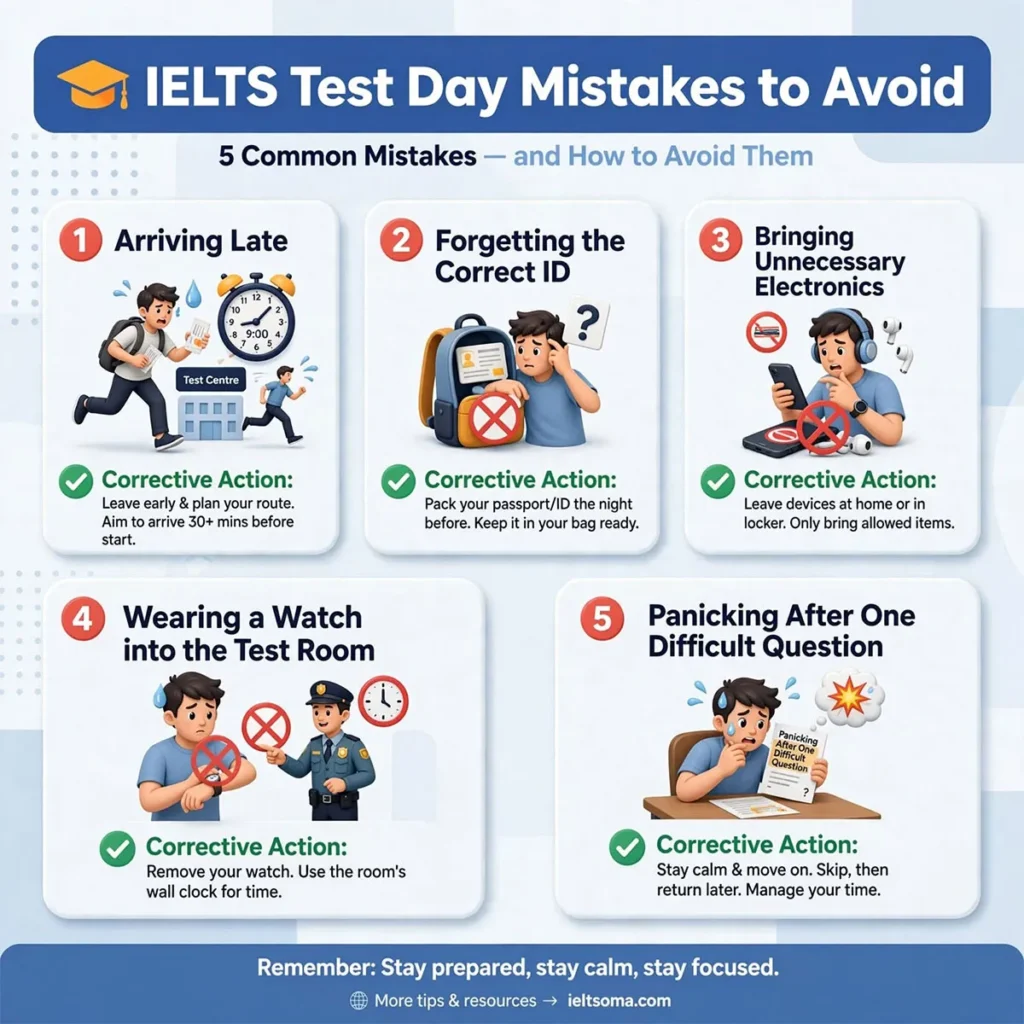
14. What NOT to Do on IELTS Test Day
Your final checklist should include things to avoid.
Do not arrive at the last minute
Traffic, parking, security procedures or finding the correct room can take longer than expected.
Do not forget your ID
This is potentially much more serious than forgetting your favourite pen or lucky charm. IELTS requires the same identification document used during booking.
Do not bring unnecessary electronic devices into the test environment
Phones and other electronic devices must be switched off and stored according to test-centre procedures.
Do not wear a watch into the test room
IELTS states that watches are not allowed in the test room.
Do not memorise essays
A memorised answer can become difficult to adapt to the actual question and may sound unnatural.
Do not compare yourself with other candidates
Someone finishing before you does not mean they are performing better.
Someone looking nervous does not mean they are performing badly.
Your test is your test.
15. The Final 30-Minute IELTS Test Day Checklist
If you are leaving home shortly, use this quick version.
Before leaving
- I have the correct identification document.
- I have checked my test date and time.
- I know the exact test centre location.
- I have planned my route.
- I have allowed extra travel time.
- I have eaten something suitable.
- I am adequately hydrated.
- I have used the toilet.
- I am wearing comfortable clothing.
- I have left unnecessary belongings at home.
At the test centre
- Follow staff instructions.
- Keep your identification document ready.
- Store belongings where instructed.
- Switch off electronic devices.
- Listen carefully to the supervisor.
- Ask for clarification if you do not understand an instruction.
- Stay aware of time.
- Concentrate on the question in front of you.
During the test
- Read instructions carefully.
- Answer the question actually asked.
- Keep moving if a question is difficult.
- Do not panic over one mistake.
- Check answers where time allows.
- Maintain concentration from beginning to end.
IELTS Test Day Checklist: The Golden Rule
The best IELTS exam day preparation is not about doing more.
It is about removing avoidable problems.
Know where you are going.
Know when you need to be there.
Take the correct identification document.
Follow the test centre’s instructions.
Eat, sleep and hydrate sensibly.
Then trust the preparation you have already completed.
If you have spent weeks practising Listening, Reading, Writing and Speaking, you do not need to transform yourself on the morning of the exam.
You simply need to arrive prepared enough to demonstrate what you already know.
Frequently Asked Questions About IELTS Test Day
What should I take to IELTS test day?
The most important requirement is the same valid identification document you used when booking your IELTS test. You should also follow your test centre’s instructions about permitted items. Personal belongings and electronic devices are generally stored outside the test room according to centre procedures.
Can I take my mobile phone into the IELTS test room?
You should not expect to use your mobile phone in the test room. IELTS instructs test takers to switch off mobile phones and other electronic devices and leave personal belongings in a safe place outside the test room.
Can I wear a watch during IELTS?
No. IELTS states that watches are not allowed in the test room. Test rooms have a clock available to help you manage your time.
Can I take water into the IELTS test?
IELTS states that you can take water into the test room if it is in a clear, transparent bottle. However, always follow the specific instructions provided by your test centre.
What should I do the night before IELTS?
Prepare your identification document, confirm your test details and route, organise anything you are permitted or required to take, eat normally and get sufficient sleep. A short review of familiar strategies is generally more useful than attempting to learn a large amount of new material.
What should I do if I make a mistake during IELTS?
Move on and focus on the next task. You cannot change an answer that is already finished, but you can prevent one mistake from affecting subsequent questions.
Should I study on the morning of my IELTS test?
A short review can be useful, but avoid intensive last-minute study. Review familiar strategies, common personal mistakes and timing rather than trying to learn large amounts of new material.
What happens if I bring the wrong ID to IELTS?
This can prevent you from taking the test. IELTS specifically states that you must bring the same identification document used when booking your test. If you have any uncertainty about your identification requirements, contact your test centre before test day.
Is the IELTS test on computer now?
IELTS announced in March 2026 that paper-based testing would be phased out from mid-2026, with exact timelines varying by market. Selected markets may also offer a Writing on Paper option. Candidates should therefore check the current arrangements for their location and test booking.
Is IELTS Online the same as IELTS at a test centre?
IELTS Online is an Academic test delivered remotely, and its content and format are designed to correspond with IELTS Academic. However, it has specific technical and environmental requirements, including a suitable computer, webcam, microphone, speakers and reliable internet connection.
Final IELTS Test Day Checklist
Save this final version:
ID → Test details → Route → Early arrival → Food → Water → Sleep → No unnecessary electronics → No watch → Follow instructions → Manage time → Stay calm → Focus on the next question.
That is what effective IELTS exam day preparation looks like.
Your final job is not to become a better English speaker overnight.
It is to make sure nothing preventable gets in the way of showing the examiner what you can actually do.
Further Reading: