You can have a strong English vocabulary, understand the general meaning of a passage and still lose several IELTS Reading marks.
The problem is often not your English. It is how you read under pressure.
The IELTS Reading test gives you 60 minutes to answer 40 questions. You need to find information quickly, understand paraphrases, distinguish facts from opinions, recognise the writer’s ideas and avoid tempting wrong answers. There is no extra time for transferring your answers after the Reading test.
That is why effective IELTS Reading Comprehension Tips can make such a significant difference.
Instead of reading every sentence slowly from beginning to end, you need a flexible approach that combines skimming, scanning, detailed reading, vocabulary awareness and careful question analysis.
Whether you are preparing for IELTS Academic or IELTS General Training, this guide from IELTSOMA will show you practical IELTS Reading Comprehension Tips that you can apply during practice and on test day.
Table of Contents
Understanding the IELTS Reading Test
Before developing your strategy, understand exactly what you are preparing for.
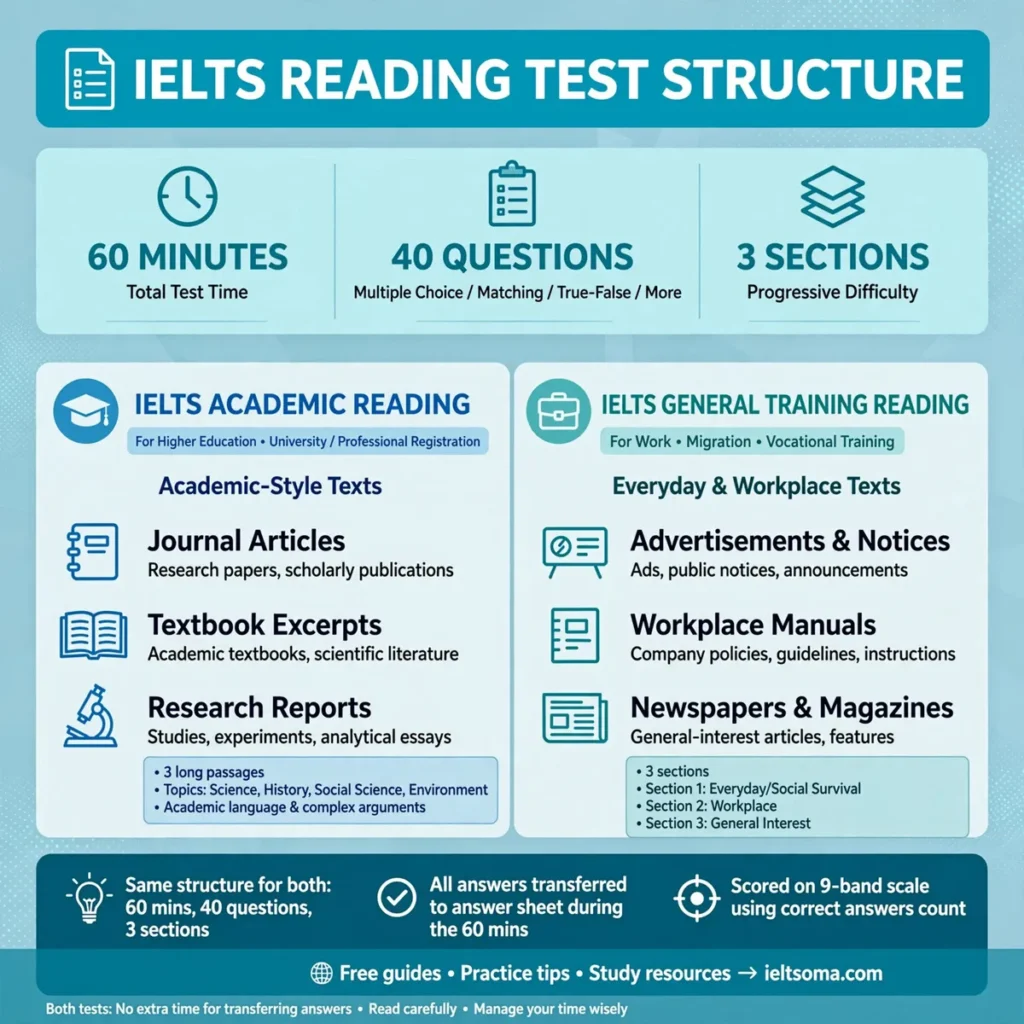
The IELTS Reading test lasts 60 minutes and contains 40 questions. You must complete and transfer your answers within those 60 minutes. Each correct answer receives one mark, and your final result is reported as an IELTS band score from 1 to 9.
The Reading test is different for Academic and General Training.
IELTS Academic Reading
The Academic Reading test contains three sections, with a total text length of approximately 2,150–2,750 words. The texts can come from books, journals, magazines, newspapers and online resources and may include descriptive, narrative, discursive or argumentative writing.
At least one Academic Reading text contains a detailed logical argument, so you need to be comfortable following relationships between ideas.
IELTS General Training Reading
General Training Reading also contains three sections, but the material is more closely connected to everyday life, workplace situations and general-interest topics.
Section 1 may contain notices, advertisements, timetables or other everyday texts. Section 2 focuses on workplace-related material, while Section 3 contains a longer and more complex general-interest text.
Although the content differs, many of the same reading skills are required in both tests.
11 IELTS Reading Comprehension Tips for a Higher Score
1. Do Not Read Every Word at the Same Speed
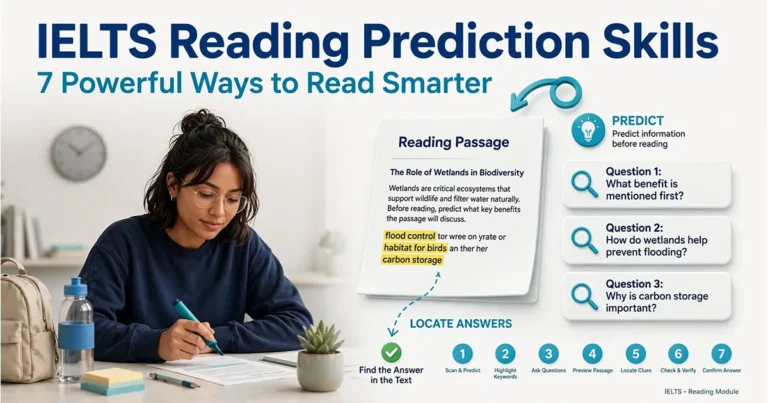
One of the most important IELTS Reading Comprehension Tips is to stop treating every sentence as equally important.
Imagine that you have a passage about the development of renewable energy.
You do not necessarily need to understand every adjective, example or technical term before answering a question.
Instead, use three levels of reading:
Skimming: Read quickly to understand the overall topic and structure.
Scanning: Search for specific information such as names, dates, numbers or distinctive terms.
Detailed reading: Slow down when you locate the relevant part of the passage.
This approach saves valuable time.
A common mistake is spending several minutes reading the entire passage carefully before looking at the questions. By the time you reach the questions, you may have forgotten where important information appeared.
Read strategically instead.
2. Preview the Questions Before Reading in Detail
Before committing to detailed reading, look at the questions.
Identify:
- Keywords
- Names
- Dates
- Numbers
- Technical terms
- Comparisons
- Opinions
- Descriptions
- Cause-and-effect relationships
For example:
What was the main reason researchers changed their approach?
The important concepts are likely to be main reason and changed their approach.
You can then search the passage for information related to those concepts rather than trying to memorise the entire text.
However, do not assume that the exact words will appear.
IELTS questions frequently test your ability to recognise paraphrased information.
3. Learn to Recognise Paraphrasing
This is one of the most valuable IELTS Reading Comprehension Tips for candidates aiming for a higher band.
The wording of a question may be very different from the wording in the passage.
For example:
Question:
The number of people using public transport increased significantly.
Passage:
There was a substantial rise in the use of buses and trains.
The words are different, but the meaning is similar.
Develop the habit of looking for relationships such as:
- increase → rise / grow / climb
- decrease → fall / decline / drop
- important → significant / crucial
- difficult → challenging / demanding
- result → consequence / outcome
- method → approach / technique
- problem → issue / difficulty
- purchase → buy
- approximately → around / roughly
- reduce → decrease / cut
You do not need to memorise endless synonym lists.
Instead, practise recognising meaning changes and paraphrases in context.
4. Use Keywords Strategically
Keywords can help you locate relevant information quickly.
Suppose the question says:
According to the study, which year did the researchers begin collecting data?
The distinctive keyword researchers or a specific year may help you locate the relevant paragraph.
But be careful.
A keyword appearing in the passage does not automatically mean you have found the answer.
IELTS can place the same word in several parts of a passage while changing the meaning around it.
Therefore:
Keyword → Locate → Read surrounding sentences → Confirm meaning.
Do not choose an answer merely because you found the same word.
5. Master True, False and Not Given
True/False/Not Given questions cause problems because candidates often confuse False with Not Given.
The distinction is straightforward.
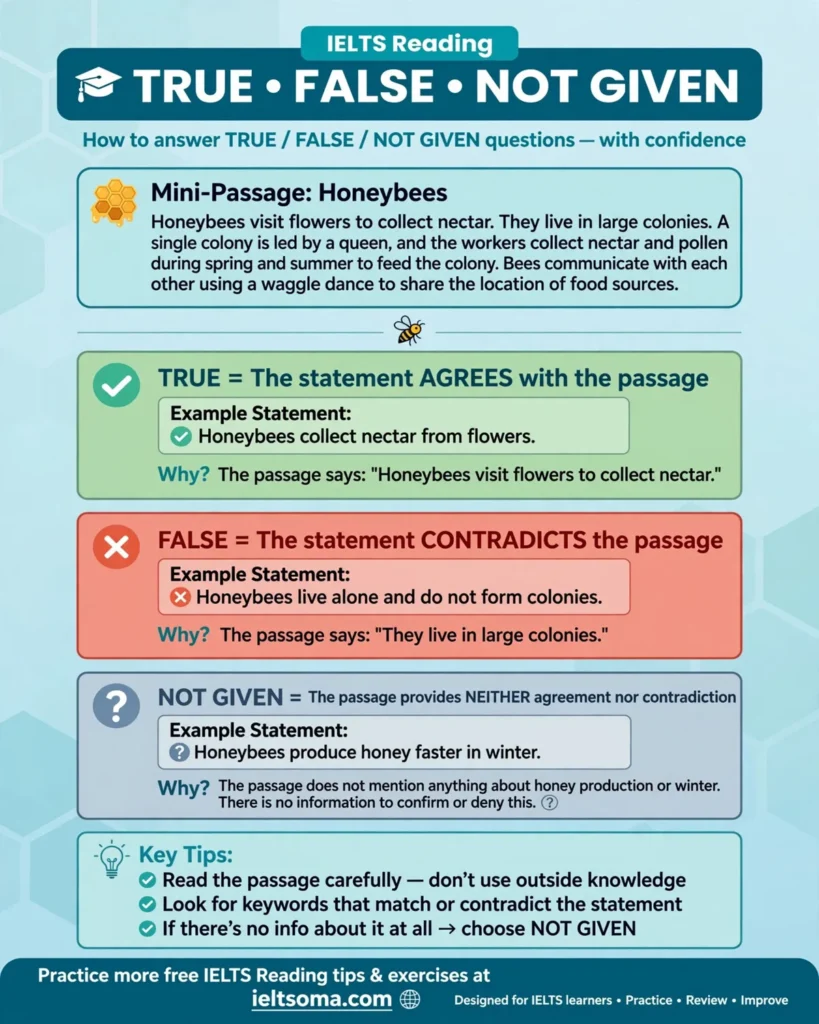
TRUE: The statement agrees with the information in the passage.
FALSE: The statement contradicts the information in the passage.
NOT GIVEN: The passage does not provide enough information to say whether the statement is true or false.
For example, imagine the passage says:
The museum opened in 1985 and attracts thousands of visitors each year.
Now consider:
Statement A: The museum opened in 1985.
Answer: TRUE
Statement B: The museum opened in 1990.
Answer: FALSE
Statement C: The museum is the most popular attraction in the city.
Answer: NOT GIVEN
The passage does not tell us whether it is the most popular attraction.
This distinction is specifically highlighted in the official IELTS Reading guidance. Candidates should base their answers on the information in the text rather than on their own knowledge.
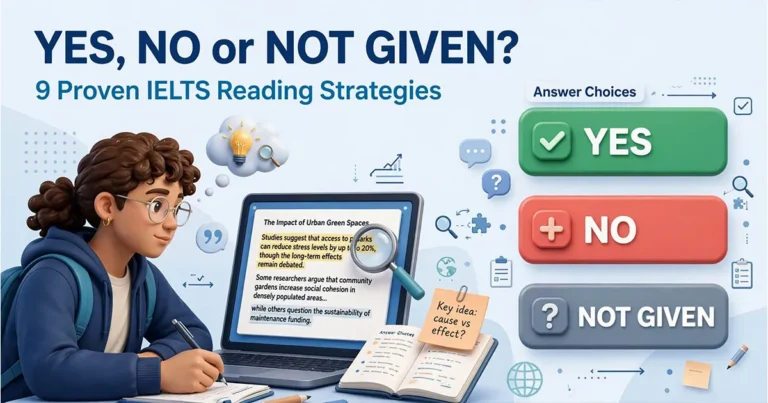
6. Understand Yes, No and Not Given
Yes/No/Not Given is similar to True/False/Not Given, but it normally concerns the writer’s views or claims.
Think about the difference:
True/False/Not Given → information or facts
Yes/No/Not Given → writer’s views or claims
Suppose a writer says:
Governments should invest more heavily in public transport.
A question might ask:
The writer believes governments should increase spending on public transport.
The answer is YES because the statement reflects the writer’s position.
If the passage says the opposite, the answer is NO.
If the writer does not express a position, the answer is NOT GIVEN.
Do not use your own opinion when answering these questions.
Your job is to identify what the passage or writer actually says.
7. Do Not Panic When You See an Unknown Word
You will probably encounter unfamiliar vocabulary in the Reading test.
That does not mean you cannot answer the question.
One of the most practical IELTS Reading Comprehension Tips is to learn when an unknown word matters.
Suppose you read:
The researchers developed an innovative methodology for assessing…
You may not know exactly what methodology means.
But if the question asks about the year the research began, that word may be completely irrelevant.
Ask yourself:
Do I actually need this word to answer the question?
If not, keep moving.
When an unfamiliar word is essential, use the surrounding context.
Look for:
- Definitions
- Examples
- Contrasts
- Cause and effect
- Synonyms nearby
- Grammatical clues
Context can often give you enough information to continue.
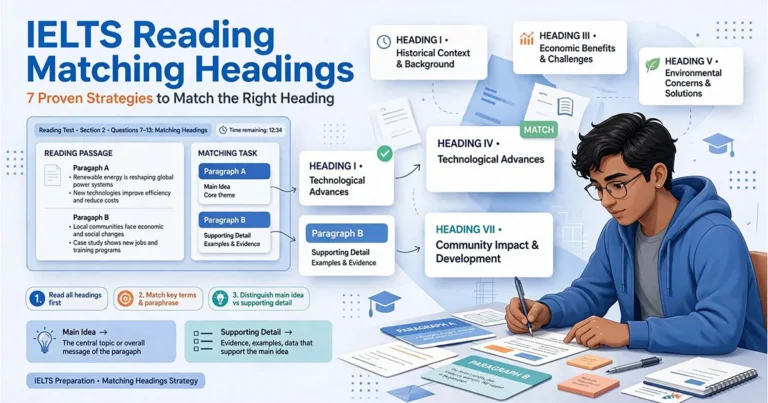
8. Use Matching Headings Differently from Matching Information
These two question types can look similar, but they test different skills.
Matching headings focuses on the main idea of a paragraph.
Matching information asks you to locate specific information.
For matching headings, ask:
What is this paragraph mainly about?
Do not choose a heading simply because one sentence appears to match it.
A paragraph may mention an invention, for example, but its main purpose may actually be to explain why the invention failed.
For matching information, search for the specific detail requested.
Official IELTS guidance explains that matching headings requires you to identify the main idea of a paragraph, while matching information focuses on locating specific information such as a detail, example, reason, comparison or explanation.
9. Pay Close Attention to Word Limits
This is a simple rule that can cost you a mark if you ignore it.
Suppose the instruction says:
NO MORE THAN TWO WORDS AND/OR A NUMBER
Your answer must follow that instruction.
If the correct information is:
renewable energy sources
and you write:
alternative renewable energy sources
you may exceed the permitted word limit.
Official IELTS guidance states that candidates lose the mark when they write more than the specified word limit.
Also check spelling carefully.
The Reading answer sheet matters because spelling and grammar errors can affect your marks.
10. Manage Your 60 Minutes Carefully
Time management is one of the biggest differences between an average Reading performance and a strong one.
You have:
60 minutes
40 questions
That gives you an average of approximately 1.5 minutes per question, although you should not treat every question as requiring exactly the same amount of time.
Some questions can be answered quickly.
Others require more careful analysis.
A practical approach is to divide your time approximately like this:
- Passage/Section 1: 15–17 minutes
- Passage/Section 2: 18–20 minutes
- Passage/Section 3: 23–25 minutes
The exact timing can vary according to your test type and strengths.
The important principle is to avoid spending five minutes fighting with one question.
If a question is consuming too much time:
- Make your best decision.
- Mark it if your test format allows.
- Move forward.
- Return later if possible.
Do not allow one difficult question to damage your performance on several easier ones.
11. Analyse Your Mistakes After Every Practice Test
Simply completing Reading tests is not enough.
One of the most powerful IELTS Reading Comprehension Tips is to investigate why you got an answer wrong.
Create an error log with categories such as:
- Vocabulary problem
- Misread question
- Missed paraphrase
- Poor scanning
- Incorrect inference
- True/False/Not Given confusion
- Yes/No/Not Given confusion
- Matching headings mistake
- Word-limit error
- Spelling error
- Time-management problem
For example, suppose you answered:
FALSE
but the correct answer was:
NOT GIVEN
Do not simply write the correct answer in red.
Ask:
What evidence did I use to decide it was false?
Then ask:
Did the passage actually contradict the statement?
This type of analysis helps prevent the same mistake from appearing in your next practice test.
IELTS Reading Strategies for Academic and General Training
Although the Academic and General Training Reading tests are different, many core strategies are transferable.
IELTS Academic Reading Tips
Academic candidates should become comfortable with:
- Longer texts
- Academic vocabulary
- Complex arguments
- Writer’s opinions
- Supporting evidence
- Paraphrased information
- Logical relationships
You do not need specialist knowledge of every topic.
The Academic Reading texts are written for a non-specialist audience, and technical terms may be explained when necessary.
Focus on understanding the argument and locating the information required by the questions.
IELTS General Training Reading Tips
General Training candidates should practise reading everyday and workplace material as well as longer general-interest texts.
This may include:
- Notices
- Advertisements
- Timetables
- Workplace documents
- Job descriptions
- Training materials
- Contracts
- Magazine or newspaper-style texts
The General Training Reading test progresses from everyday material towards a longer and more complex general-interest text.
The ability to identify purpose, specific information and key details is therefore particularly important.
Common IELTS Reading Mistakes to Avoid
Even candidates with good English can lose marks because of poor test technique.
Avoid these common mistakes:
Reading every word slowly: This wastes time and can reduce concentration.
Using your own knowledge: The answer must come from the passage.
Looking only for exact keywords: IELTS frequently uses paraphrases.
Choosing an answer because it sounds logical: A logical answer is not necessarily supported by the text.
Confusing False with Not Given: Look for contradiction before choosing False.
Confusing No with Not Given: First determine whether the writer actually expresses a conflicting view.
Ignoring instructions: Word limits and answer formats matter.
Spending too long on one question: Keep moving and protect your remaining time.
Checking only your score: The score tells you what happened; error analysis tells you why.
A 30-Minute Daily IELTS Reading Practice Routine
You do not have to complete a full Reading test every day.
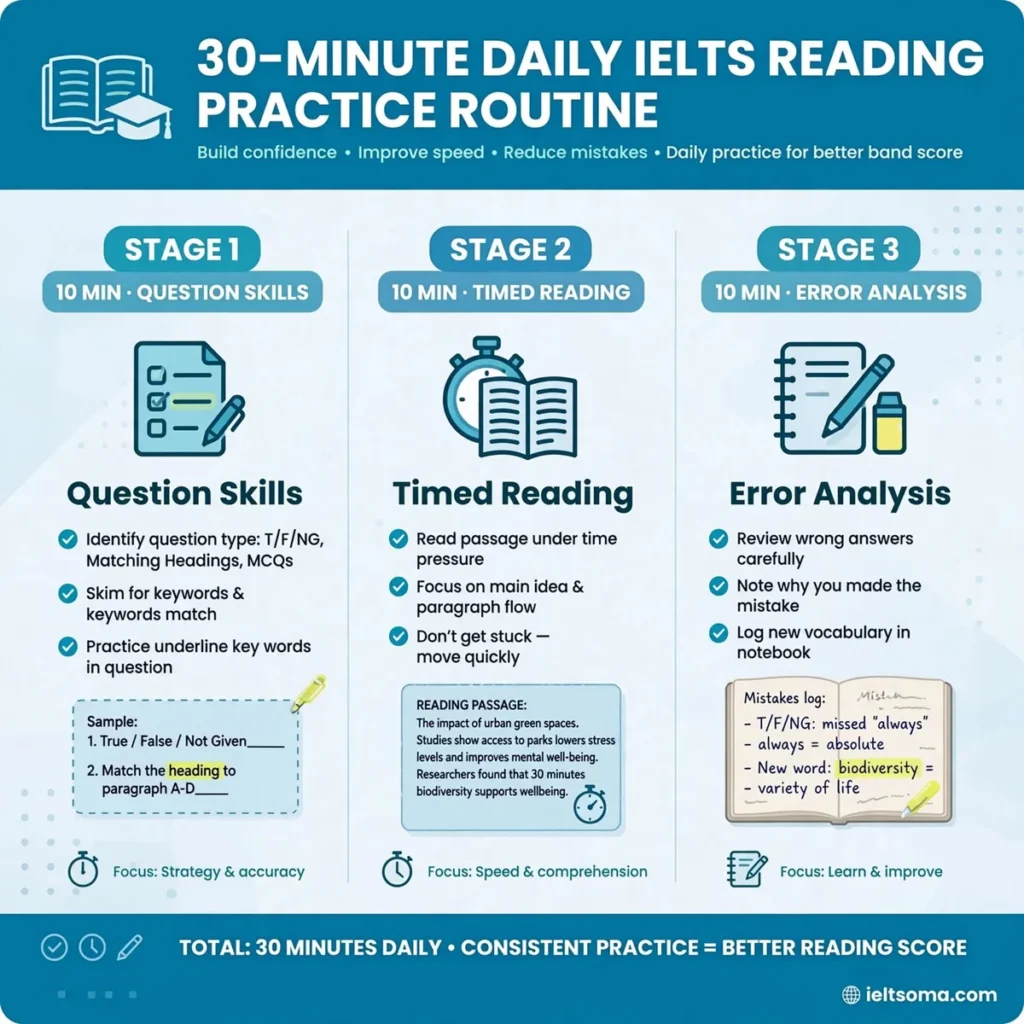
A focused 30-minute routine can be more useful.
10 Minutes: Question Skills
Choose one question type.
Practise:
- Matching headings
- True/False/Not Given
- Yes/No/Not Given
- Multiple choice
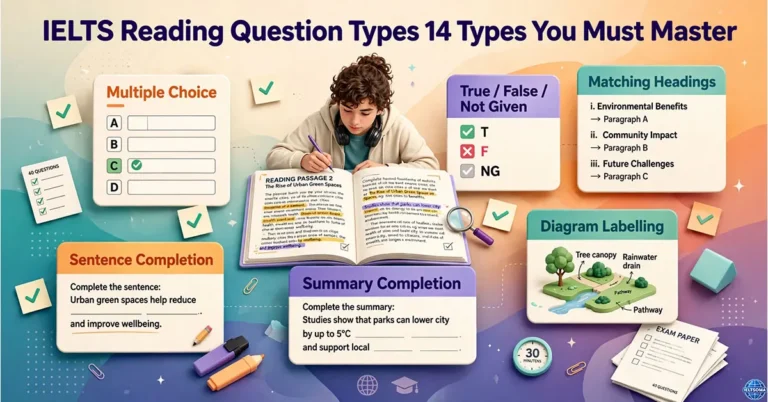
- Sentence completion
- Matching information
Focus on understanding the logic behind the question type.
10 Minutes: Timed Reading
Read a short passage and answer questions under time pressure.
Practise locating information without translating every sentence into your first language.
10 Minutes: Error Analysis
Review every incorrect answer.
Identify the exact sentence or paragraph that contained the evidence.
Then explain why the correct answer is correct and why your answer was wrong.
This final stage is often more valuable than simply completing another exercise.
How to Improve IELTS Reading Comprehension
If your Reading score has stopped improving, change the way you practise.
Instead of asking:
“How many questions did I get right?”
ask:
“What caused each mistake?”
For example, if you repeatedly lose marks in matching headings, your problem may be identifying main ideas.
If you repeatedly lose marks in True/False/Not Given, you may be relying on assumptions.
If you regularly run out of time, you may be reading too slowly or spending too long on difficult questions.
If spelling errors are costing marks, add a final answer-checking routine to your practice.
The goal is not simply to do more tests.
The goal is to become better at the specific skill that is costing you marks.
Frequently Asked Questions About IELTS Reading Comprehension Tips
What are the best IELTS Reading Comprehension Tips for beginners?
Start by learning how to skim, scan and identify keywords. Then practice recognizing paraphrases and understanding each major question type. Once these skills become familiar, introduce timed practice.
Is it necessary to read the entire IELTS Reading passage?
Not always in the same level of detail. You should skim the passage to understand its structure and then scan for relevant information before reading the relevant section carefully.
How can I improve my IELTS Reading speed?
Practise timed reading, reduce unnecessary rereading and learn to scan for distinctive information. Avoid translating every sentence word by word.
What should I do if I do not understand a paragraph?
Do not immediately stop. Look at the surrounding sentences and identify the paragraph’s main purpose. If the paragraph is not relevant to your current question, continue and return to it if necessary.
Is vocabulary important for IELTS Reading?
Yes, but knowing every word is not necessary. You need enough vocabulary to understand meaning, recognize paraphrases and use context to interpret unfamiliar terms.
Which is harder: IELTS Academic or General Training Reading?
They are different rather than simply being “easy” or “hard”. Academic Reading uses texts aimed at a non-specialist academic audience, while General Training Reading includes every day, workplace and general-interest texts.
How many questions are there in IELTS Reading?
There are 40 questions, and the Reading test lasts 60 minutes for both Academic and General Training.
Can I use my own knowledge to answer IELTS Reading questions?
No. Your answer should be based on the information, ideas or views presented in the passage. This is especially important for True/False/Not Given and Yes/No/Not Given questions.
Final Thoughts
A high IELTS Reading score is not achieved simply by reading faster.
It comes from reading intelligently.
Use these IELTS Reading Comprehension Tips to develop a systematic approach: preview questions, identify keywords, recognize paraphrases, skim and scan strategically, distinguish facts from opinions, respect word limits and analyze every mistake.
Most importantly, stop measuring your preparation only by the number of practice tests you complete.
Measure your progress by the number of mistakes you understand and eliminate.
With consistent practice and the right approach, IELTS Reading can become a much more predictable part of your test preparation.
Keep building your skills with IELTSOMA, and turn every Reading practice session into an opportunity to improve your accuracy, speed and confidence.