If you keep losing marks in IELTS Listening even though you understand most of the recording, the problem may not be your English.
You may simply be missing the patterns.
IELTS Listening is not about hearing every word perfectly. It is about recognising how information is introduced, changed, repeated, corrected, paraphrased and organised while the recording moves forward.
Once you learn these patterns, the test becomes much more predictable.
This guide explains IELTS Listening Pattern Recognition step by step, including what to listen for, how to predict answers, how to recognise distractors, and how to train your brain to follow the recording without falling behind.
Table of Contents
What Is IELTS Listening Pattern Recognition?
IELTS Listening Pattern Recognition is the ability to recognise recurring patterns in the way information appears in the recording and questions.
For example, a speaker may first mention one price and then correct it:
“The membership costs £60… actually, I should say £50 for students.”
If the question asks for the student price, recognising the correction pattern helps you avoid choosing the first number you hear.
Other common patterns include:
- Question keywords followed by paraphrased information
- An initial answer followed by a correction
- A general statement followed by a specific detail
- A question followed by an explanation
- A problem followed by a solution
- A comparison between two options
- A sequence of locations or stages
- An opinion followed by a reason
- A speaker introducing an example after making a general point
The objective is not to memorise scripts.
It is to train yourself to recognise what is happening in the conversation as it develops.
Why Pattern Recognition Matters in IELTS Listening
The IELTS Listening test contains four parts and 40 questions. You hear the recordings once only, and the questions follow the order of information in the recording. Different accents can also appear, including British, Australian, New Zealand and North American accents.
That structure creates an important advantage.
You usually do not need to search randomly through the recording for an answer. If you know where you are in the sequence and understand what information the question is asking for, you can anticipate what may come next.
Consider this simple sequence:
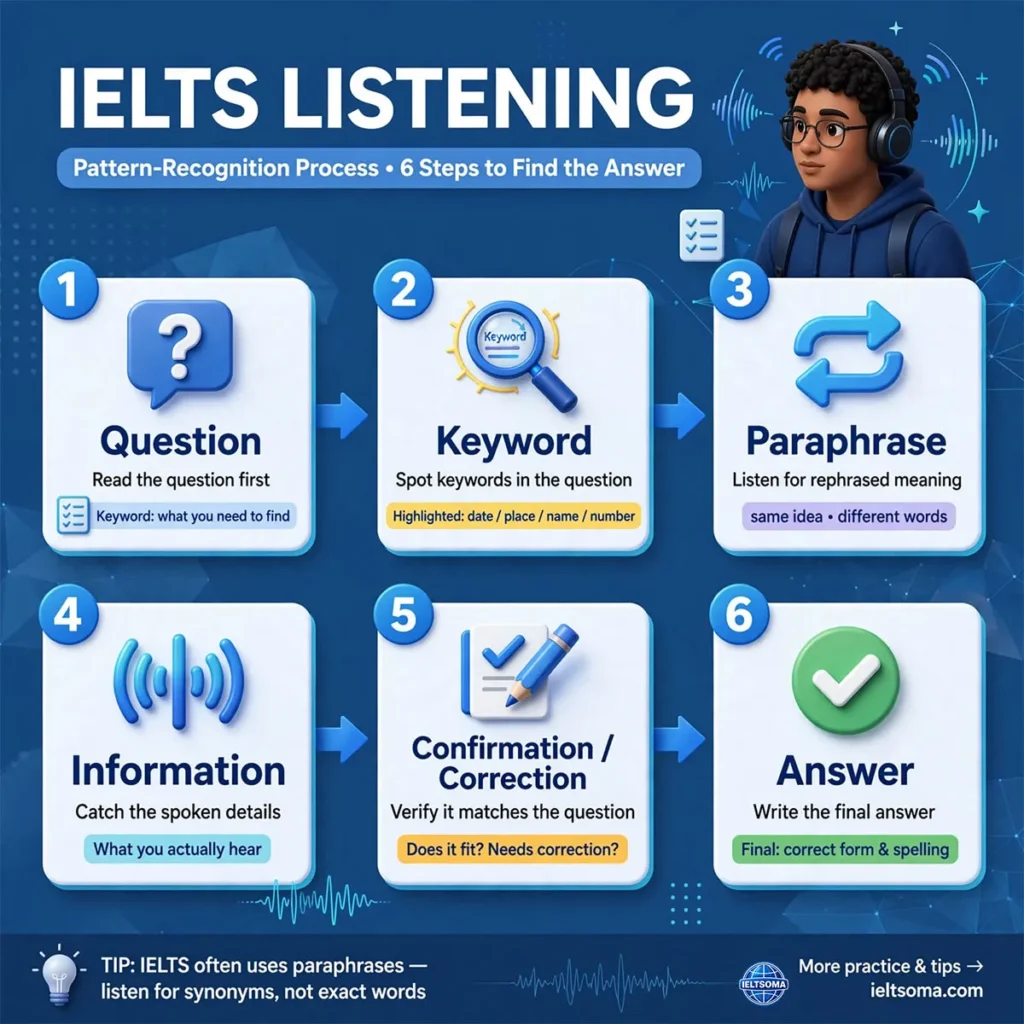
Question → keyword → paraphrase → answer → next question
Now consider a more complicated pattern:
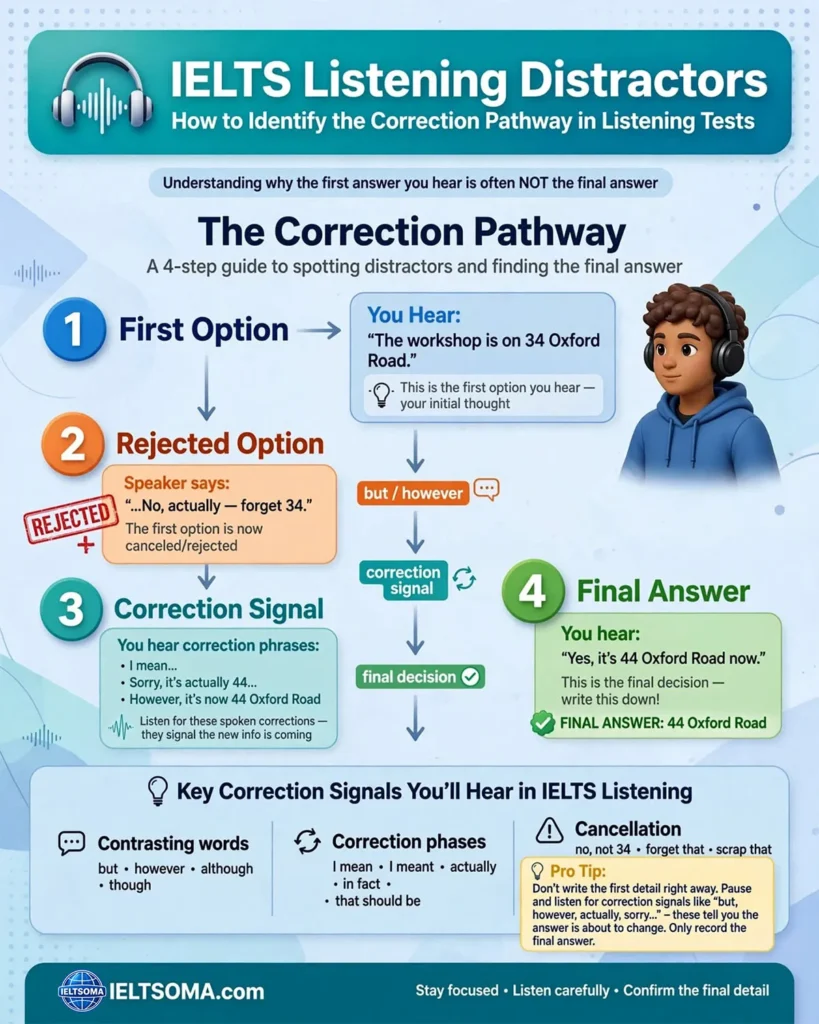
Question → possible answer → correction → final answer → explanation
A candidate who listens only for exact words may choose the wrong answer.
A candidate who recognises the pattern can wait for the speaker to finish the idea.
This is why strong Listening performance involves more than vocabulary. It requires prediction, attention, interpretation and quick decision-making.
1. Recognise the Question-to-Answer Pattern
One of the most useful IELTS Listening patterns is the relationship between the question and the information that answers it.
Suppose the question says:
The new course begins on ______.
You should immediately predict that the answer is likely to be:
- a day
- a date
- a month
- a time period
You are therefore not listening equally to every word.
You are listening with a purpose.
The recording might say:
“The course was originally planned for Monday, but because the building isn’t available, we’ve moved it to Wednesday.”
If you are waiting for a day, both “Monday” and “Wednesday” may attract your attention.
Pattern recognition tells you that the second piece of information may be the final answer because it corrects the first.
Train yourself to predict before listening
Before each question, ask:
- What type of information do I need?
- Is it likely to be a name, number, place, date or description?
- Could the speaker give an alternative?
- Could the information be paraphrased?
- Is there likely to be a correction or qualification?
This takes only a few seconds but gives your listening a clear target.
2. Learn to Recognise Paraphrase Patterns
IELTS does not require the recording to repeat the exact words used in the question.
Instead, the speaker may express the same idea differently.
For example:
Question:
The museum is located near the railway station.
Recording:
“It’s only a five-minute walk from the train station.”
The important relationship is:
railway station → train station
Another example:
Question:
The company provides free accommodation.
Recording:
“Staff members don’t have to pay for somewhere to stay.”
The words are different, but the meaning is similar.
Build meaning connections, not synonym lists
Do not try to memorise hundreds of isolated synonyms.
Instead, practise recognising common meaning relationships:
| Question | Possible recording language |
|---|---|
| purchase | buy |
| approximately | about |
| inexpensive | reasonably priced |
| assist | help |
| postpone | put off |
| occupation | job |
| accommodation | place to stay |
| commence | begin |
| children | young people |
| additional | extra |
The goal is not to find a perfect synonym.
The goal is to recognise when two expressions communicate the same idea.
3. Watch for Correction Patterns
Corrections are among the most important patterns to recognise.
A speaker may give information, realise that it is wrong, and immediately replace it.
For example:
“The meeting is scheduled for Tuesday… sorry, I mean Thursday.”
If the question asks for the meeting day, Thursday is the answer.
Listen carefully for expressions such as:
- actually
- sorry
- I mean
- rather
- no, that’s not right
- let me correct that
- or rather
- I should say
- that’s changed
- we’ve decided to
These expressions often signal that the information is being modified.
A simple rule
Do not automatically choose the first answer you hear.
When two pieces of information appear to answer the same question, listen for the relationship between them.
The second piece may correct, replace or qualify the first.
4. Recognise Distractor Patterns
IELTS Listening deliberately requires you to distinguish relevant information from information that sounds attractive but is not the answer.
A common pattern looks like this:
Option A mentioned → discussion → Option B selected
For example:
“We originally considered the Riverside Hotel, but it was too expensive. The City Hotel was also an option, but in the end we decided on the Grand.”
If the question asks:
Which hotel did they choose?
You need to follow the decision-making pattern.
The recording mentioned three hotels, but only one represents the final decision.
Common distractor signals
Pay attention when speakers say:
- but
- however
- although
- instead
- unfortunately
- actually
- rather than
- in the end
- eventually
- we’ve decided to
- the problem is
- that won’t work
These expressions can indicate a change in direction.
Do not treat every keyword as an answer.
Treat it as a signal to listen more carefully.
5. Recognise Sequence Patterns
Some Listening questions follow a clear sequence.
This is especially useful for:
- processes
- instructions
- maps
- directions
- schedules
- procedures
- stages of an activity
For example:
First → next → after that → finally
A speaker might explain how to register for a course:
“First, complete the online application. Once you’ve submitted it, you’ll receive an email. After that, you need to attend an interview. Finally, you’ll receive confirmation.”
If the questions follow the same sequence, you can use the structure of the explanation to stay oriented.
Official IELTS guidance confirms that Listening questions are presented in the same order as the information in the recording.
That makes sequence awareness particularly valuable.
6. Recognise Question-and-Explanation Patterns
Another common pattern is:
Answer → explanation
or:
Opinion → reason
For example:
“I’d recommend the evening class because it’s much smaller.”
The first important idea is the recommendation.
The second explains why.
If the question asks:
Why does the speaker recommend the evening class?
you need to listen for the reason, not simply the recommendation.
Useful signals include:
- because
- since
- as
- the reason is
- that’s because
- mainly because
- this is due to
- one advantage is
Example
Question:
Why did Sarah choose the new accommodation?
Recording:
“She liked the location, but the main reason she chose it was that it was much closer to her workplace.”
The recording contains two positive details.
The phrase “the main reason” tells you which one is most important.
Pattern recognition helps you separate supporting information from the answer.
7. Recognise Comparison Patterns
Speakers often compare two or more things.
For example:
“The old library is larger, but the new one has better study facilities.”
You need to understand the relationship:
- Old library → larger
- New library → better facilities
If the question asks which library has better study facilities, the answer is the new library.
Listen for comparison signals such as:
- more than
- less than
- better
- worse
- whereas
- while
- compared with
- unlike
- in contrast
- on the other hand
- the main difference is
Do not assume that a statement about one option automatically applies to another.
The whole comparison matters.
8. Recognise Speaker-Change Patterns in Part 3
Part 3 can involve a discussion between speakers in an educational or training context. Part 4 is a monologue on an academic subject.
In a multi-speaker discussion, your challenge is not only understanding vocabulary.
You must also track who said what.
Imagine:
Student A: “I think the introduction needs more evidence.”
Student B: “I agree about the evidence, but I think the conclusion is the bigger problem.”
Tutor: “Actually, both sections need revision.”
Three opinions have appeared.
A candidate who is not tracking speaker roles may confuse them.
Use speaker patterns
Before the recording begins, identify:
- Who is speaking?
- What is each person’s role?
- What are they discussing?
- Is someone asking questions?
- Is another person providing an expert opinion?
- Are they agreeing or disagreeing?
Then listen for:
- I agree
- I don’t think so
- I’m not sure
- that’s true
- I see what you mean
- but
- however
- I’d suggest
- I would recommend
These phrases help you follow changes in opinion.
9. Recognise the Pattern of Numbers, Names and Spelling
Some Listening questions appear easy because the answer is a simple fact.
Yet candidates frequently lose marks because they misunderstand or miss:
- names
- telephone numbers
- addresses
- dates
- prices
- postcodes
- measurements
- room numbers
Pattern recognition helps because these details often appear in predictable contexts.
For example:
Name → spelling → confirmation
“The surname is McKenzie.”
“Could you spell that?”
“M-C-K-E-N-Z-I-E.”
If you expect the spelling pattern, you are less likely to lose concentration.
The same applies to numbers:
“The fee is £80.”
“Is that per person?”
“Yes, £80 per person.”
You need to understand not only the number but what the number represents.
How to Use IELTS Listening Pattern Recognition Before the Recording
Your preparation before each section can make a significant difference.
Do not spend those seconds simply staring at the page.
Use them strategically.
Step 1: Read the instructions
Check exactly what you must write.
The word limit matters. Official IELTS guidance states that exceeding the specified word limit results in the mark being lost.
Step 2: Identify keywords
Underline or mentally highlight:
- names
- places
- dates
- numbers
- nouns
- verbs
- important descriptive words
Step 3: Predict the answer
Ask:
What type of answer fits this gap?
For example:
The course lasts ______.
Likely answer: a period of time
The meeting will be held in ______.
Likely answer: a place
The membership costs ______.
Likely answer: a price
Step 4: Predict possible paraphrases
If the question says cheap, expect the speaker might say:
- inexpensive
- affordable
- reasonably priced
- doesn’t cost much
Step 5: Prepare for change
Ask:
Could the speaker mention one answer and then change it?
This simple question can prevent many distractor mistakes.
How to Train IELTS Listening Pattern Recognition
Pattern recognition improves through deliberate practice.
Simply completing full Listening tests repeatedly is not enough.
Use a four-stage method.
Stage 1: Listen
Complete a Listening task under realistic conditions.
Do not pause the recording.
Do not replay difficult sections.
Try to follow the recording as you would in the real test.
Stage 2: Analyse
Check your answers.
For every incorrect answer, ask:
- Did I miss the information?
- Did I misunderstand the speaker?
- Did I miss a paraphrase?
- Did I choose a distractor?
- Did I fail to notice a correction?
- Did I lose track of the speaker?
- Did I misunderstand the question?
- Did I make a spelling error?
- Did I exceed the word limit?
Stage 3: Replay strategically
If a transcript is available, locate the exact part of the recording containing the answer.
Then ask:
What pattern did I miss?
Was it:
- paraphrasing?
- correction?
- comparison?
- sequence?
- opinion?
- explanation?
- distractor?
- speaker change?
This is where real learning happens.
Stage 4: Record the pattern
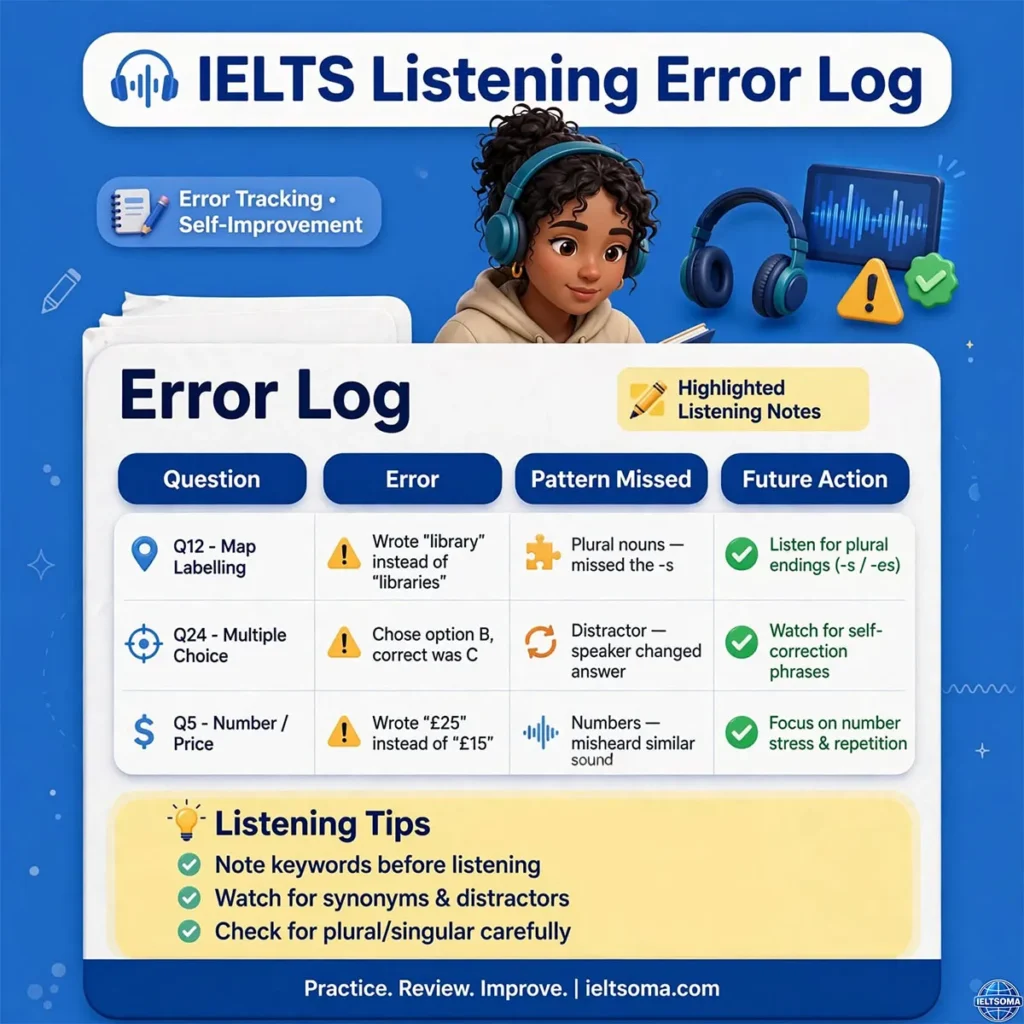
Create an IELTS Listening error log.
For example:
| Question | Error | Pattern missed | Future action |
|---|---|---|---|
| 4 | Wrong number | Correction | Listen after “actually” |
| 11 | Wrong option | Distractor | Wait for final decision |
| 18 | Missed answer | Paraphrase | Practise meaning links |
| 27 | Wrong speaker | Speaker change | Track opinions |
| 35 | Wrong word | Word limit | Check instructions |
After several tests, patterns in your own mistakes will begin to appear.
A 20-Minute Daily Pattern Recognition Routine
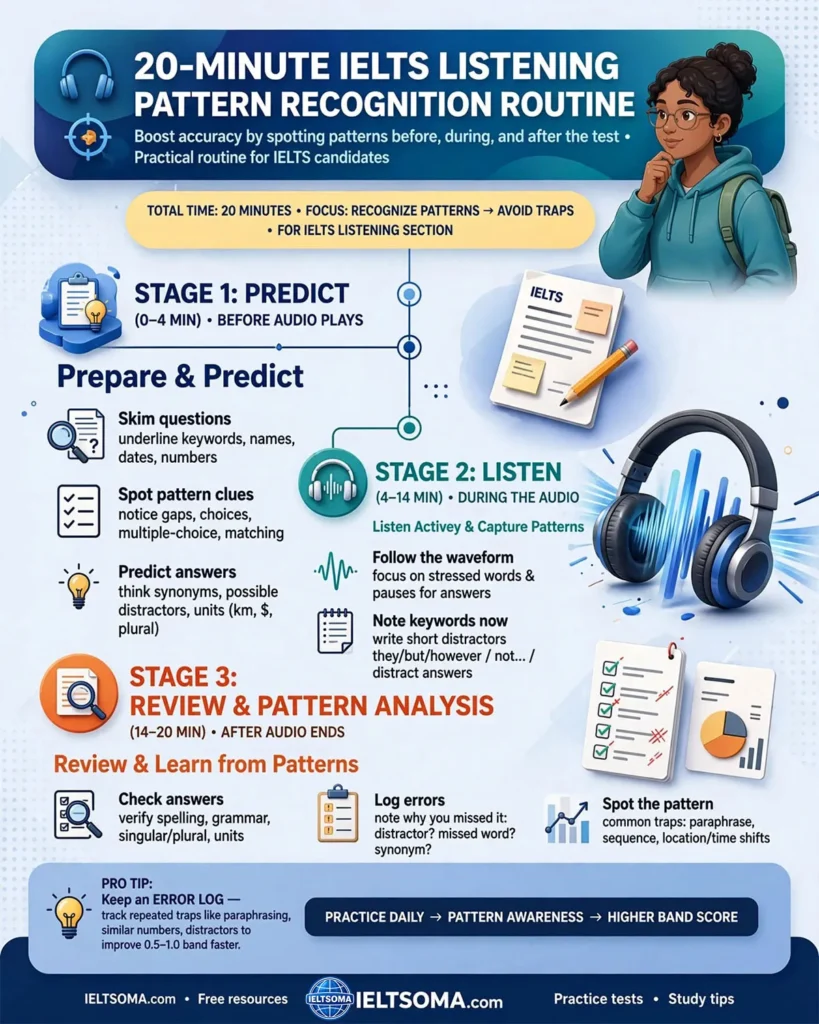
You do not need to complete a full Listening test every day.
Try this routine instead.
Minutes 1–3: Predict
Read a small set of Listening questions.
Predict:
- answer type
- possible vocabulary
- likely paraphrases
- possible distractors
Minutes 4–10: Listen
Play a short IELTS Listening section once.
Do not pause it.
Focus on the information flow.
Minutes 11–15: Review
Check your answers and identify every mistake.
Do not simply count your score.
Minutes 16–20: Pattern analysis
Replay difficult sections if appropriate.
Identify exactly what happened.
Write one sentence such as:
“I heard the correct keyword but chose the first number instead of the corrected number.”
That is much more useful than writing:
“Question 7 wrong.”
Common IELTS Listening Pattern Recognition Mistakes
Mistake 1: Listening only for exact words
The recording may use different language from the question.
Better approach: Listen for meaning and relationships.
Mistake 2: Choosing the first number you hear
Speakers may correct themselves.
Better approach: Listen for confirmation or correction.
Mistake 3: Treating every keyword as an answer
A keyword can introduce a distractor.
Better approach: Follow the complete idea.
Mistake 4: Ignoring the speaker’s purpose
A speaker may mention an option before rejecting it.
Better approach: Listen for the final decision.
Mistake 5: Panicking after missing one answer
The recording continues whether you are ready or not.
Better approach: Accept the missed question and immediately focus on the next one.
Mistake 6: Practising only one question type
Official IELTS Listening tasks include multiple choice, matching, plan/map/diagram labelling, form/note/table/flow-chart/summary completion, sentence completion and short-answer questions.
Better approach: Train across different formats.
Mistake 7: Checking only the final score
A score tells you how many answers you got right.
It does not tell you why you got them wrong.
Better approach: Maintain an error log and identify recurring patterns.
IELTS Listening Pattern Recognition and Band Score Improvement
Pattern recognition is not a shortcut to a particular band score.
It is a way of making your existing listening ability more effective under test conditions.
Official IELTS scoring information states that the Listening test contains 40 questions, with one mark awarded for each correct answer. The raw score is converted to the IELTS 9-band scale, and the precise conversion can vary slightly between test versions.
For example, official guidance gives approximately:
| Correct answers | Approximate Listening band |
|---|---|
| 16 | 5.0 |
| 23 | 6.0 |
| 30 | 7.0 |
| 35 | 8.0 |
These figures are useful for understanding the scoring scale, but they should not become your only target.
Your real objective is to reduce the mistakes that repeatedly cost you marks.
If you currently score 25 because you frequently miss corrections, improving that specific weakness can be more valuable than completing another ten random practice tests.
Frequently Asked Questions About IELTS Listening Pattern Recognition
What is IELTS Listening Pattern Recognition?
IELTS Listening Pattern Recognition is the ability to recognise recurring patterns in how information is presented during the Listening test, such as paraphrases, corrections, comparisons, distractors, explanations and changes in opinion.
How does pattern recognition improve IELTS Listening?
Pattern recognition helps you anticipate what type of information is coming, identify important signals and distinguish the correct answer from distractors. It can make your listening more focused and reduce avoidable mistakes.
What patterns should I look for in IELTS Listening?
Pay particular attention to paraphrases, corrections, distractors, sequences, comparisons, explanations, changes of opinion, speaker changes, and numbers or spelling.
How can I recognise distractors in IELTS Listening?
Listen for signals such as but, however, actually, instead, unfortunately, rather than, in the end and we’ve decided. These can indicate that the speaker is changing, rejecting or replacing information previously mentioned.
Should I choose the first answer I hear in IELTS Listening?
No. The first information you hear is not necessarily the final answer. Speakers may correct themselves, compare alternatives or reject an earlier option. Always listen to the complete idea before deciding.
How can I practise IELTS Listening Pattern Recognition?
Complete Listening exercises, then analyse every incorrect answer to identify the specific pattern you missed. Replay difficult sections and determine whether the problem involved paraphrasing, correction, distractors, sequencing, speaker changes or another pattern.
Is IELTS Listening Pattern Recognition useful for both Academic and General Training?
Yes. The Listening test is the same for IELTS Academic and IELTS General Training, so pattern-recognition strategies can be used by candidates preparing for either test.
Can pattern recognition improve my IELTS Listening band score?
It can help you reduce avoidable errors and use your listening ability more effectively, particularly when you struggle with distractors, paraphrases or changes in information. However, it should be combined with vocabulary development, listening practice and familiarity with IELTS question types.
Final IELTS Listening Pattern Recognition Strategy
The strongest candidates do not necessarily understand every word in the recording.
They know how to follow the structure of the information.
Before listening, predict.
During listening, track the sequence.
When you hear a keyword, do not immediately write it down as the answer.
Ask what happens next.
Does the speaker:
- confirm it?
- correct it?
- compare it?
- reject it?
- explain it?
- give an example?
- change the subject?
That is the heart of IELTS Listening Pattern Recognition.
Use the following checklist during your preparation:
- Predict the answer type before listening.
- Look for paraphrases rather than exact words.
- Watch for corrections.
- Recognise distractors.
- Follow information in sequence.
- Track speaker changes.
- Listen for comparisons and contrasts.
- Pay attention to numbers, names and spelling.
- Analyse the pattern behind every mistake.
- Practise different question types under realistic conditions.
When these patterns become familiar, IELTS Listening stops feeling like a stream of unpredictable English.
You begin to recognise where the information is going — and that gives you a much better chance of staying one step ahead of the recording.
Further Reading: