IELTS Listening multiple choice questions can be surprisingly difficult, even when you understand most of the recording. You may hear all three options mentioned, recognise familiar words in each one, and still struggle to identify the correct answer. The problem is often not your vocabulary. It is recognising which information the speaker actually confirms, rejects, or changes.
The most effective IELTS Listening multiple choice strategy is to predict what you need to hear, recognise paraphrasing, and evaluate the meaning of the complete statement rather than selecting an option simply because you heard a matching word.
This guide explains how to tackle difficult IELTS Listening multiple choice questions, avoid common distractors, follow changing opinions, and make confident decisions when the recording moves quickly. You will also find worked examples, practice questions, and a step-by-step method you can apply in your next listening test.
Table of Contents
1. Understand IELTS Listening Multiple Choice Questions
In IELTS Listening, multiple choice questions require you to select the correct answer from a set of options. Depending on the task, you may choose one answer or select more than one answer from a list.
The official IELTS format includes questions that test your understanding of specific details, opinions, reasons, decisions, and the main ideas of a recording. The answer may depend on what a speaker means rather than the exact words they use.
Multiple choice questions can appear in different parts of the Listening test. Part 3 is particularly challenging for many candidates because it often involves discussions in educational or training contexts, where speakers may disagree, reconsider ideas, or evaluate alternatives.
The Listening test is the same for IELTS Academic and General Training. You hear each recording once, so you must understand the information as it unfolds and keep track of the questions.
Before practising, distinguish between these common question formats:
- Single-answer questions: Choose one correct option, usually A, B, or C.
- Multiple-answer questions: Select the required number of correct options. Read the instructions carefully to determine how many answers you need.
- Sentence-completion-style options: Choose the ending that correctly completes a statement based on the recording.
Your strategy should change slightly according to what the question asks. A question about a speaker’s main reason requires a different listening focus from one asking for a specific detail.
2. Strategy 1: Analyze the Question Before Listening
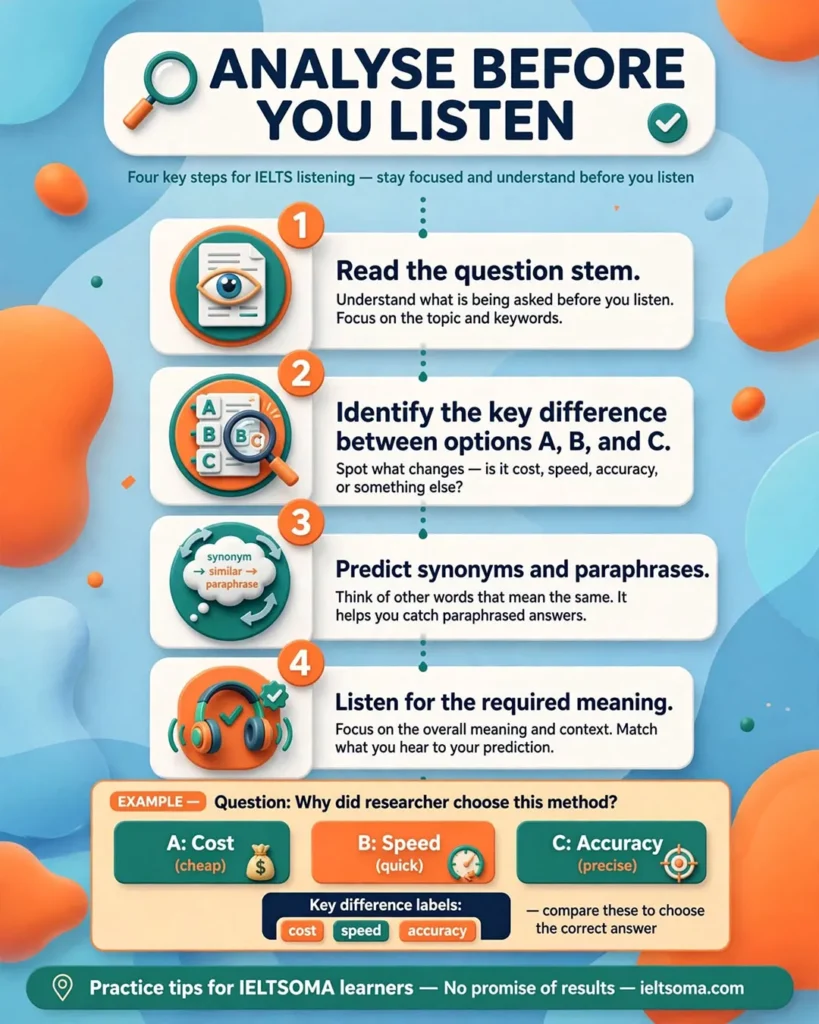
One of the most effective ways to improve your performance is to understand the question before the recording begins.
Do not spend the preparation time reading every option repeatedly without a clear purpose. First, identify the information the question requires.
For example:
Question: Why did Maya decide to change her research topic?
A. She could not find enough published research.
B. Her supervisor recommended a different approach.
C. She became more interested in another subject.
The key phrase is why did Maya decide to change her research topic? You need to identify her reason for changing the topic, not simply collect information about her research.
Underline or mentally identify the important words:
- Why: Listen for a reason or explanation.
- Decide to change: Focus on the decision and what caused it.
- Research topic: Establish the situation being discussed.
Next, identify how each option differs.
| Option | What you need to listen for |
|---|---|
| A | Difficulty finding relevant research |
| B | Advice or a recommendation from her supervisor |
| C | A change in personal interest |
This process creates a listening plan. Instead of trying to understand every sentence equally, you know which ideas to evaluate.
Predict synonyms before the audio starts
The recording may not use the same expressions as the options.
For example:
- Could not find enough published research may become “There wasn’t much literature available.”
- Recommended a different approach may become “My supervisor suggested I look at it another way.”
- Became more interested may become “I found the other subject much more engaging.”
These expressions communicate similar meanings without repeating the original wording.
Expert tip: Read the question stem first, then compare the options. Identify the difference between them and predict alternative expressions. This is more useful than trying to memorise every word.
3. Strategy 2: Recognise Distractors and Changes of Mind
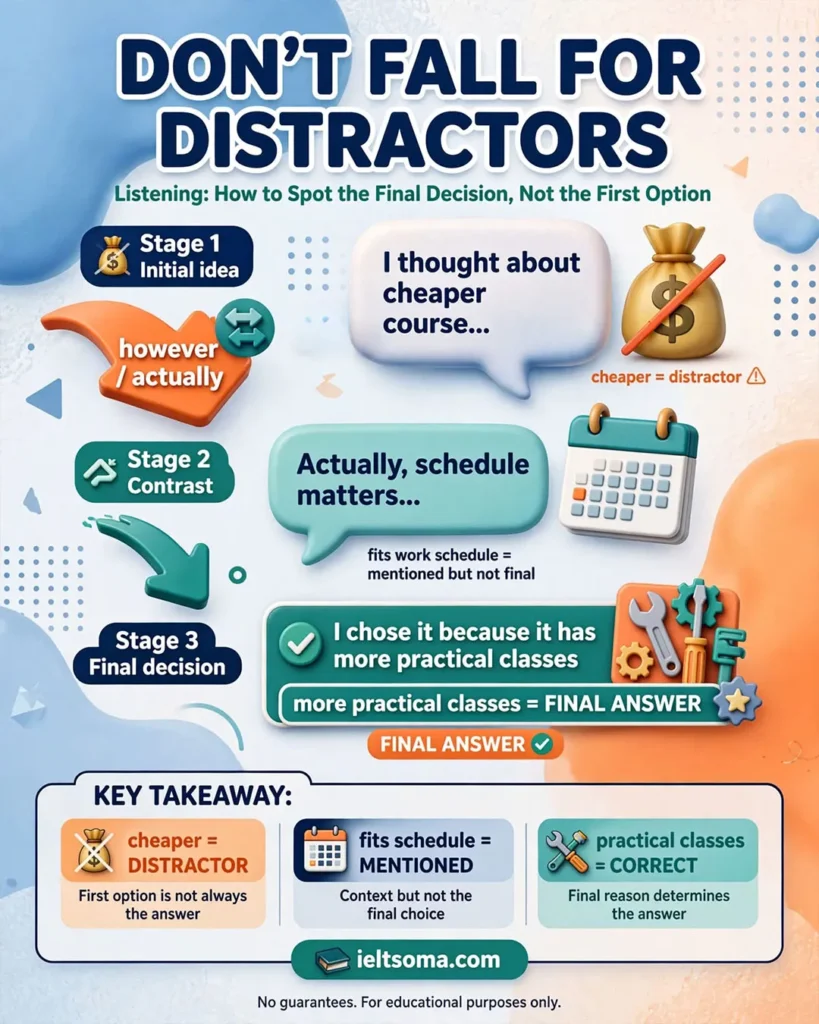
A distractor is information that sounds relevant but does not answer the question correctly. In difficult IELTS Listening multiple choice questions, distractors may be especially convincing because they contain words or ideas taken directly from the options.
The speaker might mention an option, explain why it initially seemed suitable, and then reject it. Another option may be discussed in detail before the speaker makes a final decision.
Your task is to follow the speaker’s meaning, not to select the first option you recognise.
Example: Identifying a change of mind
Question: Why did Daniel choose the evening course?
A. It was less expensive.
B. It fitted his work schedule.
C. It offered more practical classes.
Recording-style example:
“I originally considered the afternoon course because the fee was lower. However, I realised I couldn’t leave work early enough to attend. The evening option was more convenient, although it cost a little more. Both courses had practical sessions, so that wasn’t really a deciding factor.”
Correct answer: B — It fitted his work schedule.
Why?
- Option A is mentioned, but the speaker does not choose the course because it is cheaper.
- Option B matches the final decision: the evening course is more convenient because of his work schedule.
- Option C is not the deciding factor because both courses offer practical sessions.
Notice how the speaker discusses all three options. Simply hearing lower fee, evening, or practical sessions is not enough.
Listen for language that signals a change
Pay attention to expressions such as:
- Initially, I thought…
- I was going to…, but…
- On second thought…
- However…
- Actually…
- In the end…
- What changed my mind was…
- The main reason was…
These phrases can signal a contrast, correction, or final decision. However, do not assume that every answer follows the word however. The important skill is understanding how the ideas relate to one another.
A useful rule is to distinguish between what a speaker considered, what they rejected, and what they finally decided.
4. Strategy 3: Focus on Paraphrasing, Not Matching Words
Paraphrasing is one of the biggest challenges in IELTS Listening multiple choice questions. The options may use one expression while the speaker communicates the same idea using different vocabulary or sentence structures.
For example:
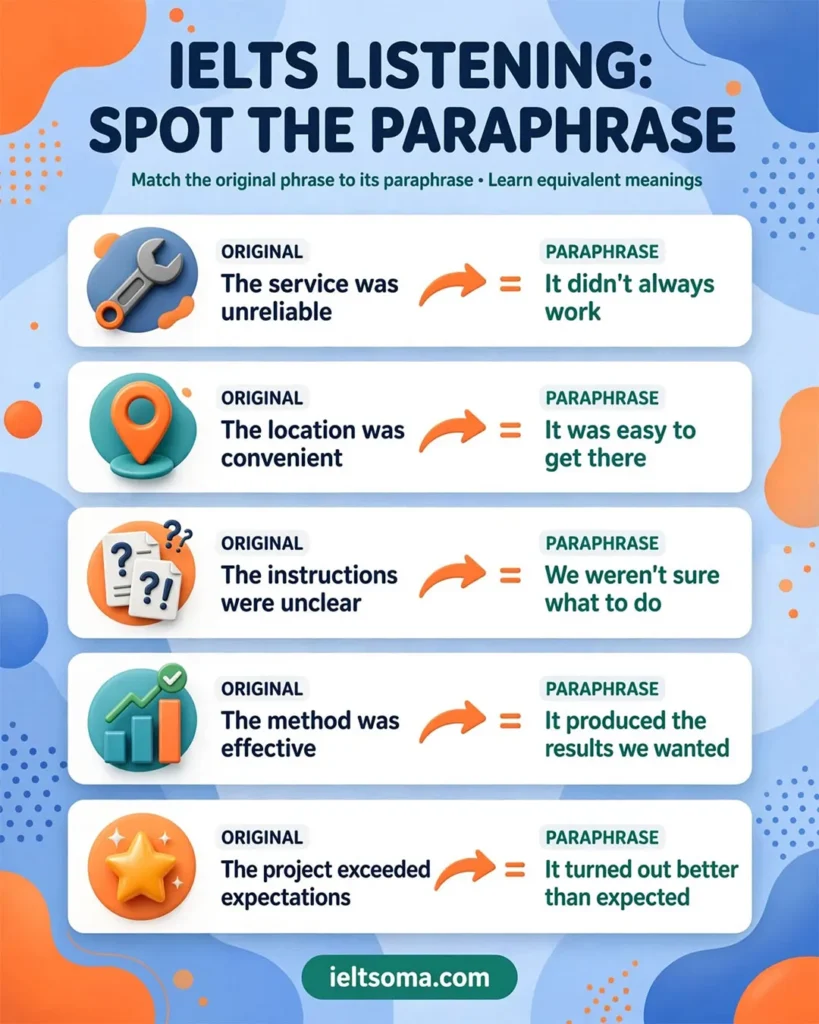
| Wording in the option | Possible wording in the recording |
|---|---|
| The service was unreliable. | It didn’t always work when we needed it. |
| The location was convenient. | It was easy to get there from where I live. |
| The project exceeded expectations. | It turned out better than we had anticipated. |
| The instructions were unclear. | We weren’t sure what we were supposed to do. |
| The method was effective. | It produced the results we wanted. |
These are illustrative examples, not fixed substitutions. The correct interpretation always depends on the context.
How to practise paraphrasing
Before listening, rewrite each option in simpler language.
Suppose the question asks:
What did the students find most challenging about the assignment?
A. Organising their research
B. Interpreting the results
C. Meeting the deadline
Your mental notes might be:
- A: putting information in order
- B: understanding what the findings meant
- C: finishing on time
Now listen for the underlying idea, not the exact phrase.
The speakers may say, “We had collected all the data, but making sense of the figures was another matter.” This would point towards option B, even though neither interpreting nor results may appear in that exact form.
Practice principle: Learn groups of related expressions but avoid treating synonyms as interchangeable in every context. Difficult, time-consuming, and expensive describe different problems, even when all three make a task less attractive.
5. Strategy 4: Understand the Difference Between Similar Options
Some difficult questions contain options that are all partly true. The challenge is deciding which one most accurately answers the question.
Consider this example.
Question: What does the lecturer say is the main advantage of the new study method?
A. It helps students remember information for longer.
B. It reduces the amount of time needed to study.
C. It makes difficult topics easier to understand.
These options are related, but they describe three different benefits:
- A: Long-term retention
- B: Time efficiency
- C: Comprehension
Suppose the lecturer says:
“Students using this method often spend less time reviewing their notes. More importantly, they can recall key concepts several weeks later. It doesn’t necessarily make complicated topics easier to understand at first.”
The best answer is A, because the lecturer identifies longer-term recall as the more important benefit.
Option B is plausible because reduced study time is mentioned. However, the question asks for the main advantage, and the lecturer gives greater emphasis to retention.
Use a comparison method
When two options seem correct, ask yourself:
- Which option answers the exact question?
- Which idea does the speaker emphasise?
- Is one option merely a secondary benefit?
- Does the speaker qualify or reject either statement?
- Does the complete meaning support the option, or only one word?
Be careful with words such as main, most important, primary, and best. They require you to compare ideas rather than identify any true statement.
Do not confuse a true statement with the correct answer
An option can contain accurate information from the recording and still be wrong for the question.
If the question asks why a student selected a university, information about the university’s accommodation may be true but irrelevant if the student’s actual reason was the research facilities.
Always connect the evidence to the question stem.
6. Strategy 5: Follow Opinions, Agreements, and Disagreements
IELTS Listening discussions may include several speakers who evaluate the same idea differently. You need to recognise who holds an opinion and whether that opinion changes during the conversation.
Consider this exchange:
Student 1: “I think the survey was a good idea because it gave us a lot of responses.”
Student 2: “True, but most of the responses came from students on our own course. That makes the results less representative.”
Student 1: “I hadn’t considered that. Perhaps the interviews would have provided a broader range of views.”
If the question asks what the students identified as the main weakness of the survey, the answer is that the responses were not sufficiently representative.
The first speaker initially praises the survey. However, the conversation develops, and the students identify a limitation.
Listen for agreement and contrast
Expressions that may indicate agreement include:
- I agree with that.
- That’s a fair point.
- Exactly.
- I had the same impression.
Expressions that may indicate disagreement or qualification include:
- I’m not entirely convinced.
- I see your point, but…
- That might be true; however…
- I’m not sure that’s the main issue.
- I wouldn’t go that far.
These expressions are useful clues, but tone and context also matter.
Track each speaker’s position
For longer discussions, make very brief notes if permitted and practical:
- Student A: supports survey
- Student B: questions representativeness
- Final view: survey limitation acknowledged
Do not attempt to write down every sentence. Your priority is to follow the development of the discussion.
This skill is particularly useful in Part 3, where students and tutors may compare methods, review research, or discuss the strengths and weaknesses of different approaches.
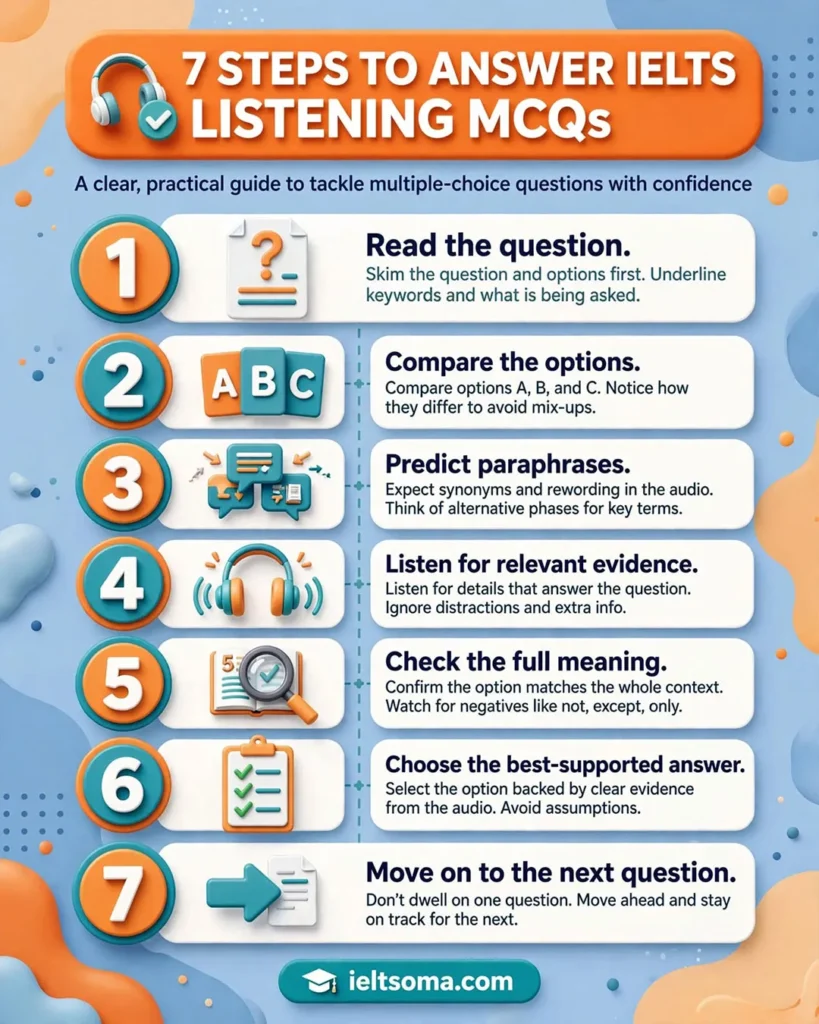
7. Strategy 6: Use a Step-by-Step Method for Difficult Questions
When a question seems complicated, use a repeatable process instead of guessing.
Step 1: Read the question stem
Identify exactly what you must determine: a reason, a preference, an opinion, a problem, a result, or a main idea.
Step 2: Identify the differences between the options
Do not read three similar options as if they mean the same thing. Find the specific detail that distinguishes each answer.
Step 3: Predict possible paraphrases
Think of alternative ways the speaker could express each idea. This prepares you to recognise meaning without relying on exact wording.
Step 4: Listen for the relevant discussion
Follow the topic and identify when the speaker begins addressing the question. Listen for supporting information, contrasts, explanations, and corrections.
Step 5: Evaluate the complete meaning
Do not choose an option just because a keyword appears. Check whether the speaker supports the idea, rejects it, or mentions it only as background information.
Step 6: Make a decision and move on
If the evidence clearly supports an option, select it. If you are uncertain, eliminate options that contradict the recording and make the best decision you can.
Step 7: Keep up with the next question
Do not allow one difficult question to make you miss the following one. The questions generally follow the order of the information in the recording, so move forward when the discussion progresses.
This method will not make every question easy. It will, however, help you approach challenging items systematically instead of reacting to familiar words.
8. Strategy 7: Manage Time and Recover After Missing Information
You cannot pause the recording to reconsider an earlier answer. That makes attention management a vital part of IELTS Listening multiple choice strategy.
Use the time before each recording or question set to read ahead, identify key distinctions, and prepare for the likely topic.
During the recording:
- Keep your attention on the current question.
- Use brief notes only when they help you distinguish ideas.
- Select an answer when the evidence is sufficient.
- Move on when the discussion shifts to the next question.
- Return to an uncertain answer only if the test format and remaining time allow it.
What if you miss an answer?
Do not mentally replay the sentence while the recording continues. You risk losing two or three answers while trying to recover one.
Instead:
- Eliminate any option you know is inconsistent with the information you heard.
- Choose the most plausible remaining answer if necessary.
- Refocus immediately on the next question.
- Continue listening for the next relevant idea.
An unanswered question cannot earn a mark, so avoid leaving gaps when you can make an informed choice.
Use the final review wisely
If you have review time, check that you selected the required number of answers and that your responses are recorded correctly. For computer-based tests, follow the instructions on screen; for paper-based tests, follow the relevant answer-sheet instructions.
The official IELTS Listening test format guide explains the question types, test structure, and one-play recording format.
9. Common Mistakes to Avoid
Even candidates with good English comprehension can lose marks by using unreliable answering habits.
| Mistake | Better approach |
|---|---|
| Selecting an option because one word matches | Check the meaning of the complete statement. |
| Choosing the first option mentioned | Listen for corrections, contrasts, and final decisions. |
| Ignoring the question stem | Identify what information the question requires. |
| Assuming the speaker’s first opinion is final | Follow how the discussion develops. |
| Treating all true statements as correct answers | Select the statement that directly answers the question. |
| Reading the options without comparing them | Identify the specific difference between each option. |
| Trying to understand every word | Prioritise the ideas relevant to the questions. |
| Spending too long on one uncertain answer | Make the best decision possible and refocus. |
| Practising only easy questions | Include challenging questions with similar options and paraphrases. |
| Checking only the final score | Review why each incorrect option was tempting. |
A particularly common mistake is confusing topic recognition with answer recognition. You might correctly understand that the recording discusses transport, research, or university facilities without identifying the specific point the question asks about.
Accuracy depends on connecting the evidence to the question.
10. Worked Practice: Difficult IELTS Listening Multiple Choice Questions
The following original practice questions illustrate common challenges. They are written examples rather than official IELTS questions or recordings.
Read each question, identify the differences between the options, and choose your answer before checking the explanation.
Practice Question 1: A changed decision
Why did Emma decide not to attend the workshop?
A. The registration fee was too high.
B. The workshop covered material she already knew.
C. The venue was difficult to reach.
Recording-style extract:
“At first, I thought the fee was reasonable, and the centre is actually quite easy to get to by train. But after reading the programme carefully, I realised most sessions covered techniques we’d already studied last term. I decided it wouldn’t be the best use of my time.”
Correct answer: B — The workshop covered material she already knew.
Explanation: The speaker explicitly dismisses the transport concern and does not complain about the fee. Her decision is based on the lack of new material.
Lesson: Pay attention to the reason that directly leads to the decision, not every detail mentioned.
Practice Question 2: Identifying the main benefit
What did the researchers consider the biggest benefit of the new method?
A. It made the experiment cheaper.
B. It produced more consistent results.
C. It required fewer participants.
Recording-style extract:
“The method wasn’t significantly cheaper, and we still needed roughly the same number of participants. What impressed us was that repeating the experiment produced very similar results. That consistency made the findings much more dependable.”
Correct answer: B — It produced more consistent results.
Explanation: The speaker rejects the cost and participant-number possibilities and identifies consistency as the important advantage.
Lesson: Listen for comparisons and emphasis when the question asks for the biggest or main benefit.
Practice Question 3: Recognising paraphrasing
What was the main problem with the original timetable?
A. It did not allow enough time between classes.
B. It placed difficult subjects at the beginning of the day.
C. It required students to travel between buildings.
Recording-style extract:
“Students said they could manage the demanding morning classes. The real issue was that one lecture ended just five minutes before the next began in a different building. By the time they arrived, the second session had already started.”
Correct answer: C — It required students to travel between buildings.
Explanation: The recording describes the practical problem rather than repeating the wording of the option. The five-minute gap matters because the students must move to another building.
Lesson: Connect the details to the underlying problem. Do not assume that a number or a complaint automatically points to the most obvious option.
Practice Question 4: Understanding a qualification
What does the tutor think about the student’s proposed survey?
A. It is suitable, provided the sample is broadened.
B. It is unlikely to produce useful information.
C. It should be replaced with individual interviews.
Recording-style extract:
“The questionnaire is a sensible starting point, and I wouldn’t abandon it. However, if you collect responses only from your own class, the findings may not reflect the wider student population. Could you include students from other departments as well?”
Correct answer: A — It is suitable, provided the sample is broadened.
Explanation: The tutor supports the questionnaire but identifies a condition that needs to be addressed. The tutor does not reject the method or recommend replacing it with interviews.
Lesson: Statements involving conditions, limitations, or recommendations often distinguish the correct option from overly positive or negative alternatives.
Practice Question 5: Distinguishing a reason from a result
Why did the team introduce a weekly planning meeting?
A. To reduce the number of tasks assigned to each person.
B. To identify delays before they affected the whole project.
C. To give the manager more control over individual decisions.
Recording-style extract:
“We weren’t trying to reduce anyone’s workload. The difficulty was that small delays often went unnoticed until they affected other teams. The weekly meeting gives us an opportunity to spot problems earlier and adjust the schedule before the project falls behind.”
Correct answer: B — To identify delays before they affected the whole project.
Explanation: The meeting is intended to identify problems early and prevent wider consequences. The other options are not supported by the extract.
Lesson: Separate the purpose of an action from its possible effects. The question asks why the meeting was introduced, so focus on the intended purpose.
How to learn from these practice questions
Do more than check whether your answer is right. For every question, explain:
- Which words or ideas in the extract support the answer?
- Why is the most tempting alternative wrong?
- Was the difficulty caused by paraphrasing, a distractor, a change of mind, or a qualification?
- What clue would help you recognise the same pattern in another recording?
This review process helps you build a repeatable skill rather than memorising individual answers.
11. How to Practise IELTS Listening Multiple Choice Effectively
If you repeatedly make mistakes on multiple choice questions, completing more full tests may not be the most efficient first step. You need to understand the reason behind each error.
Try this structured practice routine.
Stage 1: Practise with short recordings
Use short conversations or educational discussions. Before listening, read the questions and predict the differences between the options.
Listen once and select your answers without checking the transcript.
Stage 2: Analyse the transcript
After completing the task, use the transcript if one is available. Find the exact section that supports the correct answer.
Mark the evidence that rules out each incorrect option. Look for paraphrases, contrast markers, corrections, and changes of opinion.
Stage 3: Listen again
Replay the relevant section and concentrate on the relationship between the ideas. Ask yourself why you selected the wrong answer the first time.
The aim is not simply to understand the recording after reading the transcript. It is to learn how to identify the same clues when listening without support.
Stage 4: Practise under test conditions
Once you can analyse short tasks accurately, use official practice materials and complete question sets without pausing the audio.
The British Council’s official IELTS Listening practice materials include sample tasks and supporting resources.
Keep an error log
Record your mistakes in a simple table:
| Date | Error type | Why I chose incorrectly | What to practise |
|---|---|---|---|
| Day 1 | Distractor | Selected the first option mentioned | Track final decisions |
| Day 2 | Paraphrasing | Did not recognise a similar expression | Build synonym groups |
| Day 3 | Similar options | Ignored the word main | Compare emphasis |
| Day 4 | Lost focus | Missed the next question | Practise moving on quickly |
Use your actual mistakes to complete the table. After several sessions, look for repeated patterns and direct your practice towards the weakest skill.
12. Frequently Asked Questions
How do I answer difficult IELTS Listening multiple choice questions?
Read the question stem, identify the differences between the options, and predict possible paraphrases. During the recording, listen for the meaning of the relevant statement, evaluate any changes or qualifications, and select the option that directly answers the question.
Why are IELTS Listening multiple choice questions difficult?
They can be difficult because speakers may mention several options, use paraphrases, change their minds, disagree, or describe an idea before rejecting it. The challenge is distinguishing relevant evidence from information that merely sounds correct.
Should I choose the first answer I hear in IELTS Listening?
Not automatically. A speaker may mention an option and then reject it or explain why another option is more suitable. Follow the complete idea and identify the decision or conclusion relevant to the question.
How can I identify distractors in IELTS Listening?
Look for options that are mentioned but contradicted, rejected, qualified, or shown to be less important than another choice. A matching word is not sufficient evidence; the complete meaning must support the answer.
Is paraphrasing important in IELTS Listening multiple choice?
Yes. The recording may express the same idea using different vocabulary or sentence structures from those in the options. Practicing paraphrase recognition helps you identify the correct meaning without relying on exact word matches.
Which part of IELTS Listening has the hardest multiple-choice questions?
Difficulty depends on the particular task and your listening skills. Part 3 discussions can be challenging because speakers may compare ideas, disagree, and revise their views. However, multiple choice questions can appear in different parts of the test.
What should I do if I miss a multiple-choice answer?
Avoid dwelling on the missed information while the recording continues. Eliminate options you know are wrong, make the best decision you can, and refocus on the next question.
How can I improve my IELTS Listening multiple choice score?
Use official practice materials, review transcripts after attempting each task, identify why distractors were tempting, and keep an error log. Practice under timed conditions once you can explain the reasoning behind your answers.
Final Advice
Success in IELTS Listening multiple choice depends on more than recognising words. You must understand the question, distinguish between similar options, recognise paraphrasing, and follow the speaker’s reasoning as the conversation develops.
Remember these seven strategies:
- Analyse the question before listening.
- Recognise distractors and changes of mind.
- Focus on paraphrasing rather than exact word matches.
- Compare similar options carefully.
- Follow opinions, agreements, and disagreements.
- Use a consistent step-by-step answering method.
- Manage your time and recover quickly when you miss information.
Most importantly, review every incorrect answer to identify the skill that needs improvement. With focused practice, you can become more accurate at selecting the answer supported by the recording rather than the option that merely sounds familiar.
Explore IELTSOMA for more practical IELTS Listening strategies, question-type guides, and preparation resources to help you work towards your target band score.