Have you ever written an IELTS essay full of words such as moreover, furthermore, however and consequently, only to find that your writing still feels repetitive or difficult to follow?
The problem may not be your vocabulary. It may be how you connect your ideas.
IELTS Writing linking words help readers understand relationships between sentences, examples, arguments and conclusions. However, using more connectors does not automatically produce better writing. The real skill is choosing the right linking expression, placing it correctly and knowing when you do not need one at all.
In IELTS Academic and General Training, this skill matters in Writing Task 1 and Writing Task 2. Effective linking supports coherence and cohesion, one of the four assessment criteria used to evaluate IELTS Writing.
This guide explains how to choose cohesive devices, use them naturally, avoid common mistakes and practice them with realistic IELTS examples.
Table of Contents
What Are IELTS Writing Linking Words?
IELTS Writing linking words are words and phrases that show relationships between ideas. They help readers recognise whether you are adding information, contrasting viewpoints, explaining a reason, introducing an example or describing a result.
For example:
- Without a linking word: Public transport is affordable. Many people still prefer private cars.
- With a linking word: Public transport is affordable; however, many people still prefer private cars.
The second version makes the contrast explicit.
Linking words are one type of cohesive device. Other cohesive devices include pronouns, referencing expressions, repetition of key terms and substitution. Effective writing combines these techniques rather than relying on connectors alone.
For IELTS candidates, the objective is simple: make the logical relationship between ideas easy to understand.
Why Cohesive Devices Matter in IELTS Writing
The IELTS Writing assessment includes four equally weighted criteria: Task Achievement or Task Response, Coherence and Cohesion, Lexical Resource, and Grammatical Range and Accuracy.
Coherence concerns the logical organisation and development of ideas. Cohesion concerns how sentences and ideas are connected through language.
Appropriate linking expressions can help you:
- Organise an argument into a logical sequence.
- Show the relationship between a claim and its supporting evidence.
- Contrast two opinions clearly.
- Explain causes and consequences.
- Guide the reader through a description of data or a process.
- Connect ideas without making the writing difficult to follow.
However, linking words alone cannot compensate for weak paragraph organisation, irrelevant examples or an unclear argument. A well-organised paragraph with a clear central idea may need only one or two explicit connectors.
1. Learn IELTS Linking Words by Function
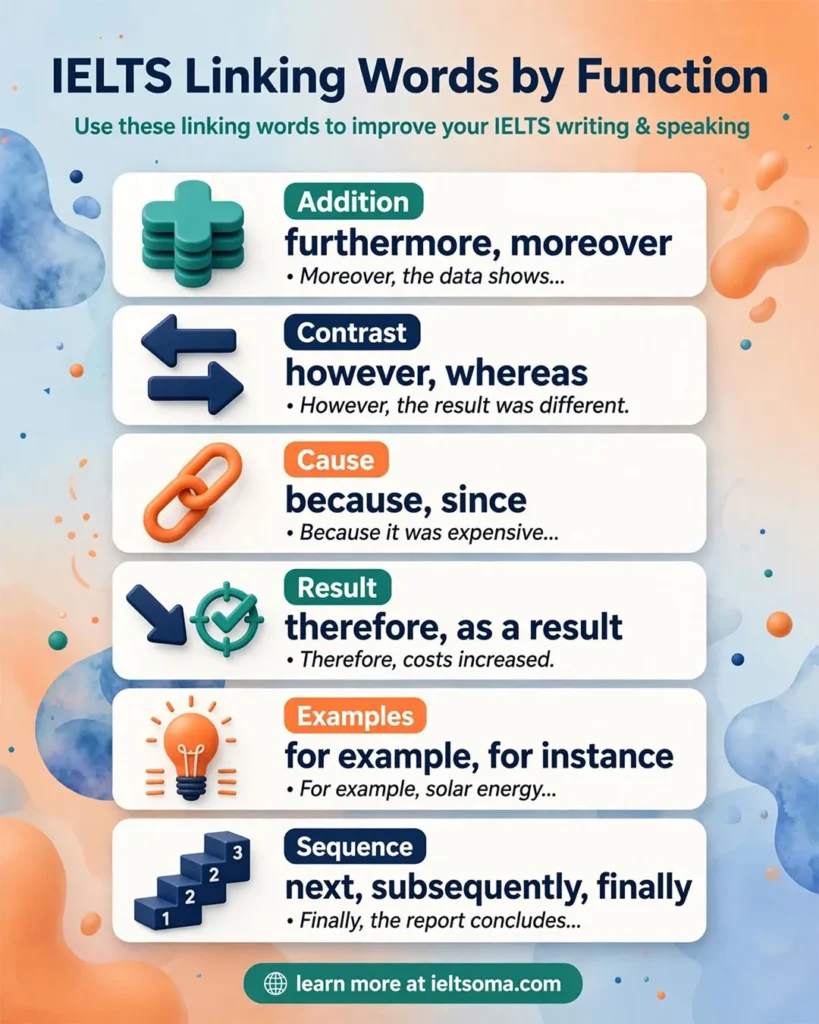
Instead of memorising a long alphabetical list, group IELTS linking words for Writing according to what you want to communicate.
| Function | Useful expressions | Example |
|---|---|---|
| Adding information | Furthermore, moreover, in addition, also | Furthermore, public libraries provide free access to educational resources. |
| Showing contrast | However, nevertheless, whereas, in contrast | However, rural communities may have fewer transport options. |
| Expressing a reason | Because, since, as | Many commuters use trains because they are relatively reliable. |
| Showing a result | Therefore, consequently, as a result | Housing costs increased; consequently, some residents moved elsewhere. |
| Giving an example | For example, for instance, such as | Several measures, such as improved bus services, could reduce congestion. |
| Showing a concession | Although, even though, despite this | Although online learning is convenient, it requires self-discipline. |
| Sequencing points | First, next, finally | First, the water is heated; next, it is filtered. |
| Summarising | Overall, in summary | Overall, the figures indicate a substantial increase in demand. |
| Expressing a condition | If, unless, provided that | Public transport can become more attractive if services are reliable. |
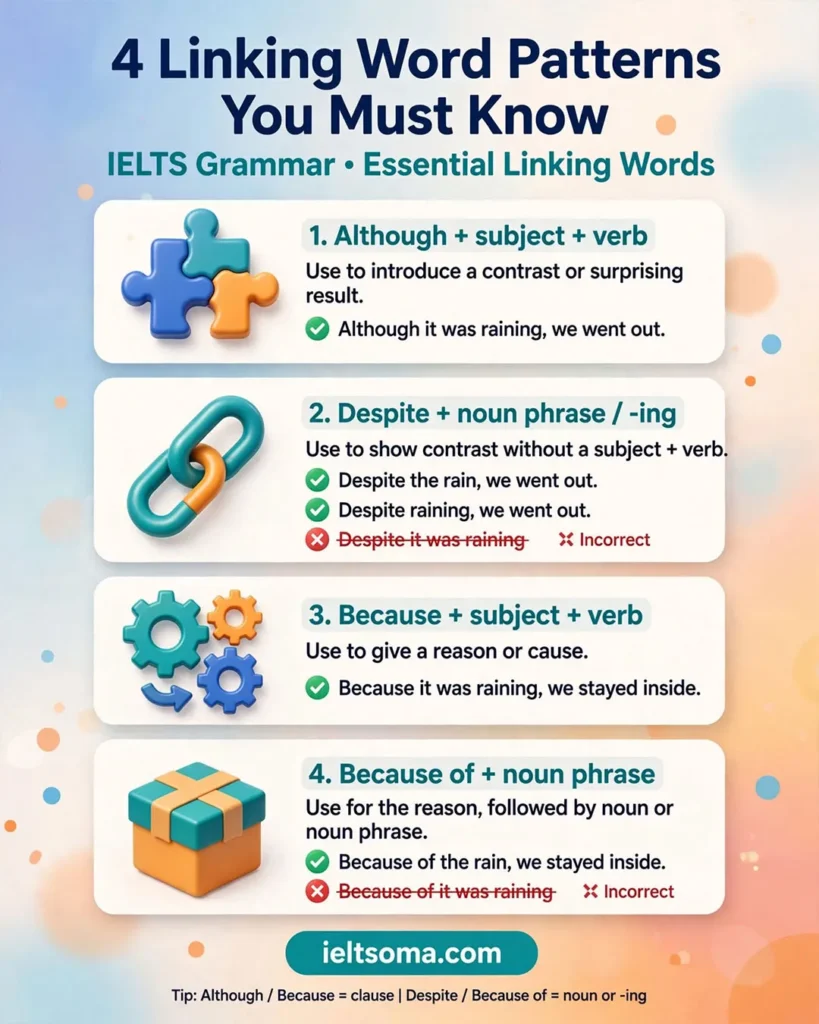
These expressions are not always interchangeable. Although normally introduces a clause, whereas despite is followed by a noun phrase or an -ing form. Therefore signals a conclusion or result, while however signals contrast.
Choose the expression that accurately reflects the relationship between your ideas.
2. Use Linking Words Naturally in IELTS Writing Task 2
In Task 2, you must present and develop an argument, discuss a topic or respond to a question. Your linking expressions should make that argument easier to follow.
Consider this question:
Some people believe that governments should invest more in public transport than in roads. To what extent do you agree or disagree?
Example of unnatural linking
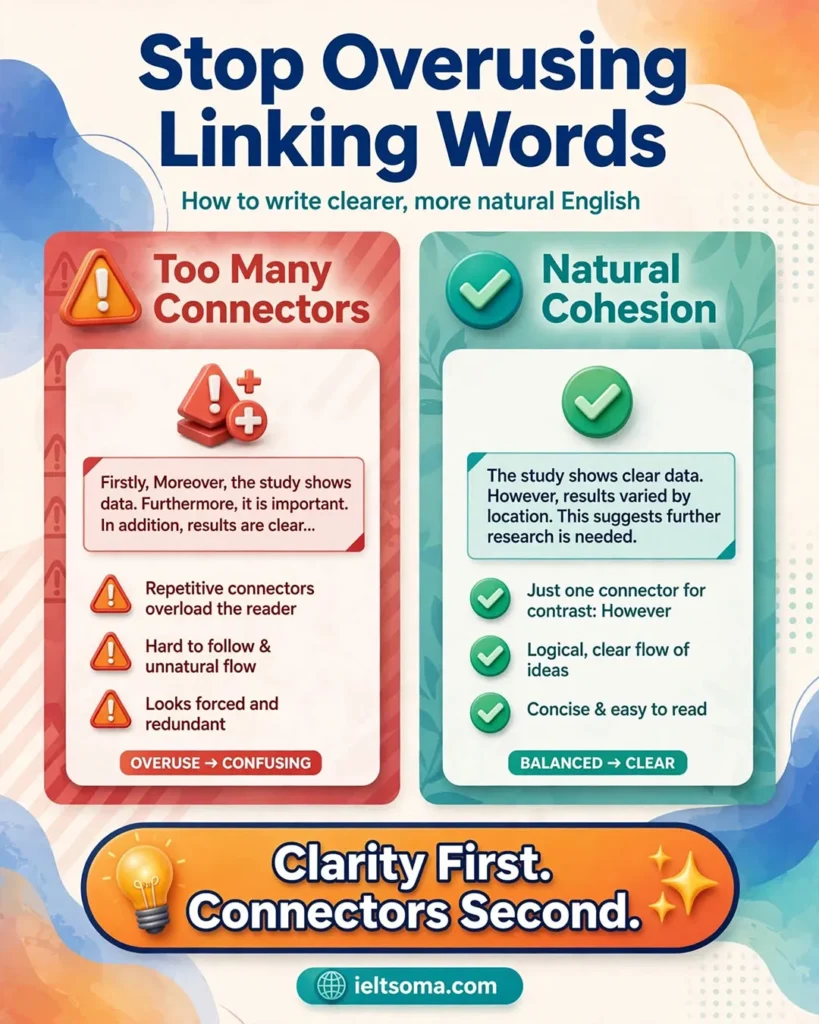
Firstly, public transport is important. Moreover, it is cheap. Furthermore, it reduces traffic. In addition, it helps the environment. Therefore, governments should invest more money in public transport.
The ideas are relevant, but the repeated connectors make the paragraph mechanical. The writer lists benefits without explaining how they support the main argument.
Improved version
Public transport deserves greater government investment because it can reduce the number of private vehicles on the road. When buses and trains are reliable and affordable, commuters have a practical alternative to driving. As a result, traffic congestion may decrease, particularly during peak hours. Better public transport can also reduce emissions per passenger when services are well used.
The improved paragraph uses fewer explicit connectors, but the relationships between the ideas remain clear. The explanation develops the main point rather than simply adding one claim after another.
Expert tip: Before adding a linking word, ask yourself whether the connection is already obvious. If it is, you may not need another connector.
3. Choose the Right Cohesive Devices for Each Relationship
The most effective cohesive devices IELTS Writing candidates use are those that express the intended meaning precisely.
To add a related point
Use also, in addition or furthermore when the next sentence genuinely contributes another relevant idea.
Example:
Online courses allow students to study at flexible times. In addition, they can provide access to specialist subjects that are unavailable locally.
Avoid using furthermore simply because you are beginning a new sentence. The new sentence should extend the discussion.
To introduce a contrast
Use however, nevertheless, whereas or although according to the sentence structure.
Example:
Electric vehicles produce no exhaust emissions while being driven. However, their overall environmental impact also depends on electricity generation and manufacturing.
Use whereas to compare two contrasting facts within a sentence:
City residents often have access to extensive bus networks, whereas people in remote areas may have limited services.
To explain a cause or result
Use because or since to introduce reasons. Use therefore or as a result when the relationship is genuinely consequential.
Example:
Many employees prefer remote work because it reduces commuting time. Consequently, they may have more time for family responsibilities or professional development.
Do not use therefore merely to introduce an opinion. The preceding information should provide a logical basis for the conclusion.
To introduce examples
Use for example or for instance to support a general claim with a specific illustration.
Example:
Governments can encourage healthier lifestyles through urban planning. For example, safe cycle lanes may persuade more residents to travel by bicycle.
An example should explain or substantiate the point, not replace the explanation altogether.
4. Use Linking Words Correctly in IELTS Academic Writing Task 1
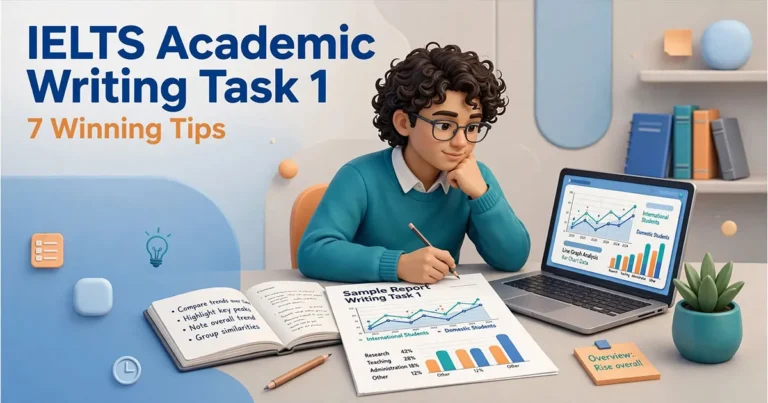
Academic Writing Task 1 requires you to describe and summarise visual information, such as charts, tables, maps and processes. Your linking expressions should help readers understand comparisons, changes and stages.
Describing trends
Useful expressions include:
- Meanwhile — to describe another development occurring over the same period.
- By contrast — to highlight a difference between figures or trends.
- Similarly — to identify a comparable pattern.
- In comparison — to draw attention to a difference or similarity.
- Overall — to introduce the main summary of the visual information.
Example:
The proportion of commuters travelling by bus increased from 20% to 30% between 2010 and 2020. Meanwhile, the figure for private cars fell from 55% to 45%.
The word meanwhile connects two developments over the same period without suggesting that one caused the other.
Comparing categories
Example:
Sales of Product A rose steadily throughout the period, whereas sales of Product B remained relatively stable.
This is more concise than writing two separate sentences and repeatedly using however.
Describing a process
Sequencing expressions such as initially, next, subsequently and finally can help clarify the order of stages.
Example:
Initially, the raw materials are mixed with water. Next, the mixture is heated before being transferred to a storage tank.
Use sequencing words only when the order matters. In a process with several stages, clear sequencing can be particularly helpful.
Important Task 1 reminder
Do not confuse linking expressions with data description. A connector cannot replace a meaningful comparison, an accurate figure or a clear overview. Your response must still identify the main features and describe the information accurately.
5. Use Linking Words in IELTS General Training Writing Task 1
General Training Task 1 requires you to write a letter. The appropriate language depends on whether the letter is formal, semi-formal or informal.
Formal letters may use expressions such as:
- Furthermore — to introduce additional relevant information.
- However — to explain a difficulty or contrasting circumstance.
- Therefore — to show the consequence of a situation.
- For this reason — to connect a problem with a request or decision.
Example:
The heating system has not been working for several days. As a result, the flat has become uncomfortable, particularly in the evenings. I would therefore appreciate it if you could arrange a repair as soon as possible.
Informal letters can sound more conversational:
I was hoping to visit next weekend, but unfortunately, I have to attend a family event. Could we arrange another date instead?
Do not make every letter sound like an academic essay. Expressions such as moreover and consequently may be appropriate in a formal complaint, but they can sound stiff in a friendly message.
Your priority is to match the tone to the recipient and purpose of the letter.
6. Avoid These Common IELTS Linking Words Mistakes
Using cohesive devices IELTS Writing candidates have memorised can backfire when the expression is grammatically incorrect, repetitive or logically unsuitable.
Mistake 1: Starting every sentence with a connector
Weak: Firstly, education is important. Secondly, it improves employment. Moreover, it benefits society. Furthermore, it supports economic growth.
Better: Education improves employment prospects by equipping people with relevant skills. It can also benefit society by supporting productivity and informed decision-making.
Use connectors to clarify relationships, not to decorate every sentence.
Mistake 2: Using contrast when there is no contrast
Incorrect logic: Many students attend university. However, they acquire professional qualifications.
The second statement does not necessarily contradict the first.
Better: Many students attend university to acquire professional qualifications.
Choose however only when the ideas genuinely contrast or qualify one another.
Mistake 3: Confusing “although” and “despite”
Incorrect: Despite the public transport is affordable, many people drive.
Correct: Although public transport is affordable, many people drive.
Also correct: Despite the affordability of public transport, many people drive.
Remember the basic patterns:
- Although + subject + verb
- Despite + noun phrase or -ing form
- Because + subject + verb
- Because of + noun phrase
Mistake 4: Misusing “on the other hand”
This expression normally introduces another side of a comparison or argument. It is not a general substitute for however.
Weak: Public transport is affordable. On the other hand, it can reduce congestion.
These points support the same argument rather than presenting opposing considerations.
Better: Public transport is affordable and can reduce congestion. On the other hand, poorly connected routes may make it inconvenient for some commuters.
Mistake 5: Using “moreover” when the idea is a result
Weak: The city expanded its train network. Moreover, journey times decreased.
If the second statement describes a result of the first, a causal expression may be more appropriate.
Better: The city expanded its train network. As a result, journey times decreased.
Use this relationship only if the information supports the causal claim.
Mistake 6: Repeating the same connector
If every paragraph contains firstly, secondly, moreover and finally, your writing can become predictable.
Vary your sentence structures, use pronouns and reference words appropriately, and allow the meaning to connect sentences without always adding an explicit transition.
7. How to Use Linking Words Naturally in IELTS: A Practical Method
If you are unsure how to use linking words naturally IELTS examiners can follow easily, practise the following method.
Step 1: Identify the relationship between ideas.
Ask whether you are adding information, contrasting two points, explaining a cause, showing a result or giving an example.
Step 2: Write the idea clearly first.
Do not begin by forcing a connector into the sentence. Write what you want to communicate.
Step 3: Select the simplest accurate expression.
Choose but or however when appropriate instead of searching for an unnecessarily sophisticated alternative.
Step 4: Check the grammar.
Confirm whether the connector requires a clause, a noun phrase, a particular punctuation pattern or a specific sentence structure.
Step 5: Read the sentences together.
Check that the transition makes sense and that the paragraph progresses logically.
Step 6: Remove unnecessary connectors.
If deleting the linking word does not reduce clarity, the word may be unnecessary.
Example of the method
Original ideas:
University education can be expensive. It gives graduates access to specialist careers.
Relationship: contrast or concession.
Possible revision:
Although university education can be expensive, it gives graduates access to specialist careers.
The revised sentence combines the two ideas and makes their relationship explicit.
However, if the paragraph needs to emphasise the financial difficulty first, two sentences may be more effective:
University education can be expensive. Nevertheless, it may provide access to specialist careers that require advanced qualifications.
Both versions are grammatically sound. The better choice depends on the emphasis and flow of the paragraph.
8. Improve Cohesion Without Relying Only on Linking Words
Strong cohesion involves more than connectors. Several other techniques can help you produce clearer IELTS responses.
Use referencing words
Words such as this, these, such and it can refer to information mentioned earlier.
Example:
Many cities have introduced congestion charges. This policy can discourage unnecessary car journeys.
The phrase this policy clearly identifies the earlier idea.
Avoid vague references such as this is a problem when the reader cannot tell what this means.
Repeat key terms strategically
Repeating an important noun can be clearer than replacing it with a loosely related synonym.
Example:
Public transport can reduce congestion. Reliable public transport also improves access to employment.
Repeating public transport is not automatically poor writing. It helps maintain the topic.
Use parallel structures
Parallel grammar can make related points easier to compare.
Example:
Governments should improve public transport, expand cycling routes and make walking safer.
The three verb phrases follow the same grammatical pattern.
Develop paragraphs logically
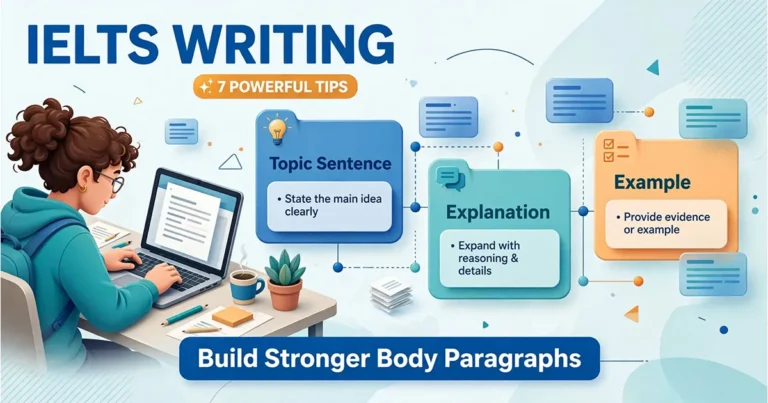
A clear Task 2 body paragraph commonly contains:
- A topic sentence that states the main point.
- An explanation of why the point matters.
- An example or supporting detail.
- A link back to the question, where useful.
You do not need a linking word between every item. The logical sequence itself creates cohesion.
9. Practise IELTS Linking Words for Writing
Choose the expression that best completes each sentence. Focus on meaning and grammar, not on selecting the most sophisticated word.
Question 1: Many people prefer cycling for short journeys. ________, it can be difficult in areas without safe cycle lanes.
A. Furthermore
B. However
C. Therefore
Question 2: The company introduced flexible working hours. ________, employee satisfaction improved.
A. As a result
B. In contrast
C. Although
Question 3: ________ online education offers flexibility, some learners miss face-to-face interaction.
A. Despite
B. Because of
C. Although
Question 4: Several measures can reduce household waste, ________ reusing containers and repairing damaged items.
A. such as
B. consequently
C. nevertheless
Question 5: The first stage involves collecting the raw materials. ________, they are transported to the processing facility.
A. Nevertheless
B. Subsequently
C. In contrast
Answers and explanations
- B — However. The second sentence contrasts with the benefits of cycling.
- A — As a result. The second sentence describes a consequence.
- C — Although. It introduces a concessive clause containing a subject and verb.
- A — such as. It introduces examples of waste-reduction measures.
- B — Subsequently. It indicates the next stage in a sequence.
For additional practice, take a paragraph from your own IELTS essay and highlight every linking expression. Label each one according to its function. Then check whether the expression is necessary, accurate and grammatically correct.
Frequently Asked Questions
1. What are the best linking words for IELTS Writing?
There is no single best list. Useful expressions include however for contrast, furthermore for additional information, because for reasons, as a result for consequences and for example for illustrations. Choose expressions according to the relationship between your ideas.
2. Do linking words increase your IELTS Writing score?
Appropriate linking words can support the Coherence and Cohesion criterion by making relationships between ideas clear. However, they do not guarantee a higher band. Your writing must also be logically organized, sufficiently developed and easy to follow.
3. How many linking words should I use in an IELTS essay?
There is no official required number. Use enough to make relationships clear, but do not insert a connector into every sentence. The number will depend on the length, structure and complexity of your argument.
4. Can I use “firstly”, “secondly” and “finally” in IELTS Writing Task 2?
Yes, when these expressions genuinely help organize a sequence of points. However, repeatedly using them can make an essay sound formulaic. Clear topic sentences and logical paragraph development are often more effective.
5. Are “moreover” and “furthermore” interchangeable?
They are often interchangeable when introducing an additional supporting point. However, neither should be used when the relationship is contrast, cause or consequence. Both expressions can also sound unnecessarily formal in some contexts.
6. Should I use linking words in IELTS Academic Writing Task 1?
Yes, where they clarify comparisons, trends or process stages. Expressions such as meanwhile, whereas similarly and overall can be useful. Accurate data selection and a clear overview remain essential.
7. Are cohesive devices important in IELTS General Training letters?
Yes. They help organize information and make requests, explanations and complaints easier to follow. Choose expressions that suit the letter’s purpose and level of formality rather than using academic connectors in every sentence.
8. How can I learn to use linking words naturally?
Practice writing short paragraphs around one main idea. Identify the relationships between sentences, choose appropriate connectors, and read the paragraph aloud. Edit out expressions that add no clarity, and review grammar patterns such as although + clause and despite + noun phrase.
Final Checklist for IELTS Writing Linking Words
Before submitting your Writing response, ask yourself:
- Does each linking word express the correct relationship?
- Have I avoided repeating the same connector unnecessarily?
- Are contrast, cause and result expressed accurately?
- Have I checked the grammar and punctuation around each connector?
- Do my pronouns and referencing expressions have clear meanings?
- Does every paragraph develop a relevant, central idea?
- Can the reader follow my argument without unnecessary transitions?
The key lesson: IELTS Writing linking words work best when they serve your meaning. A small number of accurate, natural cohesive devices is more effective than a long list of memorised expressions.
Build your paragraphs around clear ideas, explain your reasoning, and use linking words when they help the reader follow your thinking. This approach supports stronger coherence and cohesion in both IELTS Academic and General Training Writing.
Further Reading: