IELTS Reading Note Completion can look straightforward: read a few notes, find the missing information in a passage, and fill in the gaps. Yet this question type can cost you valuable marks when you overlook a word-limit instruction, choose an answer that does not fit grammatically, or find the right idea but copy the wrong words.
The solution is not to read the entire passage repeatedly. You need a systematic approach that combines prediction, scanning, careful reading and answer checking.
This guide explains an effective IELTS Reading note completion strategy for both IELTS Academic and General Training candidates. You will learn how to predict answers, locate supporting evidence, follow the note completion word limit and practice with a worked example.
Table of Contents
What Is IELTS Reading Note Completion?
IELTS Reading Note Completion is a question type in which you complete notes by filling gaps with information from a reading passage. The notes summarise key facts, stages, characteristics or explanations from a particular part of the text.
For example:
Notes on a research project
- Main objective: to investigate the effects of urban ______
- Research method: interviews and ______
- Main finding: improved access to public ______
Your task is to identify the missing information in the passage and enter the correct words in the gaps.
In tasks requiring words from the passage, you normally need to reproduce the relevant wording rather than replace it with your own paraphrase. Some tasks instead provide a list of options, so always read the specific instructions.
Note Completion tests several reading skills:
- Identifying key information and supporting details.
- Recognising paraphrases and synonyms.
- Scanning for names, figures, technical terms and other clues.
- Understanding grammar and meaning around a gap.
- Following the stated word limit accurately.
The format is used in IELTS Academic and General Training Reading. The passages and their contexts differ, but the essential approach to completing notes remains similar.
IELTS Reading Note Completion Strategy: 7 Steps
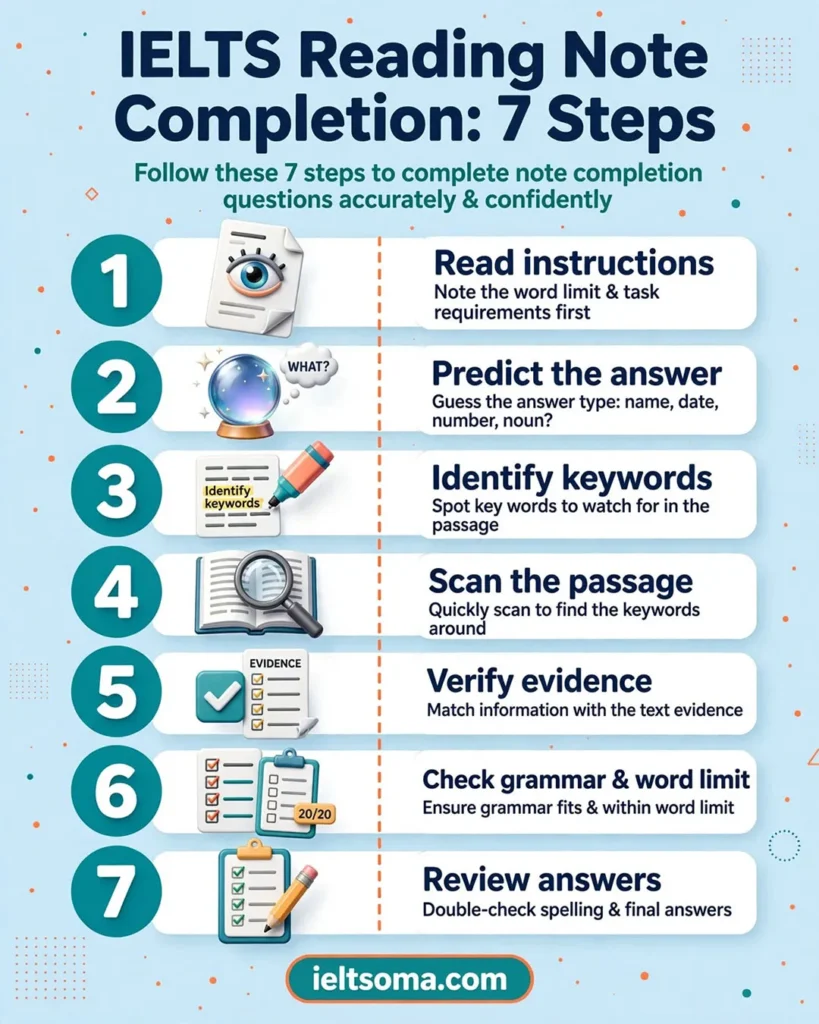
Step 1: Read the Instructions Before the Notes
Before searching the passage, check exactly how many words or numbers you may write.
Common instructions include:
- NO MORE THAN ONE WORD
- NO MORE THAN TWO WORDS
- NO MORE THAN TWO WORDS AND/OR A NUMBER
These instructions are strict. If the task permits no more than two words and you write three, your answer will be marked incorrect even if the meaning is accurate.
For example, suppose the passage contains the phrase “a network of public transport services”.
If the gap requires no more than two words, writing “public transport services” exceeds the limit. Depending on the sentence, “transport services” or another exact phrase from the passage might be the appropriate answer.
Do not assume every Note Completion task has the same limit. Read the instructions for each task carefully.
Expert tip: On a computer-delivered test, check that the answer entered in each box is complete and that you have not accidentally included an extra word.
Step 2: Understand the Notes and Predict the Missing Word
Read the title, headings, bullet points and surrounding words before looking for answers. The structure of the notes often reveals the type of information required.
Consider these examples:
| Notes | Likely answer type |
|---|---|
| The experiment lasted ______ | A period of time |
| The main cause was ______ | A cause or noun phrase |
| Participants were required to ______ | A verb or verb phrase |
| The temperature reached ______ | A number or measurement |
| The system was considered ______ | An adjective |
Prediction narrows your search. It does not mean guessing the answer without evidence.
Pay attention to grammatical signals. An article such as “a” or “an” may indicate a singular countable noun. A gap after “to” may require a verb in its base form. A gap following “because of” is likely to require a noun or noun phrase.
However, grammar alone cannot establish the correct answer. The completed note must also agree with the information in the passage.
Step 3: Identify Keywords and Possible Paraphrases
Choose two or three useful keywords from each note. Prioritise distinctive terms such as names, locations, dates, technical expressions and unusual nouns.
For example:
Note: The project reduced the cost of maintaining public buildings.
Useful search clues include:
- project
- cost
- maintaining
- public buildings
The passage may express the same idea differently:
“The initiative lowered expenditure on the upkeep of municipal facilities.”
Here, “reduced” corresponds to “lowered”, “cost” to “expenditure”, and “maintaining” to “upkeep”.
This is why searching only for the exact words in the notes can fail.
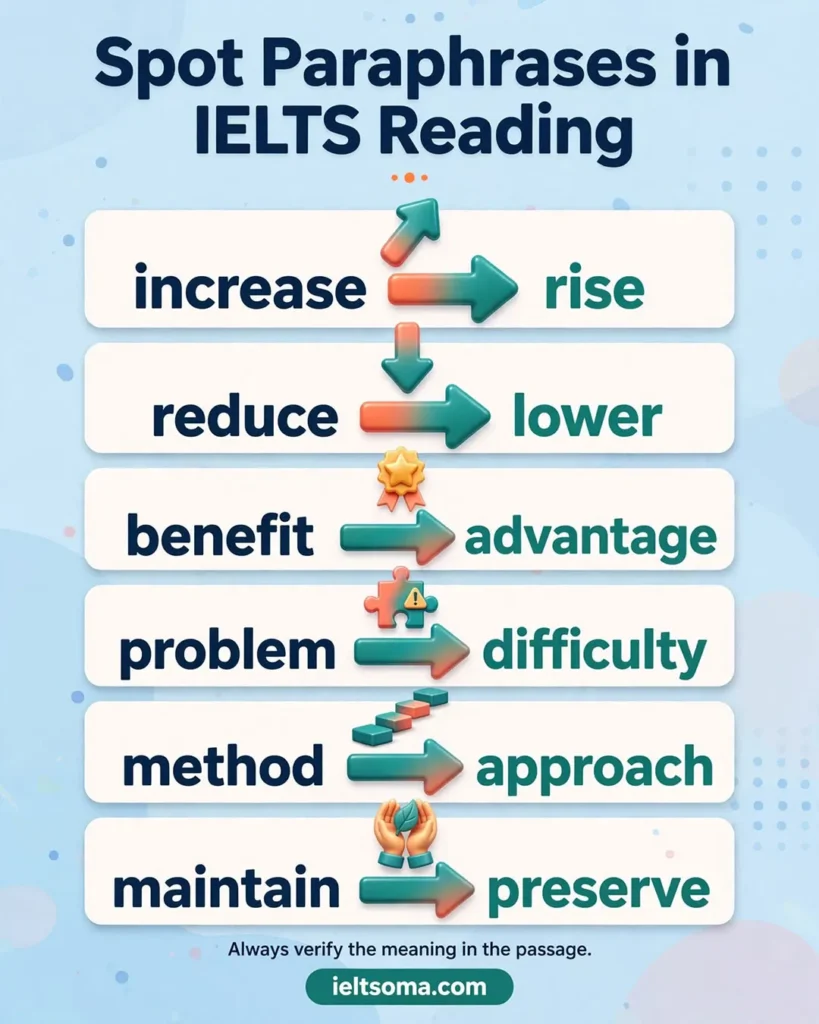
Build your paraphrase awareness by learning common relationships:
- increase → rise, grow, expand
- reduce → decrease, lower, cut
- benefit → advantage, positive effect
- problem → difficulty, challenge, drawback
- method → approach, technique, procedure
- maintain → preserve, sustain, keep in good condition
These are possible equivalents, not automatic replacements. The passage’s meaning determines which interpretation is correct.
Step 4: Scan the Passage to Locate Relevant Information
Scanning means moving quickly through a text to find specific information rather than reading every sentence in detail.
Use your keywords and predicted answer type to identify a likely paragraph. Numbers, dates, capitalised names and technical terms can be particularly helpful.
Once you find a possible match, slow down and read the surrounding sentence or sentences carefully.
Do not select an answer simply because a familiar keyword appears. The passage may mention that keyword in a different context or use it to describe a contrast.
For example, a paragraph may first describe an expensive traditional method and then introduce a cheaper alternative. If your notes refer to the new method, copying a detail about the traditional method would be a mistake.
A useful routine is:
- Locate a distinctive keyword.
- Check whether the surrounding information matches the note.
- Identify the exact words that answer the question.
- Confirm that those words fit the gap grammatically.
This approach reduces unnecessary rereading while protecting accuracy.
Step 5: Read the Evidence Carefully and Select the Exact Answer
After locating a likely passage section, establish what it actually says.
Imagine that your notes state:
The new irrigation system saved ______.
The passage reads:
“Farmers using the new irrigation system reduced their water consumption by approximately 30 per cent during the summer months.”
The answer might be water if the gap requires one word.
You should not write “money” simply because lower water consumption may reduce expenses. That conclusion is plausible, but it is not the information stated in the sentence.
This distinction matters throughout IELTS Reading: answers must be supported by the passage, not by your own assumptions or outside knowledge.
When several words seem possible, check the following:
- Does the passage explicitly support the answer?
- Does the answer refer to the correct person, object or process?
- Does it preserve the meaning of the original statement?
- Does it fit the surrounding grammar?
- Does it obey the word limit?
The strongest answer is the one that satisfies all these conditions.
Step 6: Check Grammar, Meaning and the Word Limit
Once you have selected an answer, insert it mentally into the note and read the entire phrase or sentence.
Suppose the note says:
The researchers collected ______ from local residents.
The passage states that the researchers collected “detailed responses” from local residents.
If the task permits no more than two words, detailed responses may be suitable. But if the gap already includes the word “responses”, copying both words would produce an incorrect or awkward sentence.
This is why you should examine the words immediately before and after each gap.
Also check singular and plural forms, verb forms, spelling and numbers. If the passage says “facilities”, do not automatically change it to “facility”. Where the task requires words from the passage, copy the form that fits the sentence and the evidence.
Remember that hyphenated words count as one word under the official IELTS guidance for these completion tasks. Do not rely on unusual contractions to solve a word-limit problem.
A reliable final check: Read each completed note as a whole, rather than examining the answer in isolation.
Step 7: Review Every Answer Before Moving On
Reserve a short amount of time to check your responses.
Use this checklist:
- Have I followed the exact instruction?
- Is each answer supported by the passage?
- Have I copied the necessary words accurately?
- Does each answer fit the grammar of the note?
- Have I checked spelling and singular or plural forms?
- Have I left any gap unanswered?
If you cannot find an answer immediately, avoid spending too long on one gap. Mark it mentally, continue with the remaining questions and return if time permits.
The objective is to secure as many correct answers as possible, not to spend several minutes proving a single uncertain response.
How to Answer Note Completion IELTS: A Worked Example
The following is an original practice example created to demonstrate the method. It is not an official IELTS question.
Read the passage.
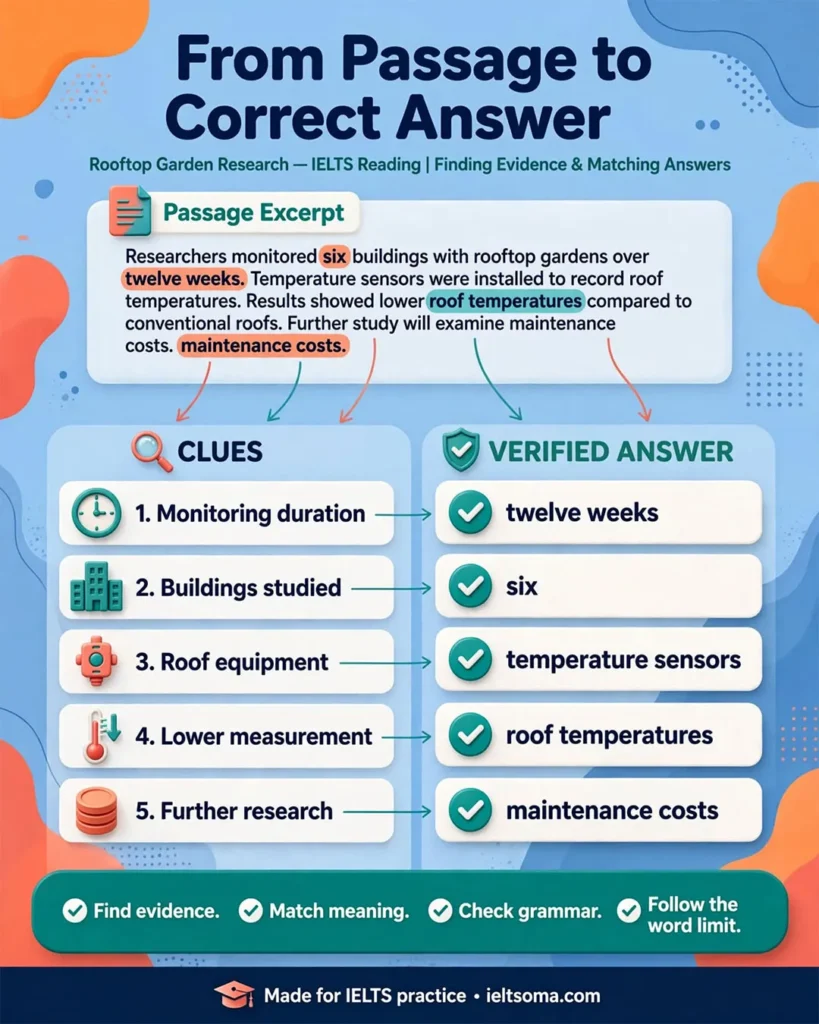
A university research team investigated how rooftop gardens affect temperatures in urban buildings. The team monitored six buildings over a period of twelve weeks. Temperature sensors were installed on the roofs, while researchers recorded readings from nearby streets. The results showed that buildings with rooftop gardens had lower roof temperatures during the hottest part of the day. The researchers concluded that vegetation could help reduce heat in densely populated areas, although they recommended further research into maintenance costs.
Complete the notes below.
Choose NO MORE THAN TWO WORDS AND/OR A NUMBER from the passage for each answer.
Rooftop garden research
- Duration of monitoring: ______
- Number of buildings studied: ______
- Equipment installed on roofs: ______
- Effect observed: lower ______
- Further research needed on: ______
Step-by-Step Solution
1. Duration of monitoring
The notes ask for a period of time. The passage states that the team monitored the buildings “over a period of twelve weeks”.
Answer: twelve weeks
2. Number of buildings studied
Look for the number associated with the buildings. The passage states that the team monitored six buildings.
Answer: six
3. Equipment installed on roofs
The phrase “installed on the roofs” appears in the passage. The equipment was temperature sensors.
Answer: temperature sensors
4. Effect observed
The passage explains that buildings with rooftop gardens had lower roof temperatures. The note already contains the word “lower”, so the gap needs the remaining information.
Answer: roof temperatures
5. Further research needed on
The final sentence identifies maintenance costs as an area requiring further research.
Answer: maintenance costs
What Does This Example Teach You?
The answers become easier to locate when you predict the type of information, scan for relevant details and confirm the wording in the passage.
Notice that the notes do not necessarily repeat the passage’s sentence structure. You must understand the relationship between the note and the original text, not merely copy the nearest phrase.
Also notice that all five answers come from one short passage section. In a real task, the relevant information may appear across a longer passage, but completion questions commonly focus on a particular part of the text.
Note Completion Word Limit IELTS: Rules You Must Know
The note completion word limit IELTS candidates see in the instructions is one of the simplest rules to follow and one of the easiest to overlook under time pressure.
Here is how common instructions work:
| Instruction | Example of a permitted answer | Example that exceeds the limit |
|---|---|---|
| NO MORE THAN ONE WORD | transport | public transport |
| NO MORE THAN TWO WORDS | public transport | local public transport |
| NO MORE THAN TWO WORDS AND/OR A NUMBER | 12 weeks | over 12 weeks |
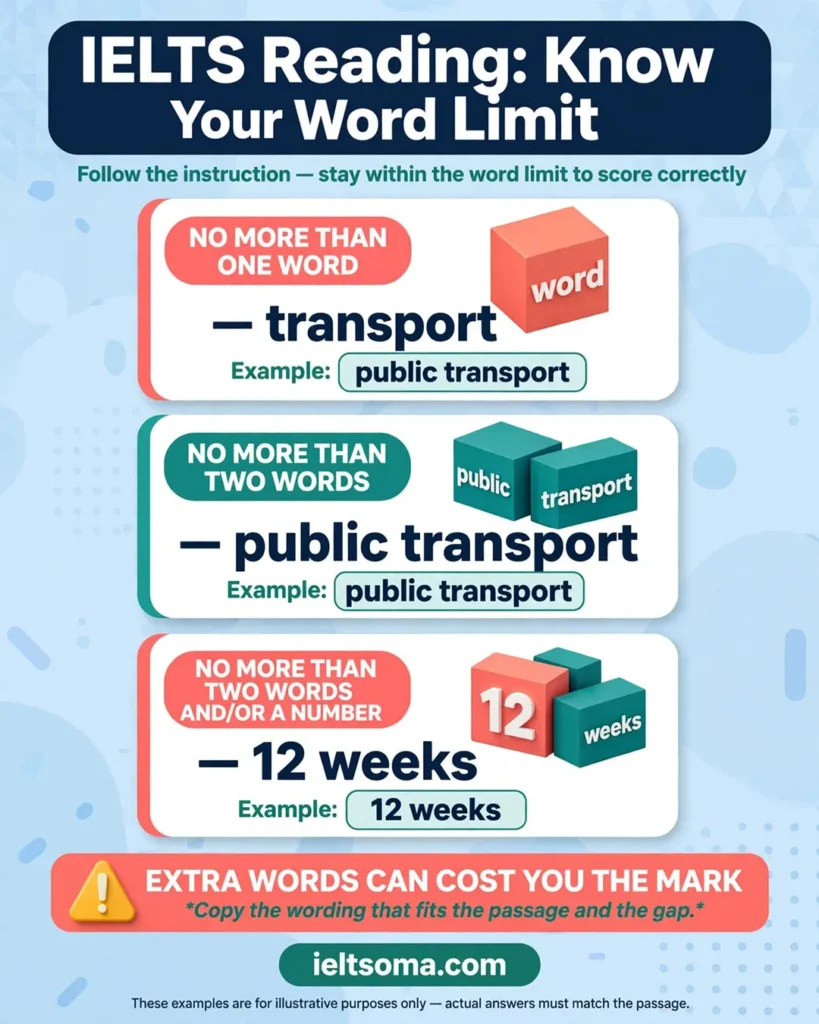
These examples illustrate word counting only. The actual answer must still match the passage and the gap.
Important rules:
- Do not add explanatory words that are unnecessary.
- Do not copy a whole sentence when only a short phrase is needed.
- Do not assume a grammatically correct answer earns a mark if it exceeds the limit.
- Follow the exact instruction printed above the questions.
- Check whether the task requires words from the passage or selection from a provided list.
In word-limit instructions, “AND/OR A NUMBER” permits combinations of words and numbers within the stated limit. For example, “12 weeks” contains a number and a word.
For more details, consult the official IELTS Academic Reading test format, which explains completion question types and their word-limit requirements.
Common IELTS Reading Note Completion Mistakes
Even candidates with strong vocabulary can lose marks through avoidable errors.
1. Reading the Entire Passage Before Looking at the Notes
Reading every sentence in detail before examining the task can waste time. Preview the notes first so you know what information to look for.
A quick skim of the passage may help you understand its structure, but use targeted scanning to find specific answers.
2. Searching Only for Identical Words
The notes may paraphrase the passage. If you search only for the exact wording, you may overlook the correct evidence.
Practise recognising synonyms and changes in sentence structure.
3. Guessing from General Knowledge
An answer may sound logical but still be unsupported. Use the passage as your authority.
4. Ignoring Grammar
An answer can refer to the right idea but fail to fit the sentence. Read the whole note after inserting your answer.
5. Exceeding the Word Limit
Extra words do not make an answer more precise. They can invalidate it. Copy only the words required to complete the gap.
6. Changing the Original Wording Unnecessarily
If the task asks you to use words from the passage, do not paraphrase the answer in your own words. Copy the relevant wording accurately.
7. Spending Too Long on One Gap
Do not allow one difficult question to consume time that could be used to answer several easier ones. Move on and return later if possible.
How to Practise IELTS Reading Note Completion Effectively
A useful practice routine should improve both accuracy and speed.
First, practise without a time limit. Focus on understanding the notes, predicting answer types and identifying evidence. Write down why each answer is correct.
Next, analyse your errors. For every incorrect response, identify the main cause:
- Missed the relevant paragraph.
- Failed to recognise a paraphrase.
- Misunderstood the passage.
- Chose the wrong word form.
- Exceeded the word limit.
- Made a spelling or copying error.
Then practise under timed conditions. Once your method becomes more reliable, complete similar tasks within a planned time allowance. Avoid imposing an arbitrary fixed time on every question set; difficulty and the number of gaps vary.
Finally, review unfamiliar vocabulary in context. Record useful expressions, synonyms and collocations from practice passages. This builds the language awareness needed to recognise paraphrases in future tasks.
For balanced preparation, practise other IELTS Reading question types as well. Skills such as scanning, understanding reference words and distinguishing main ideas from details also support Note Completion performance.
Frequently Asked Questions
1. What is IELTS Reading Note Completion?
It is a question type in which you fill gaps in a set of notes using information from a reading passage or, in some versions, a provided list of options. It tests your ability to locate relevant details and understand how they fit into a summary.
2. How do I answer Note Completion questions in IELTS Reading?
Read the instructions, understand the notes, predict the type of word needed, identify keywords, scan the passage, verify the evidence, and check grammar and the word limit. This structured approach is more reliable than guessing or repeatedly reading the entire passage.
3. What is the note completion word limit in IELTS?
The word limit varies by task. Instructions may say “NO MORE THAN ONE WORD”, “NO MORE THAN TWO WORDS” or “NO MORE THAN TWO WORDS AND/OR A NUMBER”. Always follow the instruction given for your specific questions.
4. Can I use my own words in IELTS Reading Note Completion?
When the instructions require you to select words from the passage, use the relevant wording from the text rather than paraphrasing it yourself. If the task provides a list of options, follow that task’s instructions instead.
5. Do Note Completion answers follow the same order as the passage?
Not always. IELTS guidance states that answers to summary, note, table and flow-chart completion questions may not appear in the same order as the gaps, although they usually come from one part of the text. Locate evidence carefully rather than assuming every answer will follow the sequence of the notes.
6. Is Note Completion the same as Summary Completion?
They are related completion tasks, but their presentation differs. Note Completion usually presents information as concise notes, while Summary Completion typically presents a continuous summary. Both require you to understand the passage, locate relevant information and follow the word-limit instructions.
7. Is Note Completion difficult in IELTS Academic and General Training?
Difficulty depends on the passage, vocabulary, paraphrasing and your reading skills. The question type appears in both versions of IELTS Reading. Practicing the same core method can help you prepare for either test, even though the texts and contexts differ.
8. How can I improve my Note Completion accuracy?
Practice predicting answer types, recognizing paraphrases, locating evidence and checking word limits. After each exercise, analyze every wrong answer and record the reason for the mistake. Targeted error review is more useful than simply completing large numbers of questions without reflection.
Final Takeaway
Success in IELTS Reading Note Completion depends on a repeatable process, not luck. Read the instructions, predict what belongs in each gap, scan for relevant information, verify the evidence and check every answer against the word limit.
Practise these seven steps consistently, review your mistakes and develop the habit of supporting every answer with the passage. With time, you can approach Note Completion questions with greater accuracy and confidence.
Further Reading: