A good IELTS essay can contain strong vocabulary and accurate grammar yet still lose marks because the ideas do not flow clearly.
This is why Coherence and Cohesion in IELTS Writing deserves serious attention.
Coherence is about whether your ideas are organised logically and easy to follow. Cohesion is about how effectively you connect those ideas through language, reference, paragraphing and other cohesive devices.
The official IELTS Writing criteria specifically assess how clearly information and ideas are organised, how logically the response progresses, how paragraphs are used, and how cohesive devices are handled.
The good news is that you do not need to fill every sentence with words such as however, moreover and therefore.
In fact, doing that can make your writing sound mechanical.
Instead, you need to develop a clear structure in which every paragraph has a purpose, every idea connects naturally to the next, and the reader never has to guess what you mean.
This guide explains how to improve Coherence and Cohesion in IELTS Writing, including paragraphing, logical progression, linking devices, referencing, common mistakes and practical techniques for moving towards Band 7 and above.
Table of Contents
What Is Coherence and Cohesion in IELTS Writing?
Although the terms are often used together, coherence and cohesion are not exactly the same.
Coherence
Coherence refers mainly to the logical organisation of your ideas.
A coherent response has:
- A clear overall structure
- Logical progression from one idea to another
- Clearly organised paragraphs
- A central topic in each paragraph
- Ideas presented in an order that makes sense
Think of coherence as the overall map of your writing.
If the reader can understand where your argument is going without getting lost, your writing is probably coherent.
Cohesion
Cohesion concerns the language and techniques you use to connect ideas and sentences.
These include:
- Linking words and phrases
- Pronouns
- Reference
- Substitution
- Conjunctions
- Repetition of key terms where appropriate
- Logical relationships between sentences
Think of cohesion as the connections between the parts of your writing.
For example:
Many cities are experiencing severe traffic congestion. This problem is largely caused by the increasing number of private vehicles.
The phrase this problem refers back to severe traffic congestion. That reference creates a clear connection between the two sentences.
The official IELTS preparation guidance explains that coherence involves logical organisation and progression, while cohesion involves showing relationships between ideas and information through cohesive devices.
Why Does Coherence and Cohesion Matter?
Coherence and cohesion is one of the four criteria used to assess IELTS Writing, alongside Task Achievement or Task Response, Lexical Resource, and Grammatical Range and Accuracy.
This means excellent vocabulary cannot completely compensate for poorly organised ideas.
Imagine two candidates writing about the same topic.
Candidate A uses sophisticated vocabulary but jumps between unrelated points.
Candidate B uses simpler vocabulary but presents a clear position, develops one idea per paragraph and connects each point logically.
Candidate B may produce the more effective response because the examiner can follow the argument easily.
The IELTS Band Descriptors show the difference clearly. At Band 7, information and ideas should be logically organised with clear progression throughout, while a range of cohesive devices should be used flexibly, although some inaccuracies or over- or under-use may occur.
For Band 8, the response should be easy to follow, with information and ideas logically sequenced and cohesion well managed.
So the goal is not simply to use more linking words.
The goal is to make your writing easy to follow.
1. Plan Your Ideas Before You Start Writing
One of the easiest ways to improve Coherence and Cohesion in IELTS Writing is to spend a few minutes planning.
Do not begin writing immediately after reading the question.
First identify:
- What exactly is the question asking?
- What is your position?
- What are your main ideas?
- What evidence or examples will support them?
- What order should the ideas appear in?
For a Task 2 essay, a simple plan might look like this:
Question: Some people believe governments should spend more money on public transport rather than building new roads. To what extent do you agree or disagree?
Position: Mostly agree
Body Paragraph 1: Public transport reduces congestion and pollution
Example: Reliable rail networks can encourage commuters to leave cars at home
Body Paragraph 2: Road infrastructure is still necessary in some areas
Example: Rural communities may depend heavily on roads
Conclusion: Public transport should receive greater investment, while essential road development should continue
This takes only a few minutes but gives your essay a direction.
Without a plan, candidates often introduce one idea, remember another idea halfway through the paragraph, switch topics, and then return to the original point.
That creates a problem with coherence.
2. Give Every Paragraph One Clear Main Purpose
A strong paragraph should not feel like a collection of unrelated thoughts.
Instead, each paragraph should have a central purpose.
For example:
Public transport can significantly reduce traffic congestion in major cities. When reliable buses and trains are widely available, commuters have a practical alternative to using private cars. This can reduce the number of vehicles on busy roads, particularly during peak hours. For example, cities with extensive rail networks can transport large numbers of passengers without requiring each person to travel in a separate vehicle.
Notice the progression:
Main idea → explanation → consequence → example
The sentences work together.
A weaker paragraph might look like this:
Public transport is useful. Cities are becoming larger. Cars cause pollution. Governments should build roads. Trains are comfortable. People also need jobs.
Each sentence may be individually understandable, but the paragraph lacks a clear central direction.
This is one of the most important principles of Coherence and Cohesion in IELTS Writing:
Do not simply place good sentences next to each other. Make the sentences work together.
3. Use a Logical Sentence Sequence
Even when your paragraph contains good ideas, the order matters.
Consider:
Online education has become more accessible in recent years. Many students can now attend courses without travelling to a university campus. This flexibility is particularly useful for people who work full-time. As a result, online learning can make education more accessible to a wider range of students.
This progression is logical:
Development → explanation → specific benefit → result
Now compare it with a poorly ordered version:
Online education has become more accessible in recent years. This flexibility is particularly useful for people who work full-time. Online learning can make education more accessible. Many students can now attend courses without travelling to a university campus.
The same information is present, but the progression is less natural.
Before submitting your essay, read each paragraph and ask:
“Does sentence two naturally follow sentence one?”
Then:
“Does sentence three develop sentence two?”
If the answer is no, reconsider the order.
4. Stop Treating Linking Words as Decoration
One of the most common misunderstandings about Coherence and Cohesion in IELTS Writing is that a high-band essay must contain a large number of linking words.
It does not.
Words such as:
- however
- therefore
- moreover
- furthermore
- consequently
- nevertheless
- in addition
- for example
can be useful, but only when they express a genuine relationship between ideas.
Compare:
Many people work from home. Moreover, many employees use computers. Furthermore, technology is developing rapidly. In addition, some people prefer flexible working arrangements.
The connectors do not create meaningful progression.
Now compare:
Working from home can reduce commuting time. As a result, employees may have more time for family responsibilities. However, this arrangement can also create difficulties for people who struggle to separate their professional and personal lives.
Here, as a result signals a consequence, while however introduces a contrast.
The relationship exists first; the linking word simply makes it clearer.
A useful rule
Do not ask: “Which linking word can I use?”
Ask:
“What is the relationship between these two ideas?”
Then choose language that accurately expresses that relationship.
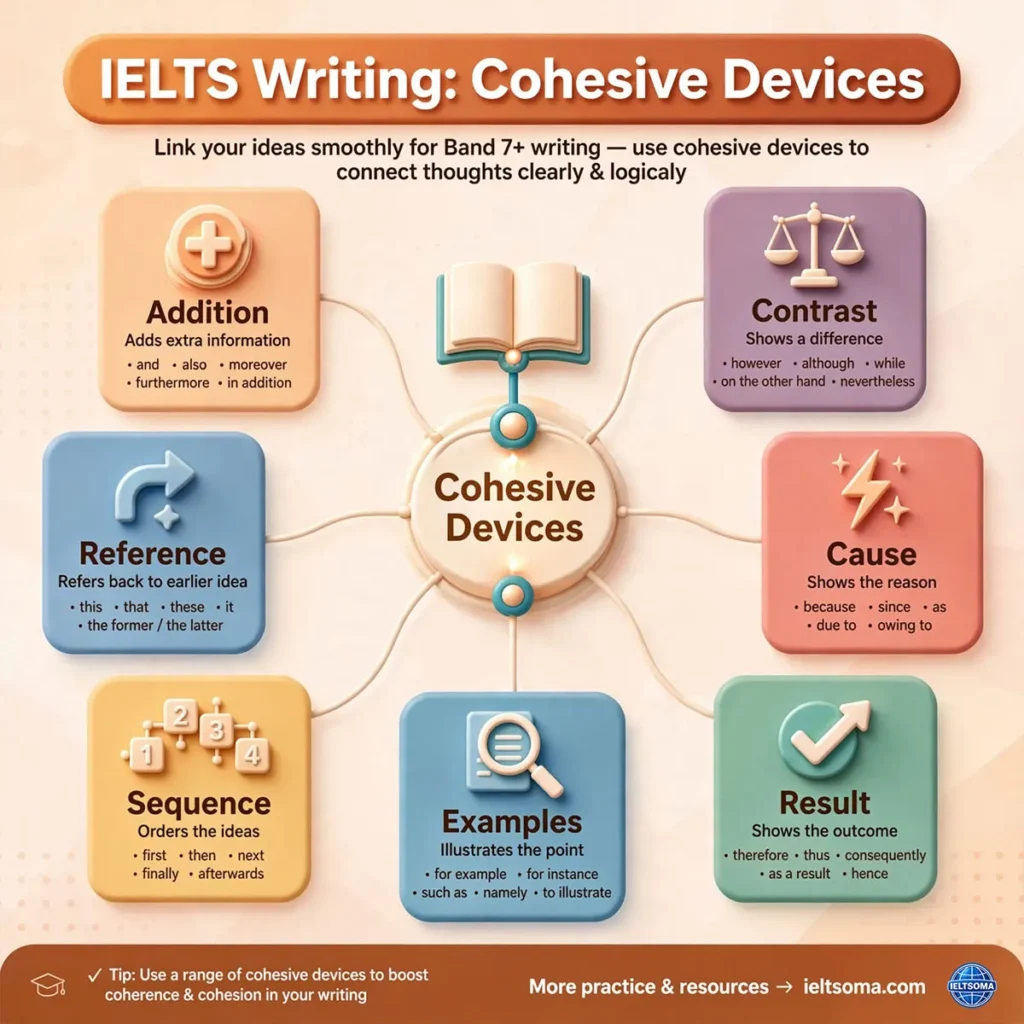
5. Learn the Main Types of Cohesive Devices
You do not need to memorise hundreds of connectors.
Instead, understand the main relationships you need to express.
| Purpose | Useful language |
|---|---|
| Addition | also, in addition, furthermore |
| Contrast | however, although, whereas |
| Cause | because, since, as |
| Result | therefore, consequently, as a result |
| Example | for example, for instance |
| Condition | if, provided that |
| Sequence | initially, subsequently, finally |
| Reference | this, these, such, it, they |
| Comparison | similarly, likewise |
The official IELTS guidance also identifies sequencers, linking devices, reference and substitution as important aspects of cohesion.
However, flexibility matters more than simply knowing a long list.
For example, instead of repeatedly writing:
Firstly… Secondly… Thirdly…
you can sometimes create progression naturally:
One major advantage is…
Another consideration is…
This is particularly relevant when…
A further consequence is…
This gives your writing more variety without forcing connectors into every sentence.
6. Use Referencing to Avoid Unnecessary Repetition
Reference is another important part of cohesion.
Instead of repeating the same noun several times, you can use pronouns or other reference expressions when the meaning remains clear.
For example:
Governments should invest in renewable energy. Governments can reduce their dependence on fossil fuels if governments support large-scale solar projects.
This is repetitive.
A better version is:
Governments should invest in renewable energy. They can reduce their dependence on fossil fuels by supporting large-scale solar projects.
The references they and their connect the second sentence to the first.
However, be careful.
Poor referencing can create confusion:
Governments should support renewable energy because this can reduce emissions, but they also need to consider the cost of it.
What does this refer to? What does it mean?
Clear reference is more important than avoiding repetition at all costs.
Sometimes repeating a key noun is better than using an unclear pronoun.
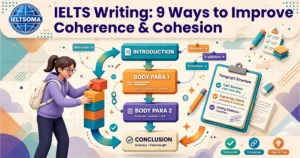
7. Build Better Paragraphs for Task 2
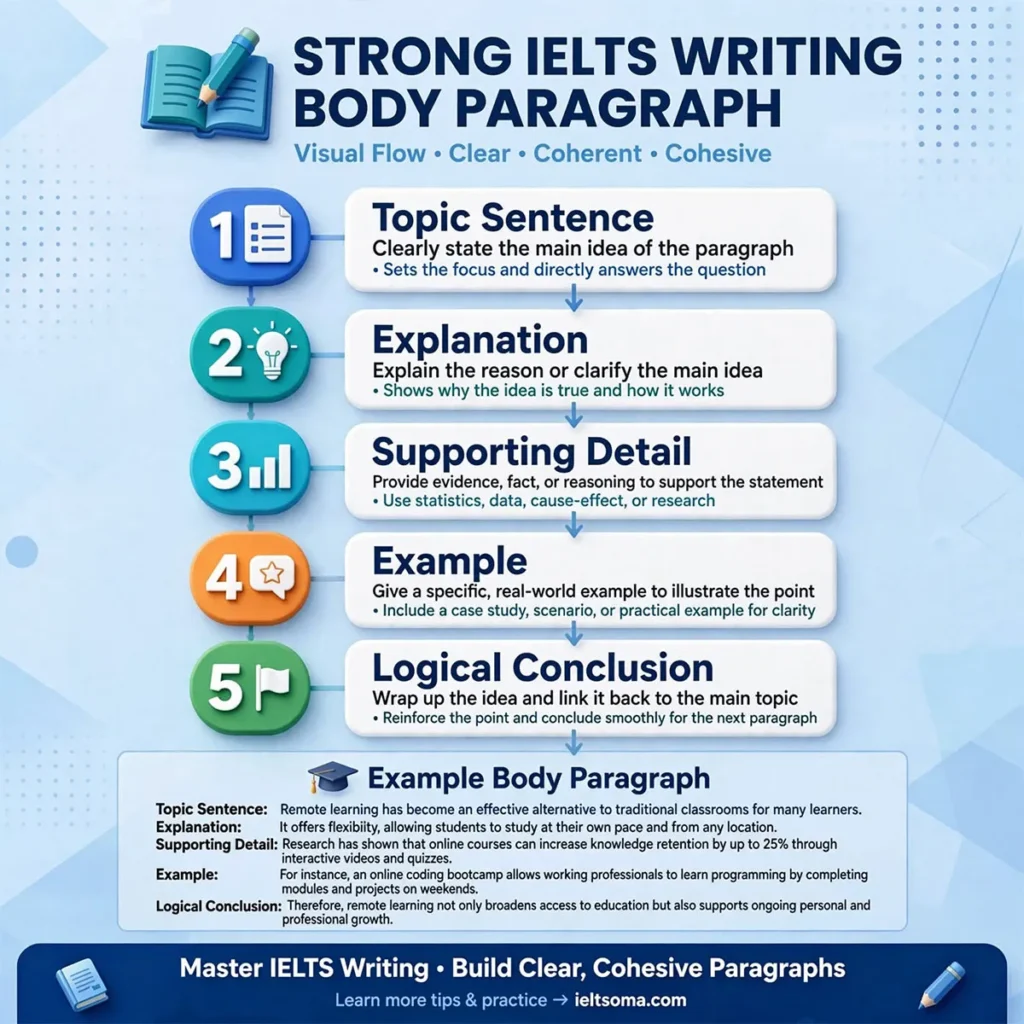
For many Task 2 essays, a practical structure is:
Introduction
- Paraphrase the topic
- Give your position or outline the response
Body Paragraph 1
- Main idea
- Explanation
- Supporting detail
- Example
Body Paragraph 2
- Main idea
- Explanation
- Supporting detail
- Example
Conclusion
- Summarise the main position
- Restate the overall answer without introducing a new argument
This is not the only acceptable structure, but it provides a useful framework for developing logical progression.
For example:
Main idea:
One significant benefit of investing in public transport is that it can reduce urban congestion.
Explanation:
When buses and trains are reliable and affordable, fewer commuters may depend on private cars.
Further development:
This reduces the number of vehicles competing for limited road space during peak periods.
Example:
For instance, expanding metropolitan rail systems can allow thousands of passengers to travel without adding thousands of additional cars to city roads.
The paragraph has a clear internal structure.
That is much more valuable than inserting a connector before every sentence.
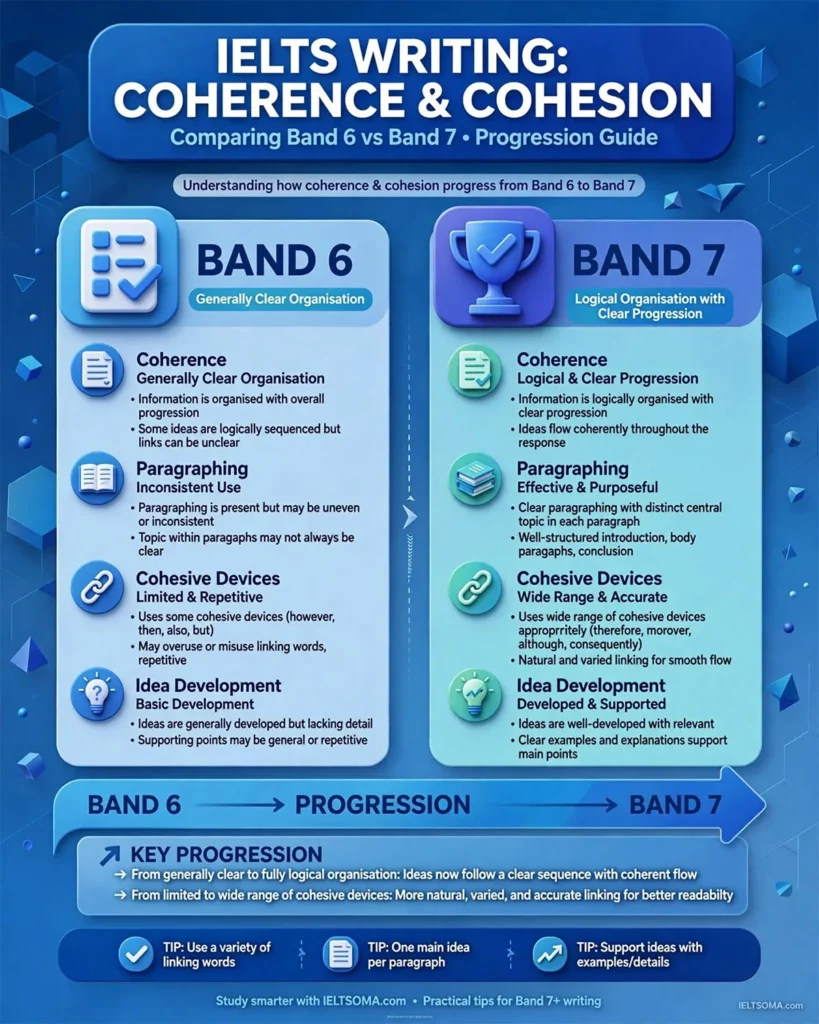
8. Understand What Band 6 and Band 7 Actually Require
If your target is Band 7, studying the difference between Band 6 and Band 7 can be extremely useful.
The official descriptors state that Band 6 responses generally have clear overall progression, but cohesion within or between sentences may become faulty or mechanical because of misuse, overuse or omission of cohesive devices. Paragraphing may also lack logic or a clear central topic.
At Band 7, information and ideas are logically organised with clear progression throughout. The writer uses a range of cohesive devices flexibly, although there may still be some inaccuracies or over- and under-use.
This distinction is important.
You do not need perfect cohesion to achieve Band 7.
You need:
- Logical organisation
- Clear progression
- Effective paragraphing
- Flexible use of cohesive devices
- Clear relationships between ideas
That means your preparation should focus on improving the whole system rather than obsessing over individual mistakes.
9. Use the “Because → Therefore → Example” Test
Here is a simple technique for checking your body paragraphs.
After writing a main idea, ask:
Why?
Then explain it.
Next ask:
What does this lead to?
Then develop the consequence.
Finally ask:
Can I give a specific example?
For example:
Public libraries remain valuable despite the growth of digital information.
Why?
They provide free access to resources for people who may not be able to afford them.
Therefore?
They can reduce inequalities in access to education.
Example?
Students from low-income households can use library computers, books and study spaces without paying for these resources.
This approach helps prevent paragraphs from becoming lists of unsupported claims.
Common Coherence and Cohesion Mistakes
Using a connector in every sentence
Too many connectors can make your writing mechanical.
Better: Use them when they clarify a genuine relationship.
Writing extremely long paragraphs
A paragraph containing several unrelated ideas is difficult to follow.
Better: Give each paragraph one central purpose.
Starting every paragraph with “Firstly” or “Secondly”
This can become repetitive.
Better: Use topic sentences that communicate the actual idea.
Repeating the same noun excessively
Repetition can make writing sound limited.
Better: Use appropriate referencing and paraphrasing where the meaning remains clear.
Using pronouns unclearly
Avoid replacing every repeated noun with this, it, they or these if the reference is ambiguous.
Better: Prioritise clarity.
Adding examples that introduce new ideas
An example should support the paragraph’s main point.
Better: Make sure the example illustrates the claim immediately before it.
Changing direction halfway through a paragraph
This often happens when candidates think of new ideas while writing.
Better: Plan your main points before you begin.
Memorising linking-word lists
Knowing 50 connectors does not automatically improve cohesion.
Better: Learn relationships between ideas and practise expressing those relationships naturally.
Coherence and Cohesion in Academic and General Training Writing
The principle of Coherence and Cohesion in IELTS Writing applies to both Academic and General Training candidates.
Both versions assess Writing using the same four broad criteria, including coherence and cohesion.
However, the Task 1 requirements differ.
In Academic IELTS, Task 1 requires you to describe visual information such as graphs, charts, tables, diagrams or processes.
In General Training IELTS, Task 1 involves writing a letter.
Task 2 is an essay for both versions.
In both tests, the minimum is 150 words for Task 1 and 250 words for Task 2, with Task 2 carrying greater weight in the Writing score.
This means your organisation should match the task.
For Academic Task 1, group information logically rather than describing every feature in the order you notice it.
For General Training Task 1, organise the letter according to its purpose and the points you need to cover.
For Task 2, develop a clear argument through purposeful paragraphs.
A 10-Minute Coherence and Cohesion Review
After completing a practice essay, do not immediately write another one.
Spend time analysing the organisation of the response.
Use this checklist:
Overall structure
- Is my position clear?
- Does each paragraph have a clear purpose?
- Is the information presented in a logical order?
Paragraphs
- Does each body paragraph have one central topic?
- Does every sentence contribute to that topic?
- Are the ideas developed rather than simply listed?
Cohesion
- Are my linking devices accurate?
- Have I overused connectors?
- Have I used reference and substitution naturally?
- Are pronouns and references clear?
Progression
- Does each sentence connect logically to the previous one?
- Does each paragraph contribute to the overall argument?
- Have I introduced any unrelated ideas?
Final test
Read the essay without focusing on grammar or vocabulary.
Ask:
“Can I follow the argument easily from beginning to end?”
If the answer is no, work on organisation before trying to add more advanced vocabulary.
A Practical Weekly Practice Routine
You can improve Coherence and Cohesion in IELTS Writing without writing a complete essay every day.
Day 1: Analyse
Take a high-quality IELTS writing sample and identify:
- Main ideas
- Paragraph purposes
- Topic sentences
- Examples
- Linking relationships
Day 2: Build paragraphs
Choose three IELTS topics and write one body paragraph for each.
Focus only on logical development.
Day 3: Practise cohesion
Take a paragraph you have written and highlight:
- Linking words
- Pronouns
- Reference
- Repeated key terms
- Cause-and-effect relationships
- Contrast
Remove any connector that does not serve a clear purpose.
Day 4: Practise sequencing
Write five sentences explaining one idea.
Then rearrange them into the most logical order.
Day 5: Write a timed response
Complete a Task 2 essay under realistic conditions.
Day 6: Review
Use the checklist above.
Identify your three most frequent organisational problems.
Day 7: Rewrite
Rewrite one weak paragraph rather than writing an entirely new essay.
Compare the original and revised versions.
This creates a much more useful feedback cycle than simply producing essay after essay.
Final Checklist for Better Coherence and Cohesion
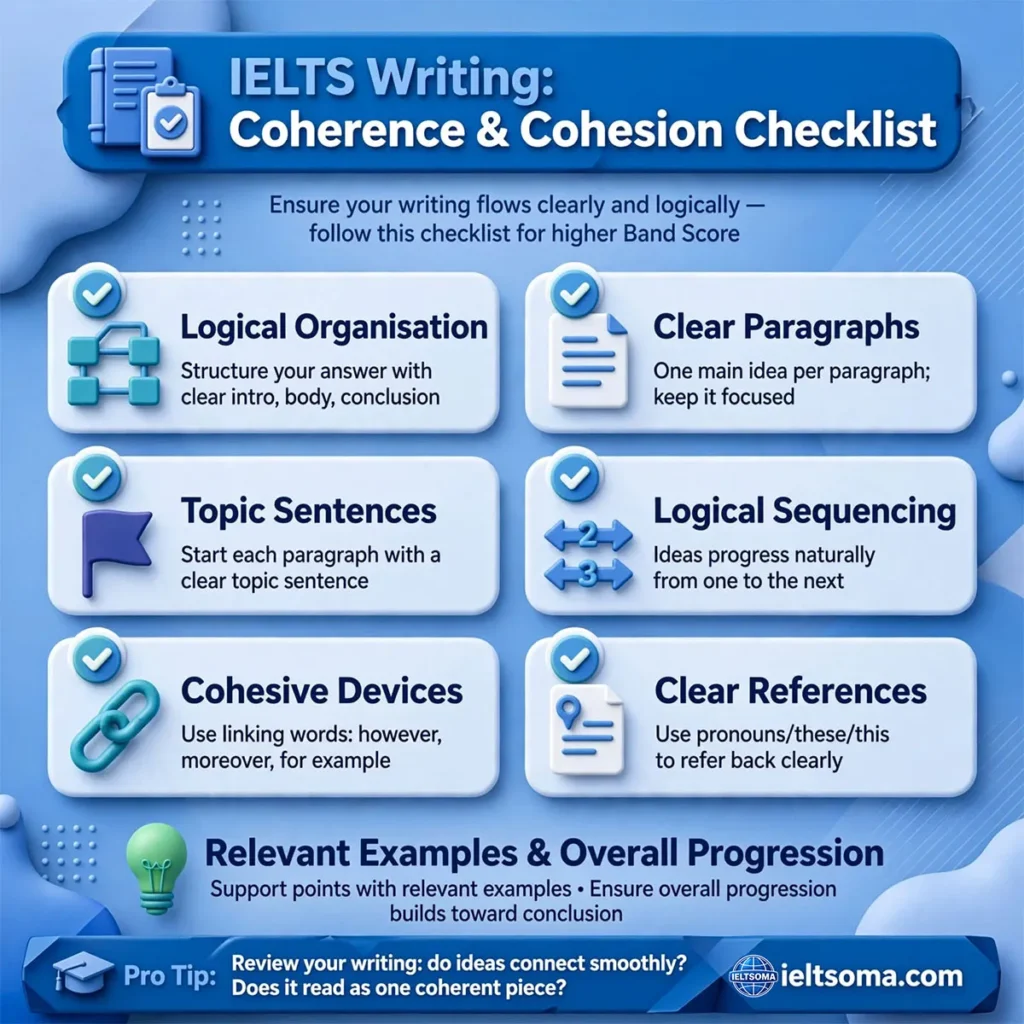
Before submitting your IELTS Writing response, ask:
- Is my answer clearly organised?
- Does the introduction establish my direction?
- Does every paragraph have a clear central idea?
- Are my ideas logically sequenced?
- Does each sentence develop or support the previous idea?
- Have I used cohesive devices appropriately?
- Have I avoided excessive linking words?
- Are my references and pronouns clear?
- Are my examples directly connected to my main ideas?
- Does the conclusion follow naturally from the discussion?
If you can answer yes to most of these questions, your writing is likely to be easier for the examiner to follow.
Frequently Asked Questions
What is coherence in IELTS Writing?
Coherence is the logical organisation and progression of information and ideas in your response. It includes how effectively you structure paragraphs and develop your argument.
What is cohesion in IELTS Writing?
Cohesion is how you connect ideas, sentences and information using cohesive devices such as linking expressions, pronouns, reference, substitution and conjunctions.
How can I improve Coherence and Cohesion in IELTS Writing?
Start by planning your ideas, giving each paragraph a clear purpose, sequencing information logically and using cohesive devices only when they clarify relationships between ideas.
Do I need to use many linking words to get Band 7?
No. Band 7 requires a range of cohesive devices used flexibly, but excessive or mechanical use can weaken your writing. The quality of the connections matters more than the number of connectors.
How many paragraphs should an IELTS essay have?
There is no single paragraph number that guarantees a particular band score. What matters is whether your paragraphs organise and develop the response effectively. For Task 2, paragraphing is an important part of coherence, particularly from Band 6 upwards.
Is coherence more important than cohesion?
They are closely connected and are assessed together under the same criterion. Coherence concerns the logical organisation and progression of ideas, while cohesion concerns the linguistic connections that make relationships between ideas clear.
Can I get Band 7 if I make some mistakes with linking words?
Yes. The Band 7 descriptor allows for some inaccuracies and some over- or under-use of cohesive devices. The response should nevertheless have logical organisation and clear progression throughout.
Should I use “Firstly, secondly and finally” in every essay?
You can use them when appropriate, but you do not need to use them mechanically. Clear topic sentences and logical development can create progression without relying on the same sequence markers repeatedly.
Conclusion
Strong Coherence and Cohesion in IELTS Writing is not about decorating your essay with sophisticated connectors.
It is about making your ideas easy to follow.
Plan before you write. Give each paragraph a clear purpose. Develop ideas in a logical sequence. Use examples that genuinely support your argument. Use cohesive devices when they communicate a real relationship between ideas, and avoid them when they merely add decoration.
Most importantly, review the organisation of your writing as carefully as you review grammar and vocabulary.
The official IELTS criteria make the expectation clear: stronger responses organise information logically, maintain progression, use paragraphs effectively and manage cohesive devices appropriately.
Once your reader can move through your response effortlessly, your writing becomes clearer, more persuasive and much easier to assess positively.
Further IELTS Writing Reads: