You can have strong ideas, relevant vocabulary and a clear essay structure—and still lose valuable IELTS Writing marks because of small grammar errors.
A missing article. The wrong verb tense. A singular subject followed by a plural verb. A sentence that looks sophisticated but is actually grammatically broken.
These mistakes can quietly lower your performance under Grammatical Range and Accuracy, one of the four criteria IELTS examiners use to assess Writing. Official IELTS guidance makes clear that examiners consider both the range of grammatical structures and how accurately and appropriately you use them.
The good news is that most IELTS Writing Grammar Mistakes are not random. Candidates tend to repeat the same errors because they have developed habits that are difficult to notice while writing under time pressure.
This guide identifies 9 costly grammar mistakes, explains why they happen, shows you how to correct them, and gives you a practical proofreading system you can use in both IELTS Academic and General Training.
Table of Contents
Why IELTS Writing Grammar Mistakes Matter
Grammar is not assessed in isolation. IELTS Writing is marked using four criteria:
- Task Achievement or Task Response
- Coherence and Cohesion
- Lexical Resource
- Grammatical Range and Accuracy
Task 1 and Task 2 are assessed separately, and Task 2 carries greater weight in the overall Writing score.
The grammar criterion therefore matters, but there is an important point many candidates misunderstand:
You do not need perfect grammar to achieve a high IELTS band.
The official descriptors recognise that occasional errors can occur even at higher bands. For Band 7, a candidate may still make a few grammatical errors, provided grammar and punctuation are generally well controlled and errors do not impede communication. At Band 8, the majority of sentences should be error-free, with only occasional, non-systematic errors.
This means your goal should not be to produce impossibly complicated sentences.
Your goal is to produce accurate, appropriately varied sentences consistently.
That distinction can completely change how you prepare.
9 IELTS Writing Grammar Mistakes That Can Cost You Marks
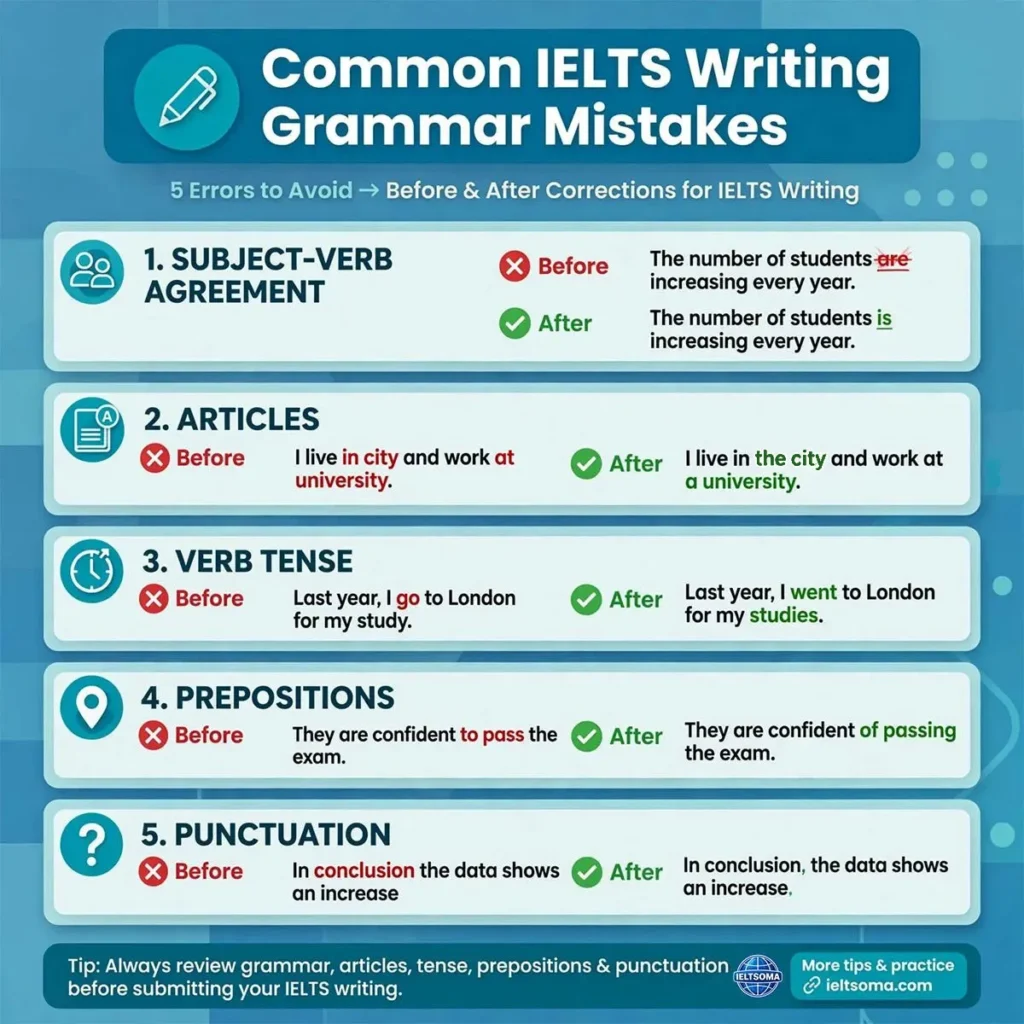
1. Subject-Verb Agreement Errors
One of the most common IELTS Writing Grammar Mistakes is using the wrong verb form after the subject.
The basic rule is simple: a singular subject generally takes a singular verb, while a plural subject takes a plural verb.
Incorrect:
The number of people who use public transport are increasing.
Correct:
The number of people who use public transport is increasing.
The phrase people who use public transport can distract you from the real subject: the number.
Compare these examples:
| Subject | Correct verb |
|---|---|
| The number of students | is |
| The percentage of households | has |
| The government | needs |
| Governments | need |
| The main reasons | are |
| One of the main reasons | is |
Be particularly careful with expressions such as:
- the number of
- a number of
- one of
- each of
- every
- neither of
- either of
- the majority of
For example:
A number of students are choosing to study abroad.
But:
The number of students is increasing.
Examiner-level tip: During proofreading, underline every subject and circle its verb. Then check whether they agree.
This takes only a few seconds and can expose repeated errors.
2. Incorrect Articles: A, An and The
Articles are responsible for a surprising number of persistent grammar errors.
Candidates often omit a, an or the, or use them when they are unnecessary.
Incorrect:
Government should invest more money in education.
Correct:
The government should invest more money in education.
However, the correct article depends on meaning and context.
Consider:
Governments should invest more in public transport.
Here, governments is being discussed generally, so no article is needed.
But:
The government should introduce stricter regulations.
Here, the government refers to a particular government or governing authority.
Another common mistake is using an article before an uncountable noun:
Incorrect:
Education is an important issue for a society.
Better:
Education is an important issue for society.
But:
The society described in the report has experienced significant changes.
The second sentence refers to a particular society.
Do not try to memorise hundreds of article rules at once. Instead, pay particular attention to articles when proofreading your own essays.
If you repeatedly make the same article mistake, record it in an error log.
3. Tense Errors and Unnecessary Tense Switching
Your tense should match the time and meaning of the information you are presenting.
This becomes particularly important in Academic Writing Task 1 when describing charts, graphs and tables.
For example:
The number of visitors increased between 2000 and 2010, and then it falls sharply in 2012.
The tense changes unnecessarily.
Correct:
The number of visitors increased between 2000 and 2010, and then it fell sharply in 2012.
For information that is still true:
The graph shows the percentage of people who use public transport.
For historical data:
The percentage of people using public transport increased between 2005 and 2015.
For predictions:
The figure is expected to rise over the next decade.
General Training candidates also need to control tense carefully when explaining situations in letters.
For example:
I am writing to complain about the service I received last Friday.
The present continuous is appropriate for the current act of writing, while the past tense refers to the previous event.
IELTS Writing Grammar Mistakes often happen when candidates choose a tense because it sounds advanced rather than because it communicates the correct time.
Choose tense for meaning first.
4. Sentence Fragments
A sentence fragment looks like a sentence but does not express a complete grammatical thought.
Incorrect:
Because many people work long hours.
This begins with because but does not contain a complete main clause.
Correct:
Because many people work long hours, they have less time for physical exercise.
Or:
Many people have less time for physical exercise because they work long hours.
Fragments become particularly common when candidates try to create complex sentences.
Another example:
Incorrect:
Although technology has improved communication between people.
Correct:
Although technology has improved communication between people, it has also created new social challenges.
Before submitting your essay, check sentences beginning with:
- although
- because
- while
- whereas
- if
- when
- which
- who
- despite
- unless
These words often introduce dependent clauses. A dependent clause may need another clause to complete the meaning.
5. Run-On Sentences and Comma Splices
The opposite problem is combining independent sentences incorrectly.
Incorrect:
Many people work from home, this reduces commuting time.
This is a comma splice. Two complete clauses have been incorrectly joined with only a comma.
You can correct it in several ways:
Many people work from home, and this reduces commuting time.
Or:
Many people work from home. This reduces commuting time.
Or:
Many people work from home; this reduces commuting time.
You can also use a subordinating conjunction:
Because many people work from home, commuting time is reduced.
However, do not turn every sentence into a long chain of clauses.
Long sentences are not automatically better IELTS sentences.
A shorter sentence that communicates the idea precisely is often stronger than a complicated sentence containing several errors.
6. Incorrect Prepositions
Prepositions are small words, but they can create noticeable grammatical problems.
Common examples include:
- interested in
- responsible for
- dependent on
- contribute to
- result in
- result from
- impact on
- increase in
- access to
Incorrect:
Technology has a significant impact to society.
Correct:
Technology has a significant impact on society.
Another common error:
Incorrect:
This can contribute in reducing pollution.
Correct:
This can contribute to reducing pollution.
Prepositions are difficult because there is not always a logical rule that tells you which one to choose.
The best solution is to learn common collocations and grammatical patterns, rather than memorising individual words.
For example, learn:
contribute to something
rather than simply learning:
contribute = help
This approach also connects grammar with vocabulary development.
7. Incorrect Use of Countable and Uncountable Nouns
This is another frequent source of IELTS Writing Grammar Mistakes.
Some English nouns are normally uncountable and cannot be used in the same way as ordinary countable nouns.
Common examples include:
- information
- advice
- research
- equipment
- knowledge
- traffic
- furniture
- accommodation
- evidence
Incorrect:
Many useful informations are available online.
Correct:
A lot of useful information is available online.
Similarly:
Incorrect:
The researcher provided several useful advices.
Correct:
The researcher provided several useful pieces of advice.
Also be careful with words that change meaning depending on whether they are countable or uncountable.
For example:
There is considerable demand for affordable housing.
But:
The government received several demands from local residents.
The first refers to demand in a general sense. The second refers to specific requests.
When learning academic vocabulary, record whether a noun is countable, uncountable or can be both.
8. Misusing Complex Sentences
Many candidates believe Band 7 requires them to make every sentence complex.
It does not.
Official IELTS guidance explains that candidates need a range of sentence forms, including simple and complex sentences. For higher bands, complex structures should be used with flexibility and accuracy.
The problem is not using complex grammar.
The problem is using it when you cannot control it.
Weak:
Although governments should invest more money in public transport which can reduce traffic congestion because people will use cars less which is good for the environment, many governments do not have enough money.
The sentence contains several ideas, but the structure is difficult to control.
A clearer version would be:
Governments should invest more in public transport because this can reduce traffic congestion. If reliable buses and trains are widely available, fewer people may depend on private cars.
Notice that the second version still uses complex grammar.
It simply uses it more effectively.
A strong IELTS response usually benefits from a mixture of:
- simple sentences
- compound sentences
- complex sentences
- sentences containing relative clauses
- conditional structures
- passive constructions where appropriate
- modal verbs
- comparative structures
Accuracy comes before complexity.
9. Punctuation Errors
Punctuation is sometimes treated as a minor detail, but it directly affects readability.
Official IELTS guidance specifically includes punctuation when discussing Grammatical Range and Accuracy. Frequent or serious punctuation problems can make a response more difficult to understand.
Common problems include:
- missing full stops
- unnecessary commas
- comma splices
- incorrect apostrophes
- inconsistent capitalisation
- missing commas after introductory clauses
For example:
Incorrect:
However many people believe that this approach is ineffective.
Better:
However, many people believe that this approach is ineffective.
Another example:
Incorrect:
If governments invest in renewable energy they can reduce dependence on fossil fuels.
Better:
If governments invest in renewable energy, they can reduce dependence on fossil fuels.
Do not insert commas randomly.
The purpose of punctuation is to make the grammatical structure easier for the reader to follow.
IELTS Writing Grammar Mistakes: Task 1 vs Task 2
Grammar problems can appear in both tasks, but the risks are slightly different.
| Area | Academic Task 1 | General Training Task 1 | Task 2 |
|---|---|---|---|
| Main focus | Describing visual information | Writing a letter | Developing an argument |
| Common tense issue | Mixing past, present and future | Confusing past and present | Unnecessary tense changes |
| Common grammar issue | Subject-verb agreement | Sentence structure and tone | Complex sentence errors |
| Important language | Comparatives, trends, passive voice | Functional language | Clauses, conditionals, modals |
| Proofreading priority | Tenses, articles, comparisons | Grammar, tone, punctuation | Sentence accuracy and structure |
Academic Task 1 requires candidates to summarise visual information, while General Training Task 1 requires a letter. Task 2 in both tests involves an essay responding to a point of view, argument or problem.
The grammar you use should therefore support the task rather than appear simply to demonstrate grammatical knowledge.
How to Fix IELTS Writing Grammar Mistakes Systematically
Random grammar practice is rarely enough.
You need to identify the mistakes you personally repeat.
Use this five-step system after every practice essay.
Step 1: Keep an Error Log
Create five columns:
| Your mistake | Correction | Grammar area | Why it was wrong | Your new example |
|---|---|---|---|---|
| People is | People are | Subject-verb agreement | People is plural | People are becoming more environmentally conscious. |
| An useful method | A useful method | Articles | Useful begins with a consonant sound | This is a useful approach. |
| Informations | Information | Uncountable noun | Information is normally uncountable | The information is reliable. |
Do not simply write the correct answer.
Write the reason.
Step 2: Look for Repeated Errors
One mistake may be accidental.
The same mistake appearing in five essays is a pattern.
For example, if you repeatedly write:
Governments should provides…
your problem is not vocabulary.
It is probably your understanding of modal verbs.
After should, use the base form:
Governments should provide…
Step 3: Correct the Original Sentence
Do not immediately move on after finding an error.
Rewrite it correctly.
Then create another sentence using the same structure.
For example:
Incorrect: Governments should invests more.
Correct: Governments should invest more.
New example: Schools should provide more practical training.
This converts correction into active learning.
Step 4: Recheck the Same Grammar Area Later
If you studied articles today, test yourself on articles again several days later.
Your objective is not to remember a grammar rule temporarily.
You want the correct structure to become automatic.
Step 5: Proofread in Passes
Trying to identify every possible error simultaneously can be overwhelming.
Instead, use separate proofreading passes.
Pass 1: Verbs
Check:
- subject-verb agreement
- tense
- modal verbs
- auxiliary verbs
Pass 2: Nouns
Check:
- singular/plural forms
- articles
- countable/uncountable nouns
- pronouns
Pass 3: Sentences
Check:
- fragments
- run-on sentences
- complex clauses
- sentence boundaries
Pass 4: Punctuation
Check:
- commas
- full stops
- apostrophes
- capital letters
This method is much more reliable than simply reading the essay once and hoping to notice everything.
What High-Band Grammar Actually Looks Like
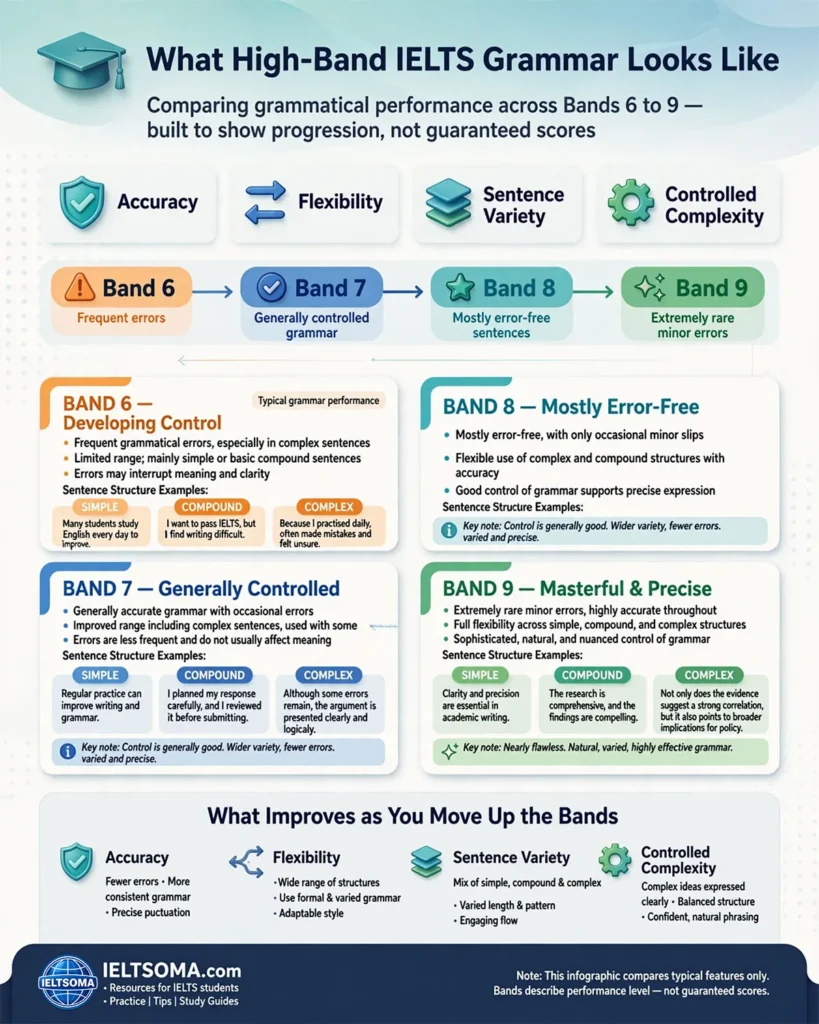
A common misconception is that Band 8 or Band 9 writing must contain complicated grammar in every sentence.
That is not what the official descriptors say.
For Band 8, the majority of sentences should be error-free, with a wide range of structures used flexibly and accurately. Band 9 requires very strong control, with extremely rare minor errors.
Consider this paragraph:
Public transport can reduce congestion in large cities. If governments invest in reliable rail and bus networks, more residents may choose to leave their cars at home. This could reduce the number of vehicles on major roads and improve air quality. However, public transport must be affordable and convenient if authorities want people to use it regularly.
The paragraph contains simple and complex structures.
It does not attempt to make every sentence unnecessarily sophisticated.
That is the point.
Strong IELTS grammar is controlled grammar.
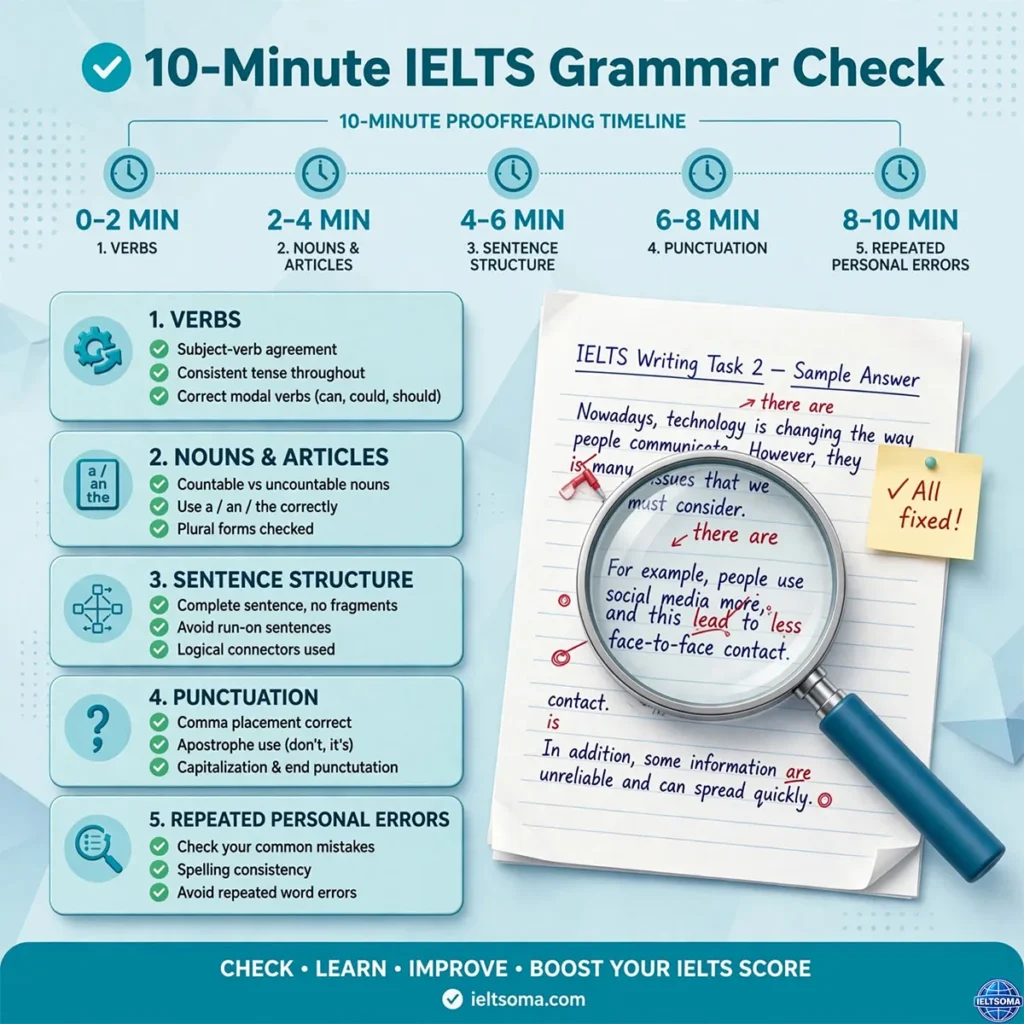
10-Minute Grammar Check Before You Finish
If you have a few minutes remaining in the Writing test, do not reread your essay passively.
Use a targeted checklist.
First 2 minutes: verbs
Check:
- subject-verb agreement
- tense consistency
- modal verbs
- verb forms
Next 2 minutes: articles and nouns
Check:
- a/an/the
- singular/plural nouns
- countable/uncountable nouns
- pronouns
Next 2 minutes: sentence structure
Check:
- incomplete sentences
- run-on sentences
- overly long sentences
- missing conjunctions
Next 2 minutes: punctuation
Check:
- full stops
- commas
- apostrophes
- capital letters
Final 2 minutes: repeated errors
Look for a mistake you know you frequently make.
If your error log tells you that you regularly confuse affect and effect, or number and amount, specifically check for those problems.
This is more effective than spending ten minutes reading every sentence without a plan.
Common Grammar Myths IELTS Candidates Should Stop Believing
“I need to use advanced grammar in every sentence.”
No.
You need a range of structures that you can use accurately and appropriately.
“One grammar mistake will destroy my band score.”
No.
IELTS assessment considers the frequency, seriousness and impact of errors. Occasional errors can occur at higher bands.
“Longer sentences get higher scores.”
Not automatically.
A long sentence full of errors can weaken your writing. A well-controlled complex sentence is much more valuable.
“I should memorise complicated grammar templates.”
Templates can help with planning, but memorised structures should not replace genuine language control.
Learn useful grammatical patterns and practise adapting them to different topics.
“I should avoid simple sentences.”
Simple sentences are useful.
The goal is variety, not complexity for its own sake.
Frequently Asked Questions About IELTS Writing Grammar Mistakes
What are the most common IELTS Writing Grammar Mistakes?
The most common problems include subject-verb agreement, incorrect articles, tense errors, preposition errors, countable and uncountable noun mistakes, sentence fragments, run-on sentences, misuse of complex structures and punctuation errors.
How can I improve grammar for IELTS Writing?
Write regularly, analyse your errors and maintain an error log. Instead of studying grammar rules without context, identify the mistakes you repeatedly make and practise correcting them in your own sentences.
Does grammar affect IELTS Writing Band 7?
Yes. Grammatical Range and Accuracy is one of the four IELTS Writing assessment criteria. For Band 7, grammar and punctuation should generally be well controlled, with only a few errors that do not impede communication.
Do I need perfect grammar to get Band 8?
No. The Band 8 descriptor allows occasional, non-systematic errors. However, the majority of your sentences should be error-free and you need to demonstrate a wide range of structures used flexibly and accurately.
Should I use complex sentences in IELTS Writing?
Yes, but selectively. Complex sentences help demonstrate grammatical range, but they must be accurate and appropriate. A clear combination of simple, compound and complex structures is usually more effective than making every sentence complicated.
How many grammar mistakes are allowed in IELTS Writing?
There is no official fixed number of permitted mistakes. Examiners consider the type, frequency and impact of errors, as well as the range and accuracy of grammatical structures used throughout the response.
Is grammar more important than vocabulary in IELTS Writing?
Neither should be treated as a substitute for the other. Grammar is assessed under Grammatical Range and Accuracy, while vocabulary is assessed under Lexical Resource. A strong response needs both accurate grammar and appropriate vocabulary.
Should I spend time checking grammar in the IELTS Writing test?
Absolutely. Reserve several minutes at the end for proofreading. Focus particularly on errors you know you repeatedly make rather than trying to rewrite the entire essay.
Final Takeaway
The fastest way to reduce IELTS Writing Grammar Mistakes is not to memorise a giant grammar book.
It is to identify your personal patterns.
Write.
Review.
Record the mistake.
Understand why it happened.
Correct it.
Use the structure again.
Then check whether you repeat the same error in your next practice response.
That process gradually turns grammar from something you consciously think about into something you control naturally.
Remember what IELTS is actually looking for: a suitable range of grammatical structures, used accurately and appropriately, with errors that are infrequent and do not interfere with communication.
Your target should therefore be simple:
Do not try to sound complicated. Try to sound accurate, clear and controlled.
That is the grammar that helps your IELTS Writing performance.
Further Reading: