IELTS Reading Sentence Completion questions can look straightforward: read a sentence, find the missing information in the passage, and fill in the gap. Yet this question type causes problems for many candidates who understand the text but still lose marks through careless scanning, incorrect grammar, spelling errors, or exceeding the word limit.
The solution is not to read every passage more slowly. It is to learn how to predict the missing information, locate the relevant evidence, and check that your answer fits both the meaning and the grammar of the sentence.
This guide explains how to answer IELTS Reading Sentence Completion questions systematically. You will learn a reliable IELTS Reading sentence completion strategy, understand the sentence completion word limit IELTS instructions, work through examples, and practise with an original exercise and answer key.
These techniques are useful for both IELTS Academic and IELTS General Training candidates.
Table of Contents
What Is IELTS Reading Sentence Completion?
IELTS Reading Sentence Completion is a question type in which you complete unfinished sentences using information from a reading passage. Depending on the instructions, you may need to select words directly from the passage, usually without changing their form.
For example:
Passage: The research team collected water samples from several rivers and examined them in a laboratory.
Question: The research team examined river water samples in a ______.
Answer: laboratory
The answer is a word taken directly from the passage, and it completes the sentence grammatically and logically.
According to the official IELTS test format, sentence completion tests your ability to locate specific information and understand details in a text. The questions generally follow the order in which the relevant information appears in the passage.
This means you can often locate an answer to an earlier question before finding the answer to a later one, rather than searching the entire passage repeatedly.
Sentence Completion is different from Matching Sentence Endings. In Sentence Completion, you fill a gap with the required word or words. In Matching Sentence Endings, you select an appropriate ending from a list of options.
7 Proven IELTS Reading Sentence Completion Strategies
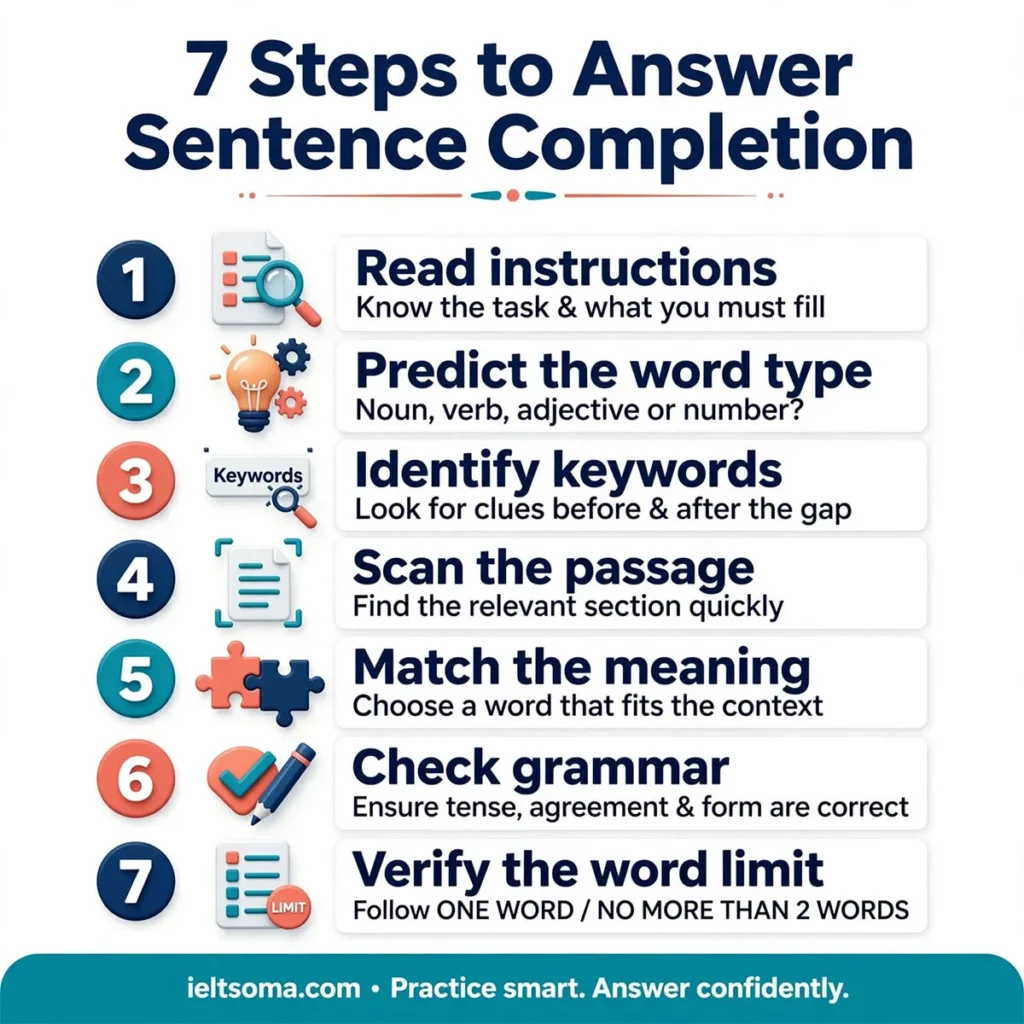
1. Read the Instructions Before Looking for Answers
Your first task is to identify exactly what the instructions permit.
You may encounter instructions such as:
- NO MORE THAN ONE WORD
- NO MORE THAN TWO WORDS
- NO MORE THAN THREE WORDS
- NO MORE THAN TWO WORDS AND/OR A NUMBER
The wording matters. If the instruction says NO MORE THAN TWO WORDS, an answer containing three words will be marked incorrect even if the meaning is right.
For example:
Passage: The new transport system uses solar energy to operate its electronic displays.
Question: The electronic displays operate using ______.
Instruction: NO MORE THAN TWO WORDS
Correct answer: solar energy
Incorrect answer: energy from the sun
The second answer expresses a similar idea, but it does not reproduce the wording used in the passage. In a task requiring words from the passage, this is not a safe substitute.
Expert tip: Before answering any question, underline or mentally highlight the maximum number of words allowed. Keep checking that limit throughout the task.
2. Predict the Type of Missing Word
One of the most effective techniques is to examine the grammar around each gap before scanning the passage.
Ask yourself: Does the sentence need a noun, verb, adjective, adverb, number, or noun phrase?
Consider these examples:
| Incomplete sentence | Likely answer type |
|---|---|
| The building was constructed using ______. | Noun or noun phrase |
| The machine can ______ the temperature automatically. | Base-form verb |
| The researchers conducted a ______ experiment. | Adjective |
| The museum receives approximately ______ visitors annually. | Number |
| The main cause of the delay was ______. | Noun or noun phrase |
This prediction narrows your search.
Suppose the sentence reads:
The researchers used a special ______ to measure air quality.
You should look for a noun referring to an instrument, device, or method. You would not normally expect an adjective or a verb in the gap.
However, do not let grammatical prediction replace textual evidence. Several words may fit grammatically, but only the passage can confirm the correct answer.
3. Identify Keywords and Possible Synonyms
After predicting the answer type, identify the most useful keywords in the incomplete sentence.
Look for:
- Names and places
- Dates, numbers, and percentages
- Technical terms
- Unusual nouns
- Words describing a cause, effect, purpose, or comparison
Then consider synonyms and paraphrases that the passage might use.
For example:
Question: The new system reduced the amount of electricity consumed by the factory.
Possible passage wording: Following installation of the equipment, the factory’s energy use fell considerably.
The question says reduced the amount of electricity consumed, while the passage says energy use fell. These expressions communicate a similar idea.
A useful keyword strategy is to combine one distinctive word with a predicted answer type. If a sentence mentions a factory and electricity consumption, search for related terms such as energy, power, consumption, or use.
Do not expect the passage to repeat every word in the question. IELTS often tests whether you can recognise the same information expressed differently.
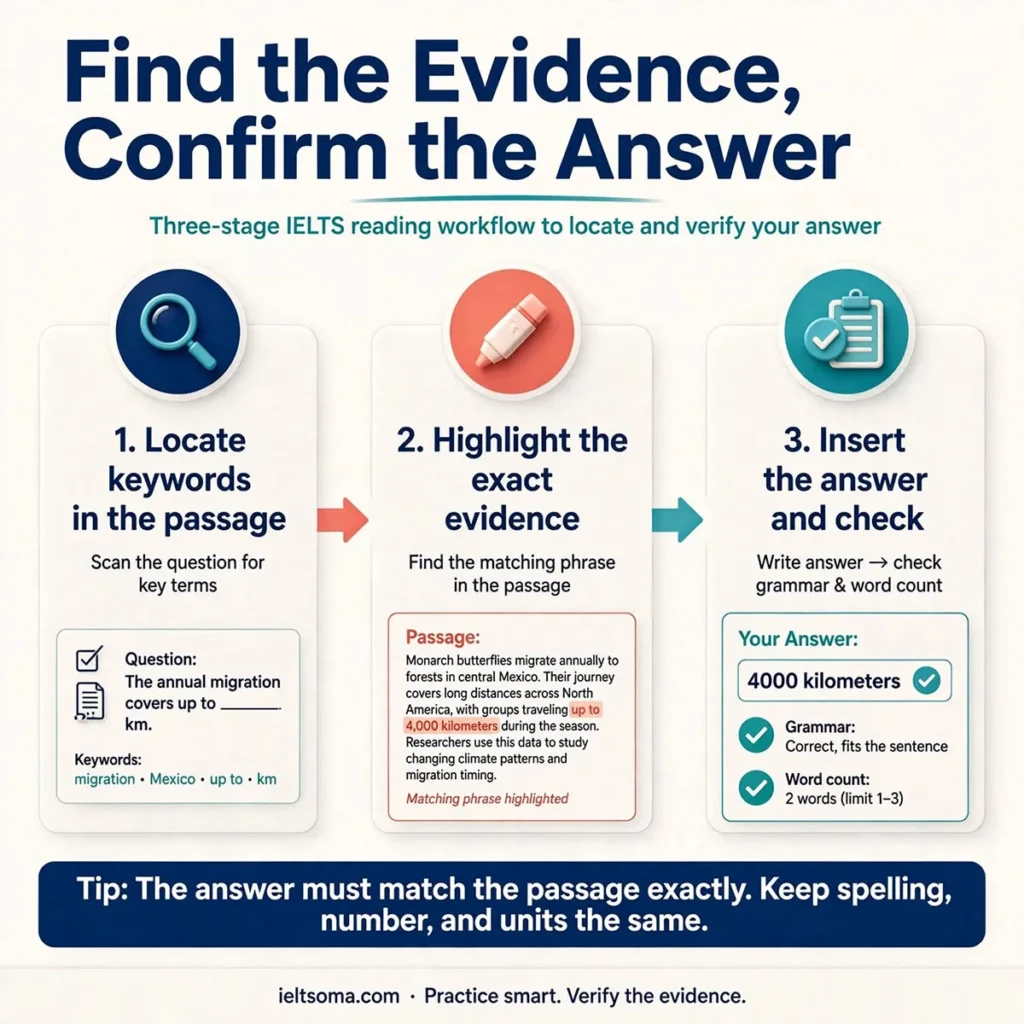
4. Scan for the Relevant Information
Scanning means moving quickly through a passage to find specific details rather than reading every sentence with equal attention.
Use your keywords to identify a likely paragraph. Names, dates, technical terms, and unusual nouns are often more useful search targets than common words such as people, important, or development.
Once you locate a promising sentence, slow down and read the surrounding lines carefully.
For example:
Question: The research was carried out in three ______.
Passage: To compare the effects of air pollution, the team selected three urban centres with different traffic levels. Measurements were taken at several points within each location.
The phrase three urban centres supplies the missing information.
Answer: urban centres
Notice the two-stage process:
- Scan quickly to locate the relevant part of the passage.
- Read carefully to confirm the exact answer.
Searching for every question from the beginning of the passage wastes time. Use the order of the questions as a guide, while remembering that you should verify the information rather than assume the next answer must be in the immediately following sentence.
5. Match Meaning, Not Just Individual Words
Finding a familiar keyword does not automatically mean you have found the answer.
A passage may mention the same topic several times, but only one reference will match the relationship expressed in the question.
Consider this example:
Question: The new programme helped students improve their ______.
Passage: Although the programme initially focused on attendance, its most significant outcome was a marked improvement in students’ reading comprehension.
A candidate might select attendance because it appears near the beginning of the passage. However, the question asks what the programme helped students improve, and the passage identifies reading comprehension as the main improvement.
Answer: reading comprehension
Always check the complete meaning of the sentence and the passage. Pay attention to relationships such as:
- Cause and effect
- Problems and solutions
- Advantages and disadvantages
- Before-and-after comparisons
- Research aims and findings
- Claims and supporting evidence
This is particularly important when a passage includes several related facts.
6. Check Grammar and Word Form
Your answer must fit naturally into the incomplete sentence.
Check whether the gap requires a singular or plural noun, a particular verb form, or an adjective rather than a noun.
For example:
Passage: The experiment produced unexpected results.
Question: The experiment produced several unexpected ______.
Answer: results
Writing result would be incorrect because several requires a plural noun.
Consider another example:
Passage: The equipment is suitable for measuring water pressure.
Question: The equipment can be used to ______ water pressure.
Answer: measure
The word measuring appears in the passage, but the question requires the base form measure after to.
In standard IELTS Reading Sentence Completion tasks that require words from the passage, you should generally copy the required word or phrase exactly. Do not change its form merely to make it fit. Instead, use grammar to determine which passage wording belongs in the gap.
If your predicted grammar seems inconsistent with the passage, reread the complete sentence and check whether you have located the correct information.
7. Verify Every Answer Against the Word Limit
The final check can save marks that you would otherwise lose unnecessarily.
After completing the gaps, ask:
- Does the answer reproduce the relevant information from the passage?
- Does it fit grammatically into the sentence?
- Have I stayed within the stated word limit?
- Have I copied the spelling correctly?
- Have I included only the words needed to complete the gap?
For instance, if the instruction is NO MORE THAN TWO WORDS, the following answers contain different numbers of words:
- research — one word
- medical research — two words
- advanced medical research — three words
Only the first two satisfy the numerical limit. Whether either is correct depends on the passage and the question.
Do not add explanations or extra words to an answer simply to make its meaning clearer. Your job is to supply the required information, not to rewrite the passage.
Sentence Completion Word Limit IELTS: What You Must Know
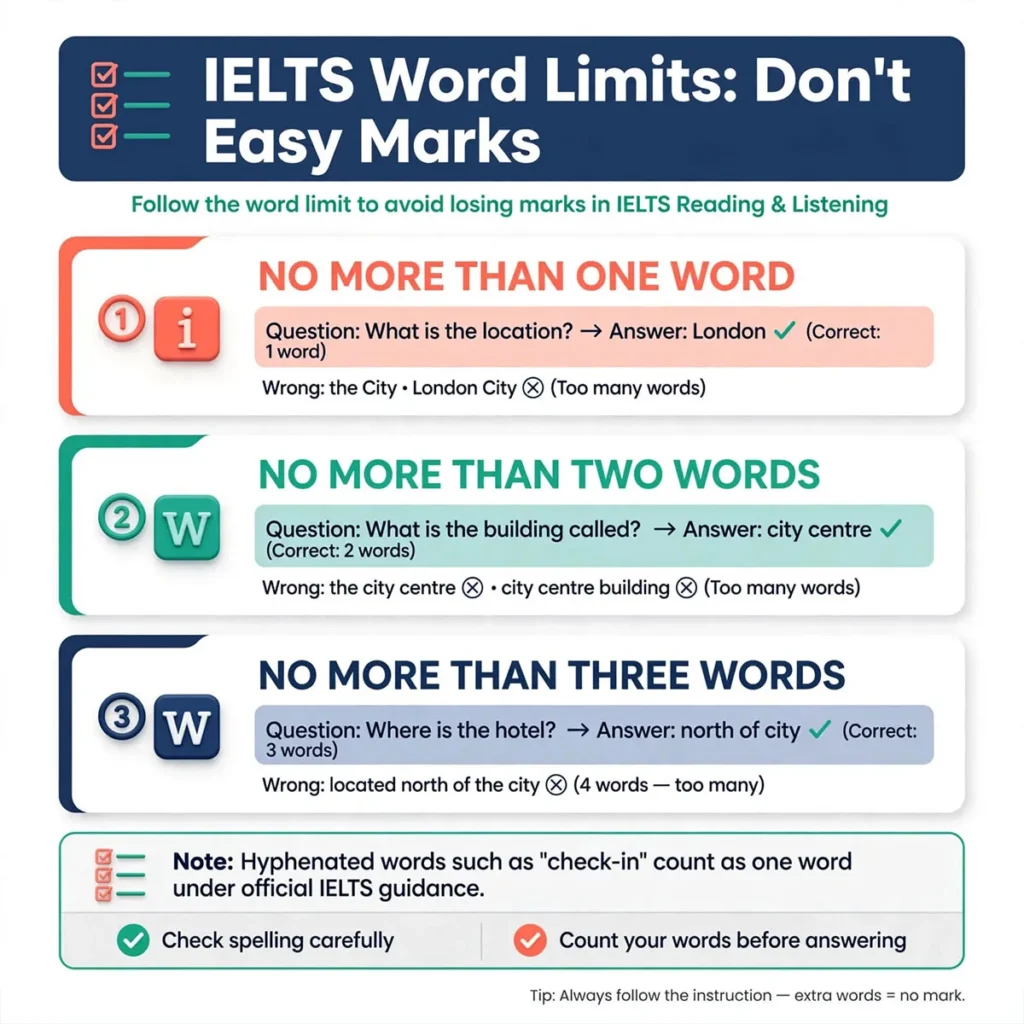
Understanding the sentence completion word limit IELTS instructions is essential because a correct idea can still receive no mark if the answer breaks the stated limit.
The official IELTS guidance explains that the word limit varies by task. You must follow the exact instruction printed above your questions.
| Instruction | Maximum permitted answer |
|---|---|
| NO MORE THAN ONE WORD | One word |
| NO MORE THAN TWO WORDS | Two words |
| NO MORE THAN THREE WORDS | Three words |
| NO MORE THAN TWO WORDS AND/OR A NUMBER | Up to two words, with a number also permitted as specified |
The last instruction allows a number in addition to the permitted words. Follow the precise wording on your test rather than assuming every question uses the same rule.
Do Hyphenated Words Count as One Word?
Official IELTS guidance treats a hyphenated word, such as check-in, as one word. You should not assume that two components joined by a hyphen count as two separate words.
Can You Change the Words from the Passage?
If the task asks you to complete sentences using words from the passage, use the relevant wording from the text. Avoid replacing it with your own synonym or paraphrase.
For example, if the passage uses public transport, do not substitute buses and trains merely because the expressions are related.
Does Spelling Matter?
Yes. A misspelt answer may be marked incorrect. Carefully copy unfamiliar terms, names, and technical vocabulary, particularly when working under time pressure.
For the authoritative instructions and sample tasks, consult the official IELTS Academic Reading test format and the official IELTS General Training Reading test format.
A Step-by-Step Example: How to Answer IELTS Reading Sentence Completion
The best way to learn the process is to apply it to a short passage.
Practice passage
The Development of Urban Gardens
Urban gardens have become increasingly common in cities where access to green space is limited. Some projects use unused rooftops, while others transform abandoned plots into productive community areas. These gardens can supply fresh vegetables and provide residents with opportunities to learn about food production.
A study of several community gardens found that regular gardening activities also encouraged social interaction among residents. However, the success of each project depended partly on the availability of water and the willingness of volunteers to maintain the plots. Some local authorities responded by providing water-saving equipment and offering training sessions for new gardeners.
Questions 1–4
Complete the sentences below.
Choose NO MORE THAN TWO WORDS from the passage for each answer.
- Urban gardens are increasingly common in cities with limited access to ______.
- Community gardens can give residents opportunities to learn about ______.
- Regular gardening activities encouraged greater ______ among residents.
- The success of a garden partly depended on water availability and the commitment of ______.
Worked answers
Question 1
The sentence requires a noun or noun phrase after access to. Scan for the opening idea about limited space.
The passage states that access to green space is limited.
Answer: green space
Question 2
The phrase learn about suggests a topic or activity. The passage explains that residents can learn about food production.
Answer: food production
Question 3
The question asks what gardening activities encouraged. The passage explicitly states that they encouraged social interaction.
Answer: social interaction
Question 4
The sentence identifies two factors: water availability and the commitment of a group of people. The passage refers to the willingness of volunteers to maintain the plots.
Answer: volunteers
Answer key
| Question | Answer |
|---|---|
| 1 | green space |
| 2 | food production |
| 3 | social interaction |
| 4 | volunteers |
All four answers use no more than two words and are supported by the passage.
Notice that you did not need to understand every possible detail about urban gardening. You needed to recognize the meaning of each sentence, locate the corresponding evidence, and copy the appropriate words.
Common IELTS Reading Sentence Completion Mistakes
Even candidates with good vocabulary can lose marks by using an unreliable approach.
Reading the Entire Passage Before Looking at the Questions
Reading the passage carefully from beginning to end may help you understand the topic, but it can consume too much time when your immediate task is to locate specific details.
Better approach: Read the instructions and questions first. Predict the missing information, then scan the relevant part of the passage.
Choosing a Word Because It Fits Grammatically
A word may fit the sentence perfectly but have no support in the passage.
Better approach: Treat grammar as a prediction tool, not proof. Confirm the answer against the text.
Ignoring Synonyms and Paraphrases
Candidates sometimes fail to locate answers because they search only for exact words appearing in the question.
Better approach: Build a small set of related terms in your mind before scanning. Look for equivalent meanings and changes in sentence structure.
Exceeding the Word Limit
Adding an unnecessary adjective or copying an entire phrase can invalidate an otherwise correct answer.
Better approach: Count your words after writing each answer. Do not wait until the end to check every gap.
Changing the Answer into Your Own Words
Replacing a passage phrase with a synonym may demonstrate your English ability, but it is risky when the task requires words from the text.
Better approach: Copy the relevant wording accurately and avoid unnecessary changes.
Spending Too Long on One Question
Repeatedly rereading the same paragraph can prevent you from completing easier questions.
Better approach: If you cannot locate an answer after a reasonable attempt, mark it for review and move on. Return to it when time permits.
How to Practise IELTS Reading Sentence Completion Effectively
Improvement comes from analysing mistakes, not simply completing a large number of exercises.
Use this four-stage routine.
Stage 1: Practise untimed questions.
Begin with short passages. Focus on identifying the answer type, recognising paraphrases, and locating evidence. Accuracy matters more than speed at this stage.
Stage 2: Explain your answers.
For every response, identify the exact sentence in the passage that supports it. If you cannot point to the evidence, investigate whether you guessed or misunderstood the question.
Stage 3: Keep an error log.
Record the reason for each incorrect answer.
| Error type | What to practise |
|---|---|
| Could not locate the information | Scanning and keyword selection |
| Missed a paraphrase | Synonyms and contextual meaning |
| Chose the wrong word form | Grammar and sentence structure |
| Exceeded the word limit | Instruction checking and word counting |
| Spelling error | Accurate copying and proofreading |
| Misunderstood the evidence | Careful reading of surrounding sentences |
After several practice sessions, look for recurring patterns. If most of your errors involve paraphrasing, spend more time comparing question wording with passage wording rather than repeating exercises you already find easy.
Stage 4: Introduce timed practice.
Once you can answer accurately, practise under realistic conditions. IELTS Reading has 40 questions and a total time allowance of 60 minutes in both Academic and General Training. You need to manage the time across the entire paper, not just Sentence Completion questions.
There is no universal time allocation for this question type. The number and difficulty of the questions vary. Practise moving on when necessary and reserving time to review uncertain answers.
Frequently Asked Questions
1. How do you answer IELTS Reading Sentence Completion questions?
Read the instructions, predict the type of missing word, identify keywords, and scan the passage for relevant evidence. Check that the selected words match the passage, fit the sentence grammatically, and comply with the word limit.
2. Do IELTS Reading Sentence Completion answers have to come from the passage?
When the instructions require you to choose words from the passage, yes. Copy the relevant word or phrase accurately instead of substituting your own expression.
3. What is the sentence completion word limit in IELTS?
The word limit depends on the question instructions. You may be asked to use no more than one, two, or three words, or a specified combination of words and numbers. Always follow the instruction for that particular task.
4. Do IELTS Reading Sentence Completion questions follow the passage order?
According to the official IELTS description of this question type, the questions are generally presented in the order of the relevant information in the passage. Use this as a search aid, but verify each answer against the text.
5. Can I use synonyms in my answers?
You should recognize synonyms and paraphrases when locating information, but if the instructions say to use words from the passage, your answer should use the relevant wording from that passage.
6. Is Sentence Completion the same as Summary Completion?
No. Sentence Completion requires you to fill gaps in individual sentences. Summary Completion requires you to complete a summary of part of a passage, sometimes using words from the text and sometimes selecting from a list. The instructions and answer-order patterns may differ.
7. Is IELTS Reading Sentence Completion the same in Academic and General Training?
The underlying skill is similar: finding and understanding specific information. However, Academic and General Training Reading use different texts and have some differences in their question-type arrangements. Practise using materials designed for your chosen test.
Final Checklist for IELTS Reading Sentence Completion
Before submitting your answers, check that you have:
- Read the word-limit instructions carefully.
- Predicted the grammatical form of each missing answer.
- Used keywords and paraphrases to locate the relevant information.
- Confirmed every answer using evidence from the passage.
- Copied the required words accurately.
- Checked spelling and singular or plural forms.
- Counted the words in every answer.
- Returned to any uncertain questions if time remains.
The key to IELTS Reading Sentence Completion is evidence, not guesswork. Predict what belongs in the gap, locate the supporting information, and verify the answer before moving on. With consistent practice and careful error analysis, you can make this question type more accurate and manageable on test day.
For further preparation, explore the official IELTS Academic sample test questions and practice with answer keys so that you can compare your responses with the expected answers.
Further Reading: